
Insta360 X5 vs DJI Osmo 360 vs GoPro Max 2: All Three Shoot 8K, But One Stops Recording After 25 Minutes
Three flagship 360 cameras, three completely different answers to the same question. We break down which one actually holds up on a long ride, in a dark pub, and — the part nobody warns you about — on the evening you have to edit the footage.


Shop Insta360 X5 on Amazon
£519.00price at 23 Aug, may change
The quick answer: which 360 camera should you buy?
If you want the verdict before the reasoning, here is how it falls out. Each camera gets a full section further down, including the specific reasons you might overrule us.
The single most useful thing we can tell you before the detail is this: with 360 cameras, the camera is the easy part and the software is the hard part. Every clip you shoot is a sphere that has to be "reframed" — you decide, afterwards, where the camera was pointing. If that process is slow or fiddly, the camera ends up in a drawer. It is the reason the Insta360 X5 remains the default recommendation despite not having the biggest sensors here, and it is the thing most buyers do not weigh heavily enough.
The second most useful thing: two of these cameras will record for well over an hour, and one of them will not. If you shoot long, continuous stuff — a bike descent, a dive, a wedding ceremony, a track day — that difference matters more than any pixel-peeping comparison.
Why 2026 is the year 360 cameras stopped being a gimmick
For most of the last decade, 360 cameras were a novelty with an excuse attached. The excuse was that you were not really buying a 360 camera — you were buying a camera that let you decide the framing later, and the resolution penalty for that convenience was brutal. Spreading pixels across a full sphere and then cropping back down to a normal 16:9 clip meant the final output looked soft, noisy, and obviously worse than a plain action camera pointed in roughly the right direction.
Three things changed. Sensors got physically bigger, which fixed the noise. Processing got clever enough to supersample from a much higher internal resolution, which fixed the softness. And the reframing software got fast enough — including automatic subject tracking that follows you through the sphere without you dragging a keyframe — that the workflow stopped being a punishment.
The result is that a 2026 flagship 360 camera produces cropped 16:9 footage that is genuinely good enough to publish, while still giving you the shots that are simply impossible any other way: the third-person "drone" follow shot from a stick your hand is holding, the shot where you realise afterwards that the interesting thing happened behind you, and the shot where you did not have to think about framing at all because you were busy actually doing the thing.
What "invisible selfie stick" actually means
Because the camera sees in every direction, the thin stick directly beneath it falls into the seam between the two lenses — the one blind spot in the sphere. The software stitches that seam closed, and the stick vanishes. What you are left with looks like a camera floating three feet from your face, following you. It is the single most impressive thing these cameras do, all three do it well, and it is why people buy them.
Insta360 X5 vs DJI Osmo 360 vs GoPro Max 2: the specs that matter
Only the figures that change a buying decision are here. Where a number is a manufacturer claim rather than an independently measured result, we say so — because on runtime especially, the gap between the two is the whole story.
| Insta360 X5 | DJI Osmo 360 | GoPro Max 2 | |
|---|---|---|---|
| Launched | April 2025 | July 2025 | September 2025 |
| UK RRP | £519.99 | £409.99 (£539.99 Adventure Combo) | £449.99 RRP, often heavily discounted |
| Sensors | 2 × 1/1.28in | 2 × 1/1.1in square | 2 × 1/2.3in |
| Max 360 video | 8K/30, 5.7K/60 HDR | 8K/50, 4K/100 | 8K/30 ("true 8K", 7680×3840) |
| 360 photos | 72MP, RAW supported | 120MP (16K) JPEG | 29MP, no RAW in 360 |
| Claimed runtime | ~88 min | ~100 min | ~66 min |
| Measured continuous 8K record | ~93 min | ~67 min | ~25–30 min before thermal shutdown |
| Waterproof (no case) | 15m | 10m | 5m |
| User-replaceable lenses | Yes | No | Yes ("Twist-and-Go") |
| Internal storage | microSD only | 128GB built in (105GB usable) + microSD | microSD only |
| Weight | ~200g | 183g | 195g |
| Stabilisation | FlowState | RockSteady | HyperSmooth + 360 Horizon Lock |
| Best at | Software, stamina, repairability | Low light, value, storage | Stabilisation, mounting, GoPro ecosystem |
The 25-minute problem: heat, battery, and how long each one really records
This is the section we would read first if we were spending our own money, because it is the one place where the marketing and reality diverge most sharply, and because a camera that stops recording is not a camera with a weakness — it is a camera that failed.
Shooting 8K in every direction at once is thermally brutal. Two sensors, two image pipelines, and a very high data rate, all inside a body small enough to mount on a helmet, with no room for a fan. Every 360 camera therefore has a thermal budget, and when it runs out the camera shuts down to protect itself. The manufacturers publish battery runtimes. What you actually want to know is how long the camera survives before either the battery or the heat stops it — and independent testing found the three cameras land a very long way apart.
The X5 is the stamina champion by a wide margin, and it is the reason it is still the camera we would hand to someone shooting a full day unsupervised. The Osmo 360 comfortably clears an hour, which covers the overwhelming majority of real shots. The Max 2 is the problem child: reviewers found it hitting thermal shutdown at around the half-hour mark on continuous 8K/30, on a 1960mAh Enduro battery, with the camera stopping itself rather than the battery running flat.
Before you write off the Max 2 on this alone
Two mitigations matter. First, dropping from 8K to 5.6K roughly doubles the Max 2's endurance — testers got close to an hour, with battery left over. Second, this is a worst-case test: a camera sitting still, recording continuously, in warm air. Bolted to a helmet or a handlebar in moving British air, it runs meaningfully cooler. If you shoot in bursts of a few minutes — which is how most action footage is actually captured — you may never hit the limit. If you shoot long single takes, you will hit it constantly, and you should buy something else.
The practical upshot: all three benefit from spare batteries, and all three run cooler with airflow. But only the X5 lets you set it recording and stop thinking about it.
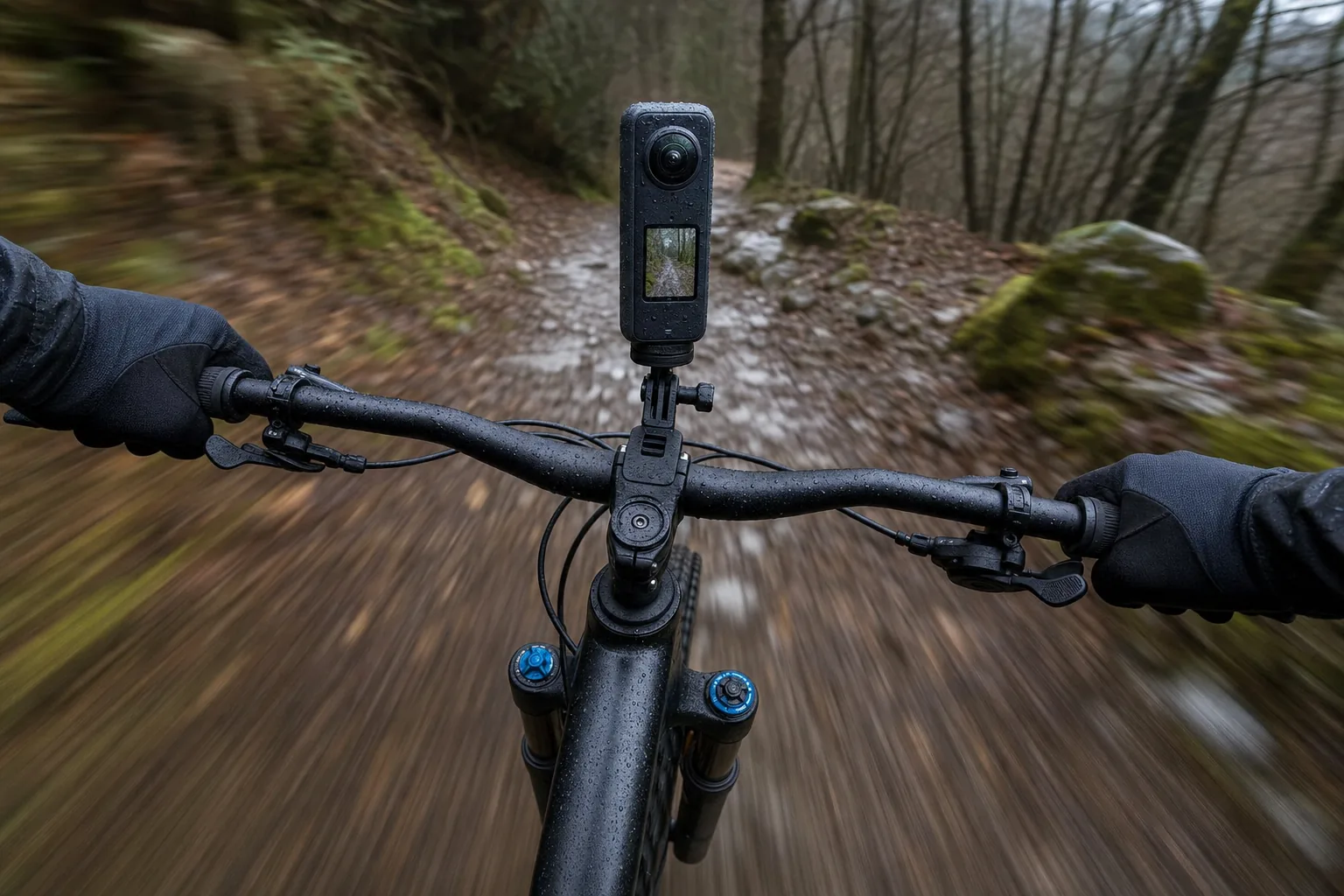
Image quality: what "8K" actually means on each camera
All three claim 8K. The claims are not equivalent, and the reason is that "8K" in a 360 camera describes the full sphere, not the clip you will eventually export. A 7680-pixel-wide sphere, cropped down to a normal rectangular view, leaves you with something in the rough neighbourhood of 1080p to 1440p depending on how tight you crop. That is the tax you pay for shooting everything. It is why sensor size and processing matter more here than the headline number.
DJI Osmo 360: the biggest sensors, and it shows
DJI's approach is the most technically interesting. Rather than using conventional rectangular sensors and wasting the corners on a circular fisheye image, the Osmo 360 uses two 1/1.1-inch square CMOS sensors, so far more of the silicon is actually doing work. DJI's claim is that this delivers panoramic coverage equivalent to a 1-inch sensor, with large 2.4µm pixels. It also shoots native 8K at 50fps — the only camera here that does — and 4K at up to 100fps in full 360, which gives you genuinely usable slow motion.
In practice, reviewers consistently rate the Osmo 360 as the best pure image quality of the three, particularly as the light drops. It records 10-bit with D-Log M, so there is real grading headroom if you care about colour. And it takes 120MP (16K) 360 photos, which sounds absurd until you realise a 360 photo has to cover an entire room.
Insta360 X5: cleverest processing, most mature pipeline
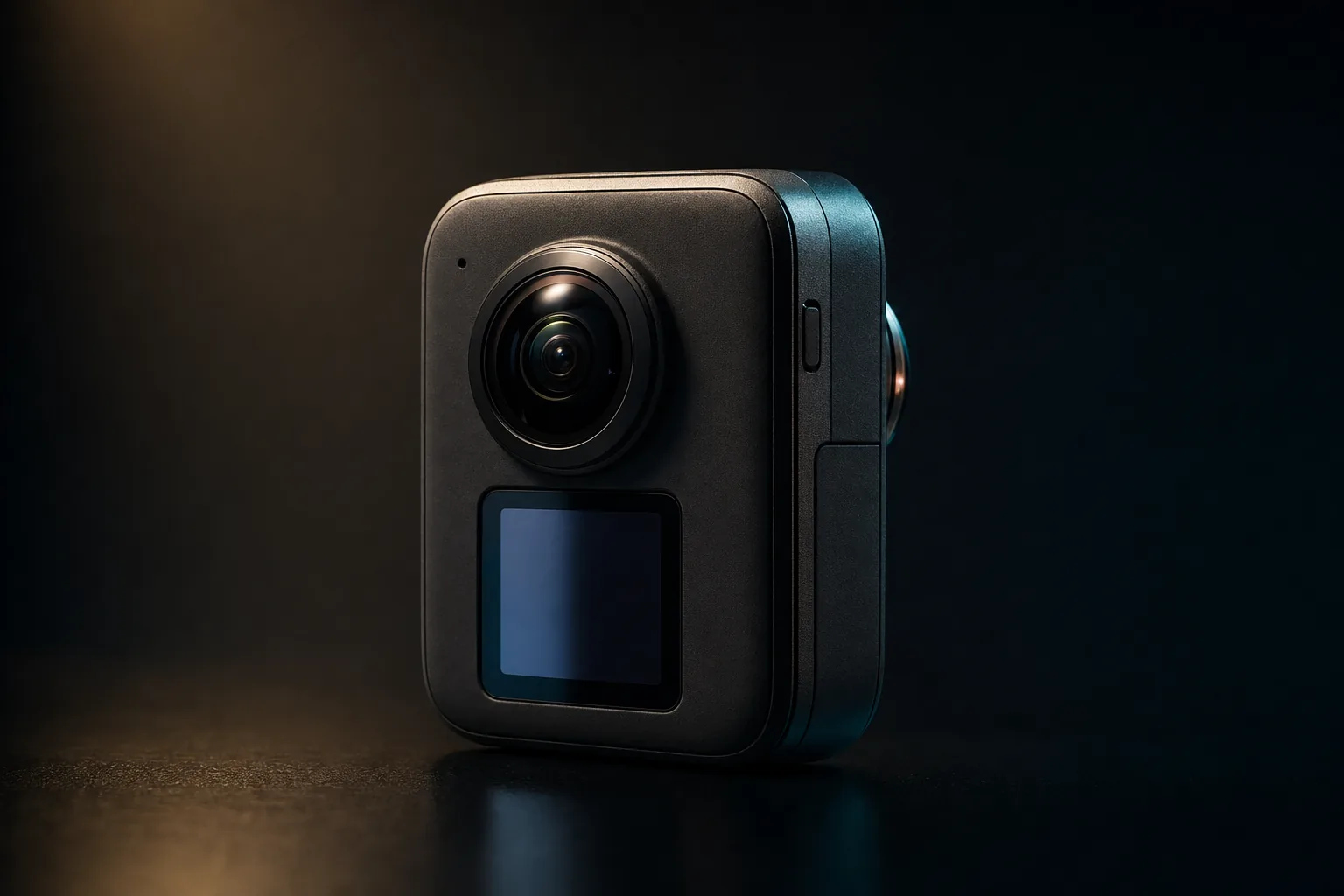
The X5's dual 1/1.28-inch sensors are 144% larger than the X4's, which was the single biggest year-on-year jump in this category. Insta360 pairs them with a triple-chip design — one 5nm AI chip plus two dedicated imaging chips — and supersamples from an 11K internal capture down to the 8K output. That supersampling is the trick: downsizing a much larger image is how you get detail without the noise, and it is why X5 footage holds together better than its sensor size alone suggests.
It shoots 8K/30 and 5.7K/60 with HDR, 72MP RAW 360 stills, and up to 11K timelapse. Where it gives ground to DJI is at the extremes: it does not offer 8K/50, and its colour pipeline is the least flexible of the three if you are a grading obsessive. For everyone else, the difference between X5 and Osmo 360 footage in daylight is small enough that you would struggle to pick them apart on a phone screen.
GoPro Max 2: the sharpest daylight, the smallest sensors
GoPro took the opposite approach: the smallest sensors here at 1/2.3 inches, paired with fast f/1.8 lenses and GoPro's colour science. And in good light the results are genuinely excellent — several reviewers rate Max 2 daylight footage the best-looking of the three, with that punchy, contrasty, unmistakably GoPro look. It is "true 8K" in the sense GoPro means it: at least 3840 active pixels on each axis of the sphere, 7680×3840 total. It records 10-bit with GP-Log, and shoots 4K single-lens at up to 60fps when you want to use it as a normal action camera.
The compromises arrive with the light and with the stills. 360 photos top out at 29MP with no RAW option at all, which is a real limitation if you want to recover shadows or fix white balance afterwards.
Low light: the biggest gap between them
If you only take one technical point from this article, take this one. In daylight, all three are good and the differences are small. Indoors, at dusk, under streetlights, in a pub, on an evening ride — the gap opens up enormously, and it opens up in the order you would predict from the sensor sizes.
The DJI Osmo 360 is the clear winner. Its 1/1.1-inch square sensors gather substantially more light than anything else here, and it holds detail and colour where the others start smearing.
The Insta360 X5 is a close and capable second, helped considerably by its PureVideo mode — an AI-driven low-light process that applies aggressive noise reduction. It is genuinely effective, though like all such processing it can soften fine texture when pushed hard.
The GoPro Max 2 is the weakest, and it is not close. Reviewers found noise appearing quickly indoors or at dusk, and this is consistently the camera's most-criticised trait. The physics are simply not on its side: 1/2.3-inch sensors are small, and no amount of processing invents photons that were never captured.
Why this matters more in the UK than the spec sheets suggest
Consider what you will actually film. British light is overcast for a large part of the year, the interesting hours in winter are the dim ones, and a great deal of the footage people want — Christmas mornings, birthdays, gigs, pub tables, evening walks — happens indoors or after dark. A camera that is only excellent in bright sun is a camera that is excellent for a fraction of the year. Weight low-light performance accordingly.
Stabilisation and horizon lock
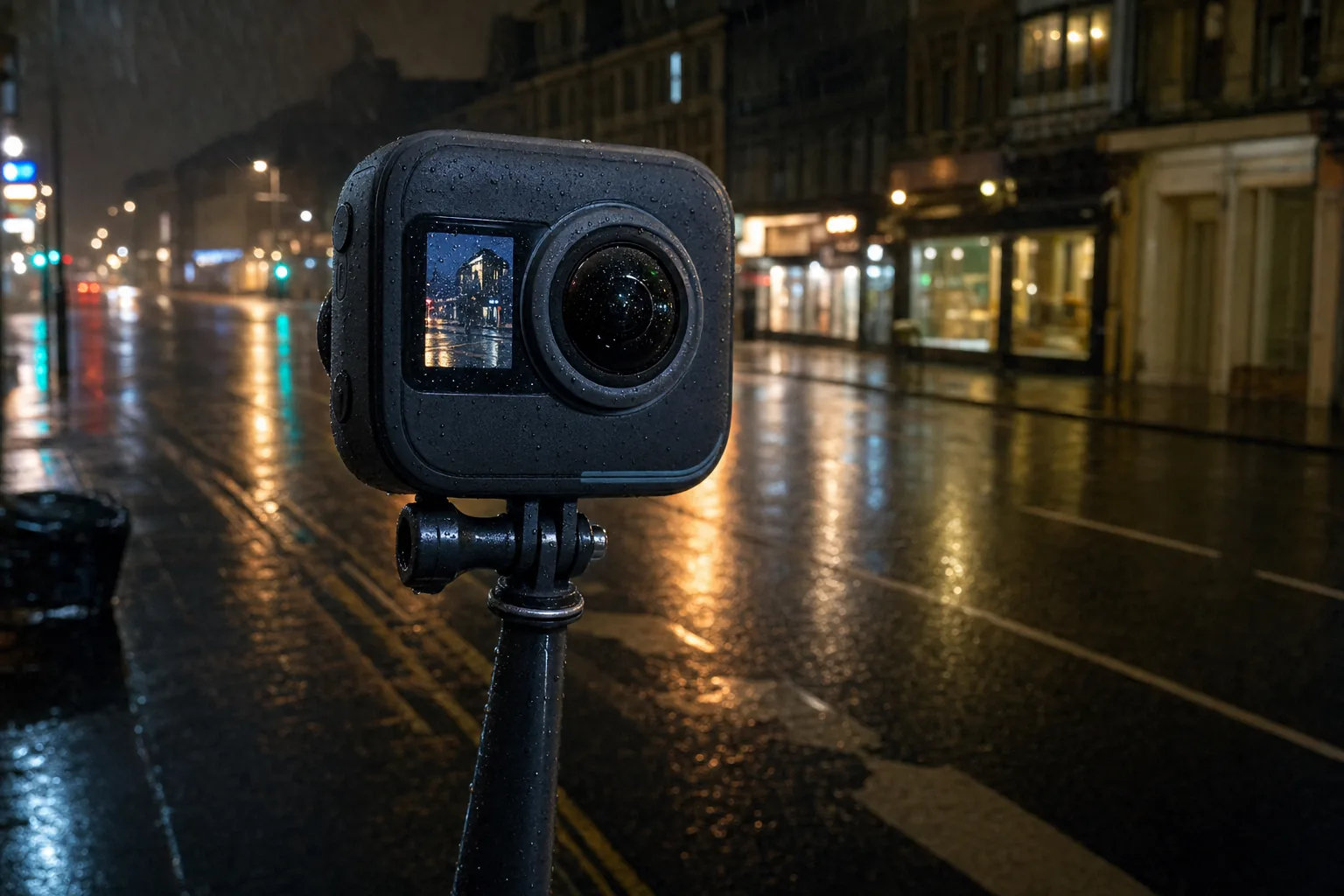
Here GoPro takes the crown back, and decisively. 360 cameras have a natural advantage at stabilisation — when you have captured every direction, the software can rotate the sphere to cancel out shake without cropping into the frame, which is why even mediocre 360 footage looks smoother than a gimbal. All three are therefore very good.
But GoPro's HyperSmooth combined with 360 Horizon Lock is on another level: reviewers describe the results as close to unreal, with the horizon staying dead level while the camera itself barrel-rolls. If your footage involves a mountain bike, a motorbike, a skateboard or a helmet, this is the single strongest argument for the Max 2, and it partly offsets the runtime problem — because that kind of shooting tends to happen in short bursts anyway.
Insta360's FlowState and DJI's RockSteady are both excellent and, for most uses, indistinguishable from GoPro's. The difference shows up at the extremes: violent, sustained, multi-axis movement.
The software: the part that decides whether you keep using the camera
We said at the top that the camera is the easy part. Here is why.
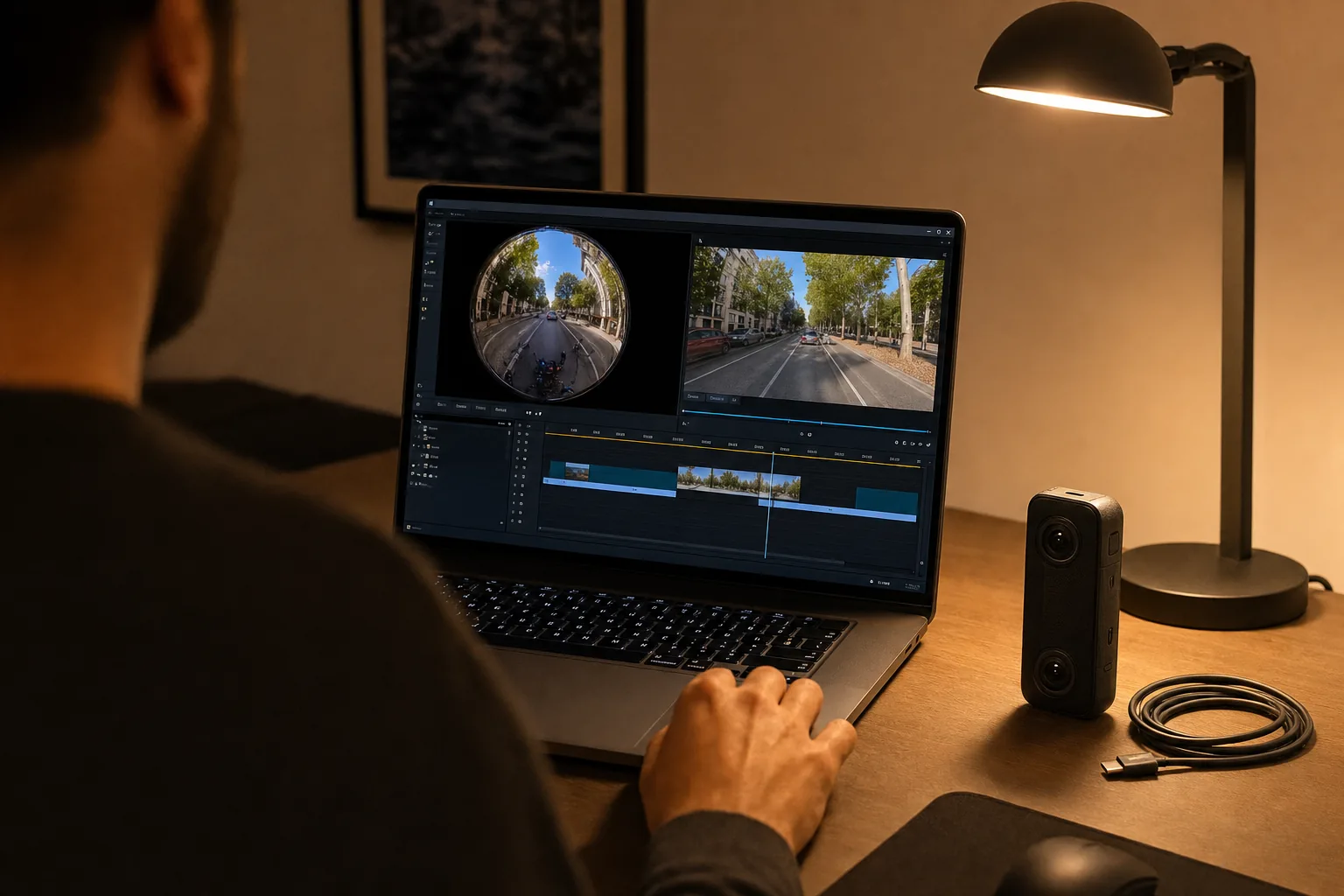
Every 360 clip arrives as a sphere in a format your normal editor cannot open. Before it becomes a shareable video, you have to reframe it: choose where the virtual camera looks, moment by moment, and export a flat clip. Good software makes this feel like play — you drag your finger across the screen, or let subject tracking lock onto you automatically, and it takes a minute. Bad software makes it feel like data entry, and the camera quietly stops leaving the house.
Insta360: the reason to buy the X5
Insta360's app and desktop Studio software are the most mature in the category by a comfortable margin, and it is not close. Subject tracking is reliable, the AI-assisted auto-edit templates produce something watchable from a folder of raw spheres with almost no input, keyframing is straightforward when you want manual control, and the desktop application is a genuine, capable editor rather than a token afterthought. Insta360 has been iterating on this for years and it shows in a hundred small places.
If you are a first-time 360 buyer, or you suspect you will not enjoy the editing, this ecosystem advantage should probably decide your purchase — even though the Osmo 360 shoots technically better footage.
DJI: strong, familiar, catching up fast
DJI's Mimo app is polished and will feel instantly familiar to anyone who already flies a DJI drone, and the company's desktop tooling is solid. It is not quite as deep as Insta360's for 360-specific reframing, but the gap has narrowed sharply and DJI iterates quickly. If you already live in DJI's ecosystem — and if you have a Mini or an Air, you do — the convenience of one app and one account is worth real money.
GoPro: the weakest link
GoPro's Quik app is mobile-first and comparatively limited for 360 work, with noticeably fewer desktop editing options. Reviewers also flag slow Wi-Fi transfers off the camera, which is a genuine irritation when 8K files are large. If you are the sort of person who wants to sit down at a computer and work through a shoot properly, this is the Max 2's second real weakness after low light.
Audio, and why it is better than you expect
360 audio is one of the underrated pleasures of these cameras. Because the camera hears in every direction too, the soundfield can be rotated to match wherever you point the virtual camera — turn the view towards someone talking and their voice moves to the front.
The GoPro Max 2 is the standout, with six microphones feeding genuine 360 audio capture — a straightforward win. The Insta360 X5 counters with a built-in wind guard and mesh shield that makes a real difference at speed, which for cycling, running and anything on a motorbike may matter more than raw channel count. The DJI Osmo 360 records competent built-in stereo and, like the others, pairs with external wireless microphones when you need clean dialogue.
For any footage where people are actually talking, a wireless lav mic transforms all three far more than the choice between them does.
Mounting, durability and the boring practical stuff
This is where reputations get made, and where GoPro's decade of ecosystem work pays off.
Mounting
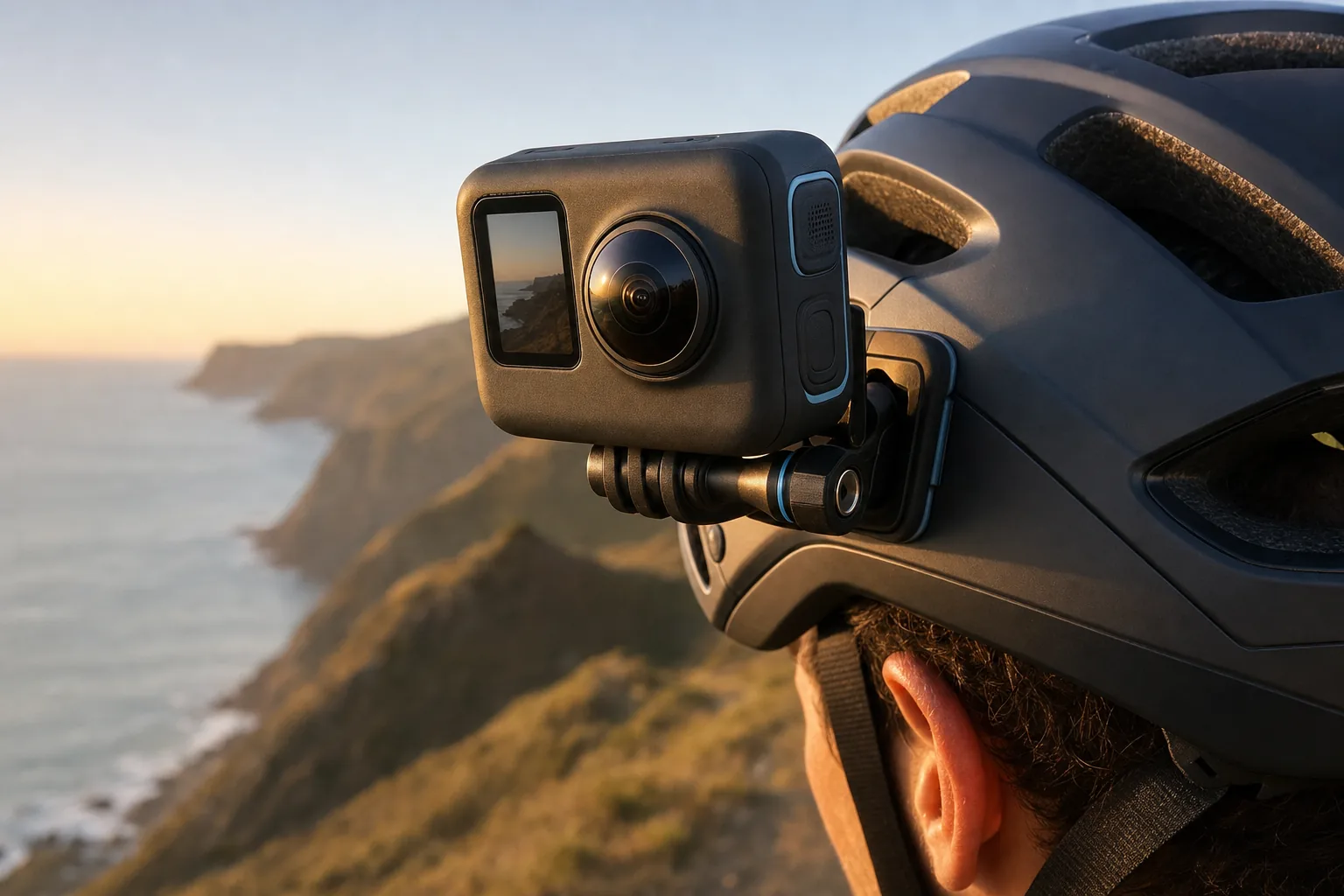
The Max 2 has the most versatile mounting system here, combining magnetic mount compatibility with GoPro's traditional fold-out fingers and a standard 1/4-20 tripod thread. If you already own GoPro mounts — and if you have ever owned a GoPro, you own a shoebox of them — everything just works. The X5 and Osmo 360 both use standard threads and have good first-party mount ranges, but neither matches the sheer breadth of third-party GoPro accessories.
Water
The X5 wins outright at 15m without a housing, ahead of the Osmo 360 at 10m and the Max 2 at just 5m. For pool, snorkel and general soaking-in-the-rain use, any of them is fine. For actual diving, the X5 is the only one we would take below snorkel depth naked, and all three have housings if you are serious.
Lenses — the repair question nobody thinks about until it is too late
360 cameras have two large, bulbous, permanently exposed lenses that stick out of the body. They are the first thing to touch the ground. Scratch one and the scratch is in every single frame you will ever shoot, in the middle of the stitch, forever.
Both the Insta360 X5 and the GoPro Max 2 solve this with genuinely user-replaceable lenses — the X5's replaceable lens system was one of its headline upgrades, and GoPro's "Twist-and-Go" lenses do the same job. A scratched lens becomes a cheap part and five minutes, not a repair bill. The DJI Osmo 360 does not offer this, which is the biggest asterisk on our value pick. Buy lens caps and use them.
Storage: the Osmo 360's quiet superpower
The Osmo 360 has 128GB of storage built into the body — around 105GB usable — as well as a microSD slot. It sounds mundane until the day you arrive somewhere having left the card in your laptop, and it is genuinely useful as an overflow when a card fills mid-shoot. If you do use a card in any of these, 8K needs a fast one: a V30-rated card is the sensible minimum. Our guide to choosing a microSD card that will not slow your camera down explains what those ratings mean and which cards to avoid.
The three cameras in full
Insta360 X5
The X5 is the camera we would recommend to nine out of ten people asking, and the reason is not the sensor — it is everything around it. The software ecosystem is years ahead, so the footage actually gets edited and shared rather than abandoned in a folder. It recorded for around 93 minutes continuously in independent testing, the longest of the three by a wide margin. It survives 15m of water without a housing. Its lenses are user-replaceable, so the inevitable scratch is a cheap part rather than a disaster. And its dual 1/1.28-inch sensors, 144% larger than the X4's, supersampled from an 11K internal capture, produce footage that is very close to the best here in anything but poor light.
What you give up: it is the most expensive of the three at £519.99 RRP, it does not match the Osmo 360 for low light or offer 8K/50, and it is the chunkiest to pocket. None of that changes the recommendation for a first-time 360 buyer.
Shop Insta360 X5 on Amazon
£519.00price at 23 Aug, may change
DJI Osmo 360
If you care most about how the footage looks — especially when the light is poor — this is the camera, and it undercuts the X5 by over £100 at £409.99 RRP. Its two 1/1.1-inch square sensors are the largest here and use their silicon far more efficiently than conventional rectangular sensors, giving panoramic coverage DJI equates to a 1-inch sensor with large 2.4µm pixels. It is the only camera here that shoots native 8K at 50fps, it manages 4K/100 in 360 for slow motion, it records 10-bit with D-Log M for grading, and it takes 120MP 360 stills. It is also the lightest and most compact of the three at 183g, and it has 128GB of storage built in.
What you give up: the lenses are not user-replaceable, which is a real long-term risk on a camera with two exposed domes — budget for caps and treat them carefully. Its reframing software, while good and improving fast, is not quite Insta360's. And it clears an hour of continuous 8K rather than the X5's hour and a half.
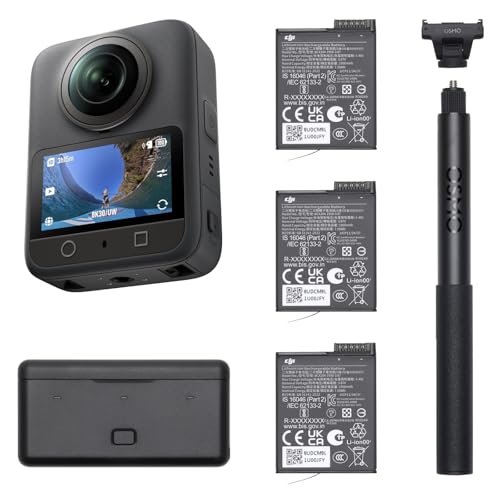
Shop DJI Osmo 360 on Amazon
£375.00 · 31% offprice at 14 Aug, may change
GoPro Max 2
The Max 2 is a genuinely excellent camera with two specific, well-defined weaknesses. Its strengths are real: HyperSmooth with 360 Horizon Lock is the best stabilisation in the category by some distance, its daylight image quality is rated by several reviewers as the sharpest and most attractive here, it has six microphones doing proper 360 audio, its lenses twist out for replacement, and it plugs straight into the enormous GoPro mounting ecosystem you probably already own. For helmet, handlebar and chest-mounted action shooting in decent light, it is superb.
What you give up: low light is clearly the weakest of the three, with noise arriving quickly indoors or at dusk. And continuous 8K recording ended in thermal shutdown at around the half-hour mark in testing — dropping to 5.6K roughly doubles that. Add the 5m water rating and the least capable software, and this becomes a specialist pick rather than a default one. If you are already a GoPro household shooting short action clips outdoors, it is arguably the best buy here.
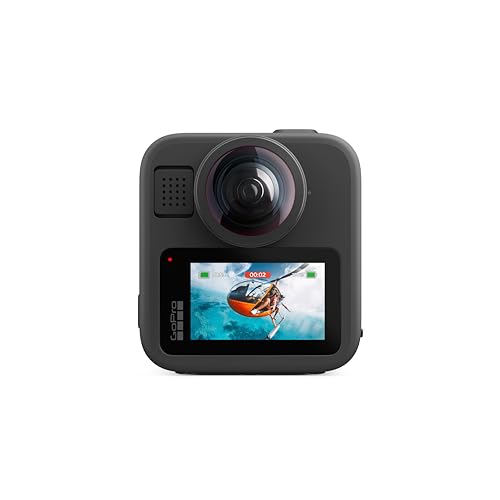
Shop GoPro Max 2 on Amazon
£269.00 · 40% offprice at 23 Aug, may change
Who should not buy a 360 camera at all
We would rather talk you out of £450 than sell you the wrong thing, so: there are people for whom none of these is the right purchase.
If you want the best possible single shot, buy a normal action camera. A conventional action camera puts all of its pixels in the direction you point it. Crop a 360 sphere down to the same view and you have fewer pixels doing the work. If you always know where to aim and you want maximum quality from that one angle, a flagship non-360 camera beats all three of these.
If you will not do the editing, do not buy one. This is the real reason 360 cameras end up on eBay. Every clip needs a decision from you before it is watchable. The auto-edit tools have got good — Insta360's especially — but if the phrase "reframe the footage" already sounds like a chore, be honest with yourself now.
If you mainly want aerial footage, buy a drone. The "floating camera" look is seductive, but it is a camera on a stick at arm's length, not a camera fifty feet up. For genuine aerial work, see our comparison of DJI's current drone range — and note that several of those cameras will also follow you around on their own.
Frequently asked questions
Is 8K on a 360 camera the same as 8K on a normal camera?
No, and this is the most common misunderstanding. On a 360 camera, 8K describes the entire sphere — everything in all directions. When you reframe that down to a standard rectangular clip, you are using only a slice of those pixels, so the finished export sits roughly in the 1080p to 1440p region depending on how tight your crop is. It is still very watchable, and it is the price of being able to choose the framing afterwards, but do not expect 8K sharpness in your final video.
Which of these three has the best image quality?
The DJI Osmo 360, mainly because of its larger 1/1.1-inch square sensors, and the gap widens as light falls. In bright daylight, several reviewers actually prefer the GoPro Max 2's sharpness and colour, while the Insta360 X5 sits very close to the Osmo 360 thanks to supersampling from an 11K internal capture. Indoors or at dusk, the Osmo 360 wins clearly and the Max 2 struggles.
Do I need to pay for a subscription?
No — all three cameras work fully without one. Each company offers a subscription bundling cloud storage, damage-replacement cover and editing extras, and GoPro in particular prices the camera attractively alongside a subscription. They can be decent value if you shoot constantly and want the replacement cover, but nothing essential is locked behind them.
How long do they actually record before stopping?
Independent testing at 8K found the Insta360 X5 running around 93 minutes, the DJI Osmo 360 around 67 minutes, and the GoPro Max 2 hitting thermal shutdown at around 25 to 30 minutes. Dropping the Max 2 to 5.6K roughly doubles its endurance. Airflow helps all three considerably, so a camera moving on a helmet or handlebar outperforms one sitting still on a desk.
Can I use one as a normal action camera?
Yes. All three have a single-lens mode that behaves like a conventional action camera, and it is genuinely useful when you know the shot and want to save both storage and editing time. The GoPro Max 2 is the strongest here, shooting 4K single-lens at up to 60fps with lens caps supplied to protect the unused dome.
What about the lenses getting scratched?
It is the most likely thing to go wrong, because two exposed glass domes protrude from the body and land first. Both the Insta360 X5 and the GoPro Max 2 have user-replaceable lenses, so a scratch means a cheap part rather than a write-off. The DJI Osmo 360 does not, which is its main long-term risk. Whichever you buy, use the lens caps every time it goes in a bag.
Which memory card should I use for 8K?
A fast, reputable microSD rated at least V30, and ideally a larger capacity than you think you need, because 8K spherical files are big. Cheap unbranded cards are the single most common cause of dropped frames and corrupted clips. Our microSD buying guide covers the ratings that matter. It is also worth having somewhere to offload footage in the field — see our picks for the best portable SSDs.
Is it worth upgrading from an Insta360 X4?
If low light frustrates you, yes — the X5's sensors are 144% larger than the X4's and it is a visible improvement, with PureVideo mode adding more. The replaceable lenses are also a meaningful long-term saving. If you shoot mainly in good light and are happy with your X4's footage, the upgrade is real but not urgent, and the money may be better spent on a decent mic and mounts.
The bottom line: which 360 camera to buy
Buy the Insta360 X5 if you want the safest all-round choice. It has the best software by a clear margin — which in this category is the difference between a camera you use and a camera you regret — plus the longest recording time, the best waterproofing and replaceable lenses. It costs the most, and it is worth it for most buyers.
Buy the DJI Osmo 360 if image quality is your priority or your budget is tight, because remarkably it is both the best-looking and the cheapest of the three at £409.99. Its bigger square sensors win comfortably in poor light, it shoots 8K/50, and the built-in 128GB is a genuine convenience. Just accept that the lenses are not replaceable and look after them.
Buy the GoPro Max 2 if you already own GoPro mounts and shoot short bursts of action in decent light. Its stabilisation is the best here and its daylight footage is superb. But go in knowing about the low-light weakness and the half-hour thermal limit at 8K — and if either of those describes your shooting, buy one of the other two.
And if you take nothing else from this: weigh the editing software as heavily as the sensor. The best 360 camera is the one whose footage you actually finish.
Related reading
- Best DJI Drone 2026: Neo 2 vs Flip vs Mini 5 Pro vs Air 3S vs Mavic 4 Pro vs Avata 2 — if what you really want is aerial footage.
- DJI Avata 360 Review — the same reframe-it-later idea, but flying.
- How to Choose a MicroSD Card That Won't Slow Down Your Camera or Switch — essential reading before you shoot 8K.
- Best Portable SSDs for UK Buyers — for getting 8K footage off the card safely.
- Best Webcams and Mics for Streaming — because good audio improves your footage more than any camera upgrade.
Similar reads
- The first lens to buy after your kit lens — six upgrades from GBP 279 to GBP 849, and the mount trap to check first