
DJI Osmo 360 II First Look: Is 8K video now worth the upgrade?
DJI's second 360 camera adds 8K/60 recording, low-light processing and replaceable lenses — but its £509 Standard Combo price asks existing owners to look beyond the headline frame rate.
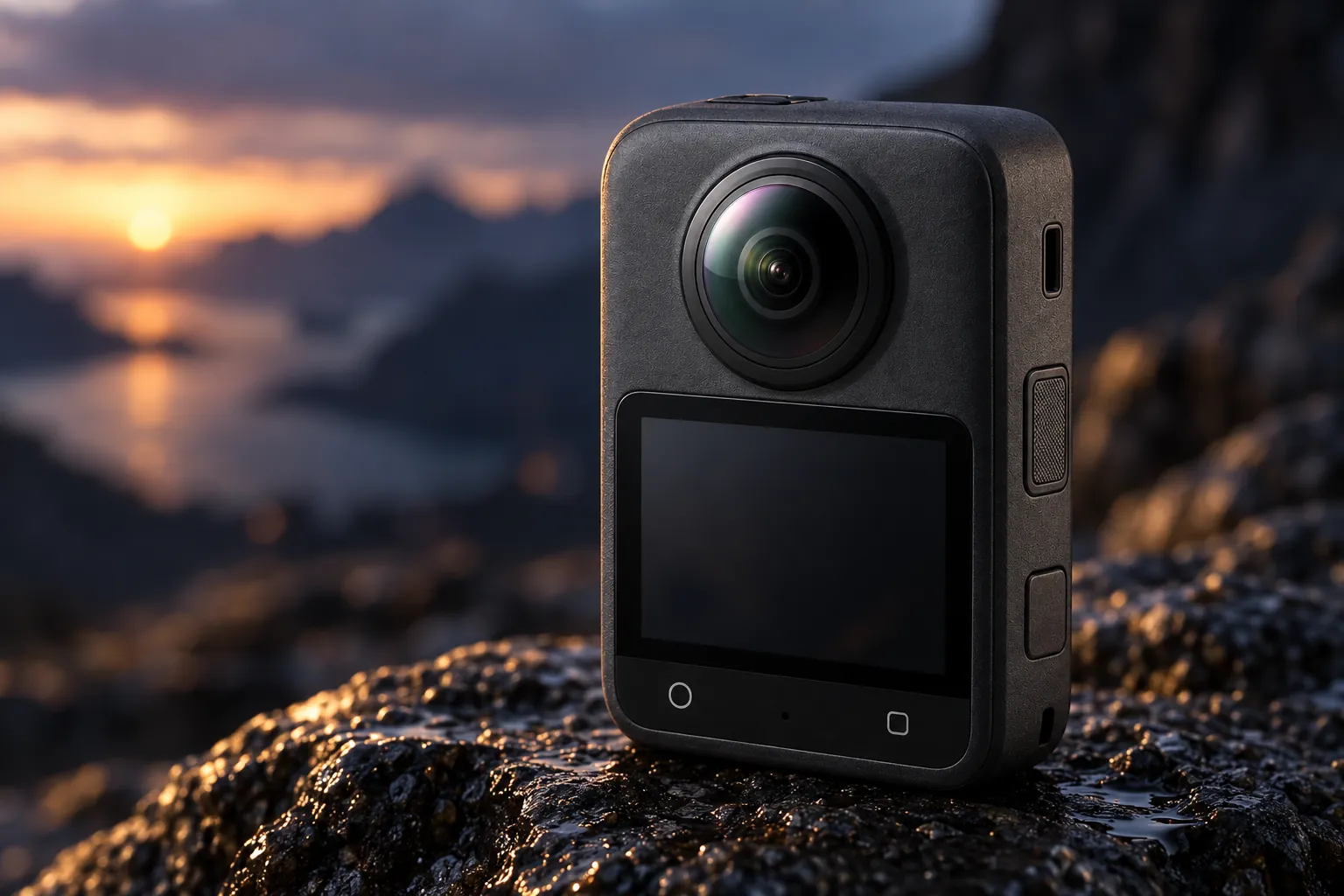


Native 8K/60, replaceable lenses and strong 8K/30 endurance make it compelling for new action-focused 360 creators.
Check price on AmazonWe link to the exact model on Amazon UK. Prices change often, so check the live price before you buy. As an Amazon Associate we earn from qualifying purchases.
You have a fast descent, a bike ride, a packed festival walkway or a windswept coast in front of you — and one chance to capture it before reframing the action later. The short answer: we recommend the DJI Osmo 360 II Standard Combo for first-time 360-camera buyers, action-sports users who value repairable lenses, and creators who genuinely need 8K/60 footage. It is a less compelling move for original Osmo 360 owners who mostly record at 8K/30, because the physical design, sensor architecture, storage and claimed runtime at that setting remain very close.
DJI announced the global Osmo 360 II on 3 September 2026 and UK ordering began on 15 September. The Standard Combo covered here was listed in stock on Amazon UK on 4 October. It is DJI's second-generation 360-degree action camera, replacing the first Osmo 360 released in 2025. The emphasis is refinement: a faster top frame rate, revised processing, stronger lens protection and a repair route for the component most likely to be damaged.
| At a glance | DJI Osmo 360 II |
|---|---|
| Maximum 360 video | 8K (7680 × 3840) at up to 60fps |
| Imaging system | Dual 1/1.1-inch square CMOS sensors, f/1.9 aperture and 2.4μm pixels |
| Video colour | 10-bit video with Standard and D-Log M profiles |
| Built-in storage | 128GB nominal, approximately 105GB usable |
| Battery claim | Up to 100 minutes of 8K/30 panoramic recording |
| Water resistance | 10m without a case |
| Weight and dimensions | 183g; 61 × 36.3 × 81mm |
| UK Standard Combo RRP | £509 |
DJI Osmo 360 II: What Actually Changed Inside?
The II keeps the same broad, pocketable body concept as its predecessor: two opposing fisheye lenses, a 2-inch OLED touchscreen, DJI's magnetic quick-release mounting system and a standard 1/4-inch tripod thread. At 183g and 61 × 36.3 × 81mm, it is the same published size and weight as the original. That matters because this is not a smaller, lighter travel camera masquerading as an upgrade; it is built around the same carry-and-mount routine.
Its two 1/1.1-inch square CMOS sensors retain the same basic architecture, with 2.4μm pixels and an f/1.9 aperture. DJI describes the combined arrangement as offering a 1-inch-equivalent 360-degree imaging area. The company's wording is important: this is an imaging-area claim for the 360 system, not a claim that the Osmo 360 II has a single one-inch sensor.
The main numerical change is native 8K/60fps panoramic recording, up from the original model's 8K/50fps ceiling. That extra 10 frames per second is not automatically transformative for every clip, but it has a clear purpose. Faster movement looks smoother, rapid turns give an editor more frames to work with, and footage intended for 60Hz timelines no longer needs the same conversion compromise.
DJI also claims up to 14.5 stops of dynamic range under its laboratory conditions, compared with 13.5 stops quoted for the original camera. The manufacturer specifies that figure for 8K/30 in Normal colour mode with automatic exposure and front/back metering. It is a useful indication of DJI's processing ambitions, rather than a promise that every high-contrast scene will gain a full stop of visible recoverable detail.
The meaningful upgrade is targeted, not wholesale
Native 8K/60, improved SuperNight processing and repairable lenses are the changes with the clearest practical effect. Buyers expecting a new sensor format, more internal storage or longer 8K/30 runtime should temper expectations.
There are other quality-of-life additions. NFC pairing can speed up connection to DJI Mimo, while four built-in microphones and OsmoAudio support let the camera connect directly with DJI Mic 3, DJI Mic 2, DJI Mic Mini 2S, DJI Mic Mini 2 and DJI Mic Mini. For existing DJI users, that is a neater route to spoken pieces than relying solely on the camera microphones in a windy environment.
DJI Osmo 360 II: The Lens Problem DJI Finally Fixed
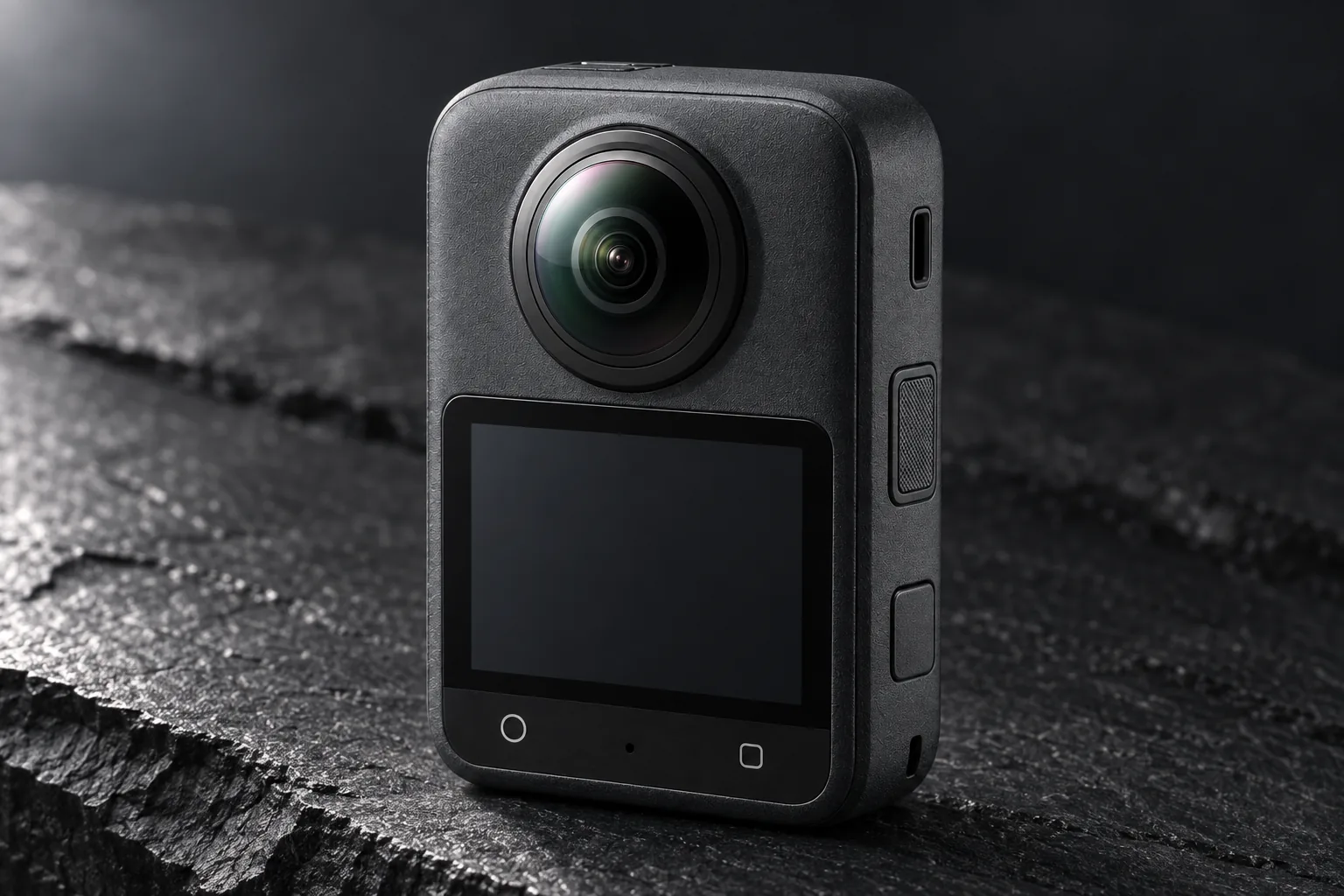
Every conventional 360 camera has an awkward physical truth: its fisheye lenses protrude. That geometry is fundamental to capturing a full sphere, but it leaves the optical surfaces exposed when a camera is dropped, scraped against rock, clipped on a bike or placed carelessly on a table.
The original Osmo 360 had fixed lenses. A serious scratch or crack could mean sending the camera to DJI for service. TechRadar identified fragile fixed lenses as one of the two major weaknesses DJI needed to address on the first model, alongside uncertainty around underwater confidence. The Osmo 360 II answers the first problem with user-replaceable lenses and an ultra-hard optical coating.
Why the new system matters
- Both protruding lenses can be replaced by the owner with DJI's official kit.
- DJI's UK replacement kit was listed at £35 for both lenses.
- Camera Jabber's Ali Jennings reported completing an official lens swap in about two minutes.
- The change reduces the financial risk of a mistake during action shooting or travel.
What it does not solve
- The lenses are still exposed and deserve careful handling.
- A spare replacement kit is an additional cost beyond the £509 Standard Combo.
- Lens repairability does not make the bare camera deeper-rated for water use.
- For serious diving, DJI's 50m waterproof case adds bulk and expense.
This is arguably a more important upgrade than the frame-rate headline for many buyers. An 8K/60 clip is useful only when the camera is still working. The option to replace a damaged lens at home changes ownership from "avoid any impact at all costs" to "keep shooting carefully, with a realistic repair plan". That is especially relevant for skiing, cycling, motorcycling and watersports, where a 360 camera may be mounted away from the user and exposed to unpredictable knocks.
The Standard Combo includes a silicone lens cap, protective pouch and cleaning cloth. It does not include the extra batteries, charging case or 1.2m selfie stick supplied with DJI's Adventure Combo.
The camera remains rated to 10m without a case when its covers are correctly closed. That should suit surface-level watersports, rain and shallow-water use. The limit is less generous than the 20m bare-camera rating reported for the Insta360 X6, so dedicated divers should factor DJI's optional waterproof housing into the purchase cost rather than treating the standard camera as an all-depth solution.
DJI Osmo 360 II: What 8K/60 Battery and Thermals Actually Allow
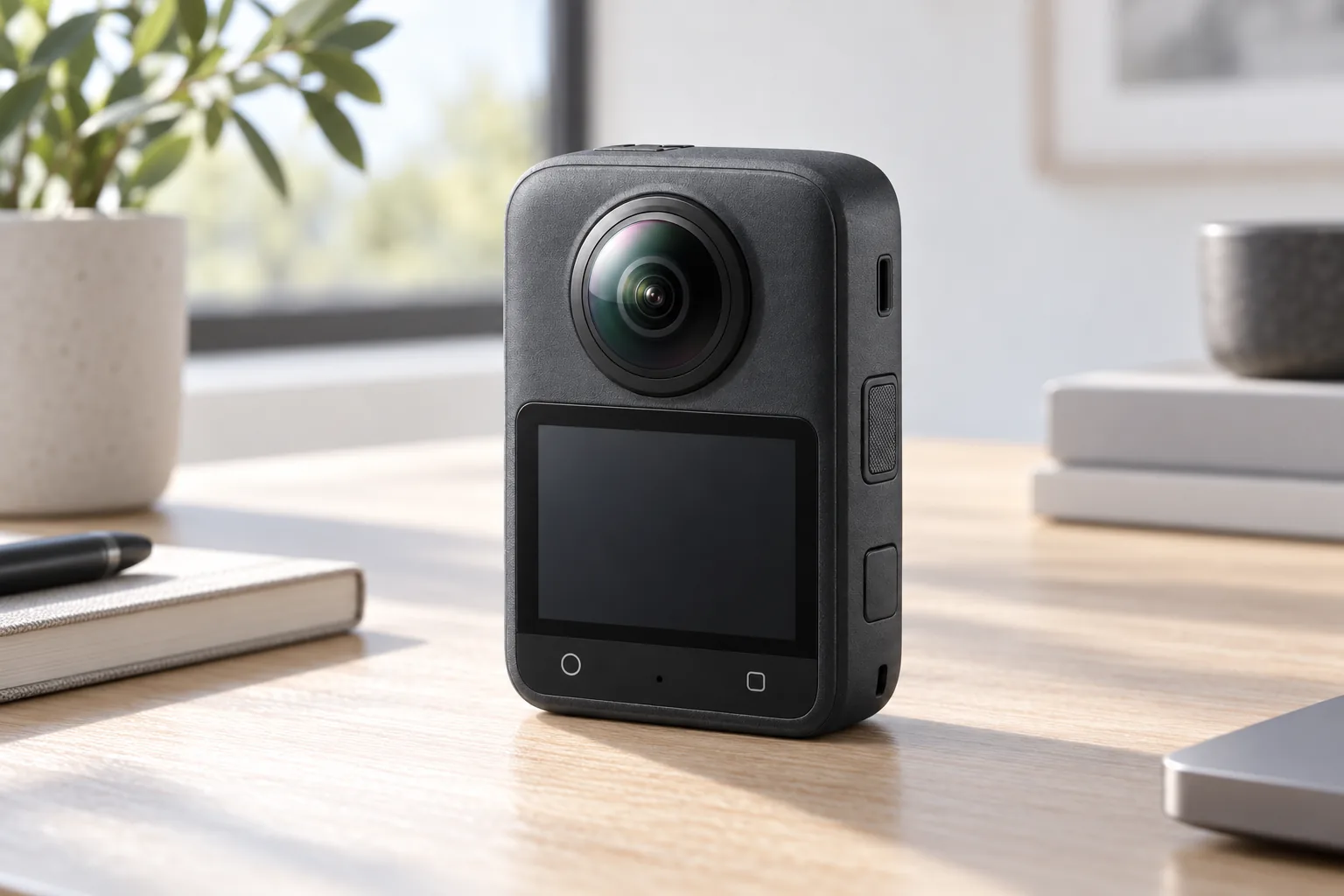
8K/60 is the specification that makes the II look decisively newer, but it comes with a practical qualification: it is also the mode that places the greatest burden on heat management. The camera uses DJI's 2,150mAh Osmo Extreme Battery Plus, yet the headline setting is not a route to an hour of uninterrupted recording in every situation.
DJI claims up to 100 minutes of continuous 8K/30 panoramic recording and up to 120 minutes in Endurance Mode. Those figures are credible for the lower frame-rate setting. TechRadar's Sam Kieldsen reported that 25 minutes of 8K/30 capture consumed 25% of the battery, closely tracking the company's 100-minute figure. Camera Jabber's Ali Jennings separately reported roughly 100 minutes in use.
At 8K/60, TechRadar reported an approximately 19-minute run indoors at room temperature without extra airflow before the camera shut down to cool itself. In a later matched comparison at around 22°C, the Osmo 360 II ran for about 34 minutes before shutting down, while the Insta360 X6 lasted around 40 minutes. Expert Reviews reported approximately 30 minutes of continuous recording at maximum quality, then a total of 1 hour 4 minutes through shorter clips and cooling intervals.
Those results are not contradictory. They show exactly why thermal claims need context. Ambient temperature, air movement, direct sun, mounting position and the length of individual clips all influence the outcome. A camera attached to a moving bike has airflow; a camera recording a static indoor interview or a long event segment may not. The II looks more comfortable as a camera for short, high-resolution action sequences than a device for unattended 8K/60 capture.
Choose the mode around the job
For long walks, travel footage and extended takes, 8K/30 is the sensible default backed by approximately 100 minutes of reported runtime. Reserve 8K/60 for fast action, deliberate slow-motion flexibility and shorter clips where its smoother motion offers a visible benefit.
That does not undermine the value of 8K/60; it defines it. In a 360 workflow, high resolution matters because creators commonly crop a small viewing window from the full sphere. The extra frame rate helps when that cropped frame follows a rider, skier or runner across the scene. It simply should not be mistaken for a permanent maximum-quality setting that carries no endurance penalty.
DJI Osmo 360 II: Charging Speed and Storage for Day-to-Day Shooting
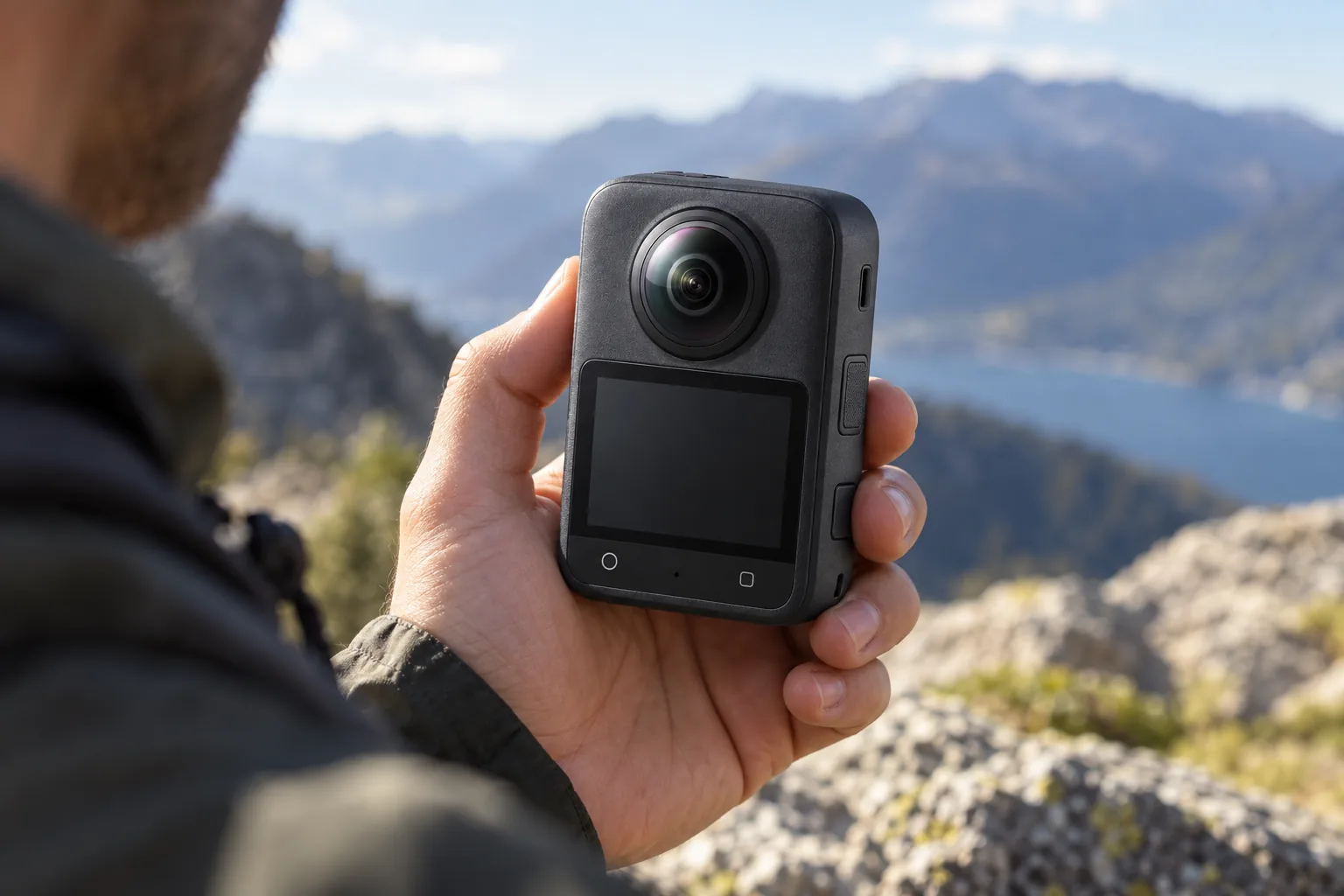
Less glamorous specifications often decide whether a camera is enjoyable on a weekend away. The Osmo 360 II's 128GB internal storage, of which approximately 105GB is usable, means it can record without immediately requiring a microSD card. It also has a microSD slot supporting cards up to 1TB, making it practical to carry a card for longer days whilst treating internal memory as useful backup.
This storage capacity is unchanged from the original Osmo 360. It is convenient rather than an upgrade, and prospective owners should remember that high-resolution 360 footage can consume capacity quickly. The point is flexibility: a forgotten or failed card does not automatically end the shoot.
DJI claims the battery reaches 80% in approximately 22 minutes through USB-C PD/PPS charging under its specified conditions. dkamera reported 50% in 11 minutes, 80% in 20 minutes and a full charge in 36 minutes using a 30W-or-higher power supply. That is close enough to DJI's claim to be genuinely useful planning information rather than an optimistic laboratory number.
The Standard Combo contains one battery only, so rapid charging is valuable, but it is not the same as having a spare ready. Buyers whose shooting regularly extends beyond a day of short clips should account for an additional battery or the Battery Extension Rod, which DJI says can add up to 180 minutes of runtime. The latter will appeal more to creators working from a selfie stick than to riders seeking the smallest possible mounting setup.
DJI Osmo 360 II: Image Quality Against Its Closest Rival
The closest contextual rival is the Insta360 X6. This is not a recommendation to buy it over the DJI, but TechRadar's direct comparison helps explain what the Osmo 360 II's £509 price does and does not buy. The DJI has the faster 8K mode, while the X6 tops out at 8K/50fps. TechRadar also noted that DJI was cheaper than the X6's UK price of £619.
Image quality did not produce a simple victory. TechRadar found the X6 cleaner, sharper and less distorted overall in daylight footage. That matters if your priority is extracting the crispest possible conventional-looking clip from a 360 capture. The Osmo 360 II, however, retained more detail in bright skies during the same comparison, a useful strength in scenes where a rider or subject is framed against sunlit cloud, sea or snow.
| Decision point | DJI Osmo 360 II | Insta360 X6 |
|---|---|---|
| Maximum 360 video | 8K/60fps | 8K/50fps |
| UK launch-price reference | £509 Standard Combo | £619 standard bundle |
| Daylight image judgement from TechRadar | More highlight detail in bright skies | Cleaner, sharper and less distorted overall |
| Low-light frame-rate capability cited by TechRadar | SuperNight 2.0 up to 60fps | PureVideo up to 30fps |
| Bare-camera water depth | 10m | 20m |
| Matched 8K thermal result around 22°C | About 34 minutes before shutdown | About 40 minutes before shutdown |
At night, TechRadar still gave the X6 a small overall image-quality advantage. DJI's counterpoint is frame rate: SuperNight 2.0 can record up to 60fps, whereas TechRadar reported the X6's PureVideo mode as capped at 30fps. That means the Osmo 360 II can provide smoother low-light movement, even if the rival's individual frames retained a narrow quality edge in that comparison.
DJI image strengths
- 8K/60 gives greater latitude for fast-action footage.
- TechRadar reported stronger highlight retention in bright skies.
- AI SuperNight 2.0 reaches up to 60fps.
- DJI supports 10-bit colour and D-Log M for more involved editing.
The honest image trade-off
- TechRadar found the X6 cleaner and sharper overall in daylight.
- The X6 retained a small low-light image-quality advantage in the same comparison.
- SuperNight 2.0 cannot be combined with D-Log M.
- Close subjects can still challenge 360 stitching; Expert Reviews cited about 75cm as a useful distance.
For buyers moving from the original Osmo 360, the evidence points to real but restrained visual gains. Camera Jabber called the low-light and dynamic-range improvements genuine, whilst also observing that they are more obvious in side-by-side viewing than during ordinary everyday shooting. Expert Reviews similarly described the II as an impressive camera but "not a huge upgrade" because much of the physical hardware and imaging system remains essentially unchanged.
That is the central judgement. If your current camera already meets your needs at 8K/30 in daylight, the II's image gains alone may not create a compelling reason to replace it. If you often shoot bright, high-contrast scenery, dim streets, rapid movement or footage intended for 60fps timelines, the refinements have more weight.
DJI Osmo 360 II: Beyond 8K and the Creative Toolkit
The Osmo 360 II is not only about recording a whole sphere and choosing the angle later. DJI has added modes designed to make the camera more playful for creators who might otherwise be tempted to leave it in ordinary panoramic capture.
16K panoramic timelapse
The camera records 360-degree timelapse at up to 16K/30fps, doubling the original Osmo 360's reported 8K/30 ceiling. This is useful when a creator wants flexibility to crop and pan across a long-changing scene.
4K/240 panoramic slow motion
Native panoramic slow motion reaches 4K/240fps. DJI Studio can also create up to 64× slow motion with AI frame interpolation, which is a software-generated result rather than native 480fps camera capture.
Vortex mode
Vortex mode reaches up to 8K/120fps for a swing-based wraparound effect. It is a specialised creative mode, not a general 8K/120fps 360 recording setting.
Spotlight Follow and Auto-Framing
The camera supports automatic subject tracking and framing tools. Spotlight Follow can export flat video at up to 4K/30fps, helping turn 360 footage into a ready-to-share conventional clip.
DJI Mimo is the mobile route for reframing and quick edits, while DJI Studio handles desktop work. Expert Reviews praised Mimo's Camera Movements presets for creating spins and zooms without manually placing keyframes. TechRadar rated DJI Studio highly for desktop editing but found DJI's mobile AI tools less impressive than Insta360's and noted that DJI Studio did not offer ProRes export during its coverage.
The Vortex mode is particularly easy to misunderstand from a specification list. "8K/120" sounds like a general-purpose high-frame-rate option, but this is a dedicated effect built around swinging the camera to create a wrapped, energetic viewpoint. It may be useful for social clips or action intros, but it is not a substitute for long, stable 8K/60 capture.
AI-generated 64× slow motion is an editing tool, not a native capture specification. It can be creatively useful, but footage quality will depend on the source clip and the interpolation process.
Elsewhere, the II supports 120MP HDR panoramic photos and RAW photo capture. These are valuable additions for scenery, property, tourism and virtual-tour work, where a still image may be the final output rather than a frame extracted from video. The four microphones include wind-noise reduction, and OsmoAudio compatibility gives creators a direct wireless option when spoken audio matters more than ambient sound.
DJI Osmo 360 II: The UK Price Ladder and Standard Combo Value
The DJI Osmo 360 II Standard Combo launched in the UK at £509. That is £99 above the original Osmo 360's £409.99 launch price, and DJI's UK store had also listed the older camera at £319 during a discount period. That gap matters because the original retains the same body dimensions, weight, 105GB usable internal storage, 10m water resistance and claimed 100-minute 8K/30 runtime.
The Standard Combo is the sensible baseline for assessing value because it is the configuration named in the Amazon UK listing. It includes the camera, one 2,150mAh Osmo Extreme Battery Plus, protective pouch, silicone lens cap, lens-cleaning cloth and USB-C to USB-C PD cable. It does not bundle the accessories that make some 360 workflows easier from day one, such as a selfie stick, additional batteries or a charging case.
Standard Combo
Camera, one battery, pouch, lens cap, cleaning cloth and USB-C PD cable.
Limitless Riding Combo
Same camera hardware with riding-oriented accessories.
Tripod Combo
Same camera hardware with tripod-focused accessories.
Explorer Combo
Same camera hardware with a larger accessory package.
DJI also listed On-the-Go, Motorcycle Multi-POV, Road Cycling POV, Skiing Multi-Angle, Road Cycling Rear-POV and Vortex bundles. Their published UK prices ranged from £567.98 to £664.96. The central point is simple: these are accessory bundles, not higher-spec cameras. They do not buy different sensors, more internal storage, longer core battery life or a different 8K limit.
For a buyer starting with no mounts, a more expensive bundle can be sensible if its accessories directly match the intended sport. For everyone else, the Standard Combo avoids paying for mounts that will remain in a drawer. The trade-off is that an active user may soon want at least one spare battery, particularly if 8K/60 clips are part of the plan.
DJI Osmo 360 II: Who This Combo Is Really Built For
First-time 360 buyers
Buy the Standard Combo if you want 8K/60 capture, 105GB of internal storage and a repairable-lens design without paying the X6's cited UK launch-price premium.
Action-sports creators
The 8K/60 mode, 4K/240 panoramic slow motion and £35 replacement lens kit make more sense for riders, skiers and outdoor shooters than for casual holiday clips.
DJI ecosystem owners
OsmoAudio compatibility with supported DJI microphones, shared mounting hardware and battery compatibility with selected Osmo Action batteries make the II easier to integrate.
Desktop-led editors
D-Log M, 10-bit video, 16K timelapse and DJI Studio suit creators willing to reframe footage carefully rather than relying solely on automatic mobile edits.
There are also clear reasons to pause. Original Osmo 360 owners who usually record in 8K/30 gain little in body size, storage capacity, water depth or claimed standard-mode endurance. Camera Jabber found no runtime improvement over the original at 8K/30 despite the larger 2,150mAh battery. The new camera makes more sense if replaceable lenses, 8K/60, SuperNight 2.0, 16K timelapse or Vortex mode solve a specific need.
Buyers concerned only with conventional flat action-camera footage should be certain that the 360 workflow is genuinely useful. A 360 camera earns its cost when you value capturing everything first and deciding the final framing later. It is less economical when most clips will be recorded from one fixed viewpoint and exported without reframing.
DJI Osmo 360 II: Frequently Asked Questions
DJI Osmo 360 II: Who Should Buy Which?
There is one product recommendation in this first look: the DJI Osmo 360 II Standard Combo. It is the right choice for a new buyer who wants an unusually capable 360 camera at DJI's £509 UK RRP, particularly if lens damage has previously made 360 ownership feel too risky. Its native 8K/60 mode, 10-bit recording, D-Log M, 120MP HDR stills, 16K timelapse and internal storage give it a broad creative foundation.
Choose it for action rather than endurance. The Standard Combo makes the strongest case when filming short, energetic sequences — a climb, run, descent, ride or moving travel shot — where 8K/60 and reframing flexibility can genuinely improve the finished clip. For sustained 8K/30 shooting, the evidence suggests dependable battery performance, but little reason for original Osmo 360 owners to replace a working camera solely for runtime.
Verdict: 8K/60 is valuable, but repairability is the smarter reason to upgrade
The DJI Osmo 360 II is a carefully judged refinement rather than a clean-sheet redesign. Its 8K/60 recording, brighter-sky highlight retention, SuperNight 2.0 and expanded creative modes make it a strong first 360 camera, whilst replaceable lenses materially improve the ownership proposition. Existing Osmo 360 owners should upgrade only for those specific gains; new buyers have a more convincing case, provided they accept that maximum-quality recording is thermally limited and the Standard Combo contains only one battery.
Sources
- DJI UK product page and Osmo 360 II launch announcement.
- TechRadar review and DJI Osmo 360 II versus Insta360 X6 comparison by Sam Kieldsen.
- Expert Reviews review by Jonathan Bray.
- Camera Jabber review by Ali Jennings.
- Digital Camera World review by Adam Juniper.
- dkamera charging and continuous-recording figures.
- DJI Osmo 360 IIRepairable 8K choiceView on Amazon
Sources and evidence (28)
- elgiganten.dk (other)
- dji.com (other)
- store.dji.com (other)
- digitalcameraworld.com (other)
- phototrend.fr (other)
- techradar.com (other)
- camerajabber.com (other)
- techradar.com (other)
- expertreviews.co.uk (other)
- store.dji.com (other)
- store.dji.com (other)
- dji.com (other)
- mynewsdesk.com (other)
- techradar.com (other)
- techradar.com (other)
- expertreviews.co.uk (other)
- digitalcameraworld.com (other)
- camerajabber.com (other)
- digitalcameraworld.com (other)
- dpreview.com (other)
- t3.com (other)
- dronexl.co (other)
- dji.com (other)
- dkamera.de (other)
- store.dji.com (other)
- cyclingweekly.com (other)
- store.dji.com (other)
- store.insta360.com (other)