DJI Avata 360 Review: The Drone That Films Everything — You Pick the Shot Later
Part FPV drone, part flying 360 camera, the Avata 360 records the entire sky in 8K and lets you choose your framing afterwards - with an invisible-drone party trick nothing else in DJI's range can match. It changes how aerial filming works. Here's our full UK review.

We link to the exact model on Amazon UK. Prices change often, so check the live price before you buy. As an Amazon Associate we earn from qualifying purchases.

See the DJI Avata 360 (RC 2) on Amazon UK
Check today's price & availability on Amazon UK
1. What the Avata 360 actually is: fly first, frame later
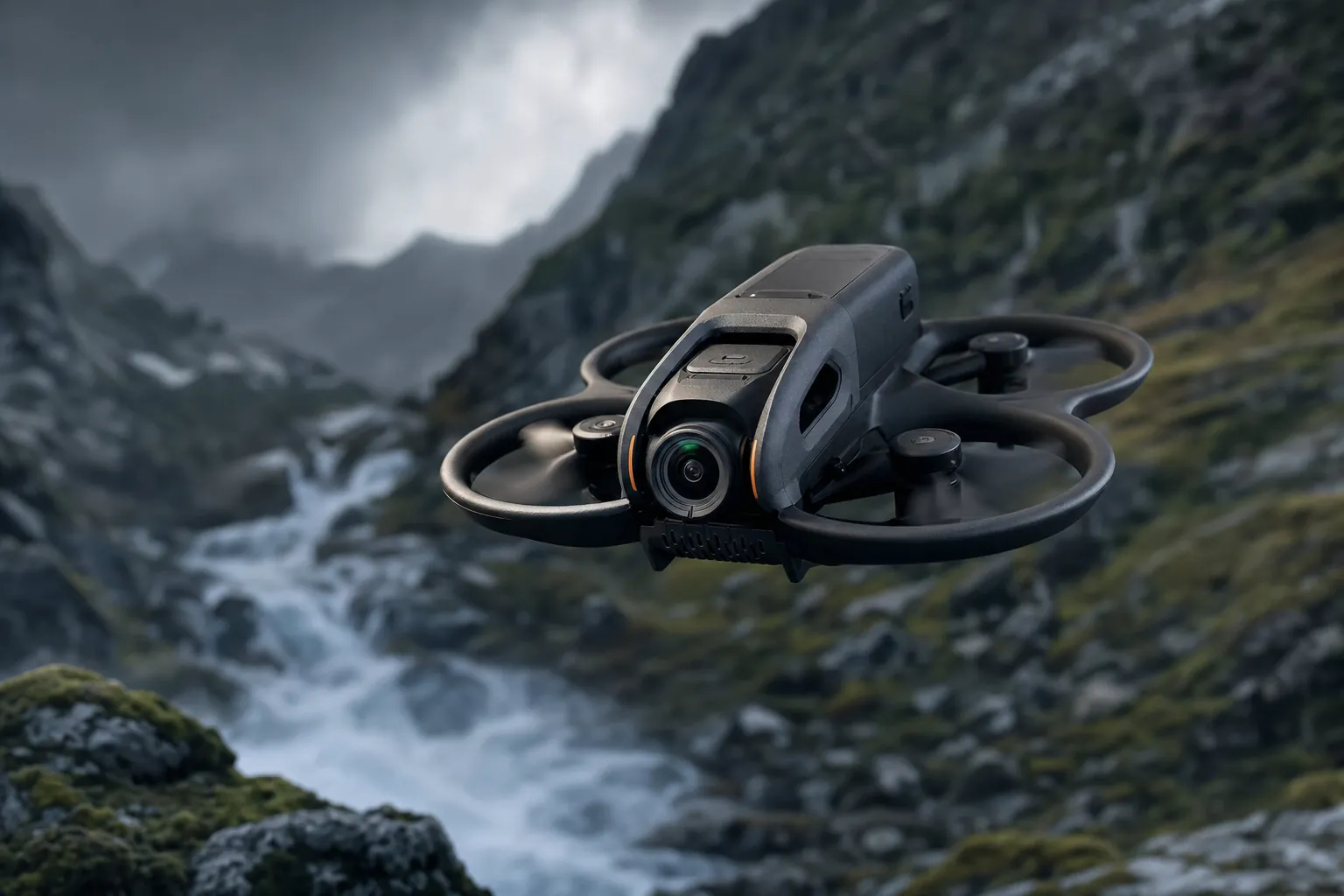
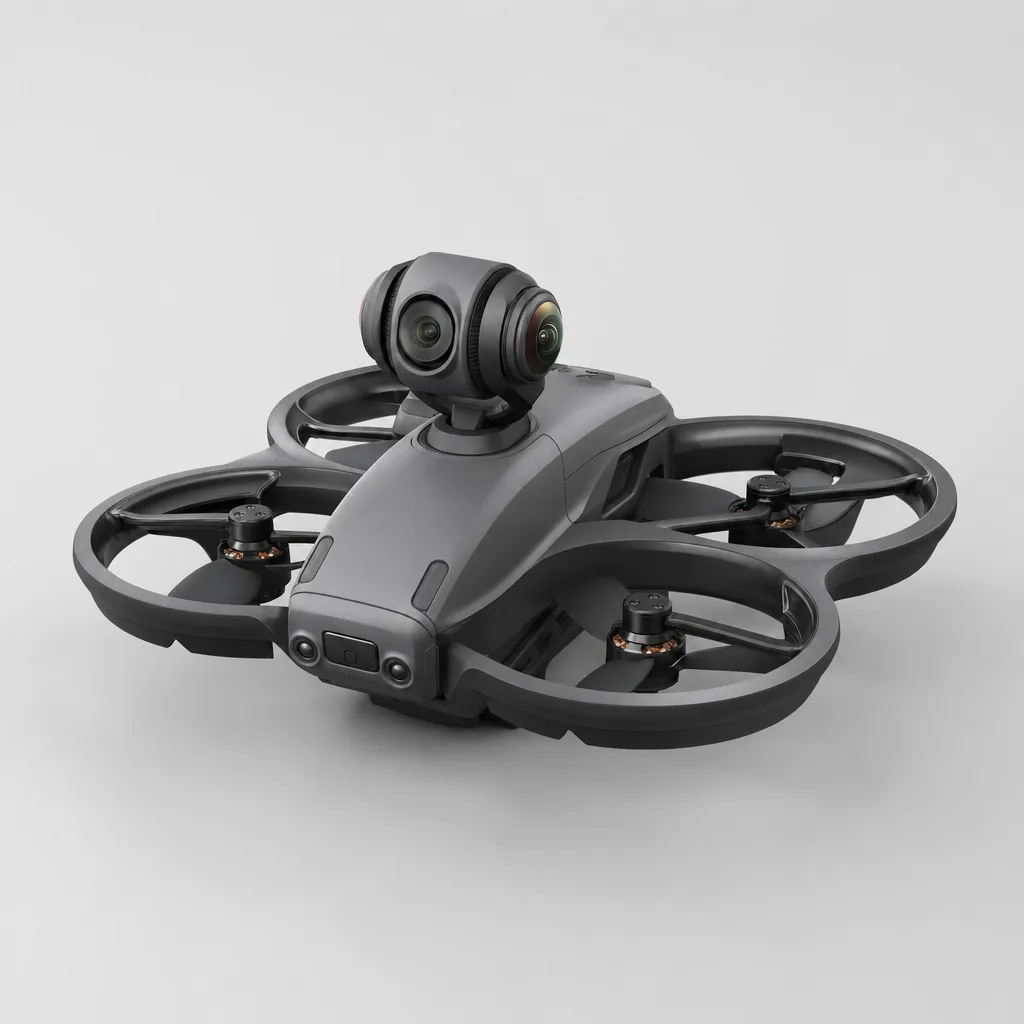
Strip away the novelty and the Avata 360 is a ducted 'cinewhoop' FPV drone with a 360 camera grown into its skeleton. Where rivals bolt an off-the-shelf 360 camera to a drone and hope, DJI designed the whole aircraft around spherical capture: two 1/1.1-inch sensors sit back-to-back in a motorised head that rotates 180° - facing forward like a normal drone camera in single-lens mode, or turning to point one lens at the sky and one at the ground for full 360 recording.
The result is footage with no fixed frame. In DJI Studio afterwards you drag the view anywhere - snap from the horizon to straight down, spin the world around your subject, run ActiveTrack on someone you never consciously filmed - and export a normal flat video. DJI calls the workflow fly once, reframe later, and after three weeks we'd call it the biggest change to how drone footage gets made since the gimbal.
It replaces the Avata 2 at the top of DJI's fun-and-FPV line, and at £409 for the bare drone it's aggressively priced for what's inside - though as we'll see, the bundle you actually want costs rather more.
2. Design: a 455g flying roll cage
The Avata 360 keeps the family look: a squat, ducted 'whoop' airframe (246 × 199 × 55.5mm) whose propellers spin inside moulded tunnels rather than out on arms. The ducts are structural armour. Mid-review, tracking a runner, ours clipped a thin branch the sensors never saw - the drone wobbled, swore quietly to itself and carried on. Any folding camera drone in our comparison would have been in the stinging nettles.
Weight is the first real catch: 455g, up from the Avata 2's 377g and a different legal world from a 249g Lito or Mini - see the UK rules section. The second catch is noise: the ducts give it a purposeful snarl that's audible a good few hundred metres away. This is not a discreet drone.
Clever touches abound. On take-off and landing the camera head rotates to tuck both lenses inward, protecting the two most scratchable surfaces on the aircraft; the lens elements themselves are user-replaceable, which anyone who has priced a 360 camera repair will recognise as quiet genius; and rubber feet keep the glass clear of the ground on grass landings. It even shrugged off light British drizzle in our testing, though DJI makes no waterproofing promises and nor do we.
3. 8K 360 capture and the invisible drone
The headline mode records 360° video in 8K at up to 60fps with HDR, at bitrates up to 180Mbps, onto 42GB of internal storage or a microSD card up to 1TB. Stills are captured as monster 120MP spherical photos (15,520 × 7,760). Because one lens faces up and one faces down, the stitching line runs through the drone itself - so the software removes the aircraft entirely. Your footage shows an impossible, floating point of view with no props, no arms, no shadow of a machine at all.
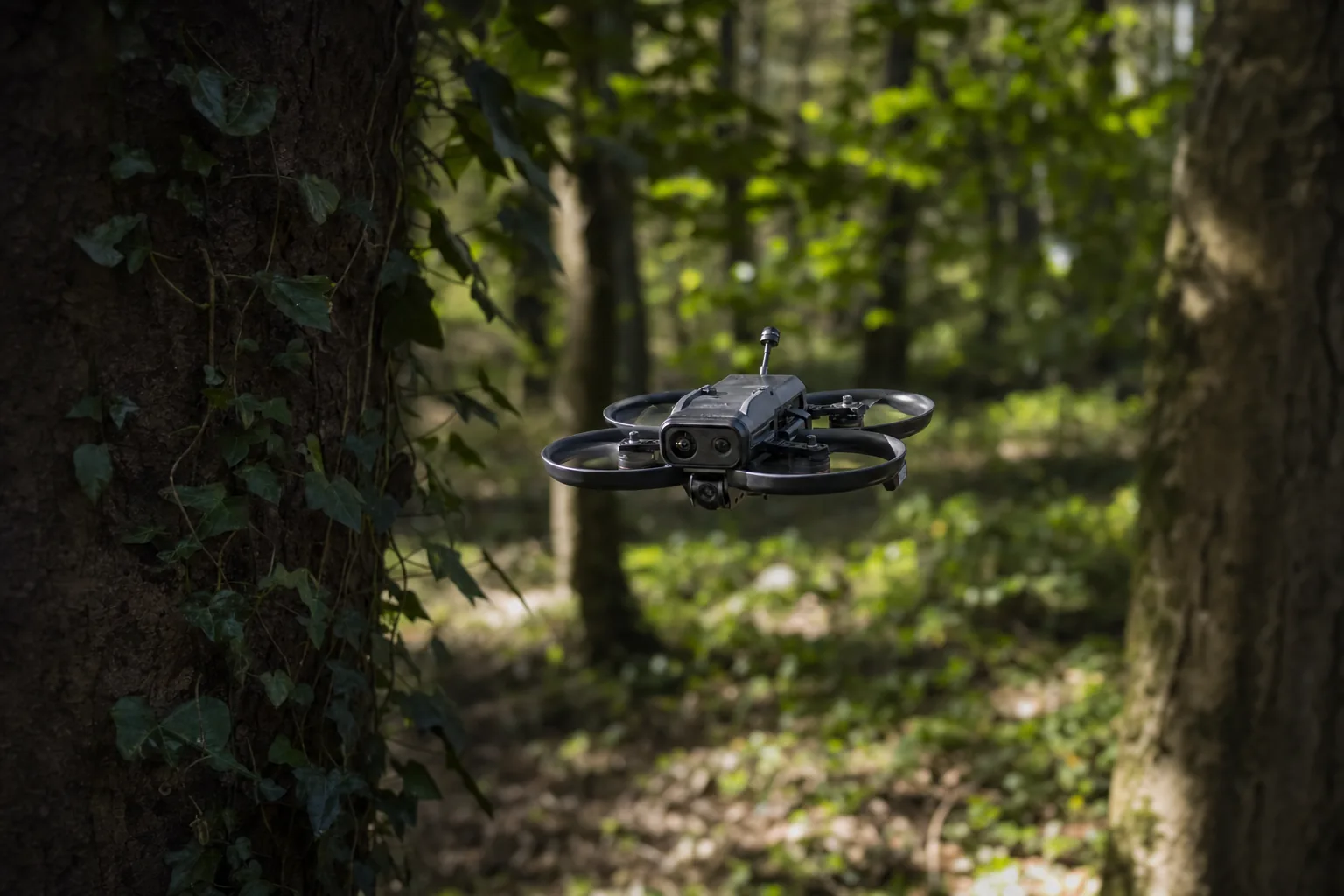
Two honest caveats. First, spherical pixels are spread thin: 8K sounds enormous, but once you punch a flat 16:9 frame out of the sphere you're working with something closer to good 4K - crisp and gradeable, but not the pixel-level bite of the Air 3S's conventional camera. Second, fisheye physics still applies at the frame edges, and fine detail like distant branches can shimmer where the two lenses' images meet. For social edits and creative work it's superb; for landscape cinematography, DJI still sells you a Mavic.
Flip the head forward and the Avata 360 becomes a conventional single-lens FPV drone shooting 4K/60 - effectively an Avata 2 impression, with a virtual gimbal whose field of view can sweep from a tight 104° to a dizzying 272°. Having both modes in one aircraft is the quiet masterstroke: one battery for the planned shots, one for the sphere.
4. The reframing workflow - and its file-size tax
Reframing happens in DJI Studio (desktop and mobile). The tools are genuinely good: drag to look around, set keyframes for camera moves, let ActiveTrack follow a subject through the sphere, then export flat video in normal resolutions. Ten minutes after our first flight we'd produced a fake 'orbit' shot - the drone flew dead straight; the camera move was invented afterwards on a laptop. Nobody who watched it could tell.
Now the tax. Five minutes of 8K 360 footage is over 6GB; a single 360 photo is around 50MB; and editing spherical 8K asks real questions of your computer - our mid-range laptop managed, but with fan noise like a small Avata. Plan for big cards, a big SSD and slightly longer evenings. The 42GB of internal storage is a grace note, good for about half an hour of sphere before you're card-shopping.
Who this workflow actually suits
Be honest with yourself here. If your current drone clips go straight from gallery to group chat, the reframe-later workflow will feel like homework and the Avata 360 is the wrong buy - get a Lito X1 and keep your evenings. If you already edit - or you've ever missed The Shot because the camera pointed the wrong way - it feels like cheating in the best possible sense.
5. Flying it: goggles, motion controller or plain sticks
The Avata 360's other superpower is that it doesn't force the FPV lifestyle on you. It flies three ways:
- Goggles + RC Motion 3 (the £829 Motion Fly More Combo, with Goggles N3): the full immersive experience - you sit inside the shot, steering with wrist tilts. It remains the closest thing to a flying dream you can buy, and the O4+ feed into the goggles is glassy at 1080p/60fps in single-lens mode.
- A normal controller (RC 2, or the RC-N2/N3 phone clamps): fly it like any camera drone, screen in hand. Less magic, far more sociable, and the mode most owners will quietly default to.
- FPV sticks (the FPV Remote Controller 3) in Easy Acro mode - flips, rolls and dives with a safety net. Note there is no full manual mode: DJI has decided Avata pilots don't get to disable the nannies, and experienced freestyle flyers will feel the ceiling quickly.
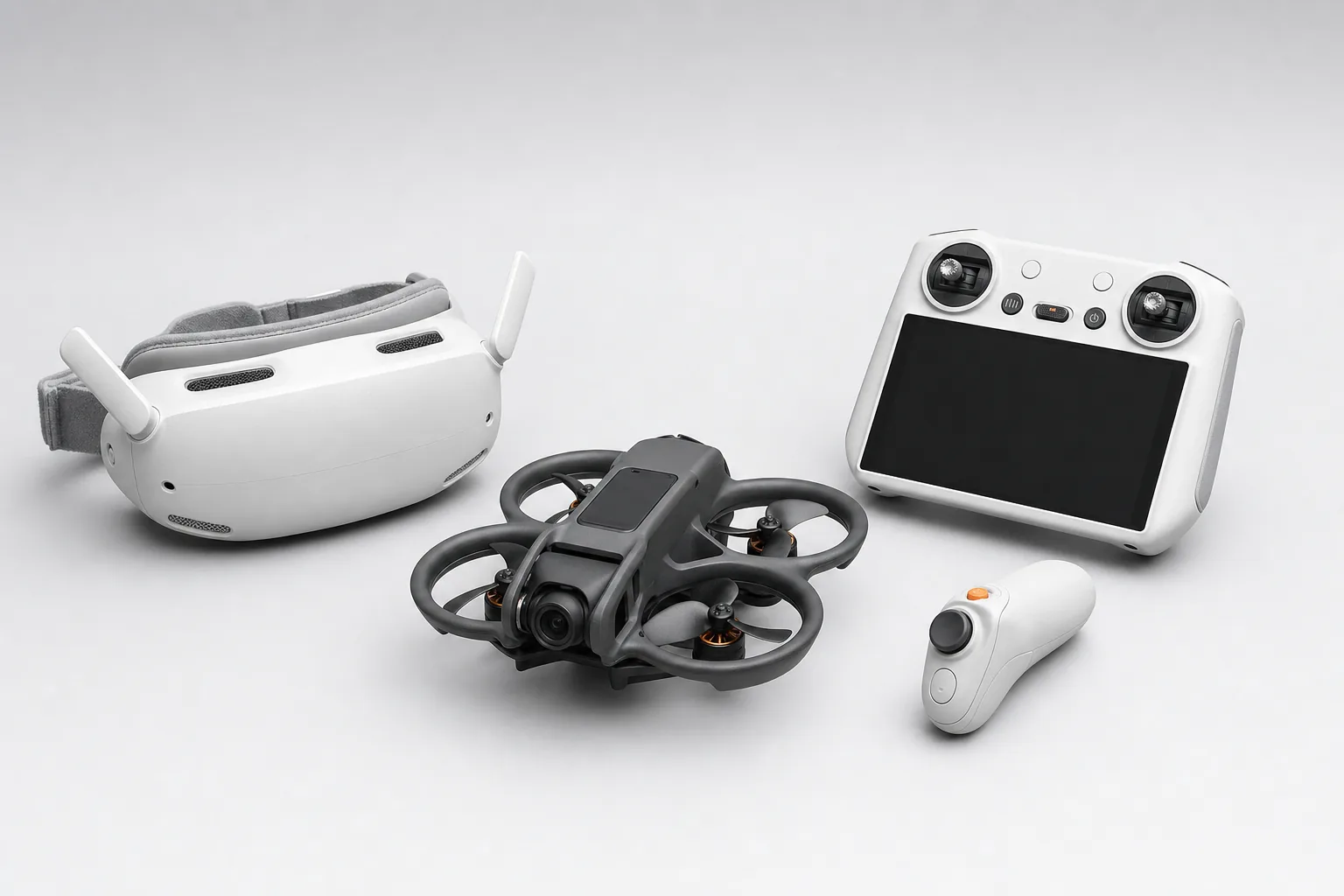
Obstacle avoidance uses DJI's omnidirectional nightscape sensing. As with any automated sensing system, keep a safe path and do not rely on it to prevent every collision.
6. Battery, range and transmission reality
DJI rates the 2,700mAh pack at 23 minutes; recording 8K 360 with the works, we averaged 18-19. That's par for a ducted drone pushing this much camera, but it makes the single-battery £409 and £639 bundles feel like a false economy - the sphere eats minutes, and you'll want three packs. Charging via the hub is unremarkable and fine.
In our range testing the transmission link remained stable, but UK Open-category flights must remain within visual line of sight. Radio range is not permission to fly beyond VLOS; longer operations require the appropriate CAA authorisation.
7. The UK rules: 455g changes things
This is the section that separates the Avata 360 from every sub-250g drone we've reviewed. At 455g it needs more from you:
- Flyer ID and operator ID both required. The flyer ID is the CAA's free online theory test (40 questions, open book, honestly fine); the operator ID is the usual small annual registration.
- Under current UK A1 rules, a C1/UK1 aircraft may fly close to individual uninvolved people and may unexpectedly pass over them, but the pilot must minimise overflight and must never fly over an assembly of people.
- Goggles need a friend. UK law requires unaided visual line of sight, so flying FPV means a competent observer standing with you, watching the actual aircraft. Factor a patient partner into the price.
None of this is onerous - an evening of admin, total - but if maximum-freedom flying matters more to you than the 360 party tricks, that's an argument for the 249g Lito X1 instead.
8. Prices, bundles and which to order
UK launch pricing (26 March 2026, shipping from April):
- £409 - drone only (for existing Avata 2 owners whose controllers and Goggles 3/N3 carry over).
- £639 - with the RC 2 screen controller.
- £829 - Fly More Combo (RC 2, three batteries) or Motion Fly More Combo (Goggles N3 + RC Motion 3 + three batteries).
See the DJI Avata 360 (RC 2) on Amazon UK
In stock and price-checked at the time of writing
See the Motion Fly More Combo on Amazon UK
Goggles N3 + Motion 3 + three batteries · the RC 2 Fly More Combo is the DJI Avata 360 Fly More Combo
Our pick: the Motion Fly More Combo if the immersive flying is any part of why you want this drone - retrofitting goggles and the motion controller later costs far more than the bundle saves. Buy the RC 2 version only if you're certain you'll fly it like a normal camera drone, at which point quietly reconsider whether you want a normal camera drone.
9. vs Avata 2 - and vs a drone plus a 360 camera
Against the Avata 2: the 360 is the more interesting aircraft in every way that isn't price. Dual 1/1.1-inch sensors against a single 1/1.3; the whole reframe-later workflow; O4+ transmission with half as many dropouts behind obstacles; the same ducted charm. The Avata 2 counters with 78g less weight, similar real-world flight time, and street prices that have sunk well below £600 for bundles since launch - if pure goggles-on flying is the whole point and 360 leaves you cold, it remains the value pick of DJI's FPV line.
Against a Mini/Lito plus an Insta360 in the sky: strapping a 360 camera to a normal drone gets you the sphere but not the invisibility - the drone sits in the middle of every shot like a proud parent - and the handling tax is real. The Avata 360's born-this-way integration (self-erasing airframe, protected rotating lenses, native ActiveTrack on spherical footage) is the actual product, not the pixel count.
Where does it sit in the family? Beneath it, the Avata 2 keeps the budget-FPV slot. Beside it, the Air 3S and Mavic 4 Pro still own serious flat-image quality. Nothing sits above it in creative flexibility - in DJI's range or anyone else's. See our updated full-range comparison for the full pecking order.
Frequently asked questions
Is the DJI Avata 360 a real 360 camera or a drone with one attached?
Fully integrated: two 1/1.1-inch sensors live in a motorised head that rotates between forward-facing (normal 4K/60 filming) and vertical (full-sphere 8K/60 recording). Because one lens faces up and one down, the stitch line passes through the airframe and the software removes the drone from the footage entirely.
Do I need FPV goggles to fly the Avata 360?
No. It flies with a standard RC 2 or RC-N2/N3 controller like any camera drone, with goggles (Goggles 3 or N3) plus the RC Motion 3 for immersive flight, or with the FPV Remote Controller 3 for stick-flying in Easy Acro mode. Older goggles - V2, Goggles 2, Integra - are not compatible.
What are the UK rules for flying the DJI Avata 360?
At 455g it needs both the free CAA flyer ID (online theory test) and an operator ID, and it can't freely overfly uninvolved people the way sub-250g drones can. Flying with goggles additionally requires a competent observer who keeps the drone in direct sight. Budget one evening for the admin.
How long does the DJI Avata 360 fly on a battery?
DJI quotes 23 minutes; recording 8K 360 in real conditions we averaged 18-19. Three batteries (the £829 Fly More bundles) is the practical minimum for a session, which is why we'd skip the single-battery options.
Is 8K 360 video actually 8K quality?
Not in the flat sense. 8K is spread across the whole sphere, so a reframed 16:9 export lands closer to good 4K - crisp, 10-bit and very gradeable, but softer at the edges than a conventional drone camera at the same price. The trade is flexibility: every direction exists in the file.
Should I buy the Avata 360 or the cheaper Avata 2?
Avata 360 if the reframe-later workflow or the invisible-drone effect excites you - nothing else does it. Avata 2 if you just want the goggles-on flying experience at the lowest price: it's lighter, discounted well below £600 in bundles, and its single camera is arguably sharper for straight-ahead FPV footage.
Verdict: the most creative drone DJI has ever shipped
The Avata 360 does something genuinely new: it removes the one decision that has defined camera drones since they existed. Record everything, choose later, and let the software erase the aircraft from its own footage. The results feel like shots from a drone that isn't there - because, on screen, it isn't.
Score: 9/10. A point held back for the file-size and editing tax, omnidirectional nightscape sensing, and a 455g weight that takes UK flying admin with it. None of that dents the achievement. For creators, this is the most exciting thing DJI has made since the original Avata - and the first drone in years where the limiting factor is honestly your imagination rather than the hardware. Pair it with a big SSD and a patient observer, and go make impossible shots.
Sources & further reading: official DJI Avata 360 specifications · FirstQuadcopter's full flight review · TechRadar's Avata 360 review · CAA drone registration · the CAA's drone rules hub.
- DJI Avata 360 (RC 2)View on Amazon
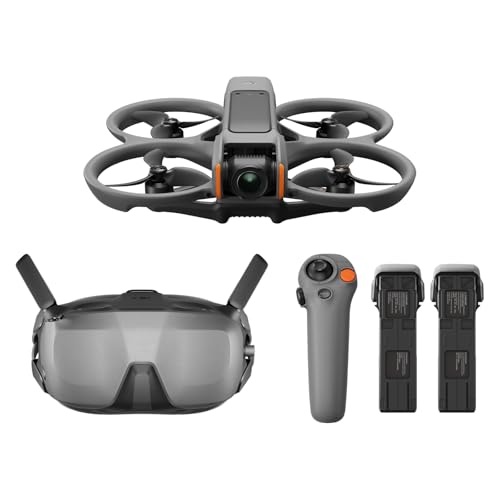 Avata 2View on Amazon
 DJI Avata 360 Fly More ComboView on Amazon
 Motion Fly More ComboView on Amazon