
DJI Osmo Action 6 First Look: can variable aperture change action video?
A larger square sensor and an f/2.0–f/4.0 lens promise more useful footage after sunset. The independent results suggest a meaningful step forward, with important small-camera compromises still intact.
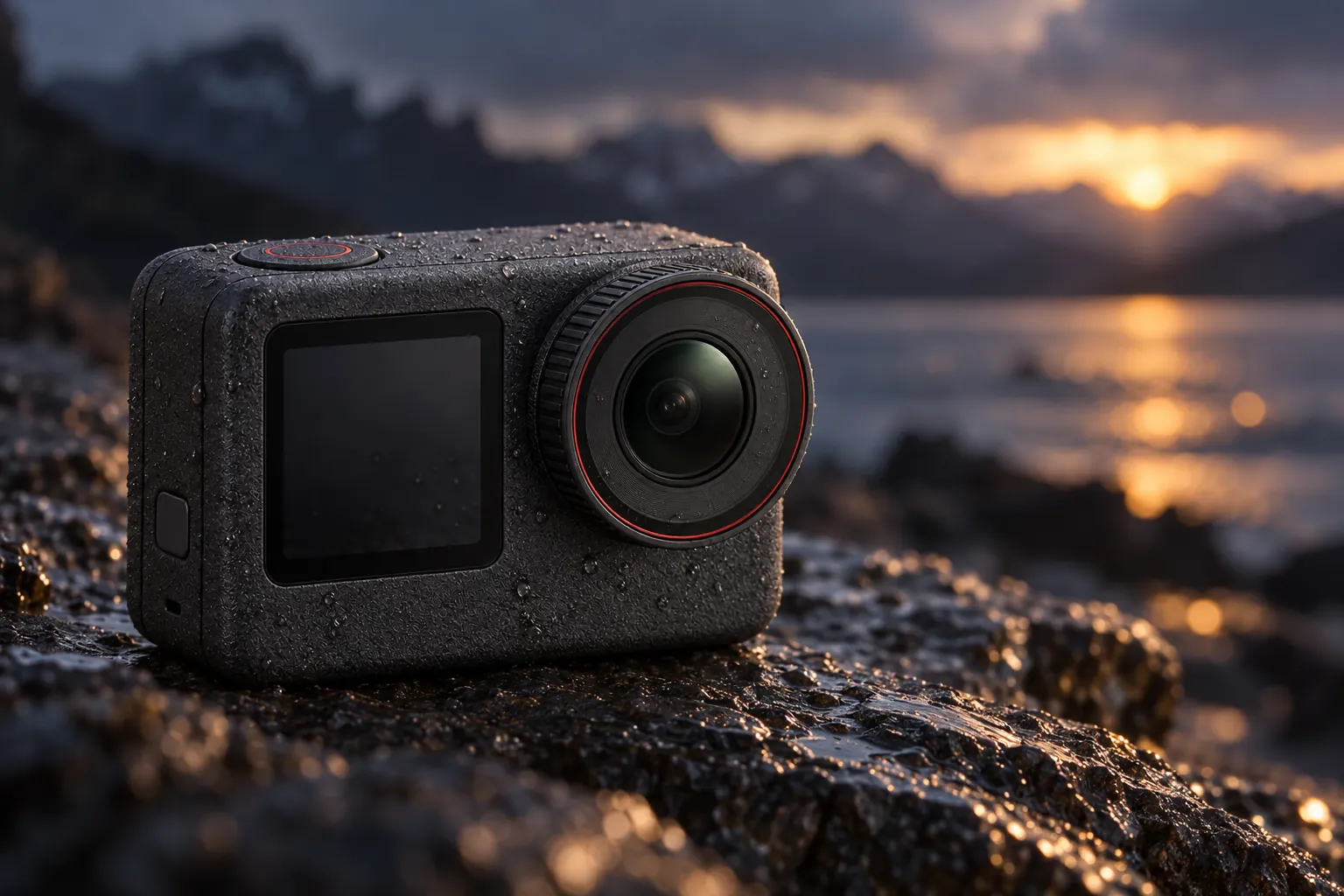


Variable aperture, square 4K capture and strong reported 4K/60 endurance make it suited to creators filming across changing light.
Check price on AmazonWe link to the exact model on Amazon UK. Prices change often, so check the live price before you buy. As an Amazon Associate we earn from qualifying purchases.
You are cycling home as the light drops, passing street lamps, car headlights and wet tarmac. Most action cameras respond by raising ISO, smearing texture and turning bright lights into distractions. The short answer: DJI Osmo Action 6 is the action camera to buy for UK creators who regularly film in mixed light and want to crop one clip for landscape and vertical posts. Its variable aperture and 1/1.1-inch square sensor materially improve the odds of usable evening footage, although they do not eliminate image noise, flare or heat during demanding recording modes.
| Key specification | DJI Osmo Action 6 | GoPro HERO13 Black | Insta360 Ace Pro 2 |
|---|---|---|---|
| Maximum video mode | 8K at 30fps; 4K at 120fps | 5.3K at 60fps; 4K at 120fps | 8K at 30fps; 4K at 120fps |
| Lens aperture | Variable f/2.0–f/4.0 | Fixed aperture | Fixed f/2.6 |
| Waterproofing without housing | 20m | 10m | 12m |
| 4K/60 indoor runtime reported by Tom's Guide | 120 minutes | 80 minutes | 76 minutes |
| Internal storage | About 50GB usable | Not confirmed | Not confirmed |
The GoPro and Insta360 models appear below only as buying context. This first look recommends and assesses the DJI Osmo Action 6 Standard Combo named in the UK listing.
DJI Osmo Action 6: What DJI Actually Changed
DJI launched the sixth-generation flagship non-360 Osmo Action globally and in the UK on 18 November 2025. It replaced the Osmo Action 5 Pro, but this was more than a routine resolution update: DJI changed the imaging proposition around a 1/1.1-inch square CMOS sensor and a variable f/2.0–f/4.0 aperture.
Check today's price: DJI Osmo Action 6 on Amazon UK
The familiar action-camera formula has generally meant a very wide fixed lens, a small sensor and heavy processing once daylight fades. DJI's approach gives the Action 6 more exposure control. Its f/2.0 maximum aperture can gather a full stop more light than an f/2.8 lens, whilst the square sensor preserves more frame area for later crops and stabilisation.
The important change is control, not simply 8K
DJI claims 2.4μm fusion pixels and up to 13.5 stops of dynamic range. Those figures are useful context, but the more practical benefit is being able to open the lens for darker scenes and stop it down when point lights, close subjects or a starburst effect call for a different look.
The body measures 72.8 × 47.2 × 33.1mm and weighs 149g. It is slightly larger than earlier DJI action cameras, according to Notebookcheck and TechRadar, so older protective cases may not fit. The camera itself is black; the various DJI packages change the supplied accessories rather than the imaging hardware.
Inside the Standard Combo: What UK Buyers Actually Get
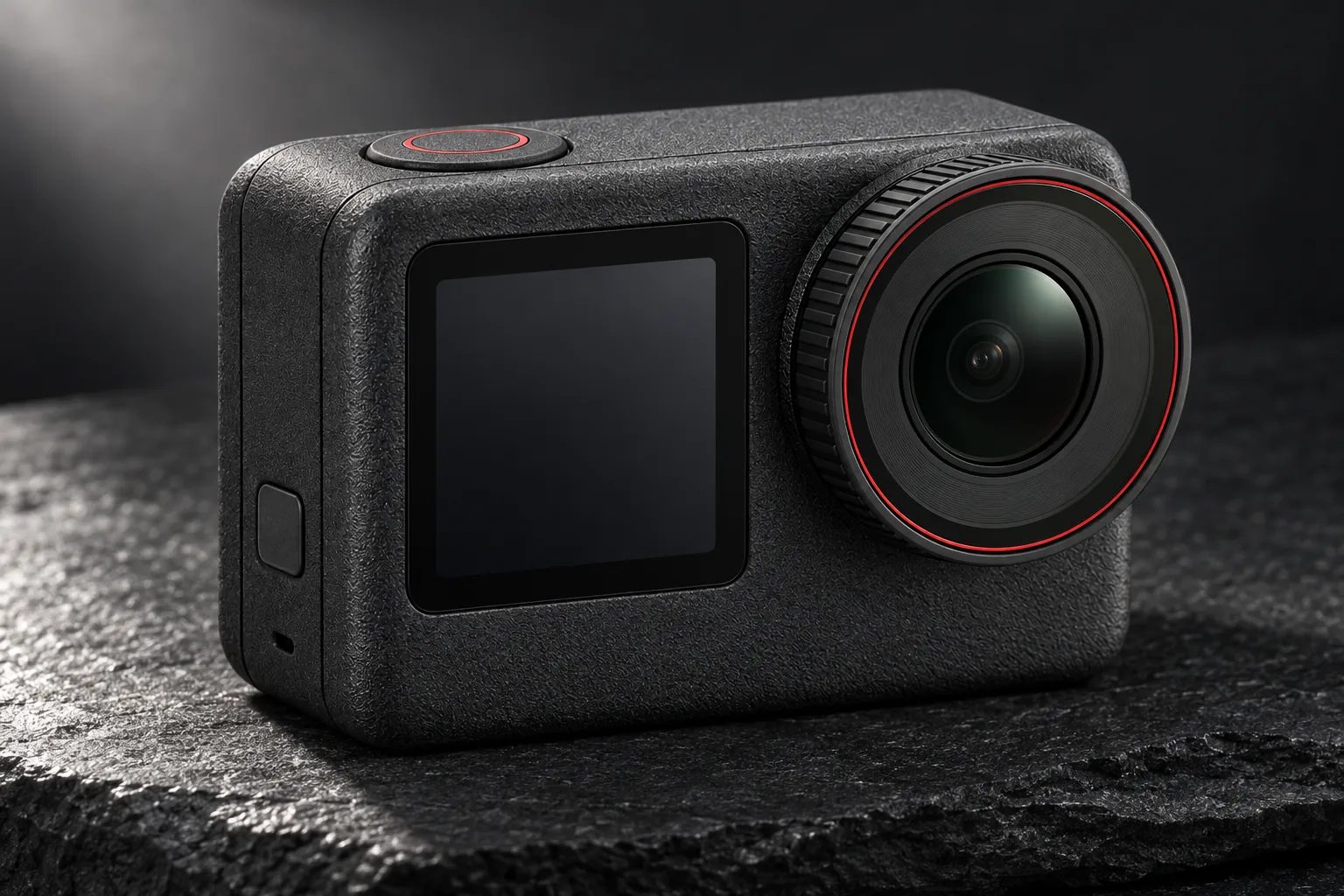
The Amazon UK product covered here is the DJI Osmo Action 6 Standard Combo. DJI's UK launch price for this bundle was £329. DJI's own UK store listed it at £379 on 21 October 2026, so buyers comparing deals should recognise the difference between its original RRP and the current direct-store price.
UK launch RRP
Standard Combo price reported at the November 2025 launch.
DJI UK store price
Current direct-store listing on 21 October 2026.
Adventure Combo launch RRP
A larger bundle, rather than a different camera.
Camera Centre UK listed the Standard Combo with the camera, one 1950mAh Extreme Battery Plus, a dual-direction quick-release adapter mount, curved adhesive base, locking screw, USB-C to USB-C PD charging cable and anti-slip pad. It is an immediately usable starter package for a helmet, bike, board or handheld setup.
The Standard Combo does not include additional batteries, the charging case, an extension rod, the optional Macro Lens or the FOV Boost Lens. Buyers planning long rides, ski days or multi-location shoots should budget for power and mounting accessories rather than assuming they are in the box.
That bundle distinction matters more than it may initially appear. The Action 6 camera hardware is identical across DJI's packages, so spending more buys a more complete shooting kit, not improved sensor performance, extra resolution or a different lens.
For a UK buyer choosing between a discounted Standard Combo and a larger package, start with the shooting day rather than the bundle name. The Standard kit is sensible for short outings, occasional swimming or a first action camera because it includes the basic mount and cable. It becomes less convenient when the plan is continuous filming across a full ride or day on the slopes: one battery means charging breaks or a separate power purchase. Conversely, buyers who already own suitable mounts may get more value from adding batteries or a charging case than from paying for activity-specific accessories they will rarely use.
The Variable Aperture Explained: f/2.0, f/2.8 and f/4.0 in Practice
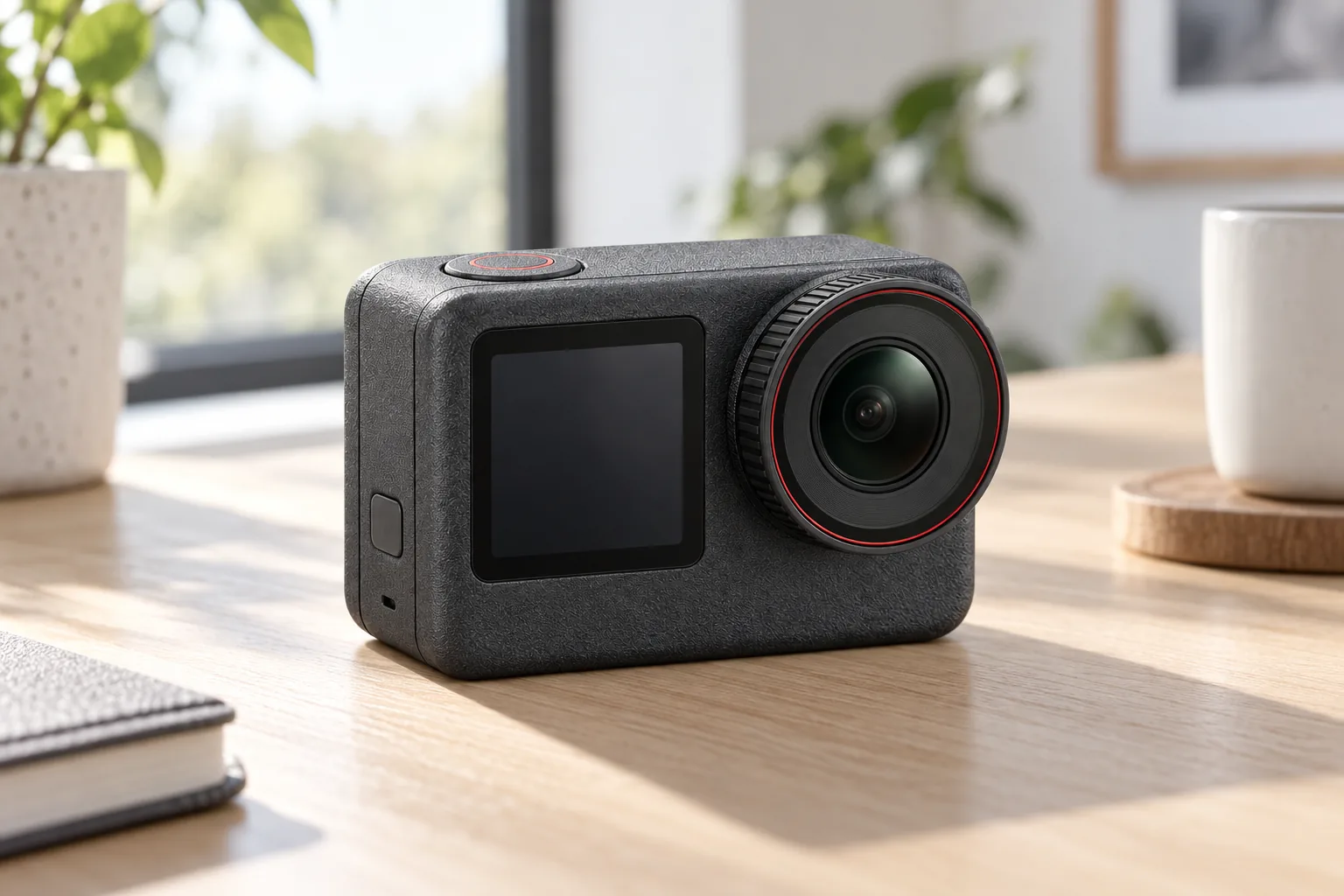
Aperture is the element that gives the Action 6 a different character from many action cameras. Instead of one fixed lens setting, DJI supplies four approaches. Auto adjusts the aperture according to conditions; Large Aperture holds it at f/2.0; Fixed uses f/2.8, which DJI describes as similar to a conventional action camera; and Starburst uses f/4.0 to create six-point bursts around bright point light sources.
Large Aperture: fixed f/2.0
This is the low-light setting. It gives the sensor more light, helping the camera retain a more useful shutter speed before it has to push ISO harder. It is the mode most relevant to evening rides, city walks and darker interiors.
Fixed: f/2.8
This provides the familiar action-camera balance of depth of field and exposure. It is DJI's conventional option for situations where lighting is adequate and the priority is an all-purpose wide-angle look.
Starburst: fixed f/4.0
At f/4.0, bright points such as streetlights and decorative lights can form six-point starbursts. The smaller aperture also increases depth of field, useful when foreground and background detail both matter.
Auto with selectable limits
Auto can work across f/2.0–f/4.0, f/2.2–f/4.0, f/2.4–f/4.0, f/2.6–f/4.0 or f/2.8–f/4.0. That lets a creator decide how readily the camera is allowed to open its lens.
There is a practical trade-off. A wider aperture admits more light, but it also reduces depth of field. On a very wide action-camera lens the effect is less dramatic than on a portrait lens, yet it becomes relevant at close distances. DJI states a focus range of 0.2m to infinity at f/4.0, and its optional Macro Lens extends the creative options for close subjects.
For everyday use, Auto with a chosen lower limit is potentially the most useful compromise. A rider moving repeatedly between open roads, woodland and built-up streets does not need to treat aperture as a manual exposure control for every shot, but can stop the camera opening as widely if they prefer a more consistent deep-focus action-camera look. Large Aperture makes most sense when the scene is already dim; Starburst is a creative choice rather than a cure for flare. It is worth checking the result on a larger screen before relying on either processing or the f/4.0 effect for an important night sequence.
Digital Camera World praised the move away from the fixed-aperture convention, particularly for low light, depth control and closer focusing. It is meaningful control rather than a decorative specification, but it does not bypass the physical limits of a compact, waterproof camera.
Square Sensor, Square Thinking: What 4K Custom Mode Actually Does
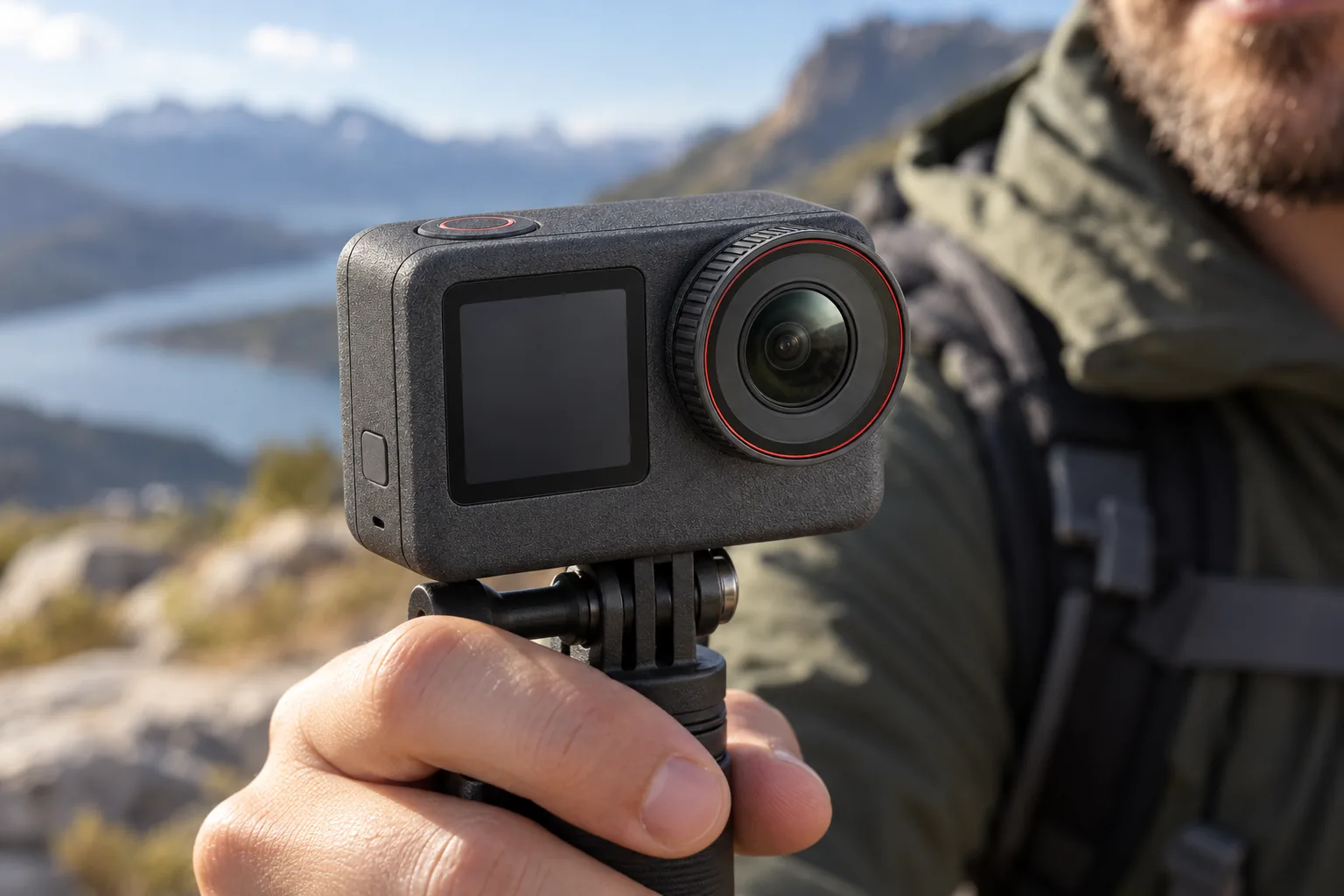
The Action 6's square sensor is arguably the feature creators will notice most often after shooting. Its 4K Custom mode records 3840 × 3840 footage at up to 60fps. That leaves enough image around the subject to make a horizontal, vertical or square edit later without physically rotating the camera for every platform.
For someone documenting a mountain-bike descent, commute or family day out, that means one securely mounted camera can yield a 16:9 YouTube cut, a 9:16 Reel or TikTok crop, and a square social post. DJI and several reviewers highlighted this as the everyday practical reason for the sensor shape, rather than simply a technical novelty.
8K is available only in 16:9 at 24, 25 or 30fps. Tom's Guide praised it as an option for cropping and producing oversampled 4K delivery, but also noted there is no intermediate 6K mode between 4K/60 and 8K/30. For fast movement, 4K/60 or 4K/120 will often be the more practical choice.
The Action 6 records MP4 using HEVC at up to 120Mbps. WIRED criticised the lack of a higher bitrate setting, arguing that the codec can show its limits in difficult footage. That is an important caveat for editors who expect a very forgiving file for heavy grading or scenes full of fine moving detail.
There is also a workflow decision behind these modes. Recording everything in 4K Custom provides useful insurance when one clip may need several outputs, but it still leaves cropping and export choices for the edit. Shooting native vertical 4K can be simpler when the final destination is certainly a phone-first post, while native 16:9 remains the straightforward option for a longer landscape edit. 8K deserves an equally selective approach: it offers extra crop latitude, but is capped at 30fps and DJI says 8K editing and downloading in Mimo is currently supported on iPhone 15 Pro-series devices and later, subject to future app support elsewhere.
Does It Actually Fix Low Light? Reading the Independent Results
The answer is partly yes. WIRED reported that Action 6 footage looked cleaner and sharper than footage from both the Action 5 Pro and Insta360 Ace Pro 2 in comparable low-light scenes, describing DJI's result as roughly one stop brighter. That matches the underlying logic of an f/2.0 lens and larger sensor area.
DJI's SuperNight mode reaches up to 4K/60fps. That matters because action-camera night processing has commonly been limited to 30fps, and 60fps can be valuable when movement is part of the shot. A cyclist moving through town, for example, may favour smoother motion over a slower frame rate.
What reviewers praised
- WIRED found video cleaner and sharper than the Action 5 Pro and Ace Pro 2 in low light.
- Digital Camera World saw useful extra control over low light, close focus and depth of field.
- Tom's Guide described 4K/30 night video as reasonably usable.
- SuperNight at up to 4K/60 offers more motion flexibility than night modes capped at 30fps.
What remains difficult
- Tom's Guide still saw visible noise in darker 4K/30 scenes.
- At 4K/60 in very low light, sharpness fell as the camera raised ISO.
- TechRadar observed strong default sharpening and noise reduction in some footage.
- Bright night-time light sources could create noticeable flare.
This is the key reality check. Variable aperture and sensor size move the Action 6's low-light floor upwards; they do not create noise-free footage after dark. SuperNight can brighten shadows, but TechRadar found that it can also remove fine texture on a large screen. It is a useful tool for sharing and fast edits, not a substitute for a larger-sensor camera when image quality is the only priority.
For a practical UK evening setup, choose the mode around the story rather than simply selecting the highest number. 4K/30 gives the camera a more manageable starting point in genuinely dark scenes, whereas 4K/60 is better reserved for footage where smoother movement matters and some loss of sharpness is acceptable. Use f/2.0 when available light is scarce, but regard SuperNight as processed footage with a distinct look, not a neutral low-light profile. If bright lamps or headlights dominate the composition, compose with the likelihood of flare in mind; the Action 6 improves the situation, but cannot make those small, intense sources disappear.
The camera's Starburst setting adds another wrinkle. Tom's Guide observed flare from bright sources at night, whilst f/4.0 can deliberately create six-point stars around those lights. That can be visually attractive in the right shot, but users filming around headlights or street lamps should expect the lens character to be visible.
Battery Reality Check: DJI's Lab Number vs Tom's Guide's Stress Run
DJI quotes up to 240 minutes of operating time, which is an impressive figure only when read alongside the conditions: 1080p/24 recording at 25°C, RockSteady enabled, Wi-Fi and voice and gesture controls disabled, and both screens switched off. It is a useful maximum, not a promise of four hours of continuous 4K or 8K capture.
Tom's Guide placed the camera under a far heavier indoor workload at 4K/60. It recorded 120 minutes total runtime. The camera overheated after 62 minutes, recovered or cooled, then overheated again after a further 40 minutes. At 8K/30, it recorded 93 minutes total, with overheating after around 65 minutes.
That indoor run was deliberately severe, and airflow from riding, skiing or walking outdoors should reduce thermal pressure. It nevertheless establishes a useful boundary: the Action 6 has stronger endurance than the three cameras in that comparison, but sustained high-performance capture can still stop because of heat.
TechRadar reported around four hours from one charge during mixed 1080p and 4K use. That is plausible for stop-start filming across a day, but it should not be read as a continuous-recording result. Cold weather also reduced endurance in TechRadar's experience, despite DJI's claim of up to 167 minutes at −20°C under its specified 1080p/24 conditions.
Plan charging around that distinction. The supplied USB-C to USB-C cable supports the camera's PD charging arrangement, and DJI recommends a charger rated at 30W or above; DJI quotes approximately 53 minutes for a full charge. For a commute or a few clips around a weekend trip, topping up through USB-C may be enough. For skiing, long rides or an all-day travel itinerary, the Standard Combo's single battery is the practical constraint. Thermal planning matters too: static recording in a warm indoor space is the toughest case, while a moving outdoor camera has a better chance of shedding heat.
Stabilisation, Screens and Everyday Handling Details
The Action 6 offers RockSteady 3.0, RockSteady 3.0+, HorizonBalancing and HorizonSteady. The horizon modes work up to 4K/60 in supported modes. Stabilisation is unavailable in slow motion and timelapse, so those modes need a steadier mount or more careful camera placement.
Notebookcheck described the stabilisation as excellent during running, jumping and handheld movement, and noted a visible improvement over the Action 4. Its cycling footage also showed the limitation shared by any electronic system: a stiff, unsuspended handlebar still produced jitter. TechRadar found RockSteady effective for walking and tracking shots.
There is a 2.5-inch rear OLED touchscreen and a 1.46-inch front OLED touchscreen. Digital Camera World described the rear display as bright, sharp and generally responsive. The front screen is particularly useful for framing a short piece to camera without reaching for a phone.
The camera includes 64GB physical storage, with roughly 50GB available to the user, plus microSD expansion. Built-in storage is not a replacement for a card on a long trip, but it is a genuinely helpful fallback if a card fills, is forgotten or develops a problem partway through a shoot.
Audio comes from three internal microphones, with 48kHz 16-bit AAC recording. Tom's Guide praised the built-in sound and found engine noise clear in motorcycle footage. The camera can also connect directly to up to two compatible DJI microphone transmitters through OsmoAudio, without a receiver. For especially loud engines or severe wind, Tom's Guide advised using a wired microphone through DJI's USB-C audio adapter instead.
Initial setup is not entirely camera-only: DJI Mimo is required for activation and also handles control, transfers, editing and firmware updates. Once activated, the physical controls and responsive screens should make routine use straightforward, but it is worth installing Mimo before leaving for a trip rather than discovering the requirement at the trailhead. Gesture control can start or stop recording or take a photo with a palm within DJI's stated two-metre range, while voice control supports English and Mandarin Chinese. TechRadar found voice commands occasionally failed when the microphone was obstructed, so buttons remain the more dependable choice under helmets, wind or heavy clothing.
How It Stacks Up Against GoPro HERO13 Black and Insta360 Ace Pro 2
DJI has a clear durability advantage on the figures available here. The Action 6 is rated to 20m without a case and 60m with DJI's optional Waterproof Case. Tom's Guide highlighted that as a substantial margin over the HERO13 Black's 10m and Ace Pro 2's 12m caseless ratings.
Its sensor is a 1/1.1-inch square design, larger than the Ace Pro 2's 1/1.3-inch sensor. The GoPro's exact sensor size was not stated in the cited official material. DJI also brings variable aperture, 4K Custom capture and about 50GB of usable internal storage to the comparison.
| Decision point | DJI Osmo Action 6 | What that means |
|---|---|---|
| Variable f/2.0–f/4.0 aperture | Available | More control over exposure, depth of field and the starburst look than a conventional fixed-aperture action camera. |
| 4K Custom square capture | 3840 × 3840 up to 60fps | One shoot can be reframed for horizontal, vertical and square output. |
| 8K recording | 16:9 at up to 30fps | Useful for cropping and 4K delivery, but not the mode for fast 60fps action. |
| Waterproofing | 20m without a housing | Useful for snorkelling, swimming and wet-weather shooting without an extra case. |
| Maximum bitrate | 120Mbps | A limitation for users who want a higher-bitrate recording option for demanding footage or intensive grading. |
GoPro retains strengths in its established accessory system and higher-than-4K intermediate capture options, whilst the Ace Pro 2 has its own 8K mode, flip screen and extensive app-based editing tools. DJI's argument is more specific: a better low-light foundation, flexible reframing and deep caseless waterproofing in one compact unit.
The alternative decision is therefore fairly clear. Choose the Action 6 if low-light action footage, flexible crops and deeper water resistance are the priorities. Consider GoPro if an established third-party accessory ecosystem, its HB lens and filter system or 5.3K/60 better matches the way you work. Consider the Ace Pro 2 if its flip screen and app-led editing are more valuable than DJI's aperture and square-sensor workflow; Insta360's reviewed UK store price of £279 for the Standard Bundle also makes it the budget-conscious alternative when price matters more than the Action 6's particular strengths. None of those choices removes the need to consider batteries, mounts and editing workflow alongside the camera body.
Who This First Look Suggests It's For
Action 3 and Action 4 owners
The larger sensor, variable aperture, built-in storage and revised stabilisation make for a clearer step forward than they do from the Action 5 Pro.
Mixed-light creators
Commuters, cyclists, hikers and skiers who move from daylight into dusk have the most to gain from the f/2.0 setting and SuperNight mode.
Multi-platform publishers
4K Custom is a persuasive fit for creators who routinely need landscape, square and vertical edits from one outing.
Compact vlogging setups
Direct pairing with compatible DJI microphone transmitters and a front OLED screen simplify short pieces to camera.
It is less persuasive for an Action 5 Pro owner who mainly captures ordinary 16:9 footage in good daylight. Digital Camera World did not see a huge improvement in that familiar scenario, and WIRED similarly judged the upgrade harder to justify without a specific need for better low light, 8K, the newer mount or the square-sensor workflow.
It is also not the natural fit for someone whose priority is maximum recording bitrate, live zoom changes or a very large accessory bundle from day one. The Standard Combo is deliberately a starting point, and the accessories that broaden the system cost extra.
Common Questions Before You Buy
Who should buy which
DJI Osmo Action 6 Standard Combo is the clear recommendation for buyers who need a rugged camera that can cope more convincingly with dusk, city lights and mixed conditions, whilst giving them one flexible source file for several social formats. The variable aperture is not a miracle cure for action-camera night footage: noise, flare, aggressive processing and thermal limits remain. But it is a credible hardware change, backed by reviewers who saw cleaner low-light footage and stronger 4K/60 endurance than key rivals. For an older DJI Action owner or a creator who routinely films across daylight and evening, it is a substantial reason to move up.
Sources
- DJI Osmo Action 6Best for mixed lightView on Amazon
Sources and evidence (27)
- dji.com (other)
- techradar.com (other)
- dji.com (other)
- cameracentreuk.com (other)
- tomsguide.com (other)
- notebookcheck.net (other)
- digitalcameraworld.com (other)
- wired.com (other)
- dji.com (other)
- store.dji.com (other)
- dji.com (other)
- dji.com (other)
- dji.com (other)
- store.dji.com (other)
- techradar.com (other)
- tomsguide.com (other)
- wired.com (other)
- digitalcameraworld.com (other)
- notebookcheck.net (other)
- cameracentreuk.com (other)
- bhphotovideo.com (other)
- techradar.com (other)
- outdoortechlab.com (other)
- repair.dji.com (other)
- engadget.com (other)
- gopro.com (other)
- insta360.com (other)