
Samsung 990 EVO Plus First Look: The Value PCIe 4.0 SSD Worth Buying?
Samsung's mainstream NVMe range looked appealing on paper for gaming PCs and laptop upgrades, but the buying decision in the UK depended far more on retailer pricing than its headline 7GB/s figures.
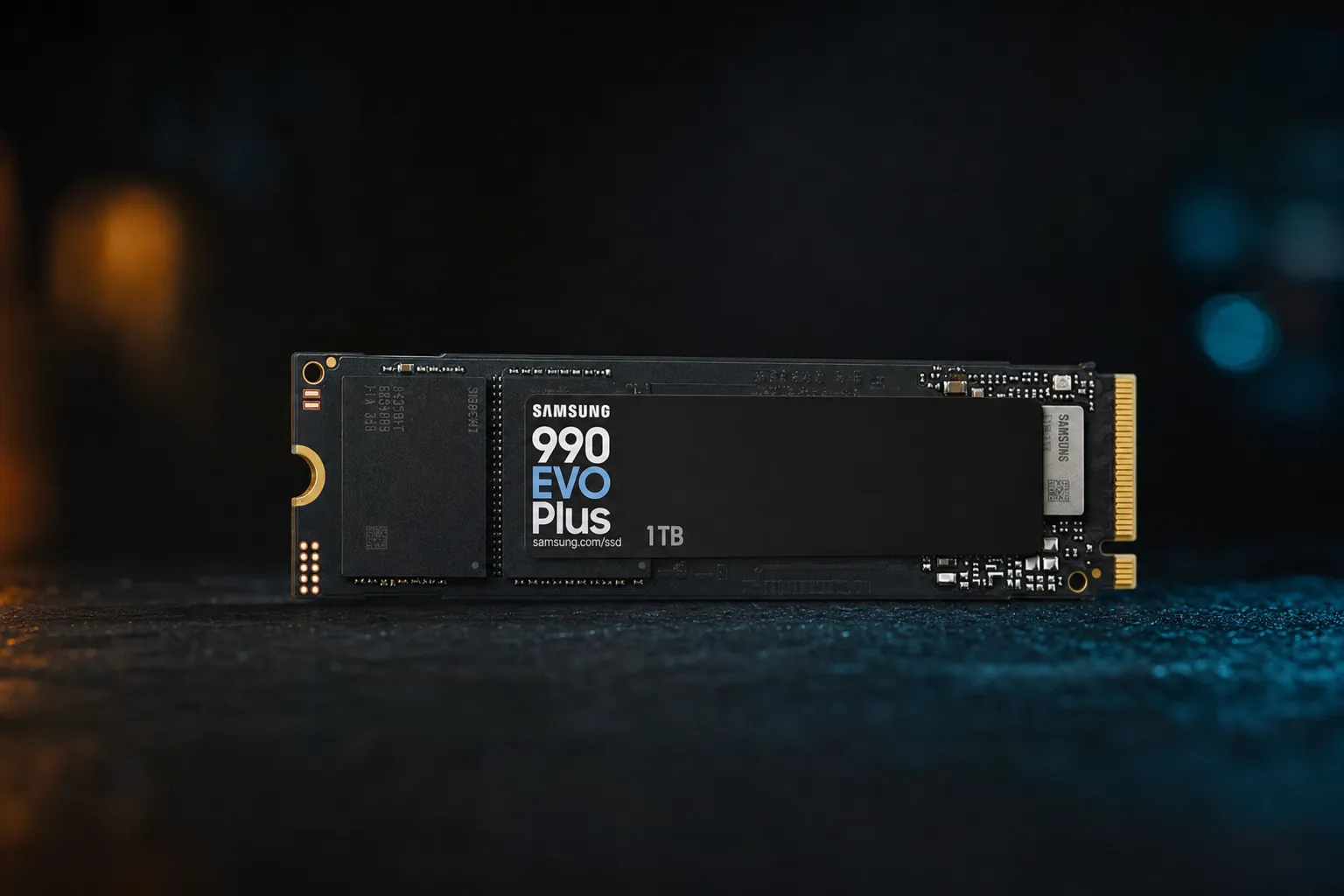

We link to the exact model on Amazon UK. Prices change often, so check the live price before you buy. As an Amazon Associate we earn from qualifying purchases.
The Samsung 990 EVO Plus made the most sense as a tidy, efficient upgrade for a laptop, compact PC or general-purpose gaming machine — but only when its price stayed close to competing TLC PCIe 4.0 drives. It combined fast quoted sequential speeds, a compact single-sided board and Samsung's mature Magician software, yet it was not a straightforward value pick at the elevated UK prices observed in September 2026.
Where Samsung 990 EVO Plus Fits in Samsung's SSD Line-up

See Samsung 990 EVO Plus 4TB on Amazon UK
Check today's price & availability on Amazon UK

See Samsung 990 EVO Plus 1TB on Amazon UK
Check today's price & availability on Amazon UK
A practical SSD purchase usually begins with capacity, physical fit and price rather than the very highest sequential figure printed on a product page. That is particularly true for the Samsung 990 EVO Plus. It was Samsung's mainstream M.2 NVMe range for buyers moving beyond basic storage, rather than the company's enthusiast-focused 990 Pro line.
The range arrived globally in September 2024, with US availability announced in October 2024. It replaced the original Samsung 990 EVO's lower performance profile and expanded the maximum capacity from 2TB to 4TB. There was no 500GB version, which positioned the family above the smallest budget upgrades and made the 1TB model its starting point.
All three capacities shared the same Samsung controller, TLC NAND, NVMe 2.0 protocol and M.2 2280 physical format. They also shared Host Memory Buffer architecture rather than a dedicated onboard DRAM cache, Intelligent TurboWrite caching, Samsung Magician support and the same five-year limited warranty structure.
The meaningful differences were capacity, endurance, quoted random performance and power draw. The 1TB model was rated for 600TBW, the 2TB version for 1,200TBW and the 4TB version for 2,400TBW. That linear 600TBW-per-terabyte relationship is reassuring for a consumer drive intended to hold a large game library, a Windows installation or day-to-day work files.
| Specification | Samsung 990 EVO Plus 1TB | Samsung 990 EVO Plus 2TB | Samsung 990 EVO Plus 4TB |
|---|---|---|---|
| Model code | MZ-V9S1T0BW | MZ-V9S2T0BW | MZ-V9S4T0BW |
| Sequential read, quoted | Up to 7,150MB/s | Up to 7,250MB/s | Up to 7,250MB/s |
| Sequential write, quoted | Up to 6,300MB/s | Up to 6,300MB/s | Up to 6,300MB/s |
| Random read, QD32 | Up to 850K IOPS | Up to 1,000K IOPS | Up to 1,050K IOPS |
| Random write, QD32 | Up to 1,350K IOPS | Up to 1,350K IOPS | Up to 1,400K IOPS |
| Average active read power | 4.3W | 4.6W | 5.5W |
| Endurance | 600TBW | 1,200TBW | 2,400TBW |
For most gaming PCs, the 2TB model was the logical capacity. One terabyte can fill quickly once Windows, a few large modern games, patches and media files are involved. Four terabytes has obvious appeal for a large library, but it only becomes compelling where the price per terabyte is sensible. Capacity alone should not excuse paying a substantial premium over similarly specified drives.
The Samsung 990 EVO Plus Dual-Mode PCIe Feature Explained
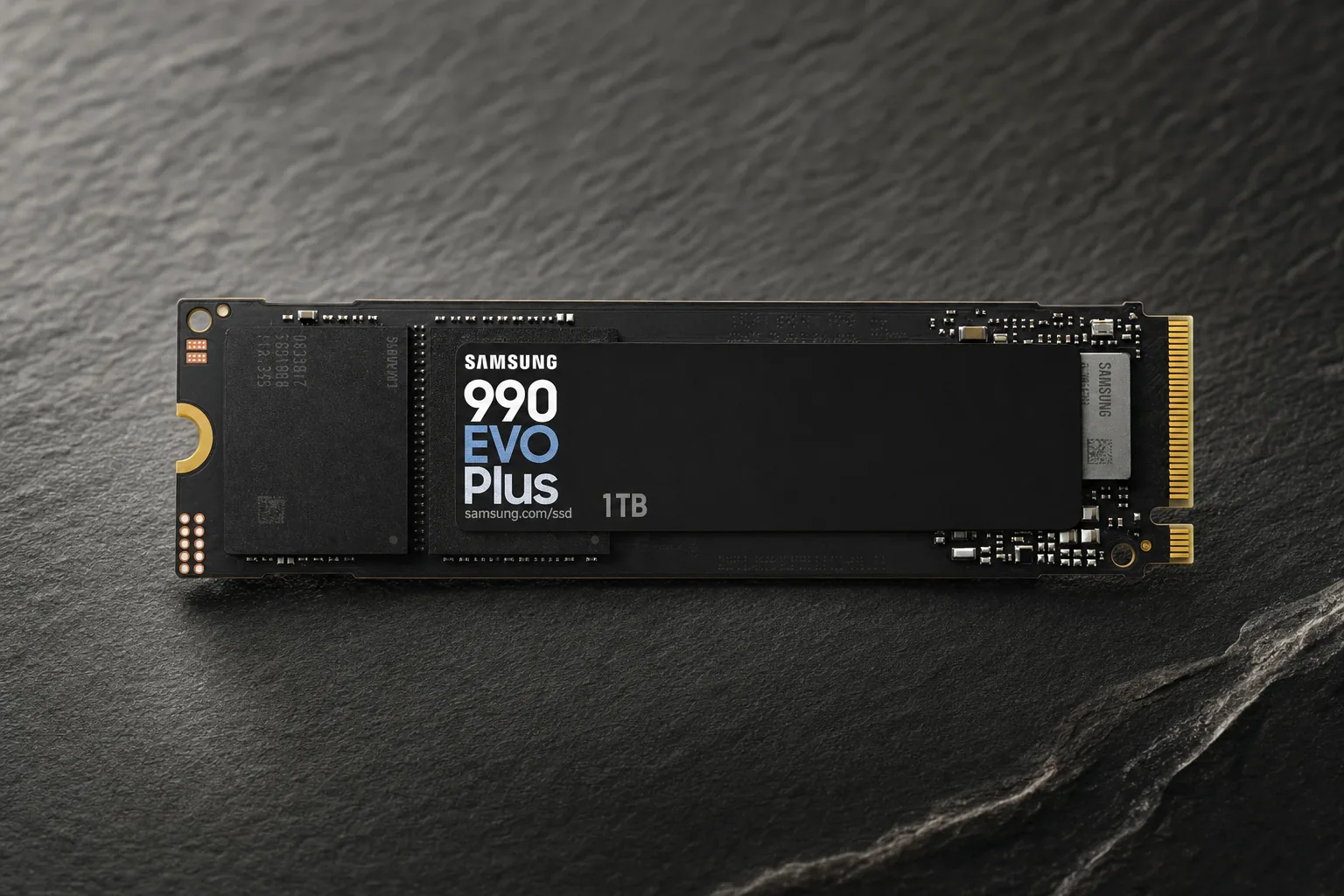
The 990 EVO Plus had an unusual interface arrangement: it could operate as PCIe 4.0 x4 or PCIe 5.0 x2. Samsung presented this as a flexibility feature, and that is the useful way to understand it. It could fit into newer platform designs that offered PCIe 5.0 connectivity without requiring Samsung to build a full PCIe 5.0 x4 drive.
PCIe 5.0 x2 did not turn this into a PCIe 5.0 flagship
Two PCIe 5.0 lanes provide broadly similar aggregate bandwidth to four PCIe 4.0 lanes. The 990 EVO Plus therefore remained a roughly 7GB/s-class SSD in either supported mode. Buyers should treat PCIe 5.0 x2 as socket and platform compatibility, not as an upgrade over a good PCIe 4.0 x4 rival.
That distinction matters because interface labels can make drives look farther apart than they are in ordinary use. A gaming PC with a PCIe 4.0 M.2 slot could already make full use of the 990 EVO Plus's quoted 7,150MB/s or 7,250MB/s read ceiling. Moving the same SSD into a compatible PCIe 5.0 x2 connection did not unlock the kind of performance associated with high-end PCIe 5.0 x4 storage.
HMB rather than dedicated DRAM
The drive borrowed a small amount of system memory through Host Memory Buffer. This reduced board complexity and contributed to its efficient design, but it was not equivalent to the dedicated DRAM found on performance-oriented drives such as the Samsung 990 Pro.
TLC flash, not QLC
Samsung used V-NAND TLC across the range. That mattered because TLC generally brings stronger endurance and better sustained-write prospects than capacity-led QLC drives, even though cache behaviour still affects long transfers.
Intelligent TurboWrite cache
TurboWrite supported high short-burst write speeds. According to Samsung's datasheet, the 6,300MB/s write rating applied only while a transfer remained within its specified cache conditions, not as a fixed figure for every long write.
Compact M.2 2280 board
The single-sided layout was useful for laptops and small-form-factor systems where rear-mounted components or an unusually thick SSD can create clearance problems.
Does the lack of dedicated DRAM matter? It depends on the task. For loading games, launching applications and general desktop use, an HMB-based TLC drive can still feel quick. The limitation becomes more relevant for low-queue-depth responsiveness, repeated demanding writes and workloads that keep a drive busy for a long time. Published commentary from PC Gamer and Tom's Hardware described the 990 EVO Plus's lower-queue-depth latency as middling rather than exceptional.
That is why shoppers should not simply compare the largest sequential read figure. A drive can quote 7GB/s yet differ in how it behaves once its cache fills, how it handles small random operations and how much power it uses in a laptop. The Samsung was designed around a balance of these factors, not around pursuing the highest possible benchmark result.
What Published Samsung 990 EVO Plus Results Showed
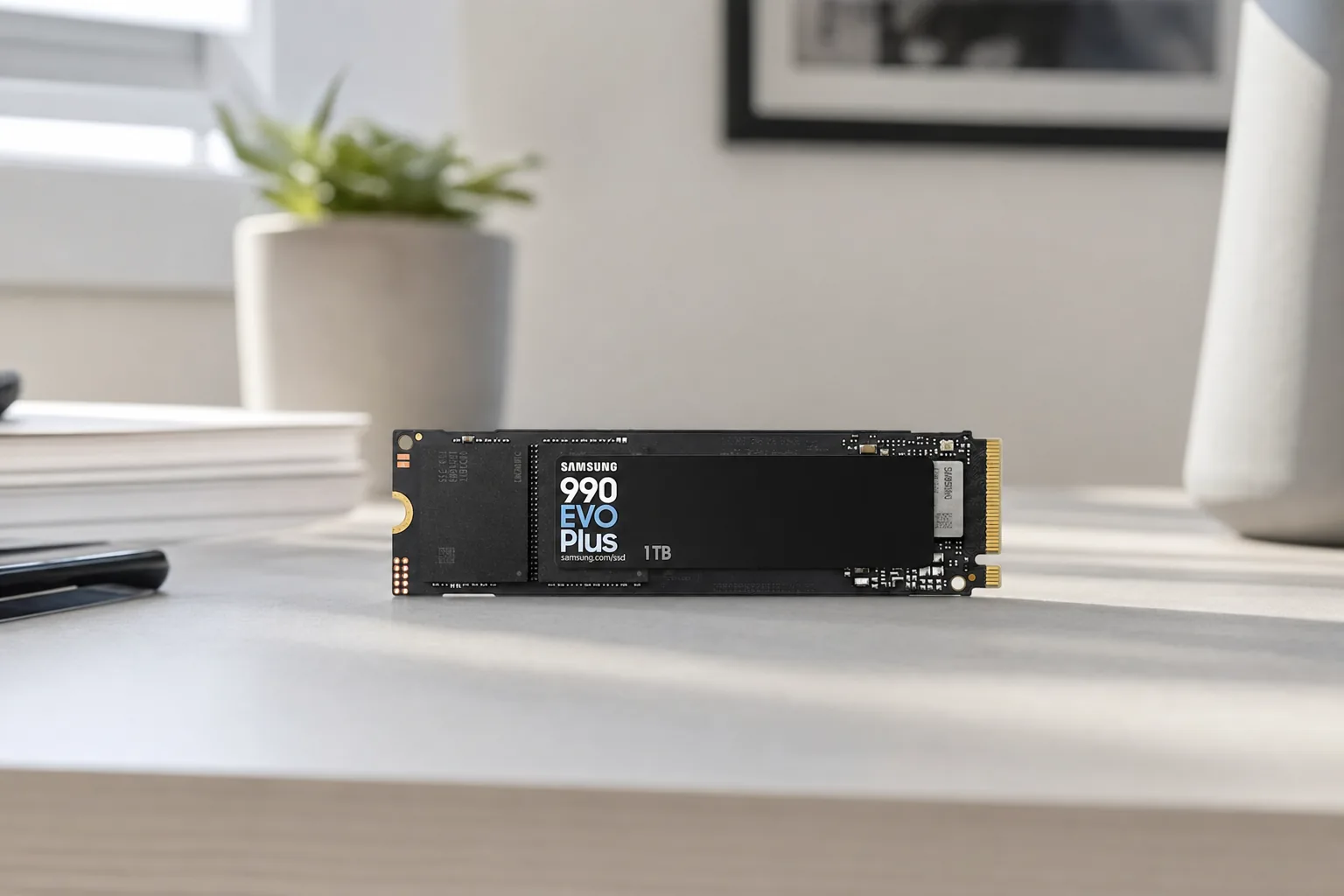
Samsung's own figures put the 1TB drive at up to 7,150MB/s sequential read and 6,300MB/s sequential write. The 2TB and 4TB versions rose slightly to up to 7,250MB/s read, whilst retaining the same 6,300MB/s write figure. Those numbers placed the range near the upper end of mainstream PCIe 4.0 sequential performance, but published results showed a more nuanced picture.
PC Gamer reported 7,150MB/s sequential read and 6,300MB/s sequential write from its 1TB sample, matching Samsung's quoted ceiling. It also reported a 59.0°C peak temperature. The publication praised Samsung's software and acceptable temperatures, whilst criticising value and less impressive 4K random performance against rivals.
StorageReview's figures for the 2TB model included 7.14GB/s sequential read and 5.76GB/s sequential write in CrystalDiskMark. Blackmagic DiskSpeed figures were 5.47GB/s read and 4.88GB/s write. Those results still represented quick consumer storage, but they also showed why the quoted 6,300MB/s write speed should be understood as a maximum under Samsung's stated TurboWrite conditions rather than a promise for every copy operation.
Long write behaviour is the principal qualification. Once the dynamic SLC cache is exhausted, the 990 EVO Plus can slow considerably. That is a common trait for DRAM-less TLC SSDs, but it is important if you regularly move multi-hundred-gigabyte video projects, disk images or large archives.
ComputerBase similarly found that synthetic write performance fell noticeably below Samsung's advertised ceiling and described practical reading and copying results as weaker than the specifications might suggest. This did not make the 990 EVO Plus unsuitable for its intended mainstream role. It did mean it was a less obvious choice for people whose routine work involves long, repeated sustained transfers.
Tom's Hardware found the 2TB model close to the Samsung 990 Pro in PCMark 10 storage performance, whilst noting that it did not consistently separate itself in CrystalDiskMark and that 4KB QD1 latency was middling. Its assessment described the drive as a strong general-purpose and laptop option, with initial pricing the central concern. That split between efficient everyday storage and less convincing price positioning remained relevant in September 2026.
Temperature reports varied considerably. KitGuru recorded 49°C during its ATTO workload. PC Gamer reported 59.0°C for the 1TB version. ComputerBase reported up to 70°C without a heatsink, and Forbes reported a 74°C peak from its 2TB sample. SSD temperature can change markedly with airflow, ambient conditions, workload duration, motherboard heatsinks, PCIe mode and the sensor used by the software.
The sensible conclusion is not that one number invalidates another. The evidence instead suggests an SSD that was generally more manageable thermally than many performance-led PCIe 4.0 and PCIe 5.0 drives, but not one that should automatically be installed without attention to cooling. A motherboard M.2 heatsink remains sensible for sustained desktop work, restricted-airflow cases and console installations.
Tom's Hardware examined the 2TB model's physical design and confirmed its single-sided construction. It also reported that the 4TB drive used two NAND packages while retaining that compact single-sided layout. For laptop upgrades, this detail can be more important than a small difference in headline throughput: a drive that physically fits under the original cover or thermal pad is much more useful than a faster option that does not.
Samsung 990 EVO Plus UK Price Reality Check
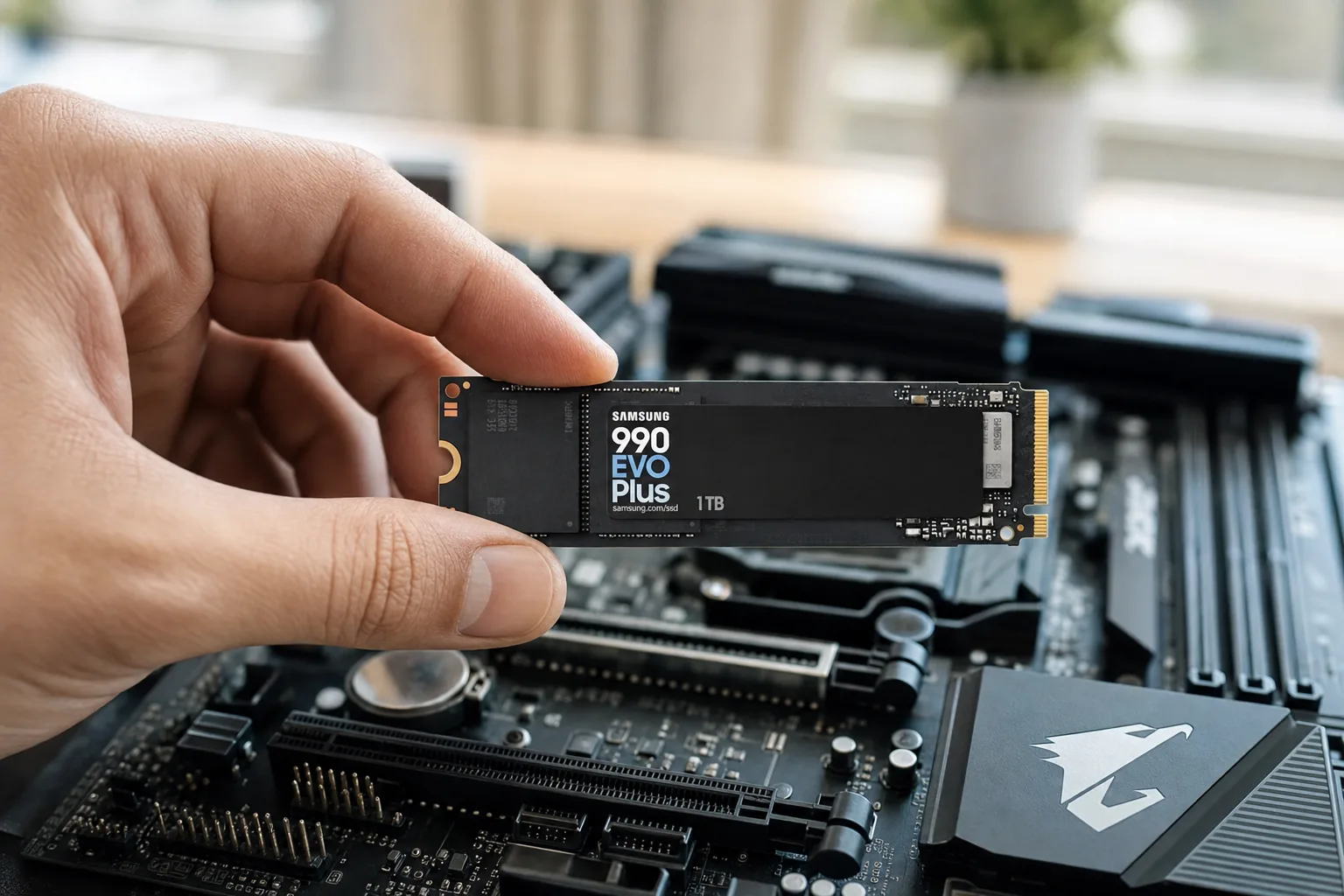
The 990 EVO Plus launched in the US at $109.99 for 1TB, $184.99 for 2TB and $344.99 for 4TB. At those launch figures, the 2TB option looked like the mainstream point in the range, offering useful capacity without the 4TB premium.
By September 2026, the market had changed. Samsung UK marked the 1TB model as "No longer available" on its direct product page. Third-party availability remained, but stock and pricing were inconsistent. Price-comparison listings observed on 10 and 11 September put the 1TB at £183.73, the 2TB at £247.99 and the 4TB at £459.99. These were retailer snapshots, not stable recommended prices.
Samsung 990 EVO Plus 1TB
Third-party listing; Samsung UK had marked this capacity no longer available directly.
Samsung 990 EVO Plus 2TB
The capacity that made the most sense for a typical gaming PC, subject to competitor pricing.
Samsung 990 EVO Plus 4TB
Large capacity and high endurance, but difficult to call value at this price level.
Those prices did not support the word "value" on their own. At roughly £248, the 2TB 990 EVO Plus needed a shopper to place meaningful value on Samsung's software, brand support, efficient design and compact construction. It was expensive beside PCIe 4.0 TLC competitors that could equal or surpass its specifications. At around £460, the 4TB model had a similar problem: capacity was useful, but the market offered other routes to high-capacity game storage.
The price threshold matters more than the label
The 990 EVO Plus was worth considering when it cost materially less than the Samsung 990 Pro and no more than comparable TLC alternatives. The observed September 2026 UK prices did not meet that simple value test. Historical 2025 promotions, when 1TB drives appeared around $59 to $75 and 4TB versions around $199 to $234, showed how much difference a genuine discount could make.
That does not mean every current listing was necessarily poor. Retail SSD pricing can vary sharply between retailers, capacities and short promotions. It does mean buyers should compare the exact model and capacity on the day, rather than assuming that Samsung's EVO name automatically signals a low-cost choice.
Samsung 990 EVO Plus Alternatives Worth Comparing
The 990 EVO Plus was not short of capable rivals. The most useful comparison is not simply "which drive has the biggest number", but whether an alternative offers better sustained performance, dedicated DRAM, a bundled heatsink or a lower price for the same capacity.
| Drive, 2TB model | Interface | Sequential read | Sequential write |
|---|---|---|---|
| Samsung 990 EVO Plus | PCIe 4.0 x4 / PCIe 5.0 x2 | Up to 7,250MB/s | Up to 6,300MB/s |
| Samsung 990 Pro | PCIe 4.0 x4 | Up to 7,450MB/s | Up to 6,900MB/s |
| WD Black SN850X | PCIe 4.0 x4 | Up to 7,300MB/s | Up to 6,600MB/s |
| Lexar NM790 | PCIe 4.0 x4 | Up to 7,400MB/s | Up to 6,500MB/s |
| Crucial T500 | PCIe 4.0 x4 | Up to 7,400MB/s | Up to 7,000MB/s |
Against the Samsung 990 Pro, the EVO Plus traded absolute performance and dedicated DRAM for lower rated active power, PCIe 5.0 x2 compatibility and a lower original price. If both drives cost nearly the same, the 990 Pro's 6,900MB/s write rating and higher random IOPS made it more persuasive for a cooled desktop system and heavier file work.
The WD Black SN850X offered similar quoted read speed at 7,300MB/s and a higher 6,600MB/s write figure. Its Game Mode 2.0 software and optional heatsink variants gave desktop gamers practical configuration choices. The Samsung countered with efficiency, Samsung Magician and a compact single-sided layout that made more sense in many laptops.
The Lexar NM790 was another DRAM-less PCIe 4.0 alternative, rated at 7,400MB/s read and 6,500MB/s write for 2TB. It could be the more rational option where it was significantly cheaper. Samsung's case rested on its more established support ecosystem, hardware encryption capabilities and the PCIe 5.0 x2 compatibility option rather than a headline speed win.
Crucial's T500 was rated at up to 7,400MB/s read and 7,000MB/s write. Forbes reported it slightly ahead of the 990 EVO Plus in gaming-storage comparisons. The Samsung still had a stronger argument for a compact system where lower power and a 4TB single-sided configuration mattered more than squeezing out a little extra throughput.
Samsung Magician, Encryption and Warranty
Samsung's software is one of the less glamorous reasons to choose the 990 EVO Plus, but it is a real one. Samsung Magician offered drive health monitoring, firmware updates, performance benchmarking, secure erase functions and general management tools. Several reviewers identified it as a tangible advantage over smaller SSD brands whose software support can be limited or inconsistent.
Samsung Magician
Drive monitoring, firmware maintenance, secure erase and performance tools were available across the range through Samsung's management software.
Hardware encryption support
AES 256-bit encryption, TCG/Opal 2.0 and IEEE1667 support added a useful layer for business users and security-conscious buyers.
Maintenance features
TRIM, S.M.A.R.T. reporting and automatic garbage collection were supported, helping the drive and operating system manage storage over time.
Five-year limited warranty
The warranty was tied to each capacity's endurance ceiling: 600TBW for 1TB, 1,200TBW for 2TB and 2,400TBW for 4TB.
These features do not make a slow drive fast, and they do not overcome poor pricing. They do make ownership easier for people who prefer a known support route and want to keep firmware current without relying on a motherboard utility or a less familiar SSD brand's tools.
The warranty and TLC NAND also made the range more reassuring than low-cost QLC options for people installing a drive as their main Windows disk. Samsung specified a 1.5 million-hour MTBF figure and a 0°C to 70°C operating range. No broad reliability issue affecting the family emerged from the reviewed sources, although that is not evidence that any individual SSD is immune to failure. Backups remain essential regardless of endurance rating or brand.
Who Samsung 990 EVO Plus Was Actually Built For
Laptop upgraders
The single-sided M.2 2280 design, 60mW typical idle figure in PS3/APST and modest active power made the 990 EVO Plus particularly well suited to compatible notebooks.
Mainstream gamers
The 2TB capacity was sensible for a Windows PC and substantial game library, provided its price did not exceed faster or better-equipped PCIe 4.0 alternatives.
Compact PC builders
Small systems benefit from a compact drive that does not require an integrated heatsink, though a motherboard heatsink still helps with extended heavy workloads.
The laptop case was especially strong. Samsung specified average active read power of 4.3W on 1TB and 4.6W on 2TB, alongside typical 60mW idle power and 5mW device-sleep power. ComputerBase highlighted idle efficiency as a particular strength, whilst Tom's Hardware described the SSD as a strong laptop option. No controlled whole-laptop battery-runtime comparison was available in the reviewed evidence, so it would be wrong to promise a specific battery-life gain. Still, low idle and active figures are relevant when selecting a notebook SSD.
For a PlayStation 5, Tom's Hardware concluded that the 990 EVO Plus had adequate performance for expansion storage. Its sequential read rating exceeded the commonly cited 5,500MB/s recommendation. The caveat is value: cheaper drives can produce much the same practical game-loading experience, and console buyers should account for the physical installation requirements and cooling arrangement of their chosen drive.
It was less well aligned with people who frequently work with very large source files, run sustained production workloads or simply want the strongest possible PCIe 4.0 figures. In those cases, a Samsung 990 Pro, Crucial T500 or another higher-performing rival can be worth paying for if the price difference is modest. The EVO Plus was a balanced mainstream drive, not an automatic substitute for a premium DRAM-equipped model.
Reasons to consider it
- TLC NAND and capacity-scaled endurance up to 2,400TBW.
- Single-sided M.2 2280 layout suited to many compatible laptops.
- Quoted sequential reads up to 7,250MB/s.
- Low idle power and restrained active power for its speed class.
- Samsung Magician, firmware support and hardware encryption features.
- PCIe 4.0 x4 and PCIe 5.0 x2 compatibility.
Reasons to shop around
- September 2026 UK pricing made it difficult to call a value purchase.
- HMB architecture did not match dedicated-DRAM rivals in every workload.
- Long writes can slow after the TurboWrite cache is exhausted.
- No heatsink was included.
- PCIe 5.0 x2 offered compatibility rather than a major speed advantage.
- Cheaper drives can deliver similar gaming results.
Samsung 990 EVO Plus Questions UK Buyers Were Asking
Samsung 990 EVO Plus first-look verdict
The Samsung 990 EVO Plus was a well-rounded TLC PCIe 4.0 SSD with a thoughtful laptop-friendly design, useful security features and Samsung's mature management software. Its dual PCIe mode was helpful for compatibility, but not a reason to expect full PCIe 5.0-class performance. For gaming, it was quick enough; for regular huge transfers, the TurboWrite cache and DRAM-less architecture were the important compromises.
In the UK, the decisive issue was price. At the retailer snapshots observed in September 2026, the 990 EVO Plus did not offer convincing value against the Crucial T500, Lexar NM790, WD Black SN850X or Samsung's own 990 Pro. We would consider the 2TB model when it was clearly cheaper than those alternatives, and the 4TB model only at a substantial discount. For a compatible laptop where compact construction, efficiency and Samsung Magician mattered, it remained easier to justify.
Sources
- Samsung Semiconductor, Samsung 990 EVO Plus product announcement and official datasheet.
- Samsung UK and Samsung US product listings, accessed for September 2026 availability context.
- Idealo UK price-comparison listings observed on 10–11 September 2026.
- Tom's Hardware, Samsung 990 EVO Plus review and PlayStation 5 storage assessment.
- PC Gamer, Samsung 990 EVO Plus 1TB review.
- StorageReview, Samsung 990 EVO Plus 2TB review.
- ComputerBase, KitGuru and Forbes coverage of the Samsung 990 EVO Plus.
- Samsung, WD, Lexar and Crucial official product specifications for compared models.
- Samsung 990 EVO Plus 1TBView on Amazon
Sources and evidence (17)
- news.samsung.com (other)
- download.semiconductor.samsung.com (other)
- semiconductor.samsung.com (other)
- samsung.com (other)
- idealo.co.uk (other)
- samsung.com (other)
- tomsguide.com (other)
- tomshardware.com (other)
- pcgamer.com (other)
- storagereview.com (other)
- computerbase.de (other)
- kitguru.net (other)
- forbes.com (other)
- tomshardware.com (other)
- samsung.com (other)
- documents.sandisk.com (other)
- americas.lexar.com (other)