
Anker Soundcore Boom 3 First Look: The Rugged Party Speaker Worth Half a JBL?
Soundcore's 140W outdoor speaker puts bass, RGB lighting, floatability and a wired input ahead of premium-brand polish. The price argument is persuasive, but the details matter.

If the goal is a loud speaker for a garden gathering, a poolside afternoon or a beach trip without moving into JBL Boombox money, the Soundcore Boom 2 Plus is the relevant model in Anker's current Boom range. It is not an official "Boom 3": Soundcore's range comprised the Boom 2, Boom 2 Plus and smaller Boom 3i. Of those three, the Boom 2 Plus is the one built around the same broad portable-party brief as JBL's Xtreme line.
Why "Half the Price of a JBL" Is the Whole Pitch
See Where the Soundcore Boom 2 Plus Fits on Amazon UK
Check price & availability on Amazon
See Anker Soundcore Boom 3 on Amazon UK
Check price & availability on Amazon
The Soundcore Boom 2 Plus launched in the US on 29 May 2024 after Anker announced it on 14 May 2024 as a flagship outdoor speaker for summer adventures. Its launch and standard US price was $249.99, whilst Soundcore's UK store listed it at £199.99 at the time of research on 25 September 2026. It remained listed and orderable in both territories.
That figure matters because Soundcore is not pitching the Boom 2 Plus as a tiny travel speaker. At 3.8kg, with a pair of woofers, a pair of tweeters, a handle and a shoulder strap, it is aimed at buyers who might otherwise consider the JBL Xtreme 4 or look towards larger JBL party products. The JBL Xtreme 4 was listed at roughly £299 on JBL's UK site and $309.95 on its US official sale page, against a $379.95 reference price. Soundcore was therefore significantly cheaper rather than consistently half-price when compared directly with that particular JBL model.
Naming clarification: there was no confirmed official Soundcore Boom 3. The £199.99 Boom 2 Plus is the larger 140W party-oriented speaker considered here. The Boom 3i is a smaller 50W IP68 adventure speaker with a different job: it is designed for backpack, beach and water use rather than direct competition with JBL's larger portable party models.
The "worth half a JBL" headline is more defensible as a value question than as a claim of like-for-like acoustic performance. A discounted Soundcore Boom 2 can fall much further below JBL Xtreme 4 pricing, but it is a smaller 80W product. The Boom 3i can be cheaper again, but is a mono 50W speaker. The Boom 2 Plus occupies the more interesting middle ground: it carries a lower official UK shelf price than the JBL Xtreme 4, has more claimed peak power and retains party staples including lighting, multi-speaker playback and a power-bank function.
The value claim needs a little context
The Boom 2 Plus is not half the official UK price of JBL Xtreme 4. It is roughly one-third cheaper at Soundcore's £199.99 direct price versus JBL's approximately £299 official UK price. It becomes a far bigger saving only when comparing smaller discounted Soundcore models with higher-priced JBL speakers, which is not an equal comparison for size or output.
Inside the Soundcore Boom 2 Plus: Drivers, Wattage and BassUp 2.0
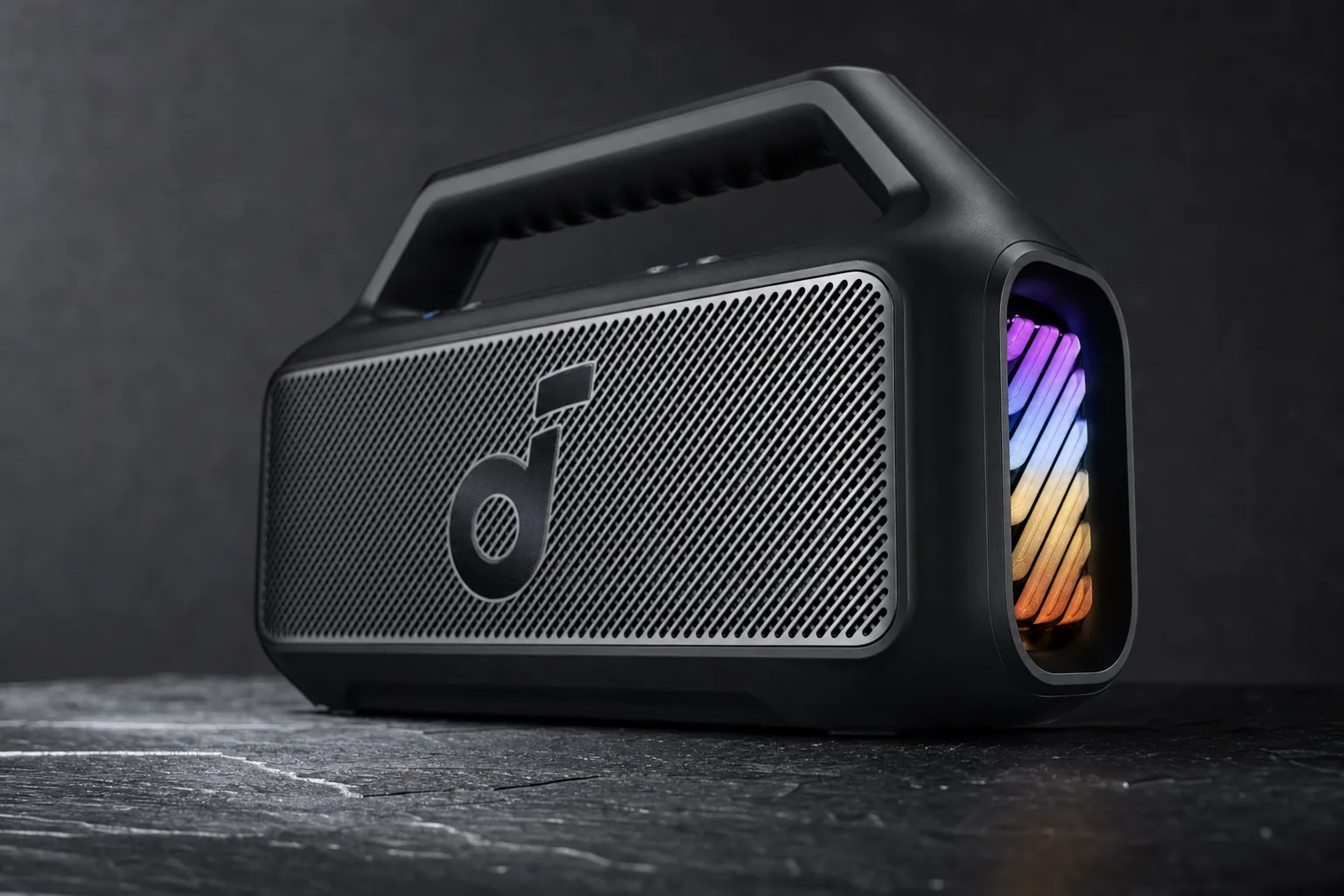
The Boom 2 Plus has a more substantial speaker arrangement than the smaller Boom 2. Soundcore specifies two 4.5-inch woofers and two 1-inch silk tweeters, configured as a 2+2 stereo system with an active crossover. This is important: used by itself, the Boom 2 Plus is designed to produce stereo playback rather than relying on a single mono driver firing from one side of a compact cabinet.
There is an important qualification around the headline wattage. The Boom 2 Plus is specified at 100W in its standard mode and up to 140W with BassUp 2.0 engaged. The latter is a boosted operating mode, not the speaker's baseline figure. BassUp is Soundcore's processing mode for increasing low-frequency impact, and it is likely to be attractive for electronic music, hip-hop and pop at an outdoor gathering where bass can dissipate quickly.
Soundcore documentation listed frequency response at 40Hz–20kHz. A 40Hz lower figure does not mean the Boom 2 Plus delivers the same depth, control or volume at that frequency as a separate subwoofer or a full-size mains party speaker; it is nevertheless a useful manufacturer specification when placed beside smaller portable designs. JBL listed the Xtreme 4 at 44Hz–20kHz, so on paper the two products sit in a similar claimed extension range.
The chart above compares manufacturer output specifications only. It should not be read as a loudness ranking. No robust independent maximum-SPL figure was located for the Boom 2 Plus, and wattage figures from different brands do not establish equal real-world volume, distortion or sound quality.
SoundGuys described the Boom 2 Plus as having strong low-end and good party impact, finding the Soundcore Signature preset the most useful starting point. Its reviewer reported that Voice, Treble Boost and Balanced presets reduced bass. That points to a speaker tuned around energy and low-frequency presence rather than studio-style neutrality. The 10-band EQ is therefore more than a decorative app feature: it is likely to be the route for owners who prefer clearer vocals or a less bass-weighted balance.
Built Like It Is Going in the Sea: Durability and the IPX7 Question
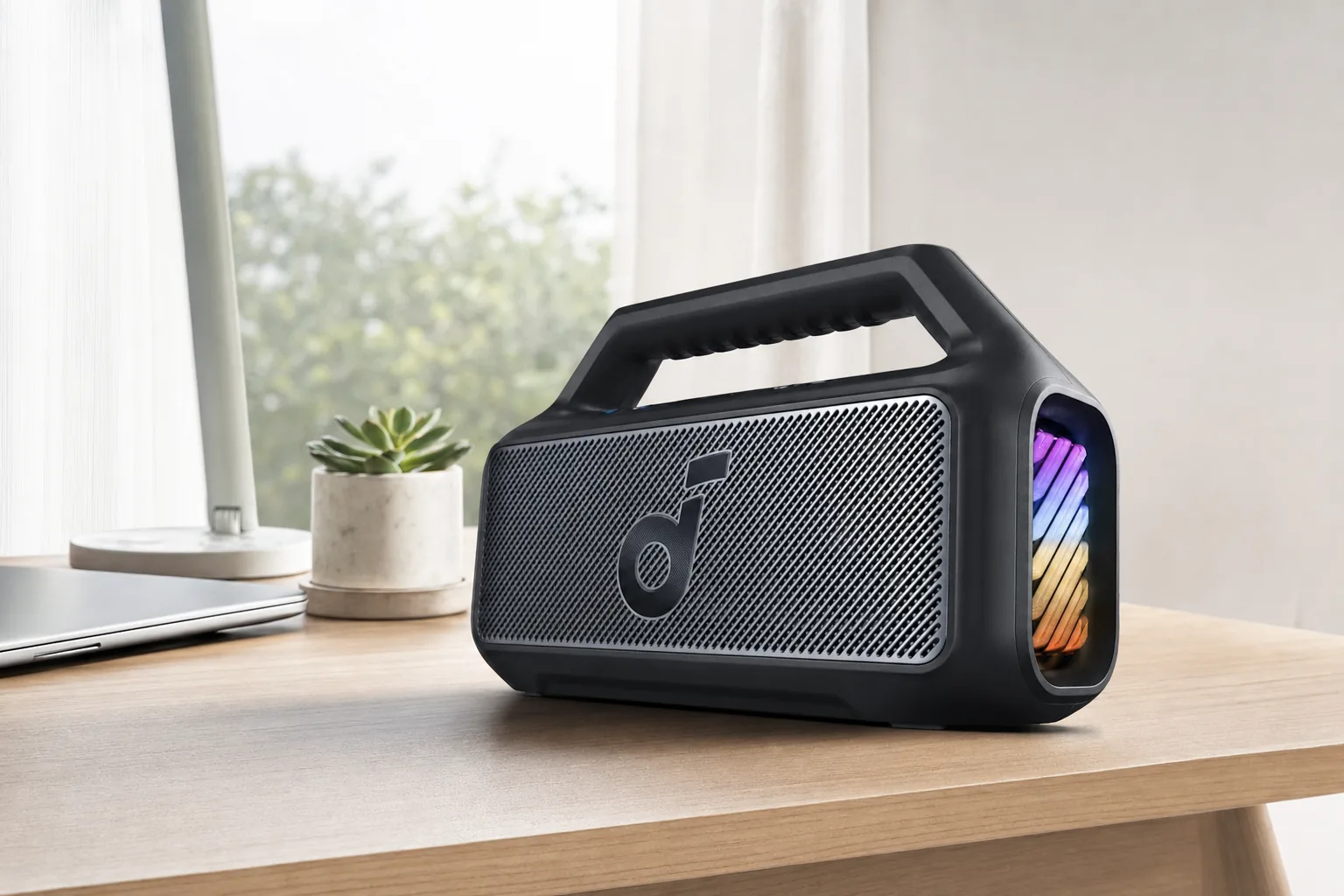
The Boom 2 Plus carries an IPX7 water-resistance rating and Soundcore says it floats. IPX7 means protection against temporary immersion in fresh water under the standard's defined conditions. For buyers, the practical upside is clear: rain, splashes, a wet pool surround and an accidental drop into calm water are less worrying than they would be with a conventional portable speaker.
The floating body is a particularly useful distinction. A speaker that survives immersion but sinks is still awkward at a pool or riverside gathering. Soundcore positions the Boom 2 Plus as floatable, so recovery should be simpler if it enters the water. It should not, however, be mistaken for the Boom 3i's more specialised upright-floating design. The Boom 3i was designed to keep its drivers facing upward during floating playback; that behaviour was not confirmed for the Boom 2 Plus.
The missing letter in that IP rating is consequential. There was no confirmed dust-ingress rating for the Boom 2 Plus, so it is not a fully dustproof outdoor speaker. This is one area where the JBL Xtreme 4 had a measurable practical edge, with an IP67 rating covering both dust and water protection. Sand, dry ground, campsite dust and festival-style use are therefore more straightforward on paper for JBL's product than on the Soundcore.
IPX7 is not IP67 or IP68. The Boom 2 Plus has confirmed water protection, but no confirmed dust rating. For a clean garden, patio, boat deck or pool area that may be an acceptable trade-off. For regular sandy beach use, the absence of a dust specification should be considered before buying.
At 442mm wide and 3.8kg, this is not a speaker to slide into a day bag. The integrated handle and detachable strap are sensible rather than optional flourishes. It remains portable in the sense that one person can take it to the park, beach or garden, but it is a deliberate item to carry rather than an everyday commuter speaker. SoundGuys identified that weight as the trade-off for the larger cabinet and extra low-end compared with smaller alternatives.
The Battery Numbers: 20 Hours Claimed, With Conditions Attached
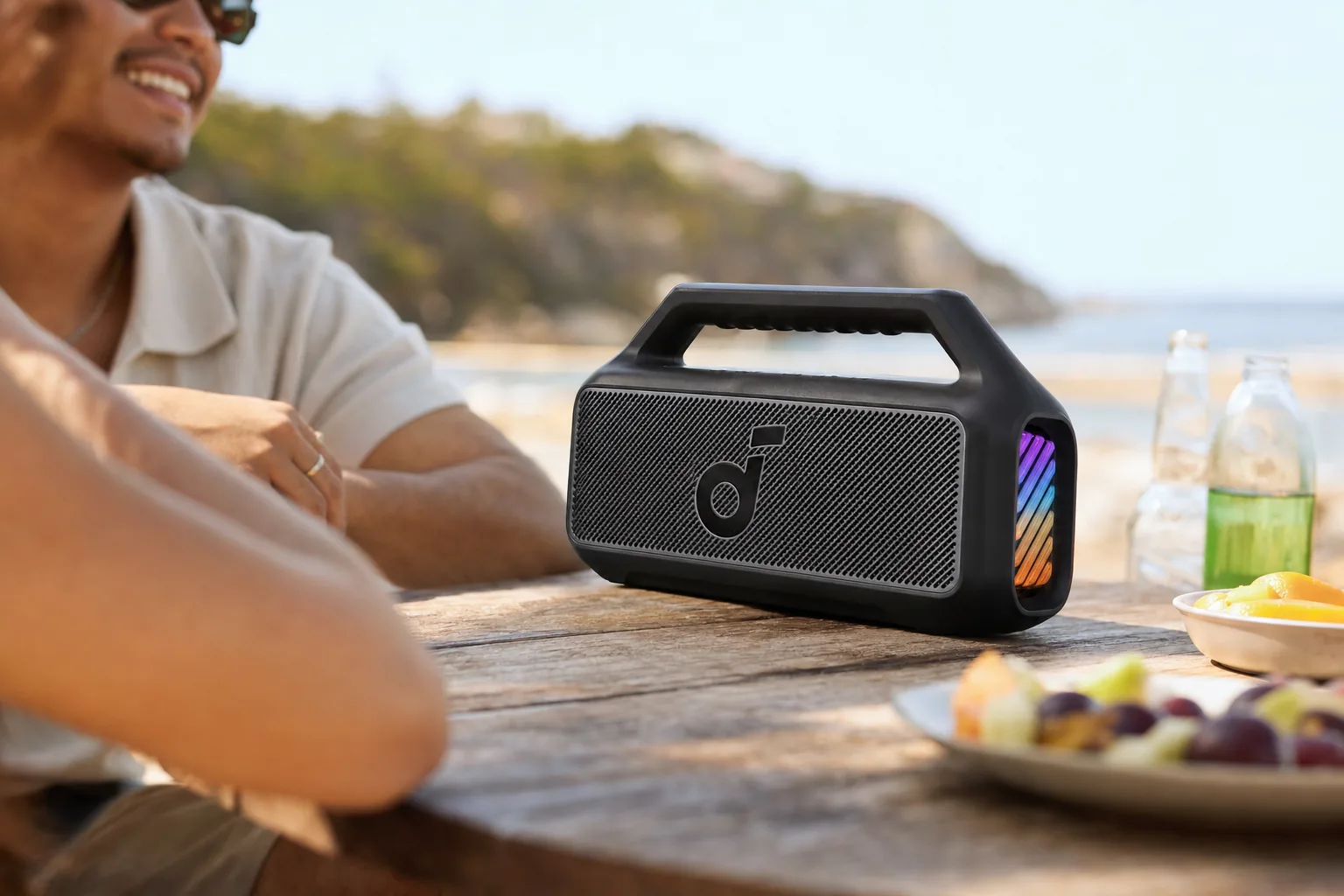
Soundcore claims up to 20 hours from the Boom 2 Plus. That result applies at 50% volume with BassUp and the lighting switched off. Those are normal conditions for a manufacturer endurance claim, but they are distant from the way many people will use a party speaker: louder volume, intermittent track changes, an active light show and bass enhancement can all draw more power.
The 7.3V/7,500mAh battery capacity reported by SoundGuys gives the claim some useful physical context, although capacity alone cannot predict runtime because output level, processing and lighting change power draw. A completed standardised independent runtime figure was not located for the Boom 2 Plus. That leaves Soundcore's 20-hour figure as the central reference point rather than a verified everyday-party result.
Charging is a stronger practical point. Soundcore specified approximately three hours when using a certified 30W charger. That is notably quicker than the approximately 5.5-hour charge time quoted for the smaller Boom 2. For someone using a speaker across consecutive days of a camping trip, festival weekend or holiday, getting back to a full charge in about three hours can be more useful than an optimistic all-day endurance estimate.
Read the runtime claim as a ceiling, not a party guarantee
Twenty hours is Soundcore's controlled claim with lighting and BassUp disabled at half volume. It is useful for comparing the manufacturer's own products, but it does not tell buyers how long the Boom 2 Plus will last at a louder garden party with the RGB effects running. That scenario had not been independently quantified in the available evidence.
The speaker can also supply 10W power to another device. It is not a fast-charging substitute for a dedicated USB-C power bank, but it could be useful for keeping a phone alive during a long outdoor session. This is a more valuable inclusion on a party speaker than it first sounds: Bluetooth playback, lighting control and guests' music requests all become less convenient when the phone managing the queue is nearly flat.
Party Tricks: Lighting, Pairing and the Soundcore App
The Boom 2 Plus has RGB lighting integrated into its passive radiators. SoundGuys reported eight light-effect variations, giving the enclosure visible movement and colour rather than simply a small status LED. Some buyers will turn the effects off to preserve battery life; others will see them as part of the reason for buying a party speaker rather than a plain Bluetooth box.
Eight reported light effects
The passive-radiator lighting can be adjusted through the Soundcore app, with SoundGuys reporting eight available effect variations.
TWS stereo pairing
Two identical Boom 2 Plus speakers can be paired for left-and-right stereo playback, useful for a wider outdoor listening area.
PartyCast 2.0
Soundcore stated support for more than 100 compatible speakers in a larger PartyCast 2.0 arrangement.
10-band equaliser
The app includes four presets and a 10-band custom EQ, allowing more control over the bass-heavy default tuning.
Auto-shutdown controls
The companion app also manages lighting, firmware updates and auto-shutdown behaviour.
Firmware support
Firmware updates are delivered through the Soundcore app, which can matter if feature behaviour or compatibility changes over time.
TWS pairing and PartyCast solve different problems. TWS is the more useful choice for a buyer who wants a proper stereo pair: one Boom 2 Plus handles the left channel and the other handles the right. PartyCast 2.0 is aimed at coverage, allowing more than 100 compatible Soundcore speakers to play together. That may suit a large garden or a multi-room social event, but it is not the same as a carefully positioned stereo system.
| Feature | Soundcore Boom 2 Plus | Soundcore Boom 2 | JBL Xtreme 4 |
|---|---|---|---|
| Official UK price found | £199.99 | £119.99 | Approximately £299 |
| Output specification | 100W standard; up to 140W with BassUp | 60W standard; up to 80W with BassUp | 100W AC / 70W battery |
| Driver arrangement | 2 woofers + 2 tweeters | 1 subwoofer + 2 tweeters | 2 woofers + 2 tweeters |
| Claimed battery life | Up to 20 hours | Up to 24 hours | 24 hours, plus up to 6 hours Playtime Boost |
| Water and dust rating | IPX7 | IPX7 | IP67 |
| Floatable | Confirmed | Confirmed | Not confirmed |
| 3.5mm AUX input | Supported | Not supported | Not supported |
| Power-bank function | Supported, 10W charge-out | Supported | Supported |
| Weight | 3.8kg | 1.7kg | 2.1kg |
For buyers who already own Soundcore equipment, PartyCast 2.0 is a meaningful reason to stay within the brand. For buyers starting from scratch, the more relevant question is simpler: does one large speaker provide enough coverage? In many gardens and small outdoor gatherings, the answer is likely yes. A second unit makes more sense where people are spread across a wider space or where stereo positioning matters more than sheer volume.
Connectivity for the Cautious: AUX, Ports and Trade-Offs
The Boom 2 Plus is the version to choose if a wired fallback matters. It has a 3.5mm AUX input, whilst the smaller Boom 2 and Boom 3i do not. That can be useful at an outdoor event where Bluetooth pairing becomes unreliable, where a laptop is providing music, or where a DJ controller and analogue source are part of the setup.
Alongside the AUX input, there is USB-C charging and USB charge-out for devices. Soundcore specified 10W device charging. Bluetooth 5.3 is supported, with SBC and AAC codecs confirmed. AAC is useful for Apple devices, although there was no confirmed support for higher-bitrate aptX variants. For a speaker focused on outdoor party playback rather than close critical listening, that is a reasonable compromise, but it is still a limitation buyers with Android devices and high-quality local music libraries may notice.
Why AUX still matters: the Boom 2 Plus can accept a wired source when Bluetooth is inconvenient. This is one of its practical advantages over both Soundcore Boom 2 and JBL Xtreme 4, neither of which had a confirmed 3.5mm AUX input in the research.
Soundcore's current product materials did not establish Auracast support for the Boom 2 Plus. That contrasts with JBL Xtreme 4, which supported Auracast. Buyers planning a future multi-speaker system built around Bluetooth broadcast standards should treat that difference as relevant. PartyCast 2.0 may be sufficient inside the Soundcore ecosystem, but it is a separate platform from JBL's Auracast approach.
Pricing Reality Check: What the UK Package Actually Offers
At £199.99 directly from Soundcore UK, the Boom 2 Plus sat above the smaller Boom 2 but below JBL Xtreme 4's approximately £299 official pricing. It was still current and orderable from Soundcore's UK and US stores, offered in Phantom Black, Explorer Blue and Adventure Green.
Soundcore Boom 2
80W maximum output, 24-hour claim, IPX7 body and power-bank output. Third-party tracking had shown lower marketplace pricing.
Soundcore Boom 2 Plus
140W maximum BassUp output, stereo driver layout, AUX input, 10W charge-out and a larger 3.8kg cabinet.
JBL Xtreme 4
IP67 protection, 24-hour claim, replaceable battery and Auracast support, with a lower weight of 2.1kg.
The Soundcore does not simply undercut JBL by deleting all useful extras. Its feature list includes the wired input JBL omits, a 10-band equaliser, lighting control, a detachable strap and a floating design. The more substantial compromises are environmental protection and weight. JBL's IP67 rating is more reassuring around dust and sand, whilst its 2.1kg weight makes it far easier to carry over distance.
The choice therefore comes down to where the speaker will spend most of its life. A Boom 2 Plus makes sense as a garden, patio, car-boot, campsite or poolside speaker where the extra 1.7kg versus Xtreme 4 is not a major burden. For long walks to a beach, frequent travel or rough dry terrain, the lighter JBL and its dust protection have a clearer practical argument despite the higher price.
Where the Soundcore Boom 2 Plus Fits
Garden and patio hosts
The 2+2 stereo layout, 140W BassUp ceiling, RGB lighting and 10W phone charging make sense where the speaker can stay close to a mains point and does not need to travel far.
Poolside and waterside groups
IPX7 protection and a floating body are useful for splash-prone locations. Take care around sand and dry dust because no dust rating was confirmed.
Buyers wanting a wired fallback
The 3.5mm AUX input is a specific advantage for laptops, analogue equipment and events where Bluetooth is not the only source.
Not aimed at long-distance carrying
At 3.8kg, this is not the natural choice for cycling, hiking or travelling light. Soundcore's 50W Boom 3i is the more compact model for those uses.
The Boom 2 Plus also looks sensible for buyers who prefer a more energetic, bass-forward sound. SoundGuys' assessment suggested that the stock Soundcore Signature preset retained the strongest balance of impact, whilst other presets reduced bass. That character can work well in open spaces, where low-frequency energy disappears more quickly than it does in a lounge.
It is less suited to somebody seeking neutral sound at low volume, pocketable portability or maximum resilience in dusty conditions. It is also not an obvious replacement for a proper PA speaker at a large event. The 140W figure is a useful indication of the product class, but no independent maximum loudness measurement was located, so it would be unwise to assume it can cover every open-air situation equally well.
Reasons to consider it
- 100W standard output, rising to 140W with BassUp 2.0 engaged.
- Two woofers and two tweeters in a stereo 2+2 arrangement.
- IPX7 water protection and a floatable body.
- 3.5mm AUX input, USB-C charging and 10W device charge-out.
- Approximately three-hour charging with a certified 30W charger.
- 10-band app EQ, RGB controls, TWS stereo pairing and PartyCast 2.0.
Reasons to pause
- 3.8kg weight makes it a carry-with-intent speaker rather than a bag speaker.
- No confirmed dust rating, unlike the IP67 JBL Xtreme 4.
- 20-hour endurance claim assumes 50% volume with lights and BassUp switched off.
- Sound is reported as bass-forward rather than neutral.
- No robust independent loudness result was available.
- Auracast support was not confirmed for this model.
Open Questions Before a Final Buying Recommendation
The central unresolved issue is battery life at actual party volume. Soundcore's 20-hour claim is clearly stated, but it comes with conditions that deliberately minimise demand: 50% volume, BassUp disabled and lights disabled. That is useful information, but it is not a substitute for a figure from a louder session with the features buyers may have selected precisely because this is a party speaker.
There is also no robust independent maximum-SPL measurement in the available research, nor a direct controlled comparison with JBL Xtreme 4. The Boom 2 Plus had a larger claimed maximum power rating, but that alone cannot tell a buyer whether it becomes louder, cleaner or more spacious than JBL's speaker. The "worth half a JBL" framing remains strongest as an affordability and features argument, not a confirmed sound-quality verdict.
Finally, buyers should distinguish between the Soundcore ecosystem features that are confirmed and wider Bluetooth broadcast compatibility. TWS pairing for two Boom 2 Plus speakers and PartyCast 2.0 compatibility were confirmed. Auracast was not. If future expansion across different brands is part of the purchase plan, JBL's confirmed Auracast support is a relevant reason to consider paying more.
Sources
- Soundcore Boom 2 Plus official product page and FAQ: output, driver configuration, connectivity, charging, battery claim, app functions and availability.
- Soundcore / Anker announcement dated 14 May 2024: Boom 2 Plus announcement, launch timing, PartyCast 2.0 support and launch pricing.
- SoundGuys, Soundcore Boom 2 Plus review: dimensions, weight, battery capacity, lighting details, app functions and externally attributed sound assessment.
- Soundcore Boom 2 and Boom 3i official pages and SoundGuys coverage: range naming and model-positioning context.
- JBL Xtreme 4 official product page: price references, weight, IP67 rating, battery information, driver configuration, frequency response, replaceable battery and Auracast support.
Sources and evidence (17)
- soundcore.com (other)
- soundguys.com (other)
- soundcore.com (other)
- soundcore.com (other)
- soundcore.com (other)
- anker-in.com (other)
- service.soundcore.com (other)
- fullspecs.net (other)
- soundguys.com (other)
- soundcore.com (other)
- anker-in.com (other)
- soundcore.com (other)
- salesforce-knowledge-download.s3.us-west-2.amazonaws.com (other)
- service.soundcore.com (other)
- soundguys.com (other)
- soundcore.com (other)
- jbl.com (other)