
Bose SoundLink Plus First Look: is this the premium portable to beat?
Bose's mid-sized outdoor speaker promises a full day of music in a floating, IP67 shell. We weigh the independent lab data and reviewer verdicts against that premium price tag.
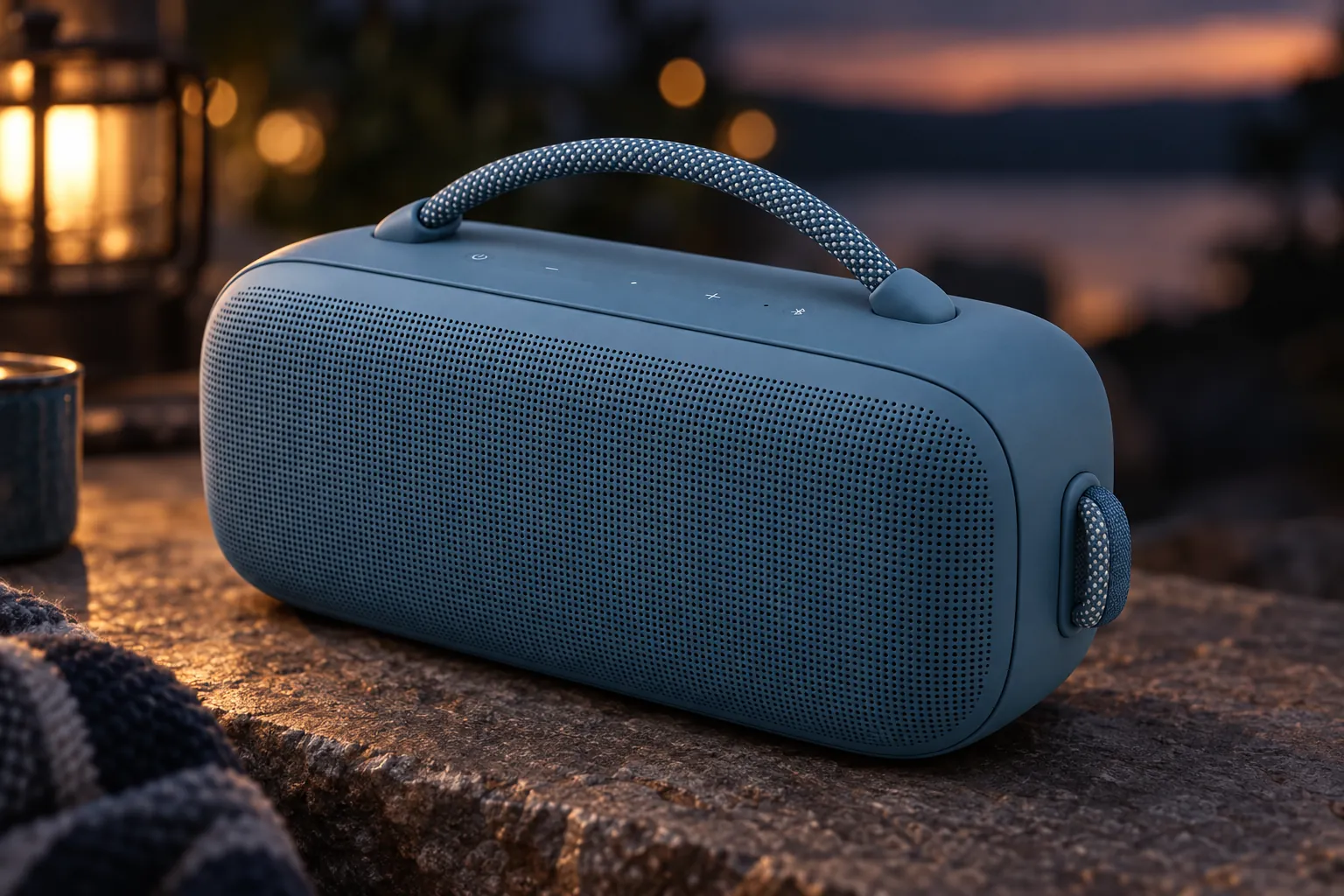


Independently measured at 19 to 21 hours, with a floating IP67 build and full, punchy sound; most compelling when discounted.
Check price on AmazonWe link to the exact model on Amazon UK. Prices change often, so check the live price before you buy. As an Amazon Associate we earn from qualifying purchases.
It's mid-afternoon in the garden, the barbecue is finally behaving, and the little speaker you bought a few summers ago has just flashed its low-battery warning for the third time. You want something that lasts until the last guest goes home, survives a knock into the paddling pool and sounds like more than a tinny phone. Bose's SoundLink Plus is pitched precisely at that moment, but at around £250 it needs to earn its place in your basket.
The short answer
Buy the Bose SoundLink Plus if all-day battery life, a rugged floating body and a warm, punchy sound matter more to you than features. Independent labs measured roughly 19 to 21 hours of playback, which is genuinely impressive for a speaker you can sling over one shoulder.
The catch is value. One unit plays in mono, there's no microphone or aux input, recharging takes about five hours, and reviewers found cheaper rivals offer more features. At the full £249.95 RRP it's a considered splurge; on a discount it becomes a far easier recommendation.
At a glance: the confirmed numbers
| Specification | Bose SoundLink Plus |
|---|---|
| UK launch RRP | £249.95 |
| On sale (UK) | 26 June 2025 |
| Drivers | 1 subwoofer/mid-bass driver, 1 tweeter, 4 passive radiators |
| Playback | Mono (stereo with two paired SoundLink Plus speakers) |
| Claimed battery | Up to 20 hours at 65% volume |
| Measured battery | 20h 55m (SoundGuys, 80dB SPL); 19.1 hours (RTINGS) |
| Charging | USB-C, up to 5 hours with a 15W supply (adaptor not included) |
| Power output | USB-C, up to 15W (5V/3A) for phones and tablets |
| Protection | IP67, floats, shock- and rust-resistant |
| Bluetooth | 5.4, SBC, AAC, aptX Adaptive (Snapdragon Sound), multipoint |
| Weight | 1.53kg (Bose specification); 1.45kg (Expert Reviews) |
| Microphone / aux / Wi-Fi | None |
Bose SoundLink Plus: What Exactly Is It? Positioning, Launch Details and UK Pricing
First, a bit of clarity, because Bose's naming can make this look like a sequel. It isn't. The SoundLink Plus was an entirely new model when it arrived in 2025, not a follow-up to some earlier SoundLink Plus, and Bose doesn't label it "1st Gen". It launched alongside the SoundLink Micro (2nd Gen), according to Bose's UK press release.
Check today's price: Bose SoundLink Plus on Amazon UK
Bose announced it in the UK on 12 June 2025, and it went on sale on 26 June 2025 at an RRP of £249.95. That was well over a year ago, so this is now a settled, widely reviewed product rather than a fresh unknown. RTINGS, SoundGuys, WIRED, What Hi-Fi?, Expert Reviews and TechRadar have all published verdicts, and RTINGS refreshed its review as recently as August 2026.
There's one size and one hardware configuration. The Amazon UK listing covered here is the Black colourway; at launch Bose also offered Blue Dusk and a limited-edition Citrus Yellow, then added a limited-edition Sunset Peach, which was available in the UK by April 2026. Colour is the only difference: same drivers, same battery, same features.
On price, think of £249.95 as the ceiling rather than what you must pay. Bose's own UK store's pricing varies by colourway: the Citrus Yellow page has listed it at £199.95, while other colour pages have shown the full £249.95. Promotions at Amazon and Argos have previously brought it down to around £199 too. Across the Atlantic, Bose itself cut the US price from $269 to $179, a sign of how promotional this corner of the market is. Check the current figure for your chosen colour before you commit.
Where it sits in Bose's range: the Plus slots between the smaller SoundLink Flex (2nd Gen) and the larger SoundLink Max. We mention those two purely for context. RTINGS notes the Max plays stereo content without downmixing and goes louder with less compression, but it's bigger and, per Bose's US comparison data, about 4.7lb against the Plus's roughly 3.3lb. The Plus is the one designed to be carried rather than placed.
Inside the Enclosure: Drivers, Materials and Why Bose Won't Talk Wattage
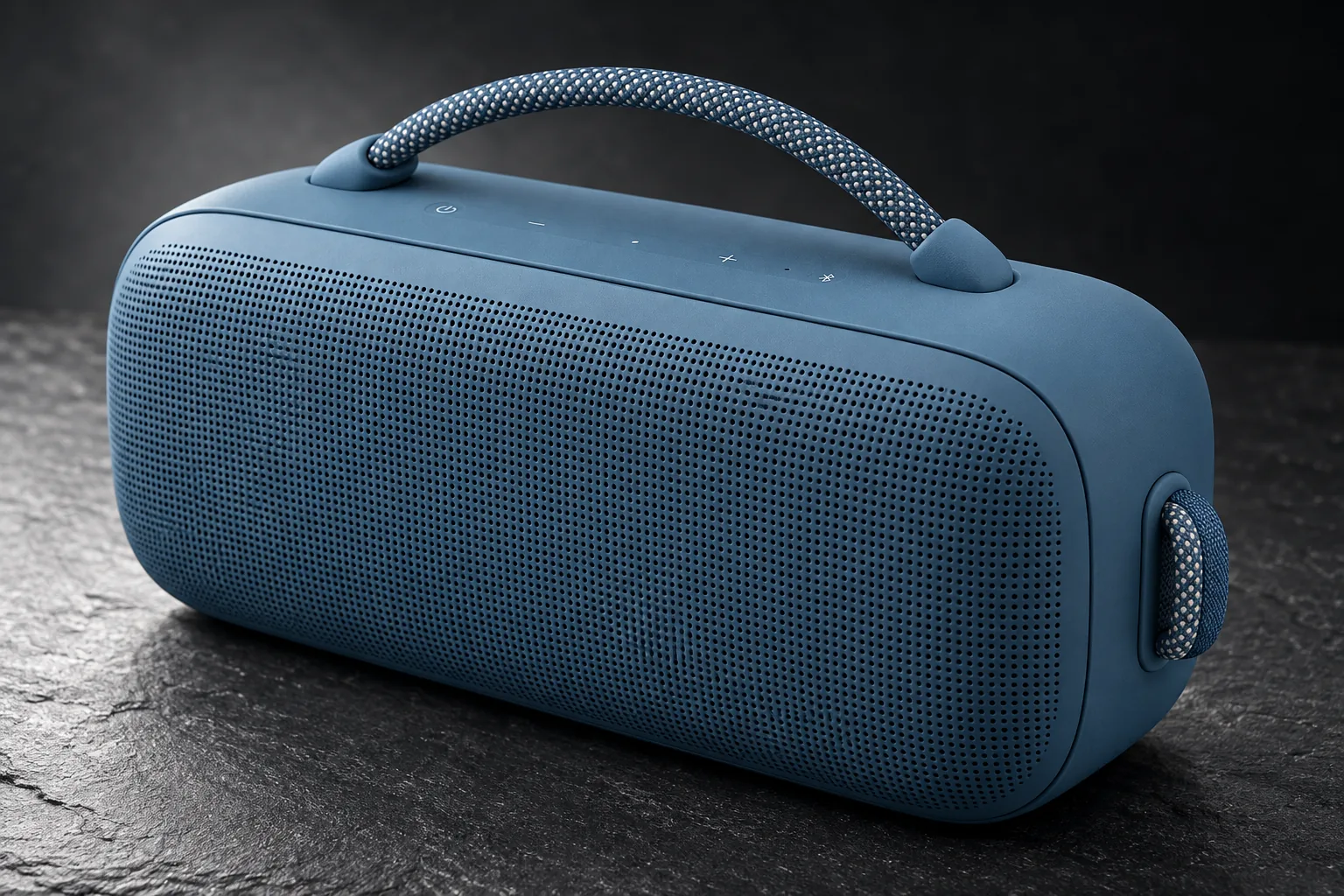
Pop the grille off in your imagination and you'd find a fairly busy little box. Bose uses one subwoofer/mid-bass driver, one tweeter and four passive radiators. That last number is the interesting one: four radiators is an unusually generous allocation for something this size, and it goes a long way towards explaining the weighty, bass-forward character reviewers keep describing.
Passive radiators are unpowered diaphragms that move in sympathy with the air pressure inside the box, helping a small enclosure produce low-end it otherwise couldn't. More of them generally means more bass reach without a bigger cabinet, which is exactly the trick Bose is pulling here.
Subwoofer/mid-bass driver plus tweeter
A two-way active layout: one driver handles the low and middle frequencies, a dedicated tweeter looks after treble. WIRED singled out the upper-midrange and treble detail on vocals, acoustic guitar and woodwinds.
Four passive radiators
The bass engine. Expert Reviews described convincing low-end weight; What Hi-Fi? called the bass powerful.
Powder-coated steel grille
Protects the drivers and gives the front a solid, premium finish. WIRED, What Hi-Fi? and Expert Reviews all praised the construction.
Soft-touch silicone exterior
Wraps a polycarbonate body, giving grip and some shock absorption for outdoor knocks.
Fixed nylon utility loop
A permanent carry rope for hanging from a branch, tent hook or backpack strap. SoundGuys and other reviewers liked it for beach and garden use.
Replaceable battery
WIRED and Expert Reviews highlighted that Bose can replace the internal battery, which matters if you plan to keep this speaker for years.
What Bose won't tell you is just as revealing. There's no driver diameter, no amplifier wattage and no frequency-response range in its specifications. TechRadar specifically called out the missing frequency-response and amplifier-power figures in its review.
How to judge a speaker with no wattage figure
Wattage on a portable speaker is rarely a reliable guide to how loud or good it sounds anyway, because driver efficiency, enclosure design and processing all matter more. With the Plus, lean on reviewer descriptions instead: What Hi-Fi? found it plays impressively loudly for its size, RTINGS called it reasonably loud for its size but noted compression at maximum volume, and both pointed to larger rivals for sheer volume. That tells you more than any number on a box would.
Toughness Audit: IP67, Floatation and Whether It Can Actually Live Outdoors
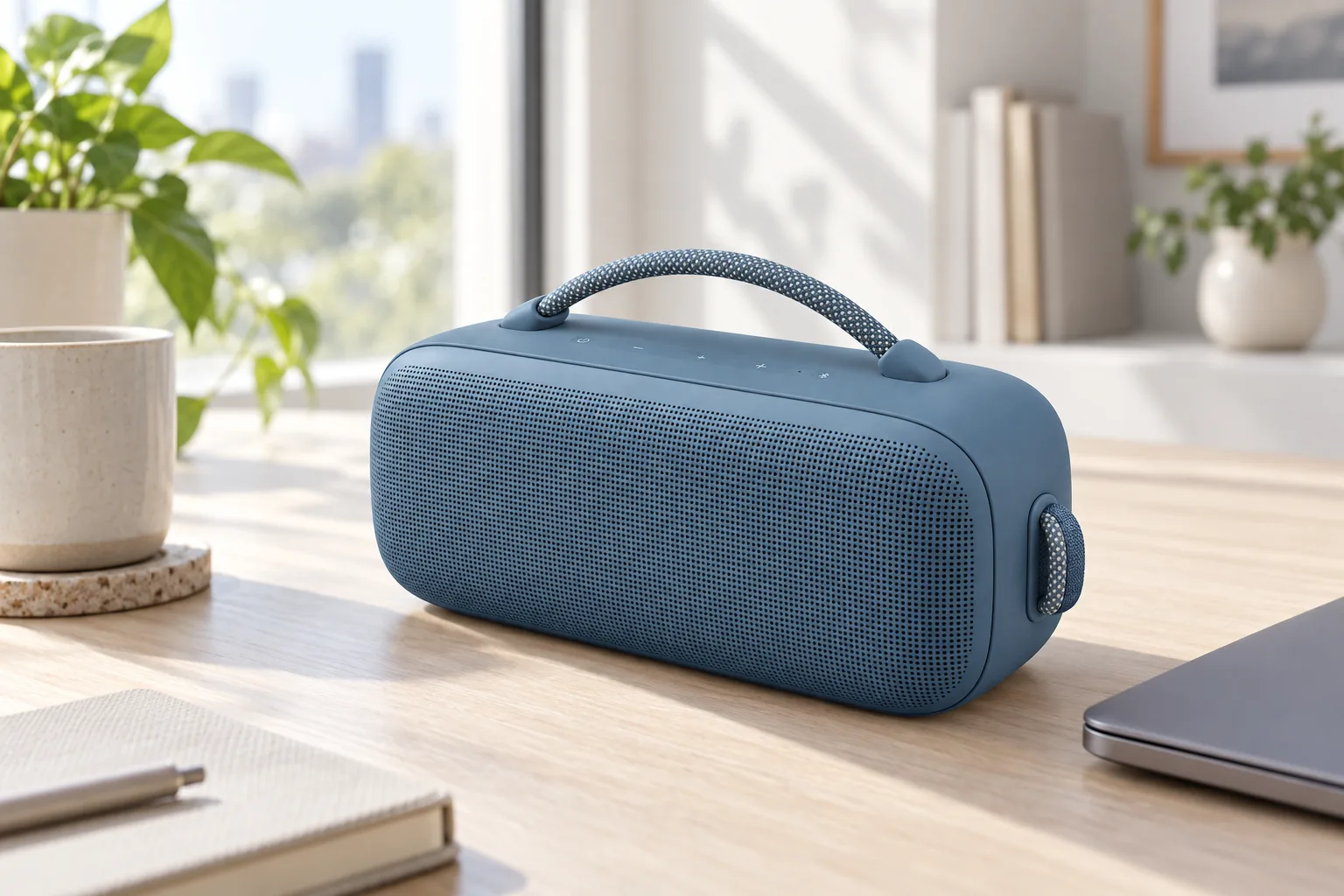
This is where the Plus starts to make a case for its price. It carries an IP67 rating, meaning it's sealed against dust and rated to survive immersion. In Bose's terms, that's up to roughly 1m of water for up to 30 minutes. And if it goes over the side of a paddleboard or into the lake, it floats.
What Hi-Fi? dunked its review sample in a sink and reported no ill effects, which is reassuring for anyone who's watched a cheaper speaker give up after one wet afternoon. Reviewers broadly agreed the Plus feels like a credible outdoor product: the steel grille, grippy silicone and fixed carry loop all point to something built for gardens, campsites and beaches rather than a mantelpiece.
For context, SoundGuys' comparison lists the JBL Charge 6 with an IP68 rating, which is technically a step above IP67. In practice, both are well beyond splash-proof. The Plus's floating design is the more practical party trick if you're near open water.
Two caveats Bose spells out: the speaker isn't designed to be played whilst it's in the water, so treat floating as a rescue feature, not a pool-party mode. And the USB-C port must be completely dry before you plug in a charger. After a swim or a rainy evening, give it time to dry out properly before topping it up, especially given the slow recharge discussed below.
The 20-Hour Promise: What Bose Claims vs What Independent Labs Measured
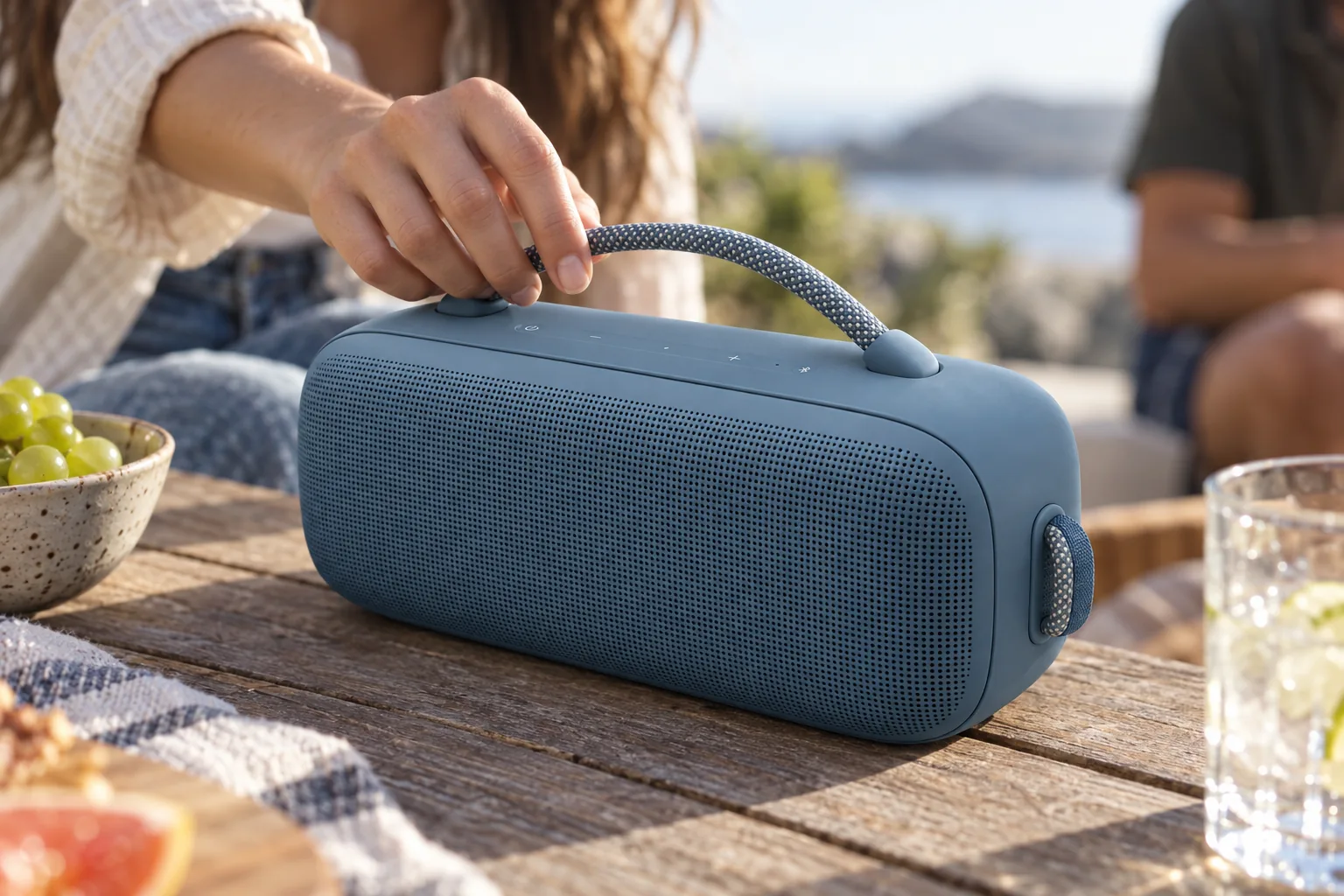
Battery claims on portable speakers are often optimistic. Bose's "up to 20 hours" claim for the SoundLink Plus holds up unusually well, and this is the single strongest argument for buying one.
Bose's figure is based on fairly specific conditions, so it's worth knowing what they are before comparing:
Now the independent results. SoundGuys ran the speaker at a steady 80dB SPL and recorded 20 hours 55 minutes, comfortably beating the claim. RTINGS logged 19.1 hours on its own test, which it described as almost 20 hours. Two different labs, two different methods, both landing within a whisker of Bose's number.
Runtime figures from SoundGuys, RTINGS and Bose documentation. Bars scaled to a 22-hour maximum.
Translate that into real life and you're looking at a long weekend camping at sensible volume, or a full day of garden listening with plenty left over. SoundGuys considered that endurance a highlight, and it's better supported by independent data than many speaker battery claims.
The volume reality check
The 20-hour headline only applies at moderate levels. Crank it to the top and endurance falls off a cliff. Bose's documentation is slightly inconsistent here: the original owner's manual quotes up to four hours at maximum volume, whilst Bose's current support page says up to three. Expert Reviews found loud listening cut runtime to under five hours. Plan on a short evening, not a full day, if you're driving it hard. Using the speaker to charge your phone will also eat into playback time.
The slow lane: charging
Here's the flip side. Bose quotes up to five hours to charge from empty using a 15W (5V/3A) USB-C supply, and there's no mains adaptor in the box, just a USB-C-to-USB-C cable. RTINGS measured about 4.6 hours; Expert Reviews put it at roughly five and called that unusually slow. WIRED and RTINGS also flagged it, and Android Central reported just over five hours.
There's no fast-charge mode, but you can play music whilst it charges. The practical habit is simple: plug it in overnight before a trip, and use a proper 15W charger rather than an old low-power phone brick, which will stretch that wait even further.
Does It Actually Sound Like a £249 Speaker? Reviewer Consensus Decoded
Sound is where opinions diverge a little, though less than you might expect. The broad consensus: full, punchy and entertaining, with more scale than its size suggests, but not the tightest or most refined presentation at its price.
SoundGuys provides the most objective view through its MDAQS scoring system, which models how listeners would rate a speaker's sound. The Plus scored 3.3/5 overall, which SoundGuys described as good but not exceptional for a speaker of this size.
SoundGuys MDAQS scores for the Bose SoundLink Plus.
Read those scores together and a clear picture forms. Timbre, essentially how natural instruments and voices sound, is the strong suit. Immersiveness is weaker, which makes sense for a single mono box. The distortion score suggests it doesn't stay perfectly clean as it's pushed, which chimes with RTINGS' observation of compression at maximum volume blunting punch and clarity.
The subjective reviews flesh that out. WIRED praised weighty, room-filling sound with robust bass and more power than the size suggests, and particularly liked the clarity on vocals, acoustic guitar and woodwinds. What Hi-Fi? called it rich, full-bodied, bold, punchy and entertaining. Expert Reviews found it substantially punchy, with useful timbral detail and enough dynamic headroom when a recording builds.
Where they push back is bass control. What Hi-Fi? found rivals' bass tighter and snappier, and Expert Reviews said the low frequencies can feel detached from the rest of the presentation. RTINGS described a broadly balanced response with boosted high bass but limited deep-bass extension. In other words, lots of thump, less of the deepest rumble, and not always perfectly in step with the rest of the music.
What reviewers liked
- Weighty, room-filling scale for its size (WIRED)
- Clear vocals and upper-midrange detail (WIRED, RTINGS)
- Rich, full-bodied, entertaining character (What Hi-Fi?)
- Strong timbre score of 3.7/5 (SoundGuys MDAQS)
- Good dynamic headroom (Expert Reviews)
What reviewers flagged
- Bass less tight and controlled than rivals (What Hi-Fi?, Expert Reviews)
- Compression at maximum volume (RTINGS)
- Treble can turn steely on some tracks (WIRED)
- Sound shifts noticeably off-axis (RTINGS)
- Mono from a single unit (RTINGS, SoundGuys)
Placement matters with this one. RTINGS rated its directivity as poor, meaning the sound changes more than usual as you move away from directly in front. Point it towards where people are actually sitting rather than tucking it sideways on a wall, and you'll get closer to the presentation reviewers praised.
Bose's Walled Garden: App, Codecs, Multipoint and the Features That Are Missing
Connectivity is modern where it counts, if a little sparse around the edges. What Hi-Fi? summed up the feature set as comparatively bare-bones, and that's fair, but the essentials are well covered.
Bluetooth 5.4, up to 9m range
Bose lists a range of up to 9m (33ft), enough to leave your phone indoors whilst the speaker sits on the patio.
SBC, AAC and aptX Adaptive
AAC suits iPhones; aptX Adaptive via Snapdragon Sound is available on compatible Android phones, a differentiator against some mainstream rivals.
Multipoint and Google Fast Pair
Two source devices can connect at once, so you and a friend can take turns on DJ duty without re-pairing. Fast Pair speeds up setup on Android.
Bose app with EQ
A three-band EQ with presets (per RTINGS and SoundGuys), plus firmware updates and shortcut customisation.
Shortcut button
Assign it to Spotify Tap or speaker linking. Expert Reviews found that range of actions fairly limited.
Party Mode, stereo pairing and SimpleSync
Party Mode with compatible Bose speakers including the SoundLink Max, Flex (2nd Gen) and Micro (2nd Gen); true stereo with a second Plus; SimpleSync with compatible Bose soundbars and smart speakers.
USB-C power output
Up to 15W (5V/3A) to top up a phone or tablet, which is handy at a festival or campsite.
Setup and controls follow the Bose pattern: connect through the app, tweak the sound if you want, and leave it be. If you already use Bose headphones or a Bose soundbar, it'll slot in with very little fuss, and SimpleSync gives it a role indoors as well as out.
The missing pieces are worth thinking about before you buy, because none of them can be added later.
Covered well
- Bluetooth 5.4 with multipoint
- aptX Adaptive for compatible Android phones
- Stereo pairing and multi-speaker Party Mode
- Phone-charging USB-C output
- App-based firmware updates
Not on the menu
- No microphone, so no speakerphone calls or voice assistant
- No 3.5mm aux input (WIRED criticised this)
- No Auracast (also flagged by WIRED)
- No Wi-Fi streaming
- No USB-C audio playback (SoundGuys contrasts this with JBL)
- EQ limited to three bands
£249.95 Buys What Exactly? Weighing Up the Premium Portable Market
To judge whether the Plus is worth its RRP, it helps to see how reviewers framed it against the speakers people most often cross-shop. A clear note first: the JBL Charge 6, JBL Xtreme 4 and Bang & Olufsen Beosound A1 3rd Gen appear here only as context drawn from reviewer coverage. They aren't picks in this article.
SoundGuys ran a head-to-head against the JBL Charge 6 with an identical battery test. The Bose lasted 20 hours 55 minutes at 80dB; the Charge 6 managed 13 hours 15 minutes under the same conditions. That's a clear Bose win on endurance, more than seven extra hours.
Despite losing on battery, the JBL still scored higher overall with SoundGuys, 8.4 against 7.6. SoundGuys rated the Bose's value at just 6.0/10, arguing cheaper rivals deliver comparable performance, and recommended waiting for a sale. It credited the Bose with longer endurance, floatation and aptX Adaptive, while judging the JBL the better value overall.
The JBL Xtreme 4 is the other name that came up repeatedly. What Hi-Fi? reviewed it at around £249, so it's priced alongside the Bose's RRP. It's a larger speaker that plays louder, and What Hi-Fi? found it more nuanced and cohesive, with tighter, snappier bass. The Bose answers back with a smaller, more portable body, aptX Adaptive and the ability to float.
TechRadar compared the Plus with the Bang & Olufsen Beosound A1 3rd Gen and ultimately preferred the B&O, citing its 24-hour rated battery, built-in microphones for calls and more refined, immersive sound. Still, TechRadar considered the Bose a strong choice, particularly when discounted, and noted its more rugged, rough-and-ready design and typically lower UK price on sale.
The value maths in plain English
At £249.95 you're paying for endurance, build and Bose's sound character, not for features. If you'd actually use a microphone, wired playback, a detailed EQ or maximum loudness, reviewers suggest you'll get more elsewhere for similar or less money. If what you mostly want is a tough speaker that keeps going all day, the Plus's measured battery advantage is real and substantial. Our editorial view: it makes much more sense at a promotional price, around the £199 it has previously dropped to, than at full RRP.
Who Should Actually Put This in Their Basket
Strip it back and the SoundLink Plus is a specialist rather than an all-rounder. It does a few things very well and skips several things entirely. That makes the buying decision refreshingly clear.
The outdoor regular
Gardens, camping, beaches and medium-sized gatherings are its natural habitat, as SoundGuys noted. The floating IP67 body and carry loop mean you won't be precious about it, and the warm, bass-forward sound suits pop, rock and dance outdoors more than critical listening.
The away-from-the-mains listener
The 19 to 21 hours measured by RTINGS and SoundGuys is the headline strength. Add the 15W phone-charging output and it becomes a small hub for a long day out, as long as you keep the volume sensible.
The existing Bose owner
If you already own a SoundLink Max, Flex (2nd Gen) or Micro (2nd Gen), Party Mode lets them play together, and a second Plus gives you a true stereo pair. SimpleSync links it to compatible Bose soundbars and smart speakers indoors.
Look elsewhere if…
You want stereo from one box, hands-free calls, an aux input, Wi-Fi streaming, quick recharging or the most volume per pound. Reviewers also pointed fans of tight, controlled bass and detailed EQ towards rivals.
A gentle word of caution for the "I'll just buy two for stereo later" plan. Two Plus speakers would cost you roughly double the outlay, so if stereo is important to you from day one, weigh that against a single larger stereo speaker such as Bose's own SoundLink Max, which RTINGS considered better for music.
First Look FAQ: The Questions UK Buyers Are Actually Asking
The verdict: a premium portable to beat?
Not across the board, but in one area it sets a high bar. On endurance, the SoundLink Plus is genuinely impressive: two independent labs measured roughly 19 to 21 hours, and SoundGuys found it outlasting the JBL Charge 6 by more than seven hours under identical conditions. Pair that with a floating IP67 body, a premium steel-and-silicone build, a replaceable battery and a warm, punchy sound reviewers enjoyed, and you have a properly capable outdoor companion.
It isn't the feature leader, the loudness leader or the value leader, though. Mono playback, no microphone or aux, a three-band EQ and a five-hour recharge all count against it, and reviewers consistently found more for the money elsewhere at full price. Our recommendation: if long, carefree days outdoors are your priority, the SoundLink Plus is an easy one to like, and a sale price around previous lows turns it from a considered splurge into a smart buy.
Sources
- Bose UK: SoundLink Plus product and specification page
- Bose UK: SoundLink Plus and SoundLink Micro (2nd Gen) launch press release
- Bose: SoundLink Plus owner's guide and support specifications
- RTINGS: Bose SoundLink Plus review (updated August 2026)
- SoundGuys: Bose SoundLink Plus review; Bose SoundLink Plus vs JBL Charge 6
- WIRED: Bose SoundLink Plus review
- What Hi-Fi?: Bose SoundLink Plus review
- Expert Reviews: Bose SoundLink Plus review
- TechRadar: Bose SoundLink Plus review; Bose SoundLink Plus vs Bang & Olufsen Beosound A1 3rd Gen
- Bose SoundLink PlusBest for all-day outdoorsView on Amazon
Sources and evidence (17)
- assets.bose.com (other)
- bose.co.uk (other)
- expertreviews.co.uk (other)
- assets.bose.com (other)
- soundguys.com (other)
- wired.com (other)
- support.bose.com.au (other)
- rtings.com (other)
- whathifi.com (other)
- techradar.com (other)
- bose.com (other)
- support.bose.ca (other)
- bose.com (other)
- soundguys.com (other)
- assets.bose.com (other)
- support.bose.co.uk (other)
- techradar.com (other)