
Samsung Galaxy Watch 8 Classic First Look: is the rotating bezel back in fashion?
Samsung's premium 46mm Android watch puts a mechanical control ring back at the centre of the experience. The appeal is clear; the compromises are equally tangible.
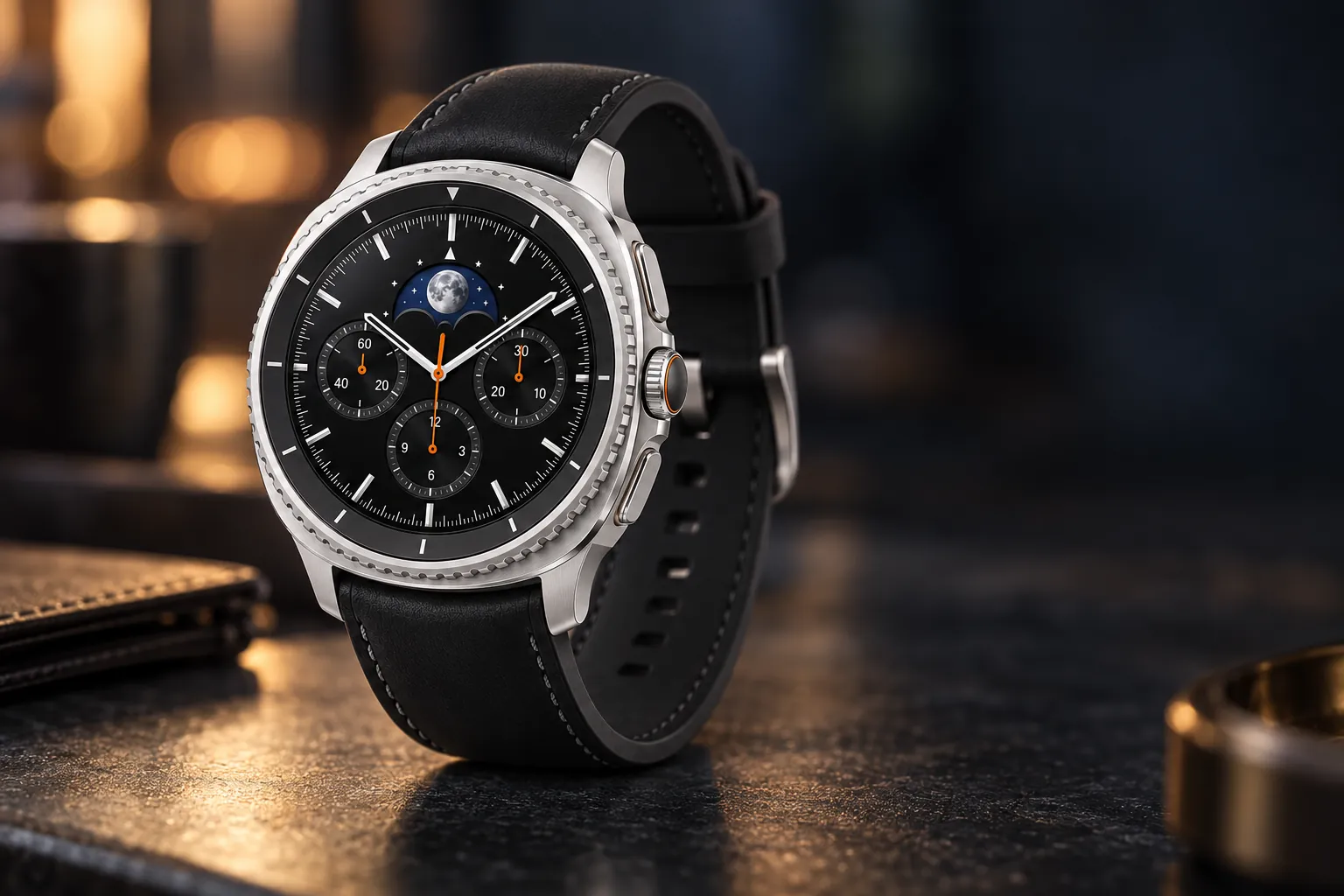
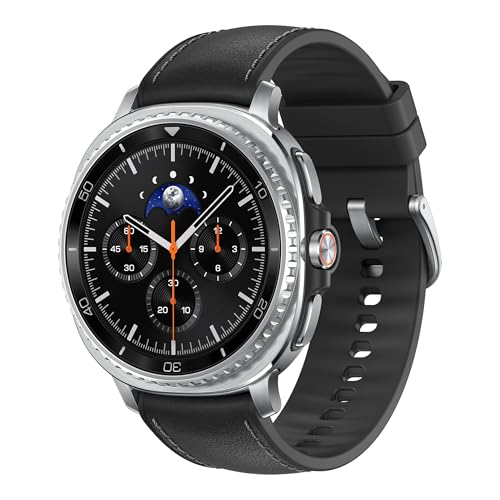
Choose it for the rotating bezel, steel build, bright display and deep Samsung health integration on a compatible Galaxy phone.
Check price on AmazonWe link to the exact model on Amazon UK. Prices change often, so check the live price before you buy. As an Amazon Associate we earn from qualifying purchases.
You are glancing at a notification on a crowded train, or changing a workout screen with sweaty fingers, and the touchscreen suddenly feels like the wrong answer. The Samsung Galaxy Watch8 Classic answers that problem with a physical rotating bezel: a stainless-steel ring that scrolls precisely without your finger swallowing the display.
The short answer: we recommend the Samsung Galaxy Watch 8 Classic to Android users, particularly Samsung Galaxy phone owners, who want tactile controls and traditional watch presence rather than the lighter, sportier feel of Samsung's regular Watch8 models. It is a premium choice for its bezel, steel construction, 64GB storage and bright display. Buy with clear eyes, though: it is a large, 63.5g watch body with a relatively compact screen, proprietary straps and battery life that usually means charging every day or two.
| At a glance | Samsung Galaxy Watch 8 Classic |
|---|---|
| Exact UK model covered | 46mm Black Bluetooth/Wi-Fi, product code SM-L500NZKAEUA |
| Case and controls | Stainless steel; rotating bezel; touchscreen; three physical buttons including Quick Button |
| Display | 1.34-inch Super AMOLED, 438 × 438, Sapphire Crystal, Always-On Display |
| Processor and memory | Exynos W1000 five-core 3nm processor, 2GB RAM, 64GB storage |
| Battery | 445mAh; rated up to 30 hours with Always-On Display and up to 40 hours without it |
| Location and connectivity | Bluetooth 5.3, dual-band Wi-Fi, NFC, dual-frequency GPS; this model is not LTE |
| Phone support | Android 12 or later with at least 1.5GB phone memory; iPhone support is absent |
| UK launch RRP | £449 for Bluetooth/Wi-Fi; £499 for LTE |
First Impressions: Why This Launch Matters
Samsung introduced the Galaxy Watch8 Classic on 9 July 2025 and it reached UK shops on 25 July 2025. It replaced the Galaxy Watch6 Classic from 2023, after Samsung omitted a Galaxy Watch7 Classic entirely. That two-year gap matters because the Classic line had become synonymous with one thing the mainstream smartwatch market increasingly ignored: a proper rotating bezel.
The product considered here is specific: the Samsung Galaxy Watch 8 Classic 46mm Black Bluetooth/Wi-Fi version listed on Amazon UK, rather than the separately sold LTE model. It remained in stock on Amazon UK on 27 October 2026. The "3 Year Extended Warranty" wording in the listing title describes a retail warranty package, not another watch generation or a hardware upgrade.
Position in the range: the Classic shares Samsung's current Wear OS and health platform with the Watch8 family. Its higher launch price paid for different hardware priorities: a rotating bezel, stainless-steel case, Quick Button and 64GB storage rather than a fundamentally different app or sensor platform.
The question is not simply whether the bezel is fashionable again. It is whether it makes enough practical difference to justify choosing a heavier, more expensive watch with only one 46mm size. Reviews make a persuasive case for the control method, whilst also showing that the Classic is not automatically the sensible fit for runners, smaller wrists or people who want several days away from a charger.
Samsung Galaxy Watch 8 Classic: Design, Build and What's in the Box
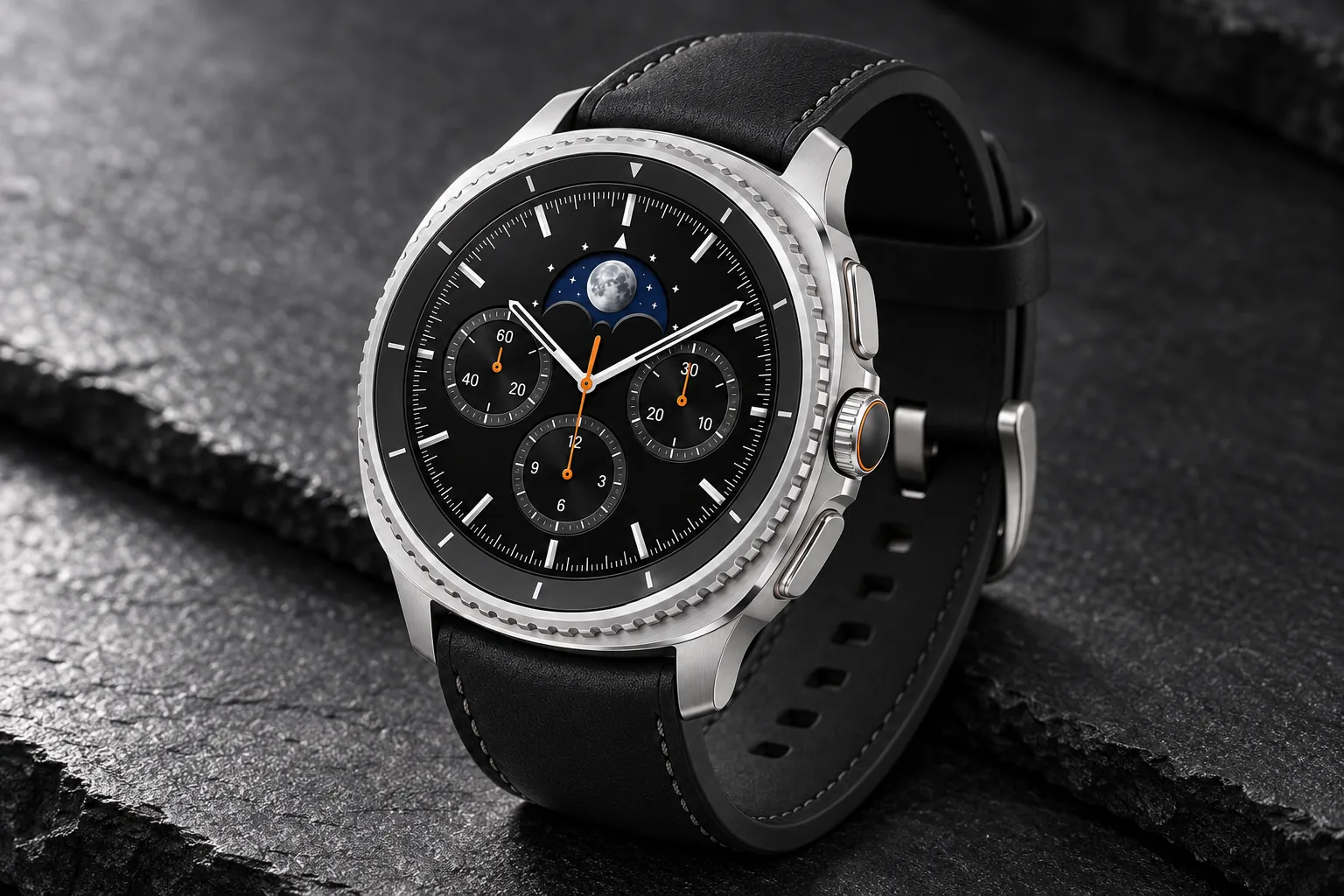
The Classic does not simply recreate the fully round Galaxy Watch6 Classic. Samsung gave it the cushion, sometimes described as squircle, outer case shape introduced by the Galaxy Watch Ultra, then placed a circular display and rotating bezel inside it. The result is more angular and more visibly connected to Samsung's newer watch design than the previous Classic.
It is a substantial piece of hardware. The case measures 46.0 × 46.4 × 10.6mm and Samsung specifies a 63.5g watch weight before the strap. Notebookcheck's scale reading was close at 63.2g without the strap, rising to 87.3g with the supplied Hybrid Band attached. That is useful context: this is a watch buyers will feel on the wrist, especially overnight.
There are three physical buttons: Home, Back and the programmable Quick Button. Samsung positioned the extra button as a shortcut for activities and utilities, including workouts, flashlight, stopwatch, water lock, camera controller and voice recorder, depending on configuration. It is a useful distinction from the two-button regular Watch8, particularly for someone who wants quick access while moving.
The supplied Hybrid Band attaches through Samsung's Dynamic Lug system. It allows a one-button strap release, but it also ends compatibility with the standard 20mm straps used by older Galaxy Watches. Android Authority praised the security and fit of the new system; TechRadar found the release mechanism awkward for people with short nails. Anyone with a drawer full of previous Galaxy Watch bands should factor in replacement strap cost before buying.
The material difference
Steel and sapphire crystal give the Classic a more jewellery-like, conventional-watch presence than the aluminium Watch8. The trade-off is direct: Samsung's 44mm regular Watch8 weighs about 34g before its strap, against the Classic's 63.5g.
The Bezel Question: What Does It Actually Add?
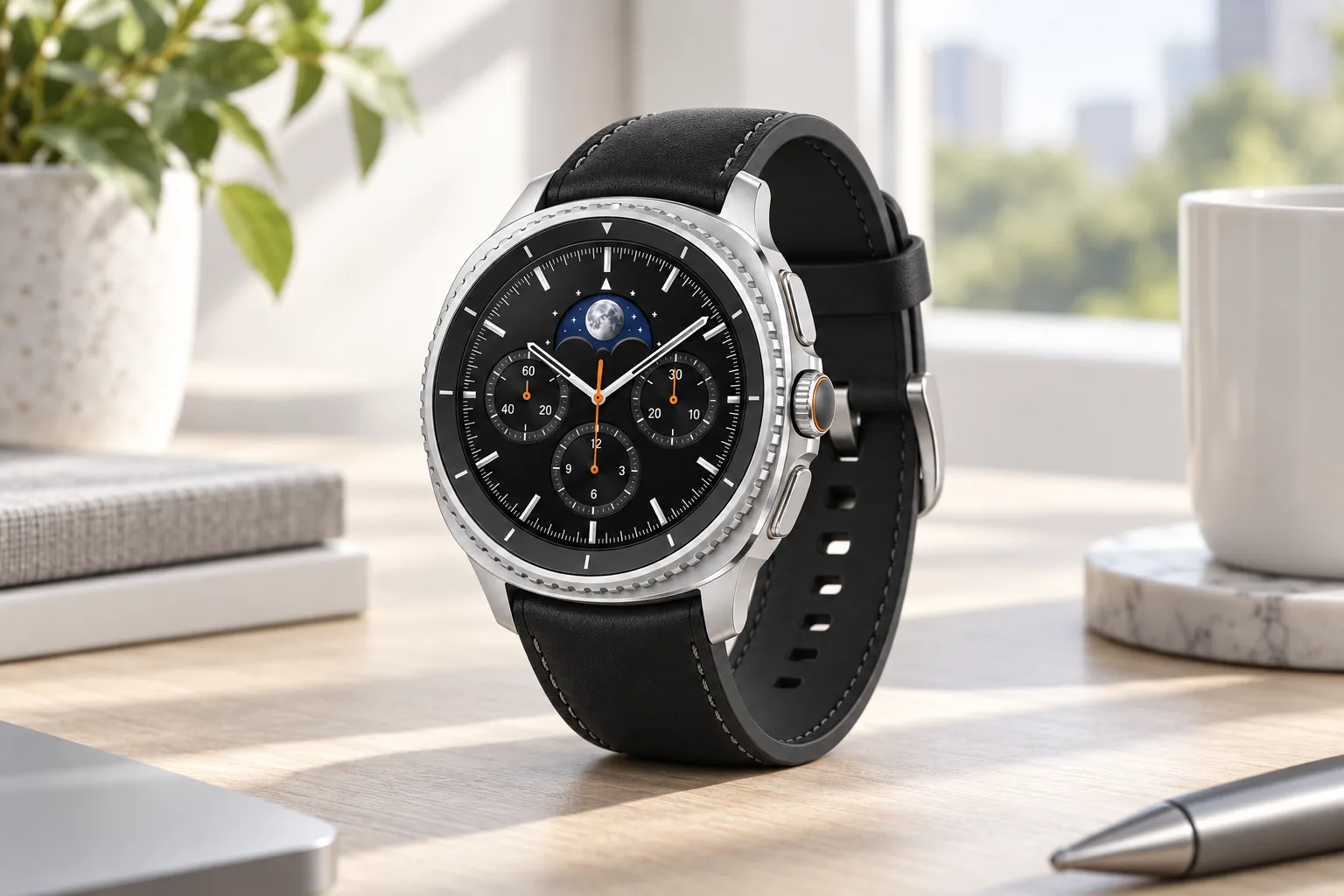
The bezel is not decorative. Rotate it and it scrolls through tiles, menus, notifications and workout screens. It can adjust selected settings and move through the interface without covering the display with a thumb. That sounds modest on a specification sheet, but it directly addresses the cramped interaction problem shared by touchscreen watches.
Clearer screen interaction
Scrolling from the outer edge means messages, maps and workout data remain visible instead of disappearing behind a finger.
More practical with wet hands
A physical ring remains useful when fingers are wet, sweaty or gloved, situations in which a small touchscreen can become fiddly.
Natural long-list navigation
The control feels especially suited to moving through notifications, app lists and vertically stacked settings without repeated swipes.
Tom's Guide and Android Authority both treated the bezel as the central reason to choose the Classic over the standard Watch8. Digital Trends called it its preferred smartwatch control method, and Expert Reviews wrote that One UI Watch feels designed around it. These are not claims that touch navigation is poor; they are a recognition that the rotating ring offers a distinct, tactile route through the same software.
The qualification is size. The bezel takes physical room around the display. Samsung has put a 1.34-inch display in a 46mm case, so it does not deliver the visual expanse some buyers may expect from its footprint. The Classic's control mechanism adds value chiefly for people who actively dislike swipe-first navigation. If that does not sound like you, the screen-to-case trade-off is harder to defend.
Samsung Galaxy Watch 8 Classic: Display, Chipset and Everyday Performance
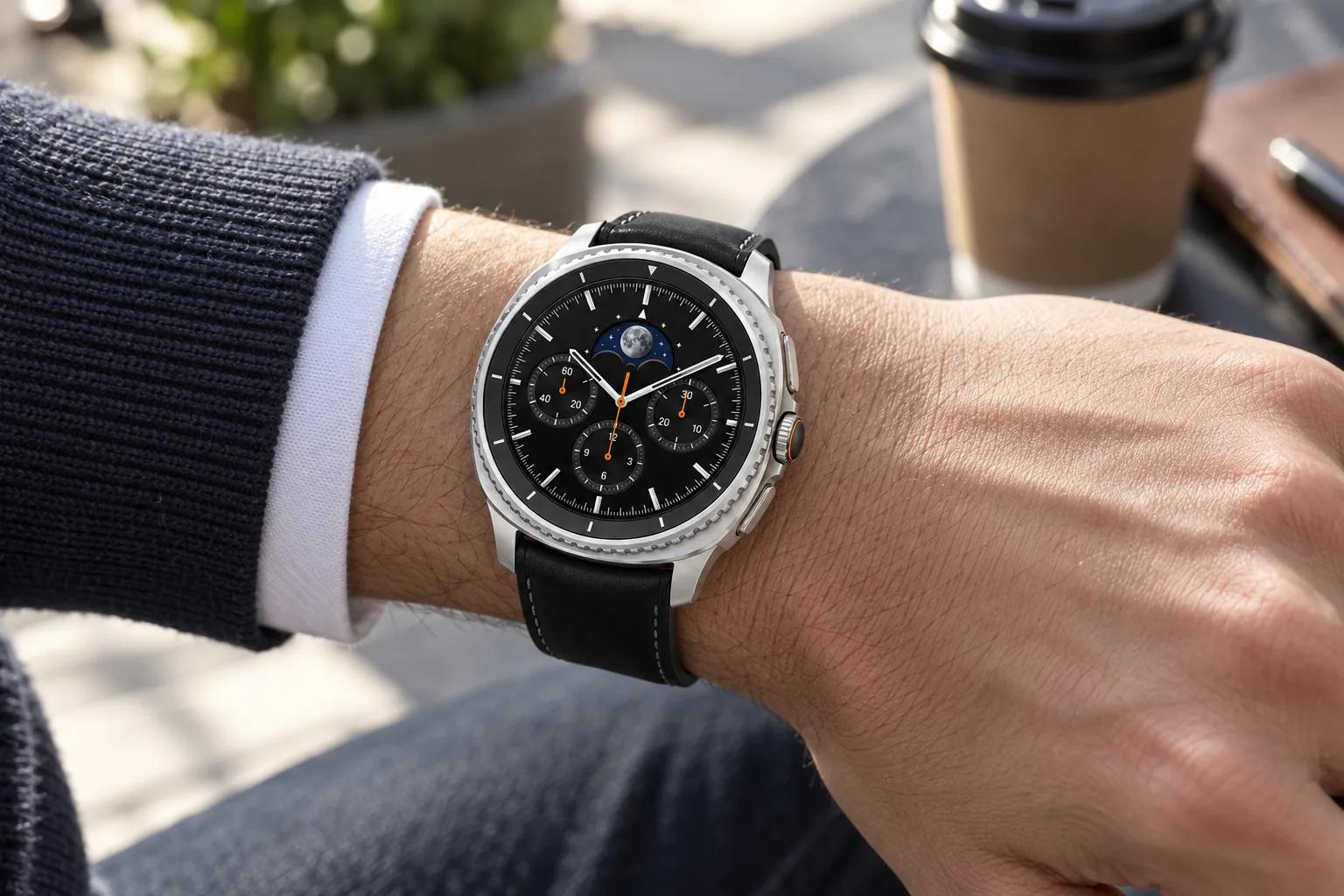
The screen is a 1.34-inch full-colour Super AMOLED panel at 438 × 438 pixels, protected by Sapphire Crystal. It supports an Always-On Display, and Samsung quoted a peak brightness of up to 3,000 nits. That combination places a sharp, high-contrast display behind a durable cover, appropriate for a watch intended to work outdoors as well as indoors.
Notebookcheck measured 3,052cd/m² with the ambient-light sensor active, which supports the outdoor-readability praise from both Notebookcheck and SamMobile. The same publication measured just 533 nits when the sensor was disabled. In practical terms, the automatic setting is important if outdoor brightness is one of your buying reasons; manual brightness behaviour was much less impressive.
Notebookcheck also recorded 60Hz PWM behaviour. People sensitive to display flicker should take that seriously, particularly if they wear the watch's Always-On Display for long periods. The same review identified a 60Hz panel; Samsung did not publish a variable LTPO refresh-rate specification for this model.
Performance comes from Samsung's five-core Exynos W1000, built on a 3nm process, paired with 2GB of RAM. Samsung lists CPU speeds of 1.6GHz and 1.5GHz; Notebookcheck identified one ARM Cortex-A78 core and four Cortex-A55 cores, alongside an ARM Mali-G68 MP2 GPU. SamMobile described day-to-day use as fast and fluid with very little stutter, whilst Notebookcheck placed it among the strongest-performing Wear OS watches it had assessed.
The 64GB storage allocation is another meaningful Classic benefit. Samsung says approximately 49GB is available to the owner, leaving ample room for offline music, downloaded apps and watch content compared with the 32GB on the regular Watch8. It will matter most to people who want to leave the phone behind for runs or gym sessions, although this Bluetooth/Wi-Fi model still needs a phone connection or Wi-Fi for its wider connected functions.
Battery Life: Why the Numbers Depend on Who's Measuring
The 445mAh non-removable battery has an official claim of up to 30 hours with Always-On Display enabled and up to 40 hours with it disabled. Those are sensible starting points, not a guarantee of identical results for every person. GPS, streamed audio, notifications, display settings, sleep tracking and workout frequency materially alter the result.
The spread between published results is unusually wide. Notebookcheck reported approximately 33 hours with all sensors active, automatic workout detection enabled and Always-On Display switched on. Tom's Guide recorded an average of 40 hours with Always-On Display enabled and more than 50 hours with it disabled. Android Authority reported roughly a day and a half with Always-On Display, daily exercise and sleep tracking.
Expert Reviews offered the less rosy end of the picture: after 24 hours on default settings with Always-On Display active, its unit had lost at least 60%. Its result reinforces the practical advice here. Treat the Classic as a daily or near-daily charging watch if you use its display, workouts and health features heavily; do not buy it for long breaks between charges.
Battery positives
- Several reviewers exceeded Samsung's 30-hour Always-On Display estimate.
- Tom's Guide found the Classic delivered the longest battery life within the Watch8 range.
- A 445mAh cell gives it a modest capacity edge over the 44mm Watch8's 435mAh battery.
Battery caveats
- Real-world reports ranged from roughly 33 hours to more than 50 hours.
- GPS exercise, podcasts and overnight tracking can make a next-day charge necessary.
- It does not deliver the several-day endurance expected from dedicated long-life sports watches.
Charging is not a clear strength. Android Authority reached 50% in roughly 30 minutes and 100% in 75 minutes. Tom's Guide recorded 52% in 29 minutes and a full charge in 90 minutes. Notebookcheck also reported about 90 minutes, whilst TechRadar took more than 100 minutes from 10% to full. Expert Reviews measured a 4.1W maximum charging draw, despite Samsung advertising 10W support. Short top-ups whilst showering or getting ready make more sense than relying on a rapid full refill before leaving home.
Health and Fitness Tools: How Deep Does the Tracking Go?
The Galaxy Watch8 Classic has a deep sensor list: accelerometer, barometer, bioelectrical-impedance-analysis sensor, electrical heart sensor, gyroscope, geomagnetic sensor, Hall sensor, infrared temperature sensor, light sensor and optical heart-rate sensor. It supports heart-rate tracking, ECG, blood oxygen, blood pressure, body-composition analysis, sleep tracking, sleep-apnoea detection, cycle tracking, stress monitoring, VO₂ Max, Energy Score, Running Coach, Bedtime Guidance, Vascular Load and Antioxidant Index.
That is an expansive wellness package for a general-purpose smartwatch. TechRadar praised the detail in Samsung's sleep, exercise and recovery information, while SamMobile highlighted the breadth of the health tools and generally good tracking. The important framing is that several tools are wellness features rather than medical diagnoses, and availability varies according to region, software and connected device.
Sleep and recovery focus
Sleep tracking, sleep-apnoea detection, Bedtime Guidance, Energy Score and Vascular Load are designed to turn overnight data into daily guidance.
Training features
Running Coach, VO₂ Max, GPS workout tracking and automatic workout detection sit alongside regular activity and exercise records.
Body and heart measurements
ECG, optical heart rate, blood oxygen, blood pressure and BIA body composition create a broad picture, subject to phone, app, calibration and regional requirements.
Notebookcheck compared heart-rate readings with a Polar H10 chest strap and recorded 2.37% average deviation across three measurements, with a maximum single difference of 7 beats per minute. Its blood-oxygen comparison against a Braun pulse oximeter produced an average difference of 0.35 percentage points. Those results are encouraging, but they do not erase every concern in the wider review picture.
SamMobile found heart-rate readings close to an Apple Watch during jogging and walking, yet it also saw GPS cut-offs and route overestimation around turns. Digital Trends and Expert Reviews raised concerns around inconsistent heart-rate readings in some situations. Serious athletes who choose equipment chiefly for highly dependable route and heart-rate data should regard the Classic as a capable smartwatch with workout tools, rather than assume its dual-frequency GPS specification settles every accuracy question.
Samsung-phone advantage: ECG and blood-pressure functions require a compatible Samsung Galaxy phone and Samsung Health Monitor. Some other health and wellness features also depend on regional approval, Samsung Health or calibration. Owners of other Android phones receive a less complete experience.
Software and Gemini: What One UI 8 Watch Changes
The Classic launched with Wear OS 6 and One UI 8 Watch, making the Watch8 generation Samsung and Google's first smartwatch generation with Gemini pre-loaded. Gemini can handle voice-led actions such as starting workouts, composing messages and interacting with compatible apps, extending the watch beyond basic timers and commands.
Android Authority called One UI 8 Watch its favourite Wear OS interface, praising its organisation and the way it works with the hardware controls. Notebookcheck found Gemini reliable for voice commands and more complex requests. The bezel has a role here too: Wear OS may be touch-centric by nature, but the Classic gives menus and tiles a physical navigation route that suits a watch's small screen.
For the Black Bluetooth/Wi-Fi model, connectivity includes Bluetooth 5.3, Wi-Fi on 2.4GHz and 5GHz bands, NFC and GPS. Location support covers dual-frequency L1 and L5 GPS plus GLONASS, BeiDou and Galileo. NFC is present, although payment availability depends on country, bank and software support. This model does not have LTE, so standalone mobile connectivity requires choosing the separate LTE hardware version.
Samsung Galaxy Watch 8 Classic vs the Rest of the Watch8 Family
The following is context for the Classic's place in Samsung's range, rather than a list of alternative recommendations. The regular Watch8 models and Galaxy Watch Ultra explain the compromises Samsung chose: lighter materials and more screen space on one side, or tougher outdoor positioning and a bigger battery on the other.
| Feature | Watch8 40mm | Watch8 44mm | Watch8 Classic 46mm |
|---|---|---|---|
| Case material | Armor Aluminum | Armor Aluminum | Stainless steel |
| Weight without strap | 30g | 34g | 63.5g |
| Display | 1.3-inch, 438 × 438 | 1.5-inch, 480 × 480 | 1.34-inch, 438 × 438 |
| Battery capacity | 325mAh | 435mAh | 445mAh |
| Storage | 32GB | 32GB | 64GB |
| Rotating bezel | No | No | Yes |
| Quick Button | No | No | Yes |
| UK Bluetooth launch RRP | £319 | £349 | £449 |
The counterintuitive point is display size. The 44mm Watch8 has a larger 1.5-inch, 480 × 480 display than the Classic's 1.34-inch, 438 × 438 panel despite being smaller and much lighter. Notebookcheck and SamMobile both treated that as a drawback of the Classic. The rotating bezel is useful, but it is also the reason the screen occupies a smaller part of the case.
The Classic's 445mAh battery is only slightly larger than the 44mm Watch8's 435mAh cell, so capacity alone does not explain its place in the range. Tom's Guide found it achieved the strongest real-world battery life among Watch8 models. Buyers should read that as an advantage measured in hours, not a transformation into a multi-day endurance watch.
Praise and Pushback: What Reviewers Actually Found
There is a coherent positive case for the Classic. Reviewers repeatedly praised the tactile bezel, responsive Exynos W1000 performance, premium case and unusually bright display. SamMobile and Notebookcheck described fast, fluid operation; Notebookcheck's 3,052cd/m² figure gives the outdoor-readability claim a hard number behind it. TechRadar and SamMobile found the sleep and health information detailed and useful.
There is also a coherent negative case. TechRadar found the body bulkier and less comfortable for running than the standard Watch8. SamMobile noted that the cushion case may disappoint people who wanted the more traditional round Classic silhouette. The lack of a smaller case is a firm limitation, rather than a matter of taste: Samsung sells the Watch8 Classic only in 46mm.
Where the Classic makes its case
- The bezel gives physical, precise navigation that reviewers consistently valued.
- Stainless steel, sapphire protection and a 3,000-nit-class display support its premium positioning.
- 64GB storage doubles the capacity of the standard Watch8 models.
- Wear OS 6, One UI 8 Watch and Gemini provide a current, capable Android smartwatch platform.
- Notebookcheck's health comparison figures were broadly reassuring for heart rate, blood oxygen and blood pressure.
Where the compromises show
- The 46mm case surrounds a smaller screen than the 44mm regular Watch8.
- Weight, thickness and one-size-only availability reduce its appeal for smaller wrists and running.
- Charging commonly took 75 to more than 100 minutes, depending on the publication.
- Battery reports vary sharply with use, from roughly 33 hours to more than 50 hours.
- The proprietary Dynamic Lug system prevents direct reuse of older standard 20mm Galaxy Watch straps.
This mixed picture is more useful than pretending every review reached the same conclusion. The rotating bezel is genuinely well regarded. The display is demonstrably bright in automatic mode. The software and processor appear mature. But buyers who primarily want low weight, a large screen, highly consistent GPS or minimal charging should not assume premium materials make the Classic the natural answer.
Who the Galaxy Watch8 Classic Is Really For
The traditional-watch buyer
Choose it for stainless steel, a circular screen and a tactile bezel if touchscreen-first smartwatch design leaves you cold.
The Galaxy phone owner
The full Samsung Health Monitor proposition, including ECG and blood pressure where supported, makes most sense with a compatible Galaxy phone.
The daily smartwatch user
It suits people who value a bright display, sleep tools, voice assistance and responsive everyday software over long battery endurance.
Skip it if you use an iPhone, need a small watch, want to retain a collection of conventional 20mm straps or expect several days between charges. It is also not the obvious fit for someone choosing a watch chiefly for demanding sport tracking, given SamMobile's GPS observations and mixed heart-rate comments from other reviewers.
Pricing and Where It Sits on Amazon UK Today
Samsung set the UK launch RRP at £449 for the 46mm Bluetooth/Wi-Fi Classic and £499 for LTE. The Black Bluetooth/Wi-Fi model covered here was the £449 configuration at launch. By comparison, the Watch8 range began at £319 for the 40mm Bluetooth model and £349 for the 44mm Bluetooth model.
Watch8 40mm
UK Bluetooth launch RRP
Watch8 44mm
UK Bluetooth launch RRP
Watch8 Classic 46mm
UK Bluetooth/Wi-Fi launch RRP
That £100 to £130 launch premium was for the steel case, rotating bezel, Quick Button and 64GB storage. It was not a payment for exclusive health features or a different operating system. Amazon and other UK retailers have run promotions on the Watch8 generation, so current shelf prices can differ materially from Samsung's original figures. The value argument therefore changes with the actual price on the day, but the hardware trade-offs do not.
Buying check: ensure the listing specifies the 46mm Bluetooth/Wi-Fi model if that is what you want. The Black Amazon UK model discussed here is not the LTE version, despite both versions sharing the Galaxy Watch8 Classic name.
Common Questions From UK Buyers
Who should buy which?
The Samsung Galaxy Watch 8 Classic is the one to choose when a physical bezel, premium steel case and 64GB storage matter more than low weight, display size and rapid charging. It makes particular sense for Samsung Galaxy phone owners who will use the wider health platform. The rotating bezel is not merely a nostalgic flourish: the reviewers cited here consistently regarded it as a useful way to operate Wear OS. But it comes wrapped around a bulky 46mm-only body, with a 1.34-inch display and real-world endurance that remains measured in roughly one to two days. That makes it a deliberate premium Android watch purchase, not an automatic upgrade for every smartwatch buyer.
Sources
- Samsung UK product page and specifications: samsung.com/uk/watches/galaxy-watch/galaxy-watch8-classic-46mm-black-bluetooth-sm-l500nzkaeua/
- Samsung UK Watch8 series launch announcement and pricing: news.samsung.com/uk/samsung-galaxy-watch8-series-ultra-comfort-from-sleep-to-workout
- Notebookcheck Galaxy Watch8 Classic review and measurements: notebookcheck.net/The-one-with-the-bezel-Samsung-Galaxy-Watch8-Classic-smartwatch-review.1133154.0.html
- Tom's Guide Galaxy Watch8 review: tomsguide.com/wellness/smartwatches/samsung-galaxy-watch-8-review
- TechRadar Galaxy Watch8 Classic review: techradar.com/health-fitness/smartwatches/samsung-galaxy-watch-8-classic-review
- SamMobile Galaxy Watch8 Classic review: sammobile.com/samsung/galaxy-watch-8-classic/review/
- Expert Reviews Galaxy Watch8 Classic review: expertreviews.co.uk/beauty-wellness/wearables/samsung-galaxy-watch-8-classic-review
- Android Authority Galaxy Watch8 Classic review: androidauthority.com/samsung-galaxy-watch-8-classic-review-3585894/
- Samsung Galaxy Watch 8 ClassicTactile premium AndroidView on Amazon
Sources and evidence (19)
- samsung.com (other)
- news.samsung.com (other)
- notebookcheck.net (other)
- sammobile.com (other)
- androidauthority.com (other)
- tomsguide.com (other)
- expertreviews.co.uk (other)
- techradar.com (other)
- api.samsungmobilepress.com (other)
- samsung.com (other)
- digitaltrends.com (other)
- consumerreports.org (other)
- sammobile.com (other)
- techradar.com (other)
- samsung.com (other)
- argos.co.uk (retailer)
- wareable.com (other)
- techradar.com (other)
- androidcentral.com (other)