JBL Bar 1300MK2 First Look: can it challenge Samsung's Atmos champion?
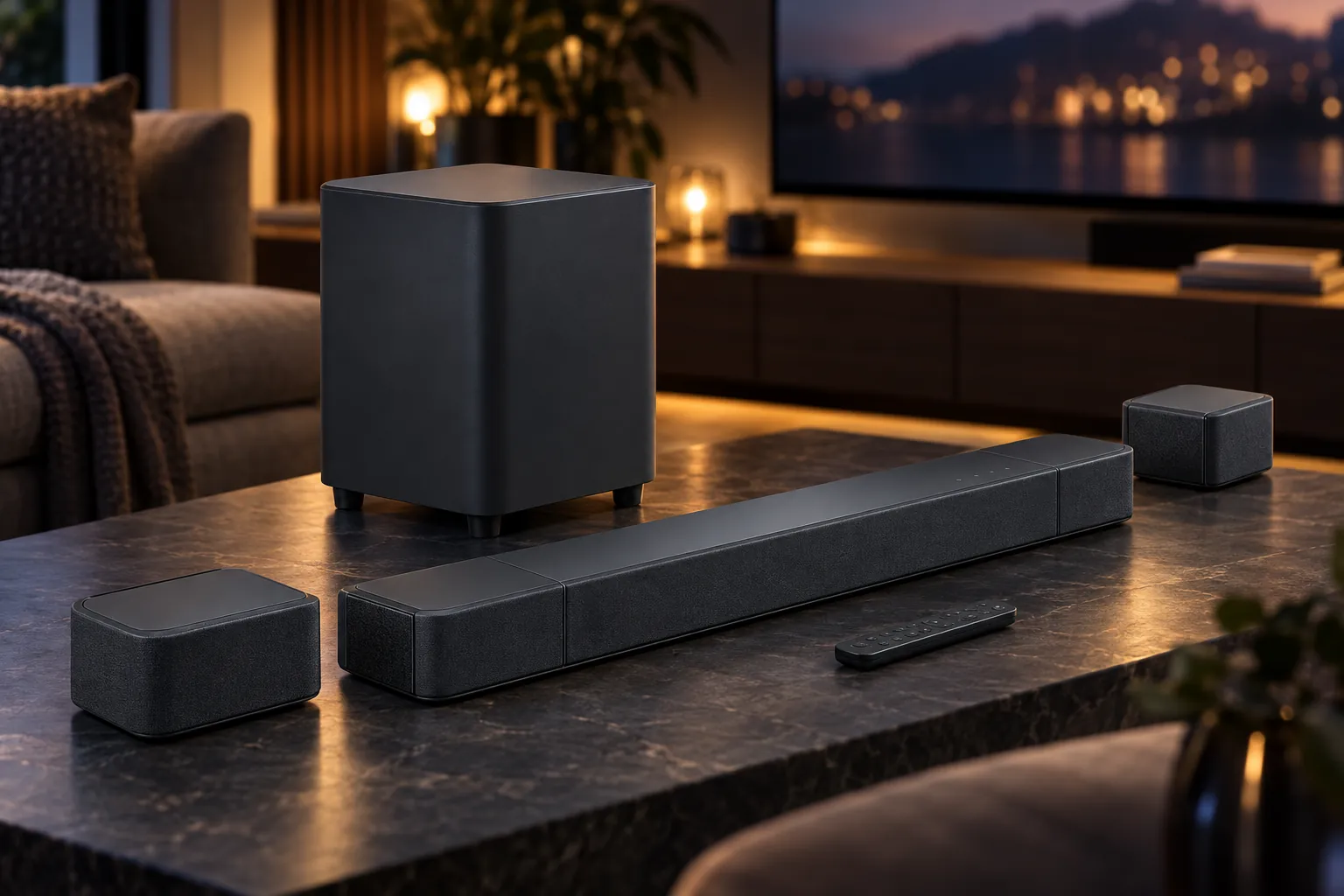
An 11.1.4 system whose rear speakers clip off the ends of the bar, run on batteries and wander off round the house. Here is what the specifications and independent measurements add up to.
Black Friday week is on at Amazon until 30 November. See Amazon's deals

Physical 11.1.4 sound, 110dB measured output and detachable battery surrounds, though HDMI passthrough stops at 4K/60Hz.
Check price on AmazonWe link to the exact model on Amazon UK. Prices change often, so check the live price before you buy. As an Amazon Associate we earn from qualifying purchases.
The film is queued, the lights are down, and the sofa sits in the middle of the room with no tidy route for rear-speaker cables. That is the exact problem JBL's flagship sets out to solve: proper surround and height effects without drilling, cable channels or a receiver. At well over a thousand pounds, the question is whether that convenience costs you anything in cinema scale.
The short answer
If you have a large living room, a wide TV unit or wall, and you want genuine rear and height channels without a permanent speaker install, the JBL Bar 1300MK2 is a very strong choice. Critics have rated it extremely highly for Atmos films, music and dialogue, and its detachable surrounds are something rival flagships simply do not offer.
Two catches matter. Its HDMI inputs stop at 4K/60Hz, so a PS5 or Xbox Series X belongs in the TV, not the bar. And it is big: 1.4 metres wide with the speakers docked, plus a 12kg subwoofer. Against Samsung's HW-Q990H it matches the channel count and beats it on flexibility, but concedes gaming connectivity and, for some critics, a little finesse.
At a glance
| Specification | JBL Bar 1300MK2 |
|---|---|
| Channels | 11.1.4 |
| Drivers (including subwoofer) | 29 |
| Claimed maximum output | 2,470W at 1% THD |
| Subwoofer | Wireless, two opposed 8-inch (200mm) drivers |
| Formats | Dolby Atmos, DTS:X |
| HDMI | 3 inputs, 1 eARC output; 4K/60Hz passthrough with HDR10+ and Dolby Vision |
| Surround battery | Up to 10 hours claimed per speaker |
| Width with surrounds docked | 1,404mm |
| UK price | £1,299.99 at launch; JBL's current RRP is £1,399.99 |
JBL Bar 1300MK2: what actually changed for the MK2 generation
The Bar 1300MK2 replaces the original JBL Bar 1300, which arrived in 2023. Harman announced the five-model MK2 range in June 2025, with the smaller bars landing that summer and the flagship following later. JBL's launch material stated that the Bar 1300MK2 would be available from September 2025.
The family runs from the compact 5.0 Bar 300MK2 through the 500MK2, 800MK2 and 1000MK2 to this 11.1.4 flagship. Only the 1000MK2 and 1300MK2 use dedicated up-firing drivers and decode DTS:X natively; the cheaper models rely on virtual Atmos and DTS Virtual:X. So if real height channels are on your list, the choice narrows to those two quickly.
That makes the Bar 1000MK2 the one to weigh up first. It is a 7.1.4 system with up-firing drivers in the bar and in each surround, three HDMI inputs and DTS:X, but it pairs them with a single 10-inch subwoofer, 960W of claimed output and lighter 0.9kg surrounds. When we checked JBL's UK store on 19 November 2026, the 1000MK2 was on promotion at £849.99 against an RRP/reference price of £1,099.99, while the 1300MK2 was promoted at £1,185.99 against JBL's stated £1,399.99 RRP. Roughly £300 more buys the 11.1.4 layout, the dual-driver sub with AI Sound Boost and more than double the claimed output. In a modest room, the cheaper bar is the more proportionate buy; the flagship earns its premium in larger spaces.
The bigger surprise is regional. The flagship is not one global product, and US reviews do not translate directly to the version sold here.
The bar and detachable surrounds are shared between the two regions; the subwoofer is not. That 900W gap in claimed output comes entirely from the sub, so treat any American review or measurement of the 1300XMK2 as a guide to the bar and surrounds only, not to the bass you will get from the UK box.
Inside the 11.1.4 claim: real drivers or marketing maths?
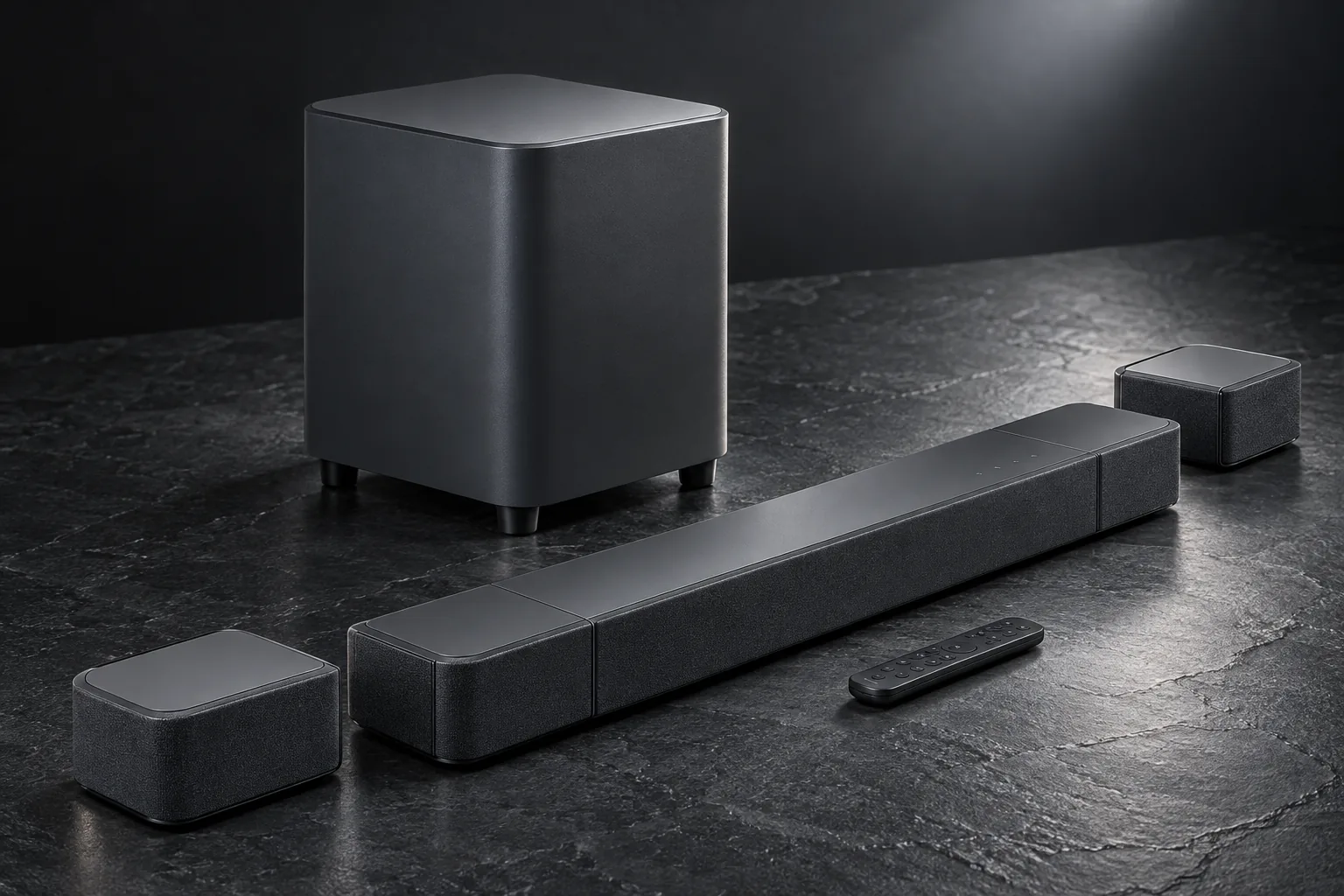
Eleven ear-level channels is an unusual number for a soundbar, and the sceptical reading would be that most of them are processing tricks. What Hi-Fi? put the question to Harman directly. The answer: five channels come from the main bar and three from each detachable speaker, every one of them fed by physical drivers rather than conjured virtually.
The driver count backs that up. The main bar alone carries 19 drivers before the surrounds are even attached, and the full system reaches 29 once you add the rears and the subwoofer's pair.
Up-firing drivers in the rears matter more than the headline number suggests. Height effects that arrive from behind as well as in front are what make a helicopter feel like it crosses overhead rather than hovering above the TV. Reviewers consistently described the height layer as convincing, provided the surrounds are sensibly placed behind the seating.
MultiBeam 3.0
JBL's side-firing beam processing, which bounces sound off side walls to widen the front stage beyond the bar's physical width.
PureVoice 2.0
Automatically adjusts dialogue against the volume and the surrounding content. Voices were consistently reported as clear, which is what saves you riding the remote during quiet conversations between explosions.
SmartDetails and the JBL ONE app
A seven-band EQ, room calibration and listening modes, plus bass, height and rear levels adjustable straight from the remote.
Dolby Atmos and DTS:X
Native decoding of both major object-based formats, so DTS:X discs are not folded down to a virtual version.
One small irritation surfaced: What Hi-Fi? listed the lack of a calibration "off" switch as a negative. If you prefer to hear a system uncorrected before deciding how much processing you want, there is no clean way to do it.
The detachable surrounds: JBL's genuine point of difference
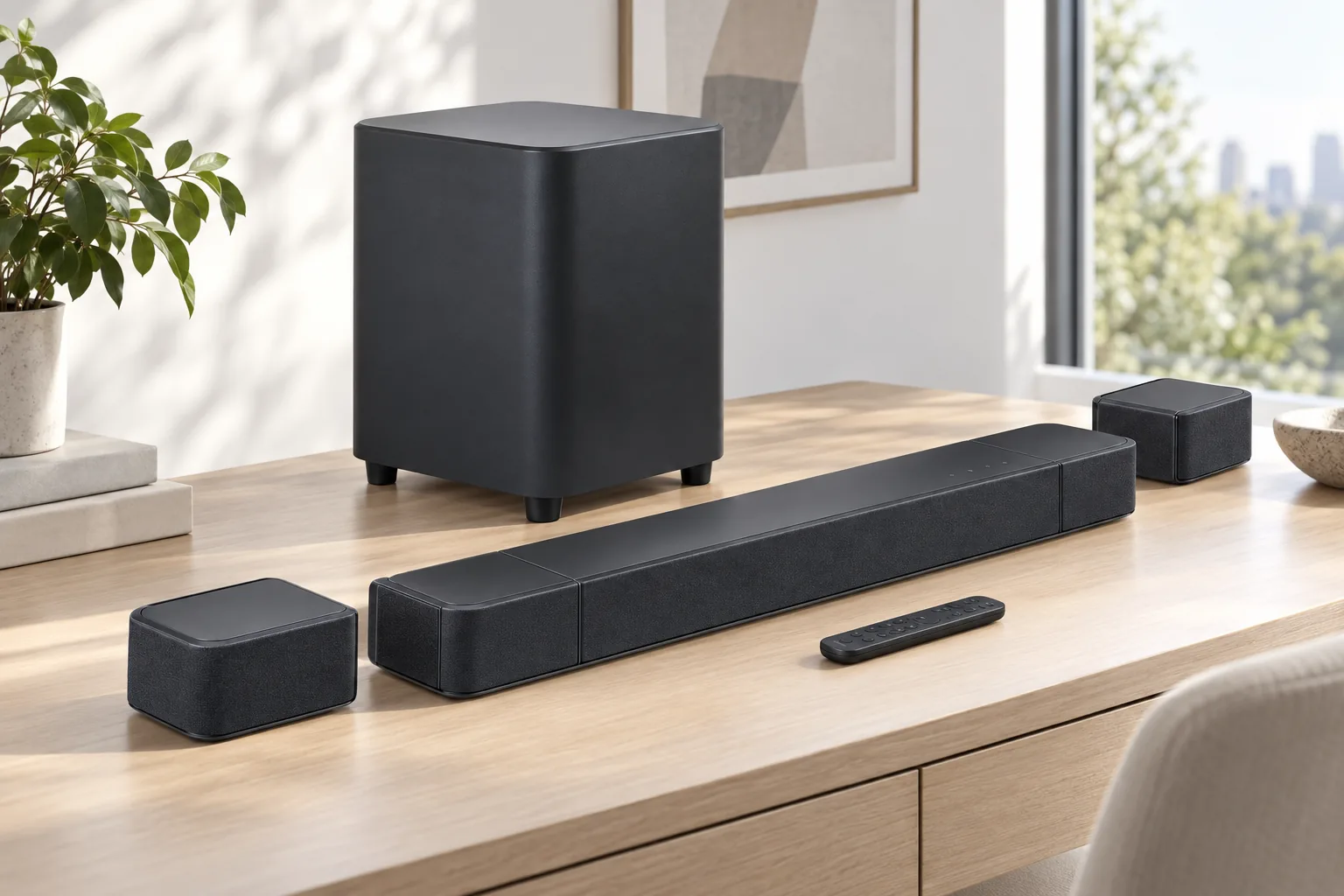
This is the reason to choose the 1300MK2 over a conventional flagship. The two end sections lift off the bar, run on their own batteries, and become wireless Atmos rears behind the sofa. When the film finishes, they clip back on to recharge and the bar looks like a single, tidy unit again.
Each one weighs 1.3kg and measures 202 × 58 × 136mm, which is light enough to carry to the kitchen with one hand. Inside is a 7.2V, 4,722mAh lithium battery that JBL rates for up to 10 hours depending on volume and content. AVForums recorded roughly four hours to recharge them.
Docked
Attached to the bar, they widen the front stage and charge at the same time.
Wireless rears
Placed behind the listening position for full 11.1.4 surround and rear height effects, with no speaker cable involved.
Standalone Bluetooth
Use one as a mono speaker or both as a stereo pair, each running Bluetooth 5.4.
Broadcasting
Send the TV or music feed to the surrounds elsewhere in the home, with Auracast-compatible broadcasting supported.
Night Listening
Mutes the bar and subwoofer whilst the detachable speakers play close to you, keeping late films from rattling the bedroom ceiling above.
The honest catch is that they are small battery speakers, not hi-fi. AVForums felt they lacked some "ballast" for music on their own. Battery-powered rears also mean remembering to dock them, and lithium cells age, so after a few years the 10-hour figure will drift lower.
Be clear about what is and is not proven here. No independent runtime-under-load test has been published, and long-term battery cycle life is unconfirmed, so the 10-hour figure is JBL's own. Reviewer reports indicate the flagship's surrounds can also be charged away from the bar, which helps if one spends a few days in a bedroom or study, though the exact charging port should be checked against the UK manual.
How the 1300MK2's surrounds compare with the rest of the range
The Bar 300MK2 and 500MK2 have no detachable surrounds at all. The 800MK2's are much smaller: 0.7kg each, a single 44 × 90mm racetrack driver and no up-firing driver, which is why that model's Atmos is virtual. The 1000MK2 adds one up-firing driver per surround at 0.9kg each. The 1300MK2's rears are the only ones in the family with two racetracks, an extra full-range driver and an up-firer, powered by 2 × 160W.
Placement tip
The height illusion depends on the rear up-firers bouncing sound off your ceiling above and behind you. Low or sloping ceilings, or rears pushed against a back wall at floor level, will blunt the effect. A side table or shelf roughly level with your ears, a little behind the sofa, is the realistic sweet spot for most living rooms, and running room calibration after you move them lets the system account for the new positions.
Bass by numbers: what the dual 8-inch subwoofer really delivers
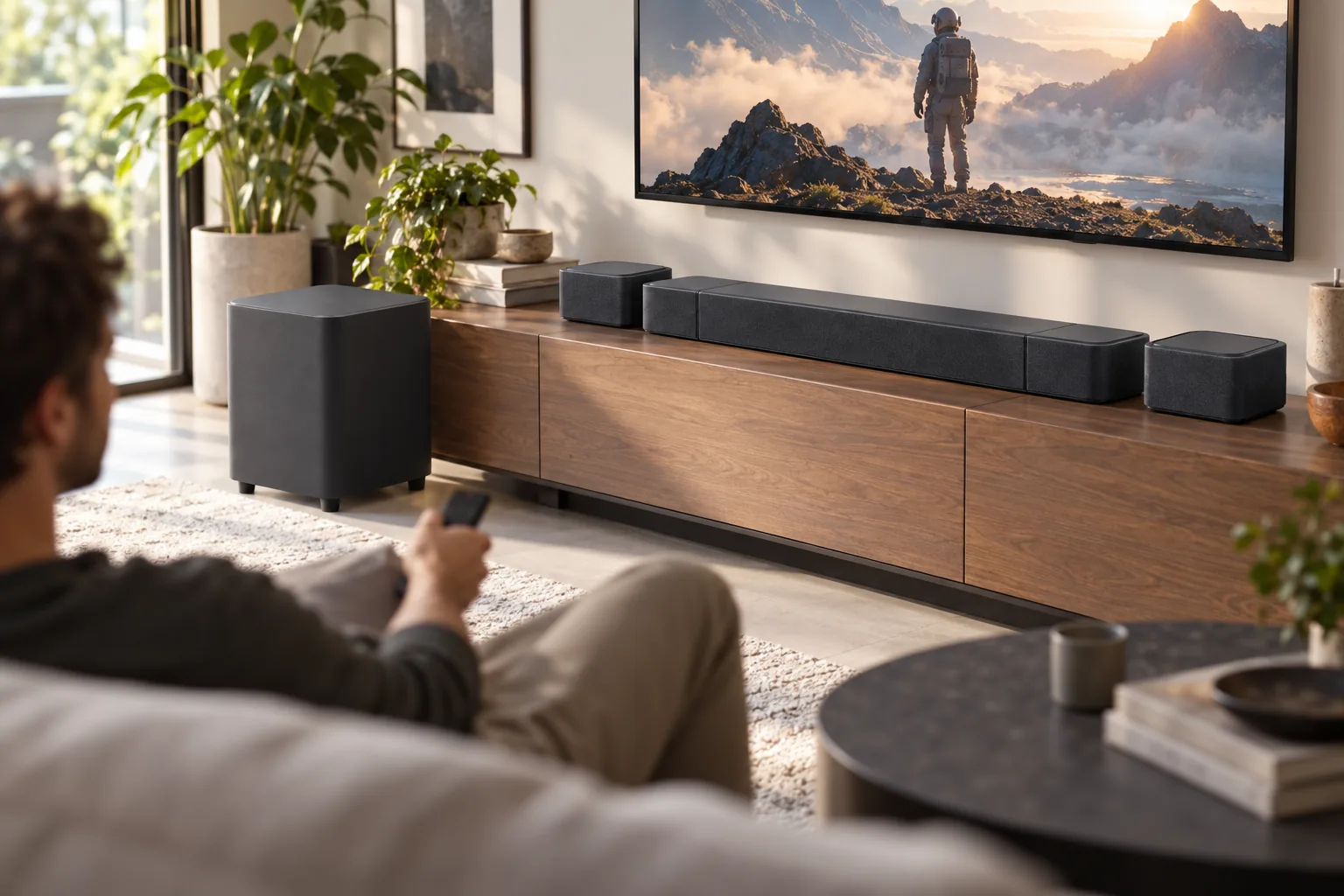
JBL's UK sub takes an unusual approach. Instead of one big cone, it uses two 8-inch drivers firing in opposite directions inside a sealed enclosure, a layout designed to cancel cabinet vibration. It accounts for nearly half of the system's claimed power.
Share of JBL's claimed 2,470W maximum system output, rated at 1% THD. Manufacturer figures, not measurements.
Wattage claims tell you little about real loudness, which is why the independent figures matter. French site Frandroid measured the UK-spec system at 110dB at one metre, with usable low-frequency energy reaching down to around 30Hz and the strongest impact in the 40–80Hz band where kick drums and explosions live. That sits comfortably with JBL's claimed 33Hz–20kHz response at -6dB. The same review reported the system filling a 40 square metre room without strain and keeping its tonal balance as volume rose.
Forty square metres is a big open-plan lounge by UK standards, so most living rooms will leave plenty in reserve. JBL adds AI Sound Boost, processing exclusive to this subwoofer within the MK2 range, designed to extract more output from the compact dual-driver box.
The recurring caution is quantity, not quality. Out of the box the subwoofer level is set high, and several critics found the bass excessive or a touch one-note until it was reined in. AVForums found running room calibration substantially tamed a sub that initially sounded overly forceful near a wall. Plan to calibrate on day one, then trim the bass from the remote to suit your room and your neighbours.
Music is where the system surprised critics. Rather than a cinema-effects box that struggles with an album, it was described as warm, balanced and musical with stereo material, and capable with Atmos music. Streaming support is broad: AirPlay, Google Cast, Spotify Connect, Tidal Connect and Roon Ready.
How critics scored it: AVForums awarded 10/10 overall, including 10/10 for sound quality and value. TechRadar gave 5/5 for performance and setup. Which? scored it 82% in its lab-based assessment of sound, ease of use and features.
Connectivity reality check: where the flagship falls short
On paper the connections look generous: three HDMI inputs and an eARC output, where every MK2 model below the 1000MK2 makes do with one input. In practice those inputs are HDMI 2.0b-class, so video passthrough tops out at 4K/60Hz rather than 4K/120Hz.
For films and streaming that is no problem at all. HDR10+ and Dolby Vision both pass through, and HDCP 2.3 is supported, so a 4K Blu-ray player or streaming stick plugged into the bar delivers full HDR picture quality. The pinch is gaming, and it is sharpest for anyone whose TV has only two HDMI 2.1 ports and was hoping the bar would act as an extra hub.
| Source | Recommended connection |
|---|---|
| PS5 or Xbox Series X at 4K/120Hz | Connect the console to the TV's HDMI 2.1 port; audio returns via eARC, since the bar's inputs cap out at 4K/60Hz |
| 4K Blu-ray player with Dolby Vision | Plug into one of the bar's three inputs |
| Streaming stick with HDR10+ | Plug into the bar, or use the TV's own apps |
| TV's built-in apps | One HDMI cable from TV to the bar's eARC port |
| Older kit with optical only | Use the optical digital input |
Setup is described as close to plug-and-play: the bar, subwoofer and surrounds pair themselves, and the JBL ONE app handles Wi-Fi, calibration and updates. Budget about ten minutes for the first firmware update, which AVForums timed at roughly that.
Three smaller points for UK buyers. What Hi-Fi? lists Ethernet among the connections on its UK review sample, worth using if your router sits near the TV and Wi-Fi is patchy. The USB-A port will not play music from a memory stick here, because UK/EMEA units reserve it for servicing, so your own files need to arrive by streaming, Roon or Bluetooth. And latency is reported as improved over the previous generation but still not class-leading, another reason to keep games running through the TV.
Weighing the JBL against Samsung's Atmos flagship
Samsung's HW-Q990H is the obvious yardstick, and it appears here purely as context for where the JBL sits in the market. On channel count the two are level at 11.1.4. The structural difference is the rears: Samsung supplies dedicated rear speakers built to stay behind the sofa, whilst JBL's detach, run on batteries and double as portable Bluetooth speakers. No other flagship in this bracket does that.
| Feature | JBL Bar 1300MK2 (UK) | Samsung HW-Q990H |
|---|---|---|
| Channels | 11.1.4 | 11.1.4 |
| Driver / speaker count | 29 drivers | 23 speakers |
| Main bar weight | 5.93kg | 7.3kg |
| Rear speakers | Detachable, battery-powered, 1.3kg each | Dedicated rears, 3.4kg each |
| Subwoofer | Wireless, dual opposed 8-inch, 12kg | Wireless, 8.3kg |
| HDMI inputs | 3 | 2 |
| 4K/120Hz, VRR, ALLM passthrough | No (4K/60Hz) | Yes |
| HDR passthrough | HDR10+, Dolby Vision | HDR10, HDR10+, Dolby Vision |
| Streaming | AirPlay, Google Cast, Spotify Connect, Tidal Connect, Roon Ready | AirPlay, Chromecast, Spotify Connect, Tidal Connect, Roon Ready |
| App / ecosystem | JBL ONE | SmartThings, Q-Symphony with Samsung TVs |
| UK list price | £1,399.99 RRP (£1,299.99 at launch) | Around £1,599 |
Critics did not agree on which sounds better, and the split is instructive. What Hi-Fi? preferred the Samsung's wider, more detailed presentation. Frandroid leaned the other way, finding the JBL more forceful and more capable in the bass. RTINGS, testing the US 1300XMK2 with its different subwoofer, judged the two broadly comparable overall, but gave Samsung the edge on latency and passthrough.
Read together, the picture is clear enough. The JBL is the more muscular, bass-led and flexible system with an extra HDMI input. The Samsung is the more polished all-rounder for gamers and anyone already invested in a Samsung TV that can use Q-Symphony.
The price picture
The JBL launched at £1,299.99 and JBL now lists an RRP of £1,399.99, though its own store has been running promotions below that during the Black Friday period. Samsung's UK pricing has been far less consistent. If you are weighing the two, compare live prices on the same day: on list prices the JBL is the cheaper flagship, and a promotion can widen that gap considerably.
On 19 November 2026, JBL's UK store showed the 1300MK2 at £1,185.99 on promotion while another JBL page still listed £1,399.99. Samsung's official UK page, meanwhile, displayed a puzzling £3,299 figure alongside a £2,399 reference price, so check a mainstream retailer for what the Q990H actually costs before deciding.
Living with the size: room fit and practical setup
Measure before you buy. The main bar alone is just over a metre wide; dock the surrounds and it stretches to 1.4 metres. That suits a large TV on a long media unit or a wall, but it will overhang a compact console and look odd beneath a smaller screen. Its 58mm height is modest, which helps keep it clear of the bottom edge of most TVs.
The subwoofer is compact for its output but dense at 12kg, so pick its spot carefully the first time. Corners and walls reinforce bass, which with this sub's generous default level is not always welcome. The 28.6kg box is a two-person job up the stairs, though at least the parts inside separate into manageable pieces.
One trap when measuring up: JBL's US-style specification quotes a far larger 380 × 482.5 × 380mm, 15.4kg subwoofer. Those figures belong to the American 1300XMK2's 12-inch unit. The UK dual-8-inch sub is the smaller 315 × 277 × 275mm, 12kg design above, so do not clear more floor space than you need.
JBL clearly expects plenty of buyers to wall-mount. Alongside the remote, HDMI cable and power leads, the box includes wall-mount brackets and screws, a wall-mount template and side caps for when the surrounds are away from the bar.
Wall-mounting and detachable surrounds work well together: the rears lift off the mounted bar just as they do on a cabinet. Leave clear space at each end so they can be removed and re-docked easily, as they recharge on the bar.
Looks divide opinion more mildly. The design is functional rather than luxurious, with critics calling it plain and a little bulky. Nobody buys this for its styling, and in a dark room you will mostly notice what it sounds like.
Who this system is actually built for
Large-room film fans
Spacious lounges and action-heavy viewing play to its scale, 110dB measured output and deep bass extension.
Renters and cable-avoiders
Real rear and height channels with no speaker cable, and rears that pack away when the room needs to look tidy.
Music listeners
Stereo and Atmos music were praised as warm and balanced, backed by Tidal Connect, AirPlay, Google Cast and Roon Ready.
4K/120 gamers using the bar as a hub
Passthrough stops at 4K/60Hz. Route the console into the TV and use the bar for audio only.
Small rooms and narrow units
A 1.4m bar and 12kg sub can overwhelm a compact space and its furniture.
Lovers of lean, neutral bass
The tuning leans heavy by default. Calibration and EQ help, but the character is muscular.
Three quick scenarios settle most decisions. If you own a recent Samsung TV and game seriously, the HW-Q990H's 4K/120Hz passthrough, VRR, ALLM and Q-Symphony tip the balance its way. If your sofa floats mid-room or you rent and cannot run cables, the JBL's battery rears solve that more neatly than anything else at this level. And if the system will soak up as much music as film, the JBL's praised stereo sound plus surrounds that can follow you into the kitchen make it the stronger all-day companion.
Pros
- Physical 11.1.4 layout with up-firing drivers in bar and rears
- Detachable surrounds double as portable Bluetooth speakers
- 110dB measured at 1m, usable bass to around 30Hz
- Clear dialogue with PureVoice 2.0
- Three HDMI inputs, Dolby Vision and HDR10+ passthrough
- Broad streaming support and easy app-led setup
Cons
- No 4K/120Hz passthrough
- Subwoofer set too hot out of the box
- No option to switch calibration off
- 1,404mm wide with surrounds attached
- Surrounds lack heft as standalone music speakers
- Plain, functional styling
Early questions prospective buyers are asking
Verdict
Can it challenge Samsung's Atmos champion? On sound and flexibility, yes. The JBL Bar 1300MK2 delivers real 11.1.4 channels from physical drivers, measured cinema-scale output, deep bass and music skills that earned it top marks, and its detachable surrounds solve the rear-cable problem more elegantly than any rival in this class.
Buy it if your room is large, your wall or TV unit is wide, and your consoles can live in the TV. Look elsewhere if you need 4K/120 passthrough through the bar or prefer a restrained, lean bass character. For everyone else wanting proper surround without a full speaker setup, it is the flagship we would put at the top of the shortlist.
Sources
- JBL UK: Bar 1300MK2 product page
- JBL: Bar 1300MK2 specification sheet
- JBL UK: MK2 Bar range announcement
- Harman: MK2 range launch release
- AVForums: JBL Bar 1300 MK2 review
- What Hi-Fi?: JBL Bar 1300MK2 review
- TechRadar: JBL Bar 1300MK2 review
- Which?: JBL Bar 1300MK2 review
- Frandroid: JBL Bar 1300 MKII test
- RTINGS: JBL Bar 1300XMK2 review (US model)
- Samsung UK: HW-Q990H product page
- JBL Bar 1300MK2Flexible Atmos flagshipView on Amazon
Sources and evidence (32)
- avforums.com (other)
- news.jbl.com (other)
- uk.jbl.com (other)
- techradar.com (other)
- which.co.uk (other)
- whathifi.com (other)
- support.jbl.com (other)
- avforums.com (other)
- jbl.com (other)
- jbl.com (other)
- frandroid.com (other)
- news.harman.com (other)
- jbl.com (other)
- jbl.com (other)
- support.jbl.com (other)
- jbl.com (other)
- support.jbl.com (other)
- support.jbl.com (other)
- rtings.com (other)
- uk.jbl.com (other)
- uk.jbl.com (other)
- uk.jbl.com (other)
- uk.jbl.com (other)
- jbl.com (other)
- jbl.com (other)
- jbl.com (other)
- techradar.com (other)
- insideci.co.uk (other)
- avforums.com (other)
- whathifi.com (other)
- samsung.com (other)
- d21buns5ku92am.cloudfront.net (other)