
Dyson R2 Nurovi First Look: can its heated mop dock justify the price?
Dyson's premium robot promises a cleaner mop after every run. The awkward question is whether that dock still earns its keep if the vacuum cannot consistently empty itself into it.
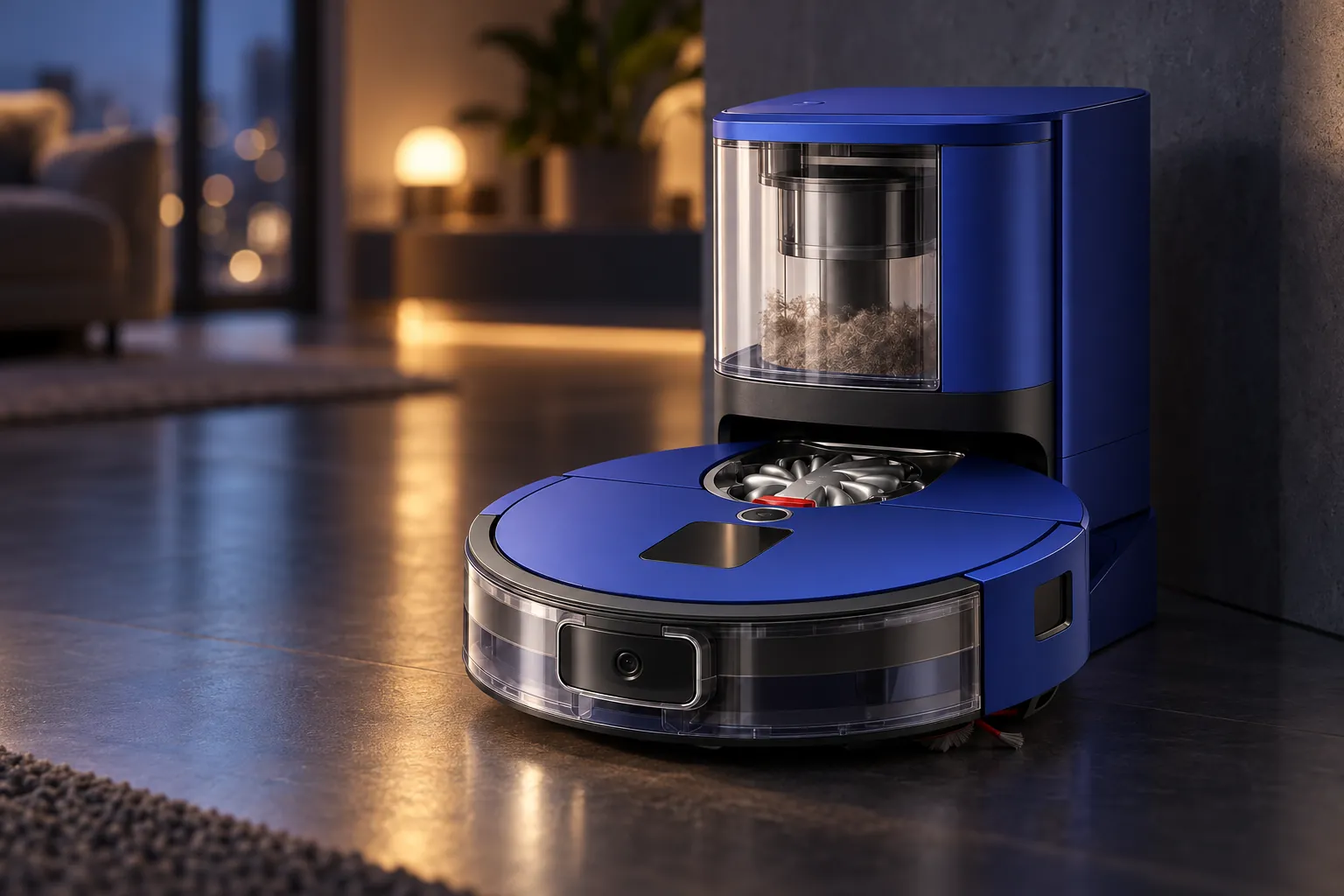

A strong hard-floor concept with heated pad care, but reported auto-empty failures make a good returns policy essential.
Check price on AmazonWe link to the exact model on Amazon UK. Prices change often, so check the live price before you buy. As an Amazon Associate we earn from qualifying purchases.
Picture the post-dinner kitchen floor: crumbs under the table, a faint sticky mark by the worktop and a robot returning to its dock with damp pads. Dyson's R2 Nurovi Wash+Dry is built around avoiding the unpleasant bit afterwards. Its dock washes two mop pads with 75°C water, dries them using 45°C hot air and empties dry debris without disposable bags. The short answer: this is a compelling option for hard-floor-heavy homes that value automated mop maintenance and bagless dust collection, but the reports of unreliable auto-emptying mean we recommend buying only from a retailer with a straightforward returns policy.
| At a glance | Dyson R2 Nurovi Wash+Dry |
|---|---|
| Cleaning type | Robot vacuum and hard-floor washer |
| Maximum stated suction | 21,000Pa in Powerful mode |
| Mop system | Two spinning Reuleaux triangle pads |
| Dock pad washing | 75°C water |
| Dock pad drying | 45°C hot air |
| Maximum stated runtime | 90 minutes |
| Robot dimensions | 352mm × 352mm × 96mm |
| Robot weight | 3.6kg |
Dyson R2 Nurovi Wash+Dry: what Dyson announced and when UK buyers could get it
Dyson announced the Nurovi robot range on 3 September 2026, then put the R2 Nurovi Wash+Dry on sale in the UK on 4 September 2026. It was positioned between the vacuum-only R1 Nurovi Dry and the more elaborate R3 Nurovi Spot+Scrub UV.
The R2 was the wet-and-dry middle model: it retained the R1's 21,000Pa stated suction figure and Twin-capture pickup system, then added simultaneous vacuuming and hard-floor washing, along with a dock that can wash and dry its pads. Dyson's UK launch RRP was £749.99. John Lewis also listed that price, and had shown a £599.99 promotion; those figures describe past listings rather than a promise of a current price.
R1 Nurovi Dry
R2 Nurovi Wash+Dry
R3 Spot+Scrub UV
That makes the R2 a premium purchase rather than a simple step up from a basic robot vacuum. The argument for spending more is not stronger stated suction than the R1. It is the ability to complete a vacuum-and-mop routine in one pass, then return to a dock intended to leave the pads cleaner and drier for the next run.
For UK buyers, the sensible question is not simply whether £749.99 is affordable, but which job the R2 would remove from the weekly routine. In an open-plan kitchen-diner with hard flooring, its combined pass and automatic pad care address a regular, repetitive task. In a mostly carpeted flat, the same money is harder to justify because the R2's mopping system is for hard floors and the R1 offers the same stated suction without the wet-cleaning hardware. Stock and promotions have varied, so it is worth comparing the live Amazon UK listing with other UK retailers rather than assuming the launch price is the only realistic price.
Inside the dock: why 75°C water is the whole story here
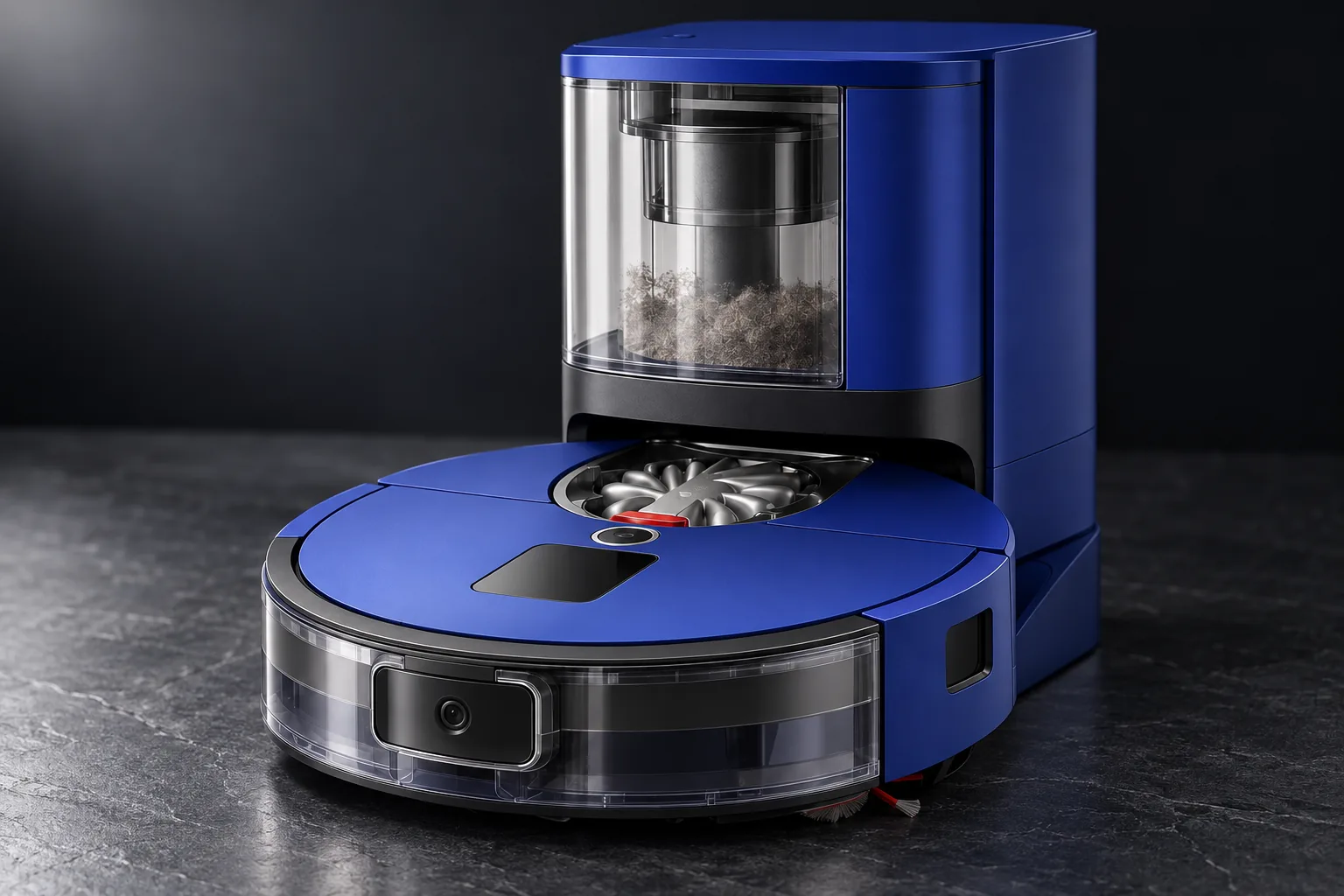
A robot mop is only as hygienic as the fabric it drags around on its next outing. Dyson's answer is a dock that washes the R2's pair of pads with water heated to 75°C, then dries them with 45°C hot air. The stated purpose is to limit mould and odour build-up rather than leave damp pads sitting in a closed base.
What the hygiene claim really means
The heated wash and drying cycle makes practical sense for reducing greasy residue and stale-pad smells. It should not be treated as a sterilisation claim: Dyson published the temperatures, but not a bacterial reduction figure, pathogen kill rate or residual-moisture result for this model.
The rest of the base is equally ambitious. Dyson specifies a bagless, cyclonic docking station with eight cyclones. It automatically empties dry debris, washes and dries the pads, refills the robot, self-cleans and recharges it. Dyson says it can hold up to 90 days of dry debris, based on internal work; actual emptying intervals will depend on pets, floor types, household size and how often the robot runs.
Dyson lists 2.6 litres of dry-debris capacity, while retailer descriptions identify that figure as the dock capacity. Either way, it is the large canister-style base that does the long-term storage job rather than the small container carried by the robot.
Bagless collection is a meaningful differentiator for buyers who dislike the ongoing cost and waste of proprietary dock bags. It also means the self-emptying mechanism has to work consistently for that convenience to matter.
Day to day, this is the part of the R2 that should make ownership feel less like maintaining a mop. You can schedule a combined clean, allow the robot to return for pad washing and drying, then check maintenance alerts in the app rather than immediately removing and hand-rinsing damp pads. That is useful after light kitchen spills or frequent hallway traffic, when running a conventional mop feels disproportionate. It does not mean the dock needs no care: the published specification confirms automated self-cleaning, but does not promise that users will never need to inspect the robot, empty its stored debris or respond to an alert.
The 90-day claim also needs the right interpretation. It is a claimed maximum dry-debris interval from Dyson's internal testing, not a timetable for every household. A home with shedding pets, long hair or lots of tracked-in debris could fill the system sooner, while the reports of transfer problems mean buyers should check early that debris is actually reaching the dock. The heated wash is a strong maintenance feature; it cannot compensate if the dry-debris route is not behaving as intended.
The Reuleaux triangle pads: clever geometry, unproven corners
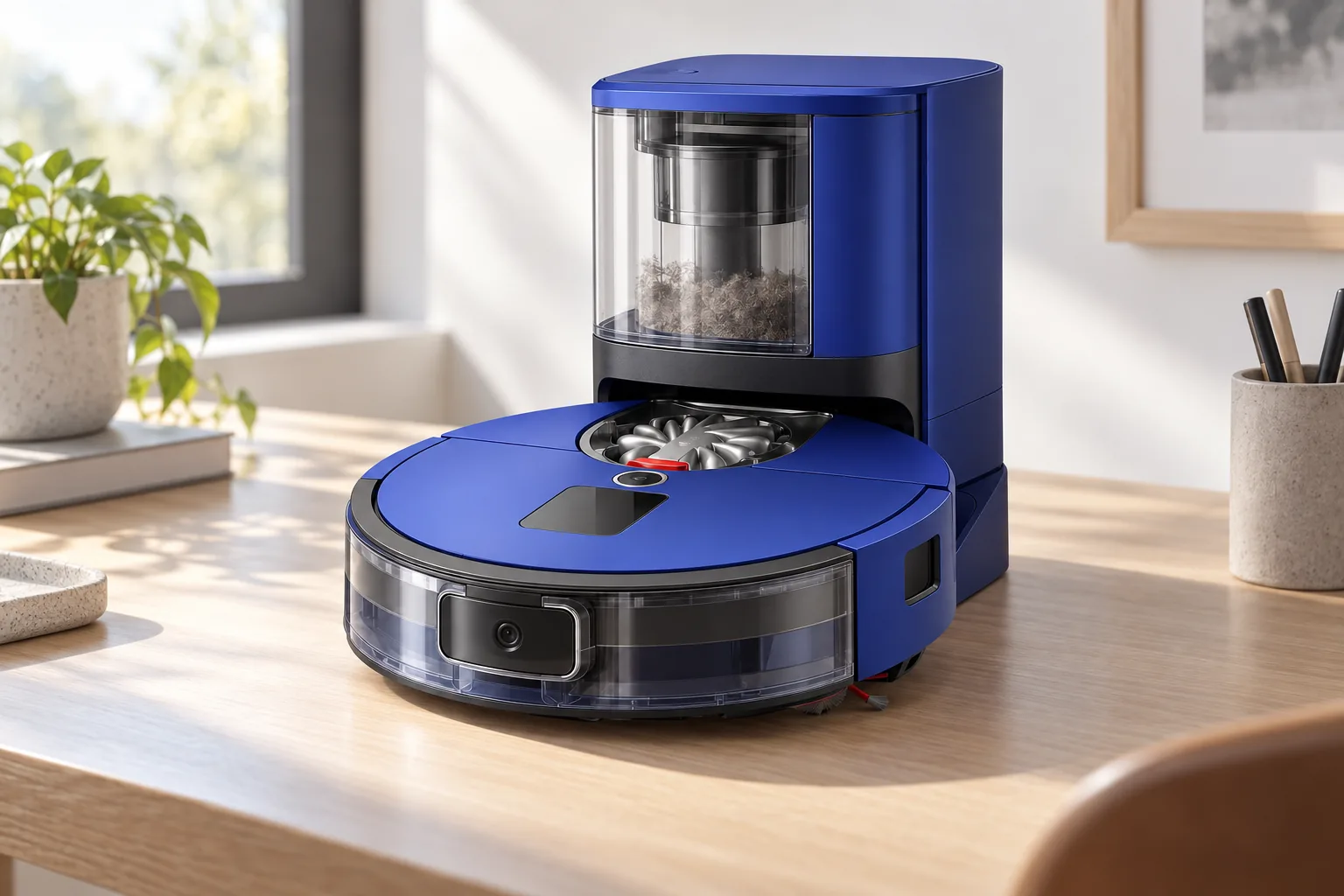
The R2's visual signature is its pair of Reuleaux triangle mop pads. A Reuleaux triangle is a curved, constant-width triangular shape, and Dyson uses the pointed sections to argue that its pads can reach further into corners than conventional circular pads. The pads spin with an eccentric movement pattern rather than simply rotating in place.
Two spinning triangle pads
Dyson designed their curved triangular shape to maintain a smooth spinning motion while placing more pad material close to walls and corners.
27mm extending side sweeper
The side brush reaches outward for loose dust, hair and crumbs at skirting boards, where a round robot body cannot sit flush to the wall.
Vacuum and wash together
The R2 is intended to pick up dry debris and wash hard flooring within one routine rather than requiring separate cleaning passes.
The geometry is interesting, but it has not yet earned the kind of proof Dyson's corner-cleaning message implies. Expert Reviews pointed out that Dyson's launch demonstration did not actually show the R2 cleaning a corner. T3's Lizzie Wilmot later reported that the pads did not reach into corners as effectively as expected.
That does not make the pads pointless. T3 found the extending side sweeper more successful at gathering hair and dust along edges. For everyday housekeeping, that can be more useful than a dramatic corner-cleaning claim. But buyers expecting every 90-degree corner to emerge scrubbed should treat the triangle shape as a promising design idea, not a guaranteed outcome.
Twin-capture suction and the auto-empty problem two reviewers both hit
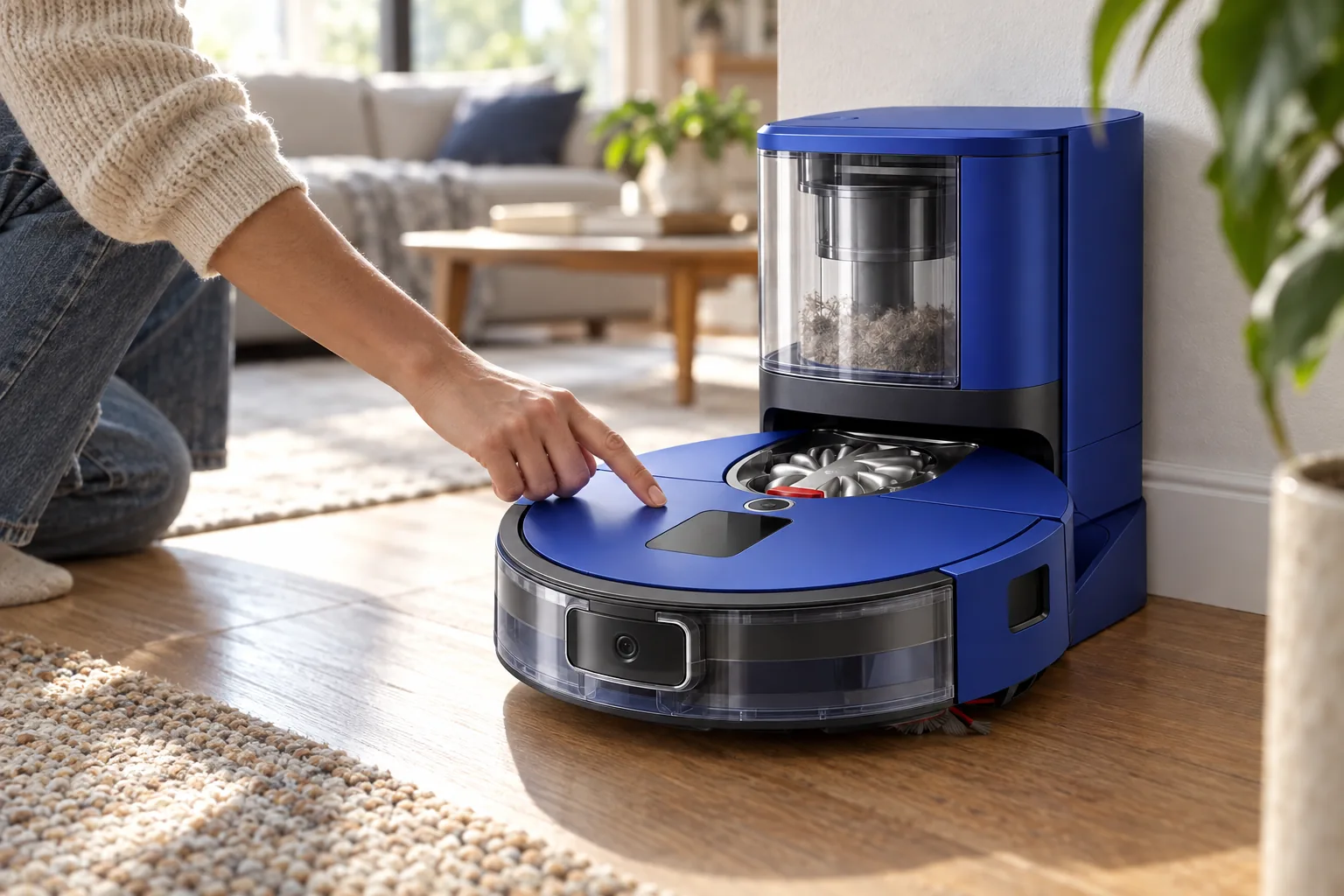
Dyson's Twin-capture system separates the jobs of handling larger debris and fine dust. A brush bar is intended to deal with larger particles, while a separate high-efficiency suction path targets finer debris. Dyson quotes up to 21,000Pa in Powerful mode, a maximum figure that has not been independently measured for this robot.
The main brush bar is marketed as anti-tangle and designed for hair and pet hair. It is partnered by the extending anti-tangle side sweeper. On paper, this is a sensible approach: a single opening does not always handle cereal, grit, hair and fine powder in the same way.
However, the route from robot bin to dock has raised a serious practical concern. T3 reported that debris repeatedly remained in the R2's onboard bin rather than transferring reliably into the dock. Wilmot had to empty the robot manually after several runs, cutting directly against the appeal of a self-emptying machine.
Tom Shelton at Just A Dad Approved described a similar issue over three months. Once the onboard bin filled, he reported that the dock could not pull debris out. His account linked the problem to the small suction port behind the brush roll, and he reported that one Cheerio clogged that route in his assessment.
What reviewers liked
- T3 described hard-floor vacuuming and mopping as strong.
- T3 reported a living-room-and-dining-room clean in about 20 minutes.
- The extending sweeper performed well on edge dust and hair, according to T3.
- Shelton praised LiDAR mapping and reported that the robot passed his clutter check.
- The bagless dock avoids recurring dust-bag purchases.
Where caution is warranted
- T3 and Just A Dad Approved both reported dock-transfer failures.
- Shelton reported hair wrapping around the brush roll and scored hair handling 6/10.
- T3 described dock emptying as very loud.
- Triangle pads did not deliver the corner reach T3 expected.
- Shelton scored mopping 6.5/10 in his three-month scorecard.
Two separate reviewers hitting the same failure mode does not establish that every R2 will do it. It does mean the dock cannot be treated as a proven hands-off solution. At this price, dependable debris transfer is not a small convenience feature; it is central to the product's purpose.
There is a useful distinction between a buyer happy to supervise a premium robot and one buying specifically to avoid chores. If you do not mind checking the brush bar, looking at the robot bin occasionally and intervening if something blocks the route, the R2's hard-floor strengths may still outweigh its risk. If your aim is to leave it running while you are out and assume every stage will complete without attention, the reviewer evidence makes that a less comfortable bet. The same caution applies to larger debris and to homes where hair is likely to be the dominant mess.
Mapping, the MyDyson app and everyday run times
The R2 uses high-speed LiDAR mapping alongside line lasers and edge sensors for navigation and obstacle recognition. An ultrasonic sensor distinguishes hard flooring from carpet so that the robot can change its cleaning behaviour, while a piezo sensor counts and sizes dust particles and can raise suction automatically in Auto mode.
MyDyson supports editable maps, room editing, schedules, no-go zones, do-not-disturb periods, zone cleaning and maintenance alerts. T3 praised the app's map editing, including room splitting and the ability to add furniture to the floorplan. That kind of adjustment matters in a British home where a kitchen, hallway and living room may have different surfaces and different cleaning priorities.
Set-up was not completely frictionless in T3's account. Pairing took several attempts and roughly 10 minutes, although the robot mapped the area quickly once connected. That is a manageable irritation rather than a reason to rule it out, but it is another reminder that premium robot cleaning still needs occasional attention.
T3's reported roughly 20-minute vacuum-and-mop run across its living room and dining room is encouraging for daily maintenance. It should not be treated as a whole-home endurance benchmark, but it suggests that the R2 can make a visible difference without turning a routine clean into an all-afternoon event.
Before planning a first run, it is worth deciding which rooms genuinely suit simultaneous cleaning. The R2 is intended to adjust behaviour across hard floors and carpets, but its standout benefit is the hard-floor wash. Use the editable map to separate a kitchen or dining area from rooms where you mainly want vacuuming, mark places the robot should avoid and set a do-not-disturb period if the dock is near a bedroom or home office. That turns the app from a novelty into a practical way to fit the robot around the household rather than asking the household to adapt to it.
Connectivity also has a modest but real setup requirement: Dyson says the MyDyson app needs a compatible device, Wi-Fi or mobile data and Bluetooth 4.0 support. The pairing issue reported by T3 does not prove a general fault, but it makes sense to allow time for connection and map creation rather than expecting an instant out-of-box clean. Once the map is established, scheduled rooms, no-go zones and maintenance alerts are the functions most likely to matter in daily use.
Size, noise and the low-furniture problem
The robot measures 352mm by 352mm and stands 96mm high, with a stated weight of 3.6kg. T3 recorded it at roughly 35cm by 35cm and just under 10cm tall, closely matching Dyson's figures. That height is important: the R2 may not reach beneath lower sofas, beds and TV units.
Shelton specifically warned that it would not fit under most low couches and beds. Before buying, measure the gap under the furniture you expect it to clean beneath. A robot that cannot enter the dusty strip under the sofa can still handle open flooring well, but it cannot replace an occasional manual clean there.
The dock is substantial too, at 517mm high, 467.5mm long and 415mm wide, with a stated weight of 9.2kg. T3's recorded dock dimensions were approximately 52cm high, 47cm long and 42cm wide. This is a base that needs a proper home rather than a narrow sliver beside a cupboard.
T3 described the dock as very loud during its emptying cycle. No measured decibel result was published, but it is sensible to schedule cleaning away from bedtime, meetings or a sleeping baby if the base will sit close to living space.
That physical footprint is a meaningful UK-home trade-off. The dock is not something to tuck casually into a narrow hallway, and its weight means it is better treated as a semi-permanent appliance once positioned. Measure the intended dock area as well as the robot's route beneath furniture. Buyers in smaller flats may find the R2 works best when the base can live near an open kitchen or utility area; buyers who would need to move it constantly are less likely to enjoy the automation.
Does £749.99 stack up? Positioning against Dyson's own range
The R2's launch price placed it £250 above the R1 Nurovi Dry. The R1 has the same stated 21,000Pa suction rating and Twin-capture system, so the additional spend is about wet cleaning and dock automation, not a higher maximum suction figure.
The R3 Nurovi Spot+Scrub UV sat far above it in Dyson's range, with a US price of $1,199.99. It adds 30,000Pa stated suction, a self-cleaning wet roller, AI recognition for almost 200 spills, stains and objects, UV floor checking, a 200-minute maximum runtime and a three-hour charge time. Those are substantial paper advantages, but they do not make the R2 redundant: the R2 is the model aimed at buyers who want a serious mop dock without moving into flagship pricing.
| Dyson range context | R1 Nurovi Dry | R2 Nurovi Wash+Dry | R3 Nurovi Spot+Scrub UV |
|---|---|---|---|
| Cleaning format | Vacuuming | Vacuuming and hard-floor washing | Vacuuming and wet-floor washing |
| Stated suction | 21,000Pa | 21,000Pa | 30,000Pa |
| Wet-cleaning system | Not applicable | Two Reuleaux triangle pads | Self-cleaning wet roller |
| Maximum stated runtime | 90 minutes | 90 minutes | 200 minutes |
| Charge time | 6.5 hours | 6.5 hours | 3 hours |
| Launch or listed price | £499.99 UK launch RRP | £749.99 UK launch RRP | $1,199.99 US listed price |
The practical value calculation is therefore simple. If you only need autonomous vacuuming, the R1's lower launch price and matching stated suction make it the rational Dyson alternative. If you want mopping but do not want to manually rinse pads after every run, the R2's heated dock is the part worth paying for. Its weakness is that the convenience case is weakened by those auto-empty reports.
There are credible category alternatives, but the available evidence does not make a clean one-to-one winner obvious. Roborock's QX Revo Ultra 2 is listed by Costco with a 25,000Pa claim, while T3 identified the Eufy Omni S2 as an alternative with higher stated suction and similar mopping and corner-reach ideas, albeit at a considerably higher price. However, suction-pressure ratings like these are not standardised cleaning tests, and the exact dock temperature for the Roborock model was not confirmed in the sources reviewed. The R2's clearer differentiators remain its bagless cyclonic dock and unusual triangular pads, rather than an uncontested specification lead. Vacuum Wars described the R2's 75°C dock temperature as near the lower end of current high-temperature dock claims among rivals, rather than a leading figure.
Where the evidence is still thin
The R2 arrived in September 2026, so there is limited long-term independent coverage. Vacuum Wars stated that it had not independently assessed the R2 when it covered the Nurovi launch, leaving several of Dyson's most ambitious claims dependent on manufacturer material.
There is no independently measured suction result for the 21,000Pa maximum. There is also no published independent result showing how dry the pads are after the 45°C drying cycle, how much odour reduction the dock achieves over time, or how the 75°C wash affects microbial contamination. The engineering logic is credible, but the hygiene case remains stronger as a maintenance argument than as a laboratory-proven health claim.
Corner performance needs the same restraint. The shape of the pads is genuinely different, and the R2's extending side sweeper clearly gives it another tool at the edge of a room. Yet neither a published corner-cleaning percentage nor a measured remaining-gap result supports treating the triangular pads as a finished answer to every awkward corner.
Runtime and noise deserve similar caution. The 90-minute maximum and 6.5-hour charge time are Dyson figures, while no independent loaded-runtime test or controlled sound-pressure measurement was found. T3's description of a very loud emptying cycle is useful real-world context, but it is not a decibel benchmark. Buyers comparing robot vacuums should therefore avoid treating a long list of claimed numbers as proof of better cleaning, quieter operation or greater reliability.
Who this robot is actually built for
Hard-floor households
The R2 makes the most sense in homes with substantial hard flooring, everyday dust and occasional light wet messes.
Routine-first cleaners
It suits people who want vacuuming and mopping handled in the same scheduled run rather than as two separate jobs.
Bag-free buyers
The eight-cyclone dock is attractive if you prefer emptying a canister over repeatedly buying disposable dust bags.
Low-furniture homes
At 96mm high, the R2 is a poor fit if cleaning underneath low sofas and beds is central to your routine.
Pet-hair-heavy homes
Shelton reported hair wrapping around the brush roll and gave hair handling 6/10, so caution is sensible with long hair or shedding pets.
Fully hands-off expectations
Two reviewer accounts of failed debris transfer make this a difficult recommendation for anyone unwilling to empty a robot bin manually.
The R2 is not a deep-pile-carpet specialist, nor is it a robot to buy purely for its corner-cleaning promise. T3 and Just A Dad Approved found it most effective as a hard-floor maintenance machine that can keep kitchens, dining areas and hallways looking presentable between bigger cleans.
A useful decision scenario is the busy household with regular crumbs, footprints and light spills on hard floors: here, the R2's combined routine and heated pad maintenance are easy to understand. Another is the design-conscious Dyson buyer who specifically wants a bagless dock and is prepared to monitor early performance; the R2 may appeal despite its risk. The weakest scenario is a pet-heavy home that needs reliable hair handling and unattended emptying every day. Shelton's reported tangles and clogging mean the R2 has not yet earned a confident recommendation for that use.
Common questions before you buy
Who should buy which
For the buyer choosing from the product covered here, the recommendation is focused. Choose the Dyson R2 Nurovi Wash+Dry if you have plenty of hard flooring, want mopping and vacuuming completed together, and place real value on a dock that washes and dries its own pads. The bagless design is an added advantage for homes that would rather empty a container than purchase replacement bags.
Hold off if your main priority is reliable, fully automated debris disposal. The same weakness appeared in T3's coverage and Shelton's longer account, and it undermines the feature that is meant to make premium robot ownership less hands-on. Buyers with low furniture, long hair or shedding pets should be especially careful.
If you are choosing strictly within Dyson's range, the R1 is the sensible lower-cost option for vacuum-only needs, because it shares the R2's stated 21,000Pa figure and Twin-capture system. The R2 earns its extra cost only when automatic pad washing and drying would genuinely change your routine. The R3 offers considerably stronger paper specifications, but its confirmed price is a US figure and its UK launch was reported for 2027, so it is not a direct UK purchase alternative at present. For the R2 itself, a retailer with a straightforward returns process remains the most practical safeguard while independent long-term evidence is limited.
Verdict: hygienic ambition, but a critical convenience question
The Dyson R2 Nurovi Wash+Dry has a more thoughtful hygiene proposition than a basic robot mop: 75°C pad washing, 45°C hot-air drying and a bagless cyclonic dock directly address the unpleasant maintenance that often follows automated mopping. Its hard-floor cleaning, mapping and combined cleaning routine were praised by reviewers. Yet the repeated reports from T3 and Just A Dad Approved of debris failing to reach the dock prevent an uncomplicated recommendation at its premium launch price. Buy for the heated mop maintenance and bag-free design, not on the assumption that the auto-empty system will always remove manual intervention.
Sources
- Dyson R2 Nurovi Wash+DryHeated dock appealView on Amazon
Sources and evidence (23)
- rgbdirect.co.uk (other)
- dyson.co.uk (other)
- dyson.com (other)
- dyson.co.uk (other)
- dyson.co.uk (other)
- johnlewis.com (retailer)
- t3.com (other)
- justadadapproved.com (other)
- expertreviews.co.uk (other)
- techradar.com (other)
- vacuumwars.com (other)
- dyson.com.au (other)
- vacuumwars.com (other)
- dyson.com (other)
- dyson.com (other)
- robovations.com (other)
- app.warehouserunner.com (other)
- dyson.com.sg (other)
- costco.com (other)
- us.roborock.com (other)
- irobot.com (other)
- reddit.com (other)
- dyson.com (other)