
GoPro MAX2 First Look: can 360 video finally go mainstream?
"True 8K", twist-off lenses and the GoPro mounts you may already own. We weigh up what reviewers found, and whether ordinary action-camera buyers should make the leap.
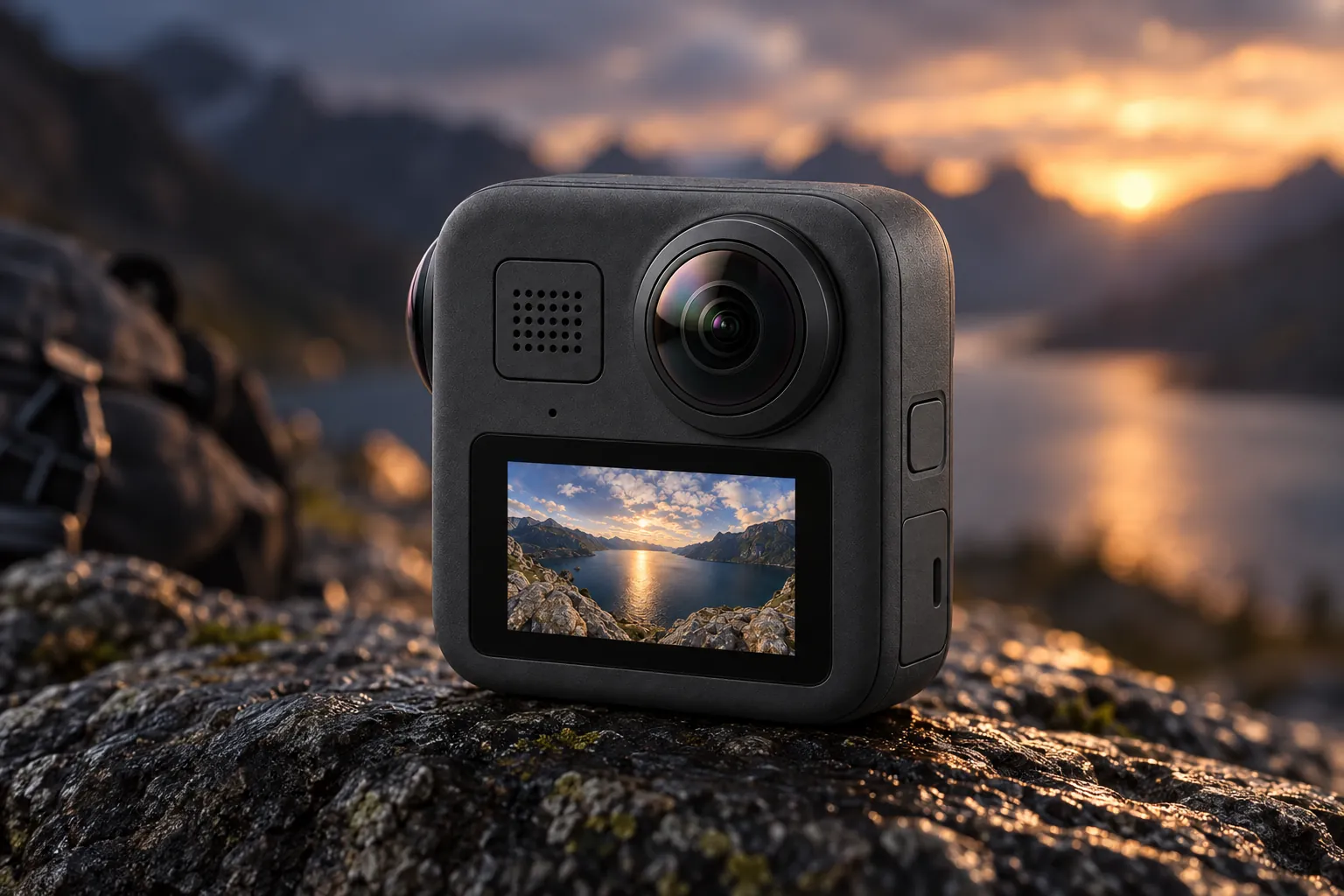


Reviewers praise its sharp daylight 8K, replaceable lenses and GoPro mounts; low light and indoor 8K overheating are the catches.
Check price on AmazonWe link to the exact model on Amazon UK. Prices change often, so check the live price before you buy. As an Amazon Associate we earn from qualifying purchases.
You clip the camera to your helmet, set off down the trail and simply stop thinking about it. No wondering whether you aimed it right, no missing the moment your mate wiped out behind you, because a 360 camera captures everything and lets you choose the shot afterwards. That is the dream. The question is whether the GoPro MAX2 delivers it without turning your Sunday ride into a Sunday night of editing.
The short answer
The GoPro MAX2 is a strong buy if you film outdoors in daylight, already own GoPro mounts, or want serious creator tools such as 10-bit colour and GP-Log. Reviewers rate its daylight 8K detail highly, and the Amazon UK bundle's two batteries, pole and memory card make it ready to go out of the box.
Think twice if you mostly film after dark, indoors or from a tripod, or if you want the simplest phone-only workflow. Reviewers found rivals better in low light and easier to edit with, and the MAX2 can overheat during long, static 8K recordings. It makes 360 capture easy; it does not make 360 editing effortless.
| At a glance | GoPro MAX2 |
|---|---|
| Camera type | Dual-lens 360 action camera with single-lens mode |
| Top 360 video | 8K at up to 30fps, 10-bit colour |
| Single-lens video | Up to 4K60 |
| 360 stills | Approx. 29MP |
| Waterproofing | 5m without a housing |
| Battery | Removable 1,960mAh Enduro |
| Weight | 190g (GoPro support page); 195g quoted by reviewers and GoPro's spec sheet |
| Storage | microSD only (V30 or faster recommended) |
| Extras | Built-in GPS, six microphones, replaceable lenses, GoPro mounting fingers |
| UK launch | Announced 23 September 2025; pre-orders and retail availability from 30 September 2025; launch RRP £449.99 (camera plus one battery) |
GoPro MAX2: What 'True 8K' Means, and Why It's the Whole Pitch
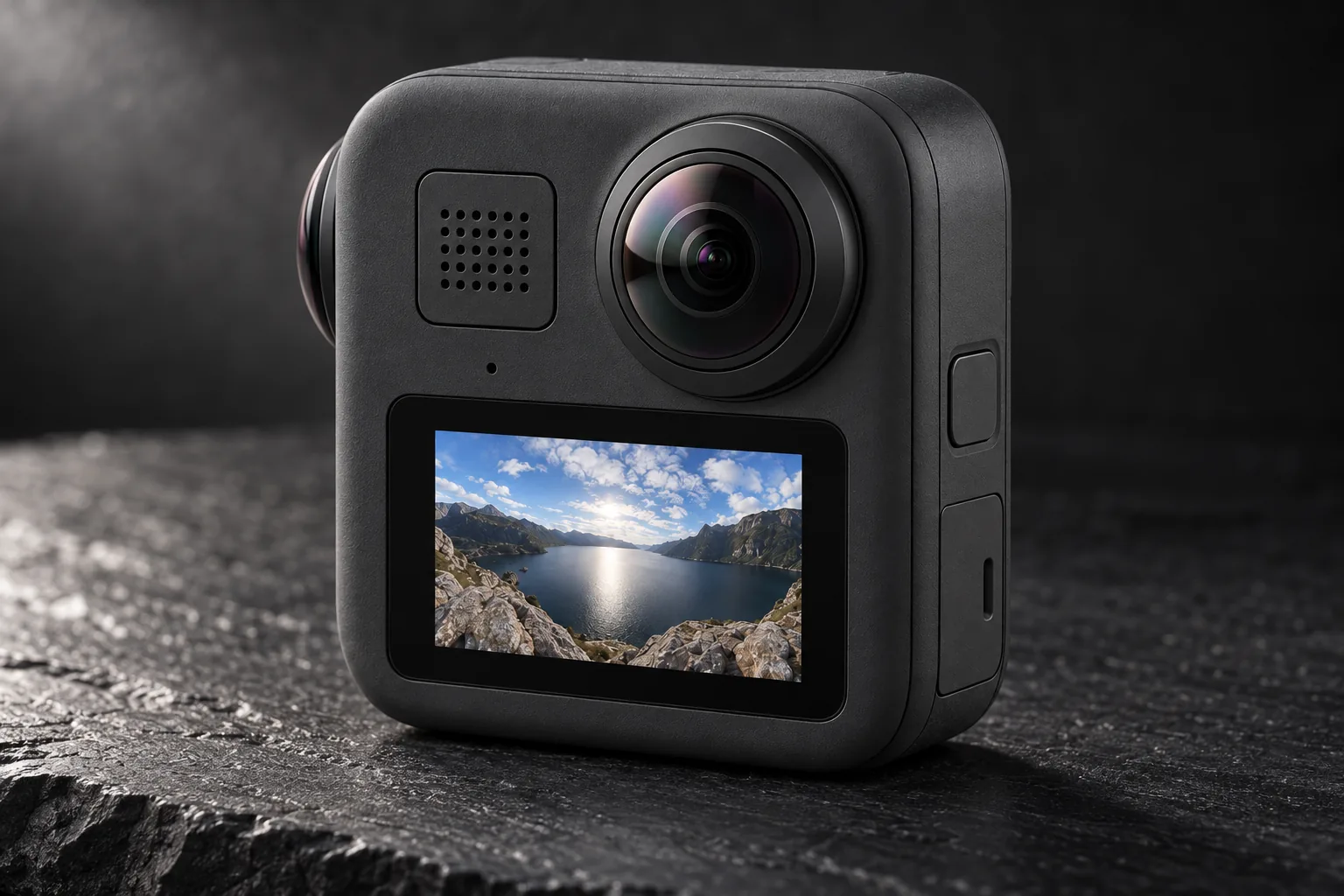
The MAX2 is GoPro's second-generation 360 camera, replacing the original MAX that launched back in 2019. Two lenses sit back to back, each capturing a huge circular fisheye image, and the camera stitches them into a full sphere of video. You then "reframe" that sphere into a normal flat video, pointing a virtual camera wherever you like.
GoPro's headline claim is "True 8K". Most 360 cameras quote a resolution that includes the overlapped, unused or black areas around those circular fisheye images. GoPro says it counts only active image pixels, and claims this gives up to 21% more usable resolution than rival cameras labelled 8K.
That is a real distinction, but treat it carefully. It is a difference in how resolution is measured, not a promise that every clip will look 21% sharper. It does, though, help explain why reviewers singled out the MAX2's daylight detail, which we come to shortly.
In single-lens mode the MAX2 behaves like a conventional action camera, with Max HyperView (up to a 180-degree view at 4K60, according to GoPro), Max SuperView, Ultra Wide, Wide and Linear digital lenses. Stabilisation comes from Max HyperSmooth, and 360 Horizon Lock keeps the horizon level however the camera tilts.
The small print on frame rates and bitrate
GoPro now advertises 4K100 for slow motion, whilst Tom's Guide's review listed 4K/90; the available rate can depend on firmware and region settings. Similarly, GoPro's launch announcement promised up to 300Mbps through its experimental GoPro Labs firmware, but the official spec sheet lists 120Mbps as standard and a March 2026 firmware update (v1.30) added a 200Mbps setting. If high bitrate matters to you, check the current firmware notes rather than relying on the launch figure.
Inside the Box: What UK Buyers Actually Get
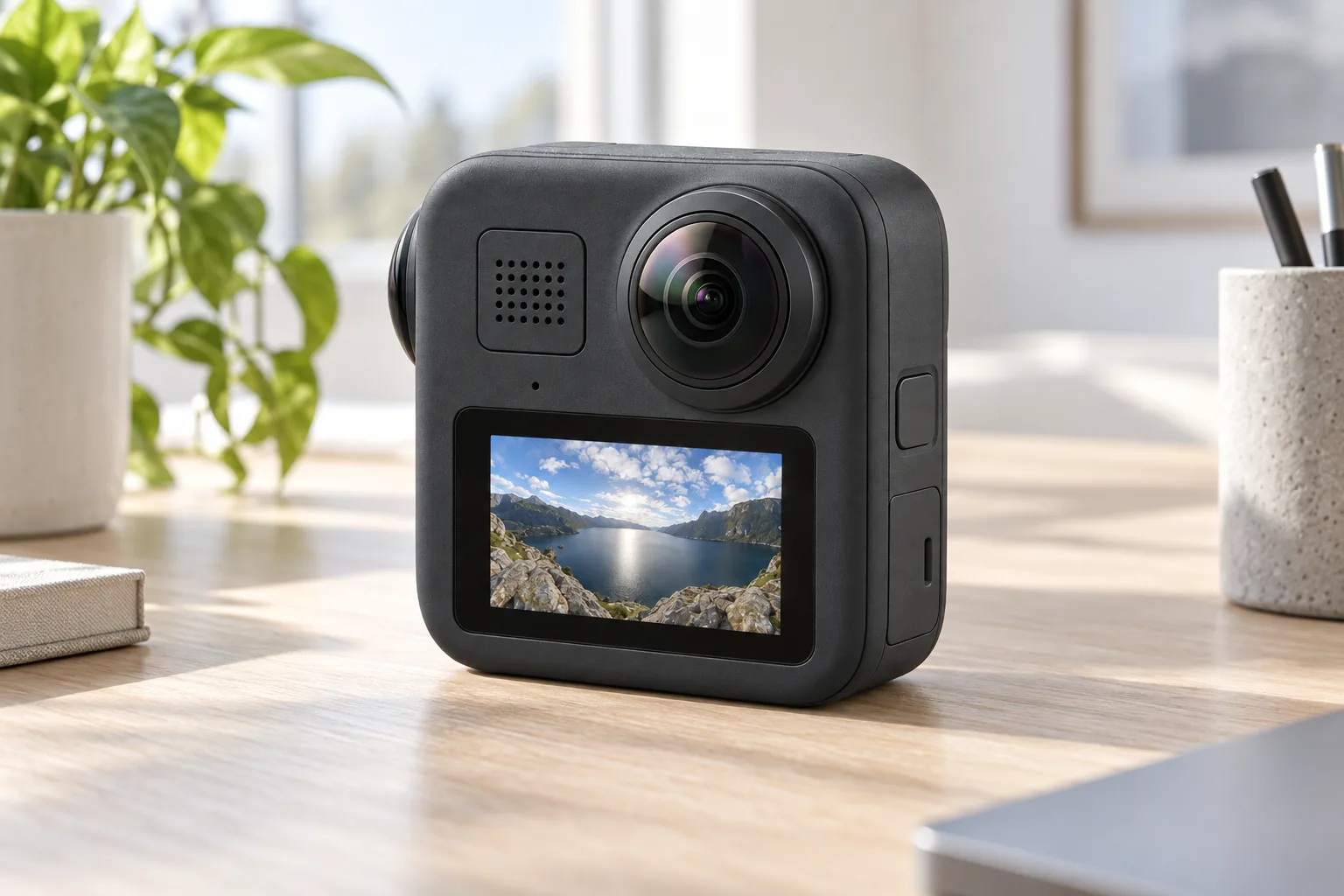
The listing we are looking at on Amazon UK (ASIN B0FTC6GVYD) is GoPro's MAX2 + Accessories Bundle. It was in stock when we checked on 3 November 2026, and GoPro's own UK store lists identical contents:
- GoPro MAX2 camera (model CHDHZ-311-RW, black)
- 4ft (1.2m) extension pole
- Two 1,960mAh MAX2 Enduro batteries
- SanDisk Extreme 64GB microSDXC card
GoPro announced the MAX2 on 23 September 2025, with pre-orders and global retail availability beginning on 30 September 2025. Its launch RRP was £449.99 for the standard package, which includes only one battery and no memory card. Prices have moved around since; GoPro's US store, for instance, was running a substantial promotion in early November 2026. Retailer bundle pricing in the UK varies and changes often, so compare the bundle against the standard camera on the day you buy.
MAX2 (standard)
Camera, one Enduro battery, USB-C cable and basic mounting kit. You supply the memory card.
MAX2 + Accessories Bundle
Adds the 1.2m pole, a second battery and a 64GB SanDisk Extreme card. This is the Amazon UK listing.
Activity bundles
Action Essentials, Water Sports, Ski, Travel and Drone-Like Aerial packs, each with different accessories.
Every MAX2 bundle contains the same CHDHZ-311-RW camera. Image quality, battery life, software and thermal behaviour are identical across all of them; only the accessories change. Choose a bundle for what is in the box, not because you expect a better camera.
Of the extras, the pole earns its place. Because 360 stitching can erase the pole from the finished shot, a 1.2m stick creates that "invisible selfie stick" or drone-like floating viewpoint that makes 360 footage look so distinctive. The second battery, as you will see, is close to essential.
Daylight Hero, After-Dark Zero: How the Footage Looks
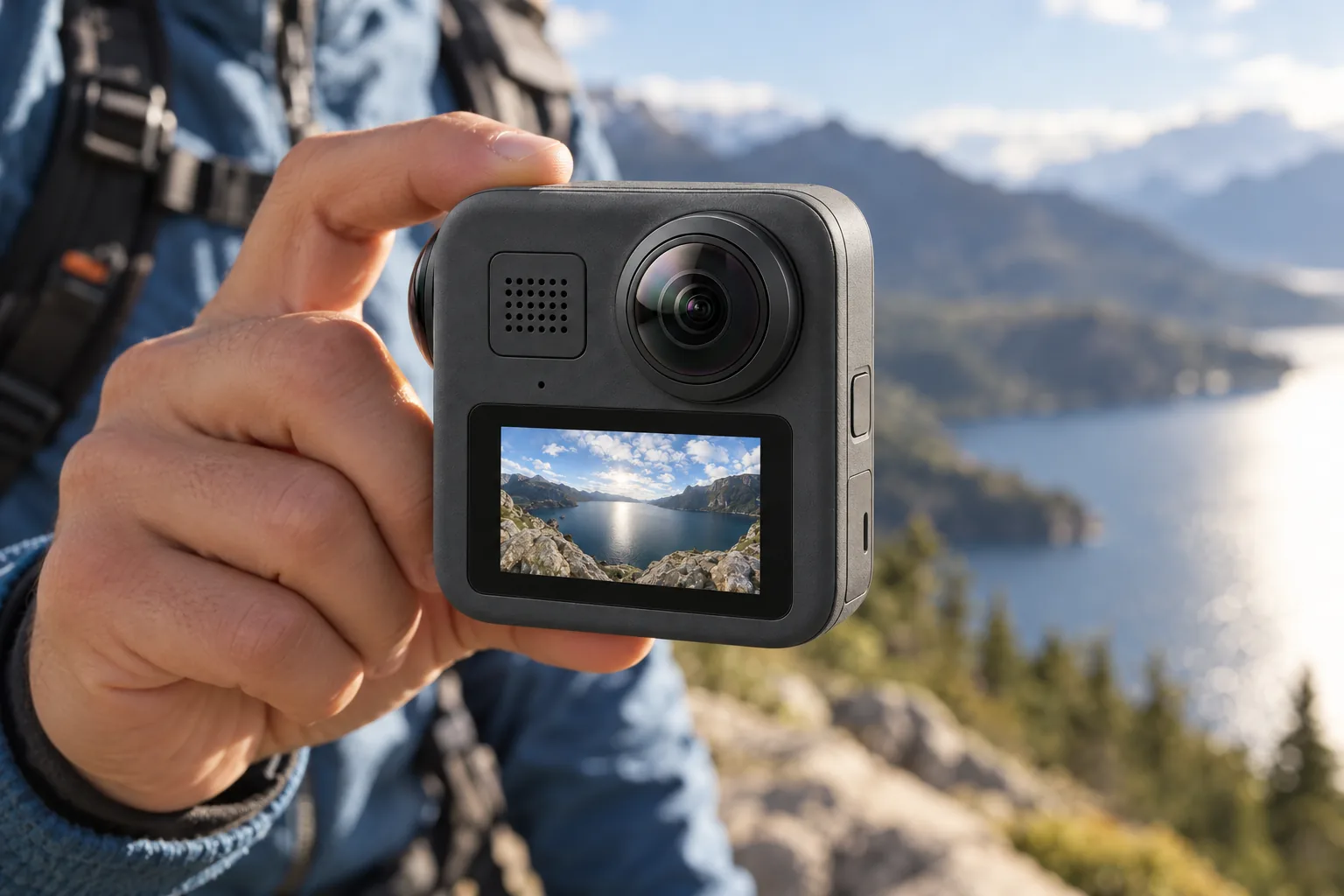
In good light, the reviews are glowing. TechRadar compared the MAX2 with the DJI Osmo 360 and Insta360 X5 and judged that the GoPro produced the cleanest and sharpest 8K footage of the three. WIRED found it slightly sharper than the Insta360 X5 in foliage-heavy scenes, with stronger contrast and more realistic default colour, and noted that 10-bit colour helped avoid banding in skies and sunsets.
The picture changes once the sun drops. The MAX2 uses two sensors reported by Tom's Guide and other detailed specifications as 1/2.3-inch, whereas the Insta360 X5 uses larger 1/1.28-inch sensors. TechRadar said the DJI and Insta360 made usable low-light footage easier, whilst the MAX2 struggled after dark. Cycling Weekly reached the same conclusion and advised avoiding the MAX2 if night recording is your priority.
There is a subtler issue too. TechRadar saw some footage that looked slightly overexposed or washed out under bright skies. Switching to manual exposure improved things, but that is an extra step a casual buyer might not know to take.
Image strengths
- Cleanest, sharpest 8K daylight footage of three rivals in TechRadar's comparison
- 10-bit colour reduces banding in skies, per WIRED
- GP-Log for grading if you edit seriously
- Max HyperSmooth smoothed bumpy motorcycle footage, according to Tom's Guide
Image weaknesses
- Struggles after dark compared with DJI and Insta360 rivals
- Some washed-out bright skies on automatic exposure
- 4K100 slow motion becomes relatively low resolution once reframed
- Wind reduction was weak in breezy conditions, per TechRadar
| Shooting situation | What reviewers reported | What it means for you |
|---|---|---|
| Sunny ride, hike or ski run | Excellent detail and colour (TechRadar, WIRED) | The MAX2's home turf |
| Bright, open sky | Occasional overexposure (TechRadar) | Learn manual exposure for snow and beach days |
| Dusk, night, dim venues | Rivals easier for usable footage (TechRadar, Cycling Weekly) | Consider a different camera if this is your main use |
| Windy coast or descent | Wind reduction insufficient (TechRadar) | A Bluetooth mic or earbuds may help |
One more expectation to set. Reframing an 8K sphere into a flat 16:9 or 9:16 clip gives roughly 4K-equivalent output, according to Tom's Guide's analysis, but that is still well below pointing a dedicated action camera straight at the subject. You trade some sharpness for the freedom to look anywhere.
The Overheating Problem: Why Where You Film Matters
This is the finding most likely to catch an ordinary buyer out. TechRadar left the MAX2 recording 8K30 indoors at room temperature and it shut itself down to avoid overheating after just under 30 minutes. Expert Reviews reported something similar: the camera grew hot after about 20 minutes of 8K and stopped around the 30-minute mark.
Drop the resolution and things improve. TechRadar's sample managed almost 58 minutes at 5.6K/30 indoors before thermal shutdown. Tom's Guide ran single-lens 4K60 indoors for a full 90 minutes until the battery was exhausted, with no overheating at all.
Continuous recording time before the camera stopped. Results come from two different outlets with different methods, so treat them as indicative rather than directly comparable.
The key word is "indoors". TechRadar noted that cooler outdoor conditions produced longer recording times, and reviewers broadly agree that moving use, such as cycling or a helmet mount, cools the camera's heat sink with airflow. The MAX2 behaves very differently as a worn action camera than as a static tripod camera.
If you plan to film a child's school play, an indoor party, a long interview or a timelapse from a fixed spot, 8K is a gamble beyond half an hour. Use 5.6K or single-lens mode, and do a trial run at home with your chosen settings before an event you cannot repeat. GoPro also quotes an operating range of roughly -10°C to 35°C, so a parked camera on a hot summer day is another risk.
Battery Reality Check: Why the Second Battery Matters
The removable 1,960mAh Enduro battery is rated for cold weather down to -10°C, which is reassuring for UK winters and ski trips. How long it lasts depends heavily on the mode and on how independent outlets ran their tests.
| Mode | Result | Source and conditions |
|---|---|---|
| 8K/30 360 | 73 minutes | Tom's Guide, standardised battery test |
| 8K/30 360 | Just over one hour | TechRadar, outdoor use |
| 8K/30 360 | 30–40 minutes | Camera Jabber, more conservative test |
| 4K/60 single-lens | 90 minutes | Tom's Guide, indoor, no overheating |
The most consistent figures point to roughly an hour to 75 minutes of outdoor 8K per battery, with shorter runs possible when the camera sits still or the weather is warm. Single-lens mode is gentler on both battery and heat.
Charging is less clear-cut. GoPro does not publish a full-charge time, and independent reports range from about 1.5 hours with a 15W charger to more than 2.5 hours, with one reviewer criticising the lack of fast charging. You cannot rely on topping up quickly over a café stop.
Plan your day around two batteries
With two Enduro batteries, the Amazon UK bundle gives you around two hours of 8K recording on the figures above. For most rides, hikes or a day on the slopes, that covers the highlights if you start and stop recording rather than leaving it running. All-day or multi-day trips will want a third battery or a power bank, and a charging plan for the evening.
Twist, Click, Done: The Replaceable Lens System
Every 360 camera has the same weak spot: two bulging lenses poking out of either side. They cannot be tucked behind a flat cover like a standard action camera's lens, so one scrape on gravel or a knock against a doorframe can ruin your footage.
GoPro's answer is tool-free, twist-and-go optical glass lenses. According to GoPro, you twist off a damaged lens, twist on a new one, and no tool or factory calibration is needed. It is the kind of feature that matters most on the day you need it.
No tools, no calibration
GoPro states the lenses swap by hand, with no recalibration afterwards, so a roadside or chairlift fix is realistic.
Reviewer backing
TechRadar and Cycling Weekly both called it a major practical advantage. Cycling Weekly judged it simpler than Insta360's system and more durable as a long-term ownership proposition.
Real-world toughness
WIRED reported that a waist-height drop onto gravel did not damage its lens, but still valued the ability to replace one in the field.
For an ordinary buyer, the value is peace of mind. A scratched lens becomes a replacement part rather than a reason to write off the whole camera, which makes the MAX2 a more sensible long-term purchase for people who genuinely use it hard.
Built for being bashed about
Reviewers described the body as rugged and well-built, and Tom's Guide found its squat shape less cumbersome than the taller Insta360 X5 for some helmet and body mounts. It also folds out standard GoPro mounting fingers and has a 1/4-20 thread, with compatibility for more than 35 GoPro mounts and accessories.
Reframe Later, Think Now: Does the Quik App Make 360 Usable?
Here is the crux of the mainstream question. A 360 camera removes the work of aiming, but it moves that work to later, when you sit down and decide where the virtual camera should point. How painless that is depends almost entirely on the software.
GoPro's Quik phone app handles reframing, keyframes, effects, stabilisation, trimming and social-media exports. That is a genuinely approachable starting point. However, Tom's Guide found it less feature-rich and less user-friendly than Insta360's app, which is widely regarded as more mature for quick 360 edits.
On a computer, the options are narrower. GoPro discontinued its Quik desktop editor in late 2024, so serious work now runs through GoPro Player, Adobe Premiere Pro and After Effects plug-ins, or DaVinci Resolve's ReFrame plug-in. Those are capable tools, but they are not the drag-and-drop experience a first-time buyer might expect.
Then there are the files themselves. 8K 360 video is large, it lives only on the microSD card because there is no internal storage, and reviewers note you need a capable phone or computer to edit it comfortably. The supplied 64GB card is a useful start, though it will fill up faster than you might expect on a long day of 8K.
Workflow positives
- Quik offers reframing and keyframes on your phone
- Plug-ins for Premiere, After Effects and Resolve
- Built-in GPS embeds location without your phone
- Bluetooth mic support, including compatible earbuds
Workflow frustrations
- Quik less polished than Insta360's app, per Tom's Guide
- No dedicated GoPro desktop editor any more
- No internal storage backup if a card fails
- No wired microphone input
The camera's own controls draw mixed comments. Tom's Guide found the 1.82-inch rear touchscreen bright and reasonably sharp, but too small and fiddly, especially in gloves, and preferred the larger screens on Insta360 models. With autumn cycling and winter ski trips in mind, that is a real consideration; voice control and starting recordings from your phone can ease it.
Be honest about your editing habits. If you rarely edit videos from your phone today, a 360 camera will not change that, and unedited 360 footage is awkward to share. If you enjoy fiddling with clips, reframing can be genuinely fun.
MAX2 vs the Field: Where It Wins and Where It Doesn't
Two rivals came up repeatedly in the reviews: the Insta360 X5 and the DJI Osmo 360. We include them purely for context so you can judge the MAX2's trade-offs; this first look covers the GoPro alone.
| Specification | GoPro MAX2 | Insta360 X5 | DJI Osmo 360 |
|---|---|---|---|
| Top 360 video | 8K/30 | 8K/30 | Up to 8K/50 |
| Weight | 195g | 200g | 183g |
| Waterproofing | 5m | 15m | 10m, IP68 |
| Sensor size | 1/2.3-inch (reported) | 1/1.28-inch | Not confirmed |
| 360 stills | 29MP | Approx. 72MP | Not confirmed |
| 8K/30 battery (Tom's Guide) | 73 min | Similar to MAX2 | 112 min |
| 4K/60 single-lens battery (Tom's Guide) | 90 min | 87 min | 112 min |
| GPS geotagging | Built in | Via phone or accessory (TechRadar) | Via phone or accessory (TechRadar) |
| Low light (TechRadar) | Weaker | Easier usable footage | Easier usable footage |
Tom's Guide single-lens battery comparison. In the same outlet's 8K/30 test, the MAX2 ran 73 minutes against the Osmo 360's 112.
Against the Insta360 X5
The X5 brings larger sensors, three times the waterproof depth, much higher-resolution stills and, according to reviewers, a more polished app and stronger low-light results. It also charges quickly: 80% in 20 minutes with a 30W charger. The MAX2 answers with built-in GPS, simpler tool-free lens swaps, a squatter body for helmets and, in WIRED's eyes, slightly crisper daylight detail.
Against the DJI Osmo 360
DJI's camera lasted far longer in Tom's Guide's battery test, goes deeper underwater, reaches a higher maximum 360 frame rate and includes internal storage as a backup if a card fills or fails. The MAX2's advantages are GPS, replaceable lenses, daylight sharpness and compatibility with the GoPro accessories many action-camera owners already have in a drawer.
Against the original GoPro MAX
If you own the 2019 MAX, the jump is substantial: 8K/30 against 5.6K/30, 10-bit colour, tool-free lenses and newer stabilisation. Reviewers consistently described the MAX2 as dramatically ahead. Note that the batteries differ, so your old spares will not carry over.
So, Who Is This Actually For?
Back to the big question. Can the MAX2 take 360 video mainstream? It gets closer than any GoPro before it, because capture is genuinely simple: mount it, press record, forget about framing. What still separates it from a normal action camera is everything after the ride. If you accept that trade, it is a very capable tool.
Existing GoPro owners
Your mounts and many accessories carry over, and the Quik app will already be on your phone. Adding 360 means no new ecosystem to learn.
Daylight riders, skiers and hikers
Strong daylight detail, Horizon Lock, a helmet-friendly shape and replaceable lenses suit outdoor hobbies, provided you carry the spare battery and live with the small screen.
Serious and semi-pro creators
10-bit colour, GP-Log, manual controls and GPS reward people who already edit in Premiere or Resolve, given GoPro's desktop app has gone.
Night and indoor filmers
Low-light footage trails rivals, and static 8K recording can stop after around half an hour.
Phone-only casual sharers
Reviewers found Insta360's app easier for quick social edits. If you want instant flat video, a standard GoPro Hero is simpler.
Divers and all-day shooters
The 5m depth rating and roughly hour-long 8K battery fall short of the X5 and Osmo 360 on paper and in testing.
Our verdict
The GoPro MAX2 is the first GoPro 360 camera we would comfortably point an ordinary action-camera buyer towards, as long as that buyer mainly films outdoors in good light. Reviewers praise its daylight 8K detail, stabilisation and clever replaceable lenses, and the Amazon UK bundle supplies the second battery, card and pole you would otherwise buy separately.
It is not yet the effortless, point-and-shoot answer that "mainstream" implies. Low light, wind noise, indoor overheating and a less polished app all count against it. We recommend it for daylight adventurers, GoPro loyalists and creators who already edit; night-time and indoor filmers should look elsewhere.
Quick Answers: What UK Buyers Are Asking
Sources
- GoPro MAX2 product and specification pages: gopro.com; UK bundle page: gopro.com/en/gb
- GoPro support, size and weight: community.gopro.com
- GoPro MAX2 launch announcement (23 September 2025): investor.gopro.com
- TechRadar review: techradar.com
- Tom's Guide review: tomsguide.com
- Cycling Weekly review: cyclingweekly.com
- WIRED review: wired.com
- VideoMaker review: videomaker.com
- UK model code listing: harveynorman.co.uk
- GoPro MAX2Best for daylight actionView on Amazon
Sources and evidence (20)
- harveynorman.co.uk (other)
- gopro.com (other)
- techradar.com (other)
- gopro.com (other)
- gopro.com (other)
- tomsguide.com (other)
- videomaker.com (other)
- gopro.com (other)
- s21.q4cdn.com (other)
- community.gopro.com (other)
- community.gopro.com (other)
- gopro.com (other)
- cyclingweekly.com (other)
- investor.gopro.com (other)
- 1410dd2bdd37e05ebf19-a2305060cc55ab8db83b1ef4b8835a6b.ssl.cf5.rackcdn.com (other)
- maisondudrone.com (other)
- wired.com (other)
- static.gopro.com (other)
- gopro.com (other)
- gopro.com (other)