DJI Osmo Pocket 4 Review: The Tiny Camera That Makes Phone Video Look Lazy
A proper three-axis gimbal, a rotating screen and a 1-inch sensor in something that genuinely fits in a pocket. The catch? Your phone is still annoyingly good.

We link to the exact model on Amazon UK. Prices change often, so check the live price before you buy. As an Amazon Associate we earn from qualifying purchases.
DJI's Osmo Pocket 4 is a dedicated camera for the moments where holding a phone simply does not produce the same composed, steady result.
Your Phone vs. A £445 Gimbal: Why Bother?

The DJI Osmo Pocket 4 existed to answer a slightly awkward question: if the phone in your pocket already shoots crisp 4K video, why carry another tiny rectangle that also needs charging, updating and not dropping into a puddle?
It is a fair question. Modern flagship phones had become brilliant at the easy bits: a quick clip of the dog, a birthday candle moment, a sunset you wanted to post before dessert arrived. They were always with you, their HDR processing was clever, and editing was one tap away. For most people, that remained the whole game.
But phones still had a habit of looking a little frantic once you started moving. Walk-and-talk clips can feel floaty, over-smoothed or aggressively cropped. Indoor footage often became soft and noisy. The front camera was usually the weak link. And once you added a proper gimbal and a wireless microphone to make a phone behave like a small production camera, the supposedly simple setup became a bag full of bits.
That was DJI's opening. Announced on 16 April 2026, the £445 Osmo Pocket 4 combined a 1-inch sensor, 20mm-equivalent f/2.0 lens, rotating two-inch screen and a physical three-axis gimbal in a 190.5g body. It was a specialist camera, not a literal phone replacement. That distinction matters.
The £529 Osmo Pocket 4P, launched on 30 July 2026, took the idea further with a second, genuine 60mm-equivalent f/1.8 camera. It was not a digital crop wearing a nice hat. It was a separate medium-telephoto camera with its own 1/1.28-inch sensor.
This review comes down to five things that actually affect whether you will use one: stabilisation, low-light video, the rotating screen, audio options and whether the improvement is worth carrying a second camera alongside your phone.
After living with this kind of camera, my broad answer is simple: a phone remains enough for casual clips. The Pocket 4 becomes worthwhile when video itself is the point. If you regularly film people while walking, make vlogs, record family days out or want footage that feels calmer before you have even opened an editing app, it does something a bare phone still struggles to replicate.
Pocket-Sized Engineering: Design and Build
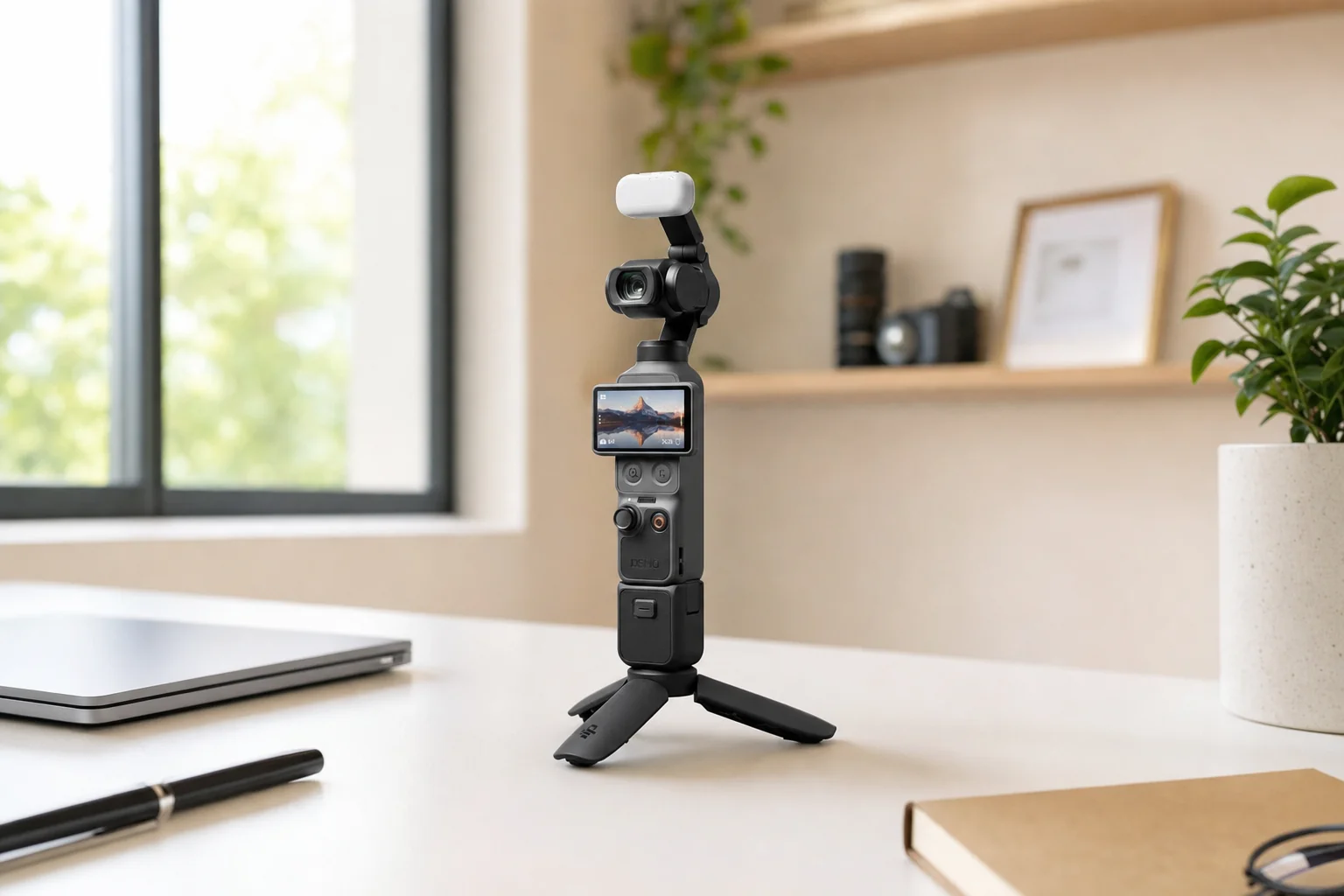
The Pocket 4's trick is not just that it is small. Plenty of action cameras are small. The trick is that it carries a moving, stabilised camera head and still feels like an item you can slip into a jacket pocket rather than a commitment you need to plan a day around.
At 144.2 x 44.4 x 33.5mm and 190.5g, it is taller than an action camera but wonderfully narrow. In the hand, it feels more like a compact handle with a clever camera attached than a conventional camera body. That makes it discreet at family events and much less conspicuous than a phone clamped into a full-size gimbal. It also means it is easier to hand to someone else without first delivering a small training course.
The exposed gimbal head is the obvious compromise. It is precisely the part that makes the Pocket special, and precisely the part you do not want rattling around loose with keys, snacks and a child's collection of suspicious pebbles. A protective cover is sensible rather than optional. This is a camera, not a rugged action cam pretending it enjoys being kicked down a hill.
The Pocket 4's narrow grip and rotating display make it more practical for one-handed filming than its miniature dimensions suggest.
The 2-inch touchscreen had a 556 x 314 resolution and 1,000 nits of brightness. That is not a huge canvas for examining focus pixel by pixel, obviously, but it is bright enough to frame yourself outdoors and far better suited to self-filming than a screenless gimbal camera. Two physical buttons below it handle zoom and a customisable function, cutting down on touchscreen swiping when you are walking.
DJI rated the gimbal for an angular vibration range of ±0.005° and a controllable speed of 180° per second. Those figures sound like the sort of thing you nod at while pretending to understand aerospace engineering, but the practical message is straightforward: it can make small corrections very precisely and pan swiftly enough to follow normal real-world movement.
One Camera or Two? Meeting the Pocket 4 Family
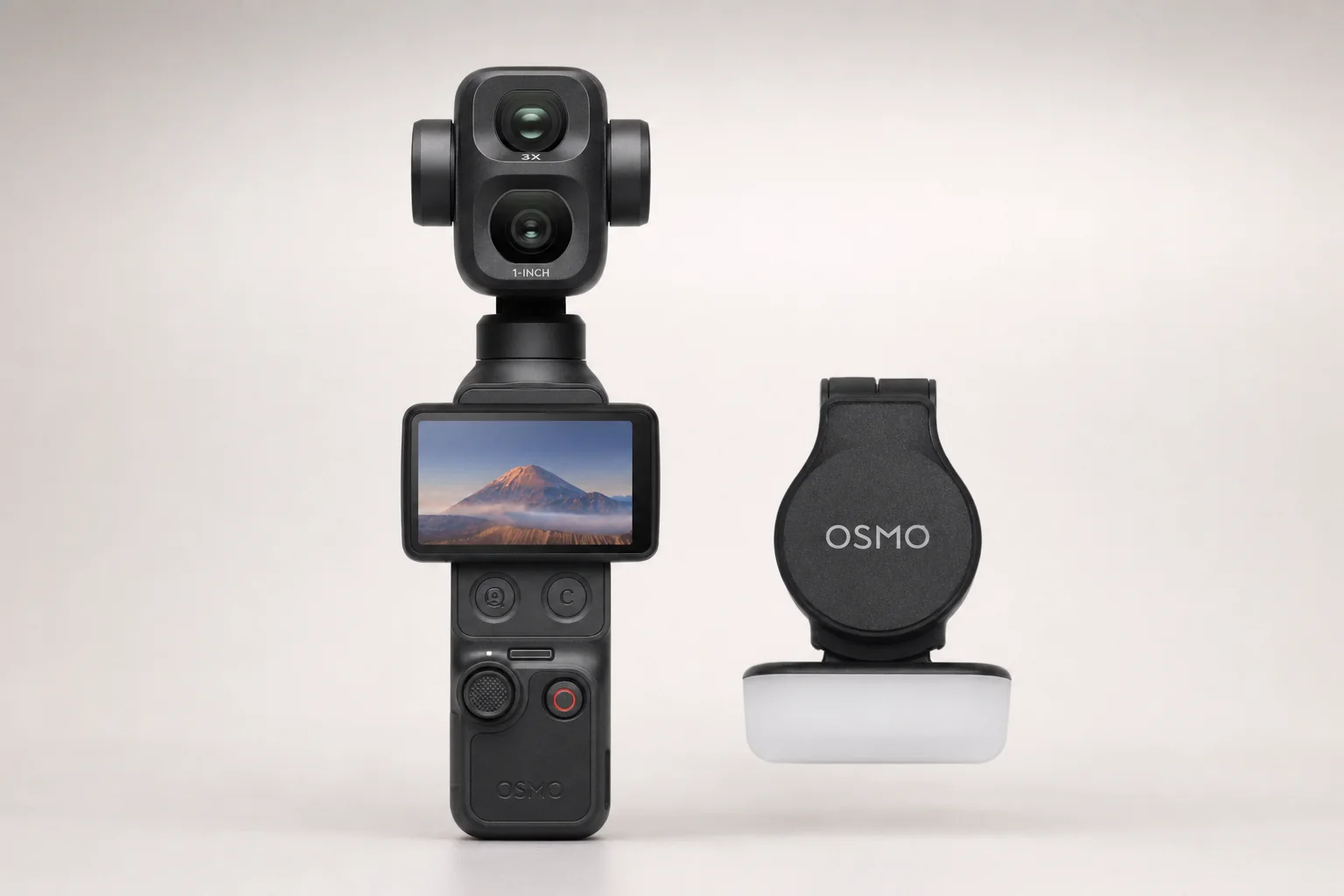
The regular DJI Osmo Pocket 4 is the clean, uncomplicated version. One 1-inch CMOS sensor. One 20mm-equivalent f/2.0 lens. One very strong case for people who want stable, wide-angle vlogging and family footage without putting a phone on a stick.
The Pocket 4P is a more interesting beast. It keeps the 1-inch wide camera but adds a 60mm-equivalent f/1.8 medium-telephoto camera using a 1/1.28-inch sensor. That matters because 60mm creates a very different look from 20mm. Faces are more flattering, busy backgrounds become less distracting, and you can film somebody across a room without standing over them like an overenthusiastic documentary crew.
For family video, that second camera might be more useful than it first appears. The standard Pocket 4 is ideal for a parent talking to camera, a wide view of the kitchen or following children around a park. The 4P lets you switch to a tighter shot for a school performance, a portrait, a grandparent opening a present or a child proudly showing you something from a few metres away. Those are all moments where a fixed wide lens can make people look smaller and the scene look busier than it felt.
| Feature | DJI Osmo Pocket 3 | DJI Osmo Pocket 4 | DJI Osmo Pocket 4P |
|---|---|---|---|
| UK price from | £309 (current DJI UK sale listing, not a fixed RRP) | £445 | £529 |
| Main sensor | 1-inch CMOS | 1-inch CMOS | 1-inch CMOS wide camera |
| Lens system | 20mm-equivalent f/2.0 | 20mm-equivalent f/2.0 | 20mm f/2.0 wide + 60mm f/1.8 tele |
| Maximum slow motion | 4K/120fps | 4K/240fps | 4K/240fps wide; 4K/200fps tele |
| Built-in storage | microSD required | 107GB | 103GB |
| Weight | 179g | 190.5g | 230g |
| Official battery rating | 166 minutes | 240 minutes | 210 minutes |
| Screen | 2-inch rotatable touchscreen | 2-inch rotating touchscreen | 2-inch rotating touchscreen |
| Buy | Check price | Check price | Check price |
The trade-off is unsurprising: the Pocket 4P is larger at 159.5 x 63.3 x 33.5mm, weighs 230g, carries 103GB rather than 107GB of internal storage and has a shorter 210-minute official battery rating. It remains compact, but it crosses a small psychological line. The standard model is something you forget you packed. The 4P is still portable, but you notice it.
My advice is not to assume the 4P automatically wins because it costs more. If your footage is mostly wide, walk-and-talk material, its second lens can be a luxury. If you film people rather than just places, though, it is the more versatile camera and the better answer to the "can this replace some of my phone shooting?" question.
The Gimbal Effect: Why Walking Footage Finally Looks Cinematic
This is the bit that sells the Pocket 4. Not the frame rates. Not the internal storage. The gimbal.
Phone stabilisation is mostly computational. The phone reads motion, crops into the image and uses software to correct the wobbles. It can be extremely effective, especially in bright light, but it has limits. More correction can mean more crop. Less light can mean softer footage. Fast, awkward movement can confuse it. And, crucially, a phone cannot physically keep its camera level when your hand does something daft.
The Pocket 4's three-axis mechanical gimbal moves the camera itself. Pitch, roll and yaw are physically corrected in real time, so a gentle walk, a pan around a room or a turn towards a child can retain a level, composed feel. It is not magic. If you stomp like you are testing floorboards, the footage will still know about it. But it turns normal human movement into something calmer and more intentional.
TechRadar awarded the stabilisation five out of five and called it "stellar", which felt about right. The strongest results come from mundane movements: walking through a room while talking, following a child on a path, slowly revealing a view, filming a friend who is also walking. This is precisely where a phone can look fine in isolation but slightly messy next to footage from a proper stabilised camera.
Walk-and-talk footage
The Pocket 4 earns its keep when you are both presenter and camera operator. It smooths small hand corrections without forcing the wide, heavily processed look of many phone stabilisation modes.
Natural pans and reveals
A physical gimbal makes slow pans look measured rather than twitchy. That sounds minor until you compare two clips side by side. Then it becomes hard to unsee.
Subject-facing composition
ActiveTrack support gives the camera a better chance of keeping a person in frame while you move, which is particularly handy for self-shot videos and lively family scenes.
The three-axis camera head is the Pocket 4's defining advantage: movement is corrected physically, not merely cropped and processed after the fact.
There is a small etiquette point here too. A Pocket 4 looks more like a small camera than a phone held at face height. That can make self-filming feel less performative in public. It is not invisible, and the moving head attracts the occasional curious glance, but it is a neater tool than a phone in a large gimbal rig.
Where it does not win is rough action. There is no waterproofing, no confirmed IP rating and no rugged action-camera body. For rain, pool days, muddy cycling routes or a holiday that involves more splashing than strolling, an action camera remains the sensible choice. The Pocket's stabilisation is better suited to deliberate movement than abuse.
After Dark: Low-Light and Dynamic Range Reality Check
Low light is where DJI's choice of a 1-inch sensor really starts to make sense. The Pocket 4 pairs that sensor with an f/2.0 lens and a dedicated low-light video mode for 4K and 1080p recording at up to 30fps. It also records 10-bit D-Log and carries a claimed 14 stops of dynamic range.
In plain English: it has more hardware and more recording flexibility than the average front-facing phone camera, particularly when the lights go down. Dim living rooms, restaurants, evening streets and birthday parties tend to be exactly where family clips become precious and phone video starts looking like it has been filmed through a slightly dirty window.
The improvement over the Pocket 3 was evolutionary rather than dramatic, but reviewers found darker-scene detail and noise control cleaner. That matters more than it sounds. The best family videos are rarely shot on a tripod in perfect lunchtime light. They happen in kitchens, halls, gardens at dusk and living rooms lit by one lamp that has apparently been chosen to challenge every camera in the house.
Low-light reality check
The Pocket 4 gives you a stronger starting point than most phone front cameras and many action cameras, but it does not remove the laws of physics. Low-light mode tops out at 4K or 1080p at 30fps, and a current flagship phone can still produce more immediately flattering automatic HDR in difficult mixed light.
That last point is important. Phones remain absurdly good at deciding what you probably meant to shoot. Point one at a window-lit face and a dark room, and its HDR processing may deliver a ready-to-share clip with less effort. The Pocket 4 rewards a slightly more deliberate approach. If you shoot in D-Log, you also need to be willing to grade footage afterwards. It gives you flexibility, not an excuse to ignore exposure.
For most people, standard colour modes will be the better daily choice. D-Log is there for creators who want to match clips, recover highlights carefully and edit in a proper workflow. It is a useful feature, but do not buy this camera solely because a 10-bit logo looks impressive on a product page. Your future self, staring at a timeline at 11pm, may have opinions.
A 1-inch sensor and dedicated low-light mode give the Pocket 4 a meaningful advantage for indoor family scenes and evening walk-and-talk footage.
The 4P's wide camera preserved this main-camera advantage. Its telephoto camera was still useful in soft light, thanks to its f/1.8 lens, but it used a smaller 1/1.28-inch sensor. Treat the wide lens as the low-light hero and the tele lens as the framing tool. That is the sensible way to use the pair.
Flip, Frame, Film: Living With the Rotating Screen
A rotating screen sounds like a very ordinary feature until you use a camera without one. Then it becomes the thing you keep trying to recreate with awkward grips, guessed framing and a phone app that disconnects at precisely the wrong moment.
The Pocket 4's two-inch touchscreen physically rotates between horizontal and vertical orientations. It is a mechanical solution, which is better than a software crop because the camera's controls, shooting posture and framing adapt to what you are actually making. Twist it for landscape family footage. Rotate it for vertical social video. Done.
It is especially good for self-filming. You can hold the grip naturally, see your framing, check that ActiveTrack has found your face and get on with talking. No mounting a phone, no balancing it against a coffee cup and no discovering later that your forehead had been the star of the entire clip.
The display is small, yes, but 1,000 nits makes it usable outdoors. I would not use it to make forensic focus judgements in direct sun, but it is bright enough for the job it needs to do: framing, basic settings and confirming the camera is recording before your child does the thing you were trying to capture.
Native horizontal and vertical shooting
The rotating display supports the way you are shooting rather than forcing you to decide later whether a cropped export will do. This is far more pleasant for vertical vlogs and social clips.
Less menu-diving while moving
Dedicated zoom and custom-function buttons beneath the screen make one-handed use more realistic. The menu system can still feel busy, but the most common adjustments are easier to reach.
Built for self-framing
The screen makes the Pocket 4 more approachable than a conventional action camera and more self-contained than a phone gimbal setup.
There are limitations. The interface still has enough options to feel fussy at first, and a two-inch display is not a substitute for a larger monitor when you are making something polished. But for everyday filming, DJI had got the priorities right: rotate, frame, record. This camera wants to be used quickly, not lovingly configured for half an hour.
Sound Advice: Microphones and the DJI Mic Ecosystem
Good video with bad sound is still bad video. You can get away with a slightly imperfect image in a family montage. You cannot get away with wind making every spoken word sound like it is being broadcast from inside a crisp packet.
The Pocket 4 has three built-in microphones and records audio at 48kHz, 16-bit AAC. For quick clips, close-up family video and simple pieces to camera, the onboard audio is useful. It is a more thoughtful starting point than treating sound as an afterthought, which is what plenty of compact cameras historically did.
For vlogging, the more important feature is direct connection to DJI Mic transmitters. Pair a compatible transmitter and the Pocket 4 becomes a far tidier setup than a phone, adapter, lavalier cable and separate recorder. DJI supported up to four-channel recording in compatible workflows, allowing voice and ambient sound to be captured more flexibly.
For serious talking-to-camera footage, the wireless mic is the upgrade that makes the biggest practical difference after the camera itself. It helps when the subject is more than arm's length away, when there is traffic or wind, and when you want people to hear the person rather than the room.
The distinction between "usable" and "good enough for a vlog" matters. The internal microphones are handy because they are always there. A wireless transmitter is better because it puts the microphone close to the person speaking. That is not a DJI-specific revelation; it is just how sound works. The Pocket 4's advantage is making the better option easy to integrate.
For family footage, this is surprisingly valuable. Think of a child talking while running around a garden, a parent explaining a holiday location, a grandparent telling a story at a birthday meal. A clean voice track turns a nice clip into something you may actually want to keep. It is a small technical detail with a very human payoff.
The Pocket 4's direct DJI Mic support keeps a creator setup compact, with fewer adapters and fewer chances for audio to go wrong.
One caveat: the best audio experience may mean buying the right bundle or adding accessories separately. The camera itself is compact; a complete audio setup is still a setup. That is worth remembering before declaring your phone obsolete and donating every cable you own to a drawer marked "later".
The Honest Answer: Is Your Phone Already Good Enough?
For lots of people, yes. Absolutely. That is not a cop-out; it is the most useful conclusion here.
If you have a recent flagship phone, mainly film quick clips in daylight, value instant sharing and would not willingly carry another device, the phone is already very good. It has multiple focal lengths, computational HDR, automatic night processing, immediate editing and a screen large enough to show someone what you just recorded. The best camera is still the one you actually have when a child suddenly decides to be adorable for precisely seven seconds.
The Pocket 4 cannot beat that convenience. It needs charging. It needs carrying. It uses DJI Mimo for its connected workflow. Its files need moving if you want to edit elsewhere. And unlike a phone, it cannot make calls, navigate home or save you from the awkward silence at a family meal.
But phones become less compelling once the footage itself matters. Their stabilisation is clever; the Pocket's is physical. Their front cameras are convenient; the Pocket's rotating display is built for filming yourself. Their onboard audio is fine when close; DJI's direct wireless mic connection is much better when you are not. Their low-light modes are impressive; the Pocket's 1-inch sensor gives it more of a natural camera foundation.
The purchase test
Ask yourself one brutally simple question: do you often watch your phone clips back and wish they looked steadier, cleaner or more intentional? If the answer is no, keep your money. If the answer is yes, and especially if walking footage is involved, the Pocket 4 solves a real problem rather than inventing one.
The phone-versus-Pocket decision is therefore not about image quality alone. It is about behaviour. A phone encourages spontaneous capture. The Pocket 4 encourages better capture. The former wins more often because it is always there. The latter wins when you make the small effort to bring it.
For me, the Pocket 4 made phone video look lazy when I was moving. Not when I was standing still in good daylight. Not when I needed a quick vertical clip sent immediately. And not when I needed the telephoto, ultrawide and computational tricks of a phone all in one device. It made phone video look lazy during the kind of filming where a phone needs accessories to stop behaving like a phone.
All-Day Vlogging? Battery and Storage for Real Life
DJI fitted the Pocket 4 with a 1,545mAh lithium-ion battery rated at 11.95Wh and 7.74V. The official runtime claim was 240 minutes for the Pocket 4 and 210 minutes for the larger Pocket 4P. Both figures were measured at 1080p/24fps, with Wi-Fi and the screen switched off, at 25°C.
That is useful as a lab comparison, but it is not how most people will use the camera. Record 4K/60, leave the bright screen on, track a subject, connect a microphone, repeatedly stop and start, then do it outdoors on a warm day, and runtime will fall. This is normal. Anyone promising otherwise is either unusually optimistic or filming a black wall.
The good news is charging is genuinely fast. With DJI's 65W charger, DJI quoted 80% in 18 minutes and 100% in 32 minutes. That makes a coffee-stop top-up realistic, which is more useful than a giant theoretical runtime if you are travelling or filming around a busy family day.
Internal storage was one of the Pocket 4's quietly excellent quality-of-life features. The 107GB in the standard model, or 103GB in the 4P, means you can start shooting even if you have forgotten a microSD card. DJI said the Pocket 4 could hold about 220 minutes of 4K/60 footage at standard bitrate, though recording mode and bitrate naturally affect that figure.
It is not a replacement for buying a decent card if you film regularly, but it removes a classic camera annoyance: owning a perfectly capable camera that becomes a small expensive paperweight because the card is on a desk at home.
What It'll Actually Cost You: Bundles and Pricing Breakdown
The standard Pocket 4 began at £445 in the UK. That is not cheap in the abstract, especially when your phone already shoots video. It starts to make more sense when you remember that it includes a 1-inch camera, a mechanical gimbal, rotating display, internal storage and direct wireless-mic compatibility in one pocketable device.
Bundle choice matters. The Creator Combo added the DJI Mic 3 transmitter, fill light, wide-angle lens and mini tripod. The Vlog Combo included the battery handle and wireless microphone accessories. The Pocket 4P came in Standard Combo and Vlog Combo versions, with its extra camera naturally increasing the entry price.
DJI Osmo Pocket 3
The value route: 1-inch sensor, three-axis gimbal and rotating screen, but older hardware and no built-in storage. This £309 figure is a current DJI UK sale listing rather than a fixed long-term price.
DJI Osmo Pocket 4 Standard Combo
The sweet spot for most buyers who want the newer sensor processing, storage and 4K/240fps.
DJI Osmo Pocket 4 Creator Combo
Adds DJI Mic 3 transmitter, fill light, wide-angle lens and mini tripod.
DJI Osmo Pocket 4 Vlog Combo
Includes the battery handle and wireless microphone accessories.
DJI Osmo Pocket 4P Standard Combo
The dual-camera model for buyers who value a true 60mm-equivalent viewpoint.
DJI Osmo Pocket 4P Vlog Combo
The more complete 4P route for regular self-filming and longer days out.
The Pocket 4P costs more and weighs more, but its second 60mm-equivalent camera makes it markedly more flexible for people-focused footage.
The best-value choice depends on what you already own. If you have a DJI Mic transmitter and simply want smoother video, the standard Pocket 4 is easier to justify. If you need clean talking-head audio from day one, a bundle can save you assembling the same setup later.
The Pocket 3 was the awkward alternative for DJI because it remained excellent. At £309 — a current DJI UK sale listing rather than a fixed long-term price — it still delivered the essential Pocket experience: a 1-inch sensor, three-axis mechanical stabilisation and rotating display. It lacked the Pocket 4's 4K/240fps slow motion, internal storage and longer official battery rating, but it was not suddenly bad because a newer model arrived. Far from it.
That is why the Pocket 4 is an easy recommendation for a first-time buyer, but a less urgent upgrade for a happy Pocket 3 owner. If your existing camera already makes the clips you want, the extra capability is nice rather than transformative. The 4P is the more compelling step up because its second lens creates an entirely new framing option.
Who's This Tiny Camera Really For?
The Pocket 4 is at its best when you know why you want it. It is not a universal camera. It is a very focused answer to a handful of video problems: unstable handheld walking clips, poor self-filming ergonomics, weak audio from a distance and phone footage that starts looking strained after sunset.
DJI Osmo Pocket 4
See DJI Osmo Pocket 4 on Amazon UK
The best all-round balance of portability, three-axis stabilisation, rotating screen, built-in storage and image quality for people who want to record family life more deliberately.
DJI Osmo Pocket 4P
See DJI Osmo Pocket 4P on Amazon UK
Check today's price & availability on Amazon UK
Choose this if tighter family shots, more flattering perspective and switching between wide and 60mm-equivalent views matter more than maximum compactness.
DJI Osmo Pocket 3

See DJI Osmo Pocket 3 on Amazon UK
Check today's price & availability on Amazon UK
The sensible buy for anyone who wants the core gimbal-camera concept at a lower price and can live without the newer model's storage and 4K/240fps.
DJI Osmo Action 6

See DJI Osmo Action 6 on Amazon UK
Check today's price & availability on Amazon UK
Its waterproof 20m body and rugged action-camera format make more sense for pools, rain, cycling, skiing and anything likely to involve a hard landing.
What DJI got right
- Three-axis mechanical stabilisation is outstanding for walking, panning and self-shot footage.
- The 1-inch sensor, f/2.0 lens and low-light mode make evening video far more credible than most tiny cameras.
- The bright rotating screen is genuinely useful, not just a brochure feature.
- 107GB of internal storage removes a common camera frustration.
- Direct DJI Mic support makes better audio much easier to achieve.
- 4K/240fps offers slow-motion flexibility that Pocket 3 owners did not have.
What you need to accept
- Neither Pocket 4 model is built for water, heavy rain or rough action-camera use.
- The exposed gimbal head needs protection in bags and around enthusiastic children.
- The fixed 20mm lens on the standard model can feel limiting.
- The menu system still takes a little learning.
- You are carrying another device, charger and app alongside your phone.
- The Pocket 4 is an incremental upgrade from Pocket 3 unless you need its specific new features.
The least suitable buyer is somebody who wants one camera for beach holidays, mountain biking, pool days, rainy walks and occasional family clips. That person needs a waterproof action camera first. The Pocket 4 can do travel beautifully, but it does not enjoy danger in the way an action camera does.
It is also not for someone who hates transferring files. The fastest route to better video is still the route you will actually use. If phone-to-social speed matters more than the final look, keep using your phone and spend the money on a nice meal or a weekend away to film with it.
The Verdict: Ratings, FAQs and Final Word
The DJI Osmo Pocket 4 is one of those gadgets that can look unnecessary until you see its footage beside ordinary phone video. Then the point becomes obvious. It is not that phone cameras are bad. They are excellent. It is that they are trying to do everything, while the Pocket 4 is very specifically trying to make moving video look good.
Gadget Scout Rating reflects this publication's own editorial scoring based on the review findings above; it is not a manufacturer benchmark or third-party test result.
For creators and families who value smooth movement over sheer convenience, the Pocket 4 is a specialist camera with a very clear purpose.
Buy it if moving video matters more than instant convenience
The DJI Osmo Pocket 4 is not a phone replacement in the literal sense. Your phone remains better for spontaneous clips, quick edits, stills and sharing before the moment has passed. But as a dedicated tool for stable walking footage, low-light family video, self-framing and clean wireless audio, the Pocket 4 does things a bare phone still cannot do as naturally. The standard model is the best first buy; the Pocket 4P is the one to choose if its proper 60mm-equivalent camera fits the way you film. Either way, this tiny gimbal makes the difference between simply recording a moment and making it look like you meant to.
Similar reads
- The first lens to buy after your kit lens — six upgrades from GBP 279 to GBP 849, and the mount trap to check first
 DJI Osmo Pocket 4View on Amazon
 DJI Osmo Pocket 4PView on Amazon
 DJI Osmo Pocket 3View on Amazon
 DJI Osmo Action 6View on Amazon