
Qi2 and MagSafe Chargers Explained: What's Worth Buying Now
How Qi2 magnetic charging really differs from old Qi and MagSafe — with tested pads, stands and 3-in-1 docks to help you pick the right one.
We link to the exact model on Amazon UK. Prices change often, so check the live price before you buy. As an Amazon Associate we earn from qualifying purchases.
Magnetic wireless charging has quietly become the default — but the labels on the box are more confusing than ever.
If you've stood in a shop (or scrolled Amazon) staring at boxes labelled "Qi2", "Qi2 25W", "MagSafe" and plain old "wireless charging" wondering what on earth the difference is — you're in exactly the right place. I've spent a lot of time with magnetic chargers over the past couple of years, and the short version is this: the technology has genuinely got better, but the marketing has got messier. In this guide I'll walk you through what each standard actually means, how they perform in real testing, and which pads, stands and 3-in-1 docks are worth your money right now. No jargon dumps, just the stuff that matters.

See Belkin UltraCharge Pro 3-in-1 on Amazon UK
Check today's price & availability on Amazon UK
The Three Standards You Need to Understand
Before we talk about specific chargers, let's clear up the alphabet soup, because almost every buying mistake I see comes from misunderstanding these three names. Once you get your head around them, the whole category suddenly makes sense.
Old Qi is the wireless charging standard that's been around for years. It's the flat pad you plonk your phone onto and hope it lands in the right spot. It works, but it has no magnets, so alignment is fiddly, and power tops out fairly low — around 7.5W for iPhones and roughly 10W for many Android phones. Miss the sweet spot by a centimetre and your phone charges slowly or trickles overnight without you realising.
Qi2 is the big leap. Developed by the Wireless Power Consortium and released in January 2023, it's an open, standardised wireless charging system that uses magnetic alignment much like MagSafe — but crucially, it's available to all manufacturers, not just Apple. It delivers a consistent 15W thanks to a magnetic ring that snaps your phone into perfect alignment every single time. That magnetic snap is the whole point: no more guessing.
MagSafe is Apple's own proprietary version of magnetic wireless charging, using magnets to align chargers with compatible iPhones (iPhone 12 and later). It delivers up to 15W on those iPhones — and on the newest iPhone 16 and above, modern MagSafe chargers can push up to 25W. It's Apple-certified and Apple-only, so an Android phone gets no benefit from a "MagSafe" charger beyond basic slow Qi charging.
The magnetic ring is the headline feature of Qi2 — your phone snaps into perfect alignment and stays there.
What Qi2.2 (aka "Qi2 25W") Adds
Just when you thought you'd learned the names, along came another one. Qi2.2 — which you'll often see marketed as "Qi2 25W" — was launched by the Wireless Power Consortium in July 2025, based on Qi v2.2.1, and pushes speeds up to 25W. That's a meaningful jump from the 15W baseline, but the wattage isn't the only story.
The clever bit is thermal management. Qi2.2 features improved smart thermal management compared to standard Qi2, which lets it safely deliver higher wattage while keeping your phone cool. This matters more than the headline number suggests, because heat is the enemy of both charging speed and long-term battery health. A charger that runs hot has to throttle itself to protect the battery, which means it never actually sustains its rated speed. Qi2.2's thermal handling is designed to keep that from happening.
The 25W figure only applies to compatible devices. Plug an older iPhone 12–15 or a phone that doesn't support the faster profile into a Qi2 25W charger, and you'll still get a perfectly good 15W — just not the top speed.
Qi vs Qi2 vs Qi2.2 vs MagSafe: The Full Comparison
Here's the side-by-side I wish I'd had when I started. This is the cheat sheet that tells you, at a glance, what each standard delivers and who it's for.
| Feature | Old Qi | Qi2 (15W) | Qi2.2 (25W) | MagSafe |
|---|---|---|---|---|
| Magnetic Alignment | None | Yes (MPP) | Yes (MPP) | Yes |
| iPhone Power | 7.5W | 15W | 25W* | 15W (up to 25W on iPhone 16+) |
| Android Power | 10W | 15W | 25W* | No benefit |
| Universal | Yes | Yes | Yes | Apple only |
| Certification | Optional | WPC required | WPC required | Apple required |
*25W speeds only apply to compatible devices.
The single most important technical concept underpinning all of this is the Magnetic Power Profile (MPP). That's Qi2's defining feature. MPP defines the magnet strength, the magnets' placement relative to the charging coil, and how the power negotiation happens after alignment. In plain English: MPP is why a Qi2 charger snaps your phone into exactly the right position and then confidently ramps up to full power, rather than nervously trickling because it isn't sure the coils are lined up.
This is also why Qi2 is such a big deal for Android users. For years, magnetic snap-on charging was effectively an iPhone-only luxury. With Qi2 and MPP baked into an open standard, that same experience is now available on any brand that adopts it. The catch — and I'll be honest about this throughout — is that plenty of Android phones still need a magnetic case to make the most of it, because the magnets have to live somewhere.
How to Choose the Right Charger for You
Rather than throw a spreadsheet at you, let me break the decision down into the questions I actually ask people when they want a recommendation. Work through these and the choice practically makes itself.
Which phone do you own?
iPhone 16 or later? You can genuinely benefit from a 25W Qi2 or 25W MagSafe charger. iPhone 12–15? You'll cap at 15W regardless, so don't overpay for 25W unless you want future-proofing. Android with built-in magnets or a magnetic case? Qi2 is your friend.
Where will it live?
A bedside table wants a stand you can glance at. A travel bag wants something foldable and light. A desk with multiple Apple devices wants a proper 3-in-1 dock. Match the form factor to the location and you'll actually use it.
Do you charge quickly or overnight?
If you top up in short bursts during the day, the extra speed of 25W is worth paying for. If you dock overnight, honestly a 15W Qi2 pad is more than enough and saves you money.
Have you got the right power brick?
This is the one everyone forgets. Fast chargers need serious power supplies. Some 25W docks want a 65W USB-C adapter or higher to hit their rated speeds. If a charger includes its own PSU, that's one less thing to worry about.
Pro Tip: Mind Your Case Thickness
Magnetic charging weakens the further the magnets sit from the coil. Anker recommends avoiding cases thicker than 2.5mm and steering clear of non-magnetic cases for its Qi2 chargers. If your phone keeps sliding or charging slowly, a bulky case is very often the real culprit — not the charger.
Belkin UltraCharge Pro 3-in-1 (Qi2 25W)
See Belkin UltraCharge Pro 3-in-1 on Amazon UK
Check today's price & availability on Amazon UK
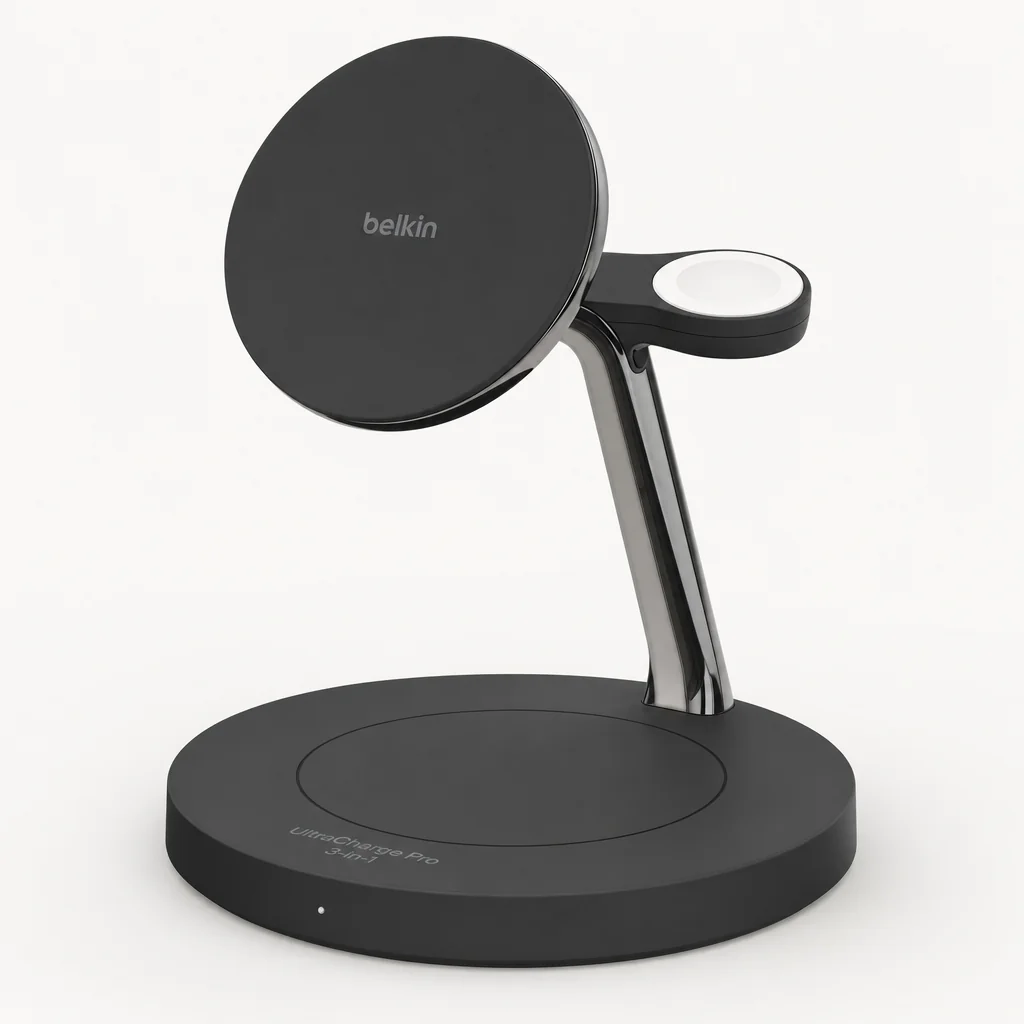
If you want the current flagship 3-in-1 experience and you're deep in the Apple ecosystem, this is the one I keep coming back to. It was the first Qi2 25W charger put through the Macworld labs, and it feels every bit like a first-generation halo product — in the best way.
Belkin UltraCharge Pro 3-in-1

See Belkin UltraCharge Pro 3-in-1 on Amazon UK
Check today's price & availability on Amazon UK
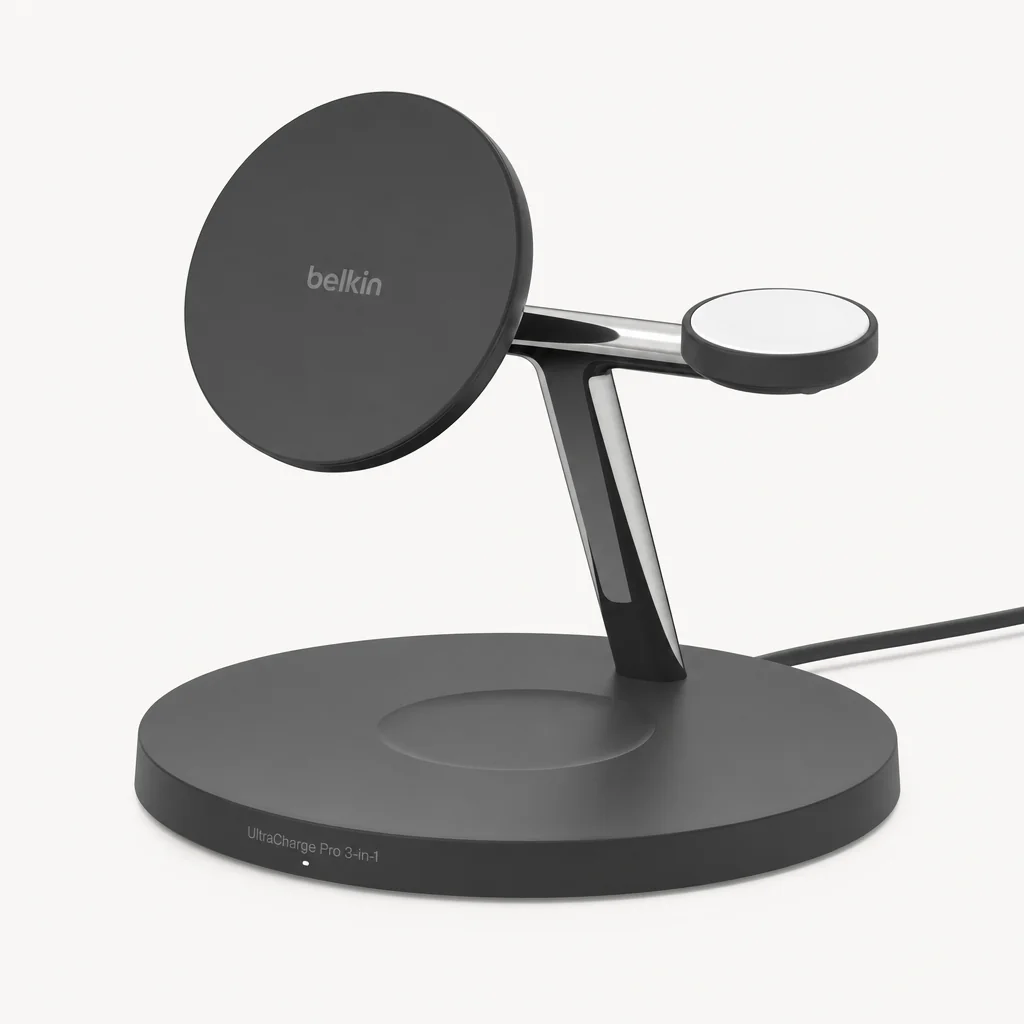
It arrives with a 45W USB-C power supply and a generous 5ft/1.5m USB-C to USB-C cable in the box, so you're not immediately shopping for a brick to make it work. The iPhone pad delivers the full 25W (dropping to 15W for iPhone 12–15), with a 5W fast-charging Apple Watch pad and a 5W AirPods pad rounding out the trio.
The standout engineering here is ChillBoost active cooling. Belkin claims up to 12°F (7°C) cooler temperature regulation during fast charging, courtesy of an optional internal smart fan with an on/off switch. In my experience with fan-cooled chargers, the fan is usually the compromise — noisy and irritating. Not here. Testers had to physically feel the unit to confirm the fan was even running, it's that quiet.
Active cooling used to mean noise. The UltraCharge Pro's fan is so quiet testers had to touch the unit to confirm it was on.
How Fast Does It Actually Charge?
Belkin's own figures are impressive: iPhone from 0–50% in 25 minutes, and Apple Watch Series 10 from 0–80% in 30 minutes. But I always care more about real-world numbers than lab-perfect ones, and here they're refreshingly close. Real-world testing on an iPhone 16 Pro showed 0–50% in 30–35 minutes — still measurably faster than 15W MagSafe, just not quite the spectacular lab figure. On a Galaxy S25 Ultra, it hit 0–50% in 25 minutes with the internal fan on and battery saver mode off.
Shorter bars mean faster charging. Real-world iPhone times run a little longer than the lab claim but still beat 15W MagSafe comfortably.
Pros
- Well-designed and perfectly tailored to support all your Apple gear
- Premium materials — chrome finish and soft-touch silicone
- Weighted base makes one-handed placement genuinely easy
- The cooling fan is essentially silent in use
- Includes the 45W PSU and cable, so no extra purchases
Cons
- No LED indicator light on the iPhone pad to confirm charging (the AirPods pad has one)
- The silicone attracts lint — pocket fuzz and dust cling stubbornly
- Premium build comes at a premium price
Belkin UltraCharge 3-in-1 Foldable (Qi2 25W)
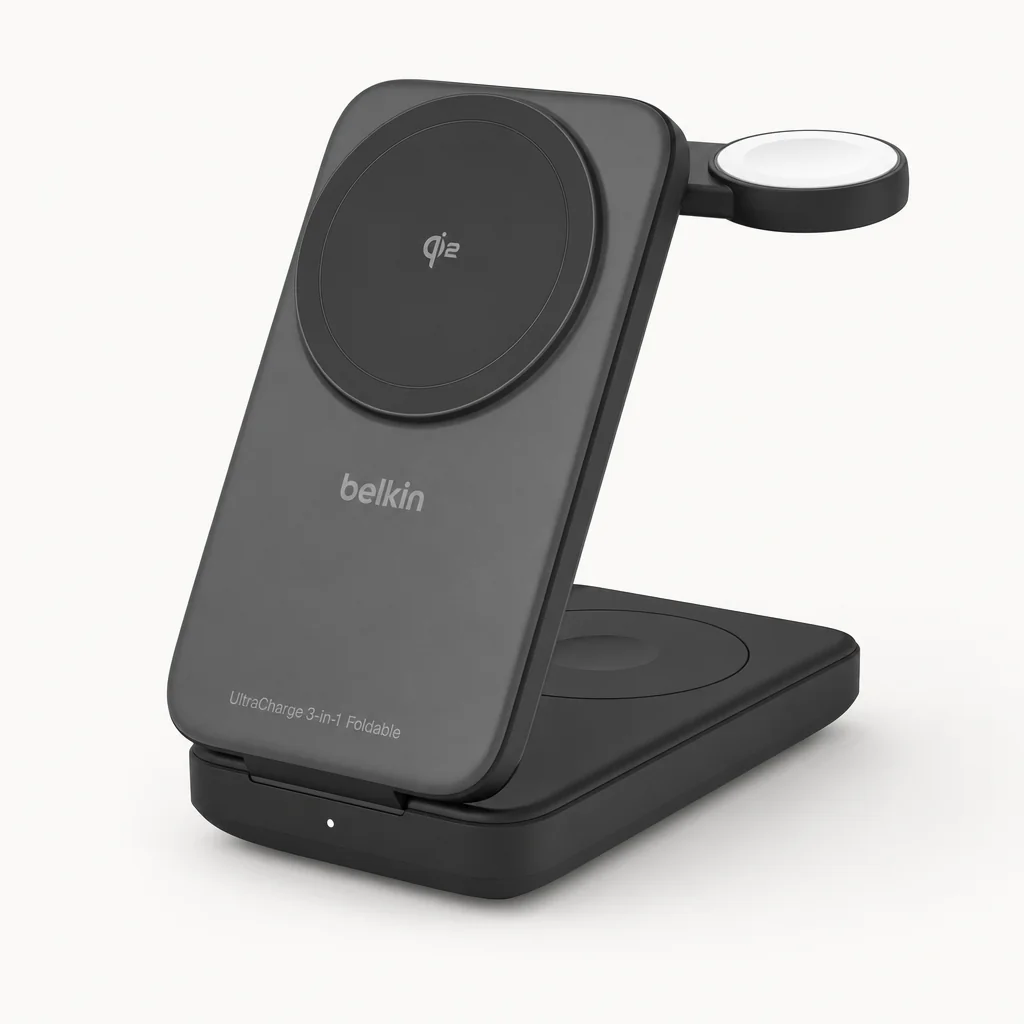
Love the idea of the Pro but need something that lives in a bag? This is the travel-focused sibling, and it's a genuinely clever piece of design. Like the Pro, it ships with a 45W USB-C PSU and a 5ft/1.5m USB-C to USB-C cable, so it's ready to go straight out of the box.
Belkin UltraCharge 3-in-1 Foldable

See Belkin UltraCharge 3-in-1 Foldable on Amazon UK
Check today's price & availability on Amazon UK
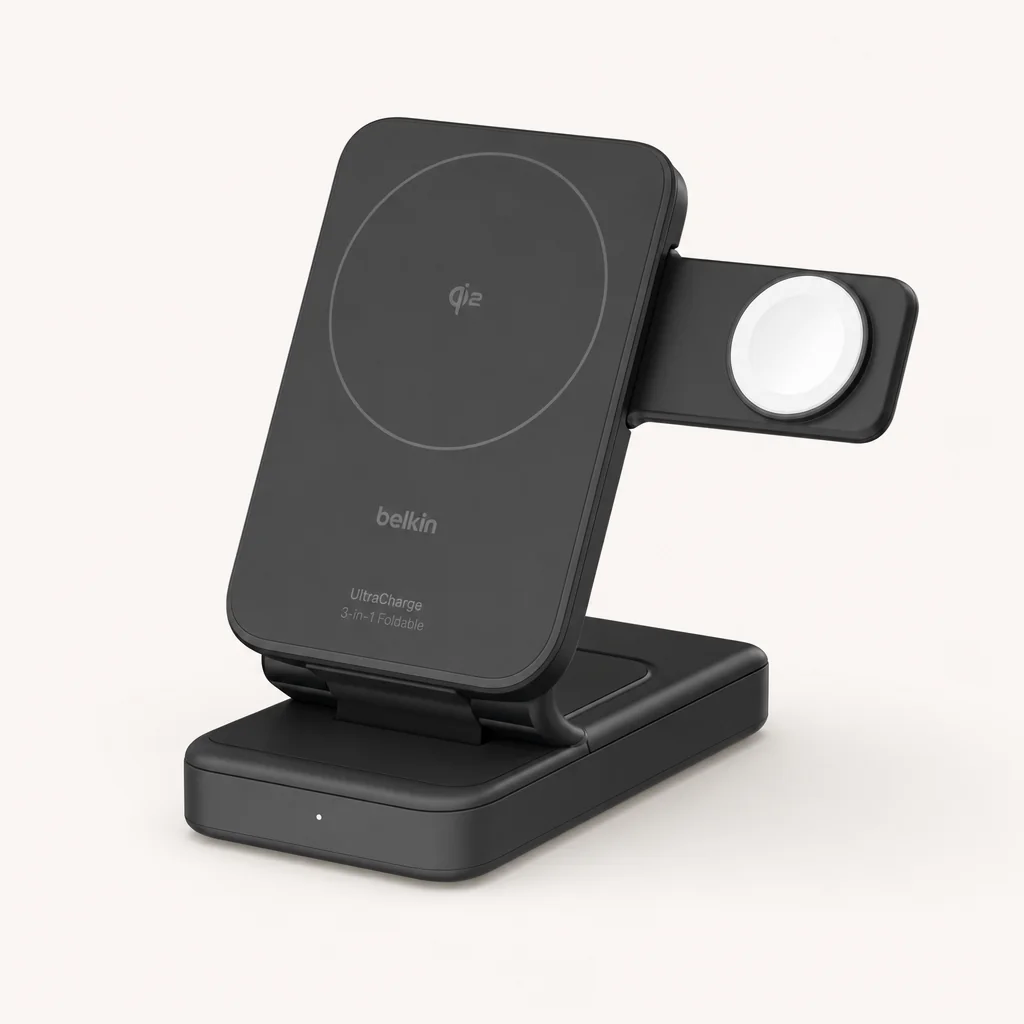
It unfolds to reveal a hidden Apple Watch puck and a secondary Qi charger, which makes it a brilliant travel and bedside companion — it charges everything without hogging your nightstand. Because it uses plastic construction rather than the Pro's chrome-and-silicone build, it's noticeably lighter to sling in a bag.
The key difference from the Pro is cooling. Instead of an active fan, the Foldable uses ChillBoost passive cooling, engineered to reduce heat during fast charging without any moving parts. That's a sensible trade for a travel unit — no fan to fail, nothing to hear at 2am. The consequence is speed: it charges an iPhone 0–50% in 29 minutes and an Apple Watch Series 10 0–80% in 30 minutes, with AirPods drawing up to 5W. Still comfortably faster than a 15W Qi2 charger, just not as quick as the fan-cooled Pro.
The passive-cooled Foldable trades a few minutes of speed for silence, lightness and packability.
Pros
- Folds flat and light — ideal travel and bedside charger
- Hidden Apple Watch puck and secondary Qi charger tuck away neatly
- Includes 45W PSU and cable in the box
- No fan means completely silent operation
Cons
- Passive cooling means it's slower than the fan-cooled Pro
- Plastic build feels less premium than the flagship
Anker MagGo 3-in-1 Foldable (Qi2 15W)
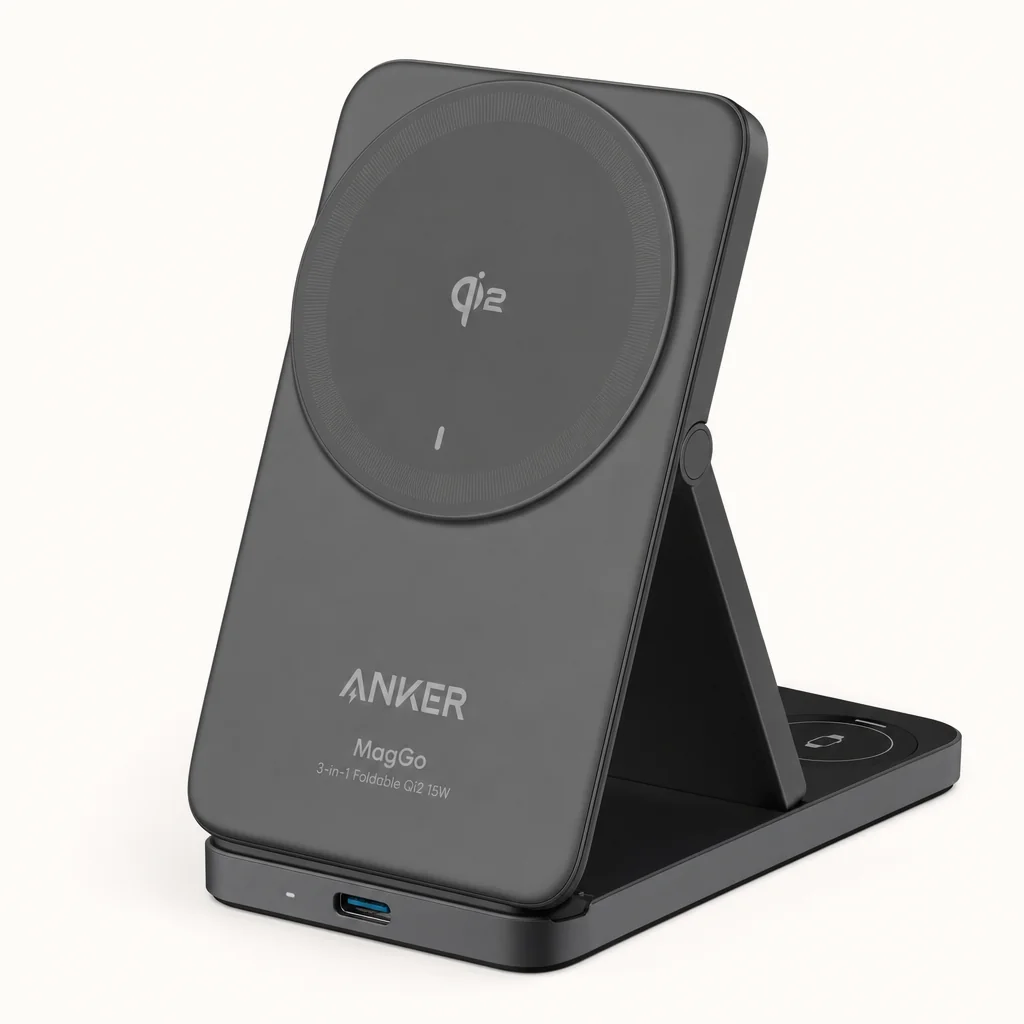
Not everyone needs 25W and a chrome finish. If you want reliable, certified magnetic charging without spending a fortune, the Anker MagGo is the one I recommend most often to friends. It's the most affordable reliable Qi2 charger I've come across, and it doesn't cut the corners that matter.
Anker MagGo 3-in-1 Foldable

See Anker MagGo 3-in-1 Foldable on Amazon UK
Check today's price & availability on Amazon UK
It delivers 15W ultra-fast charging with Anker's Wireless PowerIQ, using a custom Qi2 module with a high-conductivity aluminium build for stable output. You get 15W for a MagSafe-capable phone, a 5W wireless pad for earbuds and a 5W Apple Watch charger. Despite packing three chargers, it's about as compact as an Apple Magic Mouse.
Being Qi2 certified, it charges iPhones at 15W and compatible Android phones at up to 15W — that universal support is exactly what Qi2 was designed to deliver. The aluminium build helps it maintain an optimal device temperature during those 15W sessions, and Anker says it monitors temperature up to 3 million times per day. That's reassuring if, like me, you leave a phone charging overnight and don't want to think about heat.
To get the most from it, avoid cases thicker than 2.5mm and steer clear of non-magnetic cases. This is standard advice for magnetic charging, but it's especially worth heeding on a value model where every millimetre of alignment counts.
Pros
- Qi2 certified — 15W for iPhones and compatible Android phones
- The most affordable reliable Qi2 charger I've tested
- Compact, foldable and travel-friendly
- Temperature monitored up to 3 million times a day
Cons
- Caps at 15W — no benefit for iPhone 16+ owners wanting 25W
- Fussy about case thickness and non-magnetic cases
The most affordable reliable Qi2 chargers prove you don't need to spend flagship money for proper magnetic snap-and-charge.
Anker Prime 3-in-1 (Qi2 25W with AirCool)

See Anker Prime 3-in-1 on Amazon UK
Check today's price & availability on Amazon UK
At the other extreme sits the Anker Prime, which is what happens when engineers get to show off. This is the most technically ambitious 3-in-1 dock here, built around a proper cooling system and a little screen that tells you exactly what's going on.
Anker Prime 3-in-1

See Anker Prime 3-in-1 on Amazon UK
Check today's price & availability on Amazon UK
Its headline trick is AirCool, powered by an aerospace-grade thermoelectric cooler (TEC). Anker says it charges an iPhone 17 Pro to 50% in just 22 minutes and holds temperatures under 89°F while charging. That's fast, and staying that cool is precisely what lets it sustain the speed rather than throttle.
The safety and monitoring credentials are serious too. ActiveShield 5.0 performs over 10 million temperature checks daily — that's not a typo, ten million — and there's a built-in 1.65-inch HD display showing real-time power, temperature and charging status. You also get NFC one-tap pairing and app-based control, which is genuinely useful if you like to tweak behaviour or keep an eye on what's drawing power. To hit its best speeds, it wants a 65W USB-C adapter or higher, so factor that in.
The Prime's thermoelectric cooling posts the quickest iPhone half-charge of the bunch — the payoff for all that engineering.
Pros
- Fastest half-charge here — 22 minutes on an iPhone 17 Pro
- Aerospace-grade TEC cooling keeps temps under 89°F
- Handy 1.65″ HD display for real-time power and temperature
- NFC pairing and app control for the tinkerers
- ActiveShield 5.0 with 10M+ daily safety checks
Cons
- Needs a 65W-or-higher adapter for optimal speeds
- All those features push it to the pricier end
- Arguably more tech than a casual overnight charger needs
Which Charger Is Right for You?
Four strong options, four different buyers. Here's the quick sorting hat — find the description that sounds most like you and you've got your answer.
The Apple Ecosystem Devotee
iPhone, Apple Watch and AirPods all needing a home on your desk? The Belkin UltraCharge Pro 3-in-1 is tailored for exactly this — premium, quiet, and fast across all three devices.
The Frequent Traveller
You want everything charged in a hotel room without a fan whirring at night. The Belkin UltraCharge Foldable folds flat, weighs little and still charges your whole kit.
The Value Seeker
You just want reliable, certified magnetic charging without spending flagship money. The Anker MagGo 3-in-1 is the affordable, sensible pick — and it's Qi2 certified.
The Speed & Data Enthusiast
You want the fastest charge, the coolest temperatures and a screen telling you the numbers. The Anker Prime 3-in-1 is built for you — just pair it with a beefy 65W adapter.
Frequently Asked Questions
Not quite, but they're close cousins. Qi2 uses magnetic alignment very similar to MagSafe, thanks to its Magnetic Power Profile (MPP), which defines magnet strength, placement relative to the coil, and power negotiation. The key difference is that Qi2 is an open standard from the Wireless Power Consortium available to all manufacturers, whereas MagSafe is Apple's proprietary system for iPhone 12 and later.
Yes — that's the whole point of Qi2 being universal. It charges compatible Android phones at up to 15W (or 25W on Qi2.2-compatible devices). The main caveat is magnets: if your Android phone doesn't have built-in magnets, you'll want a magnetic case so it snaps into alignment properly. Testing showed a Galaxy S25 Ultra charging 0–50% in 25 minutes on the Belkin UltraCharge Pro.
For most people charging overnight, 15W Qi2 is genuinely plenty and saves you money — the Anker MagGo is a great example. The 25W standards (Qi2.2 and modern MagSafe on iPhone 16+) make sense if you top up in short bursts during the day and want maximum speed. Remember, 25W only kicks in on compatible devices; older iPhones cap at 15W regardless.
Nine times out of ten, it's the case. Thick or non-magnetic cases push the magnets away from the charging coil, weakening alignment and power delivery. Anker recommends avoiding cases thicker than 2.5mm. Heat is the other factor — chargers throttle to protect the battery, which is exactly why the better docks invest in cooling like ChillBoost or AirCool.
It varies, so always check. Both the Belkin UltraCharge Pro and the Foldable include a 45W USB-C power supply and a 5ft/1.5m cable in the box. The Anker Prime doesn't bundle a brick and wants a 65W USB-C adapter or higher for its best speeds, so budget for that if you don't already own one.
It does, and the numbers back it up. The Belkin UltraCharge Pro's ChillBoost active fan provides up to 12°F (7°C) cooler regulation, which lets it sustain faster charging without throttling. The passive-cooled Foldable is a touch slower as a result — 29 minutes to 50% versus the Pro's 25. Cooler running also helps long-term battery health, so it's not just about speed.
Cooling is the quiet hero of fast wireless charging — it's what separates a charger that sustains its speed from one that throttles.
The Verdict: What's Actually Worth Buying
Here's where I've landed after living with these standards. Qi2 is the genuine upgrade the wireless charging world needed — magnetic alignment via MPP finally brings the MagSafe-style snap-and-charge experience to everyone, iPhone or Android. If you only remember one thing, remember that the magnetic ring is what makes wireless charging reliable rather than a hopeful gamble.
For a top-tier Apple desk setup, the Belkin UltraCharge Pro 3-in-1 is my pick — premium, near-silent active cooling, and real-world charging that comfortably beats 15W MagSafe. Travellers should grab the Belkin UltraCharge Foldable for its clever, packable design. If you want the fastest, most data-rich experience and own a big power brick, the Anker Prime 3-in-1 and its 22-minute half-charge are hard to beat.
But my most common recommendation? The Anker MagGo 3-in-1. Most people charge overnight, don't need 25W, and just want a certified, reliable Qi2 charger that snaps into place and does its job. It delivers exactly that without the flagship price — and that, more than any spec sheet, is what "worth buying now" really means.
Quick Buying Checklist
- Own an iPhone 16+ and charge in bursts? Consider a 25W Qi2.2 dock.
- Charge overnight or on a budget? A 15W Qi2 charger is plenty.
- Android user? Choose Qi2 and add a magnetic case if needed.
- Keep your case under 2.5mm thick and magnetic for best results.
- Check whether a power supply is included, or budget for a 65W+ one.
- Belkin UltraCharge Pro 3-in-1View on Amazon
- Belkin UltraCharge Pro 3-in-1View on Amazon
- Belkin UltraCharge 3-in-1 FoldableView on Amazon
- Anker MagGo 3-in-1 FoldableView on Amazon
- Anker Prime 3-in-1View on Amazon
- Anker Prime 3-in-1View on Amazon