
Neo Geo AES+ First Look: The Most Authentic Retro Console in Years?
SNK and PLAION REPLAI's cartridge-loving Neo Geo revival has an unusually bold pitch: re-engineered ASIC hardware, old AES games, modern HDMI and proper analogue output. The important test, however, had not happened yet.
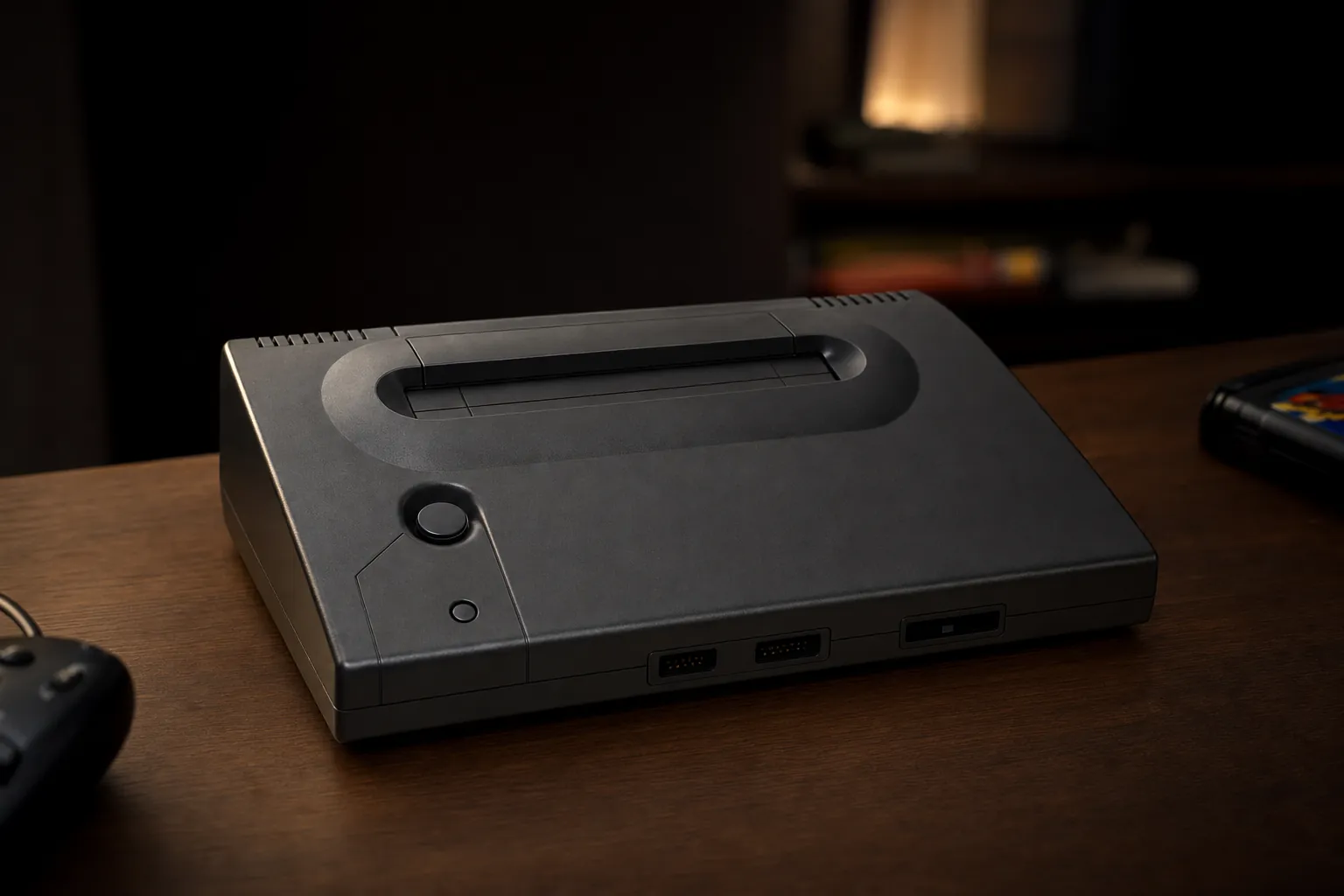
The Neo Geo AES+ is intended as a modern recreation of SNK's original home console, rather than a mini console with a fixed digital library.
Retro hardware is one of those categories where a product can sound perfect long before anyone has actually put it through its paces. The Neo Geo AES+ is a particularly good example. On paper, it tackles the things enthusiasts usually have to choose between: original cartridges, old-school controller ports, CRT-friendly output and a practical connection for a current television. That is an exciting list. It is not, by itself, proof.
The AES+ Is Official — But the Big Test Has Not Happened Yet
SNK and PLAION REPLAI had officially announced the NEOGEO AES+, a modern recreation of the original 1990s NEOGEO AES home console. It was scheduled to begin shipping on 12 November 2026. As of Wednesday 19 August 2026, though, it remained an unreleased machine. That distinction matters more here than it does with most new consoles.
The central question is wonderfully nerdy, and entirely fair: can this machine recreate the feel and behaviour of a real AES without relying on ordinary software emulation? PLAION says yes. Its stated answer is a hardware-faithful reimplementation based on re-engineered legacy ASIC chips, rather than software emulation or an FPGA approximation.
That is a much bigger promise than "it runs Metal Slug". Almost anything can run Metal Slug these days. The more demanding question is whether the experience behaves as fans expect: the timing, sprite handling, colour, audio character, slowdown and odd little quirks that make original hardware feel like original hardware. Retro enthusiasts tend to notice those things. Sometimes within about four seconds.
The honest first-look position
The AES+ looked like one of the most ambitious officially licensed Neo Geo revivals in years. It was not yet established as the most authentic retro console in years, because independent production-unit testing had not yet happened.
There were no confirmed independent measurements for input latency, HDMI latency, controller delay, audio response, operating temperature, power draw, shell quality, weight or long-term reliability. This is a rumour round-up and launch-information analysis, not a finished-product review.
Three AES+ Consoles, Three Very Different Definitions of 'Complete'
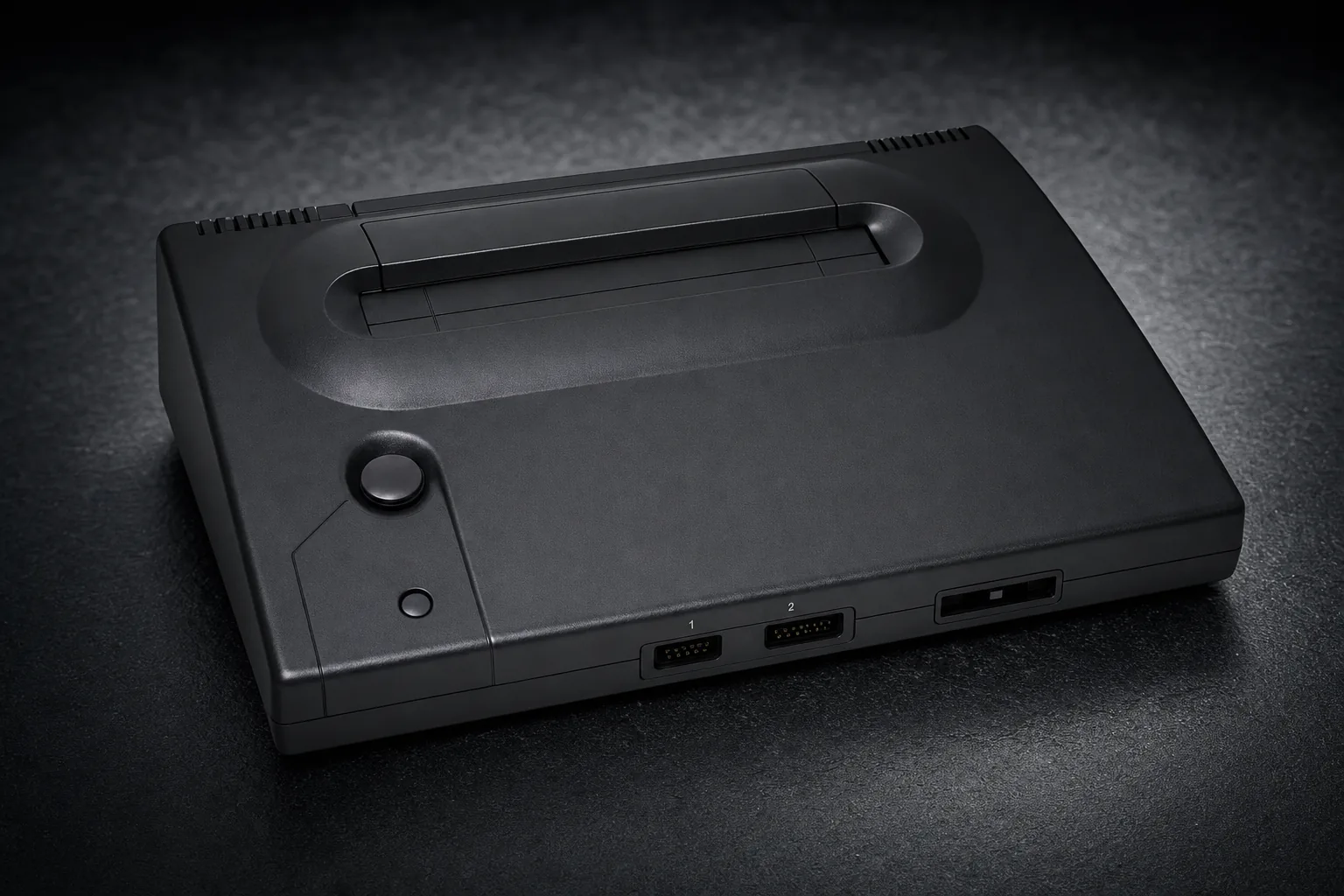
PLAION's range was not simply one console in three colours. The core AES+ platform was shared, but the bundles were aimed at sharply different kinds of buyer: the sensible entry point, the collector-friendly anniversary package and the full-fat "I would like the entire launch moment in one box" edition.
NEOGEO AES+
The standard black machine included the console, a wired 1:1 replica Arcade Stick, HDMI cable and power supply. It was the straightforward route for somebody with an existing AES cartridge shelf, or at least a plan to start one.
NEOGEO AES+ Anniversary Edition
This white bundle added a white wireless Arcade Stick, white Memory Card and an exclusive white Metal Slug cartridge. The wireless stick could also be used with a cable, which is the sort of practical detail that matters when the battery is flat and your friends have already arrived.
NEOGEO AES+ Ultimate Edition
The numbered Ultimate Edition included the console, wired Arcade Stick, wireless Arcade Stick, wireless Gamepad, Memory Card, game rack, required dongles and cables, plus all ten launch cartridges.
The Anniversary Edition's white console, wireless stick, Memory Card and exclusive Metal Slug cartridge make it a distinct collector bundle rather than a basic colour swap.
The standard console was listed at £179.99 in the UK and $249.99 in the US. The Anniversary Edition was listed at £269.99 and $349.99, while the Ultimate Edition was listed at £799.99 and $999.99. That spread tells you nearly everything about the intended audience. The standard system was the gateway. The Ultimate was a statement piece.
ASICs, Not Emulation: What SNK and PLAION Actually Promise
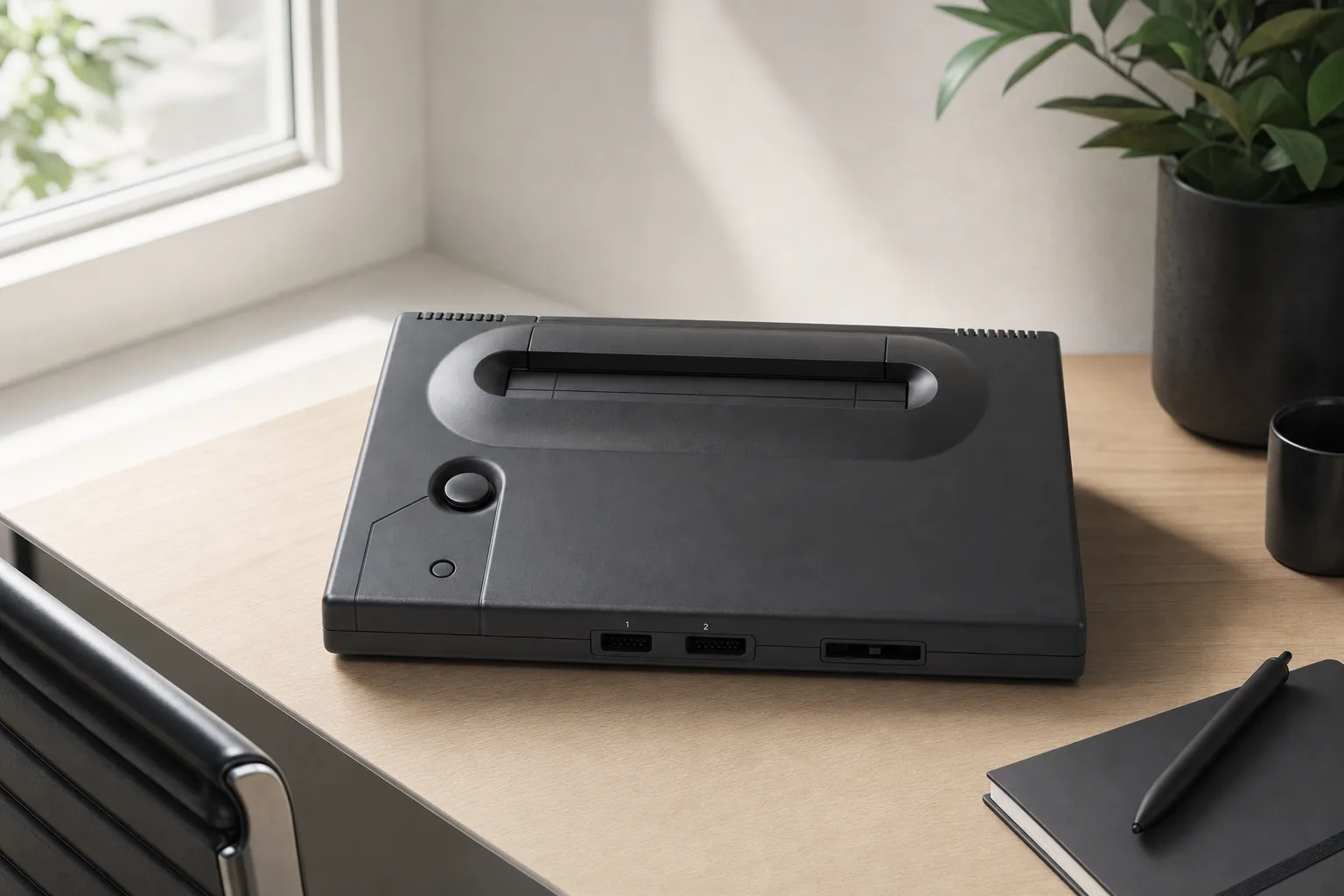
Let's separate the marketing headline from the conclusion people may be tempted to draw from it. PLAION says the AES+ uses re-engineered legacy ASIC chips. It also says the system is not using software emulation and is not an FPGA approximation. Those are the manufacturer's stated technical claims.
ASIC stands for application-specific integrated circuit. In plain English, that means a chip designed for a specific job rather than a general-purpose processor pretending to be something else through software. The AES+ pitch is that its hardware architecture is closer in spirit to the original Neo Geo than a conventional emulation box.
Why should you care? If you only want to play Neo Geo games conveniently, you may not. Modern emulation is already very good, and it remains dramatically cheaper than collecting physical AES games. But for the core audience, the attraction is not merely getting a game on screen. It is the prospect of using cartridges and controls in a machine whose behaviour aims to resemble the original platform.
There had also been technical debate around the implementation's lineage. Reporting noted claims that the ASIC approach might substantially derive from existing FPGA core work, while also noting that the public discussion did not establish that the AES+ was simply a split MiSTer core. That remains an unresolved technical controversy, not evidence of a confirmed problem with the console.
Jotego had discussed matching original Neo Geo colour and audio behaviour, including retaining original-style audio aliasing. Those were development claims reported in launch coverage, rather than independently measured production results.
What authenticity still needs to prove
An ASIC claim is interesting; it is not a benchmark. The useful evidence will be side-by-side testing against an original AES with the same cartridges, display chain and controls. Until then, "authentic" is the target, not the verdict.
The Cartridge Slot Is the Real Retro-Collector Hook
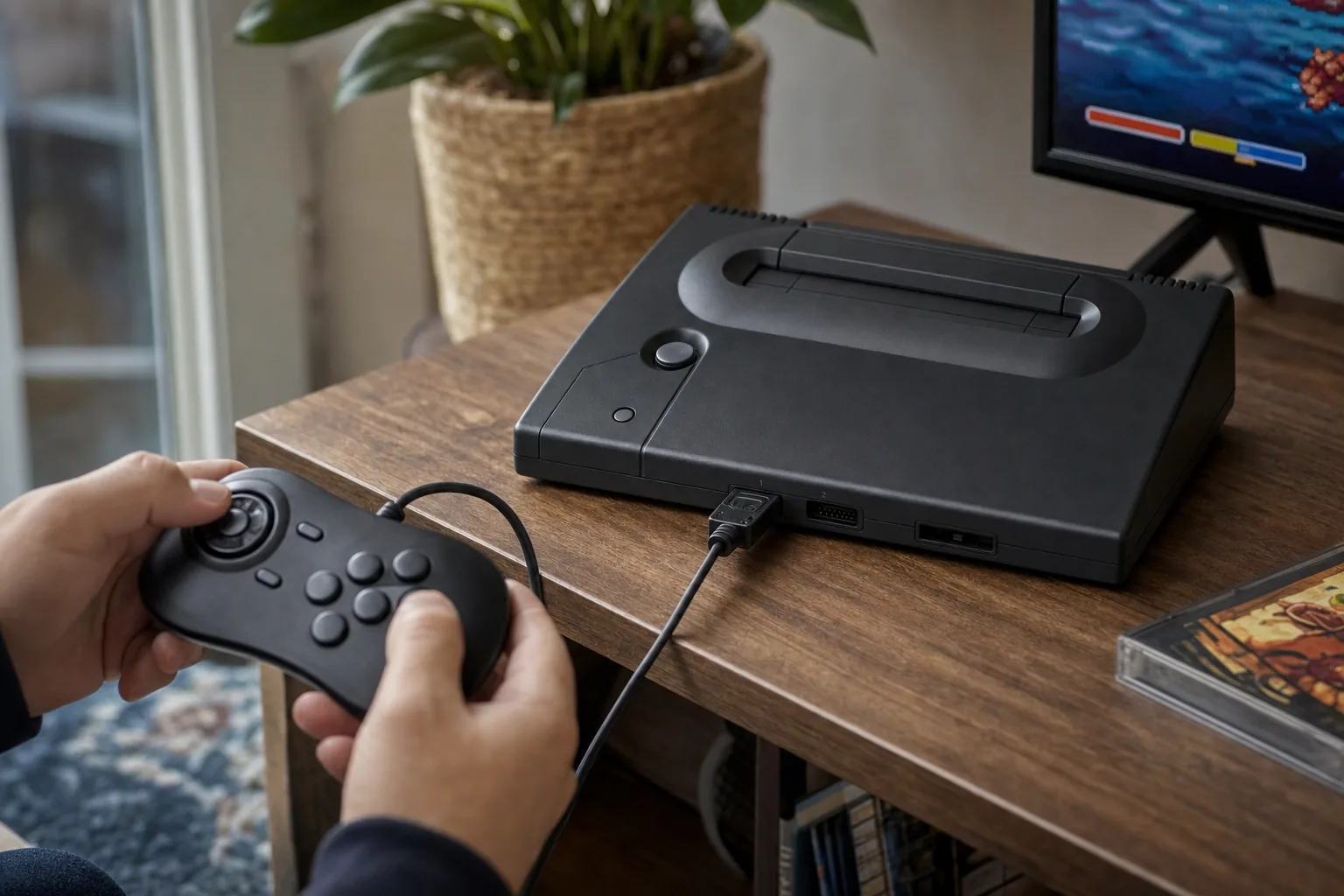
The single most tangible reason to care about the AES+ is not the HDMI socket or the white Anniversary Edition. It is the cartridge slot. PLAION says the console accepts both original NEOGEO AES cartridges and newly produced AES+ cartridges.
That immediately puts it in a different category from a mini console, a licensed plug-and-play machine or a digital compilation. You are not restricted to a preloaded catalogue. You are not being asked to buy into a download shop. The physical cartridge remains the centre of the experience: take it from the shelf, plug it in, use a real controller and play.
For existing AES owners, that could make the system especially interesting. A well-loved original console can stay connected to a CRT, while an AES+ becomes the more practical HDMI machine for a modern lounge television. Or the new unit can simply serve as a backup system for a valuable cartridge collection. Neither scenario is cheap, obviously. Neo Geo has never been a hobby famous for accidental bargains.
Original AES cartridges
PLAION confirms backward compatibility with original NEOGEO AES cartridges. The detail that still matters in practice is how broad that compatibility proves to be across cartridge revisions and edge cases.
New physical releases
New AES+ cartridges were confirmed, and newly produced games were described as region-free. They were also intended to work on original AES hardware.
Classic 15-pin controller ecosystem
The console supports the classic 15-pin NEOGEO controller connection. Original AES controllers and accessories were confirmed to work with AES+, while new accessories were designed to work with original AES hardware.
The region wording needs care. Newly produced games were confirmed as region-free. That does not automatically answer every question about how original cartridges behave across every possible regional combination, so it would be premature to assume a universal answer there.
What the cartridge approach gets right
- Original AES cartridges remain central rather than decorative.
- New games retain a physical release format.
- Newly produced cartridges are confirmed as region-free.
- The machine supports the classic 15-pin control ecosystem.
The practical catch
- New cartridges were listed at £69.99 each in the UK and $89.99 each in the US.
- Original AES games can be expensive collector items in their own right.
- Wide compatibility still needs cartridge-by-cartridge testing.
- This is enthusiast hardware, not an all-you-can-play subscription box.
Original AES cartridge support is the AES+ feature that most clearly separates it from a closed mini-console or digital-only retro system.
HDMI for Modern TVs, RGB for the CRT Faithful
Retro consoles are often awkward because they belong to one era of display technology and your living room belongs to another. The AES+ tries to bridge that gap properly. PLAION confirms low-latency HDMI output at up to 1080p, alongside original-style analogue AV output with RGB, composite and stereo audio support.
For a modern television setup, HDMI is the obvious convenience win. You can connect the console without a separate scaler, a maze of adaptors or the kind of cable arrangement that makes visitors ask whether you are trying to contact the International Space Station. Up to 1080p is also a sensible ceiling for this sort of recreation. The AES+ is not chasing a 4K marketing badge; it is presenting an older game platform through a contemporary connection.
For CRT users, RGB and composite are the more emotionally important inclusions. RGB is the higher-quality analogue route for compatible displays and equipment, while composite keeps the door open to more traditional consumer television setups. That combination gives the console a chance to fit both a living-room HDMI installation and a more dedicated retro corner.
The product information confirms selectable display modes through DIP switches. It does not establish the precise mode list, scaling behaviour, scanline treatment or aspect-ratio options, so those details need to wait for hands-on testing.
DIP Switches, High Scores and the Parts That Feel Like AES
The AES+ is not trying to make everything invisible behind a glossy modern interface. Its confirmed DIP-switch functions include language selection, display-mode settings and selectable overclocking. That sounds like a small thing until you remember what this machine is trying to be.
Neo Geo is arcade hardware with a home-console identity, and physical configuration belongs to that world. The appeal is not that a DIP switch is inherently better than a menu. It is that the system gives you a direct, hardware-flavoured way to adjust its behaviour rather than hiding every choice behind a generic launcher.
The overclocking option is particularly interesting. PLAION says it is intended to address slowdown in demanding games. That could appeal to players who enjoy the games but would rather smooth over performance dips. It also raises the obvious testing question: what does enabling it change? Timing, compatibility and audio behaviour all need independent checking before anyone can call it a universally better mode.
Permanent high-score storage is supported through a Memory Card. The Anniversary and Ultimate bundles include one, while the standard console supports it with a separately sold card. Again, it is a very Neo Geo sort of feature. There is something far more satisfying about preserving an arcade score than saving a screen capture of it to a modern dashboard you will never open again.
A deliberately old-school control philosophy
Language, display modes and overclocking being handled through DIP switches gives the AES+ a welcome sense of purpose. It is not pretending to be a universal retro box. It is trying to be a Neo Geo machine with a few sensible concessions to 2026.
Language selection
Language is selectable via the AES+ DIP switches, preserving a familiar configurable-console approach.
Selectable overclocking
The console includes an overclock option intended to reduce slowdown in demanding games.
Memory Card high scores
Permanent high-score saving is supported through the Memory Card system.
DIP switches for language, display configuration and overclocking are a distinctly hardware-minded part of the AES+ proposition.
An on-screen BIOS was also confirmed in launch information. Its detailed interface, menu structure and settings were not established, but its presence suggests the AES+ will offer some on-screen control alongside the physical switches.
The Ten-Game Ultimate Bundle Is a Collector's Statement
The Ultimate Edition was not merely the package for someone who wanted a spare controller. It was described as an extremely limited, numbered first-off-the-line run, and it bundled all ten launch cartridges. That makes it the clearest expression of what PLAION thinks the AES+ can be: not only a console, but a new collecting platform.
The game list makes a decent case for Neo Geo's range. Metal Slug and Shock Troopers cover the explosive action side. The King of Fighters 2002, Garou: Mark of the Wolves and Samurai Shodown V Special represent the fighting heritage. Pulstar and Twinkle Star Sprites bring shooting and competitive chaos. Then there is Big Tournament Golf, Magician Lord and Over Top, which provide sport, fantasy action and arcade racing respectively.
It is a strong launch selection in historical terms. It is also a very particular kind of purchase. The Ultimate includes a wired Arcade Stick, wireless Arcade Stick and wireless Gamepad, which should make it more immediately useful for different play styles and multiplayer sessions. But no independent controller-latency, battery-life or wireless-stability tests had been confirmed by 19 August.
Why the Ultimate is compelling
- All ten launch cartridges arrive together.
- It includes both Arcade Stick variants and a wireless Gamepad.
- A Memory Card and game rack are included.
- Its numbered status gives it obvious collector appeal.
Why it is not the default pick
- It was listed at £799.99 in the UK and $999.99 in the US.
- Its value depends heavily on wanting the full launch collection.
- Wireless-controller performance remained unmeasured.
- Collectors may value the bundle more than players who only want a few games.
What Is Confirmed, What Is Reported, and What Is Still Smoke?
This is the section worth reading before you get carried away. There is a solid amount of official information about the AES+. There is also a clear boundary between that information and the performance evidence we still need.
| Evidence category | Confirmed information |
|---|---|
| Confirmed by PLAION and SNK | Three AES+ editions; 12 November 2026 scheduled shipping date; original and new AES cartridge support; ASIC-based hardware claim; HDMI up to 1080p; RGB and composite output; DIP switches; Memory Card high-score support; bundle contents. |
| Reported development claim | Jotego discussed matching original Neo Geo colour and audio behaviour, including original-style audio aliasing. That was reported development context, not an independent performance result. |
| Technical controversy | Reporting covered debate about whether the implementation derives substantially from existing FPGA work. Public discussion had not established that the AES+ was simply a split MiSTer core. |
| Still awaiting independent proof | Latency, timing accuracy, sound character, heat, power draw, long-session reliability, controller behaviour, shell quality and broad original-cartridge compatibility. |
The strongest case for the AES+ is its combination of confirmed hardware design intent and physical-media support. The weakest case is any claim that it has already beaten original hardware, FPGA alternatives or established emulation on measurable accuracy. That conclusion had not been earned yet.
The Ultimate Edition's ten cartridges cover fighters, shooters, action games, racing, golf and fantasy arcade fare rather than relying on one genre alone.
The Numbers We Still Need Before Calling It Authentic
There are no useful performance charts to draw yet, because there are no valid comparable benchmarks. I am not going to turn "low latency" into a made-up milliseconds figure, or pretend an untested wireless stick has a known response time. That would look reassuring and tell you absolutely nothing.
The first essential test is controller-to-screen latency. That means measuring the full chain from a button press to the corresponding visual response, ideally with both the wired stick and wireless accessories. HDMI processing latency matters too, because even a faithful core can feel wrong if the video output adds a noticeable delay.
Then comes frame pacing and game behaviour. Does a demanding title show slowdown where an original AES does? What changes when the overclock option is enabled? Are sprite effects, palette changes and audio behaviour matched closely? A proper comparison needs the same game running on original hardware and AES+, captured through suitable matched setups.
The test that matters most
A game booting successfully is only the beginning. The meaningful proof will be a cartridge-level comparison across a varied library, including games that stress timing, audio, slowdown and unusual hardware behaviour.
Who Is the AES+ Really For?
The AES+ was never going to be the universal answer to Neo Geo games. It is far too focused for that, and that is largely the point. The best audience is existing AES owners and enthusiasts who want to keep using original cartridges and 15-pin controls without committing every session to an ageing console and a CRT.
It also makes sense for players who care about the hardware story. If the difference between emulation, FPGA and re-engineered ASIC logic is interesting to you rather than alarming, you are the target audience. You may enjoy the physical cartridge ritual, the arcade-stick layout and the chance to adjust machine behaviour through DIP switches. This is very much not a device for somebody whose first question is "where are the 500 built-in games?"
Best for existing AES owners
The standard NEOGEO AES+ is the logical entry point for people who already own original cartridges and want HDMI alongside analogue output.
Best for Metal Slug collectors
The NEOGEO AES+ Anniversary Edition is the natural fit if the white console, wireless stick, Memory Card and exclusive white Metal Slug cartridge are the attraction.
Best premium pick
The numbered NEOGEO AES+ Ultimate Edition is for the buyer who wants all ten launch games, both stick types and the wireless Gamepad in one collector-led package.
Best lower-cost alternative
The HyperMegaTech Super Pocket was the budget route for portable Evercade-compatible retro play, though it is not an AES cartridge machine.
Strong match
- AES cartridge collectors.
- CRT users wanting RGB or composite output.
- Arcade-control enthusiasts.
- Players who prioritise physical media and hardware character.
Weak match
- Casual players seeking the biggest library for the least money.
- Buyers wanting 4K output or confirmed online features.
- Anyone who prefers a broad multi-system device.
- Players who are entirely happy with modern emulation.
The AES+ has the clearest appeal for players who want original cartridges and arcade-style controls on both current televisions and CRT setups.
How It Compares With the More Practical Alternatives
No alternative below is a direct replacement for an AES+. That is important. The Evercade and Analogue products solve different problems, use different game formats and appeal to different collecting habits. Still, they show just how specialised PLAION's proposition is.
| Product | UK price | Form factor | Game format | Original AES cartridges |
|---|---|---|---|---|
| NEOGEO AES+ | £179.99 | Home console | Original and new AES cartridges | Yes |
| Evercade EXP-R | £99.99 | Portable handheld | Evercade physical cartridges | No |
| Evercade Alpha | £199.99 introductory price | Countertop bartop arcade | Evercade cartridges and Capcom content by edition | No |
| HyperMegaTech Super Pocket | £49 original launch price | Portable handheld | Built-in games and Evercade compatibility by model | No |
| Analogue Pocket | UK price not listed here | Portable handheld | Game Boy, Game Boy Color and Game Boy Advance cartridges | No |
The Evercade EXP-R is the sensible pick if portability and low entry cost matter more than original hardware. It was listed at £99.99, has Evercade cartridge support and built-in Wi-Fi, but it has no television connection and no AES cartridge support. The Evercade Alpha is more about the instant appeal of a bartop arcade cabinet. The Super Pocket is the budget option for licensed retro play in a small handheld format.
The Analogue Pocket is the closest philosophical cousin because it uses two FPGAs rather than software emulation, but it serves a different cartridge world. It supports Game Boy, Game Boy Color and Game Boy Advance cartridges natively, while Neo Geo Pocket support requires a separate adapter. It does not play AES cartridges. The optional Dock adds 1080p HDMI output.
Questions the Product Pages Do Not Yet Answer
The AES+ has enough confirmed detail to understand the concept. It does not yet answer every question that serious retro buyers should ask before committing. That is normal for pre-release hardware, but it should shape expectations.
We know original AES cartridges are supported. We do not yet have a broad independent compatibility matrix covering cartridge revisions, regional quirks or unusual titles. We know the HDMI output is described as low latency and reaches up to 1080p. We do not have measured latency figures or a clear account of every display mode. We know wireless accessories exist. We do not have independently verified battery or connection data.
Likewise, the ASIC claim is meaningful only once it faces the things enthusiasts will actually test: colour reproduction, audio response, sprite timing, slowdown, long-session stability and the slightly awkward games that tend to expose a hardware recreation's weak points. Those tests may eventually reinforce the promise. They may complicate it. Either outcome is more useful than simply trusting a bullet point.
The key unanswered question is not whether the AES+ can display Neo Geo games, but how closely it behaves alongside an original AES across a wide cartridge library.
FAQ and the Bottom Line
Gadget Scout's first-look verdict
The NEOGEO AES+ had the ingredients of a genuinely special Neo Geo revival: original-cartridge support, classic 15-pin controls, RGB and composite output for CRT users, HDMI up to 1080p, DIP-switch configuration and a stated ASIC-based design. That is a far more serious attempt at recreating the AES experience than another preloaded nostalgia box. But the most important word in the pitch remains "attempt". Until independent reviewers can measure latency, compare cartridge behaviour, assess audio and video fidelity, and live with the hardware for more than a quick session, the AES+ is best described as promising rather than proven. For committed Neo Geo collectors, though, it is absolutely one to watch.