
ASUS ROG Zephyrus G16 vs Lenovo Legion Pro 7i: Which RTX 5080 Laptop Wins?
The lighter RTX 5080 laptop for the train, lecture hall and edit suite meets the heavier one built to stay near a mains socket and chase higher frame rates.
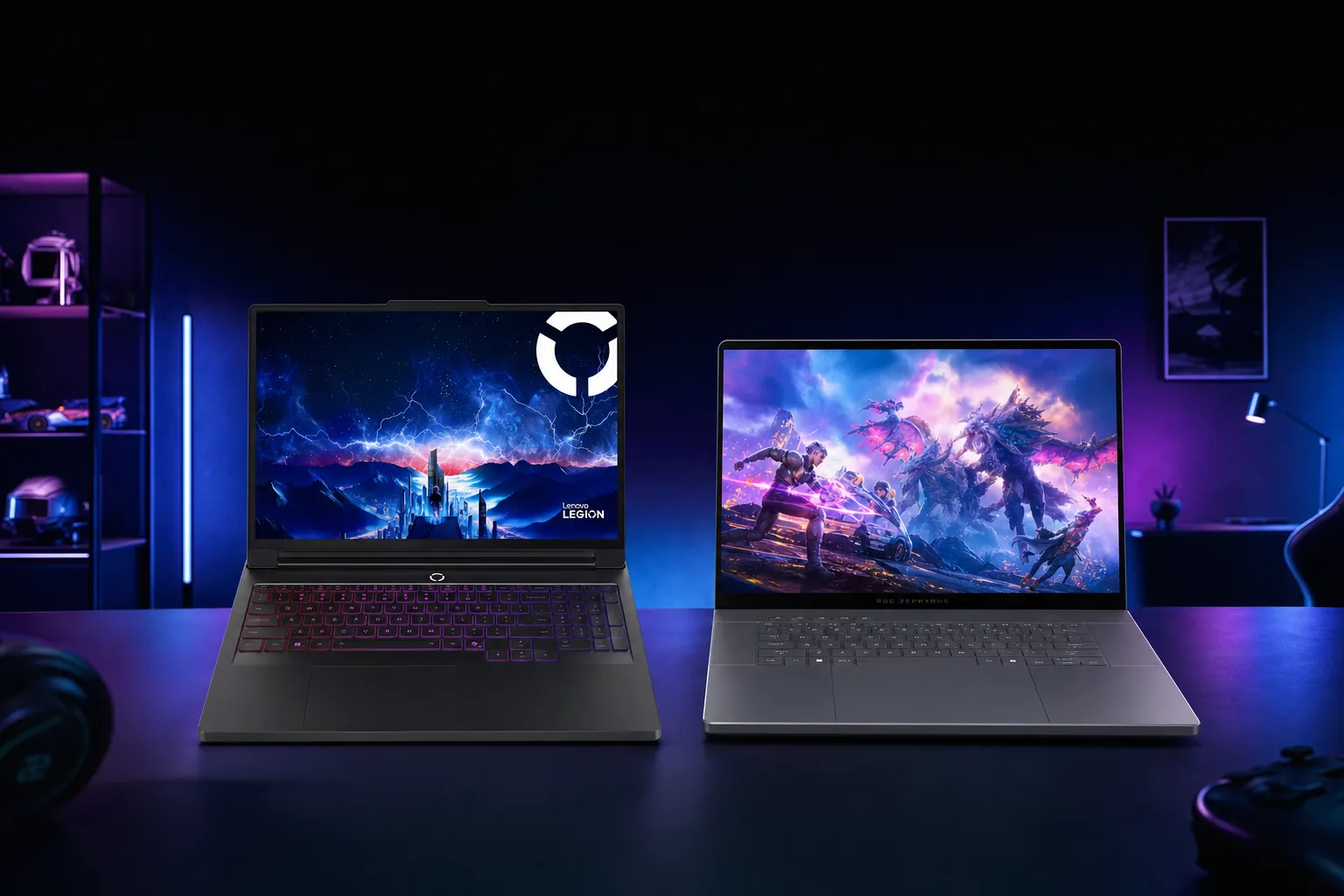


Its 175W RTX 5080, 24-core CPU and upgradeable RAM favour sustained gaming and demanding desk-based work.
Check price on Amazon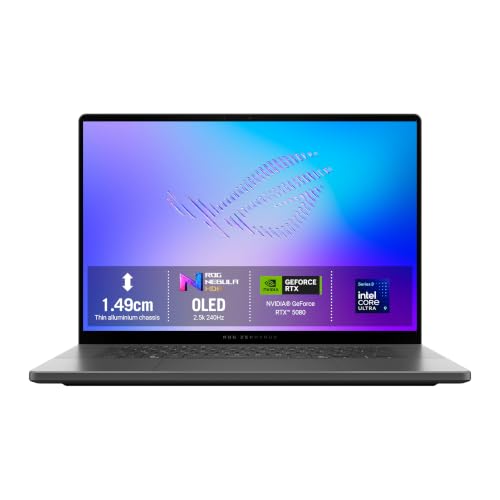
The 1.95kg aluminium design, SD reader and strong speakers suit buyers who need a powerful laptop to travel daily.
Check price on AmazonWe link to the exact model on Amazon UK. Prices change often, so check the live price before you buy. As an Amazon Associate we earn from qualifying purchases.
Picture the choice: a 1.95kg aluminium laptop slipping into a backpack, or a larger machine arriving with a 400W brick and the muscle to drive its RTX 5080 harder. The ASUS ROG Zephyrus G16 is the more practical pick for daily carrying, creative work and mixed office use. The Lenovo Legion Pro 7i is the stronger buy for plugged-in gaming, CPU-heavy work and long-term upgradeability. The important wrinkle is that the Amazon ASUS listing is a newer GU606AW generation, not the 2025 GU605 most published performance results cover.
| At a glance | ASUS ROG Zephyrus G16 | Lenovo Legion Pro 7i Gen 10 |
|---|---|---|
| Amazon-listed configuration | GU606AW, Core Ultra 9 386H, RTX 5080, 32GB RAM, 2TB SSD | Core Ultra 9 275HX, RTX 5080, 64GB RAM, 2TB SSD |
| RTX 5080 memory | 16GB GDDR7 | 16GB GDDR7 |
| Maximum graphics power | Up to 135W Turbo; up to 160W Manual | 175W TGP |
| Display | 16-inch 2560×1600 OLED, 240Hz | 16-inch 2560×1600 OLED, 240Hz |
| Weight | 1.95kg | 2.64–2.72kg in reviewed configurations |
| Battery | 90Wh | 99.9Wh in the high-capacity configuration |
| Memory upgradeability | Soldered LPDDR5X | Two DDR5-6400 CSODIMM slots |
| Key connectivity advantage | UHS-II SD card reader | 2.5Gb Ethernet and 140W USB-C power input |
| Buy | Check price | Check price |
Both Amazon UK listings were in stock on 26 September 2026. Exact retail configuration and price should be checked on the product page before purchase.
Editor's Note: A Critical Model Mismatch You Need to Know Before Buying
The Amazon UK Zephyrus listing names the GU606AW and Core Ultra 9 386H. ASUS identifies that as the 2026 Zephyrus G16 generation, whereas the 2025 GU605 RTX 5080 reviewed by TechSpot, PC Gamer and Tom's Guide used a Core Ultra 9 285H and a 120W RTX 5080 configuration.
That changes how to read this comparison. The 2026 GU606AW carries Intel's newer Panther Lake Core Ultra 9 386H, with 16 cores, a 4.9GHz maximum frequency and a 50 TOPS NPU. ASUS specifies its RTX 5080 at up to 135W in Turbo mode and up to 160W in Manual mode. That is a meaningful rise from the 120W ceiling of the 2025 GU605.
It also means older Zephyrus frame-rate figures are useful directional context rather than a direct forecast for the Amazon machine. The underlying design priorities remain clear: compact aluminium construction, a 16-inch OLED and lower travelling weight than the Legion. But buyers should expect the 2026 ASUS to perform differently from the 2025 review samples.
There is one further listing detail worth checking before ordering: Amazon names a 2TB SSD, whilst ASUS's published GU606 specification lists 1TB for the corresponding 32GB model. Check the precise retailer SKU and storage line before committing.
Design and Build: Slim Aluminium vs Desktop-Replacement Bulk
The ASUS is built around mobility. At 354×246mm, 14.9–17.9mm thick and 1.95kg, it is a remarkably compact way to carry RTX 5080-class graphics. The practical gain is not merely a lighter number on a spec sheet: it is the difference between taking a gaming-capable laptop to work every day and deciding it is too much trouble.
The Legion's 364.38×275.94mm footprint, 21.9–26.65mm height and 2.64–2.72kg reviewed weight make it a different category of machine. It is a desktop replacement with a 16-inch panel, a broad rear cooling section and enough internal room to feed a 175W GPU. Its aluminium top and bottom panels provide a sturdy foundation, but it will dominate a smaller desk and feel substantial in a bag.
Carrying reality
The laptop gap is roughly 700–800g before chargers enter the equation. Notebookcheck weighed the Legion's 400W brick at 1.206kg. The ASUS supports 100W USB-C charging for lighter-use travel, although full gaming performance requires its supplied adapter.
For UK commuters, this distinction becomes most obvious when the laptop is not the only thing in the bag. The Legion is manageable for occasional trips, a weekend away or moving between a home desk and another fixed workspace, but its adapter turns the package into a deliberately planned carry. The Zephyrus is still a premium 16-inch machine rather than an ultraportable, yet its lower weight and slimmer profile make it the more realistic choice for regular rail travel, campus days and hot-desking. Neither design is inherently better; they are optimised for different routines.
The Display Showdown: Two 240Hz OLEDs With Different Priorities
Both laptops offer the fundamentals people paying RTX 5080 money should expect: a 16-inch OLED panel, 2560×1600 resolution, 16:10 proportions, 240Hz refresh and NVIDIA G-SYNC. The extra vertical workspace is useful outside games, whilst OLED's deep blacks and rapid pixel transitions suit dark scenes, films and fast action.
The 2025 GU605 reference panel was specified at 500 nits, 100% DCI-P3, Delta E below one, 0.2ms response time and DisplayHDR True Black 500. It also carried Pantone validation and an anti-reflection coating. Those details explain why reviewers repeatedly praised the Zephyrus display for colour-rich creative work, but they should not be treated as a full specification sheet for the newer GU606AW listing.
Lenovo's panel is more clearly documented: 500 nits typical SDR brightness, up to 1,100 nits HDR peak brightness, 100% DCI-P3, Dolby Vision and DisplayHDR True Black 1000. Notebookcheck recorded 498cd/m² maximum brightness, 99.5% DCI-P3 coverage and exceptionally rapid 0.43ms black-to-white response. The Legion therefore has the stronger verified HDR credential, though its glossy surface can prove distracting outdoors.
In day-to-day terms, both screens reward buyers who split their time between games and media or creative applications. A 240Hz panel does not guarantee every demanding new game will run at 240fps at native resolution, particularly with ray tracing enabled, but it also improves the feel of lighter esports-style titles and ordinary Windows use. The main trade-off is environmental: OLED contrast looks superb indoors, while reflections remain a consideration if you often work beside a bright window or outdoors.
ASUS ROG Zephyrus G16 RTX 5080: The Slimmer Route to High-End Graphics
The Zephyrus idea is persuasive because it does not look or travel like a conventional thick gaming machine. The compact aluminium body, four-speaker system, UHS-II SD reader and 16:10 OLED make it credible as a laptop for an edit suite, university desk or client meeting as well as for evening gaming.
The product listed on Amazon UK has moved beyond the 2025 model in an important way. Its Core Ultra 9 386H and 135W-to-160W RTX 5080 power range should close some of the gulf exposed by the 120W GU605. Still, the Legion retains a 175W graphics ceiling and a much larger thermal envelope.
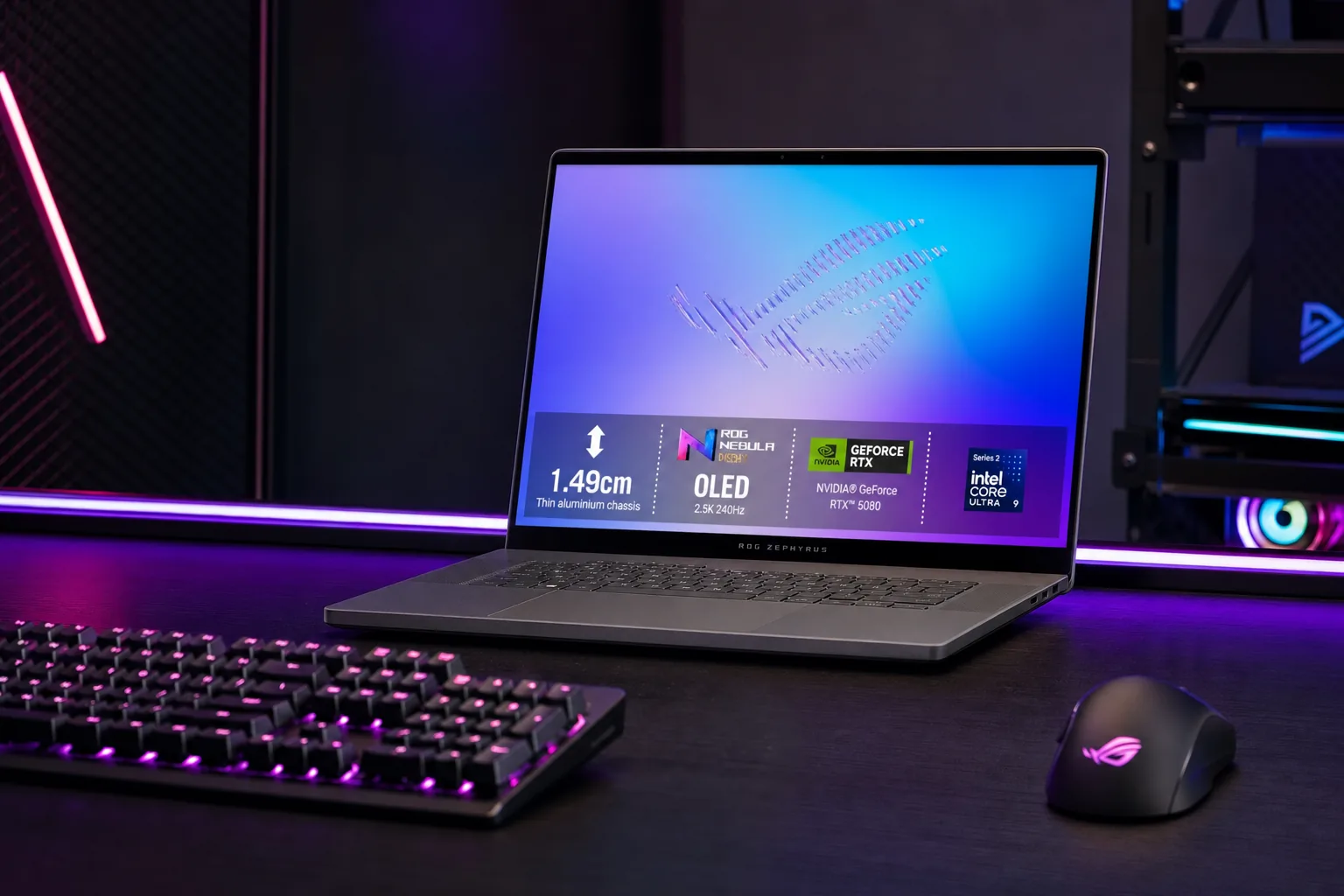
The honest catch is permanence. The ASUS has 32GB LPDDR5X-8533 onboard memory, which cannot be upgraded later. Its M.2 storage arrangement is more flexible, with two slots, but a buyer expecting to keep the machine for many years needs to choose memory capacity carefully on day one.
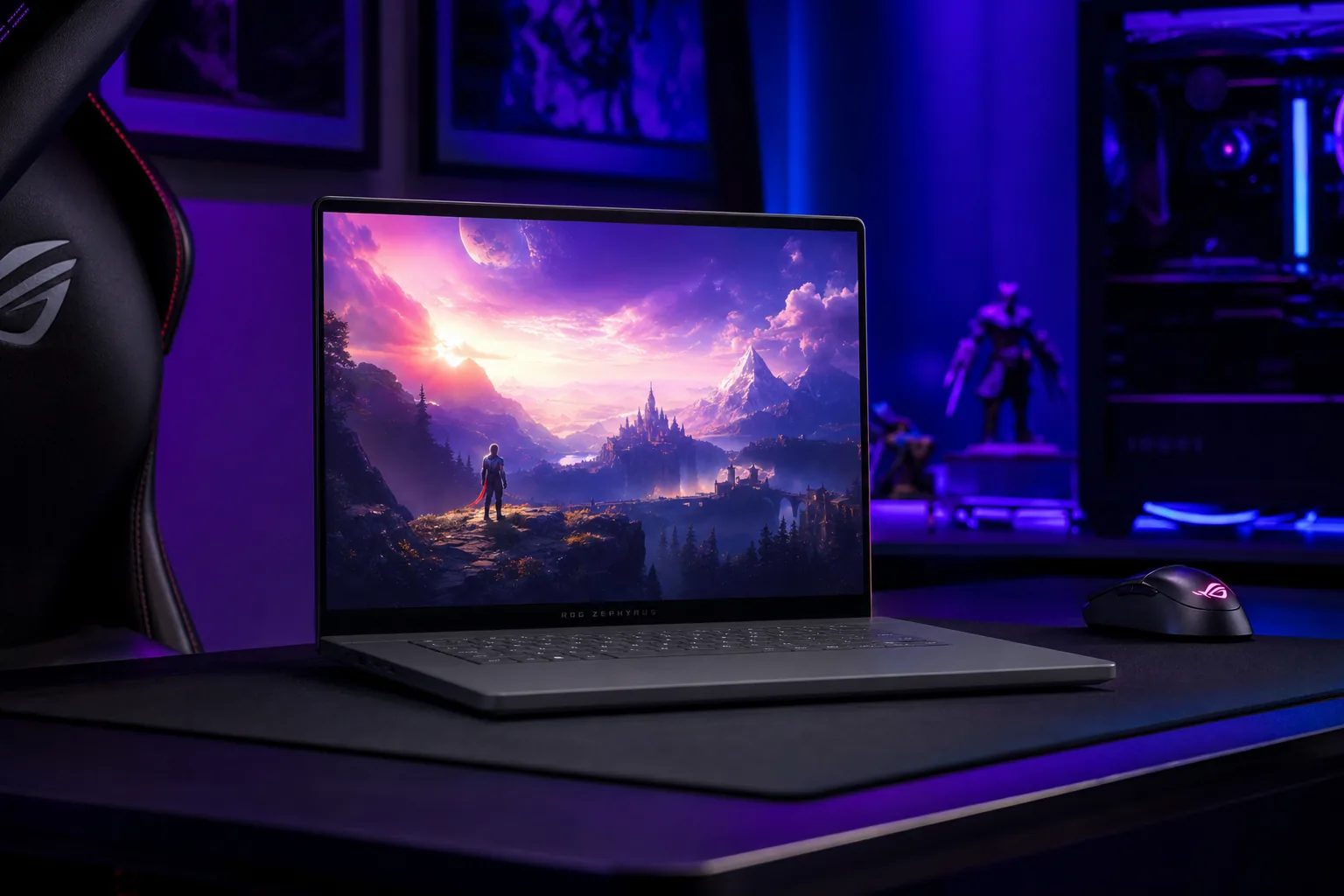
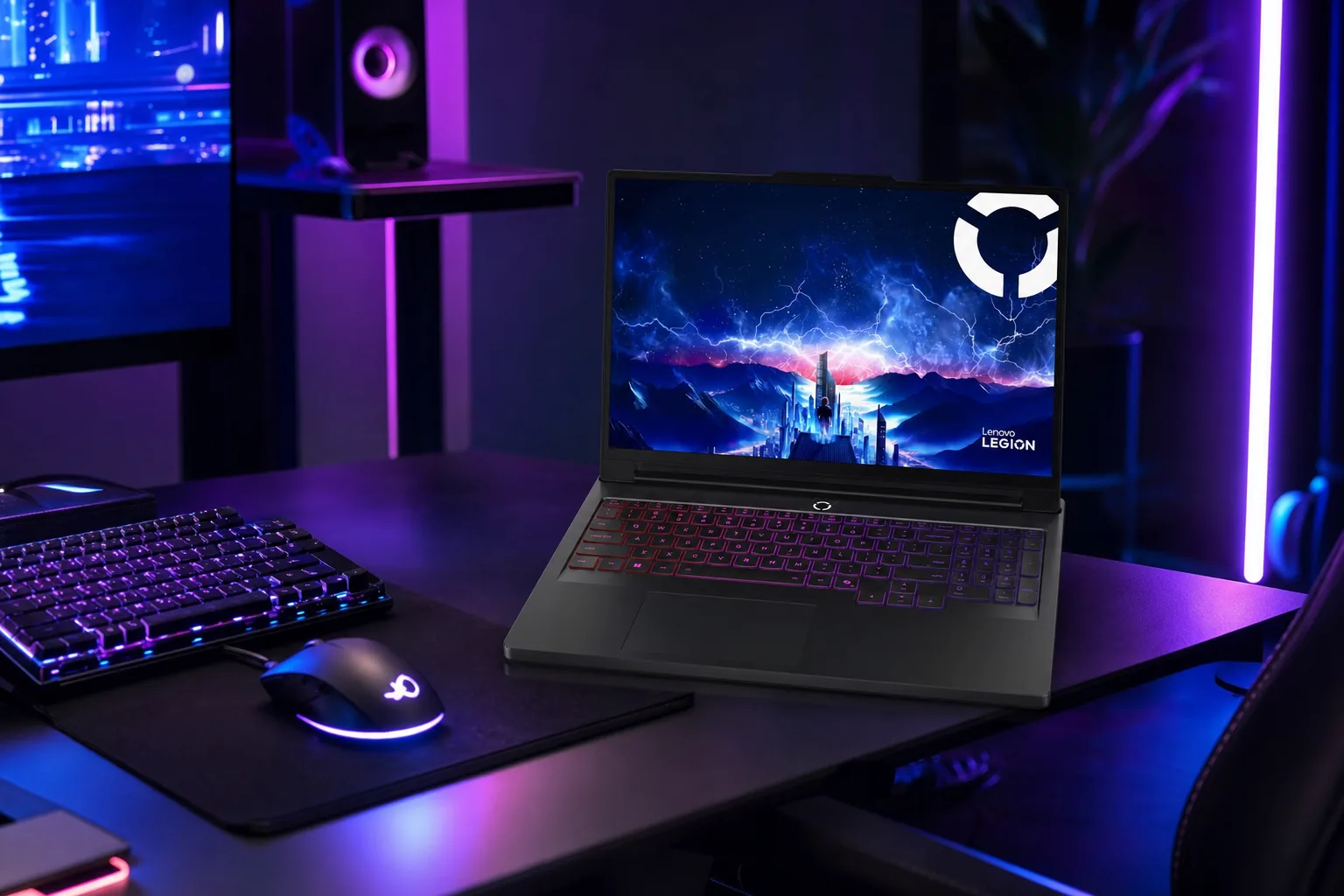
Lenovo Legion Pro 7i Gen 10 RTX 5080: The Full-Power Gaming Case
The Legion is designed around sustained output. It pairs the 175W RTX 5080 with Intel's 24-core Core Ultra 9 275HX, which reaches up to 5.4GHz. Notebookcheck listed 156W PL1 and 201W short-burst PL2 CPU limits, a scale of power that helps in heavy rendering, compiling and CPU-limited games.
Its physical size is the price of that approach. Lenovo's large cooling assembly, 400W adapter and thicker rear section are not subtle, but they give the GPU room to run at its full stated TGP. The machine also offers two DDR5-6400 memory slots and two M.2 slots, including one PCIe 5.0×4 and one PCIe 4.0×4 connection.
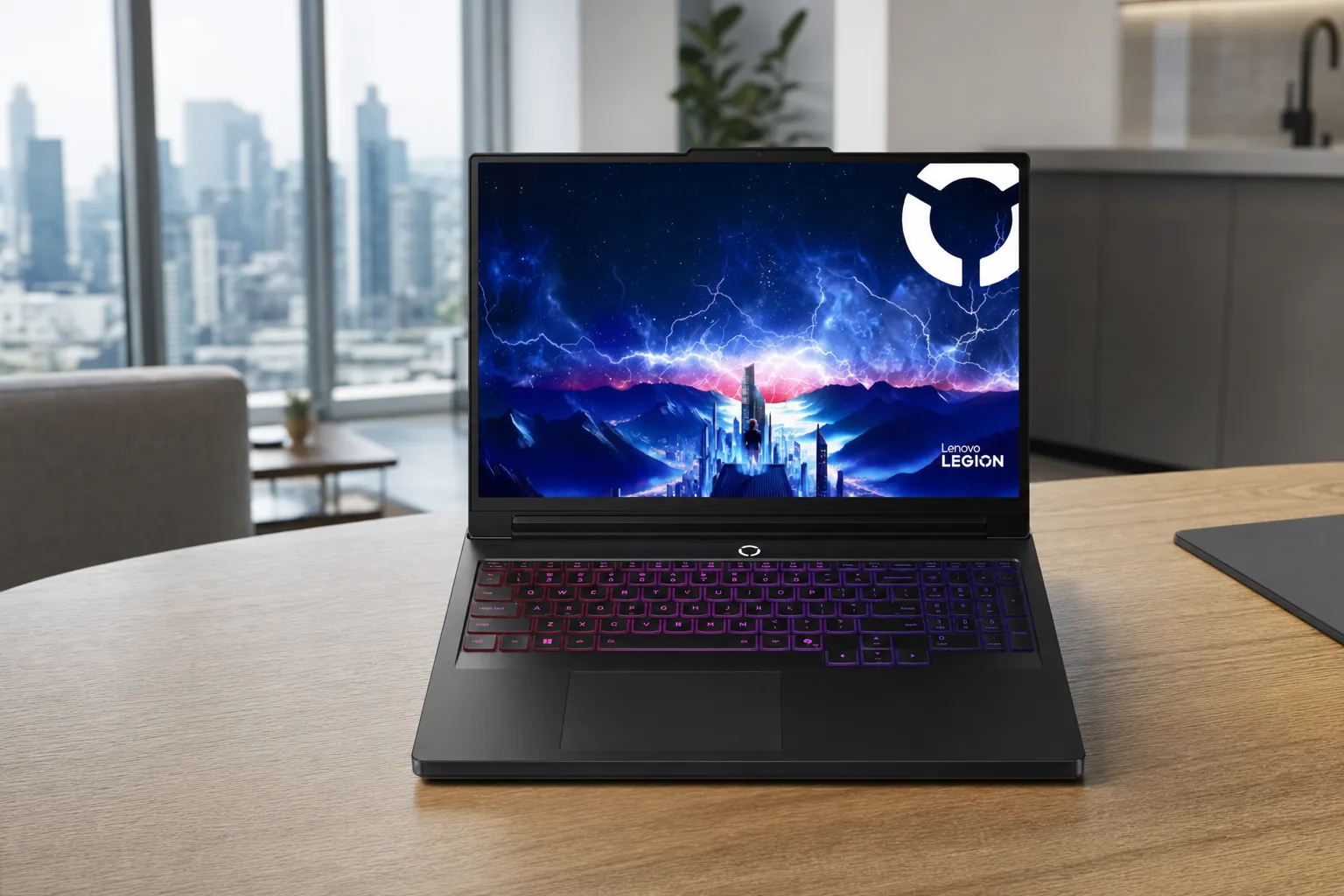
This is the laptop for someone who treats a desk as home base and wants laptop portability only in the sense that the entire system can move between rooms, flats or events. It can travel, but the ASUS is the one that makes travel feel routine.
Gaming Benchmarks Compared: The RTX 5080 Name Is Not the Whole Story
GPU naming alone is misleading here. Lenovo's 175W RTX 5080 has a 15W advantage over the ASUS GU606AW's maximum Manual setting and a 40W advantage over its Turbo figure. More importantly, published ASUS gaming results came from the earlier 120W 2025 chassis, so they show the consequence of a lower-power implementation rather than providing a direct GU606AW result.
TechSpot found the 120W GU605 around 21% slower on average in its game suite than a 175W RTX 5080 Medion Beast 16X. That is particularly relevant because the Legion also uses the 175W RTX 5080 power class and an HX-series processor. PCWorld described its Legion sample as producing the fastest Port Royal result it had encountered, whilst Windows Central reported a Time Spy result only 4% behind a larger RTX 5090 ASUS ROG Strix Scar 18.
The ASUS GU606AW's higher Turbo and Manual power limits could narrow the performance gap seen in the older 120W tests, but no published game benchmarks for the GU606AW confirm this yet. Until that data exists, the Legion remains the safer choice for buyers chasing the highest possible 1600p frame rate. If you value a much lighter machine and are content to use DLSS in demanding games, the ASUS proposition remains attractive.
That last point matters for buying decisions. A player focused on competitive games or lighter titles may gain more from the ASUS's portable chassis and 240Hz panel than from the Legion's higher ceiling, especially if the laptop is used in several locations. A buyer targeting demanding single-player releases at high native-resolution settings, or wanting more headroom for ray tracing, has a clearer reason to favour Lenovo. The Legion is not automatically "better" because it is faster; it is better only where its performance advantage will be used often enough to justify its bulk.
Thermals and Noise: Lenovo's Bulk Buys Performance, Not Silence
The surprising point is that Lenovo's extra performance does not create a dramatic maximum-noise penalty. TechSpot recorded approximately 53dB from the 2025 Zephyrus in Turbo mode. Notebookcheck recorded 53.9dB at maximum load and 54.2dB in Cyberpunk 2077 on the Legion. Both need headphones for demanding games if fan sound bothers you.
The character and consequence differ. The 2025 ASUS's Core Ultra 9 285H reached 97°C in Baldur's Gate 3, whilst its GPU peaked at 75°C in Space Marine 2. TechSpot said the chassis remained comfortable against the legs, but PC Gamer also criticised high-pitched, shifting fan behaviour and recorded a 104°C CPU result in a separate CPU workload.
Notebookcheck reported the Legion's top surface reaching 42.6°C and its underside 41.2°C under maximum load. The warmest area was away from the main controls; the WASD region, arrow keys and palm rests remained comparatively comfortable. Its Balanced mode reached roughly 40dB, but Notebookcheck associated that quieter profile with about a 15% graphics-performance reduction.
Battery Life and Everyday Usability: Plug In for Serious Gaming
Neither is a serious unplugged gaming laptop. TechSpot reported roughly 90 minutes of gaming from the 2025 Zephyrus and a little over an hour to recharge using its review setup. It also found that lighter Eco-mode work could stretch to around half a day or somewhat longer.
The Legion's larger 99.9Wh battery did not turn it into an all-day machine. Notebookcheck recorded 5 hours 23 minutes in Wi-Fi web use and 48 minutes under maximum-brightness load, with a full charge taking around 90 minutes. TechRadar separately recorded 4 hours 37 minutes of web browsing and 1 hour 36 minutes in PCMark 10's Gaming Battery run.
The practical answer
Use either laptop away from the wall for notes, media and light work. For the RTX 5080 experience that justified the purchase, plan around mains power. The Legion's larger battery is outweighed by its hungry 175W GPU and 24-core processor.
For a mixed workday, the distinction is less about choosing a theoretical winner than managing expectations. The ASUS has the more convenient fallback option because it supports 100W USB-C charging for lighter use, while Lenovo supports USB-C charging up to 140W with the appropriate Lenovo adapter or protocol. Neither USB-C route replaces the supplied high-wattage adapter for gaming. If you need to edit, browse, write or attend meetings away from a socket, both can do that; if the plan includes a full evening of high-performance gaming, bring the mains supply.
Ports, Connectivity and Upgrade Room: Lenovo Pulls Ahead on Practicality
ASUS creator-friendly I/O
HDMI 2.1 FRL, Thunderbolt 4, USB-C with DisplayPort, power delivery and G-SYNC, two USB-A ports, a 3.5mm jack and a UHS-II SD card reader make the Zephyrus convenient for camera media and portable storage.
Lenovo desk-ready I/O
Thunderbolt 4, USB-C with DisplayPort 2.1 and up to 140W power input, three USB-A ports, HDMI 2.1, 3.5mm audio and 2.5Gb Ethernet give the Legion a stronger wired setup.
ASUS fixed memory
The listed 32GB LPDDR5X-8533 memory is soldered. Storage can expand through two M.2 slots, but RAM capacity is fixed from purchase.
Lenovo serviceable core
Two DDR5-6400 CSODIMM slots and two M.2 slots give the Legion a meaningful long-term advantage for memory and storage upgrades.
Both include Wi-Fi 7, Bluetooth support, HDMI and Thunderbolt 4. The decision rests on your workflow: choose ASUS for the built-in SD reader and lower-carrying-weight setup; choose Lenovo for Ethernet, an extensive USB array and components that can grow with your needs.
The ports also shape setup friction. A desk-based Legion owner can connect wired networking, external displays and peripherals without treating the machine as a compromise between workstation and gaming system. The Zephyrus is more self-contained for mobile creator work because the card reader is built in, avoiding an extra dongle for compatible camera media. Conversely, an ASUS buyer who requires wired Ethernet will need an adapter, and a Lenovo buyer who regularly imports SD media will face the same accessory requirement. These are small differences, but they recur every time the laptop is unpacked.
Audio, Webcam and the Small Details That Shape Daily Use
The ASUS has the stronger case for built-in entertainment. Its four-speaker system uses dual-force woofers, two tweeters, Smart Amplifier Technology and Dolby Atmos. TechSpot and Tom's Guide both singled it out as unusually capable for a laptop, which matters when you want to watch films or play casually without immediately reaching for headphones.
Its 1080p Full HD IR webcam also supports Windows Hello. That is a useful quality-of-life feature on a machine intended to cross between gaming and work.
The Lenovo uses four speakers, made up of two 2W woofers and two 2W tweeters. Notebookcheck measured 81.4dB maximum loudness and described mids and highs as balanced, though bass sat 7.6% below its comparison median and maximum volume could be higher. Lenovo's keyboard adds a number pad, 1.6mm key travel and per-key RGB lighting; the ASUS uses one-zone RGB backlighting.
UK Pricing Reality Check: What You Are Paying For
Do not use past launch pricing as a substitute for a live checkout figure. Both Amazon UK listings were in stock on 26 September 2026, but prices change with promotions, memory allocation and SSD capacity.
ASUS price context
2025 GU605 RTX 5080 configurations were reported around £3,199.99 to £3,399.99, depending on promotion and memory or storage tier. The Amazon GU606AW is a newer generation and should be judged on its exact listed configuration.
Lenovo price context
TechRadar's RTX 5080 review configuration carried a £2,990 UK price reference. Lenovo's configurable UK range separately showed a Core Ultra 9 275HX/RTX 5070 Ti base configuration from roughly £3,135.99, but that price applies to the lower-tier GPU, not the RTX 5080; a confirmed current UK checkout price for the RTX 5080 configuration was not available beyond the £2,990 review-period figure. The 64GB Amazon configuration belongs in the upper end of the RTX 5080 price range.
When the checkout prices are close, Lenovo offers more frame-rate potential, replaceable memory and Ethernet for the money. ASUS earns its premium only if its lower mass, SD reader, speaker quality and more discreet day-to-day character are benefits you will actually use.
For UK buyers, compare the complete configuration rather than only the RTX 5080 badge. The Amazon Legion listing includes 64GB RAM and 2TB storage, while the ASUS listing states 32GB and 2TB but conflicts with ASUS's published 32GB/1TB GU606 specification. Since ASUS memory is soldered, that capacity difference has more long-term importance than it would on the Lenovo. Confirm the exact memory, SSD capacity, operating-system edition where relevant and delivery status on the live listing before treating one apparent deal as directly equivalent to the other.
Who Should Buy Which?
Choose the ASUS ROG Zephyrus G16
- You carry your laptop daily and want to keep the load close to 2kg.
- You edit photos or video and value the UHS-II SD reader, OLED screen and strong speakers.
- You want a gaming laptop that can pass unobtrusively through a classroom, office or meeting.
- You prefer the option of lighter 100W USB-C charging when travelling for non-gaming work.
- You accept fixed memory and are comfortable prioritising portability over the final tranche of FPS.
Choose the Lenovo Legion Pro 7i
- You want the highest sustained RTX 5080 performance available in this comparison.
- You regularly run CPU-heavy rendering, compiling or creative workloads alongside games.
- You game at a fixed desk and welcome 2.5Gb Ethernet.
- You want replaceable RAM and two M.2 slots for a longer ownership horizon.
- You can live with a 2.64kg-plus chassis and a 1.206kg-class charger.
The undecided buyer should ask one practical question: where will the laptop spend most of its working life? If the answer is "on a desk, connected to power and peripherals", the Legion's compromises become easier to justify and its upgrade path becomes more valuable. If the answer is "in a backpack, meeting rooms, lectures or several rooms each week", the Zephyrus's lower weight is a benefit experienced every day rather than an abstract specification advantage. The ASUS is not a substitute for Lenovo's desktop-replacement performance, and Lenovo is not a substitute for ASUS's ease of transport.
The Gadget Scout verdict
The Lenovo Legion Pro 7i is the recommendation for performance-first buyers: its 175W RTX 5080, 24-core HX processor, upgradeable memory and wired networking make it the more capable desk-based gaming machine. The ASUS ROG Zephyrus G16 is the recommendation for mobile premium buyers. Its 1.95kg body, SD reader, four-speaker system and OLED-first approach make it easier to live with away from a desk.
The hybrid case rests on the newer ASUS GU606AW's higher 135W Turbo and 160W Manual power limits, which may narrow the gap suggested by the older 120W GU605 figures — though matching game benchmarks for the new model have not yet been published. Buy the ASUS for the lifestyle advantage; buy the Legion when frame rate, upgrades and sustained power matter more than carrying comfort.
Common Questions UK Buyers Are Asking
Sources
- ASUS ROG Zephyrus G16 GU606 2026 specifications; ASUS ROG Zephyrus G16 GU605 2025 product and specification pages.
- Lenovo Legion Pro 7 16IAX10H PSREF specification document and Lenovo UK Legion Pro 7i Gen 10 product page.
- TechSpot, ASUS ROG Zephyrus G16 RTX 5080 review.
- Tom's Guide and PC Gamer reviews of the 2025 ASUS ROG Zephyrus G16 RTX 5080.
- Notebookcheck, TechRadar, PC Gamer, PCWorld and Windows Central coverage of the Lenovo Legion Pro 7i Gen 10 RTX 5080.
- Ultrabookreview coverage of the ASUS GU606 and Lenovo Legion Pro 7i Gen 10.
- Lenovo Legion Pro 7i Gen 10 RTX 5080Performance pickView on Amazon
- ASUS ROG Zephyrus G16 RTX 5080Portable premium pickView on Amazon
Sources and evidence (21)
- rog.asus.com (other)
- notebookcheck.net (other)
- techspot.com (other)
- psrefstuff.lenovo.com (other)
- tomsguide.com (other)
- pcworld.com (other)
- windowscentral.com (other)
- asus.com (other)
- lenovo.com (other)
- psref.lenovo.com (other)
- rog.asus.com (other)
- pcgamer.com (other)
- ultrabookreview.com (other)
- gamesradar.com (other)
- rog.asus.com (other)
- rog.asus.com (other)
- ultrabookreview.com (other)
- gaming.lenovo.com (other)
- techradar.com (other)
- pcgamer.com (other)
- ultrabookreview.com (other)