
Samsung Galaxy Watch Ultra2: Confirmed UK Specs and Availability
A near-800mAh battery, a switch to Snapdragon silicon, 5G and satellite SOS. We weigh every credible Galaxy Watch Ultra 2 leak, grade how sure we are, and tell you honestly whether to wait or buy now.
See the current Galaxy Watch Ultra on Amazon UK
£649.00price at 23 Aug, may change
Official product: Samsung announced Galaxy Watch Ultra2 on 22 July 2026. The UK model is a 47mm LTE watch with Snapdragon Wear Elite, an 800mAh battery, a 1.52-inch display rated up to 5,000 nits and up to 60 hours of typical use.
1. The state of play: what's actually solid (and what isn't)
Any imagery here is a concept visualisation based on the rumours and leaks described below - it is not a confirmed Samsung design or an official image. Treat every spec as a rumour until Samsung confirms it.
Let's anchor this in reality before the fun begins. As of June 2026, Samsung has not officially announced the Galaxy Watch Ultra 2. There is no product page, no official spec sheet, and no confirmed on-sale date from the company. What there is, unusually for a pre-announcement wearable, is a lot of converging, credible evidence - and one genuinely confirmed hardware fact that almost never leaks this cleanly.
The most concrete thing we know came not from a leaker but from a named supplier. At MWC 2026, Qualcomm publicly stated that the Galaxy Watch Ultra 2 will use its new Snapdragon Wear Elite chip - a chip vendor naming a customer's unreleased product on a conference stage, about as load-bearing as pre-launch information gets. Everything else - battery, connectivity, price, date - sits below that on the reliability ladder, and we grade each one as we go.
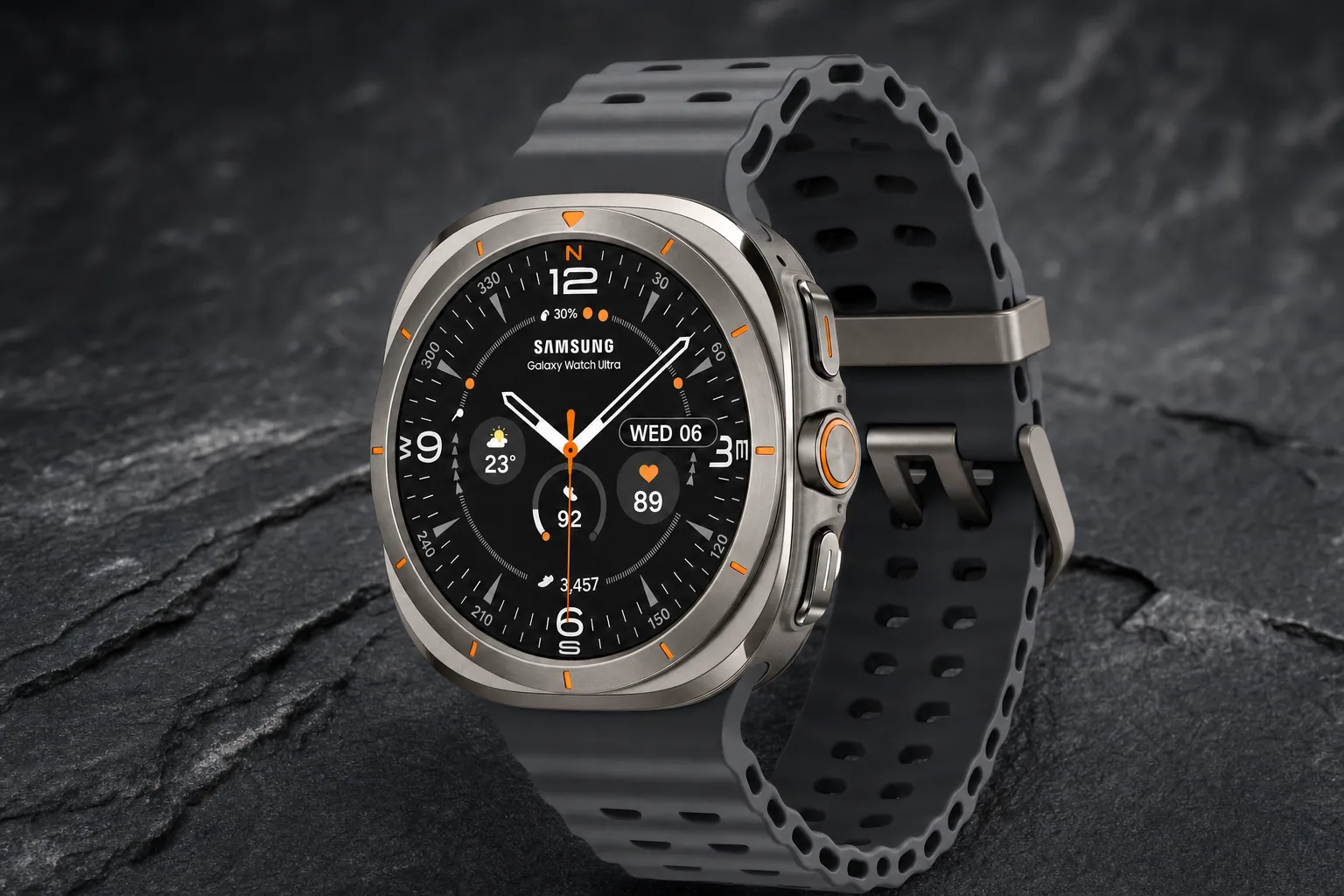
The other thing worth stating plainly: this is a real second generation, not another refresh. Multiple outlets (Android Central, SamMobile, Tom's Guide and Tech Advisor among them, across late 2025 into 2026) agree that Samsung deliberately skipped a 2025 sequel to bank a bigger 2026 jump. After two years the bar for "worth the wait" is higher - and the leaks suggest Samsung knows it. One framing to carry through: the Ultra line exists for endurance, ruggedness and fitness tracking, so the leaks that matter most are not the flashy AI features but the battery, chip efficiency and sensors - which is exactly where the juiciest rumours are.
2. Release date: when the Galaxy Watch Ultra 2 is expected
Samsung's wearables follow a reliable rhythm. The Galaxy Watch line is traditionally unveiled at the company's summer Unpacked event - the same show that launches the foldables - usually in July, with retail availability a few weeks later. Everything in the rumour mill points to the Ultra 2 slotting straight into that pattern.
- The headline date. Multiple reports through the first half of 2026 (LatestLY, Geeky Gadgets, Tech Advisor and others) coalesce around a 22 July 2026 unveiling, sharing the stage with the Galaxy Watch 9 and the next foldables (rumoured Galaxy Z Fold 8, Z Fold 8 Ultra and Z Flip 8). If that holds, expect the watch on UK shelves in late July or early August.
- The caveat. A specific calendar date this far out is medium-confidence at best. Samsung has moved its summer Unpacked around before, and one earlier report floated a London event in late June or early July rather than 22 July. The window (July 2026) is solid; the exact day is not.
- Why the long wait happened. The original landed in mid-2024. Samsung used its July 2025 Unpacked to refresh that watch - new colourway, 64GB storage, latest software - rather than ship a true sequel. That is precisely why a 2026 Ultra 2 is so anticipated: it has skipped a generation of incremental change.
Our honest timing read: a July 2026 reveal is the sensible central estimate and unusually well-supported for an unannounced wearable. Pencil in late July; do not bank your diary on the 22nd specifically. There is a practical upside too: a summer launch means stock well before Black Friday and Christmas, and it tends to drag the outgoing Ultra's price down sharply at the same time.
3. The chip: Snapdragon Wear Elite, not Exynos (and why it matters)
This is the rumour we are most confident about, because it is not really a rumour. Qualcomm announced at MWC 2026 that the Galaxy Watch Ultra 2 will run its "Snapdragon Wear Elite" platform. Many expected an Exynos W-series chip (the W1000 powers the current Ultra and a W1100 was the natural next step) - reasonable, since it is what Samsung has done for years. But the credible evidence now points the other way, and a named chip vendor saying it on a stage makes it the most reliable single claim in this article. It is a meaningful strategic shift:
- Efficiency is the headline. Both the outgoing Exynos W1000 and the Snapdragon Wear Elite are built on 3nm, so this is not a node jump. The gains come from architecture: a smarter core layout and a dedicated low-power NPU for on-device AI - in plain terms, more battery life and snappier on-watch intelligence for the same energy budget.
- Connectivity comes baked in. The platform supports Wi-Fi 6, Bluetooth 6.0, ultra-wideband (UWB) and - the interesting one - NB-NTN, the standard behind direct satellite messaging. That is what makes the satellite-SOS rumours credible rather than fanciful.
- It ends an era. Samsung has leaned on its own Exynos W silicon for its flagship watches for years. Moving the Ultra - its halo wearable - to Qualcomm is a vote of confidence in Snapdragon, and a quiet admission that efficiency and connectivity mattered more this round than vertical integration.
Confidence here is High: the source is a named supplier, not an anonymous leaker. The only realistic caveat is that plans can shift between an MWC stage and a shipping product - rare once a chip is publicly named.
4. Battery: the near-800mAh leak that has everyone excited
If the chip is the most confirmed rumour, the battery is the most exciting - and for an Ultra, battery is arguably the spec that matters most. The original carries a 590mAh cell, good for Samsung's claimed 60-ish hours of typical use (closer to a couple of days in reality with the always-on display and LTE working). The leaks say the Ultra 2 takes a big swing.
- The number doing the rounds. Reports in mid-2026 (Digital Trends, Gizmochina, Android Central, Geeky Gadgets, citing a battery-database leak) point to around 800mAh to 800mAh - roughly a 35% jump over the 590mAh original. The minor disagreement (784 vs ~800) is normal for a database leak where "typical" and "rated" capacities differ slightly.
- Why it compounds with the chip. A 35% bigger battery paired with a more efficient Snapdragon platform is a one-two punch - a bigger cell and a more frugal brain - which together could push genuine multi-day endurance even with the screen brighter and connectivity busier. This is the leak that, if true, would most change daily use.
- What it would mean against Apple. The Apple Watch Ultra 2 quotes up to 36 hours normal use (72 in low-power mode). The current Galaxy already beats that on paper; an 800mAh Ultra 2 would stretch the gap into no-charger-for-a-weekend territory.
Confidence: Medium-High. Capacity figures often leak through certification ahead of launch and are usually accurate, but the precise number can shift and "typical use" claims are marketing, not a promise. Treat ~800mAh as a strong rumour and the real-world runtime as something we will only confirm once we have tested it.
5. Design, titanium build, durability and display
The original established the line's look: a 47mm cushion-shaped titanium case, a flat sapphire-protected display, a customisable Quick Button, 10ATM water resistance plus a MIL-STD-810H rating, and a design that is unapologetically large. The Ultra 2 rumours suggest evolution rather than reinvention - which, for a rugged flagship, is usually the right call.
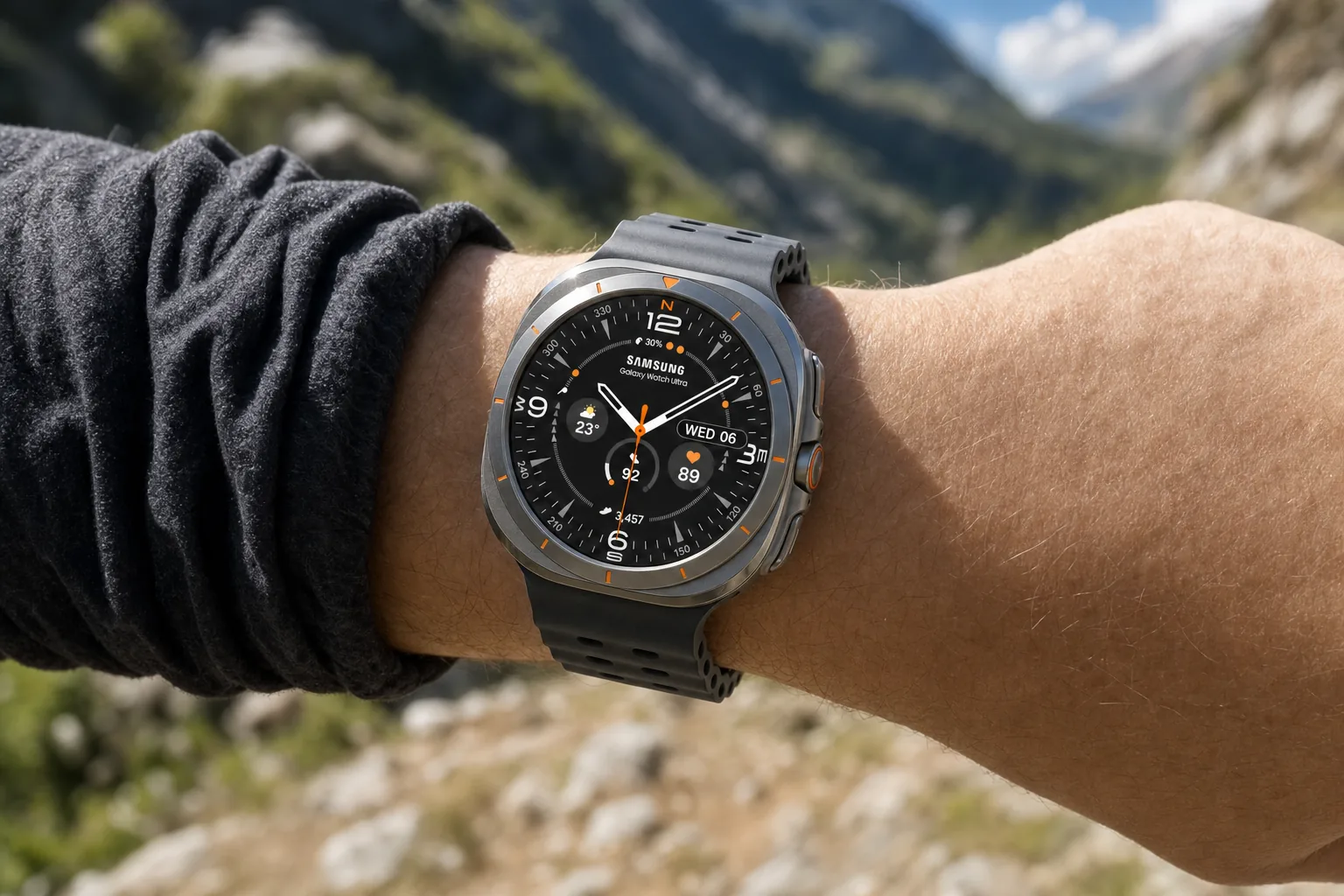
- Titanium, again. Expect a titanium case to remain central - the material that justifies the "Ultra" name and the price. Some leaks chatter about a slimmer profile and grade-5 titanium, but specifics are Low confidence; treat any exact thickness as speculation until Samsung shows the watch.
- Ruggedness as the brief. The point of the Ultra is that it survives. The original's 10ATM water resistance, IP68 dust rating and military-standard durability are the floor; the Ultra 2 should match or exceed them. Any regression would be a surprise; deeper dive certification a welcome one.
- Quick Button and case size. The orange-accented Quick Button (a useful workout shortcut) is likely to stay. Whether Samsung adds a second case size is open - the original came in a single 47mm size some smaller wrists found too big. A second size would be welcome but is unconfirmed.
Design is where leaks are thinnest. Renders and case-mould rumours circulate, but nothing carries the weight of the chip and battery claims. Assume a familiar, refined silhouette rather than a redesign - and if you find the current Ultra too large, wait to see the Ultra 2 in the metal first.
Display: already class-leading
The current Ultra has one of the best screens on any smartwatch: a 1.5-inch Super AMOLED hitting a peak of 5,000 nits, which makes it genuinely readable in harsh sunlight - the exact scenario an Ultra is built for. Expect that panel to carry over, very possibly unchanged, with sapphire crystal protection and an always-on display intact. Some leaks suggested brightness could be pushed beyond 5,000 nits, with an optimistic figure of 5,000 nits floating around. Both undershot: Samsung confirmed 5,000 nits at launch. At the time we treated the 4,000-nit number as Low confidence. The more efficient chip and bigger battery would, in theory, let Samsung run the always-on display harder without the usual endurance penalty. The original's screen is so good a sequel need not do much, so treat any display upgrade as a bonus rather than a reason to wait.
6. Health and fitness sensors: BioActive, ECG, BP, temperature, sleep apnoea
Health and fitness is the other half of the Ultra's identity, and here Samsung is strong - though the rumours point more to software gains than a new sensor array.
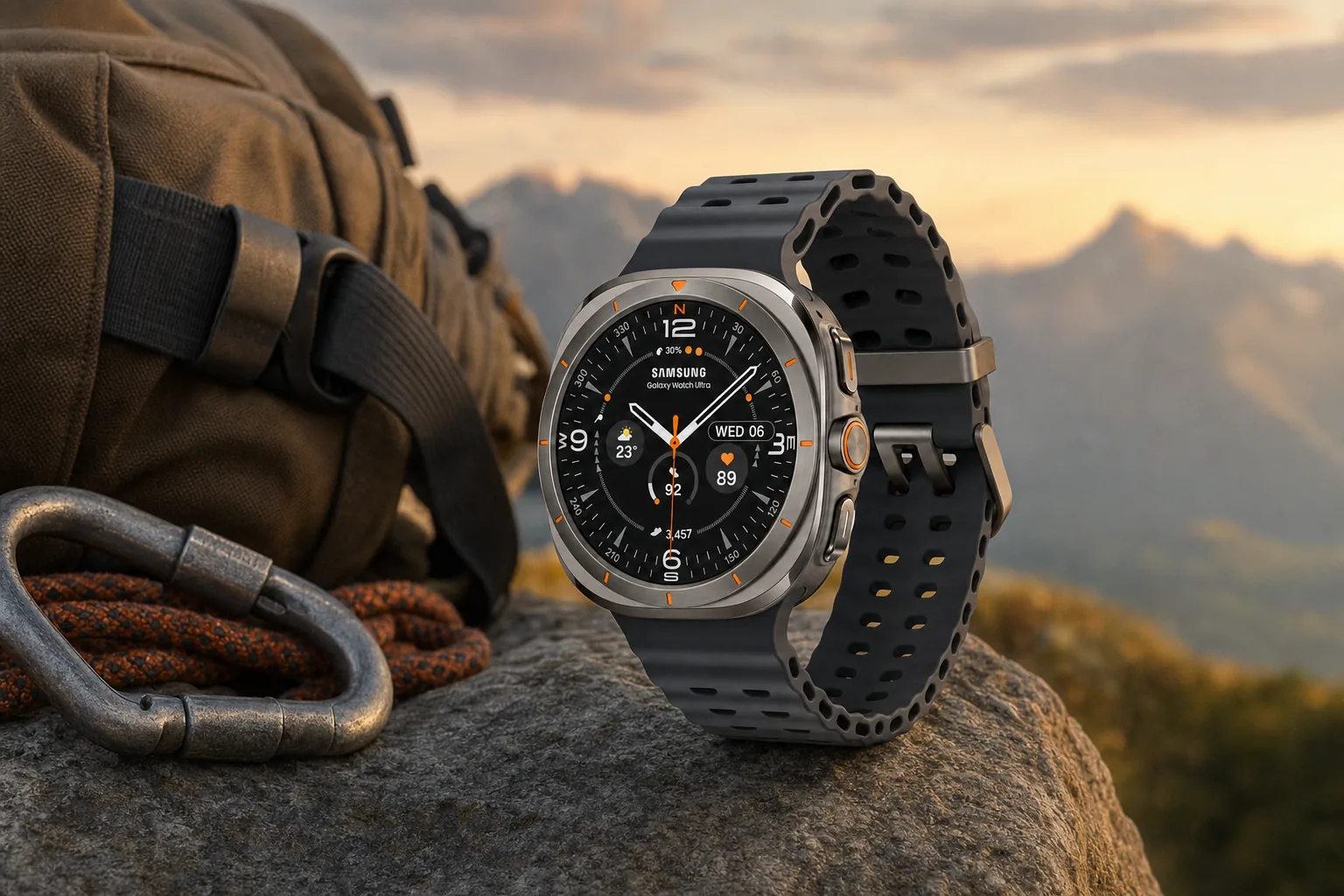
What the BioActive sensor already delivers
The current Ultra uses Samsung's BioActive sensor, bundling optical heart rate, an electrical (ECG) signal path and bioelectrical impedance analysis (BIA, for body composition) into one module, plus a deep stack of metrics:
- ECG and irregular-rhythm notifications for atrial fibrillation screening.
- Blood pressure monitoring - cuff-calibrated, and now cleared and rolling out in the US during 2026 (long available in the UK and many markets). A genuine advantage over Apple, which still does not offer it.
- Sleep apnoea detection, using blood-oxygen tracking to flag potential breathing interruptions for further testing.
- Skin temperature sensing (for cycle tracking and sleep), blood-oxygen (SpO2), body composition via BIA, and a capable sleep-coaching suite.
What might be new on the Ultra 2
Early leaks and regulatory filings suggest the Ultra 2 leans on refined sensors plus smarter software rather than a wholly new sensor type. Expect an updated BioActive module, more AI-driven coaching (Samsung has pushed "Energy Score" and AI sleep features hard) and gradual accuracy gains. The most-wished-for addition - non-invasive glucose monitoring - stays firmly in the Low confidence / probably-not-yet bucket; that technology is not ready on any wrist. For the broader picture of what Samsung's wearables track, see our Samsung smart watch guide.
The honest summary: the Ultra 2's health story is likely "everything the original does, more accurately, with more AI on top" rather than a breakthrough new vital sign. For most buyers that is still compelling - few watches match Samsung's breadth - but do not wait for a sensor that does not exist.
7. Connectivity: 5G, satellite SOS and the Bluetooth-only twist
This is where the Ultra 2 could genuinely break new ground for Samsung, and the rumours are unusually specific because they tie back to that confirmed Snapdragon platform.
- 5G - a Samsung-watch first. Multiple outlets (Android Police, SamMobile, GSMArena, Notebookcheck) report the Ultra 2 could be Samsung's first 5G watch, matching Apple's cellular ambition. On a watch, 5G is less about raw speed than future-proofing. Confidence: Medium - well-reported and chip-supported, but 5G may be limited to certain markets (the US and South Korea), with Europe potentially on 4G/LTE.
- Satellite SOS. The Snapdragon Wear Elite supports NB-NTN, enabling direct-to-satellite messaging. That makes sending an SOS from beyond mobile coverage a credible feature - potentially life-saving for a watch aimed at hikers and explorers. Confidence: Medium.
- The Bluetooth-only twist. A well-sourced detail for UK and European buyers: Samsung is reportedly preparing a Bluetooth/Wi-Fi-only version for Europe alongside the cellular model. The original launched LTE-only, so a cheaper non-cellular option would be welcome. Confidence: Medium-High.
- Other radios. Expect dual-frequency GPS to carry over for accuracy, plus the Wi-Fi 6, Bluetooth 6.0 and UWB the new platform supports.
Connectivity is where the Ultra 2 looks most like a real step forward. If 5G, satellite SOS and a Bluetooth-only variant all land, Samsung will have closed a real gap with Apple and added options the original never offered.
8. Software: Wear OS, One UI Watch and Galaxy AI
Software is where "rumour" and "near-certain" blur, because Samsung's cadence is predictable and Google has laid out its Wear OS roadmap.
- The OS base. The Ultra 2 is expected to ship with Samsung's One UI Watch on the latest Wear OS (reporting points to a Wear OS 7-based release debuting with the Watch 9 and Ultra 2). Samsung had already pushed its previous One UI Watch update to existing watches, so the new model launching on the next version is standard.
- Galaxy AI and Gemini. The obvious headline. Google has been rolling Gemini out to Wear OS watches, and Samsung has layered its own Galaxy AI health and coaching features on top - Energy Score, AI sleep insights, smarter workout suggestions, a more conversational wrist assistant. The Snapdragon's low-power NPU is there to run more of this on-device. Confidence on "more AI": High; on any specific feature: Medium.
- The AI caveat. AI features make great launch slides but are often the least transformative part of daily use. Treat them as real but secondary - battery, chip and connectivity will matter far more.
- Ecosystem. The Galaxy Watch is at its best with a Samsung or Android phone; iPhone support remains absent. For iPhone users that single fact may matter more than any spec - which is why the Apple Watch comparison later is the one to read closely.
Software is the safest area to predict: assume the newest Wear OS, the deepest Galaxy AI integration Samsung has yet shipped, and a long support window. Not a reason to wait alone, but it means the Ultra 2 should age better than an older watch bought today.
9. Price: what the Galaxy Watch Ultra 2 is likely to cost in the UK
See the current Galaxy Watch Ultra on Amazon UK
£649.00price at 23 Aug, may change
No official price has leaked, so we reason from precedent - and Samsung's recent behaviour is reassuring. The original launched at around £599 in the UK (about $649 in the US), and the 2025 refresh held that price rather than raising it.
- The likely launch price. Expect the Ultra 2 around the £599 mark. Most insiders peg the US price at $649.99 (about £599) again, which maps to roughly £599 here. Samsung held the Ultra's price across the refresh, so flat-to-modestly-higher is the reasonable expectation.
- Where a premium could creep in. If the 5G-and-satellite model is the top tier, the rumoured Bluetooth-only European variant could sit below it - giving UK buyers a cheaper way into the Ultra family for the first time.
- What it pays for. At ~£599 the Ultra 2 would still undercut the Apple Watch Ultra 2 (around £799) - the same value argument as before.
Two notes for UK buyers. First, treat any "around £599" figure as an expectation, not a promise - we do not publish scraped prices for an unreleased product. Second, smartwatch prices fall fast: the Ultra 2 will be discounted within months and around Prime Day and Black Friday. And, as we cover next, its launch is also the moment the original Ultra becomes a bargain.
10. Galaxy Watch Ultra vs Ultra 2 vs Apple Watch Ultra 2
To see what is at stake, here is the confirmed original and Apple's Ultra 2 against the best read on the Ultra 2 rumours. Treat the middle column as informed speculation, not a spec sheet.
| Galaxy Watch Ultra (confirmed) | Galaxy Watch Ultra 2 (rumoured) | Apple Watch Ultra 2 (confirmed) | |
|---|---|---|---|
| Chip | Exynos W1000 (3nm) | Snapdragon Wear Elite (high) | Apple S9 SiP |
| Battery | 590mAh | ~784-800mAh, +35% (med-high) | Up to 36h / 72h low-power |
| Display | 1.5in AMOLED, 5,000 nits | 1.5in AMOLED, 3,000+ nits (low) | 1.92in OLED, 5,000 nits |
| Case | 47mm titanium, 10ATM | Titanium, refined (med) | 49mm titanium, 100m |
| Connectivity | LTE, dual-band GPS | 5G + satellite SOS, BT-only option (med) | LTE, dual-band GPS |
| Health | ECG, BP, BIA, SpO2, sleep apnoea, temp | Refined sensors + more AI (med) | ECG, SpO2, temp, sleep apnoea (no BP) |
| Software | One UI Watch / Wear OS | Latest Wear OS + Galaxy AI (high) | watchOS |
| UK price from | ~£599 (now discounted) | ~£599 est. (speculative) | ~£799 |
| Status | On sale now | Announced 22 July 2026; on sale 7 August | On sale now |
The story is clear. The Ultra 2's gains over the original are meaningful rather than cosmetic - a much bigger battery, a more efficient chip, a real connectivity leap. Against Apple, the Galaxy keeps two long-standing advantages (blood pressure monitoring and superior battery life) while finally matching Apple's cellular ambition. The catch, as always, is the ecosystem: the Apple Watch only makes sense with an iPhone, the Galaxy is at its best on Android.
11. A note on the "Ultra" name: who got there first
It is worth pausing on the branding, because the "Ultra" naming has become a small story in its own right - genuinely interesting industry context rather than a gotcha.
Samsung has leaned on "Ultra" heavily. It introduced the tier to its phones with the Galaxy S20 Ultra in early 2020, replacing the old "Plus" as the top-end S-series option, and it has been the flagship suffix ever since (through to the S26 Ultra). Samsung then extended "Ultra" to wearables with the Galaxy Watch Ultra in 2024, and reporting suggests it may even apply it to its next foldable line (a rumoured Galaxy Z Fold 8 Ultra).
Apple, meanwhile, launched the Apple Watch Ultra in September 2022 - after Samsung had established "Ultra" on phones, but two years before Samsung brought the name to watches. So on smartwatches specifically, Apple's "Ultra" came first; on phones, Samsung's did. The overlap is striking, and it makes the Galaxy Watch Ultra look, fairly or not, like a direct response to the Apple Watch Ultra: both target the same rugged, premium, outdoor-and-fitness buyer, right down to the name. The upshot: do not read too much into the badge. "Ultra" is a marketing tier, not a guarantee - what matters is the spec sheet underneath and which phone is in your pocket.
12. How confident are we? The major rumours, graded
This is the section we think matters most. Below we grade each major rumour as High, Medium or Low confidence, based on how many credible sources back it, whether a named supplier or filing supports it, and how specific the evidence is.
High confidence
- Snapdragon Wear Elite chip - confirmed publicly by Qualcomm at MWC 2026. As close to certain as pre-launch gets.
- A real second generation in 2026 - widely agreed across reputable outlets; Samsung deliberately skipped a 2025 sequel.
- Latest Wear OS / One UI Watch with deeper Galaxy AI - follows Samsung's and Google's established roadmap.
Medium / Medium-High confidence
- ~784-800mAh battery (+35%) - from a battery-database leak corroborated by several outlets; exact figure may shift (Medium-High).
- Bluetooth/Wi-Fi-only European variant - reported with useful specificity (Medium-High).
- 5G connectivity - well-reported and chip-supported, but possibly market-limited (Medium).
- Satellite SOS - technically credible via the chip's NB-NTN support; not yet confirmed for the product (Medium).
- July 2026 launch window - strong consensus on the month; the exact 22 July date is less certain (Medium).
- Refined health sensors + more AI coaching - likely, but specifics are vague (Medium).
Low confidence / treat as speculation
- 4,000-nit display - a single optimistic figure; plausible but unverified.
- Slimmer case / grade-5 titanium / second case size - thin, inconsistent design leaks.
- Any specific UK price - reasoned from precedent (~£599), not leaked.
- Breakthrough new sensors (e.g. glucose) - not ready on any wrist; do not expect it.
The single most reliable future signal is Samsung's official Unpacked invitation - once that lands, a launch is usually two to three weeks away and most specs firm up overnight. We will revise this page's grades, and its facts, the moment harder evidence appears. That is the deal with a living rumour guide: it gets more accurate over time, and we would rather tell you what we do not yet know than invent certainty.
13. Should you wait for the Ultra 2 or buy now?
The eternal rumour-article question, answered honestly for each kind of buyer - and the timing genuinely favours patience this time.
Wait for the Ultra 2 if...
...you want the headline upgrades: the much bigger battery, the more efficient Snapdragon chip, and the connectivity leap (5G, satellite SOS, or the cheaper Bluetooth-only option). Crucially, the wait is short - a July 2026 launch is only weeks away, not the year-plus gamble rumoured products often demand. Hold out a month or two and you get the newest hardware and the choice to buy a discounted original once you have seen both. Very little downside.
Buy the current Ultra now if...
...you need a watch today, have found a strong discount, or simply do not care about 5G and satellite messaging. The original is still an outstanding rugged smartwatch - titanium, 3,000-nit screen, the full health stack, and battery life that already beats the Apple Watch Ultra. Discounted well below its £599 launch price, it is one of the best-value premium watches around.
Consider an Apple Watch Ultra instead if...
...you own an iPhone. This is the single most important fork in the road. The Galaxy Watch Ultra (and Ultra 2) only work properly with Android; on iPhone, the Apple Watch Ultra is your rugged flagship - our Apple Watch Ultra rumours guide covers what is coming there.
Look at Garmin if...
...your priority is multi-week battery life and serious sports tracking over smart features. A dedicated outdoor watch can outlast any Samsung or Apple by days. Our Garmin watch guide is where to start if endurance and GPS accuracy trump apps and AI.
The smart-money move: wait the few weeks for Samsung's launch, then decide. Either the Ultra 2's upgrades win you over, or you grab a heavily discounted original the moment the new model pushes its price down - both good outcomes, which is why there is no rush to buy at full price today.
Frequently asked questions
When will the Samsung Galaxy Watch Ultra 2 be released?
Samsung hasn't confirmed a date, but reporting through early 2026 points to an unveiling around 22 July 2026 at its summer Unpacked event, alongside the Galaxy Watch 9 and next foldables, with UK availability in late July or early August. The July window is well-supported; the exact day is less certain.
Will the Galaxy Watch Ultra 2 use Exynos or Snapdragon?
Snapdragon. Qualcomm publicly stated at MWC 2026 that the watch will use its Snapdragon Wear Elite chip - a notable break from Samsung's Exynos W-series. Both are 3nm, so the gains come from efficiency and a low-power AI engine rather than a process jump. This is the most reliable single claim about the watch, as it came from the named chip supplier.
How big is the Galaxy Watch Ultra 2 battery?
Leaks point to around 784-800mAh, roughly a 35% increase over the 590mAh original. Paired with the more efficient Snapdragon chip, that could push genuine multi-day endurance - potentially the biggest real-world upgrade. The exact figure may shift, so treat ~800mAh as a strong rumour rather than a confirmed spec.
Will the Galaxy Watch Ultra 2 have 5G and satellite SOS?
Quite possibly. The confirmed Snapdragon Wear Elite platform supports 5G and NB-NTN satellite connectivity, making both credible. Reports suggest the Ultra 2 could be Samsung's first 5G watch and add satellite SOS for emergencies beyond mobile coverage - though 5G may be market-limited, with Europe possibly on 4G/LTE. Confidence is Medium.
How much will the Galaxy Watch Ultra 2 cost in the UK?
No price has leaked. Based on the original's ~£599 launch price - which Samsung held through its 2025 refresh - expect around £599, give or take, with a rumoured Bluetooth-only European variant possibly lower. That still undercuts the Apple Watch Ultra 2 (around £799). We don't publish scraped prices for unreleased products; the real number only counts once Samsung announces it.
Should I buy the original Galaxy Watch Ultra now or wait?
If you can wait a few weeks, do - the launch is close, and even if the Ultra 2 doesn't tempt you, the original will be discounted further once it lands. If you need a watch today or find a strong deal, the original is still excellent: titanium, a 3,000-nit screen, the full health stack and battery life that already beats Apple's Ultra. On iPhone, look at the Apple Watch Ultra instead.
How does the Galaxy Watch Ultra 2 compare to the Apple Watch Ultra 2?
If the leaks hold, the Galaxy keeps its two long-standing edges - blood pressure monitoring (which Apple lacks) and superior battery life, set to widen with the ~800mAh cell - while finally matching Apple's cellular ambition. The decider is your phone: the Galaxy needs Android, the Apple Watch needs an iPhone. Pick the watch that matches the phone you carry.
The bottom line on the Galaxy Watch Ultra 2 rumours
After skipping a generation, the Galaxy Watch Ultra 2 is shaping up to be a proper upgrade rather than a token refresh - and the rumour picture is unusually coherent. The chip switch to Snapdragon Wear Elite is effectively confirmed by Qualcomm; the near-800mAh battery leak would extend the Ultra's already class-leading endurance; and the connectivity story - 5G, satellite SOS and a welcome Bluetooth-only option for Europe - would close real gaps with Apple. The health and software gains look evolutionary, which is fine: the foundations were already strong.
Our advice for UK buyers is simple this time, because the wait is short. Hold on a few weeks for Samsung's summer launch, then choose: either the Ultra 2's upgrades win you over, or you pick up a heavily discounted original the moment the new model pushes its price down. On iPhone the calculus differs - the Galaxy needs Android, so see our Apple Watch Ultra rumours guide instead; and if multi-week battery life is your priority, our Garmin watch guide is worth a look. Bookmark this page - we treat it as a living guide and will update it with every credible leak and, eventually, the real thing.
Sources & further reading: Qualcomm (MWC 2026, chip confirmation) · Android Central · SamMobile · Tom's Guide · Tech Advisor · PhoneArena · Digital Trends · Gizmochina · Geeky Gadgets · Notebookcheck · Android Police · GSMArena. All rumours dated and graded as of June 2026; nothing here is confirmed by Samsung unless stated.