
Galaxy Watch 9 Review: The Everyday Samsung Watch Refined
A faster chip, a brighter screen and a meaningful battery lift for the smaller model. The question is whether refinement is enough when the Galaxy Watch 8 already did most things rather well.
The Galaxy Watch 9 remains Samsung's clean, circular everyday smartwatch, offered in 40mm and 44mm cases.
Galaxy Watch 9 Review: The Everyday Samsung Watch Refined
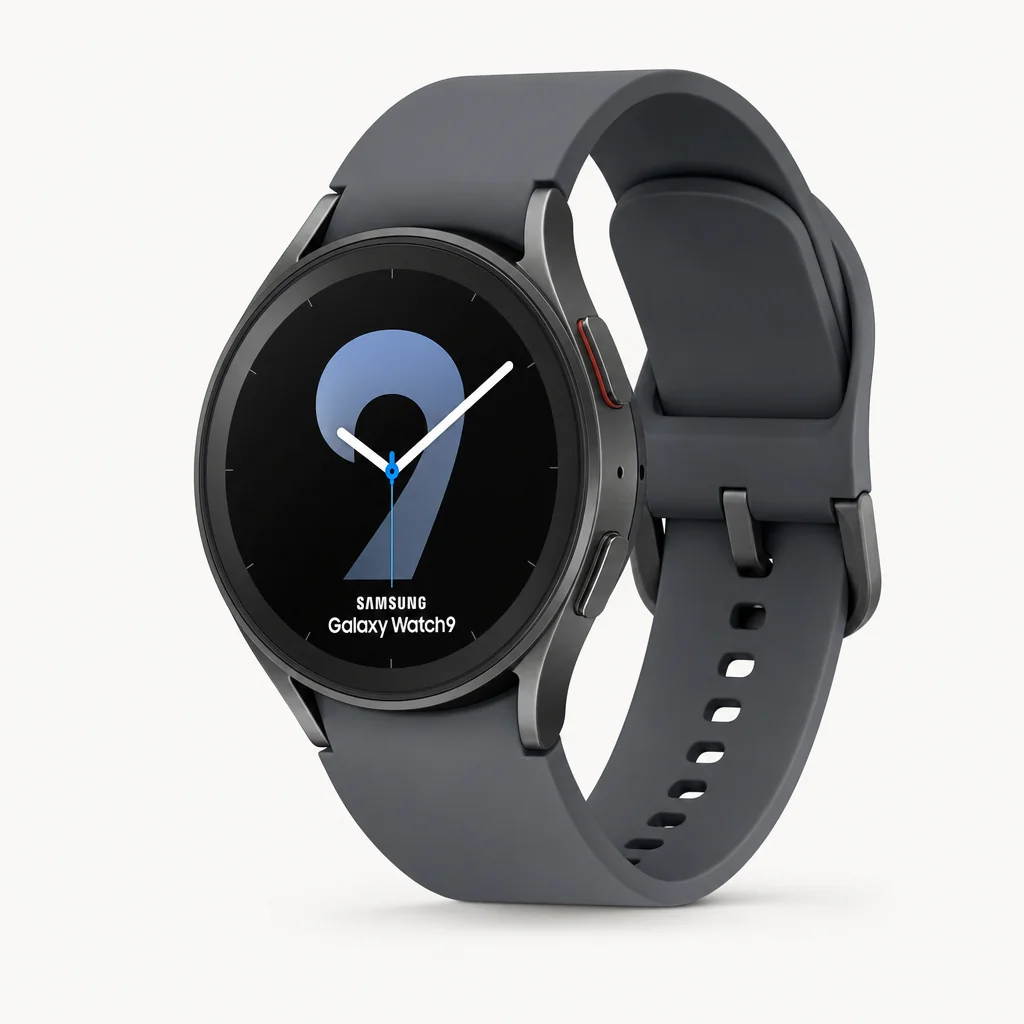
The Galaxy Watch 9 is Samsung dealing with a tricky problem: what do you improve when last year's watch was already perfectly decent? The answer is not a dramatic new shape or a feature that makes the old model instantly feel prehistoric. It is a collection of quieter improvements — a new Snapdragon Wear Elite processor, a claimed brighter display, and, crucially, a considerably larger battery in the 40mm version.
Where to buy
Prices and stock move constantly, so these open a live Amazon UK search for the exact model rather than a fixed listing.

See the Galaxy Watch 9 on Amazon UK
£349.00price at 23 Aug, may change
That makes this a very particular kind of review. If you are coming from an older Android watch, or you want a polished Wear OS smartwatch with Samsung's health tools folded neatly into the experience, the Galaxy Watch 9 looks like a strong all-rounder. If you own a Galaxy Watch 8, however, the calculation is less flattering. The design is close, the sensors are close, and the price has gone up by $30 in the US. Incremental progress is still progress, of course. It just needs to be progress you will actually notice.
Samsung announced the Galaxy Watch 9 in London on 22 July 2026. Pre-orders opened that day, with pre-order deliveries due from 3 August 2026 and general retail availability beginning on 7 August 2026. There are two sizes: the 40mm model, starting at £349 in the UK, and the 44mm model, at approximately £379. Both come in Bluetooth and LTE versions. In the US, the 40mm Bluetooth model costs $379, rising to $429 for LTE; the 44mm starts at $409, or $459 with LTE.
For most people, this will be the Samsung watch to buy rather than an enthusiast's side project. There is no Classic version in this generation's mainstream line, no physical rotating bezel, and no attempt to turn your wrist into a small circular laptop. Thank heavens. It is built to handle notifications, workouts, health trends, directions and payments without becoming the most demanding thing you own.
Specs at a Glance: What You're Actually Getting
The headline sheet is sensibly split by size rather than artificially turning one watch into two separate products. Both Galaxy Watch 9 variants share the same Snapdragon Wear Elite platform, 2GB of RAM, 32GB of storage, a Super AMOLED panel capable of up to 3,000 nits, Bluetooth 6, dual-band GPS and the same substantial durability ratings. The meaningful differences are display size, physical dimensions, weight and battery capacity.
438×438 / 480×480
60Hz refresh rate
Five-core CPU
32GB storage
Up to 30 hours AOD
Compass included
MIL-STD-810H
The 40mm has a 1.34-inch, 438×438-pixel display and a 390mAh battery. The 44mm uses a 1.47-inch, 480×480-pixel panel and a 445mAh cell. On paper, the 44mm looks like the obvious pick for screen space and battery capacity. In real life, wrists are inconveniently individual things. A watch that looks excellent in a product photo can feel comically large at bedtime, whilst the smaller option can make more sense if you intend to wear it continuously rather than merely admire it on a desk.
The specification split is straightforward: larger display and battery in the 44mm, lower weight and a notably upgraded cell in the 40mm.
The specification worth caring about
Do not get overly distracted by storage or the modest size difference. The most consequential divide is battery progression. The 40mm gains 65mAh over the Galaxy Watch 8's 325mAh cell, while the 44mm rises by only 10mAh from 435mAh.
Same Face, Smarter Details: Design and Build Quality
Samsung has not thrown out the Galaxy Watch playbook here. The Watch 9 remains a rounded, circular smartwatch in an aluminium casing, with a flat bezel around the display. It is an evolutionary design, and that wording is doing some proper work. Place it beside the Galaxy Watch 8 and you are not looking at a radical aesthetic reset. You are looking at Samsung continuing with a shape that already works for an everyday Android watch.
That is not a criticism by itself. Smartwatch design has a tendency to chase novelty for the sake of something to put on a slide. A sensible circle is familiar, easy to read and naturally suited to watch faces. The aluminium construction keeps the watch from feeling unnecessarily hefty, while the Sapphire Crystal screen should bring welcome reassurance for people who have a talent for introducing their wrist to door frames, kitchen worktops and the occasional wall. We have all done it. Some of us simply refuse to admit it.
The 40mm Galaxy Watch 9 measures 42.7 × 40.4 × 8.6mm and weighs 31.5g. The 44mm measures 46.0 × 43.7 × 8.6mm and weighs 34g. Those figures matter more than the familiar retail labels suggest. Both are slim at 8.6mm, and the weight difference between them is only 2.5g. The 44mm is therefore not a heavy, hulking alternative; it is principally a larger canvas. The smaller version, though, is the one likely to disappear more completely on the wrist.
At 31.5g, the 40mm is particularly appealing for smaller wrists and for sleep tracking. A smartwatch is only useful as a night-time data collector if you can tolerate having it on overnight. A bulky watch is not a personal health companion at that point. It is a tiny, glowing hostage situation. The 40mm's relatively light case gives it an advantage here, especially now that its battery has had the more substantial upgrade.
The 44mm has its own argument. The larger 1.47-inch screen should make dense watch faces, workout metrics and notifications easier to scan without pausing to squint. It also arrives in Graphite and Silver, whilst the 40mm is available in Cream and Graphite. Neither size is wrong; they simply prioritise different kinds of comfort. If you generally find larger watches unwieldy, do not buy the 44mm because the spec sheet says "more". If the 40mm feels cramped at a glance, equally, do not congratulate yourself for choosing the discreet option. You need to live with it, not win an imaginary minimalist award.
Pros
- Light 31.5g and 34g case weights make both sizes realistic all-day watches.
- Sapphire Crystal, IP68, 5ATM and MIL-STD-810H ratings make for a reassuringly robust package.
- Two clearly differentiated sizes make it easier to choose by wrist comfort.
Cons
- The overall look is close to the Galaxy Watch 8 rather than distinctly new.
- There is no Classic option or physical rotating bezel in this mainstream line.
- Watch 8 owners will struggle to point to one visible design reason to upgrade.
Brilliant in Bright Light: Display Performance
The display is one of the Galaxy Watch 9's easiest wins. Samsung quotes up to 3,000 nits of peak brightness for both sizes, alongside 60Hz refresh rates and Super AMOLED technology. That combination gets the fundamentals right: the panel should have enough brightness headroom for outdoor visibility, enough contrast for legible complications, and enough colour depth to make watch faces look properly alive rather than like they have been printed on damp cardboard.
Brightness numbers need a little perspective. A peak-nit figure is not a promise that every interface element will sit at that maximum all day, nor is it a substitute for sensible automatic brightness behaviour. But 3,000 nits is an important ceiling for a watch. This is the kind of device you glance at in sunshine while crossing a road, cycling, walking the dog or trying to work out whether you are late. Spoiler: you are usually late. A display that holds up at a glance is more valuable than one that only looks glorious in a dim bedroom.
The 40mm model's 438×438 resolution is very dense on a 1.34-inch circular panel. The 44mm moves to 480×480 across 1.47 inches. Neither looks compromised on paper. The 44mm is not merely a blown-up version with visibly larger pixels; it has extra resolution to support its greater surface area. That should keep text, fitness figures and complication-heavy faces crisp, while giving Samsung more room to make information feel calm rather than crowded.
Super AMOLED remains the natural fit for this type of product. Deep blacks help a circular screen blend into a dark watch face, which is particularly useful with always-on display modes. Strong contrast helps white text and coloured exercise indicators stand out. Vivid colour is not just decorative here either: it makes activity zones, weather graphics and quick visual cues easier to understand in a fraction of a second.
Both Galaxy Watch 9 sizes use a high-brightness Super AMOLED display, with the 44mm adding extra physical space for detailed watch faces.
There is a broader point here. Samsung did not use the Watch 9 to chase some exotic display technology, and that is sensible. The company refined the attributes people actually feel every day: readability, contrast, sharpness and brightness. If your current watch screen becomes a mirror at the exact moment you need it, these practical improvements are far more useful than a flashy new panel acronym.
A Chip Worth Talking About: The Snapdragon Wear Elite Inside
The Snapdragon Wear Elite chipset is the Galaxy Watch 9's most significant internal change. Samsung moved away from the Exynos W1000 used in the Galaxy Watch 8 and adopted Qualcomm's newer wearable platform. It is a move that matters because a smartwatch can have a beautiful display and an encyclopaedia of health features, but if it hesitates while opening an app or stutters when you are trying to stop a workout, the whole thing feels cheaper than it is.
The hardware is a five-core arrangement: one Cortex-A78C performance core at 2.1GHz, four Cortex-A55 efficiency cores at 1.95GHz, and an Adreno A622 GPU. It is paired with 2GB of RAM and 32GB of internal storage across both sizes. That is a stable, sensible base for a watch expected to run Wear OS, manage notifications, handle navigation, store apps and keep a steady stream of sensor information moving without turning routine interactions into a waiting game.
Samsung's own figures claim a 32% improvement in CPU tasks, a 19% gain in GPU performance and a 15% efficiency improvement over the previous generation. Those are manufacturer figures, so they should be read as direction rather than a laboratory verdict. Still, the direction is encouraging. More performance is welcome, but greater efficiency is arguably the more interesting number in a wearable. A wrist computer has much less room to hide battery waste than a phone does.
In everyday terms, the benefit is not that your watch becomes a gaming powerhouse. It is that the ordinary stuff should feel more immediate: menus, watch-face transitions, app launches, voice interactions and movement through settings. The Galaxy Watch 9 does not need theatrical speed. It needs the kind of consistency that makes you stop noticing the operating system entirely. That is the compliment every wearable should want.
Performance in context
Samsung's 32% CPU, 19% GPU and 15% efficiency figures describe the Snapdragon Wear Elite's advantage over the prior generation. The important practical takeaway is smoother interaction plus the potential for better battery management, not simply a larger benchmark number for its own sake.
It is also worth remembering what has not changed. Both variants still have 2GB of RAM and 32GB of storage, so the upgrade is not about suddenly carrying a vastly larger app library or transforming the Watch 9 into something it was never meant to be. It is about making the established Galaxy Watch formula feel more polished. That is a recurring theme with this model. Samsung has spent its effort sanding down the rough edges rather than building an entirely new piece of furniture.
Will It Last the Day and Night? Battery Life in Real Use
Battery life is the section where the two Galaxy Watch 9 sizes become genuinely different stories. Samsung quotes up to 30 hours with the always-on display enabled for both the 40mm and 44mm. That is a useful claim, because it sets the product's ambition clearly: this is supposed to be a watch you can wear through a full day and into the following morning, not something that needs a rescue charge before dinner.
The 40mm is where the real improvement happened. Its battery climbs from 325mAh in the Galaxy Watch 8 to 390mAh in the Galaxy Watch 9. That is a 20% capacity increase in a case that remains compact at 42.7 × 40.4 × 8.6mm. For anyone who prefers the smaller watch but has historically accepted that choosing compact means accepting compromise, this is a big deal. Battery anxiety is particularly irritating on a watch because it tends to collide with the point of wearing one: sleep tracking happens at night, right when many people would usually take a watch off to charge.
By contrast, the 44mm goes from 435mAh to 445mAh — a 2.3% increase. It is still the larger battery, naturally, but existing 44mm Galaxy Watch 8 owners should not expect the same leap. The new processor's claimed efficiency improvement may help, but the raw capacity change is modest. That does not make the 44mm a poor battery choice. It simply makes it a less persuasive upgrade story.
There is some useful real-world context. The Galaxy Watch 8 fell short of Samsung's 30-hour estimate in testing, lasting 26 hours between charges. With the Galaxy Watch 9 40mm, always-on display enabled, full-day high-intensity strength training and heart-rate tracking, the watch can last through the night for sleep recording. That is precisely the kind of practical threshold that matters. A watch that finishes an active day but cannot capture your sleep is only doing half its job.
Samsung's "up to 30 hours" figure applies with the always-on display enabled. Actual endurance will vary with display use, GPS activity, workout tracking, connectivity and how much time the watch spends doing the sort of background work nobody thinks about until the battery is low.
The smaller Galaxy Watch 9 receives the meaningful battery change: 390mAh, up from 325mAh in the previous 40mm model.
Charging is suitably straightforward. The Galaxy Watch 9 uses WPC-based wireless fast charging. The larger 44mm takes only 10 minutes longer to reach 100% than the smaller model, while a 30-minute charge brings it to 45%. That is not the kind of charging rate that makes you forget about battery management, but it is useful for a shower-and-breakfast top-up or for recovering enough charge before bed to maintain overnight recording.
My advice is simple. If sleep tracking is central to why you want a watch, the 40mm Galaxy Watch 9 is the more interesting model than its size suggests. Its battery upgrade solves a more acute problem. If you already own a 44mm Watch 8 and are happy with its routine, the battery case alone is not strong enough to demand an upgrade. Wait until you can point to the performance improvements, software changes or health features as things you will use regularly.
Your Health Data Hub: Fitness and Wellness Features
Samsung has packed the Galaxy Watch 9 with the broad sensor suite expected from a mainstream premium smartwatch: accelerometer, altimeter, barometer, BIA sensor, compass, dual-band GPS, ECG, gyroscope and the hardware needed for the wider health features built into the platform. The list is comprehensive without becoming absurdly specialised. This is not trying to be a niche endurance instrument for one type of athlete. It is trying to be useful to a person who walks, runs, trains, sleeps, occasionally gets serious about their habits and occasionally eats crisps for dinner. A balanced device for balanced lives.
The notable software layer is subscription-free. Vitals tracks heart rate, blood oxygen, skin temperature, heart-rate variability and breathing rate after it has built a baseline over several nights. That baseline point matters. A single reading is often just a reading; trends over time are where wearables can become more helpful. The value is not in having a watch declare that you are "good" or "bad". It is in spotting when your usual pattern has shifted.
Samsung also includes Fitness Index, Daily Cardio Load and Heart Health Score. These features aim to convert a pile of separate sensor readings into a more intelligible overview. That is welcome. Smartwatches have become very good at collecting data and occasionally rather poor at explaining why you should care. A score is never the whole truth, but it can be a useful prompt to examine training load, recovery and longer-term consistency.
Vitals
Tracks heart rate, blood oxygen, skin temperature, HRV and breathing rate once the watch has established a personal baseline over several nights.
Fitness Index and Daily Cardio Load
Brings health and activity information together to provide a broader view of fitness patterns and exertion rather than leaving every metric in its own little silo.
Dual-band GPS
Provides the location foundation for outdoor activity tracking, alongside a compass, altimeter and barometer for a more complete picture of movement and elevation.
BIA body-composition sensor
Offers body-composition tracking as part of the wider health picture. It is most useful when used consistently to observe trends rather than treated as an infallible single measurement.
ECG support is a key inclusion for people who want more than basic activity tracking. It can be a valuable tool for recording relevant heart information, but it is important to keep the watch in its proper lane. A smartwatch is not a substitute for professional medical care, diagnosis or advice. If you have symptoms or concerns, speak to a clinician rather than repeatedly refreshing a wrist widget and hoping it develops a medical degree.
The BIA sensor deserves the same sensible attitude. Body-composition measurements can be useful for observing a direction of travel over time, particularly when your routine and measurement conditions are consistent. They should not be treated as a perfect reading of your body on any given morning. Hydration and everyday variation can influence such results. The Galaxy Watch 9 is best when it supports healthier habits and better awareness, not when it turns your wrist into a source of anxiety.
The strongest point is that the new Vitals, Fitness Index and Daily Cardio Load features are subscription-free. In a category increasingly fond of making people pay twice for their own information, that is a meaningful advantage. Buy the watch, use the features, and do not discover several weeks later that the useful part lives behind another monthly bill. It should not be revolutionary. Yet here we are.
One UI 9 Watch: Living With the Software Day to Day
The Galaxy Watch 9 runs One UI 9 Watch, built on Wear OS 7. That pairing remains one of Samsung's clearest strengths in Android wearables. Wear OS gives the watch access to Google's platform, while Samsung adds its own visual language, health ecosystem and approach to watch interaction. The result is a watch that aims to feel familiar to Android users without looking like a generic version of somebody else's product.
One UI 9 Watch makes sense in the context of this hardware. A smartwatch interface succeeds when the next action feels obvious: glance at the face, swipe for information, open an app, return to what you were doing. The Galaxy Watch 9's 60Hz display and newer Snapdragon platform should help that flow feel responsive, while the circular screen remains well suited to information arranged around a central time display.
It is worth being clear about the physical controls: this standard Galaxy Watch 9 does not have a rotating bezel. Navigation is therefore centred on the touchscreen rather than the tactile ring associated with Samsung's Classic models. That will be perfectly fine for many people. Touch interaction is direct, visual and easy to understand. But if a physical rotating bezel is the feature that made you fall in love with older Samsung watches, the Watch 9 does not recreate that experience through software. A swipe is a swipe. It is not a bezel wearing an invisible hat.
Choose by interaction style, not just screen size
The Galaxy Watch 9 is built around touch-first navigation. If you want Samsung's familiar circular design and a streamlined everyday Wear OS experience, that is no problem. If physical bezel control is non-negotiable, this is not the generation designed around it.
The practical benefit of the newer platform should be felt in the unglamorous moments: scrolling through settings, moving between health summaries, launching apps and returning to a watch face without a little pause while the system gathers its thoughts. Those small delays are the things that make a wearable feel old long before its hardware has actually become incapable. Samsung's switch to Snapdragon Wear Elite is therefore as much about preserving daily polish as it is about winning a specification comparison.
For Samsung phone owners, the Galaxy Watch 9 remains the natural extension of the wider Galaxy ecosystem. For Android users more generally, it is still an attractive route into a mature smartwatch platform with strong health tracking, dual-band GPS and a flexible choice of Bluetooth or LTE connectivity. LTE makes sense for people who genuinely want to leave their phone behind at times; Bluetooth is the sensible default for those whose phone is nearly always nearby anyway. Be honest with yourself. Most of us take the phone to the kitchen.
One UI 9 Watch sits on Wear OS 7, with the newer Snapdragon platform intended to make everyday gestures and app use feel more immediate.
Galaxy Watch 9 Pricing and Value
The Galaxy Watch 9 begins at £349 for the 40mm version in the UK, with the 44mm at approximately £379. In the US, pricing starts at $379 for the 40mm Bluetooth model and $409 for the 44mm Bluetooth model. LTE adds $50 in the US, taking the 40mm to $429 and the 44mm to $459.
That means Samsung has raised the starting US price by $30 compared with the Galaxy Watch 8, which began at $349.99. The increase is not enormous in isolation, but it changes the upgrade conversation. A refined design, brighter screen, faster processor and larger 40mm battery all have value. Yet the Watch 8 remains very close in design and sensor hardware. If it is available at a meaningful discount, it becomes difficult to ignore for buyers who do not care deeply about the 40mm battery change or the Snapdragon Wear Elite platform.
Galaxy Watch 9 40mm
Bluetooth model starting price in the UK.
Galaxy Watch 9 44mm
Larger display and 445mAh battery.
Galaxy Watch 9 40mm
Bluetooth in the US; LTE costs $429.
Galaxy Watch 9 44mm
Bluetooth in the US; LTE costs $459.
The value proposition therefore depends on what you are replacing. From an older Android smartwatch, the Galaxy Watch 9 feels like a complete, current package: bright AMOLED screen, durable build, dual-band GPS, ample health features, modern connectivity and a processor upgrade that should make it pleasant for years rather than merely acceptable today. From a Galaxy Watch 8, it is more of a selective upgrade. The 40mm makes the best case. The 44mm needs you to value smoothness and software refinement enough to pay for what is, physically, a very familiar watch.
Galaxy Watch 9 vs Galaxy Watch 8
This is the comparison that matters most, because the Galaxy Watch 9 is not trying to escape its predecessor's shadow. It is standing right beside it. The central improvements are the new Snapdragon Wear Elite processor, Samsung's claimed performance and efficiency gains, and the substantially bigger battery in the smaller case. Meanwhile, the shared design language and closely related sensor package make the older watch feel far from obsolete.
| Feature | Galaxy Watch 9 40mm | Galaxy Watch 9 44mm | Galaxy Watch 8 |
|---|---|---|---|
| Starting US price | $379 | $409 | $349.99 |
| Processor | Snapdragon Wear Elite | Snapdragon Wear Elite | Exynos W1000 |
| Battery capacity | 390mAh | 445mAh | 325mAh (40mm) / 435mAh (44mm) |
| Battery change | 20% larger than Watch 8 40mm | 2.3% larger than Watch 8 44mm | Not user replaceable |
| Claimed endurance | Up to 30 hours with AOD | Up to 30 hours with AOD | 30-hour estimate; 26 hours in testing |
| Display size | 1.34in | 1.47in | — |
| Peak brightness | Up to 3,000 nits | Up to 3,000 nits | — |
| Software | Wear OS 7-based One UI 9 Watch | Wear OS 7-based One UI 9 Watch | Wear OS 6 |
The Galaxy Watch 9's strongest generational argument is internal: Snapdragon Wear Elite and a notably bigger 40mm battery rather than a visual redesign.
For the 40mm buyer, the answer is unusually clear. A 20% battery-capacity lift is not a footnote. It can change the rhythm of ownership by making overnight tracking more realistic after a busy day. Add the newer processor and the Watch 9 is the model I would choose if buying small today.
For the 44mm buyer, the decision is much more nuanced. You get the same new chip, the same bright 1.47-inch screen, the same 30-hour always-on claim and a slightly larger 445mAh battery. But 10mAh more than the previous 435mAh cell is not enough to rewrite your charging habits by itself. If you have a Watch 8 and it still performs well for you, patience is entirely reasonable. If you are buying fresh, the Watch 9 is naturally the better long-term bet because it is the newer platform. Those are two different recommendations, and pretending otherwise would be salesmanship rather than advice.
Who Should Buy the Galaxy Watch 9?
There is no single "best" Galaxy Watch 9 configuration. The correct choice hinges on whether you value compact comfort, a larger display, phone-free connectivity or simply the most sensible discount. This is where the range is at its strongest: the split is understandable, and neither size exists just to pad out a price list.
Galaxy Watch 9 40mm
The 31.5g weight and 390mAh battery make this the standout choice for overnight wear and people who dislike oversized watches.
Galaxy Watch 9 44mm
The 1.47-inch, 480×480 display is the right pick for larger wrists and anyone who wants easier at-a-glance reading.
Galaxy Watch 9 LTE
Choose the LTE version only if leaving your phone behind is a regular part of your routine rather than a nice story you tell yourself.
Keep Galaxy Watch 8
If your existing Watch 8 is working well, its similar design and sensors mean waiting is often the financially sensible move.
Buy the Galaxy Watch 9 if you are on an older watch, want a straightforward Android smartwatch with a full health suite, or especially if you have been waiting for a smaller Samsung watch with a less compromised battery. The 40mm is the sleeper hit of the range. It is compact without being obviously underpowered, and the increased battery capacity directly addresses the usual concern with smaller wearables.
Choose the 44mm if you prefer a roomier screen, find small watch text tiresome, or simply have a wrist that suits larger cases. Its 34g weight remains light, and its 1.47-inch AMOLED panel should be the more comfortable place to read maps, messages and workout data. Just do not buy it expecting a transformational battery improvement over the 44mm Watch 8.
Skip the upgrade if you own a Galaxy Watch 8 and your current watch meets your needs. That is not a knock on the Galaxy Watch 9; it is evidence that Samsung has refined rather than reinvented. The new model is better, but "better" and "worth replacing a one-year-old device" are not automatically the same thing.
Galaxy Watch 9 FAQ
The Galaxy Watch 9 is strongest as a polished daily companion: bright, light, health-focused and more compelling for new buyers than recent Galaxy Watch owners.
Final Verdict: A Better Everyday Watch, Not a Mandatory Upgrade
The Galaxy Watch 9 is Samsung being disciplined. The brighter 3,000-nit Super AMOLED display, Snapdragon Wear Elite processor, durable aluminium-and-Sapphire build, dual-band GPS and subscription-free health features make it an excellent mainstream Android smartwatch. It is comfortable, capable and sensibly equipped for the things people actually do with watches.
The 40mm model is the star. Its 390mAh battery, up 20% from the Galaxy Watch 8 40mm, makes the compact version much easier to recommend for all-day and overnight use. The 44mm remains a good choice for its bigger screen, but its battery uplift is far less significant.
Buy the Galaxy Watch 9 if you are upgrading from an older wearable or want Samsung's most refined everyday smartwatch. Keep your Galaxy Watch 8 if it is still serving you well — particularly the 44mm — because this is a thoughtful evolution, not a revolution.