
Ninja Double Stack XL First Look: Does the Vertical Air Fryer Actually Save Space?
Ninja's tall dual-drawer air fryer frees up counter width, but its 47cm depth changes the answer. Here is what the dimensions, cooking reports and UK pricing said on 16 September 2026.
The Ninja Double Stack XL makes a clear promise: deliver the capacity of a large dual-drawer air fryer without consuming the same amount of counter width. That claim held up, with an important qualification. It is substantially narrower than Ninja's side-by-side AF400 Dual Zone, but it is also much deeper. In a galley kitchen, that could be exactly the trade-off needed. On a shallow worktop, it could make the appliance harder rather than easier to place.
This is a researched first look at the 9.5L Double Stack XL family, based on manufacturer specifications and independently reported cooking, noise and energy figures. It is not based on first-hand use. The focus is the practical question behind the design: does stacking two drawers vertically create meaningful space in an ordinary UK kitchen, and what does that layout ask for in return?
Untangling the Range: Which Double Stack Is Actually Which
See Ninja Double Stack XL on Amazon UK
Check price & availability on Amazon
The name can be confusing because Ninja sold both XL and non-XL Double Stack products in the UK. This article concerns the larger 9.5L models, equivalent to 10 quarts in the US. The smaller SL300UK and SL201 family sat alongside them in Ninja's range, but they are different-capacity appliances and should not be treated as direct substitutes for the Double Stack XL.
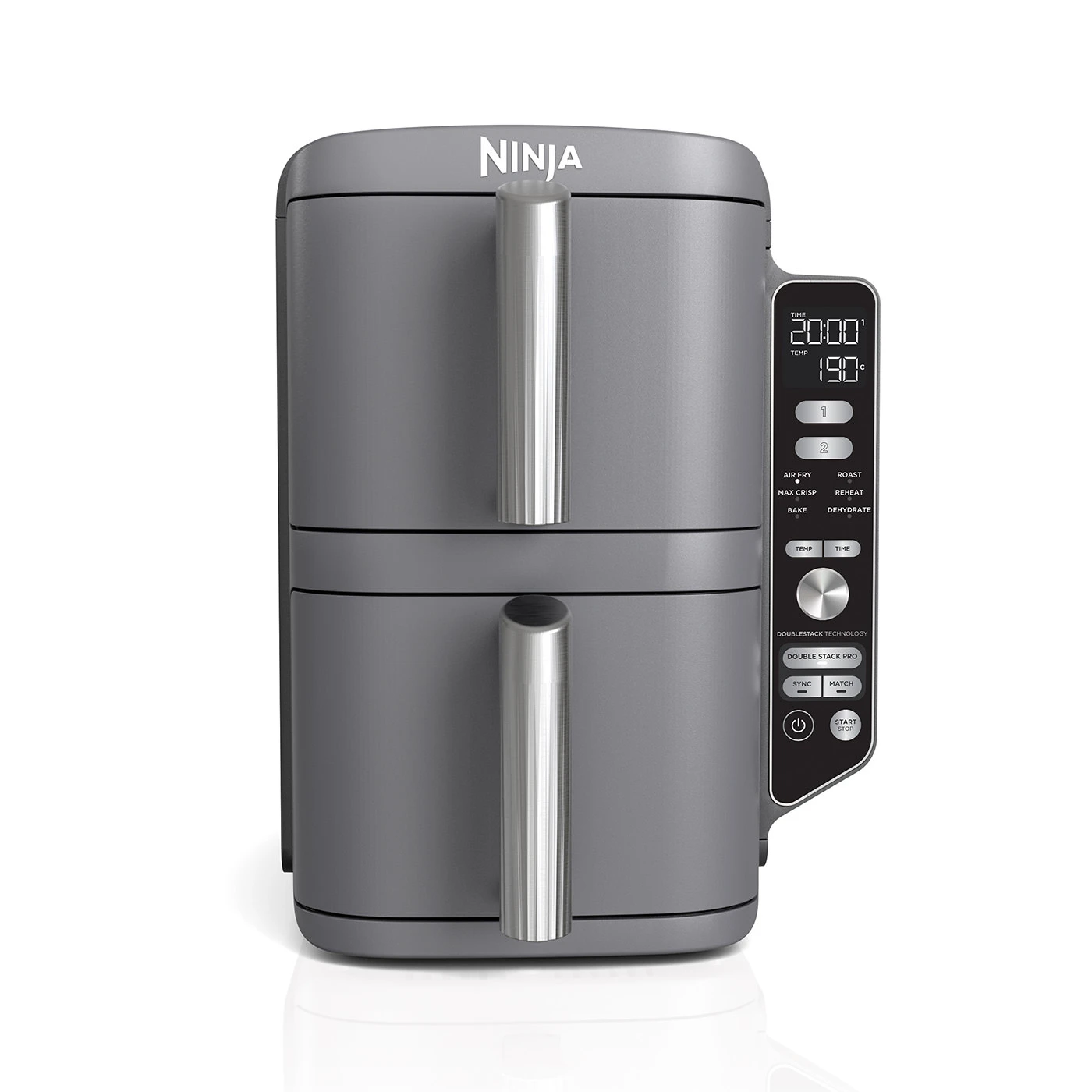
At the centre of the UK range is the Ninja Double Stack XL SL400UK, plus the SL400UKCP finish variant. Both have two vertically arranged 4.75L drawers, creating 9.5L of total capacity. Across the Atlantic, the equivalent standard model is the Ninja DoubleStack XL SL401, described as a 10-quart two-basket air fryer.
The step-up models are the Ninja Double Stack XL with Smart Cook System SL451UK and SL451UKCYD in the UK, and the Ninja DoubleStack XL SL451 in the US. Their defining extra is an integrated digital cooking probe, called the Foodi Smart Thermometer on the US product page. The probe is the substantive difference to focus on; the basic stacked two-drawer format, cooking functions, Sync and Match controls, and rack-based multi-level arrangement are shared across the XL family.
For UK buyers, SL400UKCP and SL451UKCYD appeared to be colour or finish variants of the SL400UK and SL451UK respectively. Ninja's range material did not establish a cooking, capacity, power or dimensional difference between each base model and its corresponding variant.
The original Double Stack XL was announced at SharkNinja's EMEA Product Forum on 1 February 2024, and Which? listed the SL400UK as released in April 2024. The Smart Cook version was announced at IFA on 5 September 2024. Both product generations were therefore established appliances rather than new arrivals by September 2026.
The Footprint Maths: What "Vertical" Actually Buys You on a Worktop
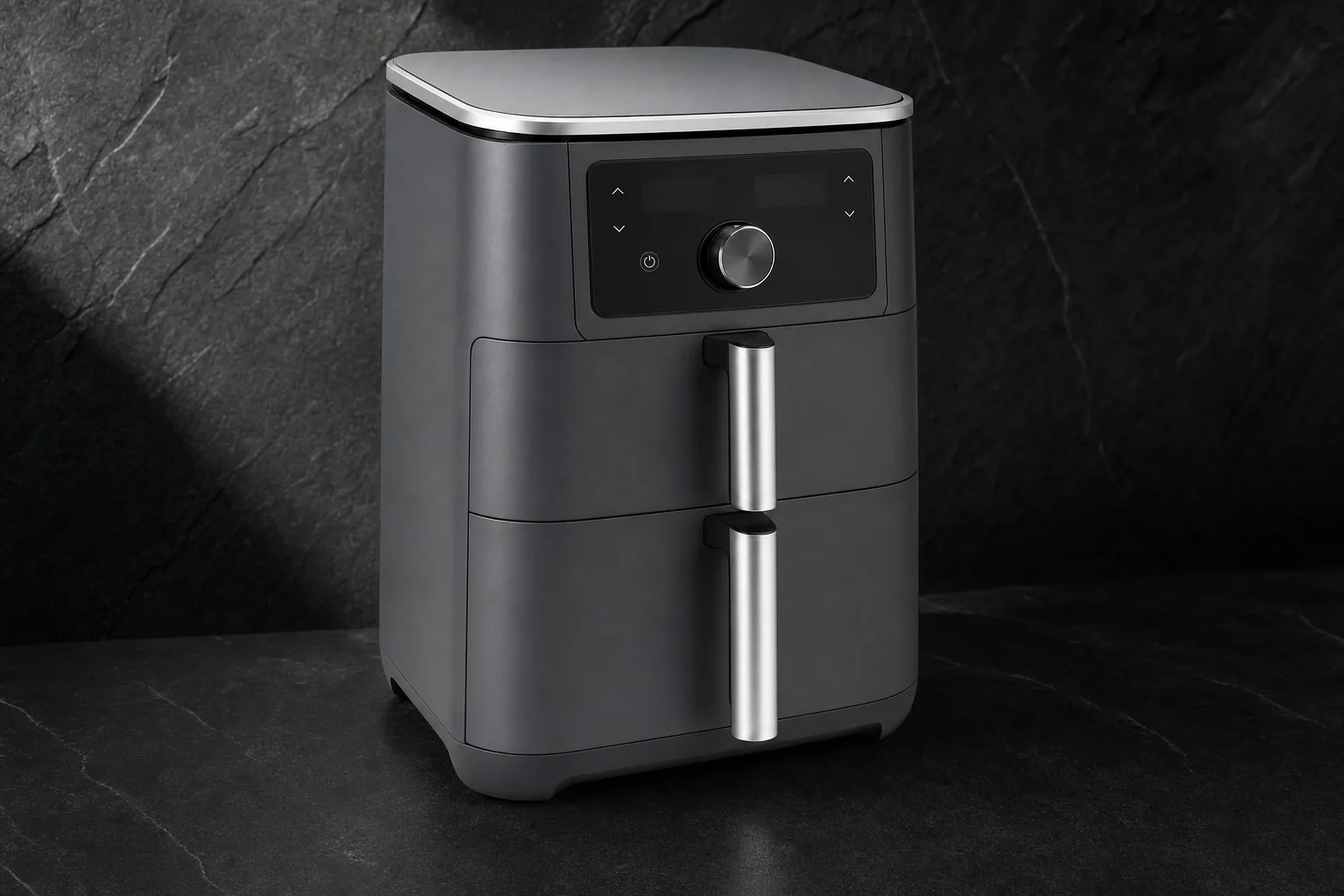
Ninja's space claim is rooted in width. The company described the Double Stack XL as approximately 30% slimmer than the Ninja Foodi MAX Dual Zone AF400. That comparison is broadly fair when the appliances are viewed from the front: the Double Stack XL is 28cm wide, while the AF400 is 41.5cm wide. The stacked model therefore frees 13.5cm of lateral worktop space.
That is a meaningful amount in the right layout. It can be the difference between having an air fryer beside a kettle and toaster, versus having to shift another appliance before cooking. It can also suit a counter run interrupted by a fridge, wall, cupboard or hob, where width is the fixed limitation. But width is not the same thing as total footprint.
| Dimension or feature | Ninja Double Stack XL SL400UK | Ninja Foodi MAX Dual Zone AF400UK |
|---|---|---|
| Total capacity | 9.5L | 9.5L |
| Height | 38.5cm | 32.5cm |
| Width | 28cm | 41.5cm |
| Depth | 47cm | 27cm |
| Nominal top-down footprint | Approximately 1,316cm² | Approximately 1,121cm² |
| Weight | 10.3kg | 8.8kg |
| Rated power | 2,470W | 2,470W |
| Drawer arrangement | Vertical | Side by side |
The calculation matters. Multiplying 28cm by 47cm gives the Double Stack XL a nominal top-down area of roughly 1,316cm². The AF400's 41.5cm by 27cm dimensions work out at around 1,121cm². Based on published dimensions, the vertical Ninja occupies about 17% more worktop area overall, despite being far narrower — this is a calculated estimate from listed dimensions, not a manufacturer-published figure, and should be treated as approximate.
The practical answer
The Double Stack XL did save space across the width of a counter. It did not automatically save total counter area. Its advantage is creating more usable room beside the appliance, not shrinking the full rectangle it occupies.
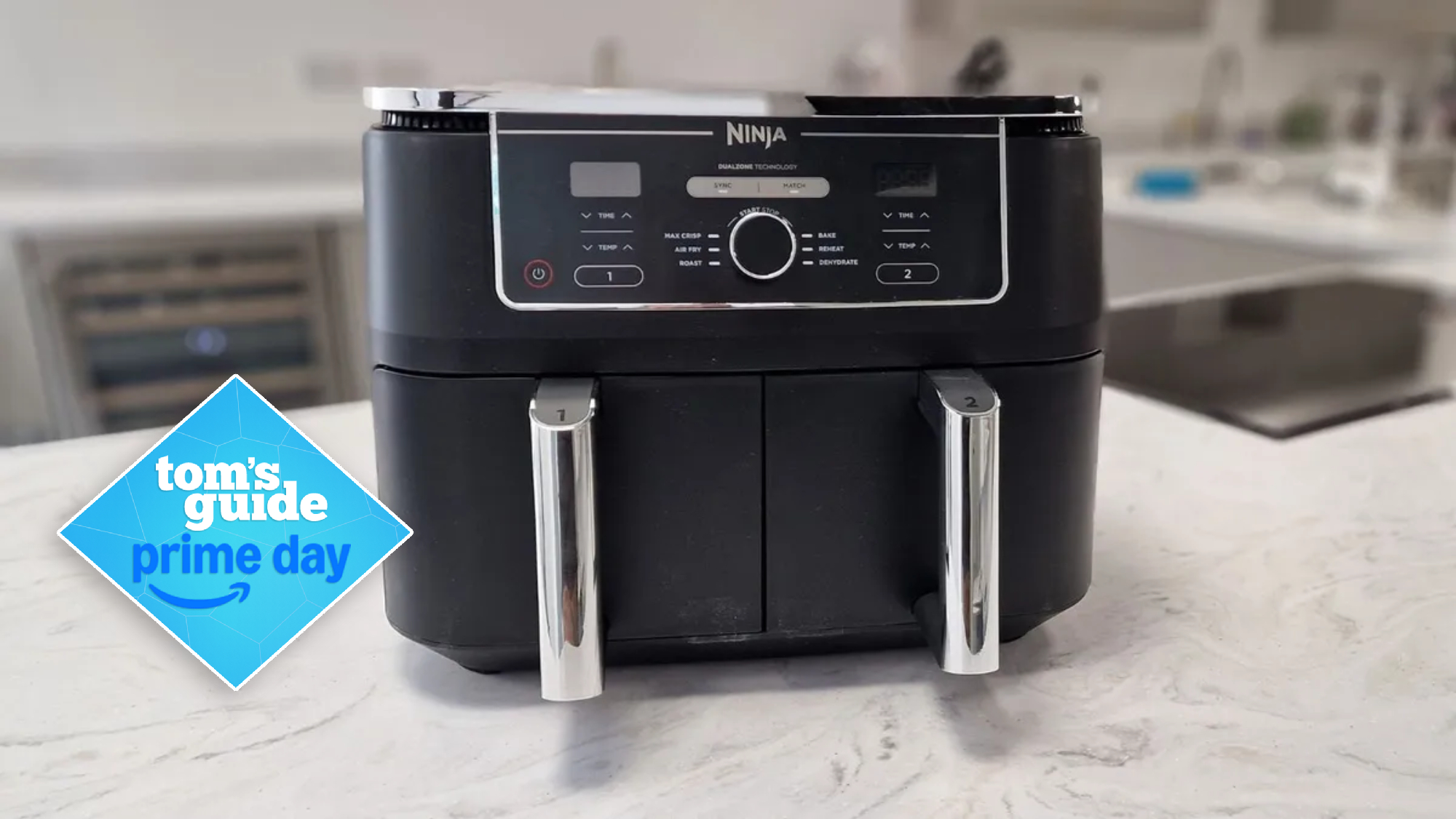
This distinction is more useful than an abstract litres-to-centimetres comparison. A 28cm-wide machine may fit in a narrow appliance bay that cannot accept a 41.5cm-wide AF400. Conversely, a 47cm-deep machine may sit uncomfortably on a shallow worktop where the AF400's 27cm depth is much easier to accommodate. Depth also affects access: drawers slide out towards the user, so a front edge needs to remain clear during cooking.
Kitchen Geometry: Where the Space-Saving Claim Holds Up and Where It Doesn't
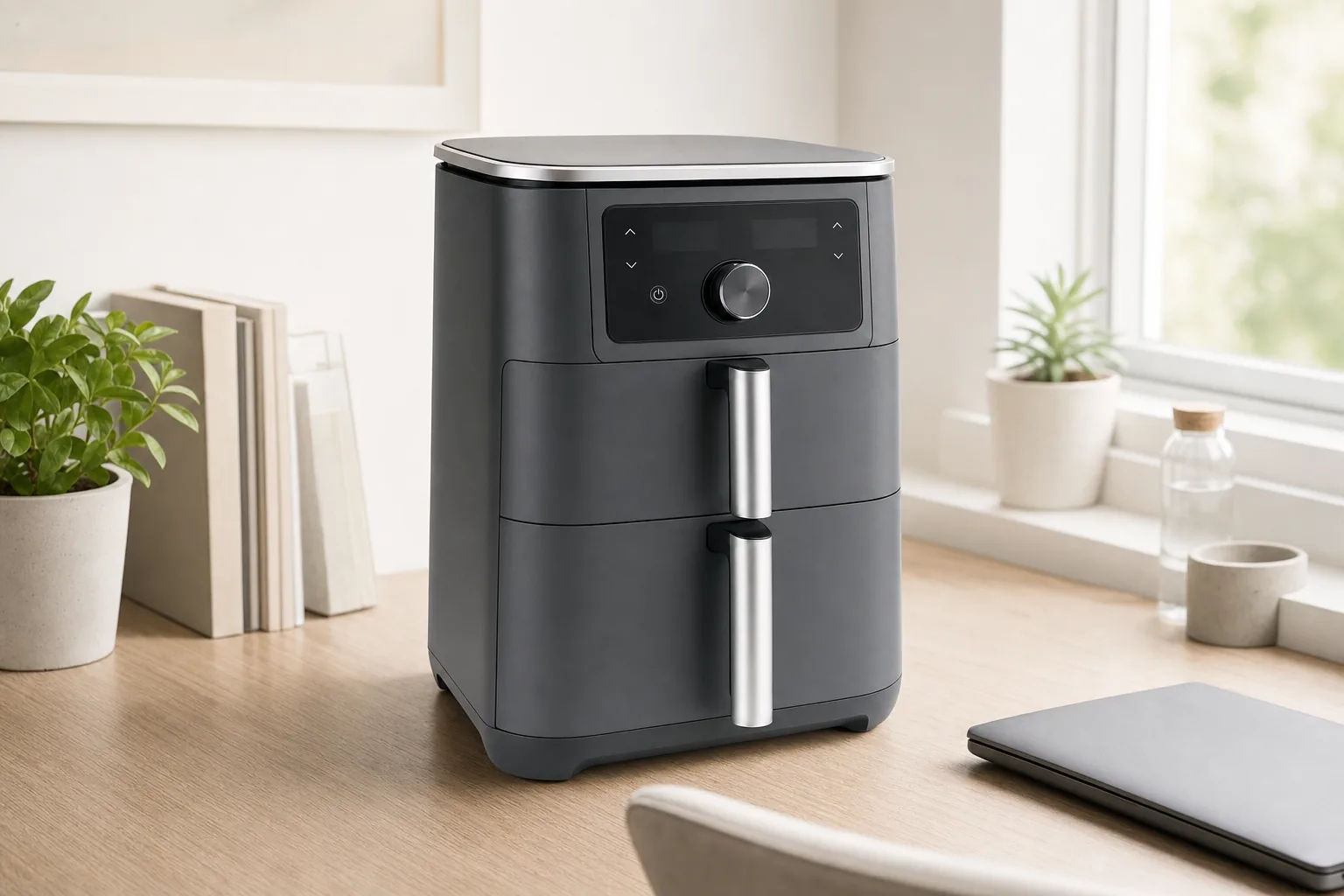
TechAdvisor described the stacked idea as using otherwise "dead" space above and in front of a conventional air fryer. That is a fair description of the strongest use case. Many kitchens have adequate vertical volume and some open counter depth, but not much uninterrupted lateral space. A narrow counter run in a rented flat, a galley kitchen or a small island can benefit from the Double Stack's 28cm width.
It may also suit someone who wants the air fryer permanently visible rather than stored away. At 10.3kg for the SL400UK, this is not a light appliance to lift into a cupboard after every meal. The tall, narrow format is therefore most persuasive when it can occupy a stable space with depth to spare and adjacent room for the side-mounted controls.
The caveat is that 47cm front to back is large for a small appliance. A typical shallow worktop or a counter interrupted by a rear upstand can make placement awkward. Any overhang is undesirable because the appliance is heavy, hot during operation and designed to have its drawers pulled forward. A narrow footprint does not make those conditions disappear.
Vertical clearance is the other measurement to take before buying. The main UK body is 38.5cm high, and T3 reported Ninja's guidance of 15cm clearance around the unit. A buyer with wall cupboards above the worktop should measure from the surface to the cabinet underside, then consider the stated clearance rather than judging only whether the appliance physically fits underneath. The same check applies to a shelf, extractor surround or any wall directly behind it.
Where the layout makes sense
- A narrow counter run where 13.5cm of reclaimed width has real day-to-day value.
- A deeper worktop, island or appliance shelf with clear space in front for both drawers.
- A household wanting 9.5L capacity without a wide, side-by-side body.
- A fixed position where its 10.3kg weight is not a regular nuisance.
Where it may be a poor fit
- A shallow worktop, where the 47cm body can dominate the available depth.
- Low wall cabinets or shelves that cannot accommodate the appliance and its recommended clearance.
- Cooking plans involving broad foods such as pizzas, whole chickens or large roasts.
- A kitchen where the air fryer needs frequent lifting and storing.
The drawer shape is part of this geometry. The double-stack concept gives two separate cooking zones and rack positions, but not the broad horizontal surface of a wide single-drawer appliance. TechRadar specifically highlighted larger foods as a limitation. For chips, wings, fish portions, vegetables and similarly compact foods, the arrangement is logical. For a pizza, a wide joint or a whole bird, a shallower but wider design can be more useful.
Two Drawers, One Brain: How Sync and Match Are Meant to Work
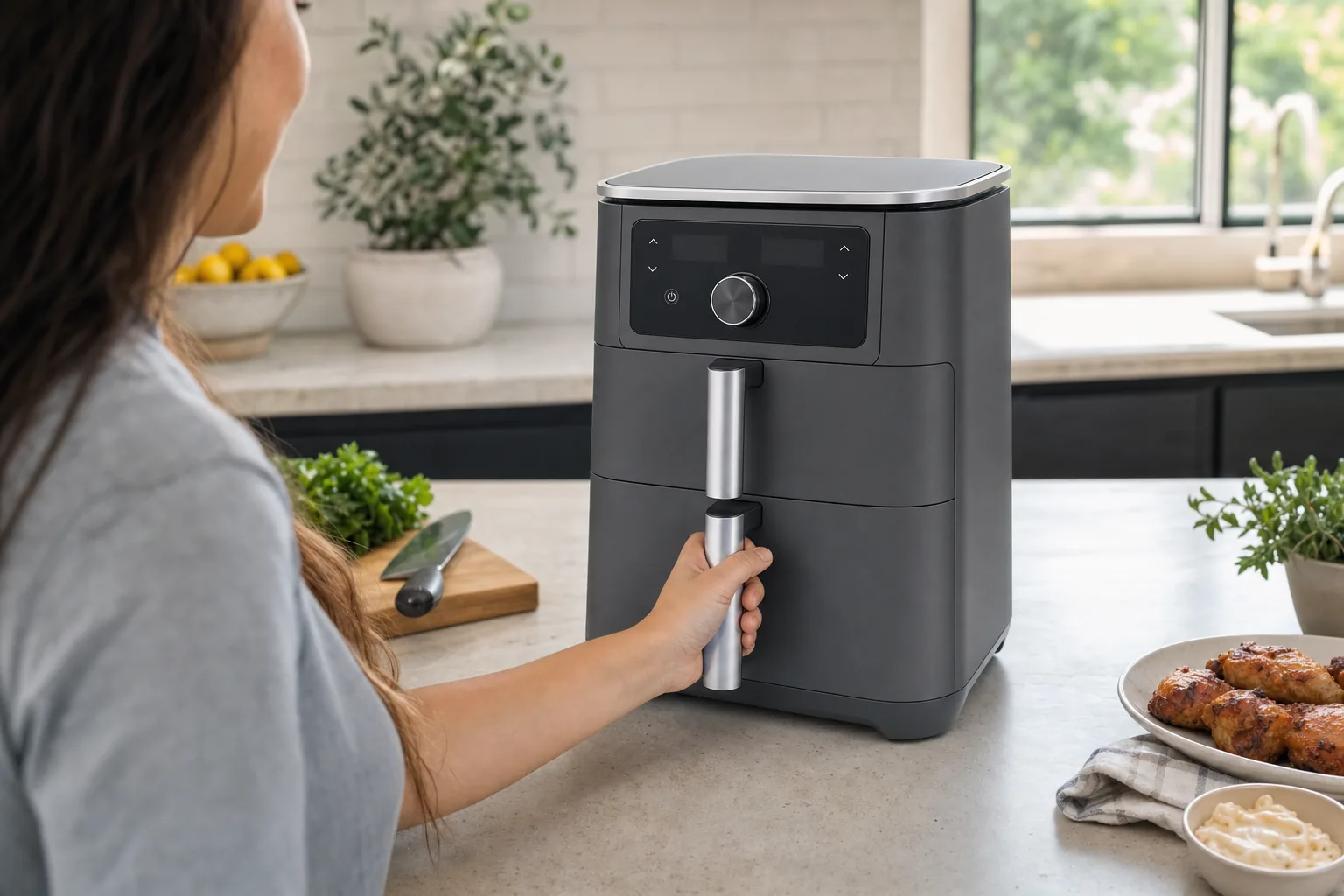
The Double Stack XL is not simply a pair of drawers placed one above the other. Each 4.75L drawer can be controlled independently, and each can accept one removable stainless-steel rack. With both racks in place, the appliance can provide up to four cooking levels. Ninja calls this Double Stack cooking, while Smart Cook UK material refers to Double Stack Pro.
That four-level claim needs to be interpreted carefully. It means four separate food positions can be used at once, rather than four full-size baskets. The lower level of each drawer remains the largest area, while the racks add a second layer above. This could be helpful for combinations such as chicken on one level and vegetables on another, provided food is not packed tightly enough to obstruct airflow.
Two independently controlled drawers
Each drawer can run its own programme, temperature and time. That is the foundation for cooking two different parts of a meal at once.
Sync / Smart Finish
This function is designed to coordinate foods with different cooking times or temperatures so that both drawers finish together. It is useful when one component needs a short, high-heat cook and another needs longer.
Match / Match Cook
Match copies settings from one drawer to the other. It is the straightforward option for cooking double portions of the same food without entering the programme twice.
Two removable stacked meal racks
The racks create the extra upper cooking positions. They are central to the four-level proposition rather than optional decorative accessories.
Six cooking functions
UK XL models provide Air Fry, Max Crisp, Roast, Bake, Reheat and Dehydrate. The standard SL400UK and Smart Cook SL451UK share this cooking-mode set.
Smart Cook System on SL451 models
The SL451UK adds an integrated digital cooking probe for meat and fish. This is the clear practical reason to pay more than for the standard SL400UK.
For ordinary two-zone cooking, Sync and Match are easier to understand than the four-level arrangement. Match suits a family-sized batch of the same food, such as two loads of chips or breaded items. Sync is more valuable for dinner plates with different requirements: salmon and vegetables, for example, or a meat-free portion beside a separate protein. The stated aim is a shared finish time, not necessarily a completely intervention-free cook.
The controls are mounted on the side rather than the front. TechRadar noted this as part of Ninja's effort to keep the front profile compact and avoid putting a display immediately below a cabinet. It is a sensible use of the narrow body, although it does mean the side must remain accessible when the appliance is installed.
What Independent Reviewers Reported When They Cooked With It
The independent evidence broadly agreed on two points. First, the Double Stack XL could produce strong results for everyday air-fryer food. Second, the more ambitious four-level setup introduced a greater need to manage food position than the product photography might suggest.
TechRadar used the Double Stack as its main countertop cooker for two weeks and reported excellent results with fries, chicken wings and salmon, alongside meals including cauliflower cheese. Its conclusion was that the stacked design did not create a meaningful general cooking compromise.
T3 reported good outcomes from chips, croquettes, padron peppers, diced potatoes, breaded chicken tenders and a Spanish omelette. However, it observed some unevenness, particularly with croquettes. The report said rotating or shaking food solved most of those issues. TechAdvisor reached a similar overall view: the appliance was fast and effective, but some foods cooked slightly unevenly.
The four-level caveat
The reported evidence supports the Double Stack XL as a capable two-drawer air fryer. Four simultaneous food positions are possible, but the rack layout is not a promise that every piece will brown identically without shaking, rotating or swapping positions during cooking.
This is important for a buyer attracted by Sync. Sync can coordinate the end time of two programmes, but it cannot remove the physical reality of airflow around food. The further a drawer is filled, and the more separate layers are loaded, the more likely it is that a cook will benefit from attention midway through. That is normal for many air fryers, but it is particularly relevant here because Ninja presents four levels as a central advantage.
There were also examples of respectable cooking speed from other publications. A Polish review reported three chicken Kiev-style fillets cooked in about eight minutes at 200°C, while thick homemade fries took about 35 minutes. These are food-specific outcomes rather than a universal timing guide: potato variety, food quantity, starting temperature and basket loading all affect results.
A 2026 Argos customer report described a 500g marinated chicken taking around 40 minutes in the Double Stack, compared with 15 to 20 minutes in that customer's side-by-side Ninja. That is a single anecdotal comparison, not a controlled benchmark, so it should not override the wider reviewer consensus. It does illustrate why buyers should not assume that two products from the same manufacturer will cook every food at the same rate merely because they offer the same headline capacity.
FryDay's 2026 measurements of an EU SL400EU recorded 52dB at one metre with one drawer running at 185°C, 54dB with two drawers at 200°C, 61dB in Max Crisp and 46dB in Dehydrate. A separate SL400EU measurement by AGD Maniak reached 58.3dB at roughly 30cm from the side vents with both chambers running, so the readings should not be treated as directly interchangeable.
Those figures put normal two-drawer Air Fry operation in the low-to-mid-50dB range at one metre in FryDay's reported conditions. Max Crisp was noticeably louder. The sound profile is not likely to be the deciding factor for most buyers, but it is relevant in an open-plan kitchen where the appliance might run while someone is working, watching television or taking a call.
FryDay also reported an energy figure for a one-drawer fries cook: 22 minutes and 0.55kWh. It observed a rated 2,470W appliance drawing heavily during the first two to three minutes per drawer, then settling in a reported 900W to 1,700W range depending on active zones. That is a useful snapshot from a European-market unit rather than a guarantee of household running cost. Ninja's UK claim of up to 55% less energy than an oven was based on recommended sausage cooking times, so it should be read as a manufacturer comparison rather than a universal saving.
Counting the Cost: XL vs Smart Cook vs the Dual-Zone Alternative
For UK buyers, the SL400UK is the logical entry point into the large Double Stack format. On 16 September 2026, SharkNinja UK listed it at a £199.99 sale price against a stated former price of £269.99. Independent price tracking had also found the model around the £200 to £219.69 range through retailers. That makes the current decision less about paying for the vertical layout at its original launch price and more about deciding whether its depth is acceptable for the kitchen.
The SL400UKCP was listed at £229.99 on sale, against a £269.99 former price. Ninja's range information indicated the same capacity, two-drawer layout, functions and vertical format, so a buyer should view the difference as a finish decision rather than an assumed performance upgrade.
The SL451UK Smart Cook version was listed at £249.99 on its direct product page, against a stated former price of £289.99, although another SharkNinja UK range result showed a £199 sale figure. That discrepancy made checkout verification sensible. The SL451UKCYD was listed at £289.99. The key value question is not simply whether the Smart Cook model costs more; it is whether the integrated probe would be regularly useful for the meals cooked at home.
Ninja Double Stack XL SL400UK
Two 4.75L drawers, racks for up to four levels, six cooking functions, Sync and Match. Direct UK pricing observed from £199.99 on 16 September 2026.
Ninja Double Stack XL SL451UK
Shares the core XL layout and functions, while adding the integrated digital cooking probe. Direct UK pricing showed £249.99 on the product page on 16 September 2026, with a separate range result showing a lower sale figure.
Ninja Foodi MAX Dual Zone AF400UK
The closest Ninja comparison for buyers prioritising equal 9.5L capacity but preferring a wider, much shallower body.
The original SL400UK's proposition is straightforward: two separate drawers and a narrow frontage. The SL451UK keeps that proposition and adds a tool that can take some guesswork out of cooking meat and fish. For someone mainly making chips, frozen food, vegetables and reheated leftovers, the standard model's controls may be sufficient. For someone regularly cooking thick chicken breasts, steaks, pork, fish fillets or joints where internal doneness is important, the probe is more likely to justify the step up.
It would be misleading to treat the Smart Cook model as inherently better at every air-frying task. The shared basics matter more: both have the same stated 9.5L capacity, vertical drawer arrangement, racks, Sync, Match and six modes. The probe is a specific convenience and control feature, not a separate cooking platform.
The AF400 remains the relevant internal alternative because it has the same 9.5L capacity, the same 2,470W UK rating and six functions. The choice is therefore dominated by kitchen geometry. The Double Stack is 13.5cm narrower, but the AF400 is 20cm shallower and around 1.5kg lighter. It is difficult to make a blanket value judgement without knowing which measurement is more constrained in the buyer's home.
Who This Layout Is Actually Built For
The Double Stack XL is not an automatic upgrade over a conventional dual-zone air fryer. It is a more specialised answer to a particular kitchen problem. Its strongest buyer is someone for whom counter width is the binding constraint and depth is available. That might be a narrow apartment kitchen, a galley layout, or a permanent appliance position between fixed fixtures.
Narrow-counter households
The 28cm width is the core attraction. This is the appropriate layout for a home where a 41.5cm-wide side-by-side fryer simply cannot fit comfortably, but a 47cm-deep position is available.
Families making separate foods
Two independently controlled drawers and Sync suit meals where different foods need different settings but should arrive together.
Batch cooks making repeat portions
Match Cook is useful for double quantities of the same food, while the 9.5L total capacity matches the AF400's headline capacity.
Frequent meat and fish cooks
The SL451UK is the more relevant choice for those who would use an integrated temperature probe often enough to make its price premium worthwhile.
It is less convincing for people who want a broad roasting area, have shallow counters, or need a machine that disappears into a cupboard after use. The narrow drawers are not naturally suited to pizza, whole chicken or large flat foods. The product is also relatively heavy, so it rewards a stable, dedicated location more than a lifestyle of frequent lifting.
Buyers should also separate "capacity" from "usable shape". The 9.5L figure is real, and the rack system expands the number of foods that can be cooked at once. But a large volume divided vertically is not identical to a wide, uninterrupted surface. A household that often cooks one large item may prefer a wide single-zone air fryer or a conventional oven tray. A household that commonly cooks two smaller components simultaneously may find Ninja's partitioned approach more useful.
Ninja Double Stack XL FAQs
First-look verdict: narrow is not the same as compact
The Ninja Double Stack XL's vertical design made a credible space-saving argument where counter width was scarce. Compared with the AF400, it reclaimed 13.5cm of side-to-side space while keeping the same 9.5L capacity and 2,470W UK power rating. That can be genuinely useful in a narrow kitchen.
Its trade-off is depth. At 47cm front to back, and with recommended clearance around the body, the Double Stack XL asks more of a worktop than the "slim" label might initially suggest. The calculated footprint was larger than the AF400's, and the tall body also demands a cabinet-clearance check.
For cooking, independent reviewers reported strong results for everyday food, alongside a sensible warning that the four-level arrangement can require food to be shaken or repositioned. The standard SL400UK makes sense for households prioritising narrow width and two-zone cooking. The SL451UK is the version to consider when the integrated temperature probe would be used regularly. For buyers with shallow counters or a preference for wide, flat food, a side-by-side dual-zone appliance remains the more natural fit.
Sources
- SharkNinja UK Double Stack range and SL451UK product pages, accessed 16 September 2026.
- Ninja Kitchen UK SL400UK and AF400UK product specifications.
- Ninja Kitchen US SL401 product listing and SharkNinja US SL451 product listing.
- TechRadar, Ninja Double Stack Air Fryer review, published 8 May 2024.
- TechAdvisor, Ninja Double Stack XL Air Fryer review.
- T3, Ninja Double Stack XL Air Fryer review.
- FryDay, SL400EU sound and energy measurements, 2026.
- AGD Maniak, SL400EU cooking and noise report.
- SharkNinja EMEA Product Forum announcement, 1 February 2024, and IFA announcement, 5 September 2024.
Sources and evidence (18)
- sharkninja.co.uk (other)
- techradar.com (other)
- ninjakitchen.co.uk (other)
- techadvisor.com (other)
- t3.com (other)
- ninjakitchen.com (other)
- sharkninja.co.uk (other)
- sharkninja.com (other)
- ninjakitchen.co.uk (other)
- fryday.fr (other)
- agdmaniak.pl (other)
- aftonbladet.se (other)
- argos.co.uk (retailer)
- which.co.uk (other)
- s202.q4cdn.com (other)
- newsroom.sharkninja.com (other)
- instantpot.co.uk (other)
- idealhome.co.uk (other)