
GaN vs Traditional Chargers: What the Hype Actually Means
Gallium nitride has quietly taken over the charging aisle — but is it genuine progress or marketing fluff? I've dug into the numbers and rounded up the best multi-port UK chargers for phones and laptops.
GaN chargers pack laptop-class power into a footprint barely bigger than the plug itself.
If you've shopped for a phone or laptop charger in the past couple of years, you've almost certainly tripped over the letters "GaN" plastered across the packaging. It's become the buzzword of the charging world — but unlike a lot of tech jargon, this one is actually backed by real, measurable benefits. In this guide I'll unpack what gallium nitride genuinely changes, where the marketing gets a little overcooked, and which multi-port chargers I'd actually put in my own bag.
What we'll cover
- What GaN actually is
- The science vs the hype
- Efficiency & heat, measured
- Size and reliability gains
- GaN generations explained
- The best multi-port chargers
- GaN vs silicon head-to-head
- Who should upgrade
- FAQs & final verdict
Naming: GaNPrime, GaNInfinity and similar labels are vendor product branding, not interoperable semiconductor generations. Compare the exact charger's certified protocols, port sharing and thermal limits.
Search the exact Anker 735 UK variant on Amazon; check the generation and port-sharing table before ordering.
So, What Exactly Is a GaN Charger?
Let's strip away the marketing first. A GaN charger is, at heart, a perfectly ordinary power adapter — it takes the alternating current from your wall socket and converts it into the steady direct current your gadgets crave. The twist is the material doing the heavy lifting. Instead of silicon, the workhorse semiconductor that's powered electronics for half a century, these chargers use gallium nitride to convert and manage the electricity.
Now, gallium nitride isn't some exotic newcomer dreamt up for chargers. It's been knocking around in other industries — LEDs and radar systems among them — for decades. What's changed is that manufacturing costs have dropped far enough to make it viable in consumer plugs. And once you understand the one physics quirk that makes GaN special, the whole "hype" suddenly makes a lot more sense.
GaN stands for Gallium Nitride. It's a semiconductor material, and in a charger it does the same fundamental job silicon always has — just considerably faster and with far less wasted energy.
The Core Technical Difference
Here's the heart of it. Gallium nitride semiconductors can switch electrical current dramatically faster than silicon — roughly 500,000 times per second versus around 50,000 for silicon. That's a tenfold leap, and it matters enormously because faster switching is what lets engineers shrink the bulky transformers and capacitors that make traditional chargers so heavy and clunky.
Why can GaN switch so much faster? It comes down to something called the bandgap — essentially the energy a material needs to start conducting. GaN has a wider bandgap of 3.4 eV compared with silicon's 1.1 eV. That wider bandgap is what enables those higher switching frequencies, and crucially it slashes the energy wasted during conversion. Less waste means less heat, and less heat means you can ditch the chunky heatsinks silicon demands.
Read these as what GaN makes possible, not as a guarantee. Gallium nitride lets engineers switch faster and pack more power into less space. Whether a specific charger is efficient, cool, small, well-protected or long-lived depends on the whole design — the transformer, the control circuitry, the thermal path and the protocols it supports. A cheap GaN charger can easily be worse than a well-made silicon one.
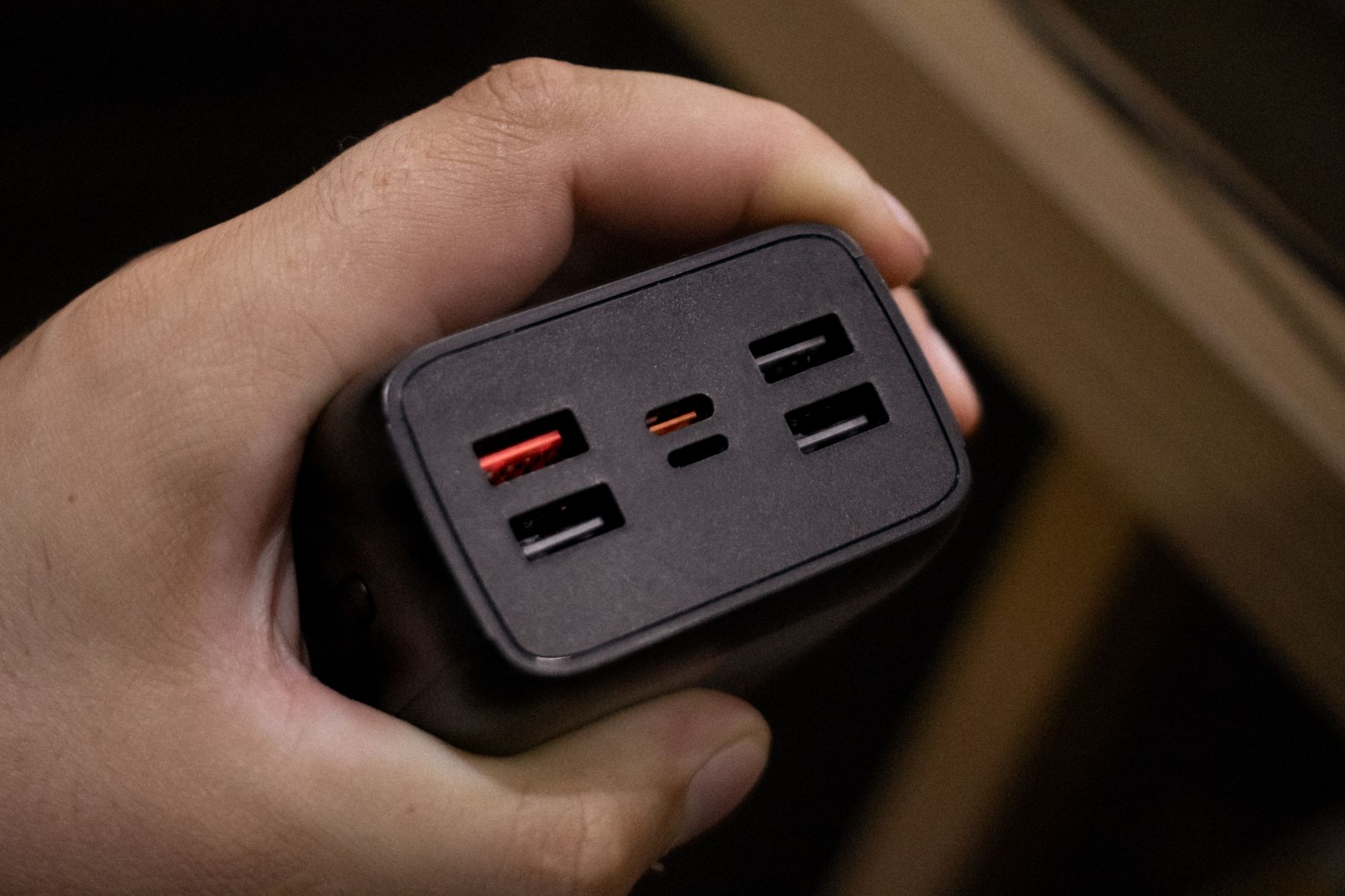
The wider bandgap of gallium nitride is the single property that unlocks every other benefit GaN chargers boast.
Efficiency: The Numbers That Actually Matter
This is where the hype meets reality. Traditional silicon chargers convert roughly 85–88% of the power they pull from the wall into actual charging — the remaining slice is simply lost as heat. GaN, by contrast, hits 90–95% efficiency, staying cool enough to skip the massive heatsinks silicon requires.
Put another way: silicon wastes around 10–15% of its input as heat, whereas GaN drops that to a mere 2–5%. That gap might sound modest, but it's exactly what enables cooler operation in those beefy multi-port units pushing 100W, 200W or more.
I'll be honest, though — the marketing sometimes implies GaN is magic, and it isn't. A real-world efficiency measurement of 91.2% is pretty standard for a modern GaN charger, meaning about 9% of input power becomes heat rather than charging your device. That's perfectly adequate and right in line with competing products, but it's not exceptional. The takeaway: GaN is a genuine, meaningful step up, not a miracle.
The bit nobody mentions
Efficiency matters most when every port is occupied. A few percent saved on a single phone charge is trivial, but multiply that across a 100W+ unit feeding a laptop, a phone and earbuds all day, every day, and the lower heat output translates into a charger that runs cool and lasts for years rather than degrading under stress.
Thermal Performance: Staying Cool Under Pressure
Heat is the quiet killer of electronics, and it's where GaN earns its keep most convincingly. Traditional silicon chargers run hot thanks to high on-resistance, slower switching and energy losses during voltage conversion — they routinely reach 50–70°C under load. Anyone who's grabbed a fast charger after an hour of use knows that toasty feeling all too well.
Testing data shows GaN multi-port chargers maintain surface temperatures 20–30°C cooler than silicon equivalents at 100W and above. That's a substantial difference you can actually feel with your hand.
The real-world implication goes beyond comfort. Picture a silicon 100W charger trying to power three devices at once — it would typically heat up to the point where it throttles its own output to protect itself, meaning slower charging exactly when you need speed. A GaN design handles that same scenario at lower surface temperatures and, crucially, without those power reductions. When all the ports are busy is precisely when GaN pulls ahead.
Lower heat per watt
GaN generates less heat for every watt it delivers, which is what keeps multi-port units stable when fully loaded.
No thermal throttling
Where silicon would dial back output to cool down, GaN maintains full power across simultaneous loads.
Cooler to the touch
That 20–30°C surface temperature advantage at high wattage means no more nervously checking if your plug is overheating.
Size and Reliability: The Tangible Wins
If efficiency is the invisible benefit, size is the one you'll notice the moment you hold a GaN charger. Because gallium nitride switches faster at higher frequencies, the same wattage needs fewer and smaller internal components. The result is a 30–50% size reduction while delivering equal or even superior power output — and generating less heat into the bargain.
To put that in perspective: GaN conducts electricity more efficiently at higher voltages than silicon, and that's what makes a 100W charger small enough to slip into a shirt pocket — something that was physically impossible just five years ago with silicon-based designs. Even at the conservative end, a 30% size cut while keeping current output rock-steady is a genuine, pack-it-anywhere convenience.
A 100W GaN unit slips into a shirt pocket — a feat silicon simply couldn't manage half a decade ago.
And it isn't just about portability. Reliability gets a boost too. Traditional silicon chargers run hotter and can degrade faster under high load, which shortens their lifespan. GaN semiconductors handle higher temperatures and voltages without breaking down as quickly, and because they stay cooler, the internal components face less stress overall. That's why the internals of leading GaN chargers are rated for no applicable battery-cycle rating — a wall charger has no charge-cycle specification — translating to years of daily use before you'd notice any meaningful degradation.
GaN describes the power-semiconductor material; PD and QC support depends on the charger's controller and exact port specification.
GaN Generations: Decoding the Marketing Names
Here's where the packaging gets genuinely confusing, because every brand has invented its own naming. Let me untangle it.
The basics first: the technology has iterated through generations. Anker's Nano II chargers use next-generation GaN II tech, which transmits energy more efficiently and operates at twice the frequency of the very first generation of GaN — and that's exactly what makes them even smaller than early models.
More recently, GaN5 arrived as the fifth-generation iteration, running cooler and more efficiently than earlier designs. On top of that, the big brands have their own proprietary chip names. GaNInfinity (from UGREEN) and GaNPrime (from Anker) are each brand's current-generation chip branding — both indicate improved thermal management over a standard GaN5 chip. So when you see those words, read them as "this is the manufacturer's latest, best-cooled silicon-replacement," rather than worrying about decoding the exact numbers.
| Aspect | GaN Chargers | Traditional Silicon |
|---|---|---|
| Switching speed | ~500,000/sec | ~50,000/sec |
| Bandgap | 3.4 eV | 1.1 eV |
| Efficiency | 90–95% | 85–88% |
| Energy lost as heat | 2–5% | 10–15% |
| Surface temp at 100W+ | 20–30°C cooler | 50–70°C under load |
| Size vs equivalent power | 30–50% smaller | Full size |
| Behaviour when fully loaded | Holds full output | Can throttle to cool |
| Rated lifespan | 50,000+ cycles | Degrades faster under load |
The Multi-Port Charger I'd Recommend
Theory is all well and good, but you came here for a recommendation. For UK buyers who want a single charger that can keep a laptop, a phone and a pair of earbuds topped up at once, the standout in this category is the Anker 735 Charger (Nano II / GaNPrime 65W).
It's a 3-port unit delivering up to 65W total, split across two USB-C ports and one USB-A port. A single device on a USB-C port can draw the full 65W, whilst the USB-A port tops out at 22.5W. Built on second-generation GaN II technology, it's compact enough to genuinely earn the "Nano" name.
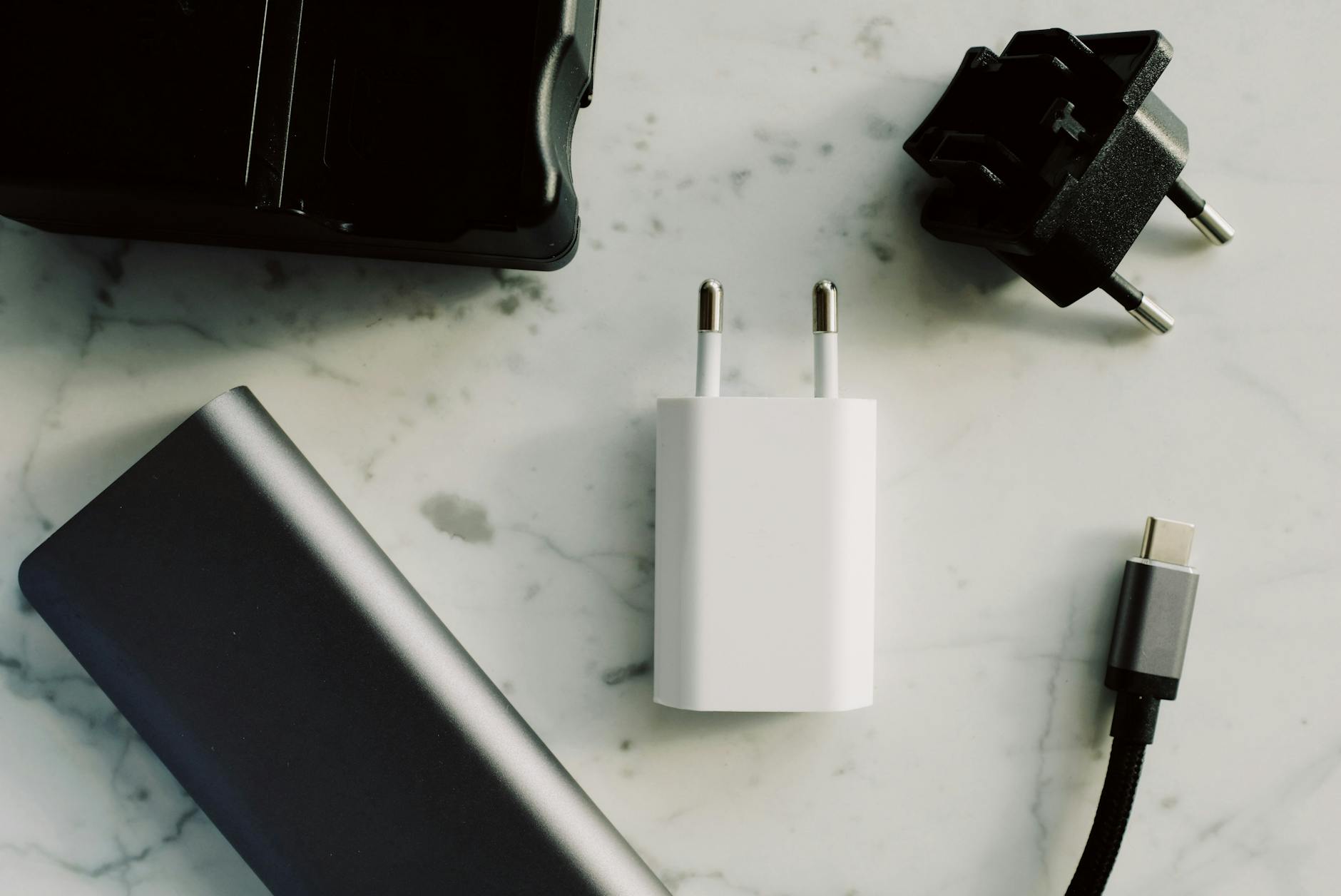
The Anker 735's two USB-C and one USB-A layout makes it a true do-it-all charger for a laptop, phone and earbuds together.
What impressed me most is how it behaves under simultaneous load. The top "C1" port drops from 65W to 40W when the other ports are also in use — but in testing, that 40W was still enough to recharge a 14-inch MacBook Pro while simultaneously charging an iPhone and a pair of AirPods. For a charger this small, that's exactly the kind of real-world juggling most of us need from a single plug.
Pricing & availability
Check the latest price and any current bundles on Amazon.
The honest pros and cons
Pros
- Genuinely charges a 14-inch MacBook Pro, iPhone and AirPods at once
- Three ports (2× USB-C + 1× USB-A) cover almost any device combo
- Compact GaN II build that's easy to pack
- Full 65W available to a single USB-C device
- Supports USB-C PD and Quick Charge for intelligent fast charging
Cons
- Top C1 port drops to 40W once other ports are in use
- 65W total is plenty for thin-and-light laptops but not the most demanding workstations
- USB-A caps at 22.5W, so it's the slower lane of the three
Our Verdict Rating
Taking everything into account — the real-world charging chops, the compact GaN II build, the sensible port layout and the honest power-sharing behaviour — here's how the Anker 735 lands as the multi-port pick of this round-up.
Who Should Actually Upgrade?
GaN is excellent, but you don't necessarily need to bin every charger you own. Here's my honest take on who benefits most.
The commuter
If you carry a laptop, phone and earbuds daily, a single pocket-sized GaN charger replaces a bag full of bricks. This is the upgrade for you.
The traveller
One small multi-port unit charging everything at once means fewer plugs and fewer adapters. The 30–50% size saving genuinely pays off here.
The home worker
A charger that runs 20–30°C cooler and won't throttle under all-day load is exactly what a permanent desk setup wants.
The single-phone owner
If you only ever charge one phone overnight, the gains are real but small. There's no urgent need to replace a working plug.
Light user
A phone and earbuds — a 65W multi-port unit is more than enough headroom.
Best fit
Laptop + phone + AirPods together — exactly what the Anker 735 was built for.
Power user
If you run the most demanding workstations, look toward higher-wattage 100W+ GaN units.
Frequently Asked Questions
The Final Word
Genuine progress, not just packaging hype — GaN is one of those rare upgrades that delivers exactly what it promises.
Verdict
After cutting through the buzzwords, my conclusion is refreshingly straightforward: GaN is one of the rare cases where the hype is mostly justified. The headline efficiency gain (90–95% vs silicon's 85–88%) sounds modest on a single charge, and on its own it isn't earth-shattering. But stack up the genuine benefits — 30–50% smaller, 20–30°C cooler at high wattage, no thermal throttling when every port is busy, and an internal lifespan rated beyond 50,000 cycles — and you've got a category that's quietly left silicon behind. The market agrees, with GaN chargers projected to grow from £1.08 billion in 2025 to £10.2 billion by 2035.
For anyone juggling a laptop, phone and earbuds on the go, the Anker 735 (Nano II / GaNPrime 65W) is the multi-port charger I'd reach for first — it does the real-world juggling act in a pocket-sized package, and it does it without breaking a sweat. If you only ever charge a single phone overnight, there's no rush. For everyone else, GaN isn't just hype — it's the new sensible default.