
Best Portable Air Conditioners UK 2026: 5 Units to Beat the Record-Breaking Heat
Britain has already smashed its May temperature record and is now bracing for its hottest-ever June day. With muggy, sleepless "tropical nights" forecast, we rounded up the portable air conditioners you can actually buy on Amazon UK right now — for every room, budget and noise tolerance — and explain exactly how they beat both the heat and the humidity.

We link to the exact model on Amazon UK. Prices change often, so check the live price before you buy. As an Amazon Associate we earn from qualifying purchases.
If you're reading this with a fan uselessly pushing warm air around your face, you're not imagining it: the UK really is hotter than it used to be, and the summer of 2026 has been one for the record books. A portable air conditioner is the single most effective thing most of us can do about it without builders, planning permission or a five-figure bill. But they are not all equal — they vary wildly in cooling power, running cost and, crucially, noise. This guide explains what actually matters, then names the units we'd genuinely buy right now, from a budget bedroom pick to a big-room bargain — and flags the premium favourites that are temporarily sold out.

See Dreo Smart 3-in-1 Portable Air Conditioner on Amazon UK
Check today's price & availability on Amazon UK
Every unit here was chosen purely on merit. We weighed independent UK reviews, manufacturer specifications and real-world owner feedback to find air conditioners that genuinely balance cooling power, running cost, noise and price — not just whichever has the flashiest spec sheet. They span every need, from a £200 value champion to a unit you can run completely off-grid. First, though, a quick explainer on why this heat is so brutal, and how to pick the right size and type for your room.
The short version
- Best overall (in stock): Dreo Smart 3-in-1 12,000 BTU
- Best value: AuraHome 9,000 BTU 4-in-1
- Best for big rooms: ZHPPED 12,000 BTU
- The usual premium picks (Meaco, De'Longhi, EcoFlow) are sold out in the heatwave right now
- A real AC removes humidity too — that's why it beats any fan
As an Amazon Associate we may earn a small commission from qualifying purchases made through the links on this page. It never affects the price you pay, and we only recommend kit we'd be happy to buy ourselves.
The 2026 UK heatwave, by the numbers
It is worth pausing on just how exceptional this year has been, because it explains why so many people are buying air conditioning for the first time. According to the Met Office, the UK shattered its all-time May temperature record on 26 May 2026, when Kew Gardens in London hit 35.1°C — comfortably the hottest May day ever recorded in England and Wales. That beat the 34.8°C set the previous day, and it obliterated the old May record of 32.8°C, which had stood since 1922. In all, 23 separate weather stations broke the old record during that single spell.
Now June is doing the same. The Met Office has issued a Red Extreme Heat Warning — the most serious category, reserved for events expected to cause widespread disruption and a genuine risk to life — with temperatures forecast to reach 38°C. For context, the existing June record is 35.6°C, set in Southampton back in June 1976; if the forecast holds, this week will rewrite the record books again.
But the raw temperature is only half the story, and arguably not even the worst half. What is making this heatwave so punishing is the humidity. Forecasters measure the muggy, sticky feeling using the "dew point", and the Met Office has flagged dew points around 22°C for the peak days. During the famous 40°C heatwave of July 2022, dew points were only in single figures — the air was bone dry. This time the air is thick and tropical, which changes everything about how the heat feels and, as we'll see, why a simple fan won't save you.
Why this heat feels unbearable: heat and humidity explained
Your body is, fundamentally, a furnace that needs to dump heat constantly to stay at its happy 37°C. It does this in two main ways: by radiating heat into cooler surrounding air, and by sweating, where evaporating moisture carries heat away from your skin. A heatwave attacks both of those mechanisms at once.
First, the temperature problem. Heat always flows from something warmer to something cooler. On a normal day your 33°C skin is much warmer than the air around it, so heat flows away from you naturally. But when the air hits 35–38°C, it is as warm as — or warmer than — your skin, and that flow grinds to a halt or even reverses. You are no longer losing heat to the room; the room is adding heat to you.
Second, and more insidiously, the humidity problem. When you can't radiate heat away, your body falls back on sweating. But sweat only cools you when it evaporates. In dry air it evaporates instantly and you feel relief. In the muggy, high-dew-point air we're getting this year, the surrounding air is already nearly saturated with moisture, so your sweat just sits on your skin doing nothing. You feel clammy, sticky and hotter than the thermometer suggests — and you keep losing fluid and salt without getting any of the cooling payoff. This is why "it's not the heat, it's the humidity" is more than a cliché: humidity disables your body's emergency cooling system.
This is the single most important thing to understand when you're shopping, because it is exactly where a fan fails and an air conditioner wins. A fan moves air over your skin, which speeds up evaporation — brilliant in dry heat, far less effective once the air is humid and above about 35°C, at which point you're essentially being blasted with a hairdryer. A proper air conditioner does something a fan physically cannot: it removes heat from the room entirely (pumping it outside through a hose) and, as a side effect of how it works, it wrings moisture out of the air, dropping the humidity. Lower temperature and lower humidity is the combination your body is desperate for.

Why a portable air conditioner (and not just a fan)
Portable air conditioners have become the default choice for British homes for one simple reason: almost nobody here has — or wants the expense and disruption of — fixed "split" air conditioning bolted to the wall. A portable unit needs no installation, no F-Gas engineer and no permanent hole in your wall. You wheel it where you need it, pop the window-vent kit in, plug it in, and you're cooling within minutes. When summer ends, it goes in the cupboard.
Here's how a portable AC actually works, because it helps you use it well. Inside is a refrigeration circuit — the same technology as your fridge. It draws in warm room air, passes it over an ice-cold evaporator coil that chills the air and condenses moisture out of it, and blows that cooled, dried air back into the room. The heat it has extracted has to go somewhere, so it's pumped out through an exhaust hose that vents through a window. That hose is non-negotiable: a portable AC must vent its hot air outside, or it's simply moving heat around the room and achieving nothing.
That refrigeration process is the reason an air conditioner beats a fan in a humid heatwave. As warm, moist air hits that cold coil, water condenses out of it (exactly like a cold drink "sweating" on a summer day) and is collected or evaporated away through the hose. Most modern units are "self-evaporative", meaning they mostly expel that water as vapour through the exhaust, so you rarely have to empty a tank. The upshot: the air coming out is cooler and drier, tackling both halves of the problem we described above. A £15 fan can't do that at any speed.
The honest downsides of portable AC
We're not going to pretend portables are perfect, because that's how you end up disappointed. They are bulkier than a fan and need floor space. They are noisier than a fan, because the compressor and fan are all in the room with you (more on noise below — it's the number one complaint). The window-vent kit can look a bit untidy and lets a little warm air leak back in around the edges. And they use considerably more electricity than a fan, though far less than you might fear (we've costed it out below). For most people enduring 35°C-plus indoors, those trade-offs are very much worth it — but go in with eyes open.
Portable AC vs the alternatives
Before you spend, it's worth knowing how a portable air conditioner stacks up against the other ways to cool a British home — because they are not interchangeable.
Tower and pedestal fans are cheap, silent-ish and use almost no electricity, and on a merely warm day they're all you need. Their fatal flaw, as we've covered, is that they don't cool air or remove moisture — they just move it. Once the room is above body temperature and humid, a fan offers almost nothing. Think of a fan as comfort for a 25°C day and an air conditioner as the answer for a 35°C one.
Evaporative ("swamp") coolers sit in between on price and are often marketed as "air conditioners", but they are not the same thing. They cool by evaporating water into the air, which works well in dry heat — but in the high-humidity heatwave the UK is getting in 2026, adding yet more moisture to already-saturated air makes the muggy feeling worse, not better. For British summers they're a poor fit.
Fixed "split" air conditioning — the wall-mounted units you see abroad — is the gold standard: quietest, most efficient and most powerful, because the noisy compressor lives outside. The catch is cost and commitment: professional installation by an F-Gas-certified engineer, a permanent outdoor unit, holes drilled through your wall, and a bill that typically runs into the thousands per room, plus possible permissions if you rent or live in a flat. For the overwhelming majority of UK households who want cooling now, without builders or landlord battles, a portable unit is the only practical option — and that's exactly why they fly off the shelves every heatwave.
How to choose: what actually matters when buying a portable AC
Spec sheets for air conditioners are full of numbers. These are the ones that genuinely change your experience, in roughly the order you should care about them.
1. BTU and room size — get this right first
Cooling power is measured in BTU (British Thermal Units per hour). More BTU means more cooling, but bigger, heavier, thirstier and louder — so you want enough for your room and no more. As a rough guide for typical UK rooms with normal ceilings:
| BTU rating | Suitable room size | Typical use |
|---|---|---|
| 5,000–7,000 BTU | Up to ~18 m² | Bedrooms, home offices, box rooms |
| 9,000–10,000 BTU | ~18–26 m² | Average living rooms, large bedrooms |
| 12,000–14,000 BTU | ~26–40 m² | Large or open-plan living spaces |
A couple of adjustments: add roughly 10% if the room is very sunny (a south-facing conservatory or loft), and add a little more for every extra person who's regularly in the room, since bodies are heat sources too. Resist the temptation to massively oversize "to be safe" — an oversized unit cools the air so fast it switches off before it has had time to remove much humidity, leaving you cold but still clammy.
2. Noise — the thing people regret ignoring
This is the complaint we see most often, especially for bedrooms, so it deserves attention. Noise is measured in decibels (dB), and the scale is logarithmic — every 10 dB is roughly a doubling of perceived loudness. For reference, a quiet library is around 40 dB and normal conversation around 60 dB. The British Standard for bedrooms (BS 8233) suggests staying below 30 dB at night, which — let's be honest — no portable air conditioner achieves, because all the noisy machinery is in the room with you rather than outside on a wall.
Realistically, portable units run between about 48 dB and 65 dB. The quietest on their lowest "night" setting sit around 44–53 dB, comparable to a soft conversation or gentle rainfall; the loudest can hit 65 dB, more like a constant background chatter or a dishwasher. If you're a light sleeper, prioritise a model with a genuine quiet/sleep mode and look hard at the quoted minimum dB figure — we flag the quiet performers below. A simple trick: stand the unit on a rubber mat to stop vibration drumming through the floor.
3. Running cost and energy rating
The headline fear — "it'll cost a fortune" — is mostly unfounded. A typical 9,000 BTU unit draws around 0.8–1.0 kW, so at current UK electricity prices it costs roughly 22–30p per hour to run. Use it for four hours on a hot evening and you're looking at well under £1.50 a day; run it across the 50-or-so genuinely hot days of a British summer and the seasonal cost lands around £50–60. Look for a Class A energy rating and the modern R290 refrigerant, which is both more efficient and far kinder to the planet than the older gases.
4. Single-hose vs dual-hose
Most affordable portables are single-hose: one pipe carries hot air out. They're simpler and cheaper, and they're perfectly fine for bedrooms and average rooms. Their weakness is that, by blowing room air outside, they create slight negative pressure that sucks warm air back in through gaps. Dual-hose units use one pipe to draw in outside air for cooling the machinery and another to expel it, which is more efficient and cools large rooms faster — at the cost of a higher price and a slightly bulkier setup. For most UK homes a good single-hose unit is the sensible buy; size up to dual-hose only for big, open-plan spaces.
5. Smart features, modes and the dehumidifier
The genuinely useful extras are a 24-hour timer (so it isn't running while you're at work, or so it pre-cools the bedroom before you turn in), a dehumidifier mode for muggy-but-not-scorching days, and Wi-Fi/app control so you can start it from your phone on the train home. Most also double as a fan in the shoulder seasons, and a few can even heat as well, earning their keep in winter too. Voice control via Alexa or Google is a nice-to-have rather than a deal-maker.
The best in-stock portable air conditioners on Amazon UK (2026)
An honest heads-up first: this year's heat has cleared the shelves. Several units we'd normally send you to first — the MeacoCool and De'Longhi Pinguino especially — are sold out right now, and a lot of what's left is either a weak evaporative "air cooler" or an unbranded box we wouldn't stake our name on. Below are the proper compressor air conditioners that are actually in stock today, led by the one big-name unit still available — with an honest note on the sold-out favourites underneath.
1. Dreo Smart 3-in-1 Portable AC (12,000 BTU) Best overall ~£600
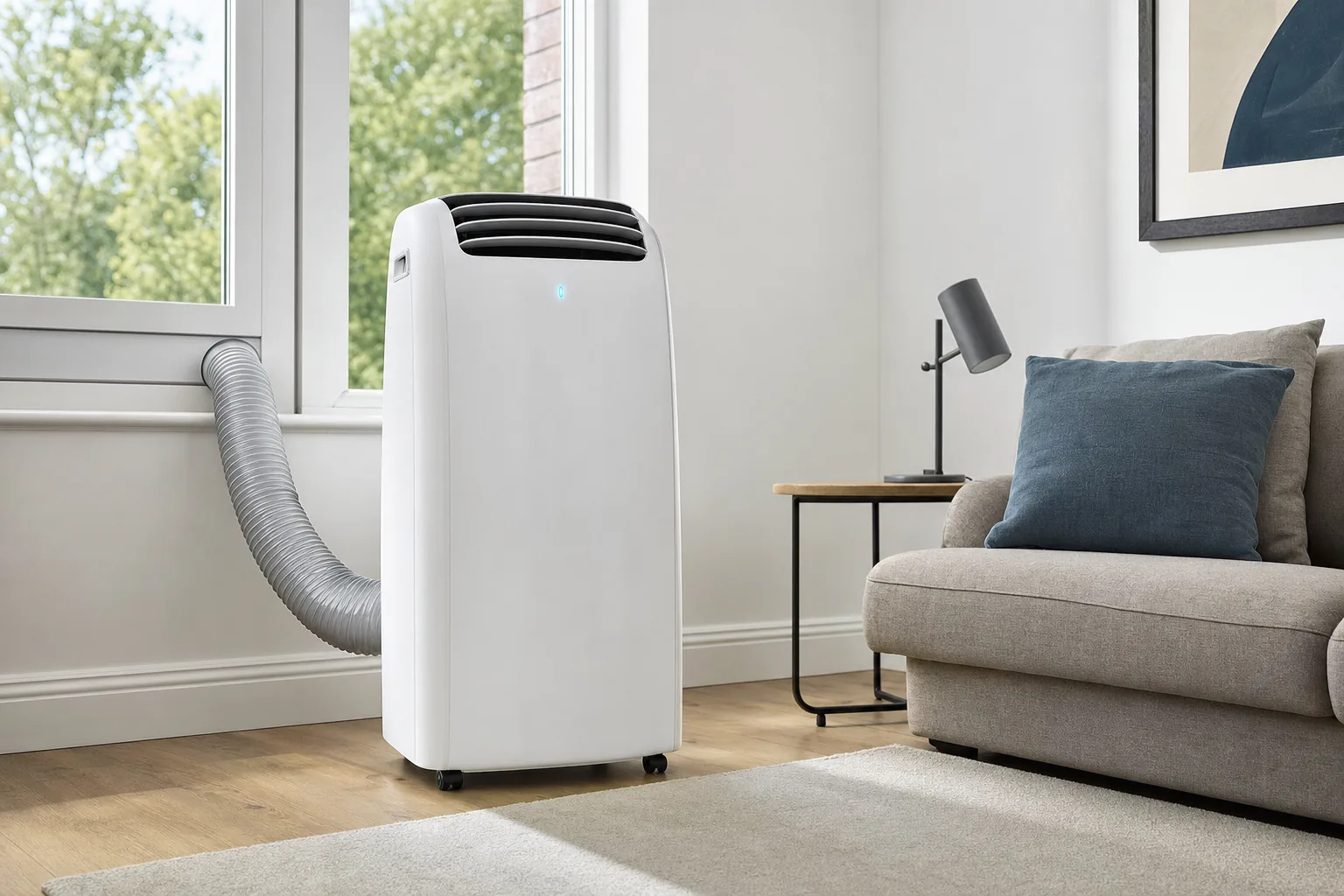
With the specialist air-treatment brands sold out, Dreo is the pick that still ticks every box. It made its name on quiet, well-engineered fans and dehumidifiers, and this 12,000 BTU portable AC carries that over: enough grunt to cool a living room or open-plan space of roughly 25–30 m², a proper compressor (not an evaporative cooler that just blows damp air around), and a genuine 3-in-1 job — air conditioner, dehumidifier and fan in one.
The stand-out feature is that it's drainage-free — it evaporates the water it pulls from the air out through the exhaust, so you're not forever emptying a tank mid-heatwave. It's app- and voice-controllable, runs quietly for its output, and comes from a brand with real UK support behind it. It's the priciest unit here and a chunky thing to wheel about, but if you want one reliable AC you can buy today and trust, this is it.
Pros
- Reputable brand — and actually in stock
- Strong 12,000 BTU cooling for larger rooms
- Drainage-free — no tank to empty
- App and voice control, quiet for its size
Cons
- The most expensive pick here
- Large and heavy to move between rooms
2. AuraHome 9,000 BTU 4-in-1 Best value ~£260
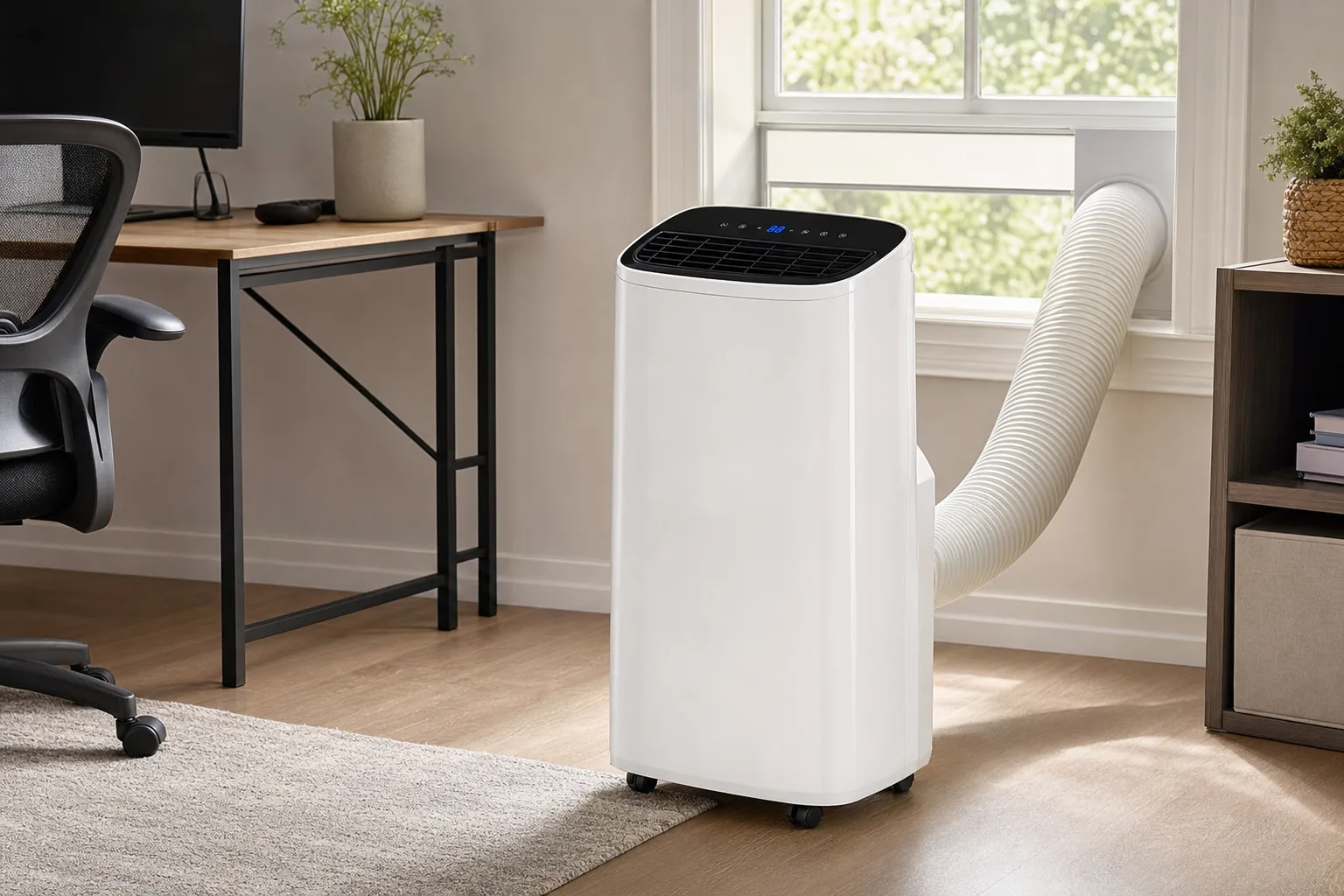
If the Dreo is more than you want to spend, the AuraHome is the sensible in-stock alternative. We'll be straight with you: it's a lesser-known Amazon brand without the track record of a Meaco or De'Longhi. But it is a real 9,000 BTU compressor air conditioner — not an evaporative cooler — with a dehumidifier and fan mode built in, and right now it's one of the most consistently available units on the site at around £260.
9,000 BTU is the sweet spot for a bedroom or a room up to roughly 18–20 m², and the 4-in-1 setup (cool, dehumidify, fan, sleep) covers the essentials with a remote and digital display. Treat it as a solid first AC to get you through the heat at a fair price rather than a premium unit for life — at this price and availability, that's a trade plenty of people will happily make.
Pros
- Genuine compressor AC, not an air cooler
- Great price (~£260) and well stocked
- 9,000 BTU suits bedrooms nicely
- Dehumidifier, fan and sleep modes
Cons
- Lesser-known brand, limited track record
- Not the quietest or most refined
3. ZHPPED 12,000 BTU Freestanding AC Best for big rooms ~about £384 at the 14 August 2026 check
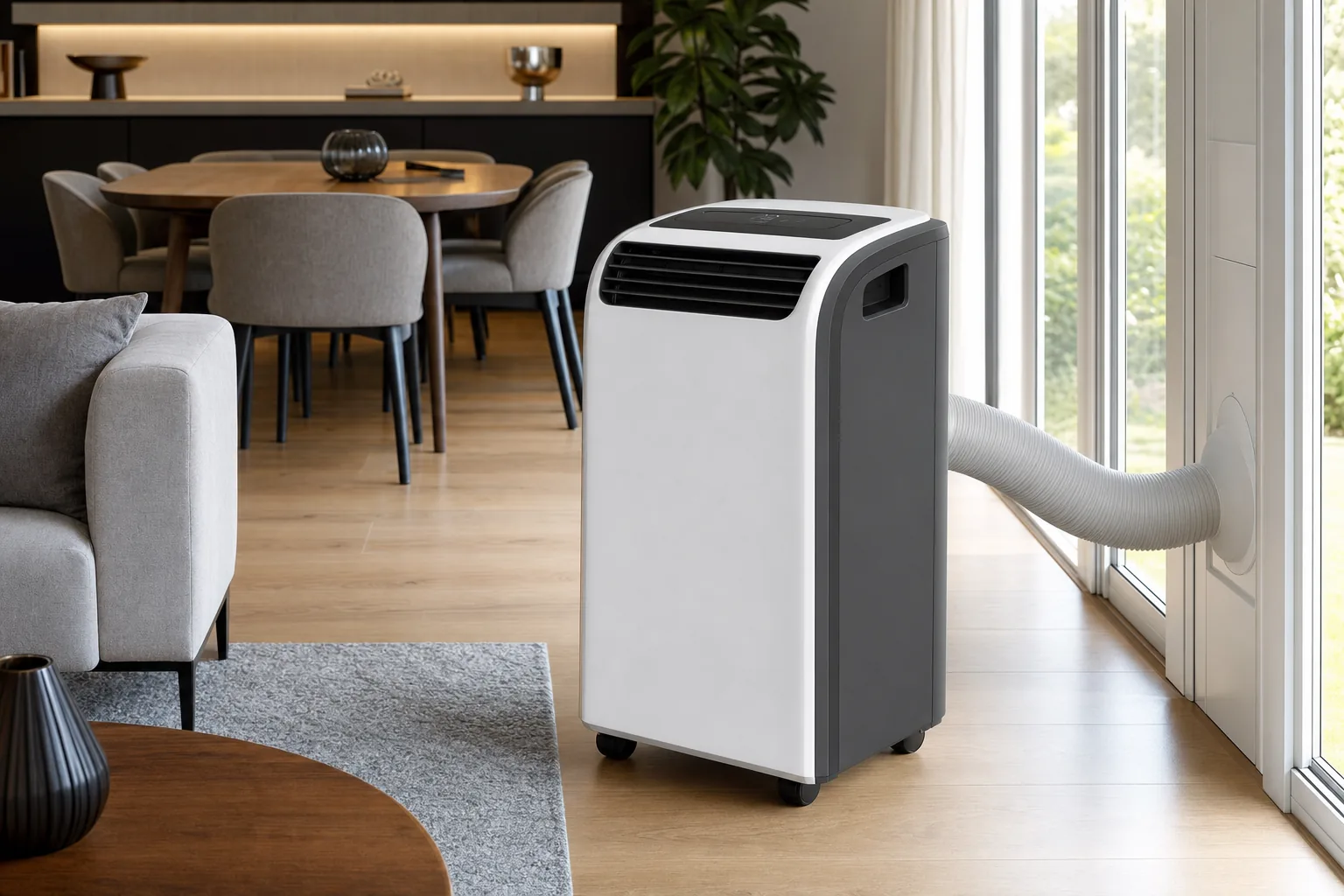
Need to cool a bigger or open-plan room without spending Dreo money? The ZHPPED gives you a full 12,000 BTU of compressor cooling for around about £384 at the 14 August 2026 check — the best cooling-per-pound of anything we found in stock. It's a freestanding unit with dehumidifier and fan modes and no outdoor unit to fit; you just vent the hose out of a window like any portable AC.
Two honest caveats. The listing quotes "12,000 BTU / 18,000" — ignore the 18,000, that's a peak marketing figure; the 12,000 is the number that matters. And like the AuraHome, ZHPPED is a budget brand, so buy it for the value and availability rather than the badge. For a big room in a heatwave when the premium units are gone, it's a lot of cooling for the money.
Pros
- 12,000 BTU for larger / open-plan rooms
- Excellent cooling per pound (~about £384 at the 14 August 2026 check)
- Dehumidifier and fan modes, no outdoor unit
Cons
- Inflated "18,000 BTU" marketing claim
- Budget brand — buy for value, not longevity
Our premium favourites — currently sold out
In a normal summer these are the units we'd recommend first. Right now they're out of stock in the heatwave — tap to check whether they're back:
- MeacoCool MC Series Pro 9000 — the expert favourite. Check for restock →
- De'Longhi Pinguino PAC EX120 Silent — quiet big-room cooling. Check for restock →
- EcoFlow WAVE 3 — runs cordless / off-grid. Check for restock →
At a glance: how the in-stock picks compare
| Model | Cooling | Best for | Brand | Approx. price |
|---|---|---|---|---|
| Dreo Smart 3-in-1 | 12,000 BTU | All-round, up to ~30 m² | Reputable | ~£600 |
| AuraHome 9,000 4-in-1 | 9,000 BTU | Value / bedrooms | Budget | ~£260 |
| ZHPPED 12,000 | 12,000 BTU | Big / open-plan rooms | Budget | ~about £384 at the 14 August 2026 check |
Sold out right now (tap the "check for restock" links above): MeacoCool Pro 9000, De'Longhi Pinguino PAC EX120, EcoFlow WAVE 3.
Sleeping in the heat: how AC turns a Tropical Night sleepable
Of all the misery a heatwave brings, the broken sleep is the part people find hardest — and there's solid science behind why. To fall asleep, your core body temperature has to drop by around a degree; that dip is one of the signals that tells your brain it's time to switch off. In a hot bedroom that dip can't happen, so you lie there wired and restless. Worse, high humidity stops your sweat evaporating, so even lying still you can't shed heat. The result, sleep researchers find, is more frequent waking, and far less of the deep "slow-wave" and REM sleep that your body uses to repair cells and shore up your immune system. A run of Tropical Nights doesn't just make you tired — it genuinely runs your body down.
The recommended bedroom temperature for good sleep is roughly 16–19°C — which during this heatwave can feel like science fiction. This is the one job a fan simply cannot do once the air is hot and sticky, and where an air conditioner is transformative: by pulling both the temperature and the humidity down, it recreates exactly the cool, dry conditions your body needs to drop into deep sleep.
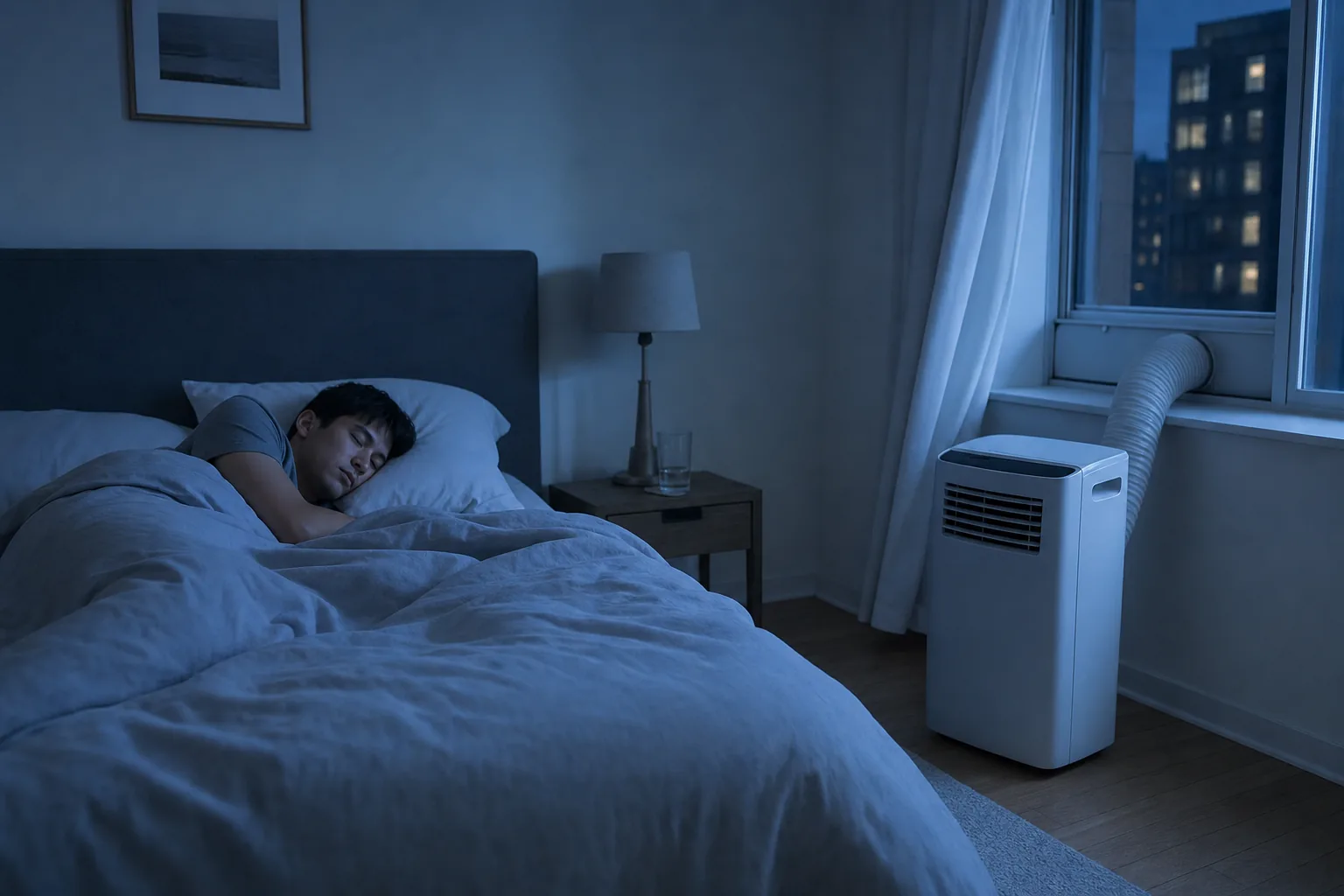
To get the best night from your unit:
- Pre-cool the room. Use the timer to run the AC for 30–60 minutes before bed so you climb into an already-cool room rather than waiting for it to catch up.
- Use sleep/eco mode. These drop the fan speed (and therefore the noise) and let the temperature drift up gently overnight, which is quieter, cheaper, and matches your body's natural cooling curve.
- Keep the door shut and curtains closed during the day. Cooling one closed room is easy; cooling a room that's open to the whole sun-baked house is a losing battle. Blackout blinds keep the daytime heat out in the first place.
- Tame the noise. Stand the unit on a rug or anti-vibration mat, position it so the airflow isn't blowing straight at your head, and consider a quieter, lower-BTU model for the bedroom specifically.
- Switch to lighter bedding — breathable cotton or linen — and the cool, dry air will do the rest.
What it really costs to run (and why it's less than you fear)
Electricity prices make everyone nervous, so let's be concrete. Running cost depends on the unit's power draw and how long you use it. Here's a realistic picture for the kinds of units above, at typical 2026 UK electricity rates:
| Unit type | Power draw | Cost per hour | 4 hrs/day for a season |
|---|---|---|---|
| 7,000 BTU bedroom unit | ~0.7 kW | ~17–22p | ~£40–50 |
| 9,000 BTU living-room unit | ~0.9 kW | ~22–27p | ~£50–60 |
| 11,500 BTU large-room unit | ~1.2 kW | ~28–35p | ~£65–80 |
In other words, even running a unit hard on the genuinely hot evenings of a British summer, you're looking at the price of a few takeaways across the whole season — not the eye-watering bills people imagine. You can trim it further by choosing a Class A unit, using the timer and sleep mode rather than running it 24/7, and cooling only the room you're actually in. Compared with the cost (and impossibility) of installing fixed air conditioning, it's remarkable value.
Heat is a health risk — take it seriously
It's easy to treat a heatwave as just an inconvenience, but the Met Office issues Red warnings precisely because extreme heat can be dangerous, and not only for the obviously vulnerable. Heat exhaustion and heatstroke build quietly: the warning signs include headaches, dizziness, intense thirst, muscle cramps, heavy sweating that then suddenly stops, nausea, and confusion. If someone stops sweating, becomes confused or loses consciousness, that's a medical emergency — call 999.
Certain groups are at much higher risk and a cool room can genuinely protect them: older adults, babies and young children, pregnant women, and anyone with heart, lung or kidney conditions, diabetes or mobility issues. For these people, keeping at least one room cool — exactly what a portable AC is for — isn't a luxury, it's a sensible health precaution. Alongside cooling, the basics still matter: drink water regularly before you feel thirsty, avoid the hottest part of the day (11am–3pm), wear loose light clothing, never leave anyone or any pet in a parked car, and check on elderly neighbours and relatives who live alone.
Setting up and venting your portable AC
Getting the most out of any of these units comes down to a good install, and it takes about ten minutes with no tools:
- Vent the hot air outside — always. Fit the supplied window kit into an opening window and attach the exhaust hose. This is what makes it an air conditioner rather than an expensive fan; skip it and it won't cool at all.
- Keep the hose short and straight. A long, sagging or kinked hose lets the hot air it's carrying radiate back into the room. Position the unit close to the window so the hose runs as short and level as possible.
- Seal the gaps. The window kit leaves small gaps that let warm air sneak back in. A foam seal or even a rolled towel around the kit makes a surprising difference to how cold the room gets.
- Close the room off. Shut internal doors and draw curtains or blinds on sun-facing windows during the day. You're cooling a sealed box; the smaller and better-sealed it is, the easier the unit's job.
- Empty the tank if needed. Most units here are self-evaporative and rarely need draining, but in very humid conditions a tank can fill — if it does, the unit will tell you, and emptying takes seconds.
Looking after your unit (so it lasts)
A portable air conditioner is a fridge on wheels, and a little care keeps it cooling efficiently for years rather than gradually wheezing out. None of it is difficult:
- Clean the filter regularly. Behind the air intake is a mesh filter that traps dust, and a clogged filter is the number-one cause of feeble cooling. Slide it out every couple of weeks during heavy use, rinse it under the tap, let it dry fully and pop it back. It takes two minutes and makes a real difference.
- Drain it before storage. At the end of the season, empty any residual water from the tank and run the unit on fan-only mode for half an hour to dry out the interior — this prevents mould and musty smells over winter.
- Store it upright. Like a fridge, a portable AC has refrigerant and oil inside that need to settle. Keep it upright in storage and, if you ever lay it down for transport, stand it up and leave it for a few hours before switching on.
- Check the hose and seals each summer. A perished window-seal foam or a split in the exhaust hose quietly wrecks performance. A quick inspection before the first hot spell keeps the unit working as well as it did on day one.
Frequently asked questions
Do portable air conditioners need a window?
Effectively, yes. A true portable air conditioner produces hot air that must be vented outside, and a window with the supplied kit is by far the easiest route. You can alternatively vent through a wall vent, a door, or a drop ceiling, but you do need some opening to the outside. The one exception in spirit is a unit like the EcoFlow WAVE 3 used in a vehicle, but even that performs best when its exhaust can reach outside air.
What size (BTU) portable air conditioner do I need?
Match it to your room: roughly 5,000–7,000 BTU for a bedroom or office up to ~18 m², 9,000–10,000 BTU for an average living room of ~18–26 m², and 12,000 BTU or more for large or open-plan spaces. Add about 10% for very sunny rooms. Bigger isn't always better — an oversized unit can cool too fast to remove humidity properly.
Are portable air conditioners expensive to run?
Less than most people expect. A typical 9,000 BTU unit costs around 22–30p an hour, so a few hours on a hot evening is well under £1.50, and a whole British summer of sensible use lands around £50–60. Choosing a Class A unit and using the timer and sleep mode keeps it down.
Is a portable air conditioner better than a fan?
In a hot, humid heatwave, yes — significantly. A fan only moves air; once the air is above ~35°C and muggy, that just blows hot air at you. An air conditioner actually removes heat from the room and dries the air, lowering both temperature and humidity, which is the combination your body needs to feel cool and to sleep.
How loud are they, really?
Portable units typically run between about 48 dB and 65 dB. The quietest, on their night setting, sit around 44–53 dB — like soft rainfall or a quiet conversation. None match a near-silent wall-mounted split system, because all the machinery is in the room with you, so if quiet is your top priority pick a model with a true sleep mode and the lowest quoted dB figure.
Can one portable unit cool a whole house?
No — and don't try. Portables are designed to cool the single room they're in, with the door shut. That's actually their strength: rather than wastefully cooling a whole house, you cool the room you're using (the living room by day, the bedroom by night) and simply wheel the unit between them.
Single-hose or dual-hose — which should I buy?
For most homes, a good single-hose unit is the sensible choice: cheaper, simpler and perfectly effective in bedrooms and average rooms. Step up to a dual-hose model only if you're cooling a large or open-plan space, where its greater efficiency and faster cooling justify the extra cost and bulk.
Do they dehumidify as well as cool?
Yes — it's a built-in side effect of how they work, as warm air condenses moisture on the cold internal coil. Most also have a dedicated dehumidifier mode for muggy days that aren't quite hot enough to need full cooling, making them genuinely useful well beyond the peak of summer.
Can I leave a portable air conditioner on all night?
Yes — they're designed for continuous running, and a sleep or eco mode is built for exactly this, easing the fan speed down overnight to cut noise and cost. For peace of mind and a lower bill, many people instead use the timer to pre-cool the bedroom and run it for the first few hours of sleep, letting the cooled, dried room coast through the rest of the night.
Do portable air conditioners work in conservatories?
They can help, but conservatories are the hardest room in the house to cool because of all that glass acting like a greenhouse. Choose a higher-BTU unit than the floor area alone suggests (add at least 10–20%), shade the glass with blinds, and keep the doors to the rest of the house shut. A cordless unit like the EcoFlow WAVE 3 is handy here if there's no convenient socket.
What is R290 refrigerant, and is it safe?
R290 is purified propane, the natural refrigerant now used in most quality portable air conditioners. It's far better for the environment than the older synthetic gases (a tiny fraction of their global-warming impact) and it's more energy-efficient too. The small quantity sealed inside is perfectly safe in normal home use — it's a tick in the "pros" column, not a worry.
How long do portable air conditioners last?
With basic care — mainly keeping the filter clean and storing it dry and upright over winter — a good-quality unit from a reputable brand should give you many summers of service, typically eight to ten years or more. Cheaper, no-name units tend to have a shorter life and weaker support, which is a big part of why we've stuck to established brands here.
The verdict: which should you buy?
In a normal summer we'd point you straight at the MeacoCool or De'Longhi — but in this heatwave they're sold out, so let's talk about what you can actually buy today. Of the units genuinely in stock, the Dreo Smart 3-in-1 (12,000 BTU) is the one to get: it's the only big-name portable AC still available, it's a proper drainage-free compressor unit, and it'll cool a living room without fuss. If your budget won't stretch that far, the AuraHome 9,000 BTU is the best-value in-stock pick for a bedroom, and for a bigger room on a budget the ZHPPED 12,000 BTU gives the most cooling per pound — just go in knowing both are budget brands rather than premium names.
Whichever you choose, buy sooner rather than later: air conditioners sell out within hours when the mercury climbs. And if your heart's set on a Meaco or De'Longhi, tap the "check for restock" links above — stock does trickle back in, and you'll want to move fast when it does. Tap any link above to check the current price and stock on Amazon UK.
Prices and availability are indicative and change frequently, especially during a heatwave — always check the live price on Amazon before buying. Specifications are drawn from manufacturer data and independent reviews and were correct at the time of writing.
- Dreo Smart 3-in-1 Portable Air ConditionerView on Amazon
 AuraHome Portable Air Conditioner 9000 BTU 4-in-1 AirView on Amazon
 ZHPPED Freestanding Air ConditionerView on Amazon