
JBL Pulse 6 First Look: is the light show finally worth paying for?
JBL's glowing portable speaker has become more useful after dark, but the sound and battery evidence still make this a carefully targeted purchase.
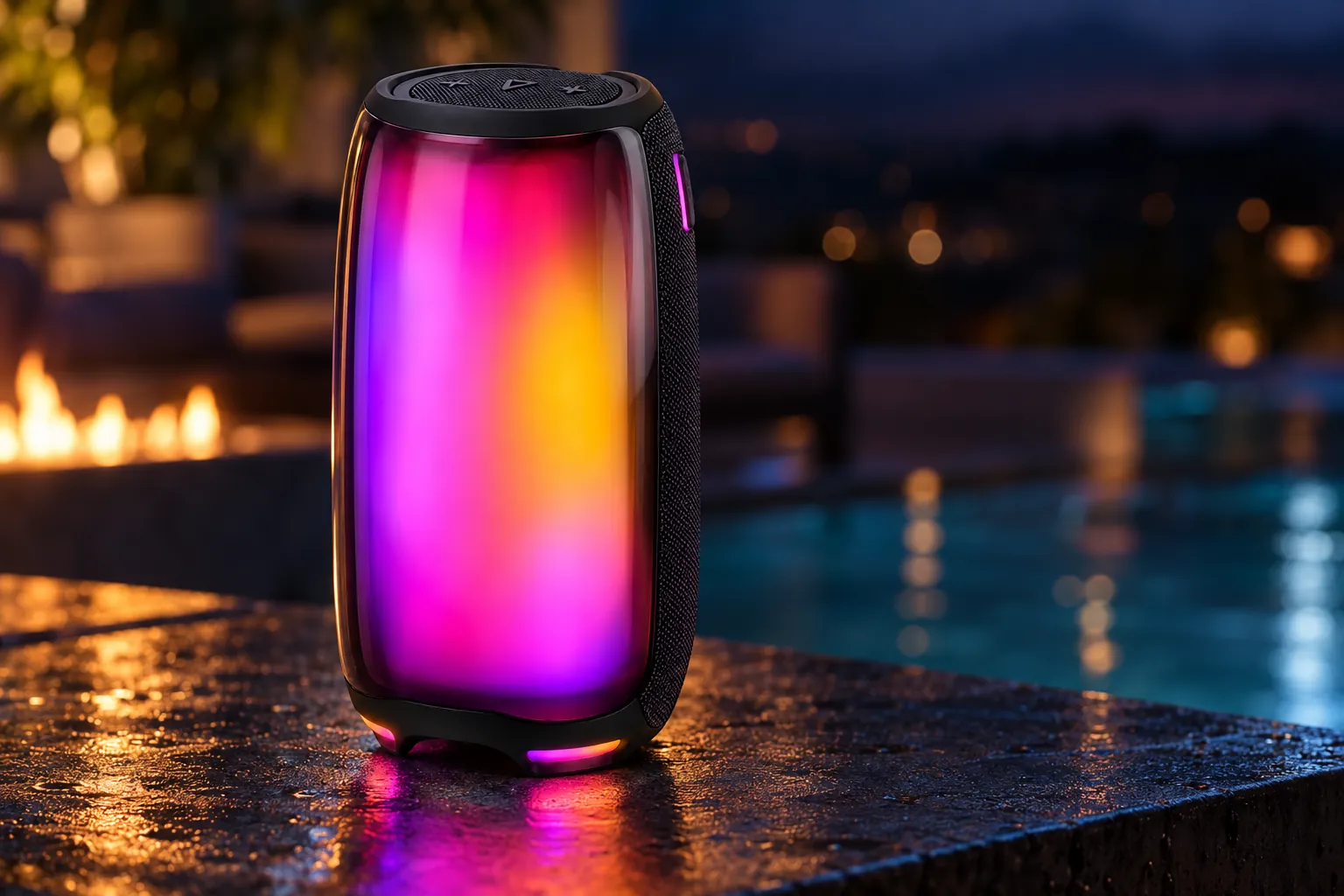
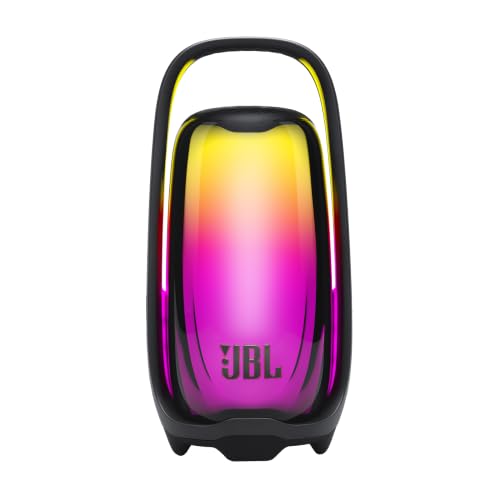
A distinctive speaker-lamp hybrid with useful ambient modes, but limited bass and an approximately seven-hour independent battery result.
Check price on AmazonWe link to the exact model on Amazon UK. Prices change often, so check the live price before you buy. As an Amazon Associate we earn from qualifying purchases.
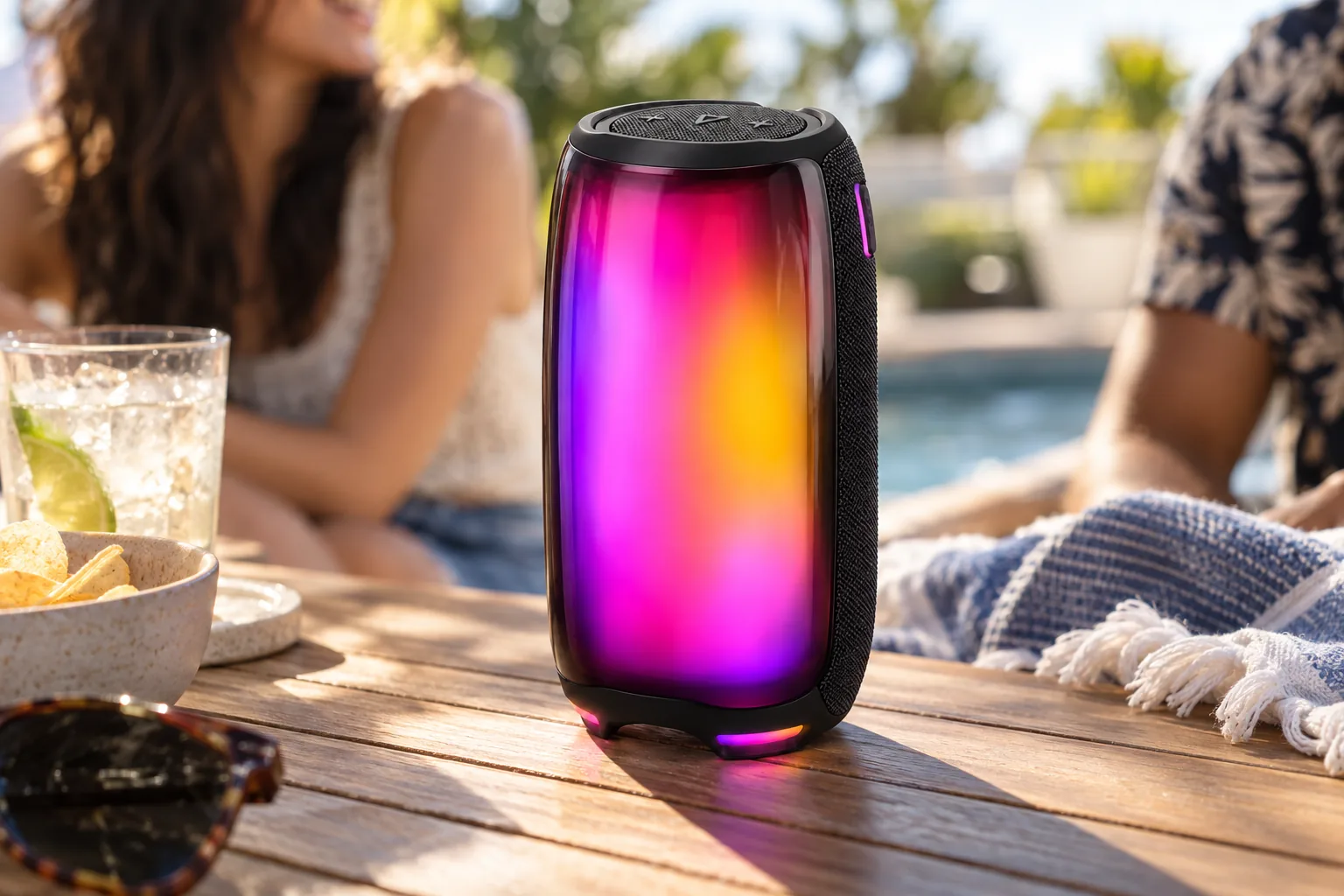
Picture the decision: you want a speaker for the kitchen counter, the patio and a bedside table, but you do not want another black cylinder that disappears into the room. JBL Pulse 6 makes a much bolder case for itself than that. Its lights climb around the body and through a proper carrying handle, then double as a soft lamp when the music stops.
| At a glance | JBL Pulse 6 |
|---|---|
| UK recommended price | £279.99 |
| Rated output | 40W RMS total: 30W woofer + 10W tweeter |
| Claimed battery life | Up to 12 hours |
| Independent battery result | Approximately 7 hours, according to RTINGS |
| Protection | IP68 dustproof and waterproof |
| Weight | 1.49kg |
| Wireless connection | Bluetooth 6.0 with Auracast and multipoint |
| Wired playback | USB-C lossless audio |
JBL Pulse 6: What's Actually New in 2026
JBL announced the Pulse 6 in the UK on 1 October 2026 and made it available from 6 October. The black JBLPULSE6BLK model was listed in stock in the UK on 28 October, carrying a £279.99 recommended price. It is the direct successor to Pulse 5 rather than a repackaged older Pulse design, with EAN 1200130037139.
Check today's price: JBL Pulse 6 on Amazon UK
The important changes are not hidden inside a revised grille or an obscure app menu. The old strap has made way for a full integrated carrying handle, and that handle now participates in the lightshow. JBL also moved from IP67 to IP68 protection, added Bluetooth 6.0 and Auracast, introduced USB-C lossless playback and built out the after-dark use case with Bedside Lamp and Sunset Mode.
The box includes the speaker, quick-start guide, warranty card and safety sheet. JBL's UK listing states that a charger is not included, and specifies a compatible 7.5W to 15W charger.
That collection of upgrades makes the new model more than an incremental refresh on paper. Yet the headline specification that many buyers will notice first, 40W RMS total output, is unchanged from Pulse 5. The story here is therefore about handling, connectivity, protection and lighting usefulness more than a wholesale reinvention of JBL's audio hardware.
For a UK buyer setting one up for the first time, the practical order is straightforward: provide a suitable charger, pair over Bluetooth or connect a compatible source by USB-C, then use the JBL One app to decide whether the speaker is acting as a music player, a light object or both. The app is where the broader ownership proposition becomes clear. It controls the lighting presentation and speaker linking as well as EQ, so it is worth treating as part of the product rather than an optional extra for enthusiasts.
That also makes the Pulse 6 a less simple purchase for someone who only wants to press play from a phone and forget about it. The physical controls cover volume and playback, but its distinctive functions depend on choosing themes, adjusting light brightness or colour temperature, and setting Sunset Mode in the app. Buyers attracted to the speaker's design should be comfortable with that degree of customisation; buyers who would leave the lights off and never open the app are unlikely to get full value from the premium.
Inside the Redesign: Handle, Lighting and That Bedside Trick
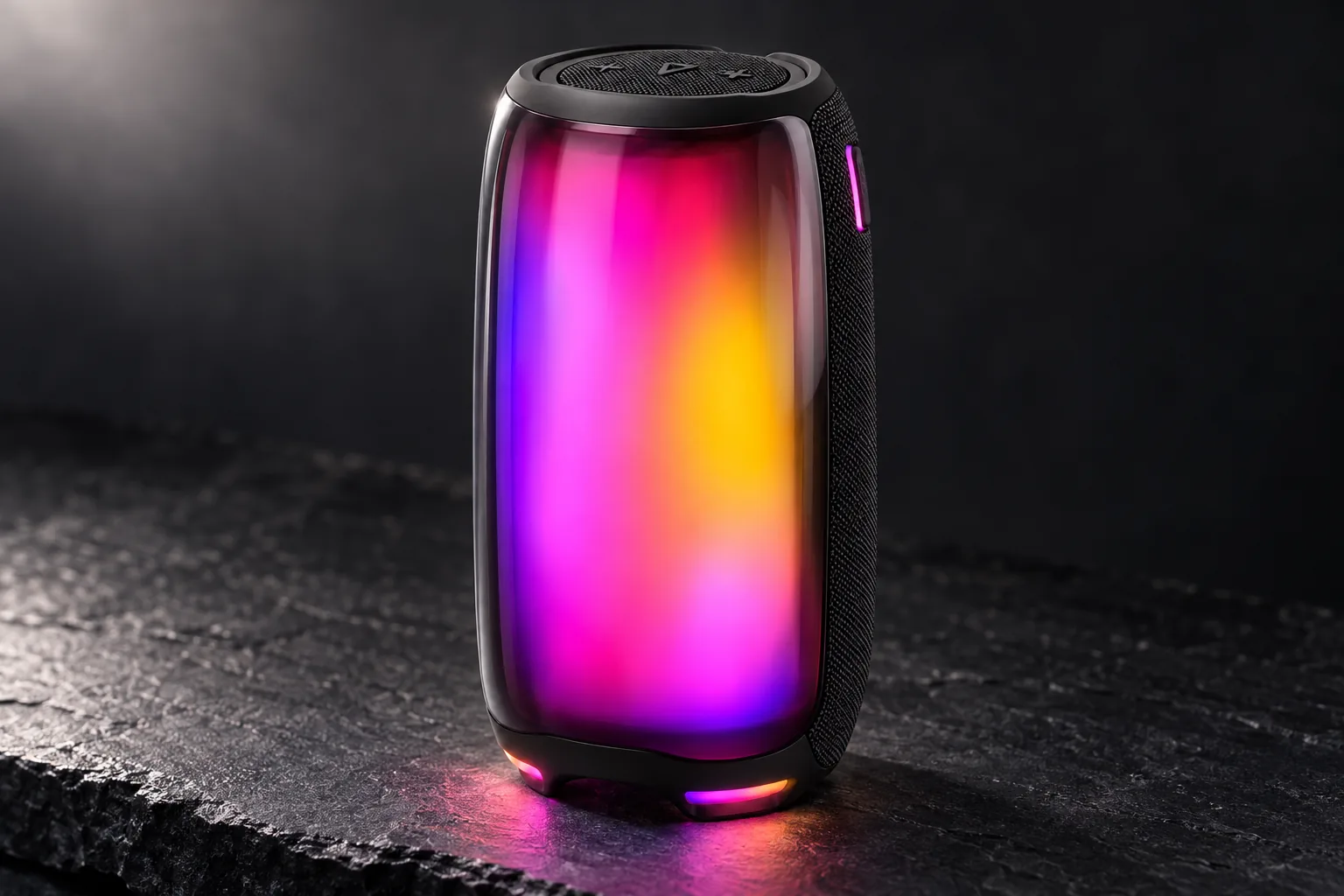
The handle is the most immediately meaningful physical change. SoundGuys described it as much easier to grip than the Pulse 5 strap, which matters with a 1.49kg speaker that will often be carried one-handed from room to room. It also reduces the need to clutch the illuminated body itself, a small but sensible improvement when the speaker has been sitting outside or beside a sink.
JBL did not treat the handle as a purely functional lump of metal. It is illuminated and becomes part of the 360-degree choreography, extending the visual effect above the speaker's main body. That makes the Pulse 6 look more like an intentional room object than a conventional portable speaker wearing some decorative LEDs.
16 lighting themes
JBL lists 10 ambient themes: Universe, Firefly, Sea, Campfire, Aurora, Blossom, Cheers, Storm, Sky and Hover. Six party themes complete the set: Neon, Loop, Bounce, Trim, Switch and Freeze.
Bedside Lamp mode
Double-tap the speaker when music is not playing and it becomes a soft glow lamp. Brightness can be adjusted with the volume buttons, whilst the JBL One app adds brightness and colour-temperature control.
Sunset Mode
A countdown of up to 60 minutes gradually fades the light and stops the music. It is a more practical use of the lighting system than a party animation alone, particularly for a bedroom shelf or bedside table.
There is one design trade-off worth understanding before treating Pulse 6 as simply "more lights". SoundGuys reported that the illuminated bottom passive radiator from Pulse 5 has gone. JBL redistributed the visual emphasis towards the sides and the new handle instead. Some buyers may prefer the handle's tall, lantern-like glow; others may miss the previous model's light at the base.
Why the lighting matters more this time
The useful difference is not merely that Pulse 6 can flash with music. Bedside Lamp, colour-temperature adjustment, Mood Sounds and Sunset Mode mean the lights can still earn their place when there is no party and no playlist running.
The JBL One app is central to that proposition. It handles lighting themes, colours, brightness and animation speed, alongside EQ, speaker linking and ambient Mood Sounds. SoundGuys liked the flexibility of the lighting controls and reported a seven-band custom EQ, although it criticised some Mood Sound mixes because individual elements such as thunder or animal noises cannot be disabled separately.
Does It Actually Sound Better? The 40W Verdict
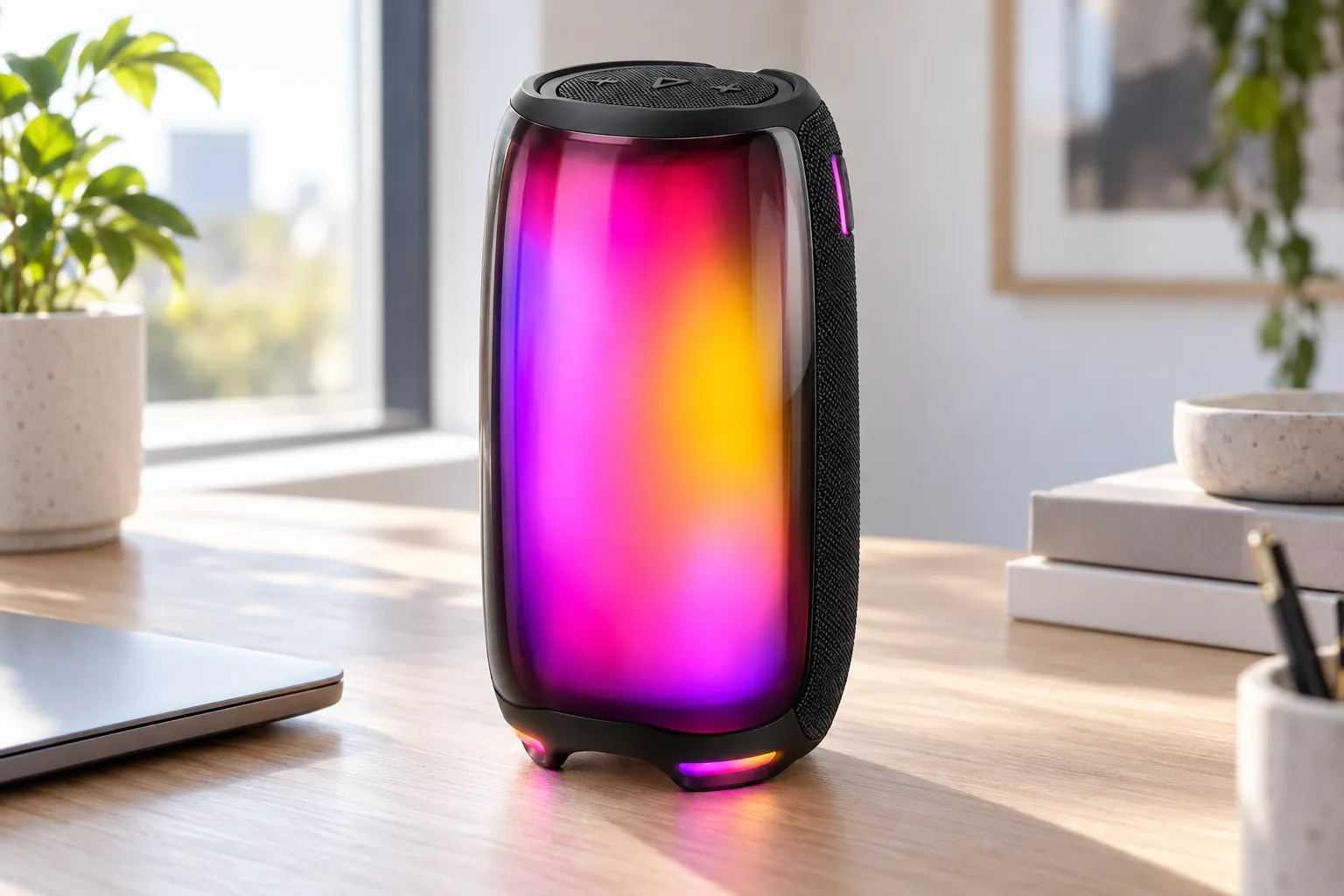
JBL specifies a 30W RMS woofer and 10W RMS tweeter, producing 40W RMS in total. The listed frequency response is 42Hz to 20kHz, with a signal-to-noise ratio above 80dB. AI Sound Boost is also included, which JBL says analyses music in real time to raise output whilst reducing distortion.
Those numbers establish a capable compact speaker, but they do not make it an obvious sound-quality bargain at £279.99. SoundGuys heard somewhat more low-end punch than from Pulse 5, but described the difference as modest rather than dramatic. That is important for current Pulse 5 owners: the case for changing is mainly the new handle, lighting functions, protection and connectivity, not a transformative leap in audio fidelity.
RTINGS was more encouraging about the midrange. It reported that voices and instruments came through clearly and with good balance, making Pulse 6 a credible choice for podcasts, radio, acoustic music and everyday background listening. The upward-firing design also spreads sound relatively consistently around the speaker, useful when it sits in the centre of a dining table or kitchen island.
What reports praised
- Clear speech and balanced voices, according to RTINGS.
- Even sound coverage around the speaker rather than a narrow sweet spot.
- A little more low-end presence than Pulse 5, according to SoundGuys.
- App-based EQ gives owners a way to tailor the tonal balance.
The audio compromises
- Deep bass, rumble and heavy kick-drum impact remain limited.
- A single Pulse 6 presents stereo material in mono.
- Complex arrangements can lose separation, according to SoundGuys.
- RTINGS positioned it for small and medium rooms, not noisy large spaces.
The mono point deserves more attention than it often gets in Bluetooth speaker buying guides. A single Pulse 6 can fill a small room evenly, but it cannot create a broad left-to-right soundstage from stereo recordings. Two Pulse 6 speakers can be linked as a stereo pair through Auracast, but that is a substantial investment and not a requirement most people will take on simply to get conventional stereo imaging.
In practical terms, this means choosing the Pulse 6 for the right sort of listening. It should make more sense beside a meal, during a podcast, or as background music while people move around a room than as the centrepiece of a bass-heavy playlist. Its upward dispersion is a genuine advantage when listeners are spread around a table, but that same all-around approach does not replace the scale and separation a larger stereo-oriented setup can provide.
The USB-C lossless option is useful for a laptop or other compatible source, particularly for someone who wants a wired connection available at a desk. It should not be read as a promise of audiophile performance, though. SoundGuys confirmed that the feature works while cautioning that the underlying product remains a compact mono-style portable speaker. The connection improves flexibility; it does not solve the limitations in bass extension, stereo width or complex-music separation.
It is also not the obvious Bluetooth video speaker. RTINGS reported relatively high Bluetooth latency on iOS and Android, which can lead to lip-sync issues depending on the phone, computer, app and video service involved. USB-C lossless playback broadens its connection options, but Pulse 6 remains designed first as a portable music and ambience product rather than a compact television sound system.
Battery Life: The Gap Between Claim and Reality
JBL quotes up to 12 hours of playback from the 34Wh lithium-ion battery, rated at 7.2V and 4,722mAh. Charging takes 4.5 hours according to JBL, through a 5V/3A USB-C input. That official figure already sits below the longer endurance commonly expected from a premium portable speaker, especially one intended to travel outdoors.
RTINGS reported approximately seven hours of battery life, a meaningful shortfall from the maximum claim. The result still covers an evening in the garden, a film-free weekend afternoon in the kitchen or a few social sessions around the house. It is less reassuring for a full day at the park, camping pitch or beach, where access to a plug may be limited.
Treat 12 hours as a favourable scenario
SoundGuys did not publish an independent runtime figure, but it noted that louder playback and more demanding lighting reduce battery life. Since the lighting is the defining reason to choose Pulse 6, buyers should consider RTINGS' approximately seven-hour figure more relevant than a maximum claim made under gentler conditions.
This is the awkward tension in the product's pitch. The brighter, more elaborate lightshow gives Pulse 6 a clear identity, but that feature has an energy cost. Buyers who value it as a lamp as much as a speaker may happily accept the trade. Buyers who view it as an occasional novelty will be paying a premium for a feature that also makes the endurance case less attractive.
There is no charger in the box, so a new buyer also needs to have a compatible 7.5W to 15W charger available. That is not unusual in 2026, but it is worth including in the real buying calculation at this price.
The sensible buying scenario is therefore an owner who normally has access to mains power: someone carrying it to a patio, moving it between rooms, or using it on a bedside table. For those uses, the official 4.5-hour charge time is a manageable planning detail. It is a less convincing option for a regular full-day trip, because the independent result leaves less margin for higher volume or intensive lighting, and no USB-C power-bank output is confirmed to help keep a phone topped up.
Built to Survive: IP68, Weight and the Latency Catch
Pulse 6 improves the protection rating from Pulse 5's IP67 to IP68. The new rating supports its use around rain, spills, dust and messy outdoor setups, and makes sense for a speaker likely to move from bedside table to balcony or patio. RTINGS also noted that it does not float if it lands in water, so waterproofing should not be mistaken for flotation.
At 1.49kg, it is not a toss-in-the-coat-pocket speaker. SoundGuys weighed it at the same 1.49kg that JBL specifies, whilst reporting that it is only around 20g heavier than Pulse 5 despite the noticeably larger handle assembly. That makes the redesign feel like a practical gain rather than a visual flourish that made portability worse.
The tall 26.4cm form and 13.2cm width give it a narrow footprint, useful on a shelf or counter where a wider horizontal speaker would take over the surface. The handle makes it more convenient to relocate, and the even upward sound dispersion means it should remain sociable when placed in the middle of a group rather than aimed at one listener.
Connectivity is substantially more current than on Pulse 5. Bluetooth 6.0 supports SBC, AAC and LC3, and SoundGuys reported multipoint operation with a phone and computer connected simultaneously. Auracast allows Pulse 6 to join compatible newer JBL products, whilst two Pulse 6 speakers can be configured for stereo playback. It cannot join older PartyBoost speakers such as Pulse 5 or Charge 5 through their previous system.
Multipoint is particularly useful in a home-office or shared-room situation: a phone and computer can remain connected at the same time rather than requiring repeated re-pairing. Conversely, existing JBL owners should check their ecosystem before buying. Auracast is the newer route forward, but it means the Pulse 6 does not extend an older PartyBoost setup. Anyone hoping to combine it with a Pulse 5 or Charge 5 should treat that incompatibility as a deciding limitation, not a minor technical footnote.
Pulse 6 vs the Rest of JBL's Line-Up: Where Does It Actually Fit?
This is a first look at JBL Pulse 6, the sole product covered and recommended here. Still, the alternatives within JBL's portable range show exactly what the Pulse premium buys, and what it gives away. The short version: Pulse 6 is the visual and ambient option, not the practical-value or high-output option.
| Feature | JBL Pulse 6 | JBL Charge 6 | JBL Xtreme 5 |
|---|---|---|---|
| UK price observed | £279.99 | £169.99 standard listing | £329.99 |
| Rated output | 40W RMS total | 30W woofer + 15W tweeter | 90W woofer + 40W tweeters on AC; 60W woofer + 30W tweeters on battery |
| Quoted frequency response | 42Hz–20kHz | 56Hz–20kHz | 40Hz–20kHz |
| Battery rating | Up to 12 hours | Up to 24 hours + 4 hours Playtime Boost | Up to 24 hours + 4 hours Playtime Boost |
| Weight | 1.49kg | 0.96kg without strap / 0.99kg with strap | 2.9kg |
| Auracast | Supported | Supported | Supported |
| USB-C lossless audio | Supported | Supported | Supported |
| USB-C power-bank output | Not confirmed | Supported | Supported |
| Bedside Lamp mode | Supported | Not supported | Not supported |
Charge 6 supplies the hard-nosed argument against Pulse 6. It is lighter, costs materially less at its standard UK listing, carries a much longer battery rating and can act as a USB-C power bank. RTINGS also positioned Charge 6 as louder and longer-lasting. Pulse 6 answers with its full 360-degree lightshow and Bedside Lamp functions, not with a more efficient travel package.
Xtreme 5 moves in the opposite direction. It is significantly heavier at 2.9kg, but has far more amplifier power, a lower 40Hz quoted bass extension, USB-C power-bank functionality and close to twice the stated battery runtime. SoundGuys recommended Xtreme 5 for buyers prioritising bass and outdoor party use. Pulse 6 is the more manageable indoor object and the more lighting-led purchase.
The comparison also clarifies why the Pulse 6 price needs a particular kind of buyer. Its premium is not fundamentally for higher wattage, longer endurance or a power-bank feature. It pays for a carefully integrated light object: body illumination, illuminated handle, app control, lamp mode and timed wind-down functions.
For many UK shoppers, the Charge 6 is the rational alternative if the speaker will regularly leave the house. Its lower observed standard price, lighter weight and stronger battery rating create room in the budget for the occasional practical extra that the Pulse 6 does not include, such as a charger. The Pulse 6 can still be the better choice in a flat, bedroom or lounge where it remains visible every day, but only when its visual role is something you would otherwise seek separately.
The Xtreme 5 is the better comparison for a buyer planning barbecue, garden or outdoor-party use rather than occasional patio listening. It asks for more carrying effort and costs more, but its power, battery rating and power-bank function fit that job more directly. Pulse 6 is not an inferior Xtreme 5; it is a different answer to a different question. The mistake would be buying it for event-scale sound when its strengths are domestic atmosphere and small-group flexibility.
Who Should Actually Spend £279.99 on This
Buy it for ambience
Pulse 6 makes sense for someone who will use a speaker in the lounge or bedroom every day and wants Bedside Lamp and Sunset Mode to be part of that routine.
Good for smaller gatherings
The carry handle, IP68 rating and broad sound dispersion fit kitchens, patios, picnics and small groups better than a large, loud event.
Skip it for outright output
Deep bass, broad stereo width, maximum outdoor volume and all-day battery life are not its strengths, particularly at this price.
There is a strong case for Pulse 6 if it replaces two modest objects in your room: a Bluetooth speaker and a soft ambient lamp. It is particularly coherent for people who want music while cooking, reading, winding down or entertaining a few friends, where warm visual atmosphere matters as much as absolute loudness.
It is a weaker proposition for someone whose priority is music-first performance per pound. RTINGS reported limited bass impact, a single unit remains mono, and its approximately seven-hour runtime is not built around an all-day event. There is also no microphone for speakerphone use and no built-in voice-assistant support.
Current Pulse 5 owners should be especially selective. The handle, IP68 rating, Auracast, USB-C lossless playback and bedside features are substantive upgrades. But SoundGuys' view that the sound improvement is modest means an existing owner should not expect the same step forward in audio as in convenience and lighting versatility.
A useful final decision test is to imagine the lights switched off. If the remaining speaker would still feel worth £279.99 to you despite the battery evidence, mono output and modest deep bass, then the Pulse 6 is a safe fit. If that thought makes the price feel difficult, the product's decorative and ambient strengths are probably not central enough to justify it. Conversely, if the lamp mode, timed fade and illuminated handle are precisely what make you want to keep it on display, those features are not frivolous extras; they are the reason this model exists.
First Look Verdict: Lighting Finally Earns Its Keep, Sound Still Doesn't
JBL Pulse 6 has a much clearer reason to exist than its predecessor. The illuminated handle is easier to carry, the lightshow is more integrated, and the Bedside Lamp and Sunset Mode turn a previously decorative flourish into something with a useful domestic role. Add IP68, Bluetooth 6.0, multipoint, Auracast and USB-C lossless audio, and the feature list feels properly current for late 2026.
The evidence also puts firm boundaries around that appeal. Pulse 6 retains a 40W RMS rating, and SoundGuys heard only a modest improvement over Pulse 5. RTINGS praised clear voices and even dispersion, but reported limited deep bass, mono playback from a single speaker, modest suitability for large spaces and approximately seven hours of runtime. Those are significant concessions at £279.99.
Gadget Scout verdict
JBL Pulse 6 is a persuasive speaker-lamp hybrid rather than a persuasive audio bargain. Buy it because you want the lighting to shape a room and you will use the bedtime functions regularly. If the lights are an occasional extra, the shorter independent battery result and limited bass leave too much of the premium doing decorative work.
Who should buy which
Choose JBL Pulse 6 if a 360-degree lightshow, illuminated handle, soft bedside glow and Sunset Mode are central to the appeal. It suits a visually minded buyer who values atmosphere in smaller rooms and casual social spaces.
Look towards JBL's more conventional models instead if your priorities are longer battery life, greater loudness, deeper bass, phone charging or outdoor party scale. Pulse 6 makes its case through personality and multifunction room use, not through outright portable-speaker efficiency.
- JBL Pulse 6Ambient light speakerView on Amazon
Sources and evidence (10)
- uk.jbl.com (other)
- news.jbl.com (other)
- soundguys.com (other)
- jbl.com (other)
- rtings.com (other)
- soundguys.com (other)
- news.harman.com (other)
- jbl.com (other)
- jbl.com (other)
- support.jbl.com (other)