
Studio Monitor Speakers for a Home Setup: KRK, Yamaha and PreSonus Compared
Three wired nearfield options for producers, podcasters and editors: one prioritises DSP adjustment, one a revealing reference balance, and one a compact desk-friendly workflow.


We link to the exact model on Amazon UK. Prices change often, so check the live price before you buy. As an Amazon Associate we earn from qualifying purchases.
A home-studio speaker purchase is less about brand loyalty than deciding what problem you need it to solve. The KRK ROKIT 5 Generation Five offers the broadest room-tuning toolkit here. Yamaha's HS5 takes a more direct, analogue route aimed at exposing balance and midrange issues. PreSonus's Eris 3.5 2nd Gen is the low-cost stereo pair for desks where inputs, headphone convenience and physical space matter as much as outright monitoring precision.
What You're Actually Choosing Between
These are active wired monitors, not portable Bluetooth speakers. Each has amplification built in, each needs mains power, and each is intended to sit near you rather than fill a large room from across the room. The signal-chain assumption is an audio interface, mixer, computer output or other analogue source feeding the speakers directly.
That distinction matters with the PreSonus range. The Eris 3.5BT 2nd Gen added Bluetooth 5.0, but it is outside this roundup: the focus here is a wired setup for people recording, editing and mixing rather than casual wireless playback. None of the three selected products supports Bluetooth.
For UK buyers, the first practical comparison is not the logo on the cabinet but what has to fit around it. KRK and Yamaha are single-monitor purchases, so budget for two speakers before comparing them with the £89 PreSonus stereo package. The larger models also need more desk depth and a sensible way to support roughly 5kg per speaker. The Eris is the easier choice where the workspace is also a study or a shared computer desk; the KRK and Yamaha make more sense when monitoring is the primary purpose of that space.
| Decision point | KRK ROKIT 5 Generation Five | Yamaha HS5 | PreSonus Eris 3.5 2nd Gen |
|---|---|---|---|
| Sold as | Individual monitor | Individual monitor | Stereo pair |
| Woofer | 5-inch woven Kevlar aramid-fibre | 5-inch cone | 3.5-inch woven glass-fibre composite |
| Amplification | 55W rated Class D bi-amplification | 70W bi-amplification | 50W total Class AB amplification |
| Stated frequency response | 54Hz–30kHz, ±3dB | 54Hz–30kHz, −10dB | 80Hz–20kHz |
| Output figure | 104dB maximum SPL at 1m | Not published by Yamaha | 98dB peak SPL at 1m |
| Adjustment approach | DSP voicings and 25 EQ combinations | Room Control and High Trim switches | High- and low-frequency trims |
| Analogue connectivity | One XLR/¼-inch TRS combo input | XLR and ¼-inch TRS inputs | ¼-inch TRS, RCA and front ⅛-inch input |
| Front headphone output | Not supported | Not supported | Supported |
The KRK and Yamaha prices are per monitor; the PreSonus price covers a complete pair. That difference is crucial when budgeting for stereo.
At the time of research, PreSonus listed the Eris 3.5 2nd Gen at £89 per pair in the UK and $99.99 per pair in the US. KRK and Yamaha were normally sold one speaker at a time, so their real-world pair cost was materially higher. KRK's UK pricing varied between manufacturer and retailer listings, whilst Yamaha HS5 pricing also varied substantially by dealer and VAT treatment. Treat a pair price, not a headline single-speaker price, as the meaningful comparison.
KRK ROKIT 5 Generation Five: For Producers Who Want to Tune the Room, Not Just the Speaker
The ROKIT 5 Generation Five is the choice for a producer who cannot place monitors in an ideal, treated room and wants practical ways to manage that compromise. It is a 5-inch active nearfield with a woven Kevlar aramid-fibre woofer, a 1-inch silk-dome tweeter and separate Class D amplification: 35W for the low-frequency driver and 20W for the high-frequency driver.
±3dB
Class D bi-amped
242mm
Its defining feature is not the amplifier rating; it is the way the monitor can change role. Mix mode is intended to provide flat frequency and phase response for critical work. Create mode adds a more enhanced presentation for writing and production sessions. Focus mode gives the midrange more attention for examining vocals and instrumental detail. Used carefully, these profiles allow a producer to move from broad composition decisions to a vocal or arrangement check without changing speakers.
25 boundary and tuning EQ combinations
These settings are designed to compensate for placement effects, including a desk or nearby wall reinforcing bass.
KRK Audio Tools compatibility
The app supports a room-analysis workflow and EQ recommendations, giving the DSP a more guided setup route.
Front-firing bass port
Front porting can be more practical on a desk or shelf where a rear wall is close, although placement still affects bass.
KRK specified a wider response range of 43Hz–40kHz at +3/−10dB, alongside the tighter 54Hz–30kHz ±3dB figure. The broader number should not be read as flat bass down to 43Hz, but it does indicate more low-frequency reach than the smaller PreSonus. Sound On Sound reported that the speaker provided more low-end extension than its narrower ±3dB figure might initially suggest.
Why the DSP matters at home
A desk against a wall, asymmetrical furniture and limited treatment all affect what reaches your ears. The ROKIT's EQ options do not replace acoustic treatment, speaker stands or sensible placement, but they give a home producer more levers than a conventional pair of rear-panel trim switches.
There are practical caveats. The menu is operated with a rear LCD and rotary control, so it is slower to alter than Yamaha's physical switches. It has only one analogue combo input, which is fine for an audio-interface-centred setup but less flexible if you regularly need several sources connected at once. Reviews also noted that low-midrange weight could feel light in some voicing modes. The sensible approach is to establish one consistent Mix-mode reference for final decisions, then use Create and Focus as deliberate secondary checks rather than swapping constantly.
That workflow is especially relevant if the monitor will be used for both production and ordinary listening. Create mode may be the more enjoyable choice while writing or playing back unfinished ideas, but a final mix decision made there is not necessarily the same as one made in Mix mode. A buyer who wants one unchanging presentation may find the options excessive rather than useful. Conversely, someone regularly moving between vocal editing, beat-making and casual playback can make the three profiles genuinely purposeful, provided the final reference remains consistent.
KRK includes foam isolation wedges, magnetic faceplates and mounting points. The grille option is useful where exposed drivers sit near a busy work area. At 4.95kg each, it is slightly lighter than the Yamaha HS5 despite similar driver size, though it remains a substantial object for a light-duty desktop arm or narrow shelf.
Yamaha HS5: The Nearfield That Refuses to Flatter Your Mix
The Yamaha HS5 is the more traditional reference-monitor proposition. Its job is not to make a rough production sound larger or more exciting than it is. MusicRadar characterised the model as a revealing monitor with strong midrange clarity, imaging and transient definition, which is why it remains a familiar option for editing vocals, balancing arrangements and finding problems that more forgiving speakers can disguise.
222mm
Its control scheme is deliberately simple. Room Control offers 0, −2dB and −4dB low-frequency shelving below 500Hz. This is useful when bass builds up because speakers are close to a wall or sitting on a desk. High Trim offers 0, +2dB and −2dB above 2kHz, which can help compensate for a particularly dull or overly live space. These are not comprehensive room-correction controls, but they are clear, repeatable and easy to understand.
The distinction between those two figures is important. Yamaha's published 54Hz–30kHz number uses the looser −10dB threshold. MusicRadar reported 74Hz–24kHz at −3dB and described noticeable roll-off below about 80Hz. In everyday terms, an HS5 can make bass notes audible, but it is not a dependable full-range window onto sub-bass. For hip-hop, bass-heavy electronic music, cinematic work or any track where the lowest octave is central, a headphone reference or subwoofer-assisted setup becomes more useful.
MusicRadar reported a roughly 3dB prominence between approximately 650Hz and 1.3kHz, plus a dip around 7–10kHz. That presentation helps explain why vocal tone, guitar balance and congested arrangements can be easy to interrogate on the HS5, whilst casual playback may feel less relaxed than on consumer speakers.
Sonarworks also reported that room acoustics strongly affected the HS5's low-frequency behaviour and that the 45W low-frequency amplifier could run short of headroom at higher output levels. That is more relevant when trying to monitor loudly than in normal nearfield listening. The more important practical lesson is not to assume that a 5-inch woofer alone guarantees deep, accurate bass in a small untreated room.
The HS5 is well suited to a buyer who wants to learn one stable reference rather than navigate profiles and app-assisted adjustment. It has balanced XLR and balanced ¼-inch TRS connections, with the TRS input able to accept unbalanced signals. It does not offer the PreSonus's front headphone socket, RCA input or ⅛-inch desktop input, so it makes most sense alongside an audio interface or mixer rather than directly as a multi-source desktop hub.
In day-to-day use, that relative lack of convenience can also be a virtue. There is less temptation to treat the HS5 as a general-purpose source switcher or to keep changing its presentation between sessions. Set the level, choose Room Control and High Trim conservatively, then spend time learning how decisions made on the Yamaha translate to headphones, a car or another familiar system. Buyers who need their speakers to serve several devices at once should factor in the simpler input provision before choosing it.
PreSonus Eris 3.5 2nd Gen: Built for the Desk You Already Have
The Eris 3.5 2nd Gen makes a different argument: get a functional wired stereo workspace without turning a small desk into a monitor-stand project. Its cabinets measure 21.0 × 14.1 × 16.4cm, and PreSonus lists 3.1kg for the product/pair package. That makes it easier to place beside a computer screen, under shelves or in compact edit bays than either 5-inch option.
Class AB
Connectivity is the Eris's central advantage. The powered speaker has two balanced ¼-inch TRS inputs, two unbalanced RCA inputs and a front-panel ⅛-inch stereo input. A laptop, audio interface and a simple consumer source can therefore remain connected without a separate input switcher. For podcasting, video editing or a shared study, that can remove an irritating amount of cable swapping.
There is also a front ⅛-inch headphone output. Plugging in headphones mutes the speakers automatically, which is particularly useful for late-night dialogue edits or checking an episode without changing operating-system audio settings. Neither the KRK nor Yamaha offers this desktop convenience in the specifications covered here.
This arrangement has a clear trade-off: the Eris is built as a powered master speaker plus a second speaker connected by the supplied speaker cable, rather than as two separately powered monitors. That is entirely practical for a compact desk, particularly because cables are included, but it is a different ownership model from buying two KRKs or two Yamahas. It also reinforces the Eris's role as a straightforward desktop pair rather than a modular studio-monitor system.
Where it makes sense
- Complete stereo pair at a lower entry cost than the two individual-monitor options.
- Practical analogue inputs for an interface, computer and auxiliary device.
- Front headphone output with automatic speaker muting.
- High- and low-frequency controls offer ±6dB adjustment at 10kHz and 100Hz.
Where it asks for compromise
- The 80Hz low-frequency specification leaves considerably less bass information than the two 5-inch alternatives.
- Its small drivers and 25W-per-side amplification leave less headroom for louder work.
- Independent response analysis indicated approximately 7.2dB deviation in the measured range.
- It is more suited to editing, rough production and desktop media duties than critical bass decisions.
A sensible podcasting choice
For spoken-word work, input flexibility and quick headphone switching can matter more than reproducing sub-bass. The Eris gives podcasters a direct desktop workflow that the more studio-purist KRK and Yamaha designs do not target as directly.
PreSonus includes speaker wire, an ⅛-inch TRS-to-stereo RCA cable and a stereo ⅛-inch TRS-to-⅛-inch TRS cable. It also specifies RF-interference protection, output-current limiting, over-temperature protection, turn-on/off transient protection and a subsonic filter. Those are useful everyday protections for a desktop speaker that may remain connected all day.
There is a real accuracy trade-off. Erin's Audio Corner published Near-Field Scanner 3D measurements including on-axis response, directivity, distortion and compression investigations. The indexed Spinorama summary showed approximately 7.2dB frequency-response deviation for the unit and range analysed. That does not make the Eris unusable for music production, but it does make it a less secure sole reference for low-midrange and bass decisions than a buyer may want for a serious mix room. Use it for arranging, editing and rough balances, then cross-check important material on headphones or another reliable system.
Reading the Numbers Side by Side: Output, Power and Low-End Reach
Numbers do not fully describe speaker character, particularly because room placement changes bass response, but they help set realistic expectations. The KRK carries the highest published output figure here at 104dB maximum SPL at 1m. PreSonus specifies 98dB peak at 1m. Yamaha did not publish a maximum-SPL figure in the reviewed material, so its 70W total amplifier rating should not be turned into an output comparison.
The low end is even more consequential. KRK's 54Hz ±3dB rating suggests more useful bass information than Yamaha's independently reported 74Hz −3dB figure or PreSonus's 80Hz–20kHz specification. KRK's wider 43Hz figure is measured to a looser tolerance, so it should be treated as extension rather than an assertion of flat response. Still, it points to the ROKIT being the more informative standalone option for kick, bass guitar and electronic low end among these three.
The Eris pair together is also substantially easier to accommodate physically. It is 21cm tall, compared with 28.8cm for the KRK and 28.5cm for the Yamaha. The PreSonus pair's listed 3.1kg package weight is only a little more than half the weight of a single 5.3kg HS5. That does not mean smaller is automatically preferable: a compact cabinet trades space-saving for less low-frequency extension and lower headroom. It simply means physical fit should be part of the buying decision before sound preferences enter the picture.
It is also worth avoiding false precision when comparing these specifications. The quoted response limits use different tolerances, and the two available SPL figures are not identical descriptions: KRK quotes maximum SPL and PreSonus quotes peak SPL. They are useful indicators of scale, not proof that one speaker will suit every room or listening distance better. The Yamaha's missing published maximum-SPL figure is similarly a reason not to rank it numerically on output alone.
Matching the Monitor to What You're Actually Recording
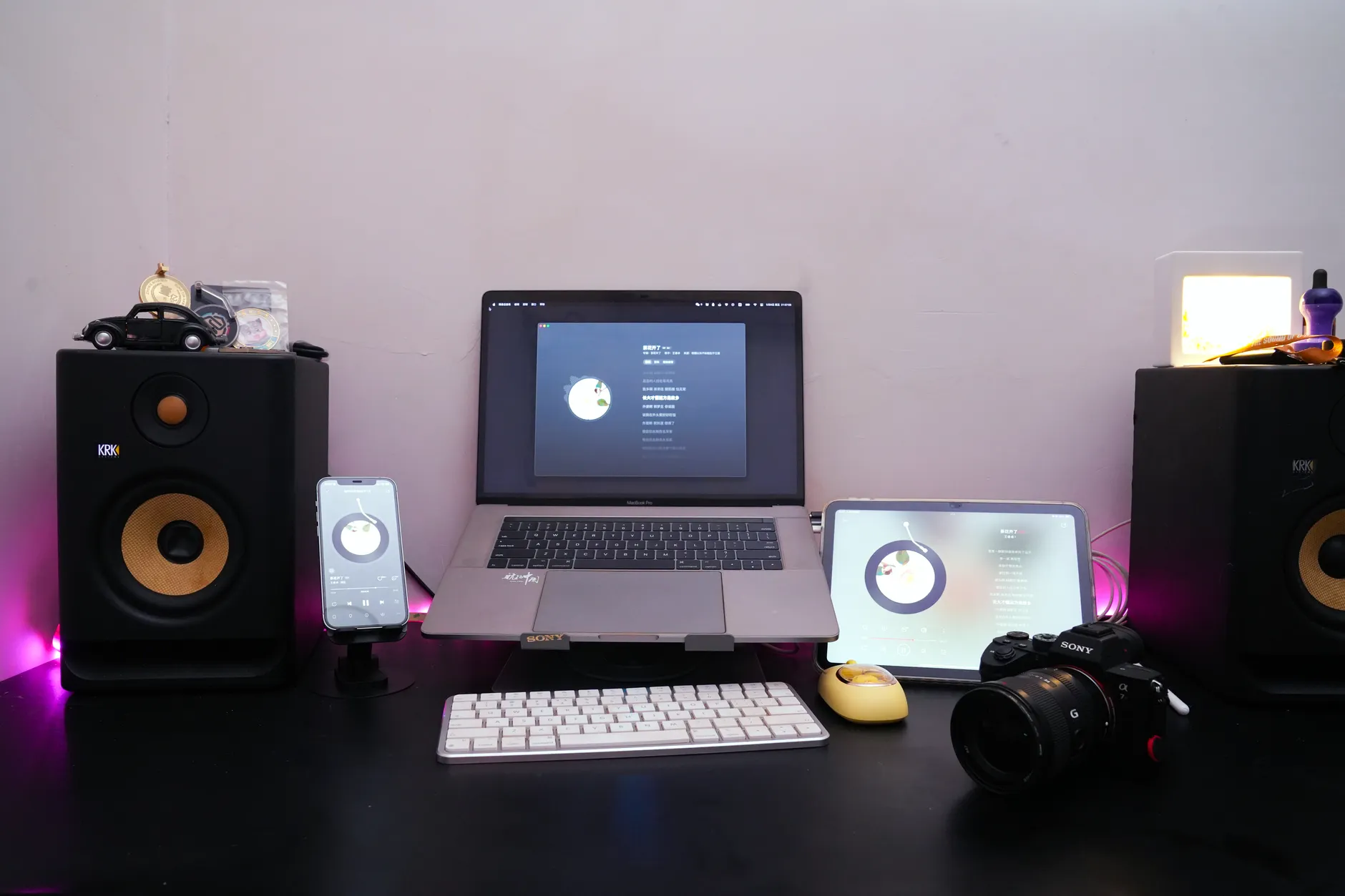
Podcasters and voice-first creators
Choose the PreSonus Eris 3.5 2nd Gen if you need a compact pair with TRS, RCA and front ⅛-inch inputs, plus a headphone output that silences the speakers. That workflow is unusually useful for laptop editing and quick source switching.
Bedroom producers with awkward placement
Choose the KRK ROKIT 5 Generation Five if your speakers must work around a wall, desk or imperfect layout. Its three voicings, 25 EQ combinations and Audio Tools compatibility provide more adjustment options than the others.
Mixers focused on balance and vocals
Choose the Yamaha HS5 if you value a stable, revealing midrange reference and accept that low-bass decisions need a separate cross-check. Its simple physical controls suit people who prefer fewer variables.
For a music producer working in a lightly treated bedroom, the KRK's flexibility is the clearest answer to imperfect acoustics. That should not be confused with automatic room correction: placement, listening distance and symmetry still matter. Start by forming an equilateral triangle between the two speakers and your listening position, keep tweeters near ear height, and avoid placing either monitor directly against a wall if the room allows. Then apply the available controls conservatively.
For dialogue editing, the Yamaha's reported midrange clarity can be a genuine advantage. Speech intelligibility, sibilance, room tone and abrupt edits live largely above the deepest bass. Yet the Eris may still be the more convenient choice when the task includes frequent headphone work, editing in a small shared room and swapping between several analogue sources.
For mastering-focused work, none of these should be considered a substitute for a properly managed room and multiple references. The HS5 is the most deliberately straightforward reference tool in this group; its limitations are visible rather than hidden behind extensive processing. The KRK is more versatile, but its modes require discipline. The PreSonus offers practical value and workflow convenience, but its published independent response analysis makes it harder to recommend as the only speaker for final low-end and low-mid decisions.
A useful setup routine is to begin with the controls at their neutral positions or intended reference mode, listen at normal nearfield levels, and change only one variable at a time. With the Yamaha, that means deciding whether Room Control is needed before adjusting High Trim. With the PreSonus, use the high- and low-frequency trims as basic compensation rather than as a way to manufacture extra bass. With the KRK, learn Mix mode before relying on Create or Focus. In every case, the aim is repeatability: a familiar imperfect reference is more valuable than a different tonal balance every session.
Questions Home Studio Buyers Keep Asking

Which One Earns a Place on Your Desk
Make the decision around your room and workflow
- KRK ROKIT 5 Generation Five: choose it for DSP voicing, room and boundary EQ options, stronger stated low-end reach and a 104dB output rating. It is aimed at producers prepared to spend time setting up a reference.
- Yamaha HS5: choose it for a simple, revealing midrange-led monitor that encourages attention to vocal, arrangement and balance problems. Plan another reference for deep bass work.
- PreSonus Eris 3.5 2nd Gen: choose it for compact dimensions, low complete-pair cost, several analogue inputs and front headphone convenience. It suits desktop podcasting, editing and smaller-scale production where workflow and space outweigh critical full-range accuracy.
The most expensive route is not automatically the sensible one. A compact desk with limited space and frequent headphone editing can justify the PreSonus pair even where a larger monitor would be more revealing. Conversely, a producer struggling with wall proximity may gain more from the KRK's adjustment tools than from a nominally simpler reference. The Yamaha remains compelling when the goal is to establish a stable monitoring baseline and learn how your decisions translate elsewhere.
Put another way, buy the Eris when your desk workflow is the limiting factor, the HS5 when critical midrange judgement is the limiting factor, and the ROKIT when placement flexibility is the limiting factor. None is a shortcut around room acoustics or careful cross-checking. The better purchase is the one whose compromises are visible in your own setup before you start mixing, rather than discovered after you have built an entire workflow around it.
Sources and methodology
This guide used manufacturer specifications and named independent review or measurement sources available on 21 September 2026. Output, response and power figures use the measurement conditions stated by their respective sources; they are not interchangeable laboratory results.
- KRK — ROKIT 5 Generation Five product specification
- Sound On Sound — KRK ROKIT Generation Five review
- Yamaha — HS Series specifications
- MusicRadar — Yamaha HS5 review
- Sonarworks — Yamaha HS5 analysis
- PreSonus — Eris 3.5 2nd Gen product specification
- Erin's Audio Corner — PreSonus Eris 3.5 2nd Gen measurement report
- Spinorama — Eris 3.5 2nd Gen indexed response summary
 PreSonus Eris 3.5 2nd GenView on Amazon
Sources and evidence (14)
- uk.presonus.com (other)
- krkmusic.com (other)
- europe.yamaha.com (other)
- musicradar.com (other)
- presonus.com (other)
- soundonsound.com (other)
- erinsaudiocorner.com (other)
- sonarworks.com (other)
- spinorama.org (other)
- gibson.com (other)
- hhb.co.uk (other)
- musicplayers.com (other)
- usa.yamaha.com (other)
- soundhouse.co.jp (other)