
Premium Dolby Atmos soundbars: which home-cinema upgrade fits your room?
A convincing movie night is not just about a longer soundbar. It is about where bass can live, whether rear speakers have somewhere sensible to go, and how many consoles compete for your TV's HDMI ports.
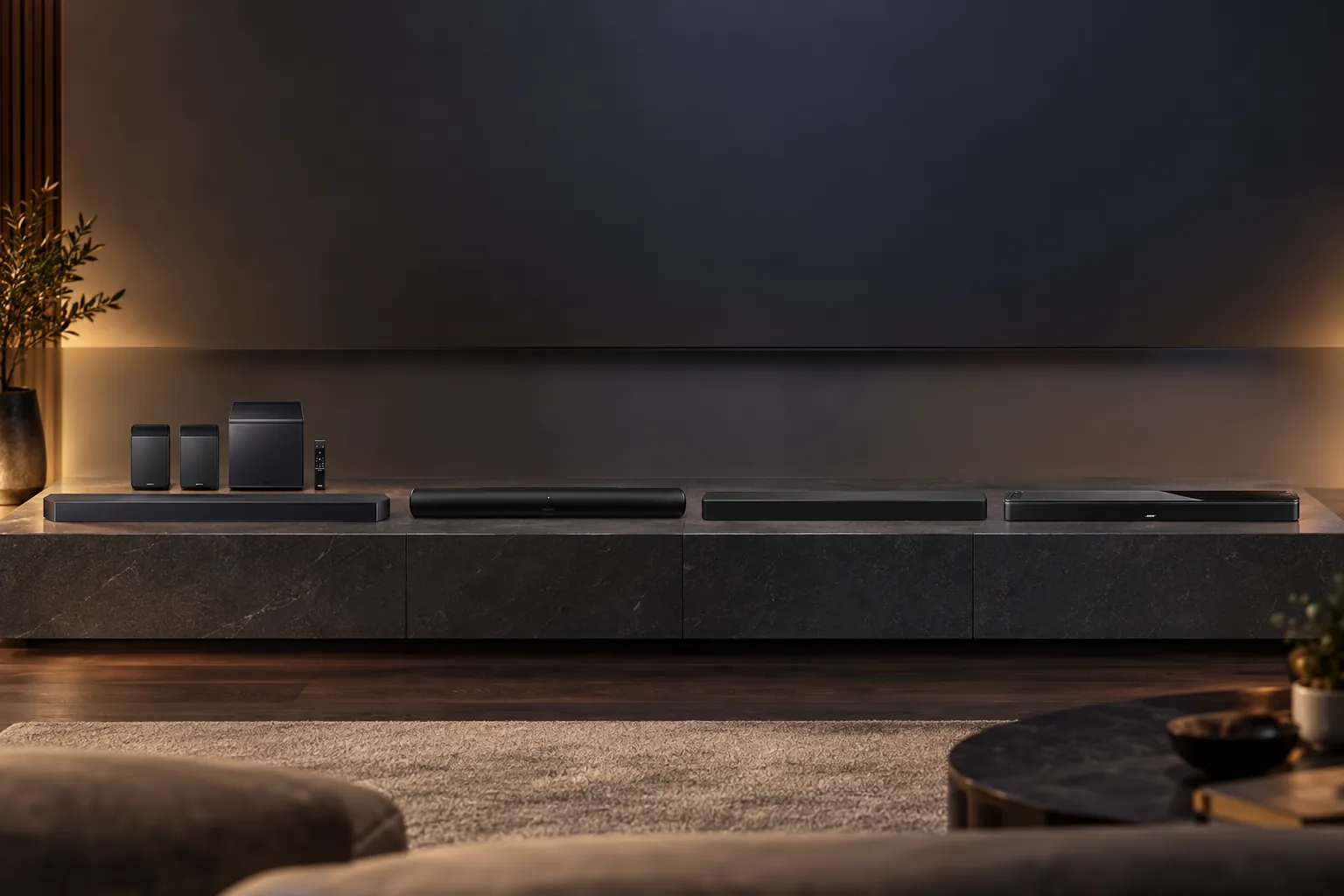


A 14-driver bar with Sound Motion bass, room tuning and a modular route into Sonos surround.
Check price on Amazon
Offers Sony TV integration, DTS:X and 4K/120Hz passthrough, with optional wireless rears and subwoofers.
Check price on Amazon
Its 1,045mm body, AI Dialogue Mode and ADAPTiQ calibration suit smaller, speech-heavy TV setups.
Check price on AmazonWe link to the exact model on Amazon UK. Prices change often, so check the live price before you buy. As an Amazon Associate we earn from qualifying purchases.
The short answer: choose Samsung HW-Q990F for a proper surround installation without separately shopping for a subwoofer and rear speakers. Choose Sonos Arc Ultra when the room must stay tidy but you still want substantial single-bar sound. Sony BRAVIA Theatre Bar 9 makes most sense for BRAVIA owners and console players planning a gradual system build. Bose Smart Ultra is the compact route for a smaller lounge where clear dialogue matters more than cinema-scale bass.
How we matched these four to your room, not the spec sheet
There is no useful single winner in this group because the central decision is physical. A soundbar can create a broad front soundstage and bounce height effects from the ceiling, but it cannot put a speaker behind your sofa unless you give it one. That distinction matters more than an impressive channel number on a product page.
Start with four questions. How large is the room? Can you position rear speakers behind or beside the seating? Does your television unlock useful brand-specific features? And do you need the soundbar to accept consoles and disc players directly rather than relying entirely on the TV's ports?
The four routes in brief
- Samsung HW-Q990F: £1,699 launch RRP for an 11.1.4-channel, 23-speaker package with a subwoofer and physical rear speakers included.
- Sonos Arc Ultra: £999 launch RRP for a 14-driver standalone bar designed to deliver more bass without immediately adding a subwoofer.
- Sony BRAVIA Theatre Bar 9: £1,399 launch RRP for a slim single bar with console-friendly HDMI passthrough and a modular Sony expansion path.
- Bose Smart Ultra: £899 launch RRP for the shortest bar here, with AI Dialogue Mode and physical upward-firing drivers.
| At a glance | Samsung HW-Q990F | Sonos Arc Ultra | Sony BRAVIA Theatre Bar 9 | Bose Smart Ultra |
|---|---|---|---|---|
| UK launch RRP | £1,699 | £999 | £1,399 | £899 |
| Channel layout | 11.1.4 | 9.1.4 spatial-audio claim | 7.0.2 | 5.1.2 |
| Speaker count | 23 | 14 drivers | 13 speaker units | 9 drivers |
| Soundbar width | 1,232mm | 1,178mm | 1,300mm | 1,045mm |
| Subwoofer and rear speakers in the box | Yes | No | No | No |
| HDMI inputs | 2 | 0 | 1 | 0 |
| DTS:X | Yes | No | Yes | No |
| Buy | Check price | Check price | Check price |
The numbers make the split clear. Samsung occupies more of your room but arrives ready to produce genuine sound behind the listener. The three standalone bars save floor space and visual clutter, but their more enveloping versions cost extra because rears and subwoofers are separate purchases.
The core trade-off: all-in-one bar or full speaker package?
Samsung is the outlier because it is a complete system: soundbar, wireless subwoofer and two wireless rear speakers form its 11.1.4-channel layout. "Wireless" means no speaker wire running from the bar to the rears, although each rear speaker and the subwoofer still needs mains power. Plan plug sockets before treating it as a cable-free installation.
Sonos, Sony and Bose instead ask you to decide how much theatre you need on day one. Sonos says Arc Ultra creates a 9.1.4 spatial-audio experience from its 14-driver cabinet; Sony's Bar 9 uses 360 Spatial Sound Mapping and beamforming; Bose uses a 5.1.2 arrangement with physical up-firing drivers and TrueSpace processing. These can all make a front room feel wider and taller than the bar itself.
That distinction changes the buying calculation. A renter who cannot route cables or put speakers on stands may get more everyday value from an Arc Ultra, Bar 9 or Smart Ultra that is easy to place beneath the television. A buyer with a stable TV wall, available sockets and a seating area that is not pressed against the rear wall can treat the Q990F as a complete system from the first film. The standalone route is not automatically cheaper over time: adding a subwoofer and rear speakers later is a deliberate convenience-and-upgrade decision rather than a shortcut to the same out-of-box package.
It is also worth deciding whether the subwoofer itself is welcome before looking at channel labels. Sonos has made Arc Ultra notably capable for a single cabinet, but LowBeats found its output below 40Hz dropped substantially. Bose, meanwhile, is often the tidiest physical choice but reviewers found it short of the weight and dynamic impact of a separate-subwoofer system. For late-night viewing, night modes and dialogue controls may matter more than maximum low-end output; for action films and gaming, the included Samsung subwoofer changes the experience more fundamentally.
But virtual surround has a limit. RTINGS reported that Arc Ultra's virtual Atmos height and surround effects could not match discrete rear speakers. Its assessment of Sony's standalone Bar 9 similarly described the simulated surround field as less dimensional than a physical-rear system. For a sofa against a wall, that compromise may be entirely reasonable. For a dedicated viewing area with space behind it, it is the reason Samsung is compelling.
Samsung HW-Q990F: the full cinema room fills in one box
The Samsung HW-Q990F/XU was Samsung's 2025 flagship and replaced the HW-Q990D. In Titan Black, it is the system to choose when the objective is not merely clearer TV sound but a home-cinema installation that does not need an accessories spreadsheet before it feels complete.

The complete system weighs 23.8kg. The 7.3kg main bar is 1,232mm wide, the compact subwoofer measures roughly 25 × 25 × 25cm and weighs 8.3kg, while each rear speaker weighs 3.4kg. Those numbers make it a better fit for a medium-to-large lounge or a room with a defined TV wall than for a narrow flat where the sofa is flush to the back wall.
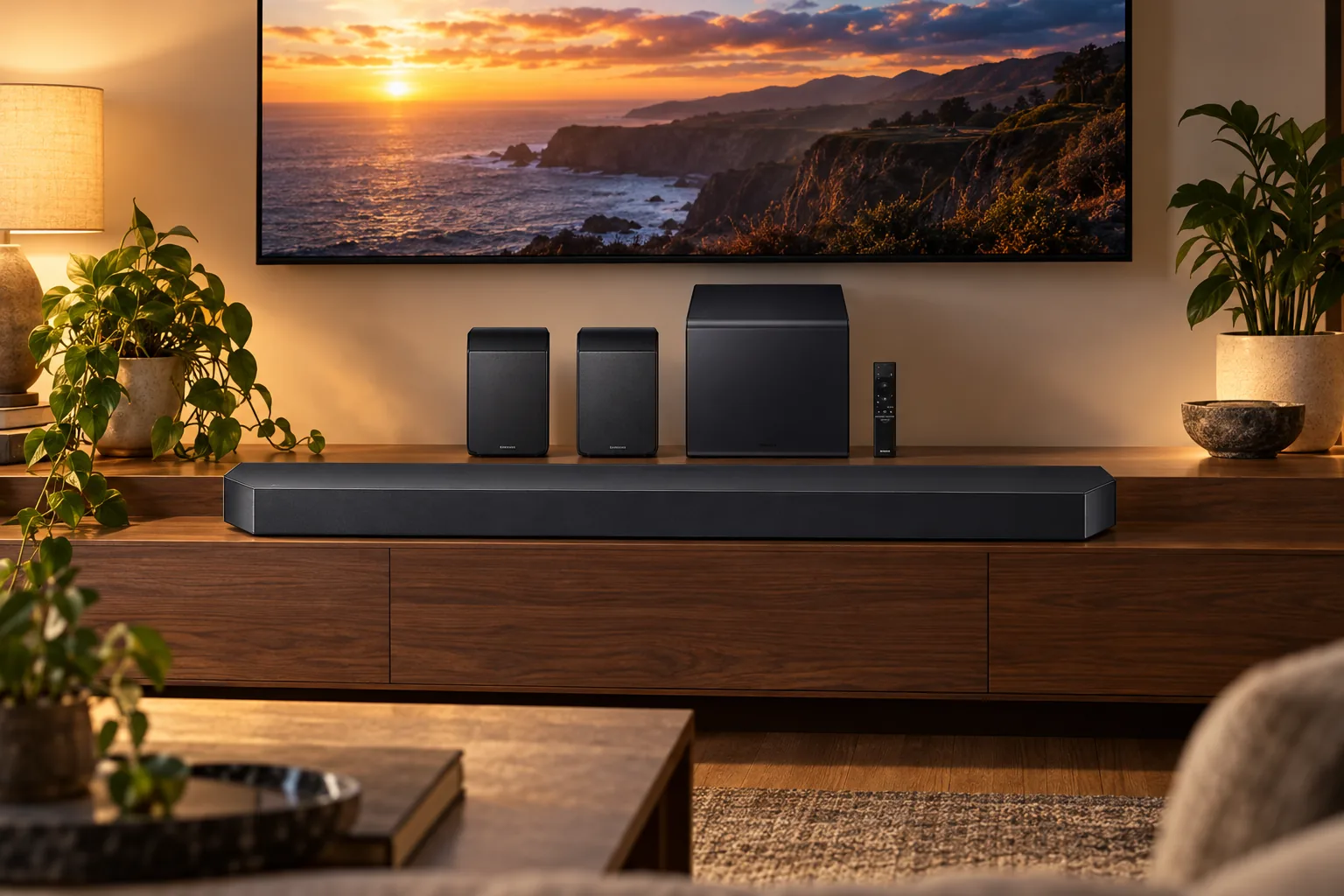
In day-to-day use, the practical task is placement rather than difficult setup. The subwoofer can be positioned away from the television furniture if that works better for the room, while the rear speakers need sensible positions relative to the main seat to earn their place. Samsung lists multi-position rear speakers and includes wall-mount brackets, which offers flexibility if shelves are unavailable. Its SpaceFit Sound Pro room correction is especially useful once the system is in place, because the layout has more separate components than the single-bar alternatives.
The Q990F also has the broadest list of listening options here. Beyond film formats, it supports Chromecast, Spotify Connect, Tidal Connect, AirPlay 2, Roon Ready, Amazon Music and Deezer, with Alexa and Works with Google support. That makes it plausible as the room's music system rather than a bar used only when the television is on. The trade-off is visual and operational: the hardware is more conspicuous than a single bar, and What Hi-Fi? criticised the small dot-matrix display, so the SmartThings app and TV on-screen feedback are likely to be more useful than reading settings on the bar itself.
Connectivity is a major practical advantage. Samsung provides two HDMI inputs, an eARC output and 4K/120Hz passthrough, alongside HDR10+ and Dolby Vision passthrough. TechRadar recorded 9.5ms of input lag while passing a 4K/120Hz Xbox Series X signal through the bar, using Battlefield V. That is valuable if a games console, streaming box and disc player would otherwise consume every suitable port on the television.
Samsung also includes SpaceFit Sound Pro room correction, Active Voice Amplifier Pro, night mode and adjustable bass. Compatible Samsung TVs add Q-Symphony, which combines the television speakers with the soundbar; TechRadar reported a wider, more forceful soundstage with that pairing. It is useful integration rather than a reason to replace a good non-Samsung TV.
Why it fits
- Physical rear speakers and a subwoofer arrive in the same package.
- Two HDMI inputs make it practical in multi-source rooms.
- Dolby Atmos, DTS:X, 4K/120Hz and broad Wi-Fi streaming support cover films, gaming and music.
- What Hi-Fi?, TechRadar and Expert Reviews praised its cohesive, dynamic Atmos presentation and controlled bass.
What to consider
- The system needs space, several mains sockets and realistic rear-speaker placement.
- What Hi-Fi? found the dot-matrix display difficult to read.
- TechRadar felt the main bar and rear speakers looked less premium than the previous Q990D.
- Adaptive mode can make some effects overly prominent, according to What Hi-Fi?.
Buy Samsung HW-Q990F if you are willing to live with additional boxes and want the payoff: effects that can travel behind you instead of merely suggesting they might. Skip it if the installation itself would be a source of daily irritation.
Sonos Arc Ultra: built for the room where rear speakers are not happening
Sonos Arc Ultra arrived in the UK on 29 October 2024 as the successor to the original Arc. It is a standalone bar, available in Black or White, and its 1,178mm width and 5.9kg weight make it broad enough for larger televisions without becoming as physically demanding as Samsung's complete system.
Its headline technology is Sound Motion: a four-motor, dual-membrane woofer intended to deliver substantially more weight from a single cabinet. Sonos combines that driver with six midwoofers, nine angled silk-dome tweeters including two upward-firing units, and 15 Class-D amplifiers. This is why Arc Ultra is a sensible first choice for renters or anyone who knows a separate subwoofer would never be welcomed into the room.
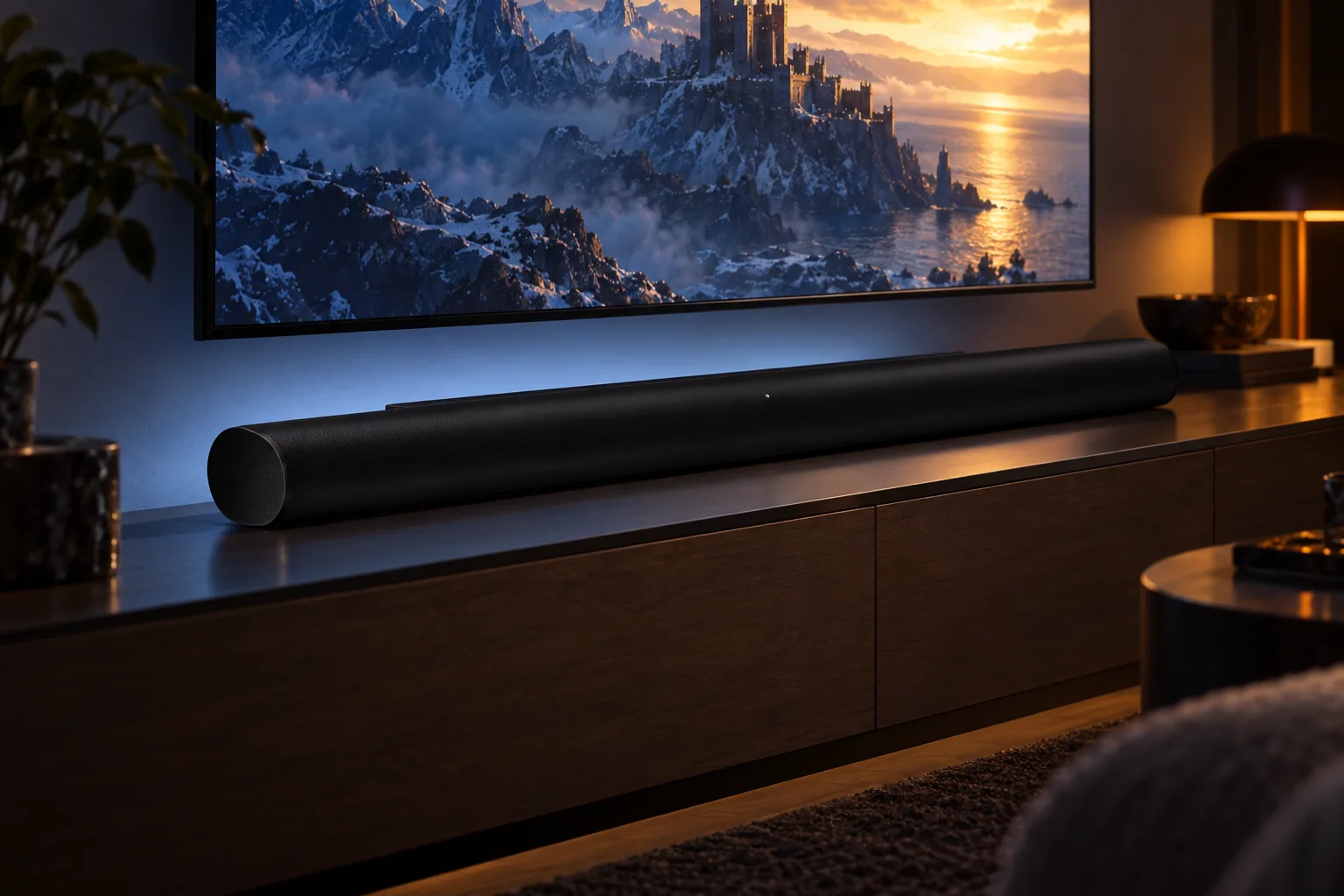
Reviewers described the result as unusually muscular for a standalone bar. TechRadar praised the dynamic range, speech clarity and height effects, while AVForums highlighted controlled bass texture and clean treble at higher volume. LowBeats measured a pronounced lift from the bass through the lower midrange, though output below 40Hz fell away; a compact bar still cannot create the lowest rumble of a dedicated subwoofer.
Format caveat: Arc Ultra supports Dolby Atmos and DTS Digital Surround, but not DTS:X. If 4K Blu-ray discs are a regular part of your setup, Samsung HW-Q990F and Sony BRAVIA Theatre Bar 9 cover more object-based soundtrack formats.
Setup is designed around one HDMI eARC or ARC connection and the Sonos app, which is a clean arrangement if the television already has enough inputs for the rest of the system. There is no HDMI passthrough to configure, but that simplicity is also the limitation: the TV must be the switching point for a console, player or streaming box. Sonos includes a 1.5m HDMI cable and a 2m power cable, while an optical adapter is separate for televisions that need it. The lack of a supplied remote means most owners will use the TV remote for television volume and the app for deeper controls.
Sonos's appeal is also the route it leaves open. You can later add a Sonos Sub or Sub 4 and Era 100 or Era 300 speakers for a larger surround system. Trueplay room tuning works on iOS and Android, while four levels of Speech Enhancement, Night Sound, AirPlay 2, Bluetooth streaming and TV Audio Swap with Sonos Ace headphones make it unusually flexible around everyday viewing.
Why it fits
- Strong bass for a single bar, without immediately sacrificing floor space to a subwoofer.
- Clear dialogue and a broad soundstage were recurring strengths in reviewer reports.
- Can grow into a Sonos surround system later.
- Quick Trueplay gives Android users a straightforward calibration option.
What to consider
- No HDMI input or video passthrough for consoles and players.
- No DTS:X support.
- Virtual rear and height effects remain less exact than physical speakers.
- What Hi-Fi? encountered app and setup glitches during its assessment.
Sony BRAVIA Theatre Bar 9: the one to buy if you'll expand later and own a BRAVIA TV
Sony BRAVIA Theatre Bar 9 is the black HT-A9000, launched in 2024 to replace the HT-A7000. It is a 1,300mm-wide standalone bar with no supplied subwoofer or rear speakers, so it begins as the cleanest-looking installation in this guide but asks for later investment if you want a full surround setup.
Inside are four front woofers, three front tweeters, two beam tweeters, side-firing drivers at each end, two upward-firing drivers and four passive radiators. Sony uses 360 Spatial Sound Mapping and room calibration to build phantom speakers around the listener. What Hi-Fi? praised its clarity, dynamics and three-dimensional processing, while RTINGS found dialogue particularly easy to follow through the dedicated centre channel.
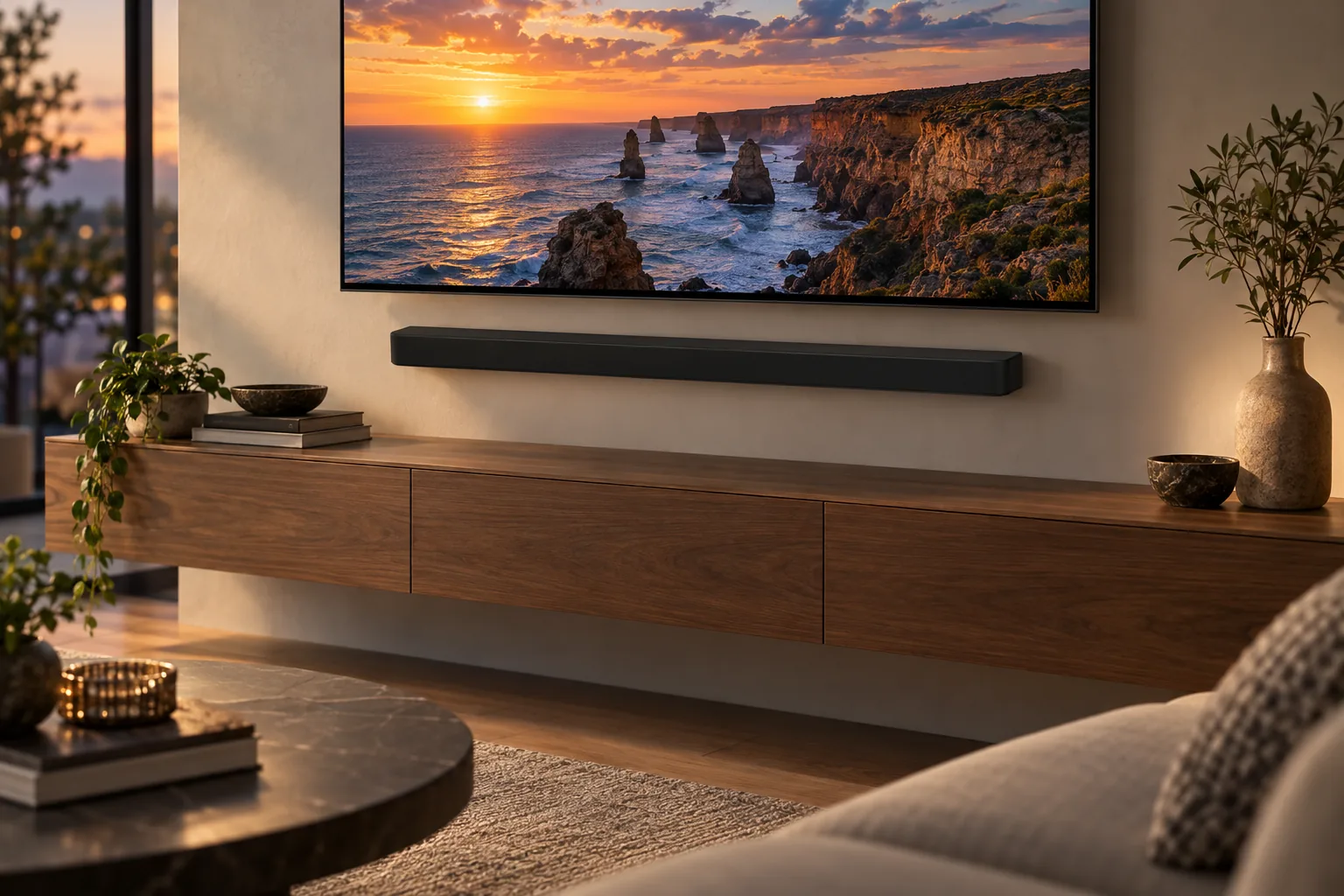
Its important distinction is HDMI flexibility. The bar has one HDMI input and one eARC output, with 4K/120Hz, Dolby Vision, VRR and ALLM passthrough. That makes it more accommodating than Sonos Arc Ultra for a directly connected PS5 or Xbox Series X. What Hi-Fi? pointed out that Sony reduced the count from two HDMI inputs on the older HT-A7000, so households with multiple source boxes may still prefer Samsung's two-input approach.
For a buyer planning in stages, Sony's optional range is the point. The Bar 9 can later work with BRAVIA Theatre Sub 7, Sub 8 or Sub 9, SA-SW3 or SA-SW5 subwoofers, plus several compatible wireless rear options. That makes the initial purchase less cluttered, but it means judging the standalone bar honestly: RTINGS found limited low bass and uneven simulated surround without those additions. Choose this route if a tidy first installation matters now and the prospect of adding components later is realistic, not merely theoretical.
BRAVIA ownership matters here. Acoustic Center Sync can use a compatible Sony television as part of the centre-channel presentation, while Voice Zoom 3 is intended to make dialogue easier to follow. The BRAVIA Connect app provides access to room optimisation, bass, voice mode, night mode and sound-field controls without hunting through a tiny display.
Why it fits
- Strong integration with compatible BRAVIA televisions.
- DTS:X, IMAX Enhanced and 4K/120Hz console passthrough add useful format coverage.
- Optional Sony subwoofers and rear speakers provide a clear upgrade route.
- Its 64mm height can suit installations where screen clearance is tight.
What to consider
- No subwoofer or physical rears are included.
- RTINGS described the standalone surround field as uneven and less dimensional than physical-rear systems.
- RTINGS also reported high HDMI latency.
- What Hi-Fi? found the presentation slightly clinical and missed a front display.
Bose Smart Ultra: the compact pick for smaller living rooms
Bose Smart Ultra is the shortest bar in this group at 1,045mm wide. Bose introduced it in the UK, going on sale on 10 October 2023, as the successor to the Smart Soundbar 900, and it is a useful fit when a 1.2m or 1.3m soundbar would dominate the TV furniture or visibly overhang a modest screen.
The 5.1.2 layout combines three tweeters and six woofers or full-range drivers. Crucially, Bose uses physical upward-firing drivers rather than relying entirely on processing for height. It also includes HDMI eARC, optical input, Ethernet, Wi-Fi, Bluetooth 5.0, Alexa and the supplied ADAPTiQ calibration headset.
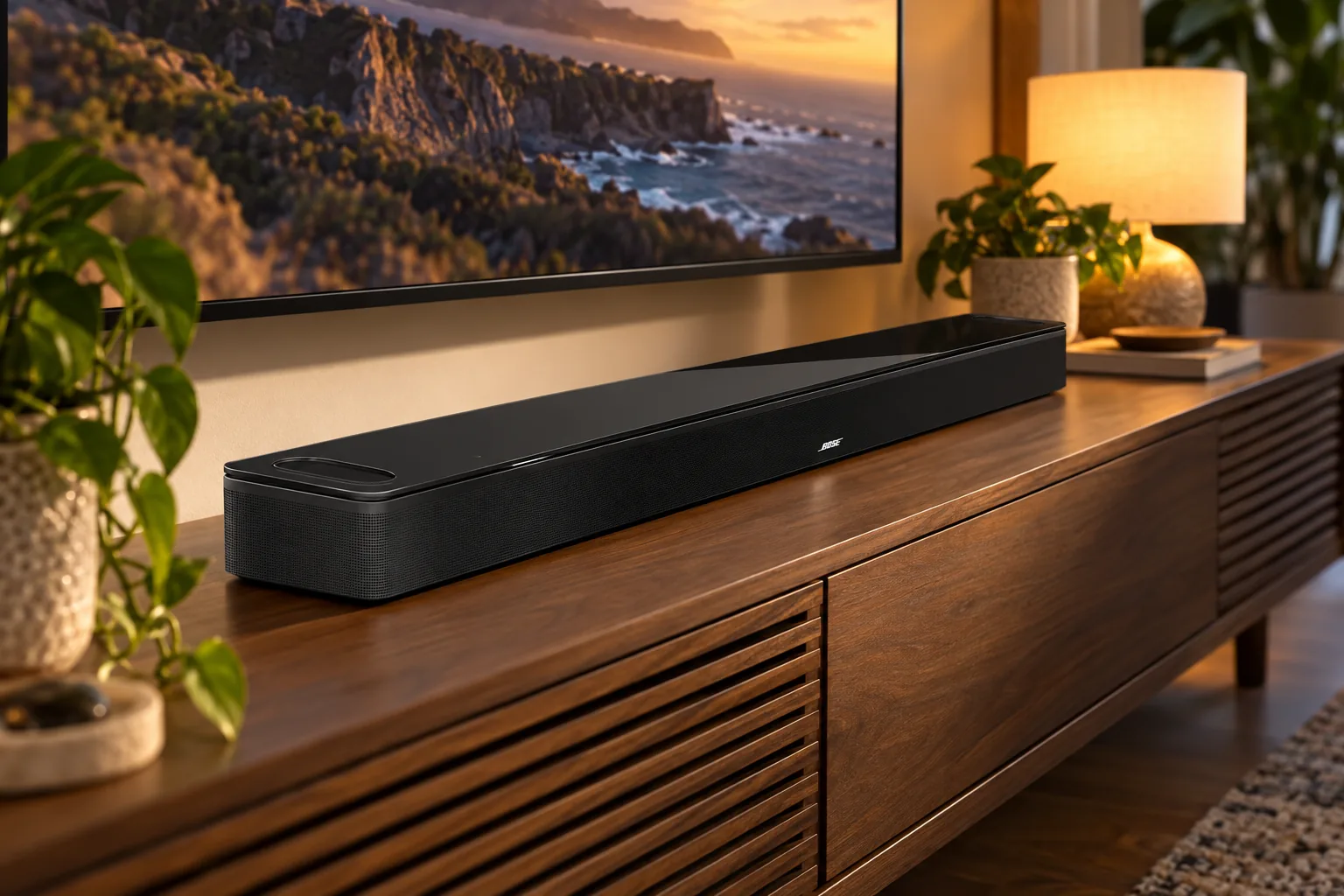
Dialogue is the sensible reason to choose it. Bose's AI Dialogue Mode is intended to lift vocals, and TechRadar praised the explicit speech and wide soundstage. What Hi-Fi? also liked the solid construction and straightforward Bose Music app. TechRadar suggested the width is a sensible match from around a 48-inch TV upward, useful guidance when proportion matters as much as raw scale.
It is the least demanding option to introduce into an existing television setup because Bose supplies both HDMI eARC and optical cables, a remote and the calibration headset. ADAPTiQ is a more involved process than simply placing a bar and pressing play, but it is intended to tailor the sound to the room rather than asking the owner to guess at settings. The bar also has Ethernet as well as Wi-Fi, useful where wireless coverage around the television is unreliable. Its reflective glass top is premium-looking, though TechRadar flagged it as a design drawback in everyday use.
The limits are equally clear. TechRadar found low-end punch and height effects modest, while What Hi-Fi? reported compressed dynamics in loud passages. Expert Reviews also found stereo and non-spatial material less persuasive than the strongest alternatives. Bose offers optional bass modules and surround speakers, but the bar's appeal is primarily a discreet, polished one-box TV upgrade rather than an instant cinema system.
Match the bar to the room: what the comparison actually means
For a larger room, width alone does not tell the whole story, but it is a useful installation check. Sony BRAVIA Theatre Bar 9 is the widest single bar at 1,300mm, Samsung HW-Q990F measures 1,232mm, Sonos Arc Ultra 1,178mm and Bose Smart Ultra 1,045mm. Measure the shelf, TV feet and any wall-mounted screen clearance before buying.
Height and depth deserve the same check. Sony is only 64mm high, Bose 58mm, Sonos 75mm and Samsung 70.8mm, but their depths range from Bose's 107mm to Samsung's 138mm. A bar that fits within the width of a cabinet can still project too far forward, and one placed directly below a television must not obscure the lower part of the screen or an IR receiver. Wall mounting can solve that, but it turns a simple purchase into a more permanent installation decision.
For impact, speaker position is more revealing than speaker count. Samsung's 23 speakers are distributed across the bar, subwoofer and two rear enclosures. Sonos's 14 drivers, Sony's 13 units and Bose's nine drivers must all create their surround impression from the front of the room until optional speakers are added.
Published listening assessments are more useful here than trying to compare headline wattage. What Hi-Fi?, TechRadar, RTINGS and other reviewers used different rooms and methods, so this guide focuses on verified dimensions, formats, connections and reported listening behaviour rather than pretending that one loudness figure settles every room.
Ecosystem lock-in: does your TV brand actually matter here?
Samsung TV owners
HW-Q990F supports Q-Symphony with compatible Samsung televisions. TechRadar reported that the combined TV-and-soundbar presentation widened the soundstage and increased impact.
Sony BRAVIA owners
BRAVIA Theatre Bar 9 supports Acoustic Center Sync and Voice Zoom 3 with compatible BRAVIA TVs, adding useful dialogue and centre-channel options.
Sonos households
Arc Ultra slots into Sonos multi-room audio and can later pair with Sub, Sub 4, Era 100 or Era 300 speakers. Sonos Ace headphones add TV Audio Swap.
Bose households
Smart Ultra works with Bose's app and supports Personal Surround when paired with compatible Bose Ultra Open Earbuds.
A brand-matched TV is a bonus, not a requirement. Sonos and Bose are deliberately television-agnostic. Still, if you already own a compatible Samsung or Sony display, their respective integrations can make those choices more attractive than a paper specification suggests.
Gaming and multi-source rooms: where HDMI passthrough decides it
A single HDMI eARC connection is enough for a simple TV-and-streaming setup. It becomes restrictive once you add a console, 4K Blu-ray player, satellite box or external streamer, particularly if the TV has only two high-bandwidth HDMI sockets and one is needed for eARC.
Samsung is the straightforward recommendation for a console-heavy room. Sony remains useful if one console is your priority and the BRAVIA features appeal, though RTINGS described HDMI latency as high. Sonos and Bose work cleanly with a capable television, but neither can act as the switcher between your sources and screen.
Who should buy which soundbar
Samsung HW-Q990F
Choose it for a large lounge or dedicated viewing room, especially if you can place rear speakers properly and want a subwoofer, surround speakers and strong HDMI provision in one purchase.
Sonos Arc Ultra
Choose it for a tidy, rear-speaker-free room where you still want fuller bass, detailed dialogue and an option to build a Sonos surround system gradually.
Sony BRAVIA Theatre Bar 9
Choose it if you own a compatible BRAVIA TV, play on one main console and expect to add Sony rears or a subwoofer later rather than immediately.
Bose Smart Ultra
Choose it for a smaller living room, a TV around 48 inches or above, and viewing dominated by speech-heavy programmes rather than bass-heavy blockbusters.
Common questions before you buy
No: all four can decode or process Dolby Atmos material in their supported formats. But rear speakers are the practical route to more precise sound behind the seating position. Samsung HW-Q990F includes them; Sonos Arc Ultra, Sony BRAVIA Theatre Bar 9 and Bose Smart Ultra rely on front-mounted drivers and processing until you add optional speakers.
Samsung HW-Q990F is the most flexible with two HDMI inputs and 4K/120Hz passthrough. Sony BRAVIA Theatre Bar 9 has one HDMI input with 4K/120Hz, VRR and ALLM support. Sonos Arc Ultra and Bose Smart Ultra require the console to connect to the television directly.
Dolby Atmos is more common across major streaming services, so DTS:X is less important for a streaming-only household. It becomes more relevant with 4K Blu-ray and some non-Dolby releases. Samsung HW-Q990F and Sony BRAVIA Theatre Bar 9 support DTS:X; Sonos Arc Ultra and Bose Smart Ultra do not.
For many living rooms, yes: these systems simplify the setup considerably. But if you have room for widely spaced speakers, a large subwoofer and speaker cable runs, a conventional separates system still allows more exact speaker placement. The Samsung comes closest to that cinema-style experience because its rears and subwoofer are already part of the package.
Bose Smart Ultra is the most compact one-box choice and includes a remote, HDMI eARC cable, optical cable and ADAPTiQ headset. Sonos Arc Ultra is also physically simple, but depends more on the app for setup and deeper control. Samsung asks more of the room because of its separate components, yet rewards that effort with the most complete package. Sony sits between those approaches: one bar first, with optional upgrades later.
The decisive verdict
We recommend Samsung HW-Q990F for buyers who can accommodate the boxes because it combines physical surround, a subwoofer and unusually useful HDMI connectivity from the start. Sonos Arc Ultra is the more elegant answer for rooms where rear speakers are simply off the table. Sony BRAVIA Theatre Bar 9 earns its place through BRAVIA integration and console passthrough, whilst Bose Smart Ultra is the compact, dialogue-led choice when scale would be a nuisance rather than a benefit.
- Sonos Arc UltraTidy single-bar choiceView on Amazon
- Sony BRAVIA Theatre Bar 9BRAVIA upgrade pathView on Amazon
- Bose Smart UltraCompact dialogue pickView on Amazon
Sources and evidence (43)
- news.samsung.com (other)
- samsung.com (other)
- techradar.com (other)
- whathifi.com (other)
- rtings.com (other)
- expertreviews.co.uk (other)
- news.samsung.com (other)
- news.samsung.com (other)
- tomsguide.com (other)
- rtings.com (other)
- assets.sonos.com (other)
- sonos.com (other)
- whathifi.com (other)
- lowbeats.de (other)
- test.de (other)
- techradar.com (other)
- wired.com (other)
- avforums.com (other)
- sonos.com (other)
- sony.co.uk (other)
- rtings.com (other)
- whathifi.com (other)
- sony.co.uk (other)
- sony.co.uk (other)
- frandroid.com (other)
- avforums.com (other)
- support.bose.co.uk (other)
- assets.bose.com (other)
- techradar.com (other)
- whathifi.com (other)
- expertreviews.co.uk (other)
- rtings.com (other)
- bose.co.uk (other)
- assets.bose.com (other)
- cdn.sennheiser-hearing.com (other)
- news.samsung.com (other)
- images.samsung.com (other)
- newsroom.sonos.com (other)
- sonos.com (other)
- sony.mediaroom.com (other)
- electronics.sony.com (other)
- bose.com (other)
- whathifi.com (other)