Best camera drones for UK buyers: which one should you fly home?
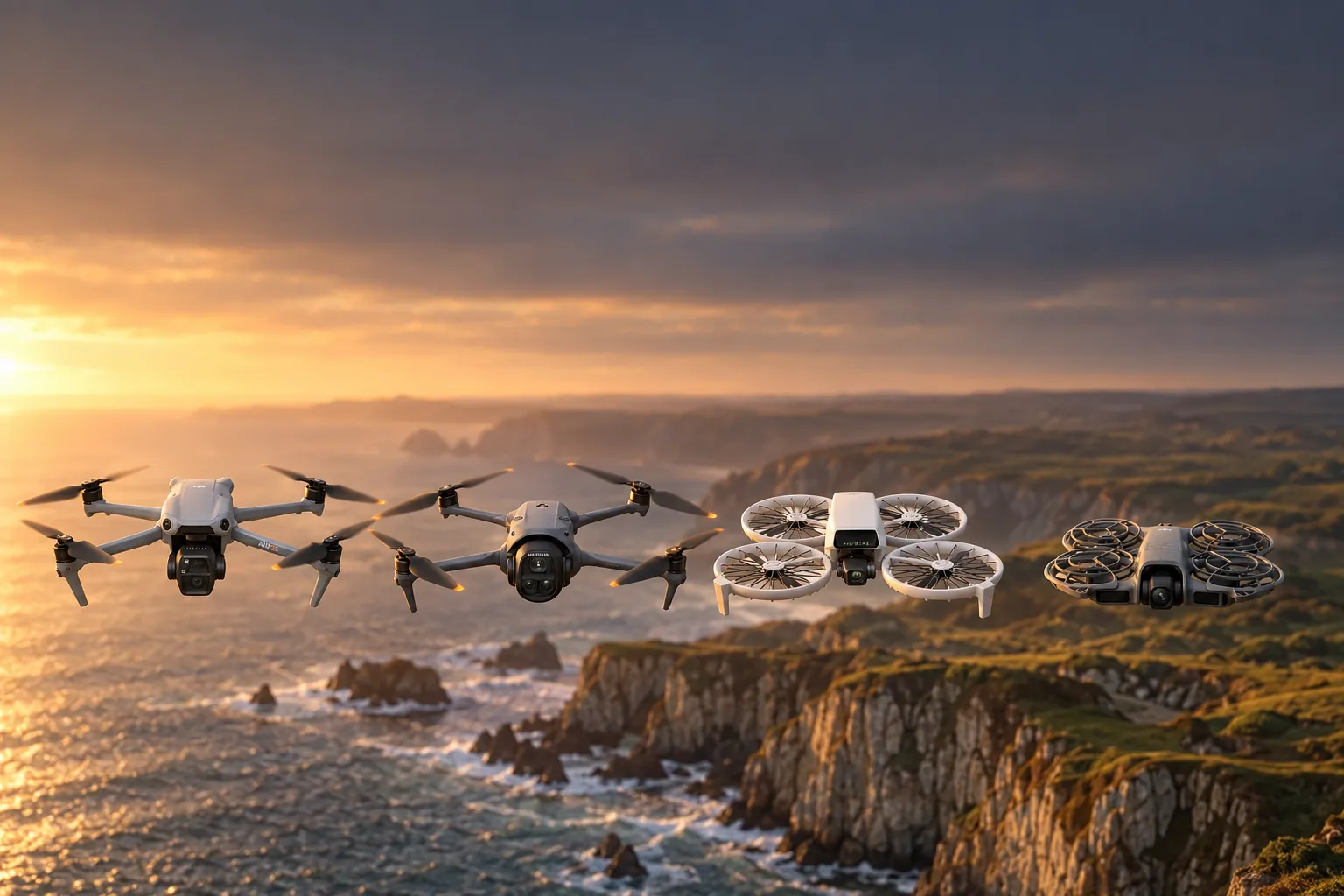
Five DJI drones, five very different reasons to take to the air: from a palm-launched follow camera to a triple-camera aerial platform and a goggles-first FPV machine.


Dual cameras, a 1-inch wide sensor and three-battery RC 2 bundle suit ambitious travel and landscape filming.
Check price on Amazon
Three focal lengths, 6K HDR and an Infinity Gimbal justify its size for demanding video work.
Check price on Amazon
Integrated folding propeller guards, 48MP photos and RC 2 control make conventional flying less intimidating.
Check price on Amazon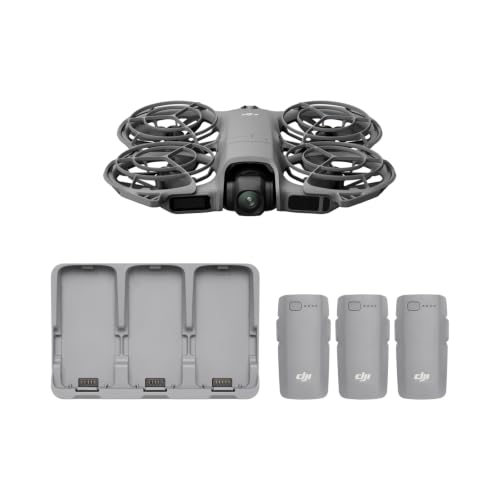
Palm launch, gestures and ActiveTrack make quick cycling, walking and family clips unusually straightforward.
Check price on Amazon
Goggles 3, motion control and a 155-degree camera create a dynamic first-person flying experience.
Check price on AmazonWe link to the exact model on Amazon UK. Prices change often, so check the live price before you buy. As an Amazon Associate we earn from qualifying purchases.
The decision usually happens before take-off. You might want a tiny drone for a weekend walk, a safer way to film a child on a bike, a serious tool for landscape work, or the stomach-dropping perspective of flying through goggles. The wrong purchase is not necessarily a poor drone; it is a drone built for a different kind of flying.
The short answer: we recommend the DJI Air 3S for enthusiasts wanting two useful focal lengths and a capable screen-controller bundle without Mavic-level cost. Choose the DJI Mavic 4 Pro when three cameras, 6K capture and a rotating gimbal justify the larger spend and heavier aircraft. The DJI Flip makes more sense for a protected, sub-249g first camera drone; the DJI Neo 2 is the grab-and-go follow-me option; and the DJI Avata 2 is for people who want to fly from inside the shot rather than compose conventional aerial scenes.
How to Choose: Weight Class, Wallet and What You'll Actually Film
These five contenders should not be treated as a straight ladder. The Flip and Neo 2 occupy the lightest end of the line-up, but they answer different questions: Flip is a conventional camera drone with a proper three-axis gimbal and a screen remote, whilst Neo 2 prioritises palm launch, gestures and automated following.
Air 3S and Mavic 4 Pro are serious aerial imaging platforms. Their larger bodies handle wind more confidently than the smallest aircraft, carry more ambitious camera systems and include Fly More bundles with three batteries. They also bring more UK flying administration and more reasons to plan a location carefully. Avata 2 is a separate proposition altogether: it comes with goggles and a motion controller, putting the pilot in a first-person view rather than behind a conventional live-view screen.
Start with the flight you will repeat
Buy for the footage you will make every month, not the one ambitious sequence you might attempt once. A runner wanting brief, automatic clips needs a different drone from a property videographer who will repeatedly use a 70mm or 168mm perspective.
There is also a practical setup distinction. The Air 3S, Mavic 4 Pro and Flip listings here include DJI RC 2, so their 5.5-inch, 700-nit screen removes the need to mount and rely on a phone for the live view. Neo 2's Drone Only Fly More package takes the opposite approach: its value lies in immediate palm, gesture, phone-app and optional-controller use, but a conventional controller is not in the box. Avata 2 is more complete for FPV because its three-battery bundle includes both Goggles 3 and RC Motion 3. In other words, compare the complete package you will actually take out, not just the aircraft.
| Model | Weight | Camera arrangement | Official maximum flight time | Bundle identity |
|---|---|---|---|---|
| DJI Mavic 4 Pro | Approx. 1,063g | 28mm 4/3 wide, 70mm medium tele, 168mm tele | 51 minutes | Fly More Combo with DJI RC 2; three batteries |
| DJI Air 3S | 724g | 24mm 1-inch wide, 70mm medium tele | 45 minutes | Fly More Combo with DJI RC 2; three batteries |
| DJI Flip | Under 249g | 24mm-equivalent 1/1.3-inch camera | 31 minutes | DJI RC 2 package; one battery |
| DJI Neo 2 | Approx. 151g; approx. 160g with Digital Transceiver | 12MP 1/2-inch camera | Approx. 19 minutes | Fly More Combo, Drone Only; three batteries |
| DJI Avata 2 | Approx. 377g | 12MP 1/1.3-inch, 155-degree camera | Approx. 23 minutes | Fly More Combo; Goggles 3, RC Motion 3 and three batteries |
The launch RRP spread illustrated the separation clearly: DJI Neo 2 Fly More Combo (Drone Only) launched at £289, DJI Flip with RC 2 at £549, Air 3S Fly More Combo with RC 2 at £1,439, and Mavic 4 Pro Fly More Combo with RC 2 at £2,459. The Avata 2 three-battery Fly More Combo launched at £1,049. Current retailer prices move, so treat those as product-positioning context rather than a promise of today's checkout total.
DJI Mavic 4 Pro: The Tri-Camera Flagship for Buyers Who Need Every Focal Length
DJI Mavic 4 Pro is the large, serious option in this guide. The Amazon UK configuration is the Fly More Combo with DJI RC 2: it carries the standard 64GB aircraft rather than the 512GB version included with the Creator Combo, and it replaced the Mavic 3 Pro when it launched in the UK on 13 May 2025.
Its appeal is not simply resolution. The three-camera arrangement gives a filmmaker a 28mm-equivalent wide view, a 70mm medium tele and a 168mm telephoto without changing aircraft. That matters when a landscape needs compressed layers, a property needs a tighter exterior detail, or a person cannot safely be approached more closely.
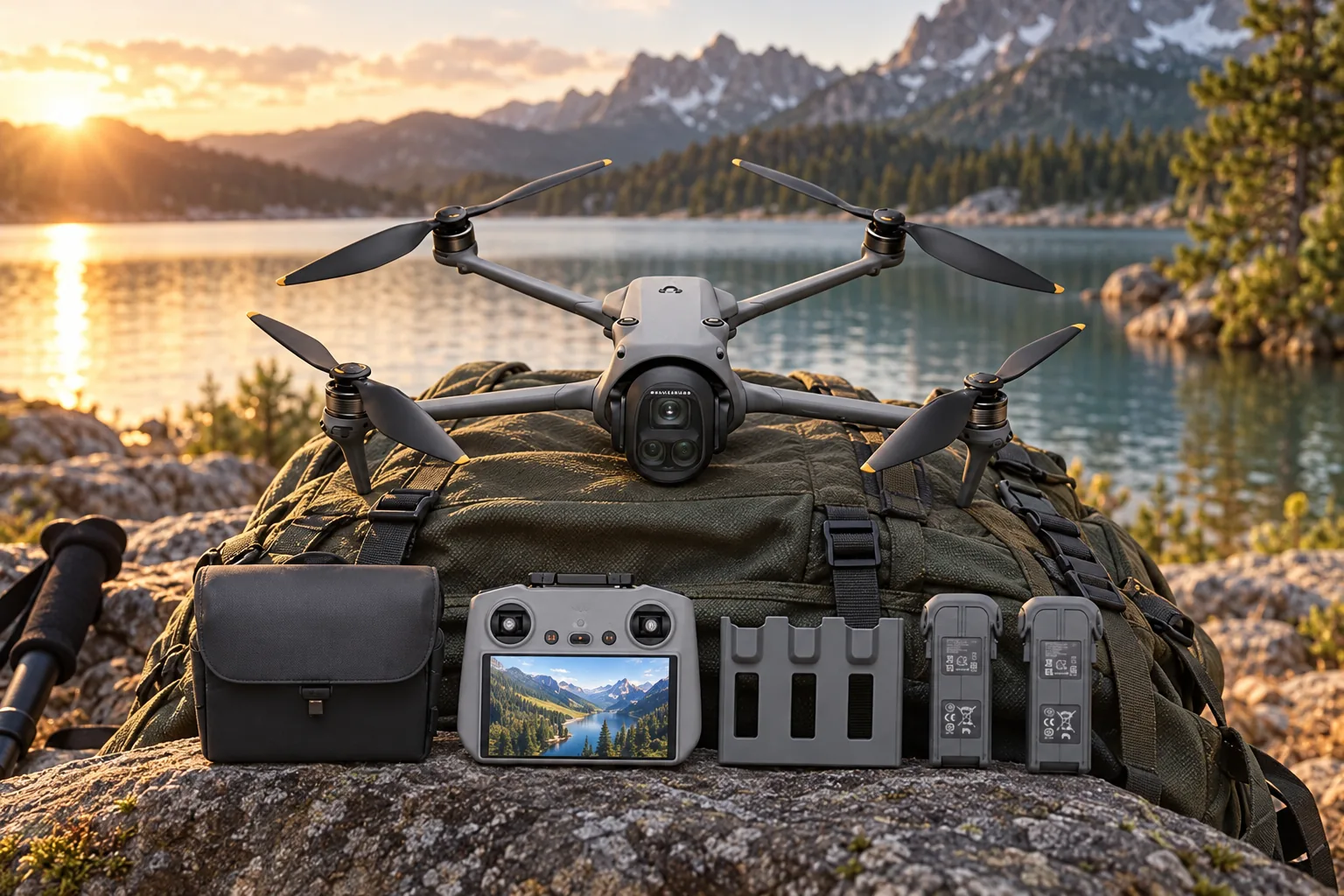
The 28mm camera uses a 4/3 CMOS sensor, can shoot up to 100MP stills and has an adjustable f/2 to f/11 aperture. The 70mm camera uses a 1/1.3-inch sensor with up to 48MP, while the 168mm camera uses a 1/1.5-inch sensor with up to 50MP. Video ceilings are 6K/60fps HDR from the main camera, 4K/120fps from the medium tele and 4K/100fps from the telephoto, with Normal, HLG, D-Log and D-Log M profiles available.
The Infinity Gimbal is the creative distinction. It rotates through 360 degrees and enables portrait shooting from the multi-camera gimbal, rather than relying solely on a cropped landscape frame. Amateur Photographer highlighted this as a genuinely useful capability on a large drone, and TechRadar praised the overall three-camera system and smooth flight behaviour.
DJI specified 51 minutes of maximum flight time, but TechRadar's James Abbott reported around 37 minutes per battery in practical flying, with Return to Home requested at 15 per cent. That is still a substantial working flight, particularly because this bundle includes three batteries and a parallel charging hub.
For day-to-day use, the distinction between this standard-storage Fly More aircraft and the Creator Combo matters. The supplied model has 64GB internal storage plus microSD expansion and does not support the Creator Combo's ALL-I encoding. Buyers who primarily record to a microSD card, work in D-Log or D-Log M and value extra batteries should not assume they need the £3,209 Creator package. Conversely, those comparing screen quality should remember that this bundle's RC 2 is rated at 700 nits; the brighter 2,000-nit RC Pro 2 belongs to the more expensive Creator configuration, not this Amazon listing.
Why it earns the spend
- Three genuinely different focal lengths make it a flexible aerial camera system.
- The main camera combines a 4/3 sensor, adjustable aperture and 6K/60fps HDR.
- LiDAR-assisted omnidirectional sensing operates down to 0.1 lux according to DJI.
The honest catch
- At roughly 1kg, it is not a casual pocket or daypack drone.
- TechRadar reported that 100MP files were not always sharper than lower-resolution captures.
- The supplied RC 2's 700-nit display is less bright than the Creator Combo's RC Pro 2.
This is the right choice for a professional or committed enthusiast who will exploit the telephoto cameras, log workflows and portrait gimbal. It is excessive for someone whose priority is an effortless holiday clip or a few automated follow shots.
DJI Air 3S: The Sensible Enthusiast's Dual-Camera All-Rounder
DJI Air 3S is the middle ground that makes the most sense for many ambitious hobbyists. This exact version is the Fly More Combo with DJI RC 2, not the phone-dependent RC-N3 bundle. It launched on 15 October 2024 as the replacement for DJI Air 3.
The wide camera has a 1-inch, 50MP sensor behind a 24mm-equivalent f/1.8 lens. Alongside it sits a 70mm-equivalent f/2.8 medium tele camera with a 1/1.3-inch, 48MP sensor. That two-camera approach does not match the Mavic's reach, but the 70mm view is a meaningful creative tool rather than a token zoom.
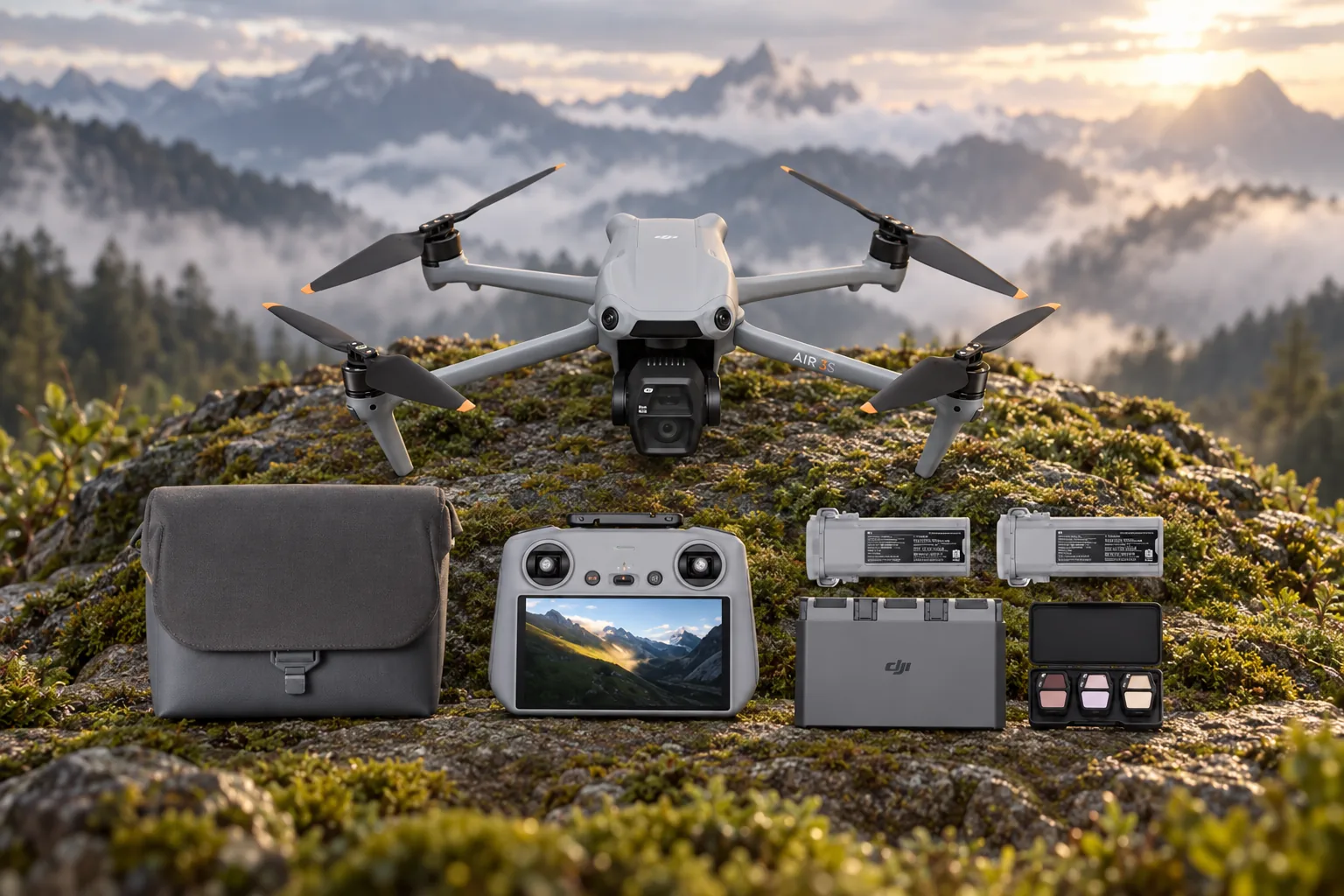
Both cameras support 4K recording, while 10-bit D-Log M and HLG offer more room for editing. The package adds a screen-equipped RC 2 controller, three batteries, a charging hub, ND filters and a shoulder bag. That is a material difference from buying a single-battery drone and discovering later that a short outing needs more power.
DJI gave Air 3S a 45-minute maximum flight-time figure. Engadget reported around 38 minutes in working conditions, WIRED reported more than 40 minutes from a fully charged battery, and Tom's Guide reported roughly 45 minutes. Expect recording, wind and assertive manoeuvres to determine where a real flight falls within that range.
| Decision point | DJI Air 3S | DJI Mavic 4 Pro |
|---|---|---|
| Camera views | 24mm wide and 70mm medium tele | 28mm wide, 70mm medium tele and 168mm tele |
| Wide sensor | 1-inch, 50MP | 4/3, up to 100MP |
| Claimed flight time | 45 minutes | 51 minutes |
| Weight | 724g | Approx. 1,063g |
| Bundle batteries | Three | Three |
| Buy | Check price | Check price |
Forward-facing LiDAR, omnidirectional binocular vision and a downward infrared sensor support its safety system. Reviewers praised its low-light image quality and responsive RC 2 experience, but Engadget reported that small obstacles could still be missed and that the LiDAR improvement is principally forward-facing at night. It remains a pilot aid, not permission to fly close to branches or buildings.
The Air 3S is particularly persuasive if your usual edit benefits from changing framing rather than chasing headline resolution. Use the 24mm camera for broad establishing shots, then switch to the 70mm camera when you want a more compressed landscape, a tighter property detail or separation from a subject without bringing the aircraft nearer. The trade-off against Mavic 4 Pro is clear: there is no 168mm option, no adjustable aperture and no 6K capture, but the Air saves both money and carrying bulk. The included ND filter set is useful because both Air cameras have fixed apertures, a limitation noted by WIRED and Stuff for daylight video work.
Choose Air 3S if you want substantial image quality and dual-camera composition in a more manageable financial tier than Mavic 4 Pro. Skip it if you need an adjustable aperture, 5.7K or 6K capture, or the simplest lightweight UK ownership experience.
DJI Flip: Guarded Propellers for Buyers Who Don't Trust Themselves Yet
DJI Flip is not merely a Mini-style drone with guards attached. Its foldable, full-coverage propeller guard is built into the design and folds with the aircraft. That makes it much less intimidating around a family garden, during close-range filming, or when launching from a palm.
The Amazon configuration is the standard DJI RC 2 package launched on 14 January 2025. It includes one battery, the screen controller, spare propellers, gimbal protector, USB-C cable and screwdriver; it is not the Fly More Combo.
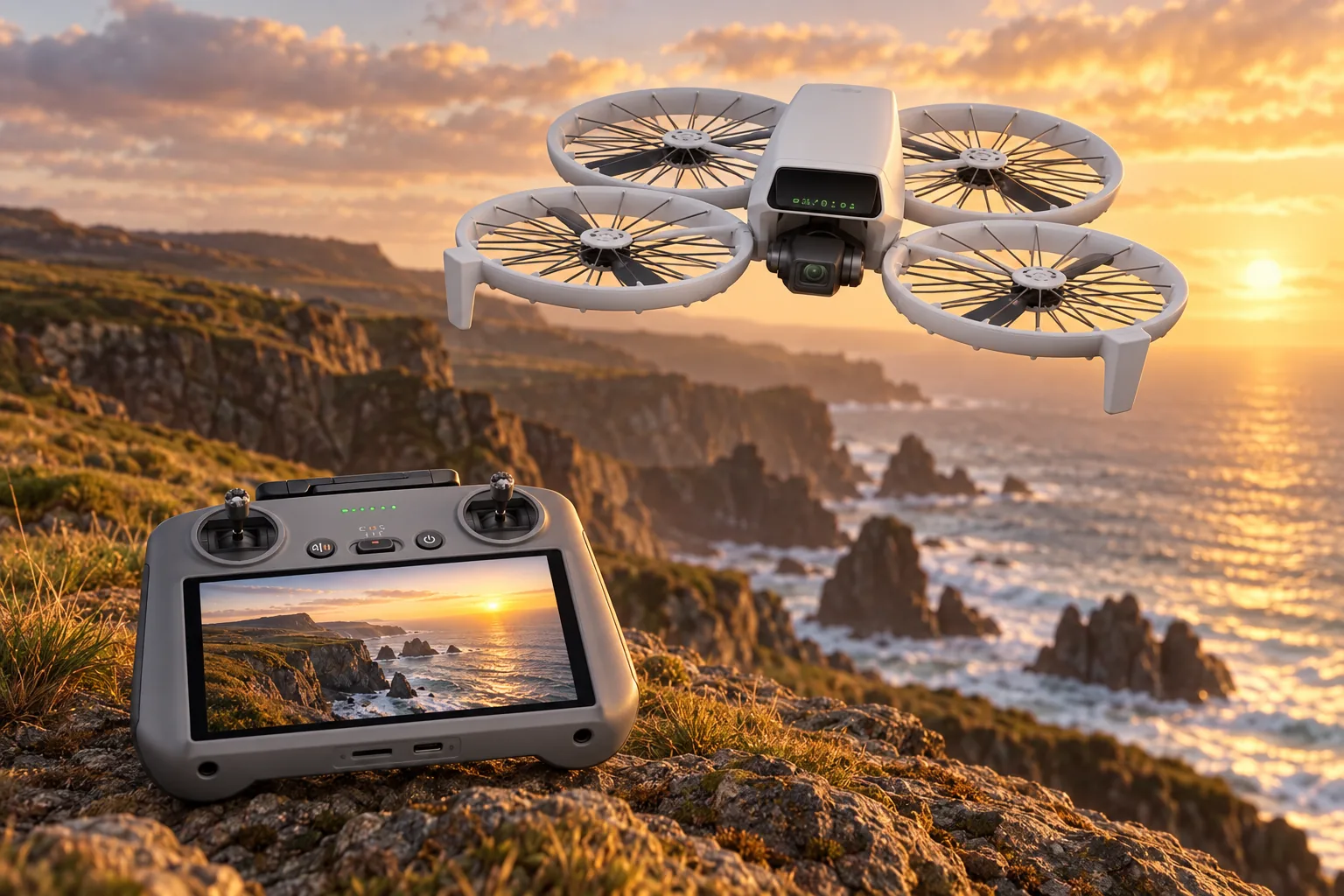
The 24mm-equivalent f/1.7 camera sits on a three-axis mechanical gimbal and shoots 4K at up to 100fps, with 10-bit D-Log M available. That is a notably more photography-oriented tool than Neo 2, although native vertical capture tops out at 2.7K rather than 4K.
Flip has forward 3D infrared sensing plus downward visual and infrared sensors. It does not have omnidirectional obstacle avoidance, and DJI states that intelligent tracking functions do not support obstacle avoidance.
Tom's Guide reported 31 minutes of flight while recording 4K/30fps in moderately windy conditions. TechRadar recorded around 27mph in Sport mode and found a moderate headwind could severely reduce forward speed. WIRED also found it less stable in wind than DJI Mini 4 Pro and louder in flight, so the guards buy confidence but not immunity from the weather.
The main buying caveat is endurance planning. One battery is enough to learn controls, capture a short family clip or decide whether drone flying suits you, but it is restrictive for a day out when real conditions or repeated takes reduce available time. DJI's separate Fly More Combo adds two batteries, a charging hub and carrying bag, and WIRED considered that package good value for frequent users. If you will mostly fly in sheltered places and want a screen-equipped controller from the outset, this RC 2 package remains compelling; if you expect regular filming sessions, compare the full bundle cost before buying accessories individually.
Choose Flip for a protected first camera drone that still gives you 48MP images, a proper controller and a three-axis gimbal. It is less suited to exposed coastal viewpoints, regular strong wind or any job where all-direction collision sensing is essential.
DJI Neo 2: The Controller-Free Follow-Me Drone That Fits in a Coat Pocket
DJI Neo 2 is the least conventional camera drone here. It was launched in the UK on 13 November 2025 as the successor to the original Neo, and this Fly More Combo is the Drone Only package. It includes three batteries and a two-way charging hub, but not a traditional remote controller.
That is deliberate rather than a compromise. Neo 2 can take off and land from your palm, respond to gestures, take voice control through a phone and fly through the DJI Fly app. It is designed for somebody who wants a quick cycling, walking or family clip without unpacking a controller and planning a conventional camera-drone mission.
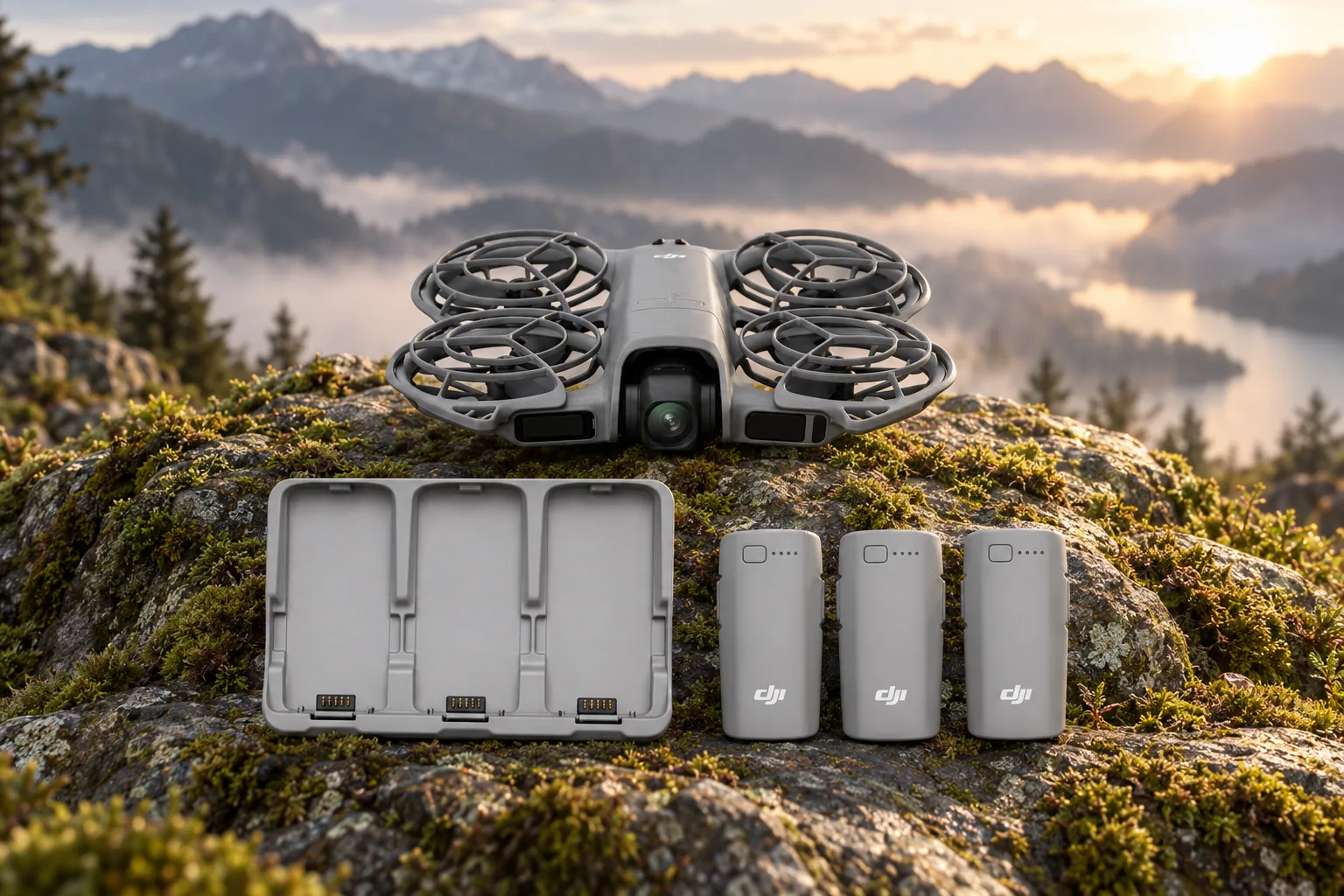
The second-generation upgrade that matters most is its sensing system: omnidirectional visual sensing, forward LiDAR and downward infrared sensing. Tom's Guide reported that it navigated around trees and branches, while TechRadar praised the obstacle-sensing improvement over the original Neo. ActiveTrack supports eight-direction tracking and includes a Cycling Follow mode.
Those figures make the three-battery package particularly sensible. TechRadar's roughly 10-minute result is a stark reminder that small tracking drones burn through a battery quickly, while Oscar Liang's 13 to 15 minutes included the added weight of the Digital Transceiver. The hub can charge three batteries in approximately 68 minutes with a 65W charger.
Its 49GB internal storage is generous for a drone this small, but there is no microSD slot. Camera quality and two-axis stabilisation are also more limited than Flip's three-axis, 1/1.3-inch setup. Choose Neo 2 for low-friction follow footage; do not choose it as a substitute for a long-duration landscape or stills platform.
Before checkout, distinguish between controller-free convenience and long-range conventional operation. The Digital Transceiver is required for O4 communication with compatible DJI controllers or goggles, while Wi-Fi operation is quoted at up to 500m. The accessible Amazon information does not confirm whether this particular Drone Only Fly More SKU includes the detachable transceiver, so buyers who already own compatible DJI equipment should verify the box contents rather than infer them from "Fly More". This also explains why Neo 2 is best viewed as an automated camera companion first and a flexible optional-control platform second.
DJI Avata 2: Strap In for First-Person Flying Instead of Aerial Photography
DJI Avata 2 changes the experience before it changes the footage. The three-battery Fly More Combo includes DJI Goggles 3, DJI RC Motion 3, a charging hub and sling bag. Rather than watching a small screen from the ground, the pilot wears goggles and sees a live first-person feed.
This is a cinewhoop-style FPV drone with integrated propeller guards. Its 155-degree camera, close-proximity character and Easy ACRO moves make it appropriate for low passes, dynamic travel sequences and visual routes through open gaps. It is not the tool for hovering over a scene and carefully working a 70mm composition.
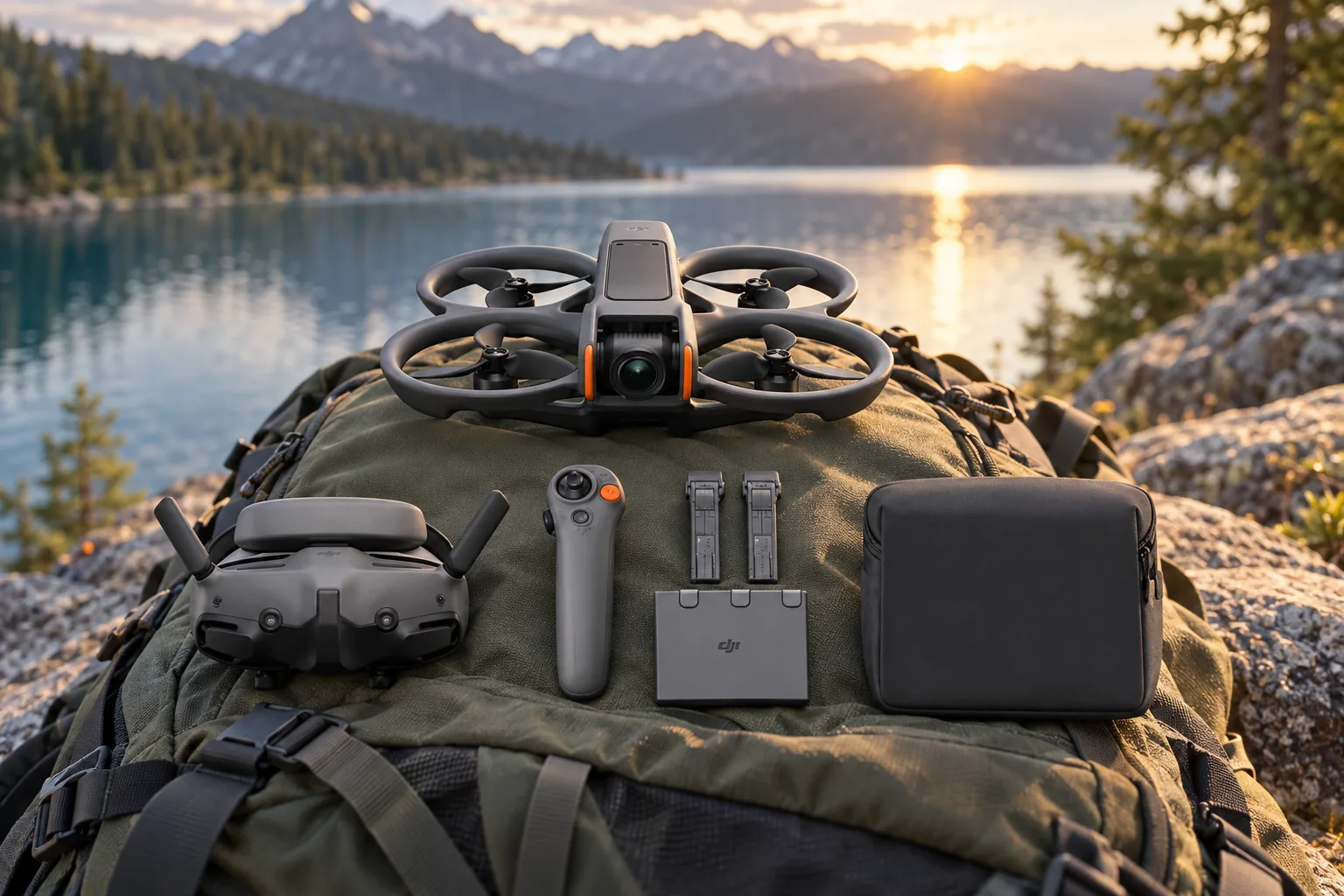
DJI specifies 4K/60fps HDR capability, 10-bit D-Log M, 46GB internal storage and microSD expansion. The motion controller supports Normal, Sport and Easy ACRO. Manual mode requires the separately sold DJI FPV Remote Controller 3, which is a meaningful consideration for experienced pilots wanting a traditional full-manual FPV setup.
Real endurance depends sharply on the way it is flown. TechRadar reported up to 26 minutes during gentle cruising in calm conditions, whilst Digital Camera World reported roughly eight minutes of hard flying. That difference is not contradictory: dives, rolls, wind and repeated high-energy moves consume battery far more quickly than a slow cruise.
The safety compromise is equally important. Avata 2 has downward and backward visual positioning but no forward obstacle avoidance. Its guards make prop strikes less catastrophic than on an exposed racing quad, but goggles do not remove the need for a spotter, careful location choice and legal visual line-of-sight operation.
It is also worth being realistic about the supplied controls. RC Motion 3 makes Normal, Sport and Easy ACRO approachable for a newcomer, which is why Avata 2 is one of the more accessible routes into FPV. However, it is not identical to a full manual FPV experience: WIRED noted limits to manoeuvres with the Motion Controller, and TechRadar found Manual mode less polished than on capable DIY FPV drones. Choose this package for a refined, protected DJI FPV system and cinematic movement, not as a replacement for a crash-tolerant carbon freestyle build or a conventional aerial-photography drone.
Five Drones, Five Regulatory Realities: What Each One Costs You in Admin
Weight changes more than what fits in a bag. Flip sits under 249g and Neo 2 is approximately 151g without the Digital Transceiver, so both occupy the lightest aircraft bracket. That is one reason they work well as spontaneous travel companions, although camera-equipped drones still require responsible operation and adherence to UK rules.
Air 3S is a 724g C1 aircraft and Mavic 4 Pro is a C2 aircraft at approximately 1,063g. DJI's UK guidance identifies Flyer ID and Operator ID requirements for Mavic 4 Pro, and the heavier aircraft bring tighter practical considerations around people and flight locations than a sub-250g drone. Avata 2 is also C1 at approximately 377g.
Classification and registration are not a substitute for checking the place you intend to fly. Restricted airspace, local landowner rules, privacy, people on the ground and visual line-of-sight obligations can still determine whether a flight is appropriate.
Technology should be understood in the same way. Mavic 4 Pro's sensing system is unusually capable on paper, including low-light operation down to 0.1 lux, but no automated return, tracking mode or obstacle sensor makes it sensible to fly through inaccessible gaps or close to bystanders.
Battery Reality Check: What DJI Claims vs What Reviewers Actually Got
Flight-time claims are useful for comparing aircraft, but they are controlled-condition maximums. The practical evidence makes the ranking clearer: Mavic 4 Pro remained aloft for around 37 minutes per battery in TechRadar's report; Air 3S results ranged from about 38 minutes in Engadget's working conditions to more than 40 minutes in WIRED's report; and Flip reached 31 minutes in Tom's Guide's windy 4K/30fps flight.
Neo 2 has the widest gap. Its approximate 19-minute claim became around 10 minutes in TechRadar's practical result, or 13 to 15 minutes in Oscar Liang's account with a Digital Transceiver fitted. That makes spare batteries less of a luxury and more of the point of buying the Fly More configuration.
Air 3S batteries take approximately 80 minutes with DJI's 65W charger or around 60 minutes through the 100W adapter and hub. Flip can take around 70 minutes in the aircraft with a suitable 30W USB-C charger, or around 45 minutes for one battery in its hub with a suitable 65W charger. Neo 2's hub can charge all three batteries in around 68 minutes.
Match the Drone to the Flyer: Four Realistic UK Buying Scenarios
For serious aerial video work
DJI Mavic 4 Pro is the fit for three focal lengths, 6K/60fps HDR, log profiles, an adjustable-aperture main camera and true portrait gimbal work.
For travel and landscape creators
DJI Air 3S balances a 1-inch wide camera, 70mm view, strong battery capacity and a screen controller without Mavic 4 Pro's size.
For a cautious first flight
DJI Flip pairs full-coverage folding propeller guards with a three-axis gimbal, 48MP stills and a conventional RC 2 controller.
For running, cycling and quick clips
DJI Neo 2 makes the case through palm launch, gestures, tracking and a three-battery bundle rather than endurance or stills quality.
For immersive movement
DJI Avata 2 is for goggles-based FPV sequences, low routes and dynamic movement rather than conventional aerial photography.
Frequently asked questions
Decisive verdict
For most UK buyers who want to make deliberate, polished aerial footage, DJI Air 3S is the sensible place to start: two cameras, long claimed endurance, strong low-light credentials and the useful RC 2 Fly More bundle. Move to DJI Mavic 4 Pro only when the third camera, 6K workflow, adjustable aperture and rotating gimbal will be used often enough to offset the weight and cost. For lighter, more spontaneous flying, choose DJI Flip for protection or DJI Neo 2 for follow-me simplicity. Choose DJI Avata 2 because you specifically want FPV, not because it happens to have a camera.
Sources
- DJI UK: Mavic 4 Pro Fly More Combo; TechRadar: Mavic 4 Pro review; Tom's Guide: Mavic 4 Pro review.
- DJI: Air 3S specifications; Engadget: Air 3S review; WIRED: Air 3S review.
- DJI: Flip specifications; Tom's Guide: Flip review; WIRED: Flip review.
- DJI UK: Neo 2; TechRadar: Neo 2 review; Oscar Liang: Neo 2 review.
- DJI: Avata 2 support and specifications; Digital Camera World: Avata 2 review; WIRED: Avata 2 review.
- DJI Air 3SEnthusiast all-rounderView on Amazon
- DJI Mavic 4 ProSerious aerial platformView on Amazon
- DJI FlipProtected first droneView on Amazon
- DJI Neo 2Follow-me choiceView on Amazon
- DJI Avata 2Immersive FPV optionView on Amazon
Sources and evidence (63)
- techradar.com (other)
- store.dji.com (other)
- 1410dd2bdd37e05ebf19-a2305060cc55ab8db83b1ef4b8835a6b.ssl.cf5.rackcdn.com (other)
- dji.com (other)
- repair.dji.com (other)
- dl.djicdn.com (other)
- viewpoints.dji.com (other)
- tomsguide.com (other)
- amateurphotographer.com (other)
- dji.com (other)
- dji.com (other)
- store.dji.com (other)
- dji.com (other)
- tomsguide.com (other)
- engadget.com (other)
- wired.com (other)
- techradar.com (other)
- amateurphotographer.com (other)
- stuff.tv (other)
- store.dji.com (other)
- dji.com (other)
- currys.co.uk (retailer)
- dji.com (other)
- tomsguide.com (other)
- techradar.com (other)
- wired.com (other)
- dji.com (other)
- dji.com (other)
- cvp.com (other)
- mynewsdesk.com (other)
- bigshopper.co.uk (other)
- store.dji.com (other)
- techradar.com (other)
- space.com (other)
- tomsguide.com (other)
- oscarliang.com (other)
- engadget.com (other)
- mynewsdesk.com (other)
- store.dji.com (other)
- dji.com (other)
- digitalcameraworld.com (other)
- oscarliang.com (other)
- techradar.com (other)
- wired.com (other)
- store.dji.com (other)
- store.dji.com (other)
- store.dji.com (other)
- techradar.com (other)
- antigravity.tech (other)
- prtimes.jp (other)
- store.dji.com (other)
- wired.com (other)
- dl.djicdn.com (other)
- techradar.com (other)
- techradar.com (other)
- store.dji.com (other)
- en.wikipedia.org (other)
- store.dji.com (other)
- prnewswire.com (other)
- store.dji.com (other)
- store.dji.com (other)
- stuff.tv (other)
- store.dji.com (other)