
Best Portable Speakers in 2026: The Premium Picks Worth Buying
Five very different ways to bring proper sound to a hotel room, a rainy garden table, a poolside afternoon or a house full of people.
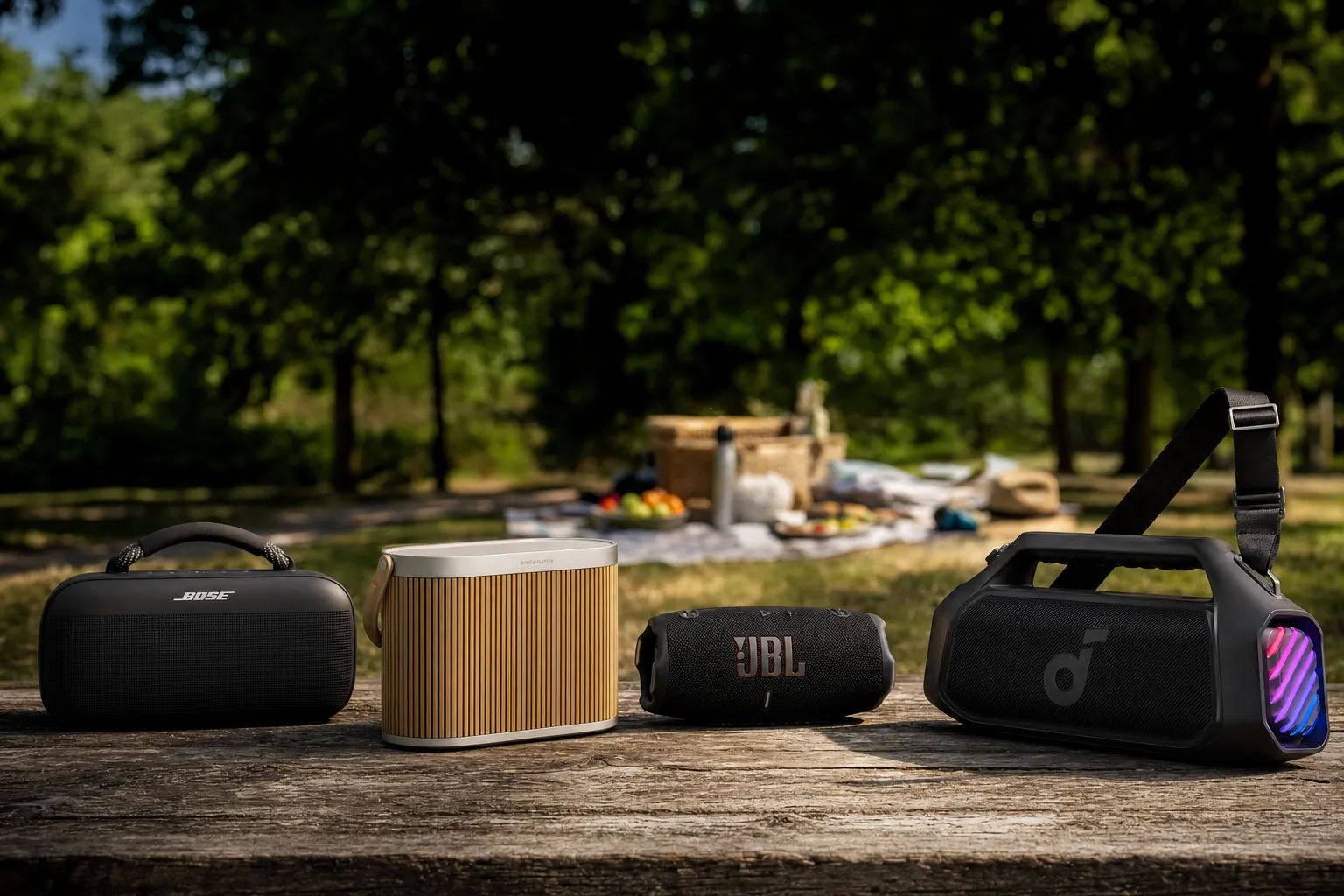

IP67 protection, stereo sound, AUX input and strong measured loudness suit gardens, holidays and straightforward Bluetooth listening.
Check price on Amazon
Wi-Fi, AirPlay 2, automatic Trueplay and a charging base make it the practical portable Sonos speaker.
Check price on Amazon
Published 101dB output, broad Wi-Fi streaming support and modular construction justify consideration for design-led serious listening.
Check price on Amazon
A 0.96kg IP68 speaker with USB-C audio, power-bank output and Auracast for everyday travel and outdoor use.
Check price on AmazonWe link to the exact model on Amazon UK. Prices change often, so check the live price before you buy. As an Amazon Associate we earn from qualifying purchases.
A portable speaker can mean a one-kilo tube that goes in a weekend bag, a three-kilo Wi-Fi speaker that lives on a charging dock, or a carryable luxury system with furniture-grade materials. The wrong choice is expensive: buy for a beach and you may end up with a speaker that dislikes water; buy for the kitchen and garden and you may miss out on the streaming system you actually wanted.
The short answer: choose Bose SoundLink Max for straightforward Bluetooth listening around gardens, hotels and poolside spaces; Sonos Move 2 if it must work as part of a whole-home Sonos system; and Bang & Olufsen Beosound A5 if design, streaming breadth and published acoustic capability matter more than price or weight. JBL Charge 6 makes the most sense for lighter travel and durable everyday use, whilst Anker Soundcore Boom 2 Plus is aimed squarely at louder, bass-led garden parties.
How We Picked: Five Jobs, Five Speakers
This is not a straight size-for-size contest. These five verified Amazon UK listings cover separate jobs: a travel-ready Bluetooth all-rounder, a Sonos-equipped home-and-garden speaker, a luxury Wi-Fi model, a compact tough speaker and a larger party-focused boombox.
Read battery and loudness claims carefully
Brands and publications use different volume levels, music, wireless connections and power-saving modes. JBL's and Bose's headline runtimes are useful for direction, but they are not directly comparable with a louder independent playback run. B&O, helpfully, ties its own figure to 70dB; Bose states that its runtime falls from up to 20 hours at moderate volume to roughly three hours at maximum volume.
| Model | Weight | Protection | Claimed battery life |
|---|---|---|---|
| Bose SoundLink Max | Approx. 2.2kg | IP67 | Up to 20 hours |
| Sonos Move 2 | 3kg | IP56 | Up to 24 hours |
| Bang & Olufsen Beosound A5 | 3.8kg | IP65 | More than 12 hours at 70dB |
| JBL Charge 6 | 0.96kg without strap | IP68 | Up to 24 hours; up to 28 with Playtime Boost |
| Anker Soundcore Boom 2 Plus | Approx. 3.8kg | IPX7 | Up to 20 hours |
The table deliberately focuses on facts that shape ownership. IP68 does not mean the same thing as better sound, and a Wi-Fi speaker is not automatically more useful if all you want is a speaker you can pair in seconds from a phone.
For UK buyers, the practical split is often between a speaker that travels in the car or a weekend bag and one that mainly moves between rooms, patio and garden. The £169.99 Charge 6 is dramatically easier to justify as an everyday carry speaker than the £399.95 Bose or £449 Sonos, while the Beosound A5 starts at £1,200 and should be approached more like a premium home-audio purchase with a handle. Check exactly what is in the box before ordering: Bose includes a USB-C cable but not a power supply in all regions including the UK, whereas Move 2 includes its charging base, 45W USB-PD adapter and cable.
Bose SoundLink Max: The Grab-and-Go All-Rounder for Travel and Gardens
The Bose SoundLink Max is the simple recommendation for someone who wants substantial sound without learning a new ecosystem. It is a stereo Bluetooth speaker with IP67 dust and water protection, a removable rope handle, a 3.5mm analogue input and USB-C phone charging. Bose listed it at £399.95 in the UK.
Its acoustic hardware is unusually substantial for a speaker of this shape: two 2.5-inch midrange drivers, one tweeter and two racetrack passive radiators. Bose does not publish wattage, but reviewers broadly agreed that it sounds large, bassy and energetic for a 2.13–2.2kg portable enclosure. What Hi-Fi? praised the lively presentation and tight bass, whilst also finding the standard tuning overly bass-heavy until the app EQ was adjusted.
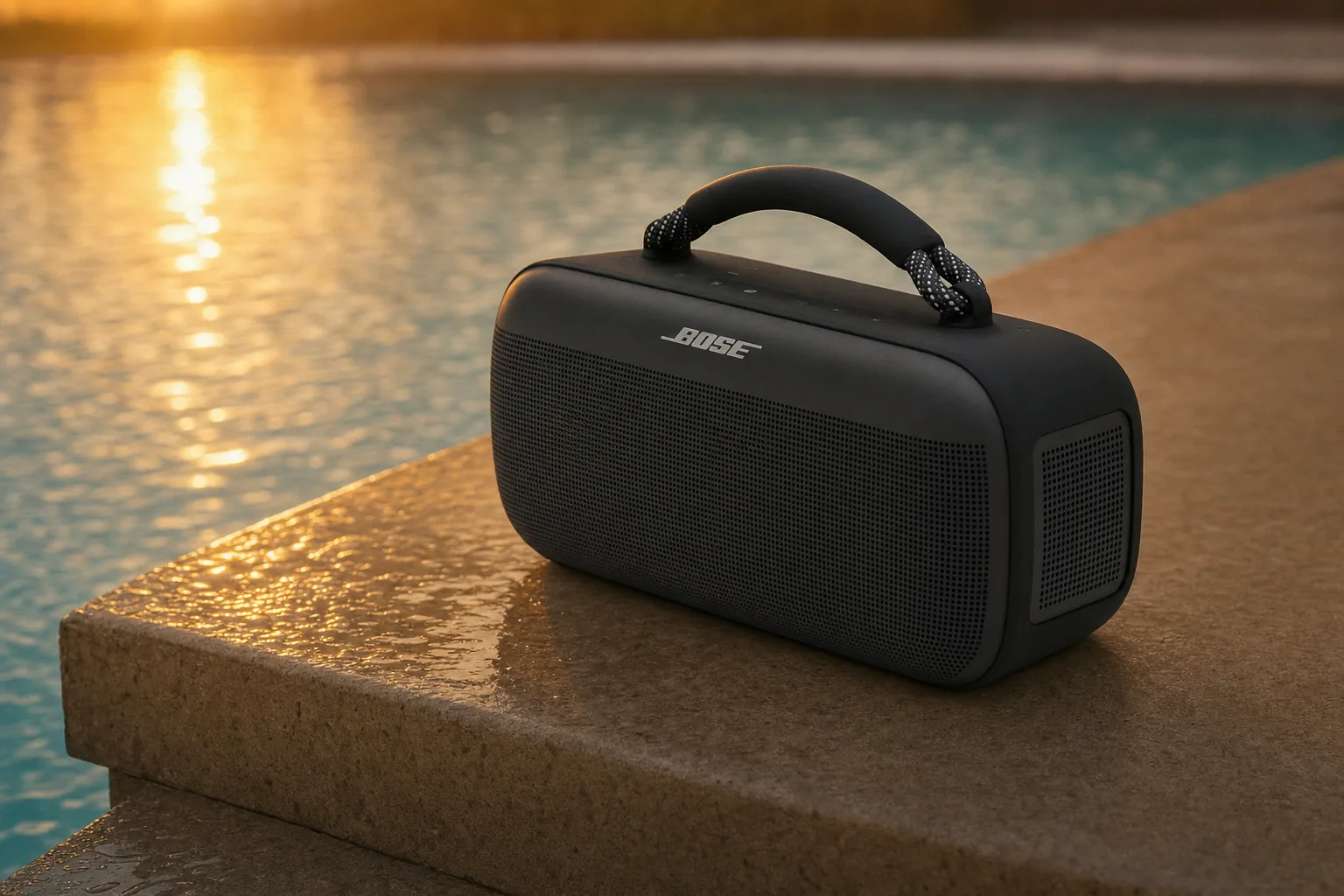
The battery evidence shows why headline figures need context. RTINGS recorded more than 15 hours of continuous playback, while TechGearLab reported 43.1 hours under its own procedure. Bose's 20-hour estimate is for moderate listening, and its support documentation puts maximum-volume playback at approximately three hours. These are not competing facts so much as different listening conditions.
Setup is deliberately conventional. Pair over Bluetooth, then use the Bose app if you want to alter its three-band EQ, set the shortcut or link speakers. It can hold two Bluetooth source connections simultaneously and remembers up to six paired devices, which is useful in a household where more than one person will use it. The AUX socket remains a tangible advantage for a turntable with suitable output, an older music player or a television source, but USB-C is for charging and power output rather than USB audio. For a listener who values uncomplicated switching between phone, tablet and wired source, that combination is more useful than Wi-Fi complexity.
What makes sense here
- IP67 protection suits wet grass, poolside use and dusty patios.
- The AUX input is valuable for older players and simple wired sources.
- TechGearLab reported 98dB maximum loudness with little quality loss at high volume.
- Multipoint Bluetooth and app EQ keep day-to-day use uncomplicated.
The honest catch
- It is heavy for a rucksack speaker and takes up space in luggage.
- A full charge can take up to five hours.
- There is no Wi-Fi, AirPlay, speakerphone microphone or built-in voice assistant.
- Reviewers noted that sand can collect around the grille and rear connections need care.
Buy the Bose SoundLink Max if you want a premium, portable speaker that behaves like a Bluetooth speaker should: pair, press play and carry it out to the garden. Skip it if the speaker will spend most of its life indoors as part of a multi-room setup; the Sonos Move 2 earns its extra complexity there.
Sonos Move 2: The One That Doubles as a Home Speaker
The Sonos Move 2 is a £449 Wi-Fi and Bluetooth speaker that happens to be portable, rather than a conventional Bluetooth speaker with extra features. It sits on a supplied charging base indoors, joins Sonos rooms over Wi-Fi, supports AirPlay 2 and can then be lifted outside when the weather or occasion changes.
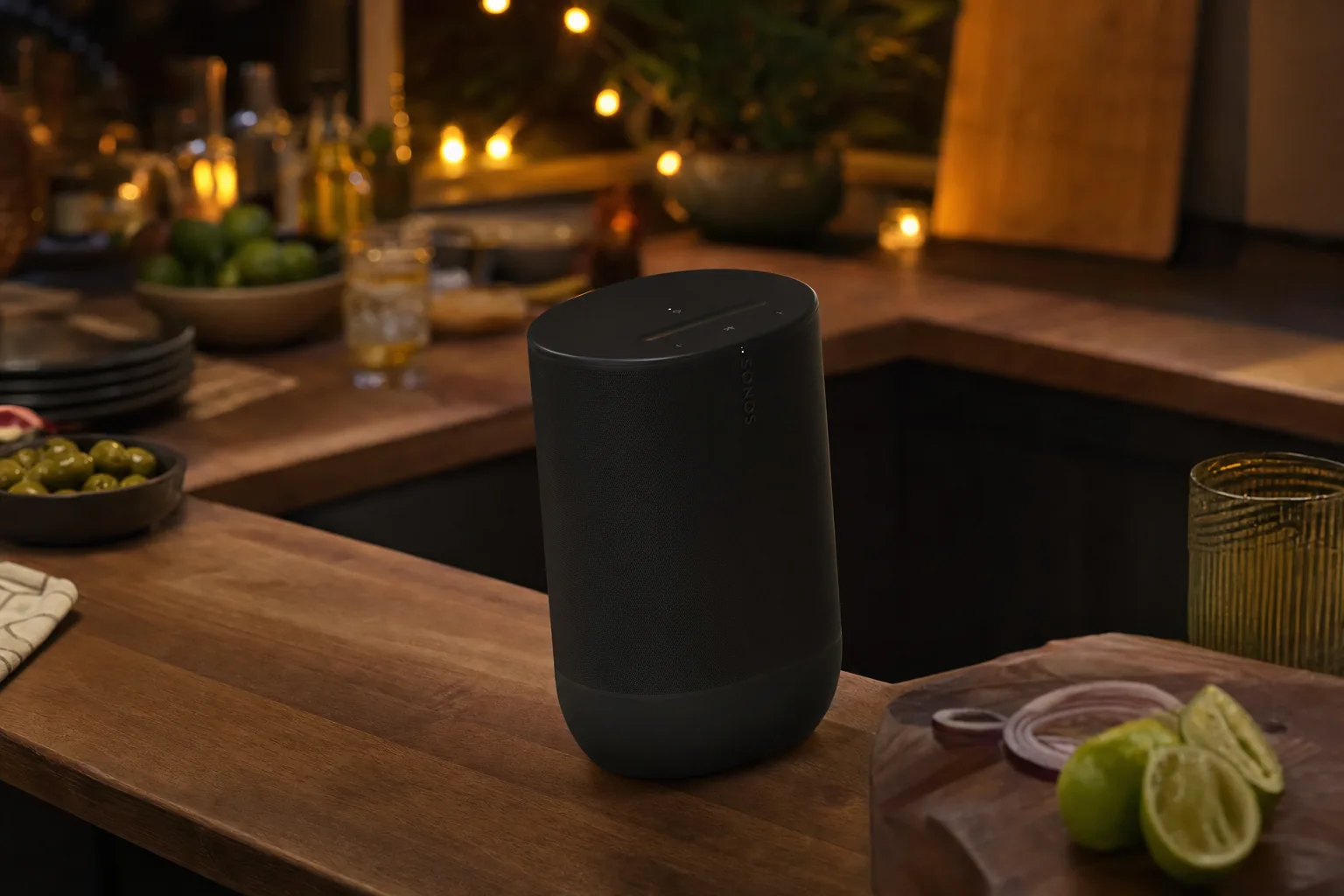
It carries two angled tweeters and one mid-woofer, powered by three Class-D amplifiers. That is a more ambitious driver arrangement than most single-box portables, although reviewers were careful not to oversell the stereo effect. DXOMARK found its sound pleasant, natural and warm with few playback artefacts, but described the stereo width as limited.
| For home-and-garden use | Sonos Move 2 | Bose SoundLink Max | Bang & Olufsen Beosound A5 |
|---|---|---|---|
| Wi-Fi streaming | Yes, with Sonos multi-room and AirPlay 2 | Bluetooth-only playback | Yes, with AirPlay, Google Cast and Beolink Multiroom |
| Weight | 3kg | Approx. 2.2kg | 3.8kg |
| Protection rating | IP56 | IP67 | IP65 |
| Battery claim | Up to 24 hours | Up to 20 hours | More than 12 hours at 70dB |
| Buy | Check price | Check price | Check price |
A controlled Sonos community battery run recorded 22 hours of playback with 17% still remaining, lending support to the 24-hour claim at moderate use. The same report observed around 1.25 hours to return from that partially depleted state to full charge on the base. TechRadar also found the 24-hour claim credible during light Wi-Fi and AirPlay listening.
There is a small setup trade-off behind that flexibility. To get the full Sonos experience, the Move 2 needs initial Wi-Fi and Sonos app configuration; Bluetooth works, but does not turn it into the same instant, app-free proposition as Bose or JBL. Its USB-C port can charge a phone and can accept line-in only through Sonos's separate Line-In Adapter, so buyers with an analogue source should include that extra accessory in the decision. The physical microphone switch is helpful if voice services are useful sometimes but unwanted in everyday listening.
The Move 2 is for Sonos households, or for someone who wants music to follow them from kitchen to patio without abandoning streaming convenience. It is less appealing for flights, beach bags and impulsive day trips: at 3kg, it is a speaker to carry deliberately rather than casually. The line-in route also requires Sonos's separate adapter.
Bang & Olufsen Beosound A5: The Luxury Choice for Serious Listening
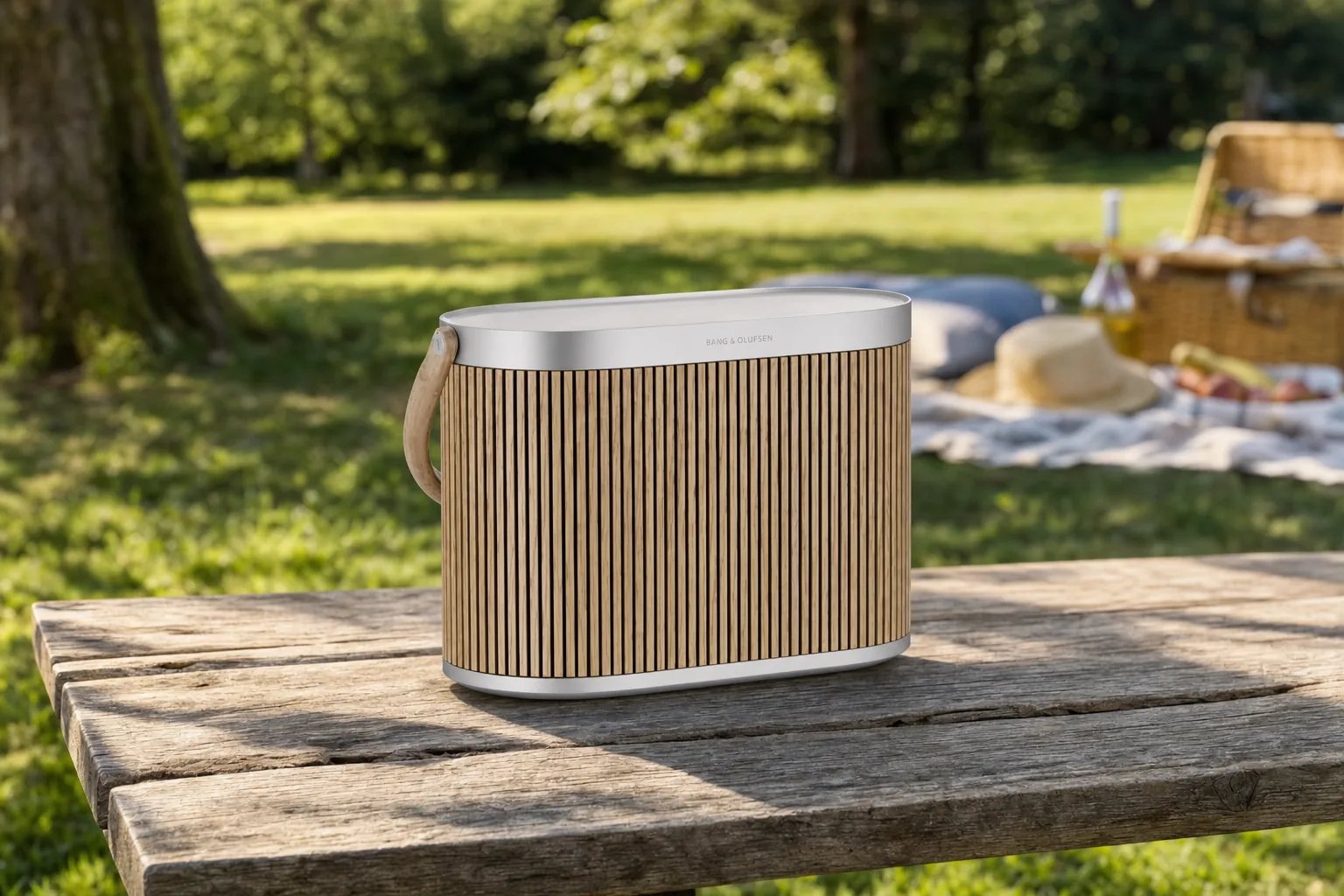
The Bang & Olufsen Beosound A5 is a different kind of purchase. Bang & Olufsen lists the A5 from £1,200 in the UK, and the Oak configuration covered here at £1,400, placing it far above the other speakers on price. In return, it brings Wi-Fi streaming, B&O's multi-room platform, active room compensation, Qi phone charging and a modular construction with replaceable battery, handle and covers.
Its published acoustic figures are substantial: four 70W Class-D channels, a 5.25-inch woofer, two 2-inch full-range drivers and a 0.75-inch tweeter. B&O specifies 280W non-clipped peak output, a 32Hz–23kHz frequency range and 101dB SPL at one metre. Those are the strongest manufacturer-published SPL and frequency figures in this five-speaker group, though amplifier ratings are not a direct measure of continuous acoustic output on battery power.
The portability trade-off
Computer Bild recorded around 11 hours at 80dB and 99dB maximum loudness. That is credible performance from a battery-powered speaker, but the A5 is 3.8kg and its wood versions need greater care around water despite the IP65 enclosure rating. It is carryable by handle, not a speaker for throwing into a backpack.
Reviewers from WIRED, TechRadar and Expert Reviews praised the detailed, controlled and broad presentation, particularly at high volume. They also agreed that its 360-degree marketing should be read as broad room-filling coverage rather than identical sound from every position. Bluetooth is not its defining strength; Wi-Fi streaming and B&O's platform are the reason to consider it.
Day to day, the A5 makes most sense where its streaming options can be used rather than treated as a very expensive Bluetooth connection. It supports AirPlay, Google Cast, Spotify Connect, TIDAL Connect, Deezer Connect and Beolink Multiroom, while its app provides Beosonic EQ and room-related adjustments. The Qi surface is a pleasant kitchen or bedside convenience, but it is not a reason to choose the speaker on its own. Buyers considering the Oak model should also treat IP65 as protection for the electronics, not permission to ignore B&O's warning about water-sensitive wood and woven materials.
The Beosound A5 suits someone furnishing a room and wanting a speaker that can also move to a terrace or garden gathering. It does not suit someone chasing maximum battery life or a low-cost outdoor speaker. Its considerable price buys materials, system flexibility, repair-oriented design and published output capability—not an automatic advantage in every travel scenario.
JBL Charge 6: The Compact Value-Led Pick for Travel
The JBL Charge 6 is the sixth-generation Charge and succeeded the Charge 5 in April 2025. The Amazon UK Black listing is model JBLCHARGE6BLK. With a UK RRP of £169.99 and a weight of 0.96kg without its detachable strap, it answers a more practical question than the larger models: how much useful sound and durability can fit in a speaker you will genuinely take away?
JBL's meaningful upgrades over the Charge 5 included IP68 dust and immersion protection, Auracast multi-speaker networking, AI Sound Boost processing and USB-C lossless audio input. Auracast does not connect to older PartyBoost products, so existing Charge 5 owners should factor that split into an upgrade decision.
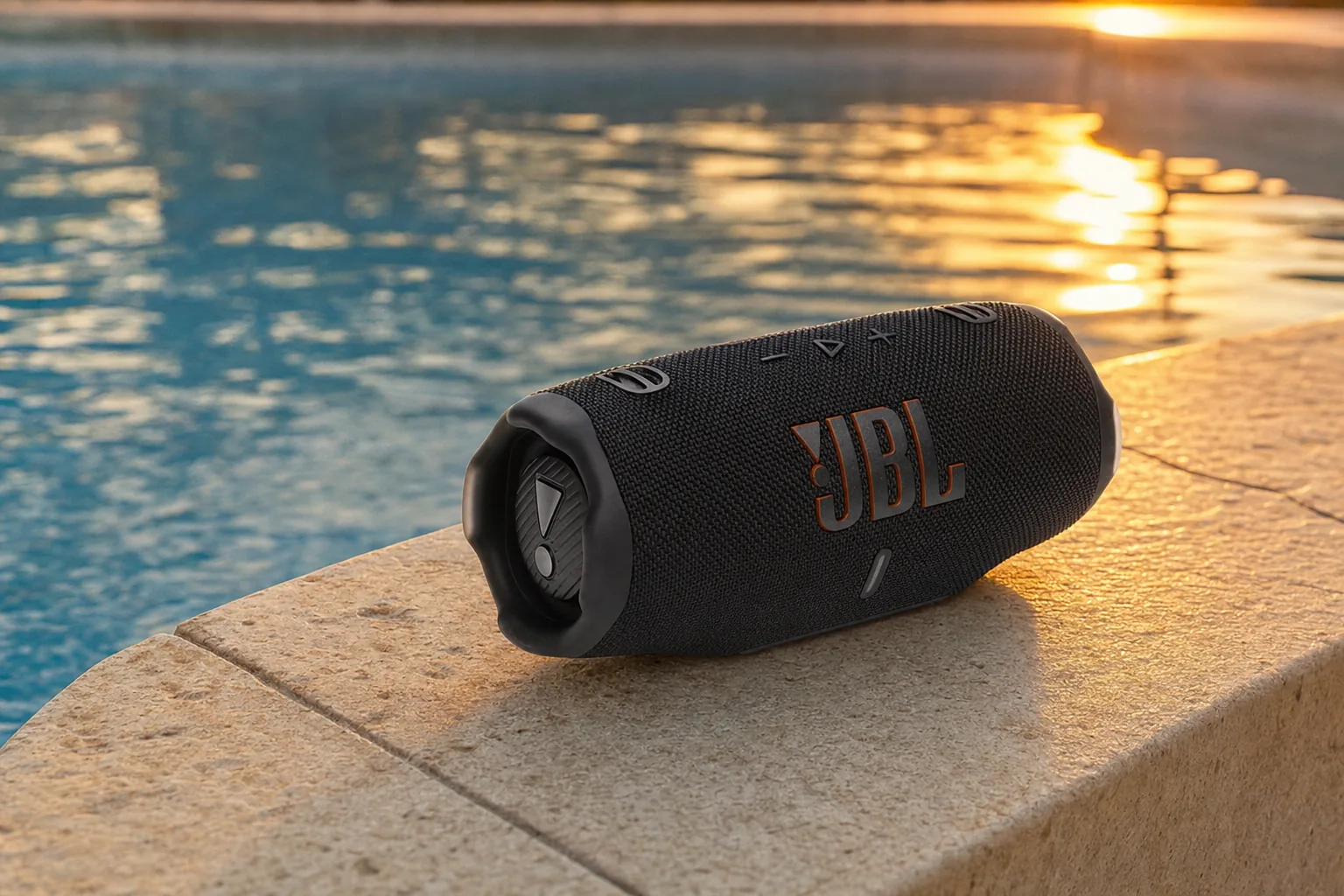
The Charge 6 uses a 53 × 93mm racetrack woofer and 20mm tweeter, rated at 30W RMS and 15W RMS respectively. It is mono rather than true stereo from one enclosure, and RTINGS reported that sound changes noticeably by listening angle. That is an acceptable compromise for a compact outdoor speaker, but it matters if it will sit in the middle of a large room.
IP68 and drop resistance
JBL specifies dust and water protection plus resistance to a one-metre drop onto concrete, making this the least precious model here.
USB-C lossless audio
USB-C supports high-resolution lossless playback up to 24-bit/96kHz according to TechRadar; there is no 3.5mm input.
Auracast expansion
It can join compatible newer JBL speakers for wider coverage, or pair with a second compatible speaker for stereo.
Runtime depends on how it is used
JBL claims up to 24 hours, or 28 hours with Playtime Boost. SoundGuys recorded 13 hours 15 minutes at a continuous 80dB.
The Charge 6 is also the clearest pick if a speaker will be used in unpredictable weather, packed next to towels or placed on a beach without much ceremony. Its IP68 rating and claimed one-metre drop resistance are stronger practical reassurances than the premium models' more furniture-like finishes. The trade-off is that Playtime Boost stretches the quoted runtime by reducing bass, and the USB-C audio feature is useful only for listeners prepared to connect a compatible wired source. It has no 3.5mm input, no microphone and no speakerphone function, so its simplicity is deliberate rather than comprehensive.
TechGearLab reported 14.8 hours under its own playback conditions and 101dB maximum loudness. Those numbers make clear why the Charge 6 can handle a picnic table or a small garden group, even if it cannot deliver the room-filling scale of the Bose, Sonos, B&O or Anker.
It is sold in Black, Blue, Pink, Purple, Red, White and Squad camouflage through JBL's UK range. Choose it when compactness, resilience and a lower entry price matter more than wide stereo sound, Wi-Fi services or the refinement of a larger cabinet.
Anker Soundcore Boom 2 Plus: The Party-Focused Alternative
The Anker Soundcore Boom 2 Plus is the loud, bass-forward option: a roughly 3.8kg outdoor speaker with 100W standard output, rising to a claimed 140W through BassUp 2.0. Its UK RRP was £199.99, and it is physically much larger than the JBL Charge 6 at 442 × 151 × 228mm.

It uses two 50W woofers and two 20W tweeters, has a stated 40Hz–20kHz response and claims 103dB maximum loudness. Picky Audio measured approximately 96dB at one metre outdoors. That falls below the headline figure, but it still points to the intended use: a speaker designed to push bass across a garden, campsite or pool area rather than disappear into luggage.
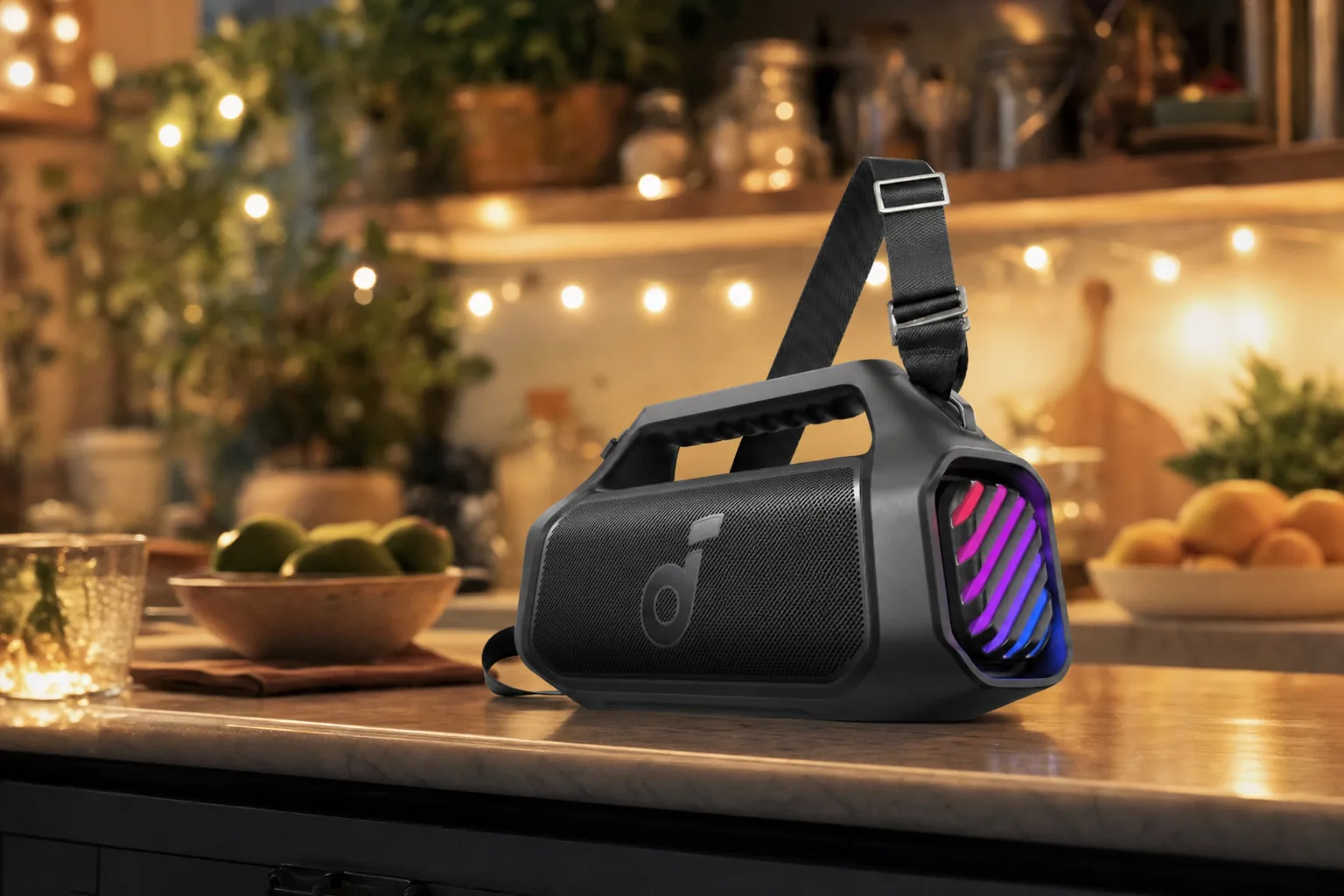
The buying decision is straightforward: choose the Boom 2 Plus when the speaker is usually carried from the house to the garden, car or campsite rather than carried all day. Its size gives it a different sense of scale to the Charge 6, but that is accompanied by a less refined midrange, a plasticky enclosure according to reviewers and no dust rating. It can float and is IPX7-rated, which makes it a sensible poolside option, yet a sandy or dusty setting is a stronger argument for the IP68 JBL. The lighting and BassUp features are social extras, not substitutes for portability.
Reasons to choose it
- BassUp 2.0, RGB lighting and PartyCast 2.0 suit social listening.
- It floats and carries an IPX7 water-resistance rating.
- There is a 3.5mm AUX input, USB-C charging and 10W phone charging output.
- The Soundcore app includes EQ, lighting controls and firmware updates.
Reasons to look elsewhere
- IPX7 does not include a dust-protection rating.
- RTINGS reported roughly 13 hours of continuous playback versus the 20-hour claim.
- High Bluetooth latency can be troublesome for video viewing.
- Reviewers found the enclosure plasticky and the sound less detailed through the midrange.
SoundGuys and Tom's Guide both described it as a speaker for beach, poolside and backyard occasions, but neither treats it as especially portable in the everyday sense. The strap helps; the 3.8kg bulk remains. Pick it for scale and bass at its price tier, not for polished all-angle sound or dust-heavy environments.
Battery Life, Decoded: Why the Numbers Do Not Match
Battery claims are not false simply because a publication records a different result. They are a snapshot of a particular listening pattern. Louder playback demands more power, bass processing changes the draw and Wi-Fi, Bluetooth, screen brightness on the source device and power-bank use can all shift the outcome.
| Speaker | Battery life context |
|---|---|
| Bose SoundLink Max | RTINGS: more than 15 hours; TechGearLab: 43.1 hours under its own procedure |
| Sonos Move 2 | Sonos community run: 22 hours with 17% remaining |
| Bang & Olufsen Beosound A5 | Computer Bild: 11 hours at 80dB |
| JBL Charge 6 | SoundGuys: 13 hours 15 minutes at 80dB; TechGearLab: 14.8 hours |
| Anker Soundcore Boom 2 Plus | RTINGS: approximately 13 hours continuous playback |
For a long outdoor day, JBL and Sonos offer the more reassuring claimed endurance figures. For loud music, use the independent figures as the safer planning baseline. Bose's explicit maximum-volume estimate is especially useful: no portable speaker maintains its brochure runtime when playing flat out.
There are two sensible ways to plan around those numbers. If the speaker will be background music at home, the manufacturer claim is a reasonable guide, especially with Sonos on its dock. If it is for a day-long gathering where volume will rise, start with the independent result where one is available and take a suitable charger or power source. Also remember that using Bose, Sonos, JBL or Anker as a phone power bank reduces the time available for music. Fast charging can help between outings, but it does not remove the basic relationship between loud bass-heavy playback and battery use.
Matching the Speaker to the Reader
For travel, beaches and hotels
JBL Charge 6 is the easier carry at 0.96kg and adds IP68 protection. Choose Bose SoundLink Max instead if fuller stereo sound and AUX matter more than luggage weight.
For gardens and casual gatherings
Bose SoundLink Max balances IP67 protection, strong output and uncomplicated controls. Choose Anker Soundcore Boom 2 Plus for more overt bass, lighting and party-focused scale.
For a Sonos household
Sonos Move 2 is the clear fit because it supports Sonos multi-room playback, AirPlay 2, automatic Trueplay and a charging base.
For sound and design first
Bang & Olufsen Beosound A5 brings the broadest streaming support, 101dB published output and 24-bit/192kHz supported file playback.
For claimed all-day listening
Sonos Move 2 claims 24 hours and integrates neatly with home charging. JBL Charge 6 is the lighter alternative, also rated for up to 24 hours.
For a lower-price premium route
JBL Charge 6 has a £169.99 UK RRP and retains USB-C audio, a power bank, app EQ and high water-and-dust protection.
If two choices still look close, decide which compromise you will notice every week. Bose is easier than Sonos if guests regularly connect their own phones. Sonos is the stronger fit if music already follows you between Sonos rooms. JBL is the least burdensome option to pack, but its mono presentation is a meaningful limitation for indoor listening. B&O's price only makes sense if its materials, streaming ecosystem and serviceable design are part of the appeal. Anker is the value-led answer when louder bass and a social atmosphere matter more than compactness or detail.
Common Questions Before You Buy
The decisive verdict
For most people spending premium money on a portable Bluetooth speaker, the Bose SoundLink Max is the balanced choice: strong output, IP67 protection, AUX, useful app controls and less setup than the Wi-Fi models. Sonos Move 2 earns its place when the speaker is part of a home system, while Bang & Olufsen Beosound A5 is the considered luxury purchase for buyers who value sound, streaming and design enough to accept its price and weight. JBL Charge 6 is the sensible smaller companion; Anker Soundcore Boom 2 Plus is the louder, more bass-led social option.
Sources and further reading
- Bose UK — SoundLink Max product specifications; RTINGS — Bose SoundLink Max; TechGearLab — Bose SoundLink Max.
- Sonos UK — Move 2 product page; Sonos Move 2 fact sheet; DXOMARK — Sonos Move 2.
- Bang & Olufsen UK — Beosound A5; B&O Beosound A5 product sheet; Computer Bild — Beosound A5.
- JBL UK — Charge 6; SoundGuys — JBL Charge 6; TechGearLab — JBL Charge 6.
- RTINGS — Anker Soundcore Boom 2 Plus; SoundGuys — Anker Soundcore Boom 2 Plus.
- Bose SoundLink MaxTravel all-rounderView on Amazon
- Sonos Move 2Home system choiceView on Amazon
- Bang & Olufsen Beosound A5Luxury listeningView on Amazon
- JBL Charge 6Compact durable pickView on Amazon
Sources and evidence (81)
- bose.com (other)
- soundguys.com (other)
- support.bose.com (other)
- bose.com (other)
- techgearlab.com (other)
- rtings.com (other)
- bose.co.uk (other)
- harman.com (other)
- jbl.com (other)
- whathifi.com (other)
- uk.jbl.com (other)
- news.jbl.com (other)
- newsroom.sonos.com (other)
- sonos.com (other)
- wired.com (other)
- sonos.com (other)
- dxomark.com (other)
- en.community.sonos.com (other)
- marshall.com (other)
- marshall.com (other)
- rtings.com (other)
- marshall.com (other)
- bang-olufsen.com (other)
- assets.ctfassets.net (other)
- computerbild.de (other)
- bang-olufsen.com (other)
- bang-olufsen.com (other)
- assets.sonos.com (other)
- uk.jbl.com (other)
- news.jbl.com (other)
- uk.jbl.com (other)
- soundguys.com (other)
- techgearlab.com (other)
- whathifi.com (other)
- rtings.com (other)
- techradar.com (other)
- tomsguide.com (other)
- support.bose.co.uk (other)
- assets.bose.com (other)
- bose.co.uk (other)
- techradar.com (other)
- whathifi.com (other)
- tomsguide.com (other)
- assets.sonos.com (other)
- sonos.com (other)
- techradar.com (other)
- lbtechreviews.com (other)
- techadvisor.com (other)
- whathifi.com (other)
- expertreviews.co.uk (other)
- lbtechreviews.com (other)
- rtings.com (other)
- argos.co.uk (retailer)
- preisvergleich.heise.de (other)
- whathifi.com (other)
- techradar.com (other)
- wired.com (other)
- expertreviews.co.uk (other)
- t3.com (other)
- bang-olufsen.com (other)
- assets.ctfassets.net (other)
- whathifi.com (other)
- techradar.com (other)
- wired.com (other)
- t3.com (other)
- expertreviews.co.uk (other)
- computerbild.de (other)
- soundguys.com (other)
- mightygadget.co.uk (other)
- soundcore.com (other)
- rtings.com (other)
- pickyaudio.com (other)
- m.media-amazon.com (retailer)
- tomsguide.com (other)
- soundcore.com (other)
- m.media-amazon.com (retailer)
- rtings.com (other)
- soundguys.com (other)
- tomsguide.com (other)
- pickyaudio.com (other)
- mightygadget.co.uk (other)