
Best OLED TVs Under £1,000: The Cheapest Sets Actually Worth Buying
Six OLED televisions you can genuinely buy in the UK today for less than a grand, with the screen size each price actually buys — and the one compromise almost nobody warns you about.
We link to the exact model on Amazon UK. Prices change often, so check the live price before you buy. As an Amazon Associate we earn from qualifying purchases.
Search for a cheap OLED television and most guides point you at a set costing £1,300. That is not cheap. This guide has one rule: every headline pick must be buyable in the UK for less than £1,000 in at least one screen size — and we tell you which size that price gets you.
Sub-£1,000 OLED Is Real Now, and the Reason Is Slightly Awkward
For most of the last decade, "affordable OLED" was a phrase used by people trying to sell you a £1,500 television. That has genuinely changed, and the reason is worth understanding before you spend anything, because it tells you exactly what you are buying.
The 2026 televisions have landed. LG's C6 and B6 are on shelves, Samsung's range runs from the S82H up to the S99H, and Philips has moved its entire line-up onto Titan OS. Those sets are not cheap: LG's confirmed UK pricing starts the C6 at £1,299 for a 42-inch and reaches £2,499 at 65 inches, with the entry-level B6 opening at £1,399.
What has happened instead is that the 2025 models underneath them have fallen off a cliff, in the nicest possible way. The LG C5, LG B5, Samsung S85F and Philips OLED760 all launched in the first half of 2025 as mid-range or premium propositions. Fifteen months later they are last-generation stock, and that is what UK retailers discount hardest. Every recommendation on this page comes from there.
So let us be blunt about the trade-off. Under £1,000 you are buying a previous-generation panel, an entry-tier model, or both — not the micro lens array or Primary RGB Tandem structures LG reserves for its 2026 flagships. What you are getting is a self-emissive screen where every pixel makes its own light and switches off completely for black, and that single property still outclasses almost any LCD at the same money.
That is not a consolation prize. When TechRadar put the C6 and C5 side by side, the newer set measured roughly 1,355 nits against about 1,165 nits — a 15 to 20 per cent gain that is real on a test pattern and considerably harder to spot during a film. For most rooms, a two-year-old C-series OLED beats a brand-new mid-range LCD at the same money, because contrast is what your eye notices first.
The caveats matter just as much. This is where brightness gets tight, where entry models drop from 144Hz to 120Hz, and where a couple of sets quietly halve their HDMI 2.1 provision. There is also a size ceiling: a 65-inch OLED under £1,000 is a clearance event rather than a purchase you can plan, so the realistic sweet spot for a grand is 48 inches from LG or 55 inches from Samsung and Philips.
One last piece of context. Under £1,000 the acronym soup of W-OLED, QD-OLED, OLED EX, evo and MLA resolves to one answer: a white-OLED panel made by LG Display, sometimes with a modest efficiency tweak. Our guide to the difference between QLED, OLED and Mini LED compares those with the LCD alternatives, and our budget OLED guide for a UK living room handles the £1,000 to £1,500 bracket above this one.
The one-line version
Under £1,000, OLED means last year's model — a feature, not a bug. You get panel technology that cost £2,000 eighteen months ago, with the compromise landing on peak brightness rather than black level, contrast or viewing angles.
At a Glance: Every Sub-£1,000 OLED Compared
Six televisions clear the bar. Read the size column carefully, because it is doing most of the work here.
Brightness figures below are measured results from professional reviewers on a 10 per cent HDR white window, the closest thing to a standard comparison. The exception is the 48-inch LG C5, where Trusted Reviews published a 5 per cent window figure, flagged so you are not comparing unlike with unlike. Where a figure comes from a review of a different size in the same range, we say so.
| Model | Size under £1,000 | Panel | Measured HDR peak | Refresh | HDMI 2.1 | HDR formats | Software |
|---|---|---|---|---|---|---|---|
| LG C5 (OLED48C5) | 48-inch | W-OLED evo | 770 nits (5% window, Trusted Reviews) | Up to 144Hz | 4 ports, 48Gbps | Dolby Vision, HDR10, HLG | webOS 25 |
| Samsung S85F (QE55S85F) | 55-inch | W-OLED (UK stock) | 777 nits Filmmaker (TechRadar) | Up to 120Hz | 4 ports | HDR10+, HDR10, HLG — no Dolby Vision | Tizen |
| LG B5 (OLED48B5) | 48-inch | W-OLED (non-evo) | 668 nits Cinema (TechRadar, larger size) | Up to 120Hz | 4 ports, 48Gbps | Dolby Vision, HDR10, HLG | webOS |
| Philips OLED760 (55OLED760) | 55-inch | OLED EX | 760 nits (10% window, Trusted Reviews) | 48–120Hz | 4 ports | Dolby Vision, HDR10+, HDR10, HLG | Titan OS |
| LG B5 (OLED55B5) | 55-inch | W-OLED (non-evo) | 668 nits Cinema (TechRadar) | Up to 120Hz | 4 ports, 48Gbps | Dolby Vision, HDR10, HLG | webOS |
| LG C5 (OLED42C5) | 42-inch | W-OLED evo | Not separately measured at this size | Up to 144Hz | 4 ports, 48Gbps | Dolby Vision, HDR10, HLG | webOS 25 |
Note the HDR peak column: every set sits between roughly 630 and 820 nits, while TechRadar measured the 65-inch LG C5 at 1,180 nits on the same window. That 400-odd nit gap is what your saving buys.
UK Prices, Checked 6 August 2026
These prices were checked across UK price-comparison listings and retailer sites on 6 August 2026. Treat them as a snapshot, not a guarantee. Last-generation OLED stock moves fast and these models have swung by £150 or more inside a single quarter — the 48-inch LG C5 alone ranged from £764 to £949 in the three months before we checked.
The under-£1,000 prices sit where you would expect: Currys, John Lewis, Argos, Richer Sounds, Hughes and the specialist AV retailers, plus Amazon during sale events. Manufacturer web stores are rarely cheapest for last year's model.
| Model | Price on 6 Aug 2026 | Where we saw it | Recent range |
|---|---|---|---|
| LG OLED48B56LA (48-inch B5) | About £649 | Currys and John Lewis; roughly £730 at Argos | Comparison sites list from about £650 |
| LG OLED42C54LA (42-inch C5) | From £749 | Specialist retailers; about £849 at Currys, Hughes and LG UK | £649–£849 over three months; briefly £611 at Amazon in June |
| Samsung QE55S85F (55-inch S85F) | £749 | Richer Sounds; £799 at Argos | £749–£899 over three months |
| LG OLED48C55LA (48-inch C5) | £799 | Listed by 18 retailers on comparison sites | £764–£949 over three months |
| Philips 55OLED760 (55-inch) | £899 | Currys and Richer Sounds | Has touched £739 during a sale |
| LG OLED55B56LA (55-inch B5) | About £899 | Argos and Hughes | £608–£900 over three months |
Several model numbers, one television. LG sells the same 48-inch C5 panel in the UK as OLED48C55LA, OLED48C54LA and OLED48C56LB, differing in stand finish, bundled accessories and stockist rather than picture quality. The gap is not trivial: when we checked, the C55LA sat around £799 while the C54LA listing on Amazon was close to £1,290 for the identical set. Price all the variants.
The Ranked Picks
Ranked on what you get for the money, not on which is objectively best. A 42-inch and a 55-inch screen are not competing for the same buyer, so read each headline before its position.
1. LG OLED48C5 (OLED48C55LA) — Best Overall Under £1,000

See LG OLED48C55LA on Amazon UK
Check today's price & availability on Amazon UK
The 48-inch C5 is the set to beat, and it is not close. At roughly £799 it is a full-fat LG C-series television: α9 Gen8 processor, webOS 25, four HDMI 2.1 ports at the full 48Gbps, refresh up to 144Hz, and the complete gaming set of VRR, ALLM, G-Sync compatibility and FreeSync Premium. Trusted Reviews measured input lag at 12.8ms.
Watch the model code, though, because this is the trap flagged above. The same television sells as OLED48C55LA and OLED48C54LA. The C55LA code is the one currently around £799; the C54LA listing has been running close to £1,290 on Amazon. Identical panel, identical picture, several hundred pounds apart.
It also, unusually for this price, sounds acceptable. LG fits a 40W 2.2-channel system with a dedicated woofer channel, double what the B5 and the Samsung manage. It will not replace a soundbar, but you can live with it while you save up.
Now the part other guides skate over. LG's own "30 per cent brighter than a non-evo OLED" claim carries a footnote excluding the 42-inch and 48-inch models, and the measurements bear it out: Trusted Reviews recorded 770 nits on a 5 per cent window and 165 nits full-screen here, against TechRadar's 1,180 nits on the larger C5. Trusted Reviews put the shortfall at around 40 per cent, and noted a faint green cast in very dark scenes plus reduced colour volume.
None of that stops it being the best buy here. It stops it being right if your main use is HDR blockbusters in a bright, south-facing room. In a normally lit living room, it is superb.
Pros
- Four full-bandwidth HDMI 2.1 ports and 144Hz.
- Best sound here at 40W across 2.2 channels.
- webOS 25 has the broadest UK catch-up and streaming coverage.
- Dolby Vision IQ adapts HDR tone mapping to your room lighting.
Cons
- Around 40 per cent dimmer than the 55-inch and larger C5 models.
- No HDR10+, so some Prime Video and Sky content falls back to HDR10.
- A faint green cast can appear in very dark scenes.
- Default sound presets need work.
2. Samsung QE55S85F — Best If You Want 55 Inches
This is the one that breaks the size ceiling. A 55-inch OLED at £749 from Richer Sounds, or £799 from Argos, is the cheapest route to a large OLED in Britain right now, and Richer Sounds includes a six-year guarantee. For a lot of people that ends the discussion.
We are not linking this one to Amazon, because we could not confirm the QE55S85F there. What Amazon UK lists is a Samsung 55-inch S84F at around £749 — a sibling code, not the same set. Buy from Richer Sounds or Argos, and check the model number letter by letter wherever you shop.
One clarification, because the internet is confused about it. Samsung's S85F uses a QD-OLED panel in the United States at 55 and 65 inches. It does not here: UK stock is white-OLED at every size. On that basis it performs well. TechRadar measured 777 nits in Filmmaker Mode and 818 in Standard on a 10 per cent window, the brightest result here, and you get four HDMI 2.1 ports, 4K at up to 120Hz, FreeSync Premium, G-Sync compatibility, ALLM and HDR10+ gaming.
Two things decide whether it suits you. The first is Dolby Vision, or rather the lack of it. Samsung does not license it on any television and is not going to start; it backs the royalty-free HDR10+ instead. Netflix, Disney+ and Apple TV titles mastered in Dolby Vision play in HDR10 here — not broken, just without the dynamic metadata. Samsung is rolling out HDR10+ Advanced to its 2026 televisions from August 2026, but the S85F is a 2025 model and we have seen no confirmation it is included.
The second is Tizen. It is fast and the app coverage is fine, but the home screen carries advertising, which several reviewers have called out at this price. You cannot switch it off.
Pros
- A 55-inch OLED from £749 — unmatched screen area per pound.
- Brightest measured result here at 777 nits in Filmmaker Mode.
- Four HDMI 2.1 ports with 4K/120, VRR, G-Sync and FreeSync Premium.
- Slim 34mm panel, 12.2kg, 300 × 200 VESA mount.
Cons
- No Dolby Vision, and no confirmation HDR10+ Advanced reaches 2025 models.
- UK stock is white-OLED, not the QD-OLED used in some US sizes.
- Advertising on the Tizen home screen.
- 20W of audio is thin for a 55-inch television.
3. LG OLED48B56LA — The Cheapest Real OLED You Can Buy
See LG OLED48B56LA on Amazon UK
If the only question is "what is the least I can spend and still get OLED", this is the answer: about £649 at Currys and John Lewis for the 48-inch B5. That is remarkable for a self-emissive panel from a major brand with a full UK warranty. This is a high-street buy rather than an Amazon one — the 48-inch has been out of stock there, and the 55-inch below is the version Amazon lists.
The B5 is LG's entry rung and the compromises are sensible: the α8 Gen2 processor rather than the C5's α9 Gen8, a standard W-OLED panel rather than the evo variant, and 120Hz maximum refresh instead of 144Hz. Connectivity is untouched — all four HDMI ports are HDMI 2.1 at the full 48Gbps, all four handle 4K at 120Hz, and VRR, ALLM and eARC are present. Measured input lag is around 13.1ms by default and about 9ms with Game Optimiser engaged.
Brightness is where the money went. TechRadar measured the B5 at 668 nits in Cinema mode and 637 nits in Standard on a 10 per cent window, with full-screen HDR figures of 131 and 172 nits. Those are the lowest numbers here, and the review's central criticism was that LG made no brightness progress at all over the outgoing B4. In a dim room watching films that barely registers; in a conservatory at three in the afternoon it very much does. Audio is 20W across two channels — adequate for dialogue, nothing more — and the 1,070mm-wide panel weighs about 11.7kg, so one person can mount it.
Pros
- The lowest entry price to OLED in the UK at roughly £649.
- All four HDMI ports are 48Gbps HDMI 2.1 with 4K/120.
- About 9ms input lag in Game Optimiser mode, plus Dolby Vision.
Cons
- Dimmest set here at 668 nits on a 10 per cent window.
- No brightness improvement over the previous B4.
- 120Hz maximum, older α8 Gen2 processor, 20W of audio.
4. Philips 55OLED760 — Best for Film Nights

See Philips 55OLED760 on Amazon UK
Check today's price & availability on Amazon UK
At £899 at Currys and Richer Sounds, the 55-inch OLED760 is the most interesting television here, and the only one supporting both major dynamic HDR formats: Dolby Vision and HDR10+, alongside HDR10 and HLG. Whatever your streaming service masters in, this set decodes it properly. It is on Amazon too, at around £949 — so the high street is genuinely cheaper.
It also has Ambilight, which deserves better than being dismissed as a gimmick. Three-sided LEDs on the rear of the chassis project colour matched to the picture onto the wall behind, so the image appears to extend past its bezel and dark-room viewing is less fatiguing.
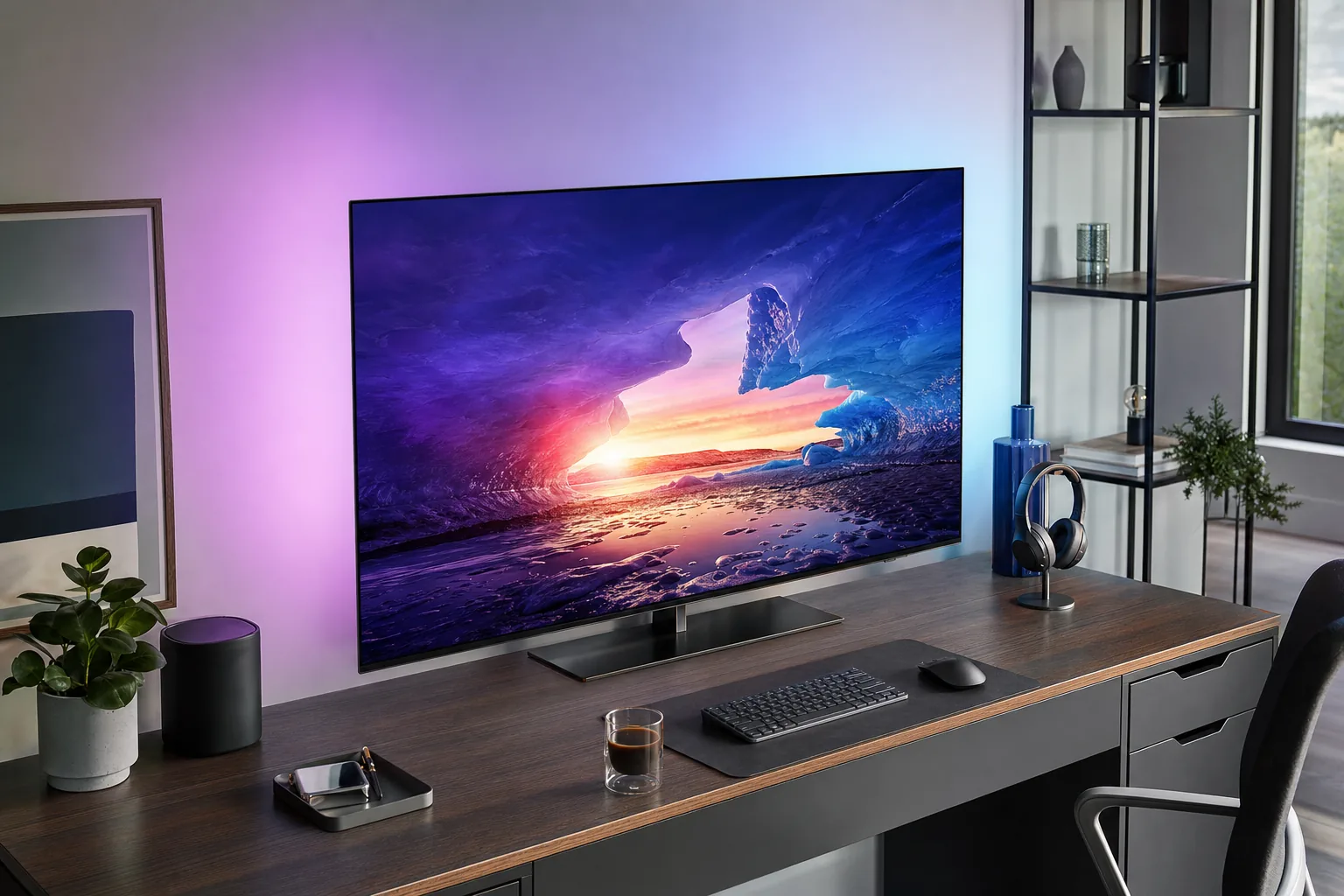
The panel is an OLED EX variant driven by Philips' 7th-generation P5 Perfect Picture Engine. Trusted Reviews measured 760 nits on a 10 per cent window with specular highlights reaching 925 nits; Expert Reviews recorded 904 cd/m² on a 2 per cent window alongside 145 cd/m² full-field. It handles small bright highlights well and struggles with large bright scenes — the standard entry-OLED story. Gaming is well covered: four HDMI 2.1 ports all capable of 4K at 120Hz, VRR from 48Hz, FreeSync Premium, ALLM, Dolby Vision Gaming and around 13ms of input lag in Game mode.
The reservations are practical rather than technical. Expert Reviews flagged just 20mm of clearance beneath the panel, which will foul a lot of soundbars, and wide-set feet that rule out narrower TV units. Audio is a modest 2 × 10W. The software is Titan OS, Philips' own platform: quick, carrying the UK Freely service, but with a thinner app catalogue than Google TV, weak voice search and a business model leaning on advertising. Plug in a Sky box or an Apple TV and none of that troubles you.
Both dynamic HDR formats
Dolby Vision and HDR10+ are both supported, so no streaming service falls back to basic HDR10 on this set.
Freely built in
Live UK channels stream over broadband without an aerial, which matters in flats and areas with poor terrestrial reception.
Pros
- The only pick here with both Dolby Vision and HDR10+.
- Three-sided Ambilight genuinely improves dark-room viewing.
- Four HDMI 2.1 ports at 4K/120 with roughly 13ms input lag.
- Freely support for aerial-free live television.
Cons
- Only 20mm of clearance under the panel, so most soundbars block the screen.
- Wide-set feet demand a broad TV unit.
- Titan OS has a narrower app catalogue and weaker voice search.
- Just 2 × 10W of audio; 145 cd/m² full-field is modest.
5. LG OLED55B56LA — 55 Inches With Dolby Vision
See LG OLED55B56LA on Amazon UK
The 55-inch B5 sits at around £899 at Argos and Hughes, and about £900 on Amazon, which answers a specific question: what if you want 55 inches and refuse to give up Dolby Vision? Samsung's S85F is cheaper and brighter but has none. The Philips is the same money with both HDR formats but runs Titan OS. This is the LG-flavoured option, with webOS and its excellent UK app coverage.
Specification-wise it is the 48-inch B5 stretched: α8 Gen2 processor, standard W-OLED panel, four 48Gbps HDMI 2.1 ports all doing 4K/120, VRR, ALLM, eARC, G-Sync compatibility and FreeSync Premium, 20W of audio and 120Hz maximum refresh. The 668 nits Cinema and 637 nits Standard figures apply — stretching the same panel across 55 inches does not make it brighter.
Shop this one hardest. Comparison sites recorded the 55-inch B5 as low as £608 within the previous three months against a £900 high, a swing of nearly £300 on the same television. If it is at £899 when you look, set an alert and wait a fortnight.
Pros
- A 55-inch OLED with Dolby Vision and webOS for around £899.
- Four full-bandwidth HDMI 2.1 ports, all 4K/120 capable.
- Has been seen far cheaper — a strong candidate for a price alert.
Cons
- Dimmer and £150 more than the Samsung S85F at the same size.
- No HDR10+, and 120Hz rather than the C5's 144Hz.
- Price volatility punishes buying at the wrong moment.
6. LG OLED42C5 — Best Small OLED and Best Desk Screen
The 42-inch C5 is a different proposition. From £749 at specialist retailers, rising to around £849 at Currys, Hughes and LG's own store, it is not cheap per square inch — a 55-inch Samsung costs less. What it is, is the best 42-inch screen you can put on a desk or in a bedroom. There is no reliable Amazon UK listing for it at the moment, so treat this as a specialist-retailer purchase and shop the comparison sites.
The full C-series specification survives the shrink: 144Hz maximum refresh, four HDMI 2.1 ports, G-Sync and FreeSync Premium, VRR, ALLM, Dolby Vision and webOS 25. As a PC monitor it is close to unbeatable at the size, with per-pixel contrast no desktop LCD can approach. Audio drops to 20W across two channels rather than the 48-inch model's 40W 2.2 system.
Like the 48-inch, it sits outside LG's brightness marketing claim, so treat it as the dimmest C5 rather than assuming it matches the 55-inch. Price behaviour is worth watching too: it ranged between £649 and £849 in the three months before we checked and briefly hit £611 at Amazon in June 2026. If you can wait for a sale, wait.
Pros
- 144Hz and four HDMI 2.1 ports in a desk-friendly 42-inch panel.
- Per-pixel contrast no 42-inch LCD monitor can match.
- Full webOS 25 and Dolby Vision; has dropped to £611 in sales.
Cons
- Poor value per inch against the 55-inch options.
- Audio drops to 20W, and it is excluded from LG's brightness claim.
- Frequently £100 more at mainstream retailers than at specialists.
Near Misses: The Sets That Almost Made It
Several televisions get mentioned in "cheap OLED" conversations that do not actually qualify, or no longer do.
Panasonic Z85A (55-inch, TV-55Z85AEB). A genuinely lovely television — TechRadar measured 697 nits in Standard and 778 in Filmmaker Mode on a 10 per cent window, with average Delta-E figures of 1.1 for greyscale and 1.2 for colour, exceptional accuracy at any price. It runs Fire TV, supports Dolby Vision IQ and HDR10+, and its 2 × 15W speakers plus 20W woofer make it the best-sounding set here. Two problems: only two of its four HDMI ports are 2.1, and UK availability has dried up. Richer Sounds lists it as discontinued; elsewhere it was £849 out of stock or £1,099 in stock when we checked.
LG C5 (55-inch). The obvious upgrade, sitting agonisingly close at about £999 from the cheapest listings. That is technically under a grand, but only just and only at some retailers. If you find it there it is the best television in this article — full C5 brightness, 144Hz, four HDMI 2.1 ports and a proper 55-inch panel. Just do not assume the £799 quoted for the 48-inch applies here.
Samsung S90F (48-inch). Carried a £999 list price and fell to £788 during Amazon's spring sale in March 2026, with a 144Hz Motion Xcelerator mode and four HDMI 2.1 ports. It is now being cleared and Richer Sounds lists it as no longer available. Worth grabbing if you see one, but not something to plan around. Note that the 42, 48 and 83-inch S90F models use white-OLED panels, not the QD-OLED found at 55, 65 and 77 inches.
Sony Bravia 8 (55-inch) and Philips 65OLED760. Both are frequently mentioned as budget OLEDs and neither qualifies. The cheapest UK Bravia 8 listing we found was £1,199, with Sony's own store at £1,399; the 65-inch OLED760 starts at about £1,099 and has not, as far as we can establish, gone below £1,000 here.
Panasonic 65Z80AEY. This 2024 Fire TV OLED is the one 65-inch set that has genuinely appeared under £1,000, and John Lewis lists it as reduced to clear. It has 2 × HDMI 2.1 plus 2 × HDMI 2.0, Dolby Vision and HDR10+, a 300 × 200 VESA mount and weighs 26.5kg with its stand. Richer Sounds has already stopped selling it. A clearance hunt, not a shopping trip.
The 65-inch reality
There is no 65-inch OLED you can reliably walk into a shop and buy for under £1,000 in August 2026. What exists are clearance units of 2024 models that appear and disappear. If 65 inches is non-negotiable and £1,000 is a hard ceiling, a good Mini LED set is the sensible purchase and there is no shame in it.
Burn-in in 2026: What the Evidence Actually Says
This is the question that stops more OLED purchases than any other, so let us deal with it properly rather than dismissing it or catastrophising.
Burn-in is permanent uneven wear. OLED pixels are organic compounds that dim slowly with use, and if one part of the screen shows the same bright static element for thousands of hours while the rest displays varied content, that area ages faster and leaves a faint ghost. It is wear, not a fault that appears overnight.
The best public evidence is RTINGS' accelerated longevity test, which ran close to three years and accumulated more than 10,000 hours on most of the televisions involved. Of 102 sets, the great majority came through it, and OLED models outperformed LCDs on overall longevity. Varied viewing produced no meaningful burn-in; the sets that suffered were showing static bright elements for many hours a day, every day, for years.
Translate that into normal life. If you watch a mix of films, drama, sport and the occasional game, your OLED will outlast your interest in it. If you leave a rolling news channel with a static logo and a bright ticker running six or more hours every day, or use the set as a permanent PC display, you are in the risk zone the testing identified.
Modern sets fight back automatically. LG's OLED Care menu includes Screen Move, which nudges the image by a few pixels so static elements never sit on the same subpixels; Logo Luminance Adjustment, which dims static bright logos; and Pixel Cleaning, which runs roughly every 2,000 hours and triggers after you switch off. Samsung's equivalent is OLED Safeguard+. Leave these on — they are on by default.
The UK warranty position, honestly. LG's five-year panel warranty applies to the G, M, W and Z ranges from 2021 onwards — it does not cover the C-series or B-series sets in this guide. Year one covers panel, parts and labour; years two to five cover only the panel, with labour chargeable. LG has previously told reviewers that image retention is not treated as a product defect. Separately, under the Consumer Rights Act 2015 your contract is with the retailer, not the manufacturer, and you have up to six years in England, Wales and Northern Ireland (five in Scotland) to pursue a claim — but only where a statutory right such as satisfactory quality has been breached. In practice, a retailer with a long own-brand guarantee is the strongest protection available; Richer Sounds includes six years on the televisions it sells.
When to Buy, and Whether You Should Wait
OLED pricing follows a rhythm, and knowing it is worth a couple of hundred pounds.
New models are announced at CES in January and reach UK shelves through spring, with firm launch prices because no old stock competes with them. Through summer the previous generation starts sliding, and the steepest falls come from mid-October as Black Friday approaches — a six-week season now rather than a weekend. The lows in these sets' price histories cluster in that window: the 55-inch LG B5 touched £608 within the previous three months against a £900 high, and the 42-inch C5 fell to £611 during a June sale.
So should you wait? If you want a specific set at the best price and can live with your current television until December, yes. Set an alert, decide the number you would be happy to pay, and buy the moment it appears. These are last-generation models being cleared, so the risk is not that the price rises — it is that stock runs out entirely, as it has for the Panasonic Z85A and the 48-inch Samsung S90F.
If you are waiting for the 2026 models to become affordable, do not. The C6 opens at £1,299 for a 42-inch and £2,499 for a 65-inch, and last-generation pricing on those is a 2027 story. Our LG C6 guide covers what the newer set adds, our G6 versus C6 versus G5 comparison shows where the extra money goes, and we tackled the timing question in budget OLED TVs have arrived, but should you wait.
One further note. The 2026 entry-level sets — LG's B6, Samsung's S85H, Panasonic's Z85C and Philips' OLED761 — use a new LG Display panel called OLED SE. When those start discounting in late 2027, this page will look very different.
What Actually Matters When You Are Spending Under £1,000
Spec sheets at this price are full of things that sound important and are not, and quiet omissions that change how you live with the television.
Your room, before anything else. Every set here peaks between roughly 630 and 820 nits on a 10 per cent window, with full-screen figures of about 130 to 170 nits. A bright wall of sky in a daytime match will not dazzle. If your viewing is mostly evening, curtains-closed film and drama, that is a non-issue and the perfect blacks are pure profit. If your television faces a south-facing patio door and you watch a lot of afternoon sport, a Mini LED set at the same money will serve you better.
HDMI 2.1, counted properly. Not "does it have HDMI 2.1" but how many ports, at what bandwidth, and whether one is the eARC port. Both LG models and the Samsung and Philips give you four; the Panasonic Z85A gives you two. With a PS5, an Xbox Series X and a soundbar, two is not enough, because the soundbar's eARC connection eats one.
HDR format support. LG and Philips do Dolby Vision; LG does not do HDR10+. Samsung does HDR10+ and will not do Dolby Vision, because Dolby charges a licence fee and HDR10+ does not. Philips is the only set here doing both. The difference is modest — a Dolby Vision film played in HDR10 still looks like HDR — but heavy Netflix and Apple TV viewers meet Dolby Vision most often.
Refresh rate, honestly. The gap between 120Hz and 144Hz matters to PC gamers running uncapped frame rates and to nobody else. Every console tops out at 120Hz.
Sound, and the space beneath the screen. Only the 48-inch LG C5 goes beyond 20W, with a 40W 2.2-channel system. Everything else needs a soundbar sooner or later — which makes the Philips OLED760's 20mm of under-panel clearance a planning issue rather than a footnote.
Smart platform and its advertising. webOS, Tizen and Titan OS all carry promoted content on the home screen in 2026, with Titan OS the most aggressively ad-funded by design. None of it matters if you plug in an Apple TV or a Fire Stick and never see the built-in home screen again.
Who Should Buy Which
Short version, by the kind of buyer you are rather than by which set scored highest.
Most people: LG OLED48C5
Around £799 for the complete LG specification — 144Hz, four full-bandwidth HDMI 2.1 ports, Dolby Vision and the best speakers here. If 48 inches suits your room, buy it.
Want the biggest screen: Samsung QE55S85F
From £749 for a 55-inch OLED, the brightest measured result here and a six-year Richer Sounds guarantee. Accept no Dolby Vision and ads on the home screen.
Tightest budget: LG OLED48B56LA
About £649 is the least you can spend on real OLED in Britain. Four HDMI 2.1 ports, 9ms input lag in game mode, and the dimmest panel here — keep it out of direct sun.
Film obsessives: Philips 55OLED760
£899 for the only set with both Dolby Vision and HDR10+, plus Ambilight that makes dark-room viewing easier on the eyes. Check your soundbar clears the 20mm gap.
Desk and bedroom: LG OLED42C5
From £749 for a 42-inch, 144Hz, Dolby Vision panel that works as well as a PC monitor as it does as a television. Poor value per inch, unbeatable at the size.
55 inches with Dolby Vision: LG OLED55B56LA
Around £899 and prone to falling much further. If you want a big LG with webOS rather than Samsung's Tizen, set an alert and pounce.
Frequently Asked Questions
The Bottom Line
Under £1,000 buys a genuinely good OLED in Britain in August 2026, because 2025 stock is being cleared to make room for sets costing twice as much. The 48-inch LG C5 at about £799 is the one to buy for most people: the full C-series specification, four proper HDMI 2.1 ports, 144Hz, Dolby Vision and the only decent speakers here. Watch the model code — it is the C55LA variant that carries that price.
If screen size is the point, the 55-inch Samsung QE55S85F at £749 is the most television per pound here, provided you can live without Dolby Vision. If you want to spend as little as possible, the 48-inch LG B5 at roughly £649 is real OLED with real gaming credentials. And if films are the point, the Philips 55OLED760 at £899 supports both dynamic HDR formats and has Ambilight.
Be honest about one thing before you spend. Every set here sits between 630 and 820 nits at its brightest. In a dim room they are magnificent. In a sun-filled conservatory they are not, and no amount of wanting an OLED will change that. Get that judgement right and you will have bought the best television of your life for less than a grand.
- Philips 55OLED760View on Amazon