
QLED vs OLED vs Mini-LED: What's the Difference (and Which Should You Buy)?
Self-lit pixels, quantum dots and thousands of backlight zones, decoded in plain English. How each TV technology actually works, where each one wins, and exactly which to buy for your room, your sofa and your budget.
1. The one distinction that explains everything: self-lit vs backlit
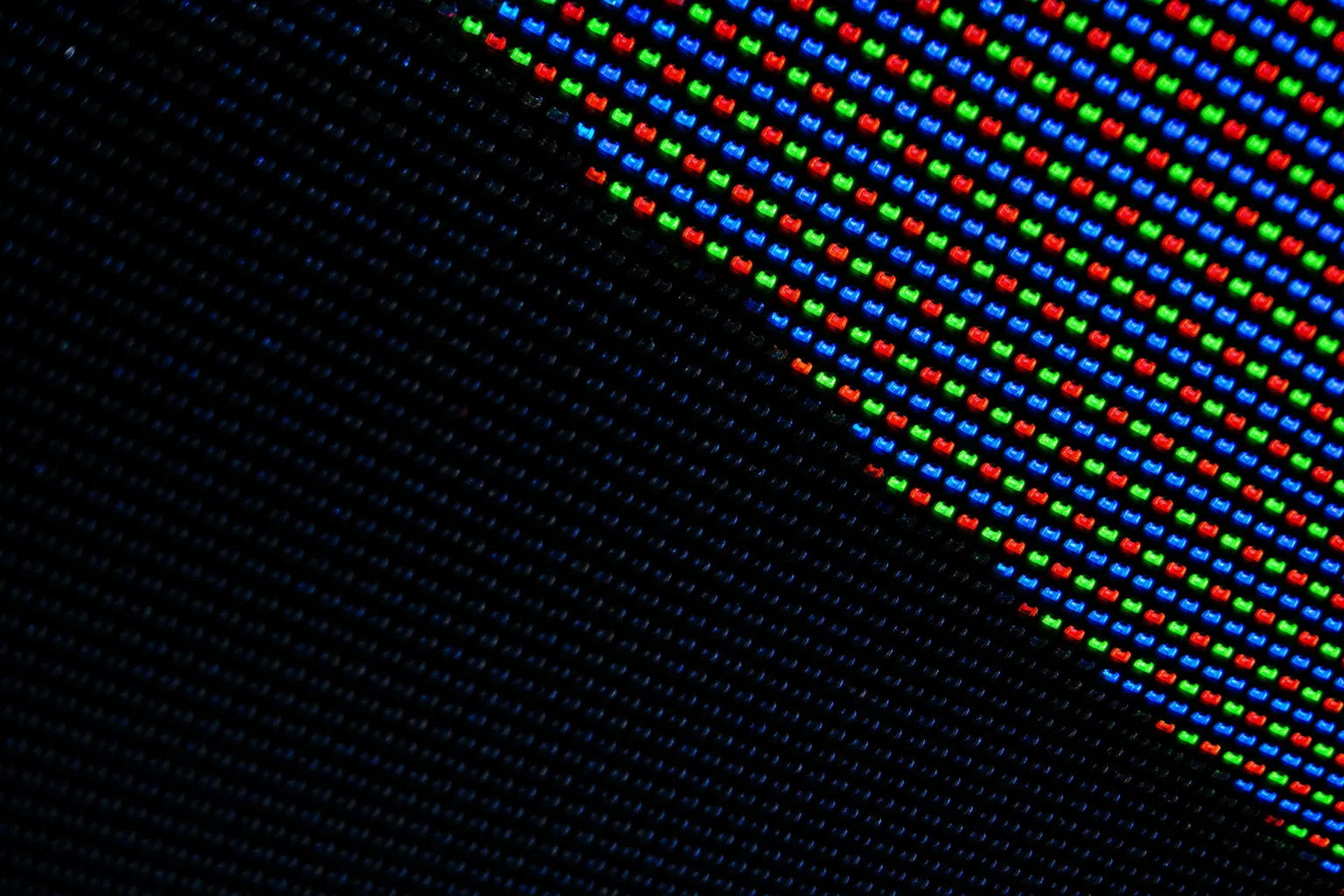
Before any brand name matters, you need exactly one idea: there are only two ways a television creates the light you see. Either each pixel makes its own light, or a separate light source sits behind the screen and shines through a layer that colours it. That single fork in the road is the difference between OLED on one side, and everything with the letters LED or LCD in it - including QLED and Mini-LED - on the other.
OLED is self-emissive. Every one of the roughly eight million pixels on a 4K OLED panel is its own tiny light, and crucially each can switch itself completely off. When an OLED shows a black pixel, that pixel produces no light at all - it is genuinely off. That is why OLED can place a brilliant star in a pitch-black night sky with no glow around it: the pixels next to the star are simply dark.
QLED and Mini-LED are backlit LCDs. Both are, underneath all the marketing, liquid-crystal display (LCD) televisions. They have a separate backlight - a sheet or grid of LEDs - that is always shining. In front of it sits the LCD layer, which acts like millions of microscopic shutters twisting open and closed to let more or less light through, plus colour filters to tint it. The catch is that an LCD shutter can never close completely, so a little light always leaks. That is why a backlit TV showing "black" is really showing a very dark grey, and why controlling that backlight cleverly is the entire game for LCD-based sets.
The 30-second version
OLED = millions of self-lighting pixels, perfect blacks, no backlight. QLED = an LCD TV with a quantum-dot layer for richer, brighter colour. Mini-LED = an LCD TV whose backlight uses thousands of tiny LEDs, grouped into local-dimming zones for far better contrast. Watch the zone count rather than the LED count — they are different numbers, and many sets have hundreds of zones rather than thousands. QLED describes the colour layer, Mini-LED the backlight - and many premium TVs are both at once.
Almost every strength and weakness we cover below - black levels, brightness, viewing angles, burn-in, even price - flows directly from whether a pixel lights itself or relies on a backlight behind it.
2. OLED in detail: the contrast champion
OLED stands for Organic Light-Emitting Diode - "organic" referring to carbon-based compounds that glow when you pass a current through them. Print millions in a grid, give each pixel its own circuitry, and you have a panel where light and colour are controlled at the level of the single pixel rather than across a whole zone.
Why OLED looks the way it does
Because each pixel is independent, OLED delivers an effectively infinite contrast ratio: the brightest white sits right next to a true, lightless black with nothing in between. This is the single biggest reason OLED pictures look so three-dimensional and "real". Shadow detail in a dark film is preserved without the murky grey wash of a backlight struggling to switch off, and there is no haloing around bright objects on dark backgrounds, because there is no backlight to bloom.
OLED also has superb viewing angles: sit off to the side - a real consideration for a family sofa or an open-plan room - and the picture holds its colour and contrast where an LCD washes out and fades. Motion handling is excellent too, thanks to near-instant pixel response, which keeps fast sport and gaming clean with no smearing behind moving objects.
The two flavours: WOLED and QD-OLED
Not all OLEDs are built the same. The long-established type, made by LG Display and used by LG, Sony and Philips, is WOLED (white OLED): white-emitting pixels behind red, green and blue colour filters, often boosted by a "micro lens array" (MLA) to focus more light forwards. The newer type, made by Samsung Display, is QD-OLED (quantum-dot OLED), used by Samsung and Sony's flagships: it passes blue OLED light through quantum dots to generate purer red and green, giving punchier colour in bright highlights.
In practice both are superb and the gap is narrower than spec sheets suggest. QD-OLED has historically edged ahead on colour and full-screen brightness, while the best WOLED panels with MLA push very high peak figures on small highlights. Either way, an OLED is an OLED first: you are buying perfect blacks and pixel-level control whichever sub-type the box mentions.
3. QLED in detail: quantum dots, brightness and the marketing trap
QLED is the term Samsung coined and the industry adopted, and it is the most misunderstood word in the TV aisle. It is tempting to read "QLED" as a sibling of "OLED" - one letter apart, surely related? It is not. A QLED is a backlit LCD television; the Q stands for quantum dot, and that layer is the innovation.
What quantum dots actually do
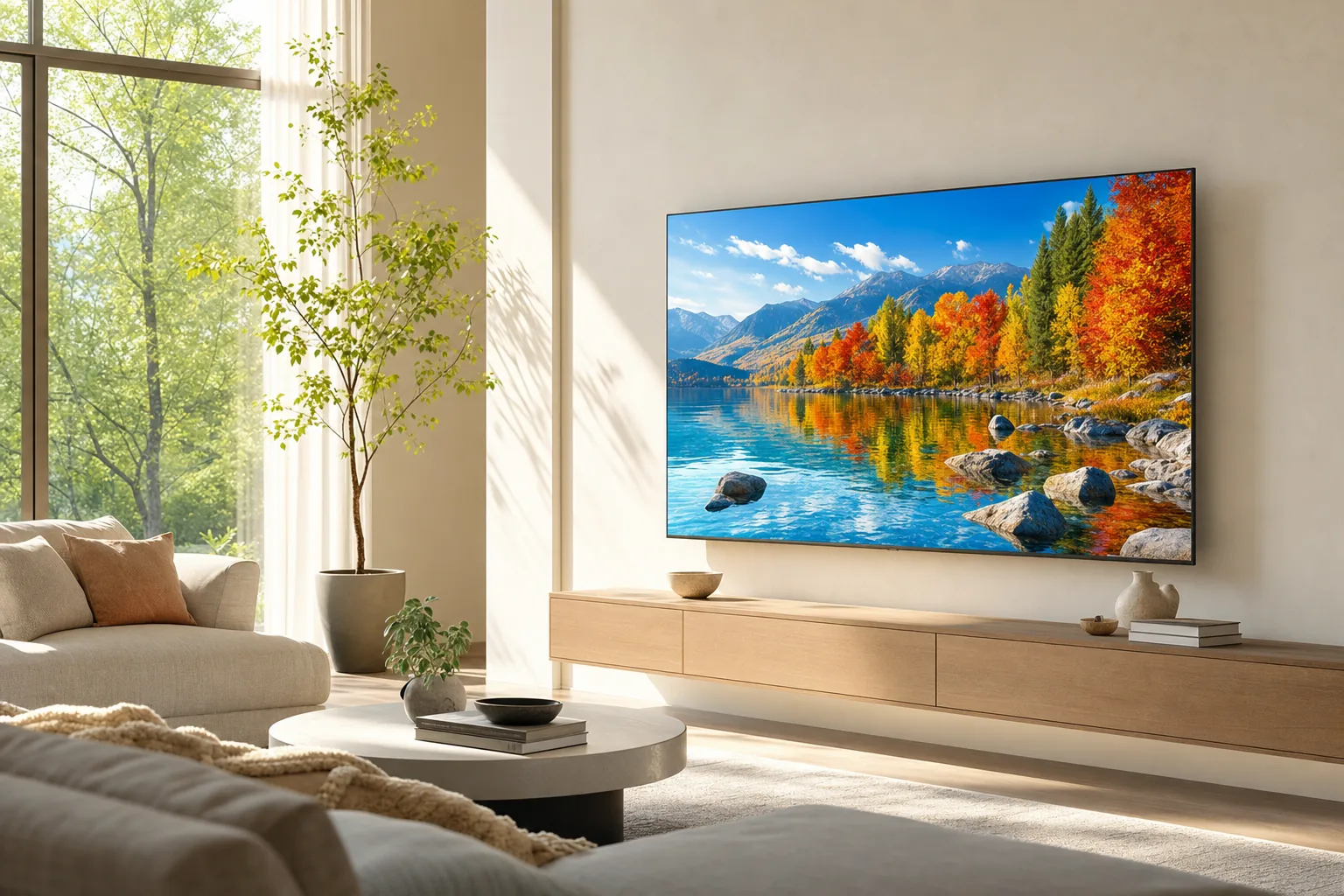
Quantum dots are nanoscopic crystals that, when hit by light, re-emit it as an extremely pure colour - and the exact colour depends only on the size of the dot. Put a film of them in front of an LED backlight and you get a light source both brighter and far purer than a plain LED. The payoff is a wider colour gamut (more shades, especially vivid reds and greens) and excellent colour volume (colours stay saturated even when the image is very bright). This is why a good QLED looks spectacularly vibrant with bright content in a sunlit room.
The trap: not all QLEDs are equal
Here is the catch the marketing hopes you miss. "QLED" only tells you the TV has a quantum-dot colour layer. It tells you nothing about the backlight behind it, and the backlight is what decides contrast. A cheap QLED can use a basic edge-lit backlight - a strip of LEDs along one side - with no meaningful local dimming. That set has great colour but mediocre blacks and obvious clouding, because the whole screen brightens and dims more or less together. A premium QLED pairs quantum dots with a Mini-LED backlight (more on that next) and looks transformatively better.
Buyer's warning
A budget "QLED" with no local dimming is one of the most disappointing purchases in the TV aisle: lovely colour, but disappointing contrast that an old plasma would have shamed. Always check whether a QLED has full-array local dimming or, better, a Mini-LED backlight. Colour is only half the picture - literally.
So treat QLED as a colour technology, not a contrast one. It answers "how rich are the colours and how bright can it go?" - not "how good are the blacks?". For that, you have to look at the backlight.
4. Mini-LED in detail: the backlight revolution
If QLED is about colour, Mini-LED is about the backlight - and it is the single most important advance in LCD televisions of recent years. It is also the technology that lets backlit TVs fight back against OLED on the one front where they were always weakest: contrast and black levels.
From a handful of zones to thousands
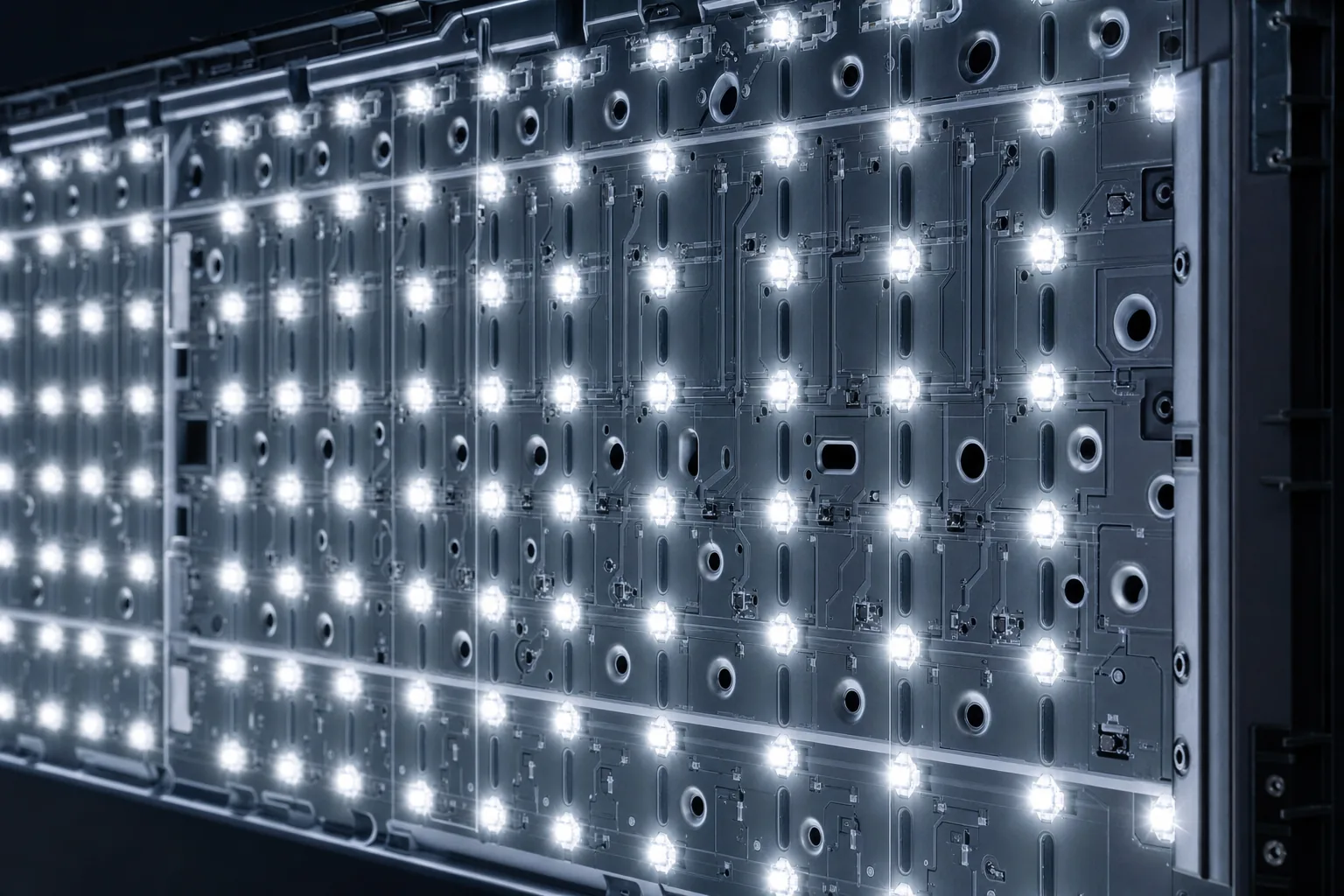
Every backlit TV that does "local dimming" divides its backlight into zones that brighten and dim independently. The more zones, the more precisely the TV can keep dark parts of the image dark while bright parts stay bright. A conventional full-array LED set might have a few dozen to a few hundred zones; a Mini-LED set uses thousands of physically tiny LEDs to push that into the thousands - and the very best 2026 flagships now reach many thousands of zones across the panel.
The result is a dramatic leap in contrast. With thousands of zones, a Mini-LED TV can render a dark scene with deep, convincing blacks and still hit searing brightness in the highlights, getting much closer to OLED's pixel-level control than older LCDs managed. For bright, punchy HDR - a sunlit landscape, a neon cityscape, a snowfield - a top Mini-LED can look breathtaking.
The unavoidable compromise: blooming
There is still a fundamental limit. Thousands of zones is a lot, but it is not millions of pixels. When a small bright object - subtitles, a star, a streetlight - sits on a pure-black background, the zone lighting it is larger than the object, so a faint halo can leak around it. This is blooming (or "haloing"), the one artefact that gives away even an excellent Mini-LED in a dark room. Processing fights it hard, and on the best sets it is barely noticeable, but it never disappears entirely the way it does on OLED.
One more naming clarification: QNED is LG's marketing term for its quantum-dot Mini-LED TVs - effectively the QLED-plus-Mini-LED combination under a different badge. Do not let the acronym throw you; it is the same two ideas (quantum-dot colour, Mini-LED backlight) wearing a different hat.
5. Contrast and black levels: where the technologies really split
This is the battleground, and where your eyes notice the difference most. Contrast - the gap between the darkest black and the brightest white a screen shows at once - is the single biggest contributor to a picture that looks rich, deep and "real" rather than flat and washed out.
OLED wins outright. Because each pixel switches off, OLED's blacks are absolute and its contrast is, for practical purposes, infinite. There is no blooming, no clouding, no grey wash in the letterbox bars of a film. In a darkened room watching a moody, cinematic title, nothing else comes close - the picture seems to float on the wall with no boundary between the image and the dark.
A premium Mini-LED comes impressively close. With thousands of dimming zones, the best Mini-LED sets deliver deep blacks and tremendous contrast that satisfy the vast majority of viewers, while hitting higher peak brightness than OLED can manage. The only tells are faint blooming around small bright objects and slightly less perfect shadow detail in the very darkest scenes. In a normally-lit room, most people would struggle to fault one.
A basic QLED without local dimming falls behind. Its blacks are really dark grey, often with uneven patches of cloudiness across the panel. Colour can still pop, but the lack of contrast control gives the picture a flatter look the moment a dark scene appears - the most common mismatch between price and performance in the aisle.
If contrast and black-level perfection are your priority - and for film in a controllable room, they probably should be - the ranking is clear: OLED first, premium Mini-LED a strong second, basic QLED a distant third.
6. Brightness and the bright-room question
If contrast is OLED's home turf, brightness is where backlit TVs hit back - and for a great many UK living rooms it is the spec that matters most, because most of us watch with daylight pouring in, lamps on, and a window opposite the screen reflecting everything.
How bright is bright?
Brightness is measured in nits, and the headline figures get exaggerated shamelessly. In real testing, today's best OLEDs reach roughly 1,500 to over 2,000 nits on small highlights - hugely improved from a few years ago, and more than enough to make HDR sparkle in a normal room. The best Mini-LED flagships push higher still, around 2,500 to 3,000-plus nits, and - just as importantly - they sustain high brightness across a larger portion of the screen for longer.
Beware the headline nit number
Manufacturers love to quote eye-watering peak figures (4,000 or even 4,500 nits has been claimed for 2026 panels), typically measured on a tiny fraction of the screen for a split second. Real, sustained, full-screen brightness is far lower - often a few hundred nits - and that figure is what governs how a TV copes with a bright, sunny scene or a sport broadcast. Treat peak numbers as marketing and judge a TV on reviews that measure real-scene brightness.
The bright-room verdict
For a sun-drenched, glary room, a high-end Mini-LED is usually the smarter buy. It has more raw light to overpower glare, it holds full-screen brightness better (vital for daytime sport on a big bright pitch), and its anti-glare coatings are often excellent. OLED has closed the gap and a good one is perfectly watchable in a bright room, but in the very brightest conditions a Mini-LED keeps the punch where an OLED can look muted. As a rule of thumb: bright room, lots of daytime and sport, favour Mini-LED; controllable or dim room, films and quality over headroom, favour OLED.
7. Gaming: 120Hz, VRR, HDMI 2.1 and input lag
If you game on a PlayStation 5, Xbox Series X or a gaming PC, the panel matters - but so does a checklist of features that cut across all three. Get the features right first, then choose the panel.
The gaming feature checklist (applies to all panel types)
- HDMI 2.1 ports - the high-bandwidth connection needed for 4K at 120Hz. Check how many; budget sets often include only one or two, and a soundbar or second console can eat them quickly.
- 4K 120Hz (and increasingly 144Hz for PC) for silky, high-frame-rate gaming.
- VRR (variable refresh rate, including FreeSync and G-Sync compatibility) to eliminate tearing and stutter when frame rates fluctuate.
- ALLM (auto low latency mode), which switches the TV into its low-lag Game Mode automatically when a console wakes.
- Low input lag - the delay between controller and screen. Under about 15 milliseconds in Game Mode is excellent.
Which panel for gaming?
OLED is the enthusiast's choice. Its near-instant pixel response gives the cleanest motion, its perfect blacks make dark games atmospheric, and modern OLEDs offer extremely low input lag plus the full suite of gaming features on their HDMI 2.1 ports. The only asterisks are the static-image concern we cover next and dialling brightness back for very long sessions.
Mini-LED is the bright-room and value gaming choice. The best gaming Mini-LEDs deliver superb brightness for vivid HDR games, strong contrast and the same 120Hz/VRR/HDMI 2.1 feature set, with zero burn-in worry - ideal if your console doubles as the family screen showing static dashboards for hours. The trade-offs are slightly less perfect motion than OLED and the familiar blooming in dark scenes.
If you also game on a laptop, our guide to the best gaming laptops covers the same refresh-rate and panel trade-offs on a smaller scale - the principle is identical: features first, panel second.
8. Burn-in, longevity and the honest risk assessment
No OLED conversation is complete without burn-in, and it is an area drowning in both scaremongering and dismissal. Here is the measured truth for 2026.
What burn-in actually is
Burn-in (more accurately, permanent image retention) is when a static element displayed at high brightness for very long periods causes the OLED pixels there to age faster than their neighbours, leaving a faint permanent ghost - think a channel logo, a 24-hour news ticker, a game's HUD or a computer taskbar left on, bright, for hundreds of hours. It is a characteristic of self-emissive OLED; backlit QLED and Mini-LED sets are effectively immune because their light source is uniform and separate.
How real is the risk in 2026?
For normal, varied viewing - films, streaming, mixed TV, gaming across different titles - the risk is very low. Modern OLEDs include a battery of mitigations: pixel-shifting that nudges the image, logo-dimming that automatically darkens detected static graphics, and periodic "compensation" refresh cycles that even out pixel wear. For the vast majority of households the panel will look perfect for its sensible lifetime.
When to think twice about OLED
Burn-in becomes a genuine consideration if the TV will spend many hours a day on a single static source: a rolling news channel left on as background, a shop display, or use as a desktop PC monitor with a fixed taskbar. In those cases a Mini-LED or QLED is the safer long-term bet. For a normal home with varied content, OLED is nothing to lose sleep over.
A few sensible habits remove almost all residual risk: avoid leaving a paused game or static channel on for hours, don't run the panel at maximum brightness all day, and let the TV perform its automatic maintenance cycles. Do that and a modern OLED will serve a typical household faithfully for years.
9. Picking by what you actually watch
Specs are abstract; your sofa habits are not. The cleanest way to choose is to think about what fills your screen most evenings, then let that decide.
Films and "proper" cinema nights
If you dim the lights and take films seriously - moody dramas, dark sci-fi, anything a director shot for the shadows - OLED is the default. Perfect blacks, no blooming around subtitles, flawless shadow detail and wide viewing angles make it the closest thing to a cinema picture in the home. Pair it with a decent soundbar and a controllable room and nothing at the price looks better.
Daytime TV, sport and bright family viewing
If the TV lives in a bright, busy room and earns its keep with daytime telly, the news, kids' programmes and weekend football, a high-end Mini-LED is often the wiser choice. The extra brightness cuts through glare, full-screen brightness holds up on a sunlit pitch, and there is no burn-in worry from hours of static scorebugs and channel logos.
Mixed gaming and movies
For a console handling both cinematic single-player games and the occasional film, OLED rewards you with the best motion and contrast - just be mindful of very long sessions with a static HUD. If the same screen shows hours of static dashboards or doubles as a monitor, lean Mini-LED.
One TV that does a bit of everything
For the classic all-rounder - the only TV in the house, a normal living room - both an OLED and a premium Mini-LED will delight you, and the deciding factor becomes your room's light and your budget. Bright room and lower budget tip towards Mini-LED; darker room and a love of film tip towards OLED.
10. Price tiers in 2026: what your money buys
2026 is a strong year for value: OLED has fallen sharply from its early-adopter days, and Mini-LED has spread down the range. These are broad UK ballparks for 55-inch and 65-inch sets, and everything drops further around Prime Day and Black Friday.
The budget tier (roughly £350-£600)
Basic QLED and plain LED-LCD sets, usually edge-lit with little or no local dimming. Colour can be good thanks to quantum dots, but contrast is weak. Fine for a kitchen, spare room or undemanding daytime viewing; not the place to spend if picture quality is your priority.
The mid tier (roughly £600-£1,100)
Entry-level Mini-LED sets and genuinely good full-array QLEDs live here, offering a big step up in contrast and HDR punch. For a bright family room on a sensible budget, this tier is the value heartland - and where many buyers will be happiest.
The premium tier (roughly £1,200-£2,500 and up)
OLED TVs and the very best Mini-LED flagships sit here. Entry OLEDs have become remarkably affordable, while top Mini-LEDs with thousands of zones and the brightest panels command the high end. This is the tier for the best picture your money can buy.
The smartest-money move
The best value in TVs is almost always last year's flagship, discounted after the new range lands. A previous-generation premium OLED or Mini-LED routinely beats this year's mid-ranger for the same money, because picture quality improves slowly year on year. Watch for new models in spring, then pounce on the outgoing flagships - our roundups of the latest LG C6 OLED and the LG OLED line-up compared show where prices are heading.
11. What's next: RGB Mini-LED, Micro RGB and the road ahead
It helps to know what is genuinely coming versus what is years-away marketing. 2026 is a busy year for new display tech, but most of it sits at the very top of the market for now.
RGB Mini-LED: the headline upgrade
The biggest 2026 story is RGB Mini-LED (Samsung calls its version Micro RGB), where the backlight LEDs themselves produce red, green and blue light directly, rather than a single colour of LED filtered through quantum dots. The benefit is dramatically wider, purer colour even at high brightness, while keeping Mini-LED's contrast strengths. Several brands have flagship sets, and some push further still - adding a fourth colour (cyan or yellow) for even more of the spectrum. It is real, it looks superb, and it is currently very expensive.
Micro LED: the long-term endgame
Micro LED (not Mini-LED) combines OLED's self-emissive perfection with LED's brightness and immunity to burn-in: millions of microscopic LEDs, each its own pixel, with no separate backlight. It is stunning - and, in 2026, the price of a small car and available only in enormous sizes. The future, but not this year's.
Should you wait?
No. There is always something better around the corner in TVs, and the gap between a great 2026 OLED or Mini-LED and these emerging technologies is far smaller than the gap between those flagships and a bargain-bin set. Buy the best OLED or Mini-LED your budget allows today, enjoy it for years, and let early adopters fund the next leap. The fundamentals in this guide - self-lit versus backlit, contrast versus brightness, OLED for the dark room and Mini-LED for the bright one - will still be the questions that matter when you next upgrade.
Frequently asked questions
Is QLED better than OLED?
Neither is simply 'better' - they excel at different things. OLED has perfect blacks, infinite contrast and the best picture in a dark room, making it the choice for film lovers. A premium QLED (especially one with a Mini-LED backlight) goes brighter, resists burn-in and is often better in a sunny room. A basic QLED with no local dimming, however, is genuinely worse than OLED for picture quality despite its bright colours. The honest answer depends on your room and what you watch.
What is the difference between QLED and Mini-LED?
They describe different parts of the same kind of TV. QLED refers to the quantum-dot layer that improves colour brightness and purity. Mini-LED refers to a backlight built from thousands of tiny LEDs. Those LEDs are grouped into local-dimming zones, and it is the zone count — often in the hundreds — that decides how much better the contrast actually gets. Many premium TVs are both at once: a quantum-dot (QLED) colour layer in front of a Mini-LED backlight. QLED answers 'how good is the colour?'; Mini-LED answers 'how good is the contrast?'.
Does OLED still suffer from burn-in in 2026?
The risk is very low for normal, varied viewing. Modern OLEDs use pixel-shifting, automatic logo-dimming and periodic compensation cycles that make burn-in a non-issue for the vast majority of households watching films, streaming and mixed content. It only becomes a real concern if the TV displays the same static image - a rolling news channel, a shop display, or a PC desktop with a fixed taskbar - for many hours a day, every day. In those cases a Mini-LED or QLED is the safer choice.
Which is best for a bright living room?
A high-end Mini-LED is usually the smarter pick for a bright, sunny room. It produces more raw brightness to overpower glare, sustains full-screen brightness better for daytime sport, and typically has strong anti-glare coatings. OLED has improved a lot and a good one is perfectly watchable in daylight, but in the very brightest conditions a Mini-LED keeps more punch. For a controllable or dim room, OLED's perfect contrast wins instead.
Which technology is best for gaming?
OLED is the enthusiast's choice thanks to near-instant pixel response (the cleanest motion), perfect blacks and very low input lag. Mini-LED is the bright-room and value choice, with huge brightness for HDR games, the same 120Hz/VRR/HDMI 2.1 features and no burn-in worry from static HUDs. Whichever you pick, check the feature list first: enough HDMI 2.1 ports, 4K 120Hz, VRR and low input lag matter more than the panel name for a great gaming experience.
Is it worth waiting for RGB Mini-LED or Micro LED?
Not for most buyers. RGB Mini-LED (and Samsung's Micro RGB) is real and excellent in 2026 but currently sits at the very top of the price range. True Micro LED is stunning but costs as much as a car and only comes in enormous sizes. There is always something better coming in TVs - the sensible move is to buy the best OLED or Mini-LED your budget allows now, enjoy it for years, and let the next generation mature and fall in price before you upgrade again.
The bottom line: which should you actually buy?
Forget the wall of acronyms and remember the one distinction that drives everything: OLED lights each pixel itself for perfect blacks and unbeatable contrast, while QLED and Mini-LED are bright, colourful backlit LCDs that fight to control a separate light source. From there the choice is genuinely simple. Watch films in a room you can darken and care most about contrast and cinema feel? Buy an OLED. Have a bright, busy room full of daytime telly and sport, want maximum brightness and zero burn-in worry, or are shopping on a tighter budget? Buy a good Mini-LED - and make sure any "QLED" you consider has a real Mini-LED or full-array backlight, not just quantum dots over a basic edge-lit panel.
Whatever you choose, two rules will save you money and disappointment: ignore the headline peak-brightness numbers and trust real-scene measurements from reviews, and hunt down last year's discounted flagship rather than this year's mid-ranger. Get the panel right for your room and your habits, and a 2026 TV will reward you for years. For where to go next, our LG C6 OLED guide and soundbar recommendations will help you finish the job.