
Best Meross Smart Home Devices: Affordable Matter Kit That Just Works
Five sensible Meross picks for plugs, garage doors and lighting — with a very important distinction between genuine Matter hardware and good old-fashioned Wi-Fi smart-home gear.
We link to the exact model on Amazon UK. Prices change often, so check the live price before you buy. As an Amazon Associate we earn from qualifying purchases.
Meross covers several very different jobs: controlling power, opening garage doors and adding colour lighting without turning the house into a science project.
Meross is one of those smart-home brands that makes far more sense when you ignore the marketing blur and focus on the individual product in front of you. The best bits are genuinely affordable, work with the major voice platforms and avoid subscriptions where rivals sometimes start rattling a digital collection tin. The catch? Not every Meross device is a Matter device. That matters rather a lot.
The affordable Meross kit, with one important Matter caveat
There is a very likeable idea at the centre of a Meross setup. Start small. Add a plug to monitor an appliance. Put a controller on the garage door so you can stop wondering whether you shut it. Add a bulb or a compact lamp for the bits of the house that could use a little atmosphere after dark. None of this needs to cost the earth, and most of it can be controlled from the same Meross app alongside Apple Home, Alexa or Google Assistant.
But this is not a single, uniform technology family. The Meross MSS315 is the standout if you specifically want Matter: Meross explicitly confirms Matter over Wi-Fi, Matter Multi-Admin and compatibility through Matter with Apple Home, Google Home, Alexa and SmartThings. It is the foundation stone here.
The garage controllers and lights are different. The MSG100, MSG200, MSL120 and MSL430 are well-established Wi-Fi products with support documented for Apple Home/HomeKit, Siri, Alexa and Google Assistant, plus SmartThings support on the lighting products. They can still be very useful in a mixed smart home. They just should not be bought on the assumption that every box contains a Matter logo and a shortcut to platform utopia.
The short version
Buy the MSS315 if Matter interoperability is the priority. Choose the other four because they suit their particular job: one garage door, several garage doors, a colour bulb or a bedside lamp. That is a much happier route than trying to force every product into the same protocol-shaped hole.
All five picks use 2.4GHz Wi-Fi. That is usually helpful for range through brick walls and into garages, but it also means your router setup is part of the purchase decision. A smart plug cannot fix a flaky network, sadly. It has many talents, but wizardry is not one of them.
The five categories are pleasantly straightforward. The MSS315 is an energy-monitoring smart plug. The MSG100 is a retrofit controller for one garage door. The MSG200 handles up to three doors and adds an external antenna. The MSL120 is an RGB bulb for existing fittings, while the MSL430 is an integrated ambient lamp with touch controls. They overlap in app control, schedules and voice support, but their real-world roles are very different.
The MSS315 is the one product here with Matter-over-Wi-Fi explicitly confirmed, making it the sensible anchor for a budget Matter-first setup.
Five picks, one quick route to the right Meross device
If you are in a hurry, here is the clean buying map. The MSS315 is my overall pick because it is the only product in this selection that is clearly and explicitly Matter-over-Wi-Fi. It also adds energy monitoring, which turns a humble plug into a useful detective for appliances that quietly nibble away at your electricity bill.
The MSG100 is the sensible one-door garage option. It is not as glamorous as a glowing smart lamp, but few smart-home upgrades are more satisfying than checking the garage from the sofa rather than standing outside in the rain wondering whether you pressed the remote. The MSG200 is for bigger garages and awkward Wi-Fi positions, although its historical reliability record deserves a proper warning label. More capability does not automatically mean more peace of mind.
For lighting, the MSL120 is the inexpensive all-round bulb: 810 lumens, RGB colour and adjustable white from 2700K to 6500K. The MSL430 is more specialised. It is an ambient lamp rather than a main-room bulb, and its touch controls make it a better bedside or desk companion than a bulb hidden behind a lampshade.
| Product | Category |
|---|---|
| Meross MSS315 / MSS315MA | Energy-monitoring smart plug |
| Meross MSG100 / MSG100HK | Single-door garage controller |
| Meross MSG200 / MSG200HK | Multi-door garage controller |
| Meross MSL120 family | RGB smart bulb |
| Meross MSL430 / MSL430HK | Ambient table lamp |
Pick by job, not by app logo
A matching app is convenient, but it should not decide the purchase. The right bulb is still the right bulb if it has the correct cap, brightness and room role. Likewise, a garage controller only earns its keep if it works with your specific opener and your garage Wi-Fi is dependable.
The setup rules that decide whether Meross feels effortless
Every device in this guide relies on 2.4GHz IEEE 802.11 b/g/n Wi-Fi. That old familiar band gets a bad rap because it is slower than 5GHz, but speed is not the point here. A light bulb is not trying to download a feature film. Range matters more, particularly when the device lives behind a washing machine, at the end of a garden room or halfway down a chilly garage wall.
The usual stumbling block is a modern router that presents 2.4GHz and 5GHz under one network name. Many routers handle this gracefully, but some setup processes become needlessly fussy when a phone hops between bands while you are pairing a device. If installation starts behaving like a hostage negotiation, temporarily separating the bands or using your router's dedicated IoT network can make life calmer.
Start with stable 2.4GHz coverage
Before fitting a garage controller, stand in the garage with your phone and see whether the 2.4GHz connection is genuinely reliable. A device can only obey a command that actually reaches it.
Matter needs more than a Wi-Fi password
The MSS315 needs an existing 2.4GHz and IPv6 network, plus a Matter-compatible hub or controller when you want to add it to Apple Home, Google Home, Alexa or SmartThings.
Keep the Meross app installed
The app remains useful for energy history on the MSS315 and practical features such as garage-door alerts, schedules and automation settings.
Check the regional hardware, every time
Plug shapes, mains ratings and bulb caps vary by region. Do not assume a family name tells you everything about the item in the basket.
Matter Multi-Admin is the MSS315's big interoperability advantage: one plug can be shared among compatible ecosystems. The other Meross devices can still work across familiar platforms, but they should be added according to their own documented integrations rather than treated as Matter products by default.
There is also a small but important philosophical difference. A Matter plug is built around a common smart-home language, while older Wi-Fi/HomeKit devices often rely on their own platform links and app integrations. In daily use, both can be perfectly fine. The benefit of Matter is not that a lamp suddenly becomes brighter or a garage door opens faster. It is that your choice of assistant and smart-home platform has more room to change later.
Plug in the Matter foundation
1. Meross MSS315 / MSS315MA — Best for affordable Matter energy monitoring

See Meross MSS315 Matter smart plugs (4-pack) on Amazon UK
Check today's price & availability on Amazon UK
The Meross MSS315 earns the top spot because it does the thing the headline promises without any footnotes doing cartwheels underneath it. It is a genuine Matter-over-Wi-Fi smart plug, supports Matter Multi-Admin and works across the major ecosystems when you have the appropriate Matter-compatible controller. For a budget smart home, that combination is extremely compelling.
It is also more useful than a basic on/off plug. The MSS315 provides live and historical energy reports in the Meross app, so you can see what an appliance is doing over time rather than merely guessing. That is handy for lamps, fans, dehumidifiers, AV kit and the assorted mystery devices that live under a desk with three extension leads and a suspicious amount of dust.
The regional qualification is important enough to say twice. The UK/EU MSS315/MSS315MA version is rated for 100–240V at 50/60Hz and up to 16A or 3,680W. US documentation lists a 15A maximum. Those are not interchangeable details, so UK buyers should choose the proper UK/EU SKU rather than assuming that similarly named listings are identical.
In testing, the energy monitor was strongest at typical household loads. Measurement error was reported at +2.9% at 8W, -0.2% at 60W and -6.6% at 2W. It was much less dependable at the extremes: -100% at 0.5W and approximately -26.7% at 1,500W. Put plainly, it is useful for understanding normal appliance use, but it is not a precision instrument for tiny standby loads or high-load accounting.
Its own power use was measured at 0.7W in standby and 1.2W when on. That is not ruinous, but it is worth remembering when your whole reason for buying a smart plug is shaving fractions from a power bill. Smart-home maths is occasionally less romantic than smart-home adverts.
Pros
- Confirmed Matter-over-Wi-Fi support with Multi-Admin.
- Useful live and historical energy reports in the Meross app.
- UK/EU version supports loads up to 16A / 3,680W.
- Compact plug format with a physical on/off button and status LED.
- Works locally within the Matter architecture.
Cons
- Needs a Matter-compatible controller for major ecosystem setup.
- Energy readings are weak below 1W and at around 1,500W.
- Uses 2.4GHz Wi-Fi only.
- No USB charging ports, which is sensible but worth knowing.
MSS315 US official-store bundle
Four-pack listed in stock, equivalent to roughly $13.25 per plug before any local pricing differences.
Best use case
Use the MSS315 on appliances where switching and ordinary energy visibility are both useful. It is a much better fit for a fan, lamp, AV stack or everyday appliance than for anything requiring precise sub-watt measurement or detailed high-load billing analysis.
A Matter plug is most useful where it can do two jobs at once: switch a device remotely and reveal its day-to-day energy habits.
The sensible one-door garage upgrade
2. Meross MSG100 / MSG100HK — Best for a single garage door on a budget
See Meross MSG100 on Amazon UK
Check today's price & availability on Amazon UK
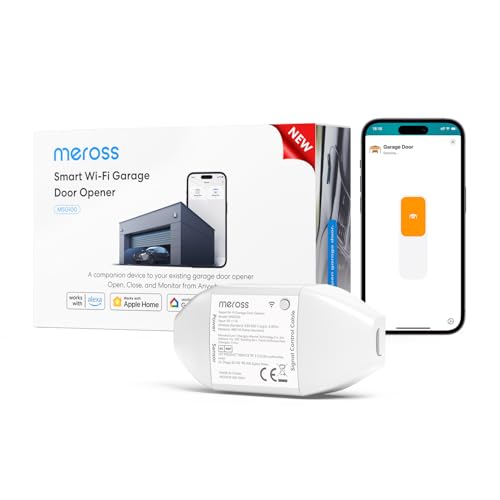
The MSG100 is the practical garage pick for a home with one compatible opener. It is not an elegant little gadget you admire on a shelf. It is a wired retrofit box that does a specific, slightly boring job very well when installed correctly: it lets you open, close and check one garage door from the Meross app or supported voice platforms.
Meross confirms Apple Home/HomeKit, Siri, Alexa and Google Assistant support. It also claims compatibility with more than 200 brands and around 1,600 opener models, although that should be treated as an invitation to use the compatibility checker rather than a guarantee that every garage opener ever made will salute politely. Certain Chamberlain, LiftMaster and Craftsman systems in the US and Canada may need an accessory.
The installation involves connecting the controller to the opener and fitting the wired magnetic or position sensor so the system knows whether the door is actually open or closed. That last part is important. A remote command alone is not enough; you want status reporting, alerts and the confidence that the garage is shut before bed.
The MSG100 offers auto-close, overtime and overnight alerts, operation history and remote control without a subscription fee. Those are sensible quality-of-life features. If the garage is used for bikes, tools, freezers or a side entrance into the house, an open-door notification can be worth more than the ability to shout "close garage" at a speaker from the kitchen.
Installation is not completely carefree. A PCWorld/TechHive review found the wiring and sensor placement more laborious than some rivals, and it observed occasional 5–10 second response delays when opening the door. That does not make the controller unusable; garage doors are not race cars. But it does mean this is a device to install carefully, test repeatedly and keep on a solid network.
Pros
- Controls one compatible garage door with proper open/closed status sensing.
- Useful auto-close, overtime and overnight alerts.
- Apple Home/HomeKit, Siri, Alexa and Google Assistant support.
- No subscription fee for core app features.
- Long sensor cable gives flexibility for installation.
Cons
- Requires wired installation rather than a simple plug-in setup.
- Not the pick to buy for confirmed Matter support.
- Occasional 5–10 second command delays were observed in hands-on testing.
- Compatibility needs checking before purchase.
Garage automation is not the category for blind faith. Test the physical operation, the sensor status and the auto-close behaviour several times while you are at home. A smart notification is useful; a correctly fitted sensor is better.
The official US store listed the MSG100 at $49.99 with limited stock. Check the latest price and any current bundles on Amazon.
More doors, more reach — but not automatically more reliability
3. Meross MSG200 / MSG200HK — Best for multi-door garages and difficult Wi-Fi positions
The MSG200 is the larger garage proposition. Its headline advantage is simple: it can control up to three garage doors, where the MSG100 is limited to one. It also has an external antenna intended to improve reception in garages, which can be a genuinely meaningful upgrade if the opener is at the far end of a detached building or behind the kind of wall that seems to have been constructed mainly to frustrate wireless signals.
There is a practical detail to keep in mind. Two sensor cables are included. If you want to control all three doors, you need a separate additional kit for the third. That does not spoil the concept, but it does mean the headline capacity is not quite the same thing as three-door operation straight from the box.
On paper, it is a tidy consolidation product. A three-car garage does not need three separate controllers, three power supplies and three spots in the app. The MSG200 also retains the genuinely useful stuff: operation history, notifications, auto-close and the closing alarm. Apple Home/HomeKit, Siri, Alexa and Google Assistant are supported too.
Here is the blunt bit. A TechHive review reported around a 50/50 success rate for open and close commands during testing, with successful actions often taking 10–15 seconds. It also encountered response-timeout errors and called out the messiness of wired sensor installation. That is a serious historical reliability concern, not a tiny nitpick from somebody annoyed by an extra menu tap.
There are more positive owner accounts, particularly where the external antenna helped a weak Wi-Fi situation. But those reports are anecdotal, and I would not let them erase the controlled review result. If the MSG200 is the only neat way to cover multiple doors, its capacity and antenna remain good reasons to consider it. Just build in some setup time and be ready to improve garage Wi-Fi if the initial experience is sluggish.
Pros
- Controls up to three garage doors from one controller.
- External antenna is useful for difficult garage Wi-Fi positions.
- Includes open-door reminders, auto-close and operation history.
- Built-in closing alarm adds an extra safety cue.
- Can reduce clutter compared with fitting separate single-door controllers.
Cons
- Only two sensor cables are included for a three-door-capable system.
- Not a confirmed Matter product.
- Historical testing found roughly 50% command success.
- Successful commands could still take 10–15 seconds.
MSG200HK US official-store price
Sale price listed by Meross; the regular price was $79.99 and promotions varied.
Buy it for the antenna and door count, not for blind optimism
The MSG200 makes sense when a single controller for several doors is genuinely useful, especially in a garage with marginal Wi-Fi. If reliability matters more than consolidation, test it thoroughly during the return period and do not ignore timeouts as "probably fine".
The MSG200's external antenna is its meaningful hardware advantage, but multi-door convenience should be weighed against its mixed reliability history.
The inexpensive colour bulb that gets the basics right
4. Meross MSL120 / MSL120HK / MSL120DAHK — Best for affordable RGB room lighting
The MSL120 is the uncomplicated lighting choice in this roundup. It is an A19 Wi-Fi RGB bulb with 810 lumens of white-light output, 9W power consumption, dimming and adjustable white between 2700K and 6500K. That makes it versatile enough for a desk lamp, bedside lamp, living-room side light or any fitting where you want proper white light during the day and colour scenes in the evening.
The regional cap choice matters here. Meross sells E26, E27 and B22 versions depending on region. UK buyers should select the correct E27 or B22 version for the fitting rather than relying on the MSL120 family name alone. A smart bulb that does not fit is still, at heart, just a small expensive ornament.
It works with Apple HomeKit and Siri, Alexa, Google Home/Assistant and SmartThings, and no dedicated hub is required. Bluetooth Low Energy is used during setup, while daily operation is over 2.4GHz Wi-Fi. Apple Home users also get Adaptive Lighting support, which is a handy way to let the white tone shift through the day without manually fiddling with sliders at breakfast.
Colour performance needs sensible expectations. A hands-on review found that white light could reach the stated 810 lumens, but saturated colours become visibly dimmer. That is normal for RGB bulbs. The same review noted colour differences compared with Philips Hue at similar settings. If you want the most refined colour matching, Hue remains the more premium option; its White and Colour Ambiance A60 E27 1100 bulb reaches up to 1,100 lumens, but costs £54.99 for one bulb.
The Meross bulb's strength is that it does not demand the same budget or a bridge-based system. It is a solid choice for adding colour and tunable white to rooms where you simply want the light to behave better, not become the headline act.
Pros
- 810 lumens provides useful white light for a standard bulb.
- RGB colour, dimming and 2700–6500K tunable white.
- No dedicated hub required.
- Works with Apple HomeKit, Alexa, Google Assistant and SmartThings.
- Adaptive Lighting support is useful for Apple Home households.
Cons
- Not the pick to buy for confirmed Matter support.
- Saturated colours are dimmer than white-light output.
- Colour matching is less consistent than Philips Hue in reviewer comparisons.
- Correct E27 or B22 regional fitting must be chosen.
MSL120HK US official-store two-pack
Sale price listed by Meross, with a regular price of $36.99.
If Matter is the requirement, look beyond this particular bulb rather than reading more into a platform icon than the specifications support. The Philips Hue White and Colour Ambiance A60 E27 1100 is one clear premium alternative, with Bluetooth, Zigbee and listed Matter compatibility. It is brighter, more expensive and part of a much more mature bridge ecosystem. The Meross is the no-fuss, lower-cost route when Wi-Fi and established voice integrations are enough.
A compact lamp for bedside scenes and softer light
5. Meross MSL430 / MSL430HK — Best for compact bedside and ambient lighting
The MSL430 is not trying to replace a bright ceiling bulb, and that is exactly why it works. It is a compact Wi-Fi table lamp for bedside tables, shelves, desks and those awkward corners where a normal bulb gives off too much glare but a little ambient light makes the room feel finished.
It offers RGB colour, tunable white from 2700K to 6500K, dimming and 16-million-colour control. More importantly for its intended role, it has top-mounted touch controls for power, brightness and colour. That means you can use it like a normal lamp when half awake, rather than needing to summon an assistant just to find the slippers.
Touch control that makes sense
The top controls are a real practical advantage in a bedroom or on a desk. App control is excellent until your phone is charging in another room.
Colour for atmosphere, white for daily use
RGB scenes handle softer evening mood lighting, while 2700–6500K white gives you a more useful range for reading, working or winding down.
Schedules and timers
Set a quiet wake-up scene, a bedtime routine or an automatic evening glow without having to remember it every night.
Compact footprint
The lamp measures 10.0 × 10.0 × 19.5cm, so it is easier to place on a crowded bedside table than a larger decorative lamp.
The MSL430 works with Apple HomeKit, Alexa, Google Assistant and SmartThings, using 2.4GHz Wi-Fi. It takes 12V at 500mA and is designed for indoor use, with an operating temperature range of 0–40°C. There is no battery, so think of it as a mains-powered accent lamp rather than something to carry around the house or take into the garden.
It is also worth being honest about what is not measured. There are favourable impressions of diffuser quality and responsiveness, but no independent lux, colour-accuracy, thermal or power-draw benchmark to lean on. That does not make it a bad buy. It simply means the case for it is about its form factor, controls and flexibility rather than a hard claim that it outshines every rival in its category.
Pros
- Useful bedside-friendly touch controls.
- RGB colour plus 2700–6500K tunable white.
- Compact 10.0 × 10.0 × 19.5cm body.
- Schedules, timers, app control and voice control.
- Works with Apple HomeKit, Alexa, Google Assistant and SmartThings.
Cons
- Not a replacement for high-output main-room lighting.
- Not the pick to buy for confirmed Matter support.
- No battery for portable use.
- Independent brightness and colour measurements are limited.
MSL430HK US official-store price
Product-page price for the MSL430HK US variant; the wider Meross lighting collection lists $46.99 as an undiscounted price.
Choose the MSL430 when you want a lamp that is pleasant to use without a phone. For a bedside table, physical touch controls are not a minor extra; they are the bit you will notice every evening.
The MSL430 is best thought of as a soft, controllable accent lamp for a bedside table, desk or shelf rather than a substitute for a main ceiling light.
Matter, HomeKit or plain Wi-Fi — choose the right ecosystem strategy
Smart-home buying goes wrong when people buy a protocol rather than a product. Matter is useful because it gives compatible devices a common route into Apple Home, Google Home, Alexa and SmartThings. For the MSS315, that is exactly the appeal: one affordable plug can sit in a mixed-platform home without demanding that everyone uses the same app or assistant.
For the other Meross devices, the question is more practical. Do you already use Apple Home? Great: the garage controllers and lights have documented HomeKit support. Use Alexa or Google Assistant? They are supported too. The MSL120 and MSL430 also have confirmed SmartThings support. That may be all you need.
Choose MSS315 for a Matter-first home
It is the clear option if Multi-Admin and future ecosystem flexibility matter more than any particular Meross app feature.
Choose HomeKit-compatible products for an Apple-led home
The MSG100, MSG200, MSL120 and MSL430 can be useful additions when Apple Home is your day-to-day control layer.
Voice control is convenience, not a safety system
Voice commands are handy for lights and garage doors, but garage status alerts and correctly fitted sensors remain the features doing the serious work.
The sensible mixed setup
A realistic budget Meross home might use MSS315 plugs where Matter and energy reports matter, an MSG100 where garage alerts are useful, then MSL120 bulbs or an MSL430 lamp where inexpensive colour lighting is wanted. That is not a perfectly uniform Matter system. It is a useful system, which is better.
For comparison, the SwitchBot Garage Door Opener is a more explicitly Matter-focused garage alternative. It supports Matter over Wi-Fi, works with Apple Home, Google, Alexa and Samsung through Matter, and was listed at £38.99 for one pack. It also supports Wi-Fi and Bluetooth, with Bluetooth operation available without Wi-Fi. If Matter is non-negotiable for the garage rather than merely desirable elsewhere, that product deserves a serious look.
For plugs, TP-Link's Tapo P110M is another Matter energy-monitoring option, listed at £10.99 on sale in Tapo's UK store, with Matter 1.3 energy-monitoring support added by firmware in July 2025. Eve Energy is the pricier Thread alternative, launched with Matter in March 2023 at £39.95. The Meross choice is compelling when you want affordable Wi-Fi Matter; Eve makes more sense for a Thread-heavy home, while Tapo is a very sharp UK price rival.
Who should buy which Meross device?
There is no single "best Meross device" unless your home is strangely committed to only one kind of appliance. The right pick depends on the job, your existing platform and how much tolerance you have for wiring. Here is the quick version before checkout.
Matter-first starter
Buy: Meross MSS315. Best for building an affordable Matter setup, controlling appliances and checking ordinary household energy use. The UK/EU 16A / 3,680W rating is especially useful for appropriately rated mains appliances.
One-door homeowner
Buy: Meross MSG100. Best for one compatible garage opener when alerts, remote checking and voice control matter more than a fully wireless install.
Large or weak-signal garage
Buy: Meross MSG200. Best when up to three doors and an external antenna solve a real problem. Buy with eyes open about the mixed reliability history.
Budget colour lighting
Buy: Meross MSL120. Best for existing E27 or B22 fittings where 810 lumens, tunable white and RGB scenes are more important than Matter.
Bedside scenes and soft light
Buy: Meross MSL430. Best for a desk, shelf or bedside table where touch controls and ambient lighting are more useful than maximum brightness.
A mixed Meross setup works best when each device is chosen for its job: Matter plugs for interoperability, garage controllers for access and lights for atmosphere.
Gadget Scout verdict
Buy the MSS315 first if you want a genuinely affordable Matter product that also monitors energy. Add the MSG100 for one garage door, consider the MSG200 only if its multi-door capacity and antenna outweigh its reliability caveat, and treat the MSL120 and MSL430 as good-value Wi-Fi lighting rather than Matter purchases. That is the honest version of the Meross story — and it is still a pretty useful one.
Questions UK buyers will ask before checkout
The best budget smart-home setup is rarely the one with the most logos on the box; it is the one that fits your network, your fittings and the small daily annoyances you actually want to remove.
The bottom line
Meross is at its best when you buy selectively. The MSS315 is the clear recommendation for affordable Matter and practical energy monitoring. The MSG100 is a sensible single-door garage retrofit, the MSG200 is a specialist multi-door option with a reliability warning, and the MSL120 and MSL430 are straightforward Wi-Fi lighting buys for colour and ambience. Start with the problem you want to solve, verify the regional version, and let the smart home stay useful rather than fussy.
- Meross MSS315 Matter smart plugs (4-pack)View on Amazon
- Meross MSG100View on Amazon