
Best large Bluetooth speakers for parties: which one should you take outside?
Six premium speakers, judged on what matters in a garden or a field: how loud they really go, how long the battery really lasts and how much effort it takes to get them there.
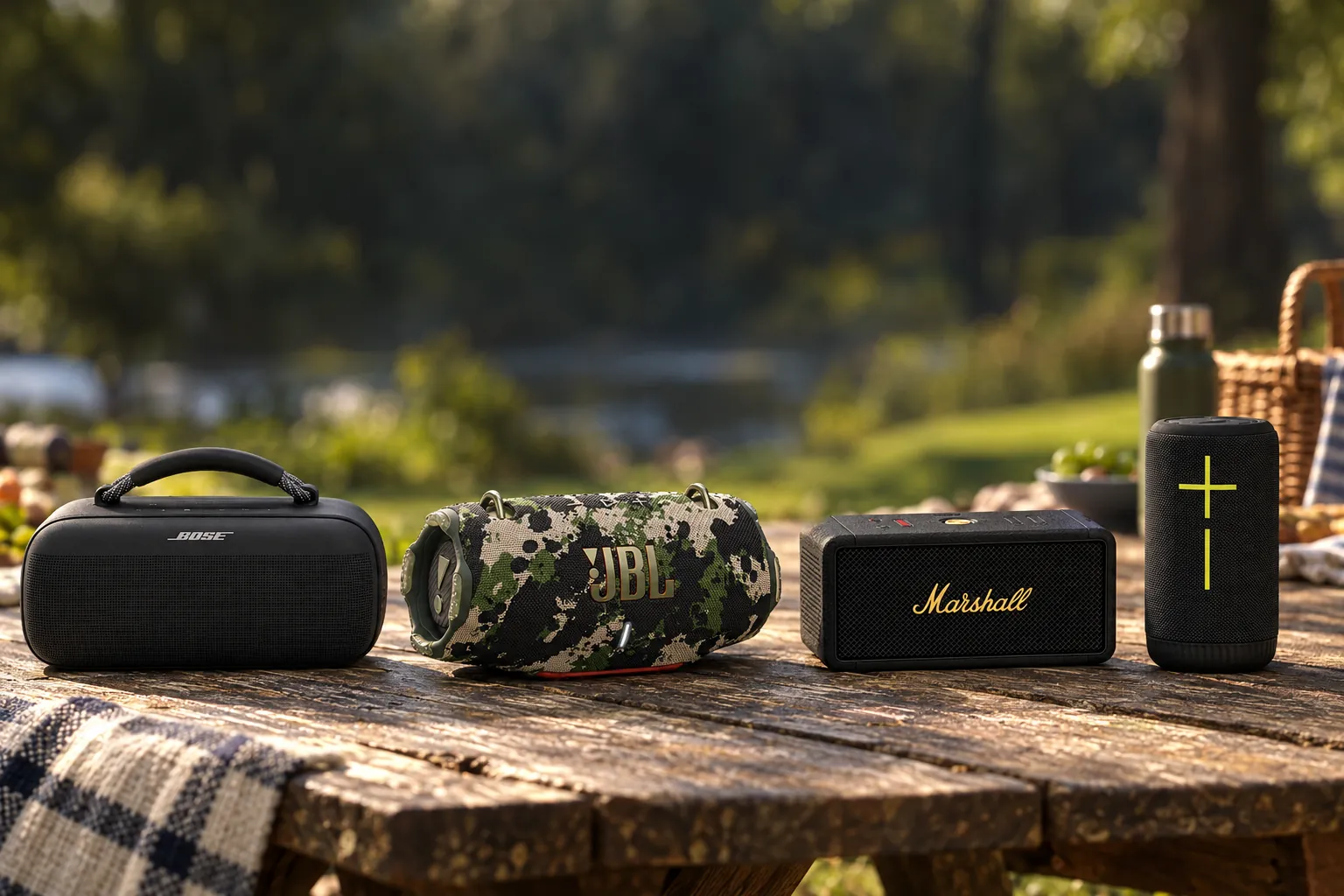

Measured 98dB and over 43 hours in lab testing, with low compression at full volume plus AUX and phone charging.
Check price on Amazon
Beat its 24-hour rating at 27.2 hours, charges phones and has a replaceable 68Wh battery.
Check price on Amazon
Compact 1.8kg stereo speaker with physical bass and treble controls, AUX input and IP67 protection.
Check price on Amazon
Floats, IP67-rated, drop-tested and just 960g, with even 360-degree sound and over 21 hours measured.
Check price on Amazon
Wi-Fi multi-room, AirPlay 2 and an included charging base make it a home speaker that also goes outside.
Check price on Amazon
Powerful, natural sound, broad streaming support and repairable modular build, but heavy and expensive for outdoor use.
Check price on AmazonWe link to the exact model on Amazon UK. Prices change often, so check the live price before you buy. As an Amazon Associate we earn from qualifying purchases.
The burgers are on, the neighbours have wandered over and somebody wants the music "a bit louder". That's when a portable speaker earns its place or doesn't: it runs flat at nine o'clock, croaks when pushed, or is too heavy to carry past the patio doors.
We've judged six premium speakers on sale in the UK against independent battery and volume measurements, not the numbers on the box.
The short answer
- Big garden, long evening: the Bose SoundLink Max reached 98dB and ran for over 43 hours in one lab's testing, and has a 3.5mm input for the guest with the old MP3 player.
- A weekend with no plug in sight: the JBL Xtreme 4 outlasted its 24-hour rating in independent testing, charges your phone and has a replaceable battery.
- Smaller gatherings and one-hand carrying: the 1.8kg Marshall Middleton brings genuine stereo drivers, physical bass and treble controls and plenty of character.
- The pool or the beach: the Ultimate Ears EVERBOOM floats and weighs under a kilo.
- The Sonos Move 2 and Bang & Olufsen Beosound A5 are Wi-Fi home speakers first. Buy them for the house and treat the garden as a bonus.
Loud, Big and Built for Outside: How We Judged These Six
An outdoor party is harder on a speaker than a living room: no walls to bounce bass back, an evening that runs long and drinks put down beside it. So we weigh four practical questions, not sound quality alone.
Measured battery versus claimed battery. Manufacturers quote runtime at moderate volume; parties aren't moderate. Where independent labs have run these speakers flat, we use their figures, and the gaps run both ways.
Maximum volume and compression. Compression is a speaker at its limit quietly reining in the bass to protect itself: louder on paper, thinner in practice. Staying composed near the top is worth more outside than a bigger headline number.
Weight and carry method. The six run from 960g to 3.8kg, with straps, handles, a carabiner and, in one case, a charging dock. That decides whether a speaker goes on the picnic or stays by the back door.
Bluetooth-only or Wi-Fi. The Sonos Move 2 and Bang & Olufsen Beosound A5 are Wi-Fi streamers that also do Bluetooth. They join multi-room systems, use AirPlay and tune themselves to the room, but are heavier and less weatherproof than the pure Bluetooth models, so they suit a different buyer.
Prices below are UK launch RRPs; several have been widely discounted since. The Xtreme 4 and Middleton have been succeeded by the Xtreme 5 and Middleton II. These listings are the earlier generations, no bad thing if the price has fallen to match.
| Speaker | Weight | Claimed battery | Water/dust rating | Wi-Fi | 3.5mm AUX in | Phone charging | UK launch RRP |
|---|---|---|---|---|---|---|---|
| JBL Xtreme 4 | 2.1kg | 24 hrs (+6 with Playtime Boost) | IP67 | No | No | USB-C power bank | £329.99 |
| Marshall Middleton | 1.8kg | 20+ hrs | IP67 | No | Yes | USB-C power bank | £269 |
| Bose SoundLink Max | 2.2kg | 20 hrs | IP67 | No | Yes | USB-C output | £399 |
| Sonos Move 2 | 3kg | 24 hrs | IP56 | Wi-Fi 6 | Via separate Sonos Line-In Adapter | USB-C output | £449 |
| Ultimate Ears EVERBOOM | 960g | 20 hrs | IP67, floats | No | No | No | £249.99 |
| Bang & Olufsen Beosound A5 | 3.8kg | 12+ hrs at 70dB | IP65 | Wi-Fi 6 | No | Qi wireless pad on top | £899 (Nordic Weave) |
Manufacturer specifications. Launch RRPs are historical reference points, not current prices.
JBL Xtreme 4: The Marathon Battery Pick With a Power Bank Built In
The Xtreme 4 is for people who never want to think about a charger. JBL rates it at 24 hours; RTINGS ran it for 27.2, making it one of three speakers here to beat its rating in independent testing. Inside is a 68Wh battery (7.2V/9,444mAh), and the USB-C port works both ways, so it can top up a flagging phone at the campsite.

The battery is also replaceable. The spare is sold separately and reviewers grumbled about its cost, but very few large portables offer this at all: when the cell wears out, you swap it rather than binning a good 2.1kg speaker.
Power depends on the source. On mains, the two 70mm woofers and two 20mm tweeters get 100W in total; on battery, 70W (2 × 20W woofers, 2 × 15W tweeters), so it's a little tamer at the far end of the field than in the kitchen. This listing has no mains adapter; a USB-C charge takes around 3.5 hours with a 20V/3A supply. JBL says ten minutes gives about two hours of play, though one review recorded closer to 90 minutes.
The bass-forward sound divided reviewers. A five-star review and a 2025 What Hi-Fi? Award praised tight, weighty bass and clear detail; another reviewer found the default low end underwhelming for its size until adjusted with the five-band EQ in the JBL Portable app. Bass compresses noticeably near maximum volume, stereo separation is narrow, almost mono, and Bluetooth latency is mediocre if you plan to watch films.
It's built for abuse: IP67, and in one review it floated on its side after being submerged in a sink and kept playing. There's a shoulder strap but no short grab handle, which some found awkward, and no AUX input, microphone for calls or aptX. Auracast links newer compatible JBL speakers, PartyBoost remains in the app, and two Xtreme 4s can pair in stereo. It launched in the UK on 14 March 2024 at £329.99 and has since been replaced by the Xtreme 5; this listing is the Squad camouflage finish.
Treat Playtime Boost as a reserve tank
Playtime Boost adds up to six hours by stripping out much of the bass and locking the EQ; two separate reviews found the result lean. Save it for the last hour of a long day.
Pros
- 27.2 hours in independent battery testing
- Replaceable 68Wh battery
- USB-C power bank for phones
- IP67, with Auracast and stereo pairing
Cons
- Output falls to 70W on battery
- Bass compresses near maximum volume
- Narrow, near-mono stereo
- No AUX, microphone or aptX; no mains adapter in this box
Marshall Middleton: Pocket-Sized Punch for the Smaller Garden Gathering
The Middleton looks like a shrunken guitar amp, brass detailing included, and at 1.8kg and 230 × 109 × 95mm it's a genuine one-hand carry, noticeably more compact than the Xtreme 4 or Bose. Only the EVERBOOM is lighter. A detachable strap helps on the walk to the park.
Check today's price: Marshall Middleton on Amazon UK
It's properly stereo: two 3-inch 15W woofers and two 0.6-inch 10W tweeters on 60W of amplification in total, with two passive radiators and True Stereophonic processing spreading sound around the cabinet. The tuning is punchy and bass-heavy even at low volume, with clear vocals, though mids are less distinct and the deepest bass is limited. It compresses at full tilt and lacks the output for a large open garden; its 87dB at 1m rating means patio, not field.
Adjust battery expectations. Marshall claims 20+ hours, but Which?'s lab measured 11 hours 30 minutes and another review about 12 hours at fairly loud volume, so plan around half the headline. A full charge takes 4.5 hours; 20 minutes buys about two hours.
Bass and treble adjust physically and in the Marshall Bluetooth app, though there's no full graphic EQ, and the central knob is fiddly: nudge it wrong and you skip a track instead of raising the volume. Bluetooth 5.1 gives 10m range; multipoint works but doesn't switch sources automatically. Stack Mode links compatible Marshalls, and the 3.5mm AUX input and USB-C power bank make it the more flexible small option for mixed-device households.
It launched in the UK on 31 January 2023 at £269 and has been succeeded by the Middleton II, which adds a microphone, a longer claimed runtime and a floating design. The original doesn't float, so treat its IP67 rating as protection against a dunking, not an invitation to swim.
| Compact contenders | Marshall Middleton | Ultimate Ears EVERBOOM | JBL Xtreme 4 |
|---|---|---|---|
| Weight | 1.8kg | 960g | 2.1kg |
| Claimed battery | 20+ hrs | 20 hrs | 24 hrs |
| Independent battery result | 11 hrs 30 min (Which?) | 21+ hrs (RTINGS) | 27.2 hrs (RTINGS) |
| Floats | No | Yes | Floated on its side in one review's sink test |
| 3.5mm AUX in | Yes | No | No |
| Phone charging | Yes | No | Yes |
| Buy | Check price | Check price | Check price |
Pros
- 1.8kg, compact and easy to carry
- Four-driver stereo with 360-degree spread
- Physical bass/treble, AUX input and power bank
- IP67 with a detachable strap
Cons
- Measured battery roughly half the claim
- Not enough output for large open spaces
- Fiddly control knob
- No microphone; doesn't float
Bose SoundLink Max: Stamina and Composure for the Big Garden
This is the speaker whose lab results made us look twice. TechGearLab measured 98dB at maximum and 43 hours 7 minutes of battery life, more than double Bose's 20-hour claim. RTINGS recorded a more conservative 15-plus hours, about 95.7dB maximum and only 2.55dB of compression at full volume: it still compresses at the very top, but holds its shape well. Either way, this is a speaker with stamina to spare and the composure to stay loud.

The spread shows how much volume and test method matter. Bose's own figure at maximum volume is about three hours.
Unlike the 360-degree speakers here, the Max fires forward in stereo from two 2.5-inch midrange drivers and a tweeter, backed by two racetrack-shaped passive radiators. Point it down the garden for a wide, full-scale image; people behind it hear less. The sound is lively, punchy and warm with a rich midrange, but the default tuning is very bass-heavy, and one review cut the bass by five or six points in the app for balance. Another found some midrange occasionally hard next to the more relaxed Sonos Move 2. There is no outdoor sound mode.
Connectivity is generous: a 3.5mm AUX input, USB-C that charges the speaker and can top up a phone, multipoint pairing and, according to launch-period reviews, aptX Adaptive alongside SBC and AAC. Two Maxes pair in stereo, Bose SimpleSync links compatible Bose products and the Bose app handles EQ and updates. The lack of microphone, Wi-Fi or voice assistant stings at this price.
A detachable handle makes the 2.2kg body easy to grab. The rear ports are exposed rather than behind a flap, which drew questions despite IP67, though Bose includes moisture detection. The optional strap is expensive. The SoundLink Max launched in the UK on 4 June 2024 at £399.
Check the box before party day. The UK package has the speaker, a USB-C cable and a safety sheet, but no mains charger. A full charge takes up to five hours with a 15W/3A USB-C supply, so buy one with the speaker and charge it the night before.
Pros
- 98dB and 43+ hours in one lab's testing
- Low measured compression at full volume
- Wide forward-firing stereo
- AUX input, phone charging, multipoint
Cons
- Bass-heavy default tuning needs taming
- Five-hour recharge, with no UK mains charger supplied
- No Wi-Fi, microphone or voice control
- Sound is less even behind the speaker
Sonos Move 2: When the Party Moves Between the Patio and the Kitchen
The Move 2 is a Sonos home speaker with a battery. Indoors it uses Wi-Fi 6, joins Sonos multi-room groups, plays via AirPlay 2, responds to Sonos Voice Control or Alexa and retunes itself with Trueplay when moved; outside it switches to Bluetooth 5.0. An included wireless charging base and 45W USB-PD adapter make the routine effortless: lift it off, carry it out, put it back.

The battery evidence is contradictory. Sonos claims 24 hours and one review matched it, losing about 4% per hour at roughly 25% volume over Wi-Fi; other tests gave 12.2 hours, and about 10 hours in outdoor use. Expect 24 hours for gentle background listening and 10 to 12 for a loud garden evening. Charging is steady rather than rapid: one test reached 41% after an hour on the base from flat.
Loudness is similarly mixed. One lab measured 98dB, level with the Bose. DXOMARK recorded 89.1dBA with pink noise and less with real music (85.2dBA for Latin, 82.9dBA for hip-hop, 78.2dBA for Asian pop), calling maximum loudness slightly below expectations, stereo width narrow despite the two angled tweeters, treble slightly dull and punch lacking. Other reviewers praised deep, controlled bass, cleaner vocals and composure at high volume, particularly outdoors. Fair summary: refined and weighty, but not a wide-stereo party cannon.
At 3kg it's a one-hand carry, but not for a long walk. IP56 shrugs off dust and powerful water jets but not submersion. Two Move 2s play Bluetooth in stereo only while connected to Wi-Fi, so not at the campsite. The battery is replaceable, and USB-C charges a phone or, with Sonos's separate adapter, accepts a wired source. It went on sale in the UK on 20 September 2023 at £449, and several reviewers argued indoor-first buyers get more from a mains-powered Sonos Era 100.
| Wi-Fi speakers | Sonos Move 2 | Bang & Olufsen Beosound A5 |
|---|---|---|
| Weight | 3kg | 3.8kg |
| Water/dust rating | IP56 | IP65 (wood and paper fibre can still be water-damaged) |
| Claimed battery | 24 hrs | 12+ hrs at 70dB |
| Replaceable battery | Yes | Yes |
| Automatic room tuning | Trueplay | Active Room Compensation |
| Stereo pairing | Yes (Bluetooth stereo needs Wi-Fi) | Yes, two A5s |
| Charging | Wireless base and 45W adapter included | USB-C PD, 27–45W recommended |
| UK launch RRP | £449 | £899 (Nordic Weave) |
Already got Sonos? If your kitchen and living room already run on Sonos, the Move 2 slots into those groups and comes outside when needed. If not, you're paying for smart features that won't help at a beach barbecue.
Pros
- Wi-Fi multi-room, AirPlay 2 and voice control
- Charging base and adapter included
- Weighty, controlled sound with automatic tuning
- Replaceable battery
Cons
- Real-world battery results as low as about 10 hours
- Narrow stereo image in lab testing
- 3kg and only IP56
- Bluetooth stereo pairing needs Wi-Fi
Ultimate Ears EVERBOOM: The One You Actually Throw in the Pool
The EVERBOOM is the speaker you stop worrying about. It's IP67, it floats, and Ultimate Ears drop-tested it from up to 1m; one review confirmed it survived the fall. At 960g with a carabiner, it's by far the lightest here: clip it to a backpack, branch or paddleboard. Two 56mm drivers fire from opposite sides of the oval body for 360-degree sound, so everyone around the fire pit hears much the same mix.
Check today's price: Ultimate Ears EVERBOOM on Amazon UK
Ultimate Ears claims up to 20 hours from the 22.5Wh battery, and RTINGS measured more than 21, well ahead of the Middleton's measured result. Charging takes about three hours with a USB-C Power Delivery charger of 15W or more, which you'll need to supply yourself.
The listing promises "Big Bass"; the reviews are more measured. Fans heard rich, assertive bass and clear vocals that carried outdoors, especially with Outdoor Boost, which adds 1dB to rated output and retunes the EQ for open air. Critics found limited bass depth, veiled or occasionally hard-edged treble, distortion near maximum and little more output than UE's cheaper MEGABOOM range, so several said it made most sense discounted from its £249.99 launch price (26 June 2024). Directivity is excellent, though, which matters more than raw volume when people sit all around it.
Features suit groups rather than gadget fans: big physical volume buttons, a Magic Button for playback and saved playlists, PartyUp linking with compatible BOOM, MEGABOOM, EPICBOOM and HYPERBOOM speakers, stereo pairing with a second EVERBOOM, a charming but laggy Megaphone mode and a customisable EQ in the UE BOOM app. It can't charge your phone, take a wired input, connect to two phones at once or join Wi-Fi, and Android users may notice lip-sync drift with video.
Know what you're buying. The EVERBOOM is rated at 90dBC, versus 101dB for the A5 and 87dB for the Middleton (each measured differently). It's the small, tough, go-anywhere option; for a large crowd and maximum volume, look at the Bose.
Bang & Olufsen Beosound A5: Premium Design for the Garden, Not the Rucksack
The A5 is a statement piece. The Nordic Weave version pairs a paper-fibre front with aluminium and an oak handle, more furniture than gadget. It's built on B&O's modular Mozart platform, so the battery, covers, handle and streaming electronics can be serviced or replaced.
Check today's price: Bang & Olufsen Beosound A5 on Amazon UK
Four 70W Class D channels (280W combined peak) drive a 13cm woofer, two 5cm full-range drivers and a 2cm tweeter, quoted at 32Hz–23kHz and a rated 101dB at 1m. COMPUTER BILD measured 99dB, the top independently measured figure in this guide (though labs measure differently), and 11 hours at 80dB, close to B&O's "more than 12 hours at 70dB" claim. Reviewers heard expansive, natural, controlled sound with deep bass, detailed treble and convincing dynamics; one called it among the best-sounding portables available. The "360-degree" billing is a stretch: broad and room-filling rather than genuinely immersive.
As a streamer it offers Wi-Fi 6, AirPlay, Google Cast, Spotify, Tidal and Deezer Connect, B&O multiroom, stereo pairing with a second A5 and playback up to 192kHz/24-bit over the network. Over Bluetooth 5.3, reviewers reported SBC and AAC only, and there's no analogue input. The Qi pad on top charges your phone. A full charge takes about three hours, or two to reach 80%.
The catch: at 3.8kg it's heavy for beaches or hikes, and despite IP65, B&O itself warns the wood and paper-fibre materials can be water-damaged. The price drew the sharpest criticism: it launched on 27 April 2023 at £899 for Nordic Weave (£999 for Dark Oak), well above everything else here.
Garden, yes; muddy field, no. The A5 suits a dry patio evening within reach of your Wi-Fi. For sand, wet grass or a car boot of camping gear, an IP67 Bluetooth speaker is kinder to your wallet.
Battery Claims vs Reality: What the Labs Actually Measured
Line up every independent runtime result and some speakers comfortably beat their ratings while others fall well short.
| Speaker | Manufacturer claim | Independent result | Source |
|---|---|---|---|
| Bose SoundLink Max | 20 hrs moderate; ~3 hrs at max | 43 hrs 7 min; 15+ hrs | TechGearLab; RTINGS |
| JBL Xtreme 4 | 24 hrs (+6 Playtime Boost) | 27.2 hrs | RTINGS |
| Ultimate Ears EVERBOOM | 20 hrs | 21+ hrs | RTINGS |
| Sonos Move 2 | 24 hrs | 24 hrs; 12.2 hrs; ~10 hrs outdoors | TechRadar; TechGearLab; RTINGS |
| Marshall Middleton | 20+ hrs | ~12 hrs fairly loud; 11 hrs 30 min | Expert Reviews; Which? |
| Bang & Olufsen Beosound A5 | 12+ hrs at 70dB | 11 hrs at 80dB | COMPUTER BILD |
Highest single independent runtime per speaker, except the Sonos, shown at its lower lab result. Test methods and volumes differ, so read this as a guide rather than a race.
Volume is the biggest factor: Bose's own figure drops from 20 hours to about three at full volume, and every speaker here behaves similarly. Connection type matters too; the Move 2's best result came over Wi-Fi at low volume, its weakest outdoors. Labs also use different music, volumes and settings, which is how the Bose recorded 15-plus hours in one test and more than 43 in another.
Treat every manufacturer figure as an upper-end case at moderate volume. For all-day running without a recharge, the data favours the Bose and JBL, with the EVERBOOM close behind. The Middleton, Move 2 and A5 are better thought of as roughly 10-to-12-hour speakers when working hard.
How Loud Is Loud Enough? Measured Decibels and Compression
Decibels are slippery to compare: pink noise, real music, distance and weighting all shift the result. Still, the measured figures sort these speakers into rough tiers.
The scale starts at 70dB to make differences visible. The EVERBOOM is rated at 90dBC (91dBC with Outdoor Boost) by Ultimate Ears; the JBL Xtreme 4 has no published maximum SPL figure.
The A5, Bose and Move 2 cluster in the high 90s in comparable-style tests. The Middleton, at 86dB against its 87dB rating, sits a clear step below, fitting its small-garden role. DXOMARK shows how much the music matters: the same Sonos produced 85.2dBA with Latin tracks but only 78.2dBA with Asian pop.
Compression decides how those top few decibels sound. The Bose is the only speaker here with a published figure, 2.55dB at maximum, and it holds together near the top. The Xtreme 4 shows noticeable bass compression approaching maximum, and the Middleton, Move 2 and EVERBOOM also compress or distort at their limits, so back them off a notch or two for a fuller sound.
Stereo width matters outdoors too. The Move 2 measured narrow despite its two angled tweeters, and the Xtreme 4 sounds close to mono. With guests scattered all around, a 360-degree design like the EVERBOOM or Middleton spreads sound more evenly; with guests mostly in front, the Bose's forward stereo makes better use of its output.
Placement beats volume
Outdoors, bass disappears into open air. A wall or fence behind the speaker gives the low end something to push against, so you can run a few steps lower, stay clear of compression and save battery.
Match the Speaker to the Trip: Six Reader Scenarios
Weekend campsite, no power for two days
JBL Xtreme 427.2 hours measured, a USB-C power bank for phones and IP67 protection. Skip Playtime Boost until the final evening.
Back-garden barbecue where volume matters
Bose SoundLink Max98dB measured, low compression at full volume and forward stereo aimed at the crowd. Keep an AUX lead handy for anyone without Bluetooth.
Small garden gathering with character
Marshall Middleton1.8kg, genuine stereo drivers and tactile bass and treble controls. Charge it fully: expect about 12 hours when it's working hard.
Pool, beach or day trip
Ultimate Ears EVERBOOM960g, floats, IP67 and drop-tested, with a carabiner and even 360-degree sound. Accept modest maximum volume in exchange.
Kitchen to patio in a Sonos home
Sonos Move 2Lives on its charging base, joins your multi-room groups and walks outside when the sun appears. Keep it away from the pool.
Design-led home with occasional garden use
Bang & Olufsen Beosound A5Powerful, natural sound and broad streaming support in a beautifully finished, repairable cabinet. Keep it dry and close to the house.
Common Questions Before You Buy
Gadget Scout's Final Call
No single winner, but three clear leaders
Bose SoundLink Max is our pick for volume that stays composed and a battery that outlasts the party: the strongest measured combination of loudness, low compression and endurance here, plus an AUX input and phone charging. Budget for a USB-C charger.
JBL Xtreme 4 is the one for multi-day trips. It beat its battery rating, doubles as a power bank and has a replaceable cell, so it should last in years as well as hours. Use the EQ to wake up the bass.
Marshall Middleton suits smaller gatherings where carrying it and how it looks matter more than filling a field: a 1.8kg stereo speaker with real knobs and real personality. Plan around a realistic 12 hours.
The Sonos Move 2 is the right call for Sonos households wanting one speaker for kitchen and patio, not for buyers who only need outdoor volume. The Ultimate Ears EVERBOOM is the sensible choice for wet, rough days out, and the Bang & Olufsen Beosound A5 for a premium, design-led home speaker that occasionally steps outside. Their cases rest more on rated specifications and fewer lab results than the three leaders.
Sources
- Manufacturer specifications and launch material: JBL UK, Marshall, Bose UK, Sonos, Ultimate Ears/Logitech support, Bang & Olufsen product sheet.
- JBL Xtreme 4: RTINGS, TechRadar, What Hi-Fi?, SoundGuys, Tom's Guide.
- Marshall Middleton: Which?, Expert Reviews, Digit, TechRadar, RTINGS.
- Bose SoundLink Max: TechGearLab, RTINGS, TechRadar, What Hi-Fi?, Tom's Guide.
- Sonos Move 2: TechGearLab, TechRadar, DXOMARK, Tech Advisor, RTINGS, What Hi-Fi?, Expert Reviews.
- Ultimate Ears EVERBOOM: RTINGS, TechRadar, Tom's Guide, What Hi-Fi?, SoundGuys, WIRED.
- Bang & Olufsen Beosound A5: COMPUTER BILD, Expert Reviews, TechRadar, WIRED, What Hi-Fi? (launch news).
- Bose SoundLink MaxBest for big gardensView on Amazon
- JBL Xtreme 4Best for campingView on Amazon
- Marshall MiddletonBest for small gatheringsView on Amazon
- Ultimate Ears EVERBOOMBest for pools and beachesView on Amazon
- Sonos Move 2Best for Sonos homesView on Amazon
- Bang & Olufsen Beosound A5Best for design loversView on Amazon
Sources and evidence (83)
- compume.jo (other)
- techradar.com (other)
- uk.jbl.com (other)
- rtings.com (other)
- whathifi.com (other)
- soundguys.com (other)
- tomsguide.com (other)
- uk.harmanaudio.com (other)
- news.jbl.com (other)
- rtings.com (other)
- group.marshall.com (other)
- littleredrooster.co.uk (other)
- marshall.com (other)
- which.co.uk (other)
- expertreviews.co.uk (other)
- digit.in (other)
- techradar.com (other)
- marshall.com (other)
- littleredrooster.co.uk (other)
- rtings.com (other)
- techradar.com (other)
- expertreviews.co.uk (other)
- which.co.uk (other)
- digit.in (other)
- support.bose.co.uk (other)
- assets.bose.com (other)
- techgearlab.com (other)
- rtings.com (other)
- techradar.com (other)
- whathifi.com (other)
- tomsguide.com (other)
- bose.co.uk (other)
- assets.bose.com (other)
- argos.co.uk (retailer)
- argos.co.uk (retailer)
- newsroom.sonos.com (other)
- sonos.com (other)
- sonos.com (other)
- support.sonos.com (other)
- techgearlab.com (other)
- techradar.com (other)
- dxomark.com (other)
- techadvisor.com (other)
- rtings.com (other)
- whathifi.com (other)
- expertreviews.co.uk (other)
- assets.sonos.com (other)
- support.sonos.com (other)
- support.logi.com (other)
- techradar.com (other)
- rtings.com (other)
- tomsguide.com (other)
- whathifi.com (other)
- soundguys.com (other)
- wired.com (other)
- ultimateears.com (other)
- business.currys.co.uk (retailer)
- harrods.com (other)
- whathifi.com (other)
- expertreviews.co.uk (other)
- bang-olufsen.com (other)
- assets.ctfassets.net (other)
- computerbild.de (other)
- techradar.com (other)
- wired.com (other)
- uk.jbl.com (other)
- news.jbl.com (other)
- sony.com (other)
- sony.co.uk (other)
- marshall.com (other)
- soundboks.co.uk (other)
- tomsguide.com (other)
- soundboks.com (other)
- soundboks.co.uk (other)
- tomsguide.com (other)
- rtings.com (other)
- soundboks.zendesk.com (other)
- soundboks.zendesk.com (other)
- avforums.com (other)
- rtings.com (other)
- sony.co.uk (other)
- soundboks.co.uk (other)
- assets.sonos.com (other)