
SwitchBot onero H1 First Look: The Humanoid Robot That Folds Laundry
SwitchBot's wheeled household robot had a genuinely interesting CES demo behind it. The "folds laundry" bit, however, needed a rather larger asterisk.
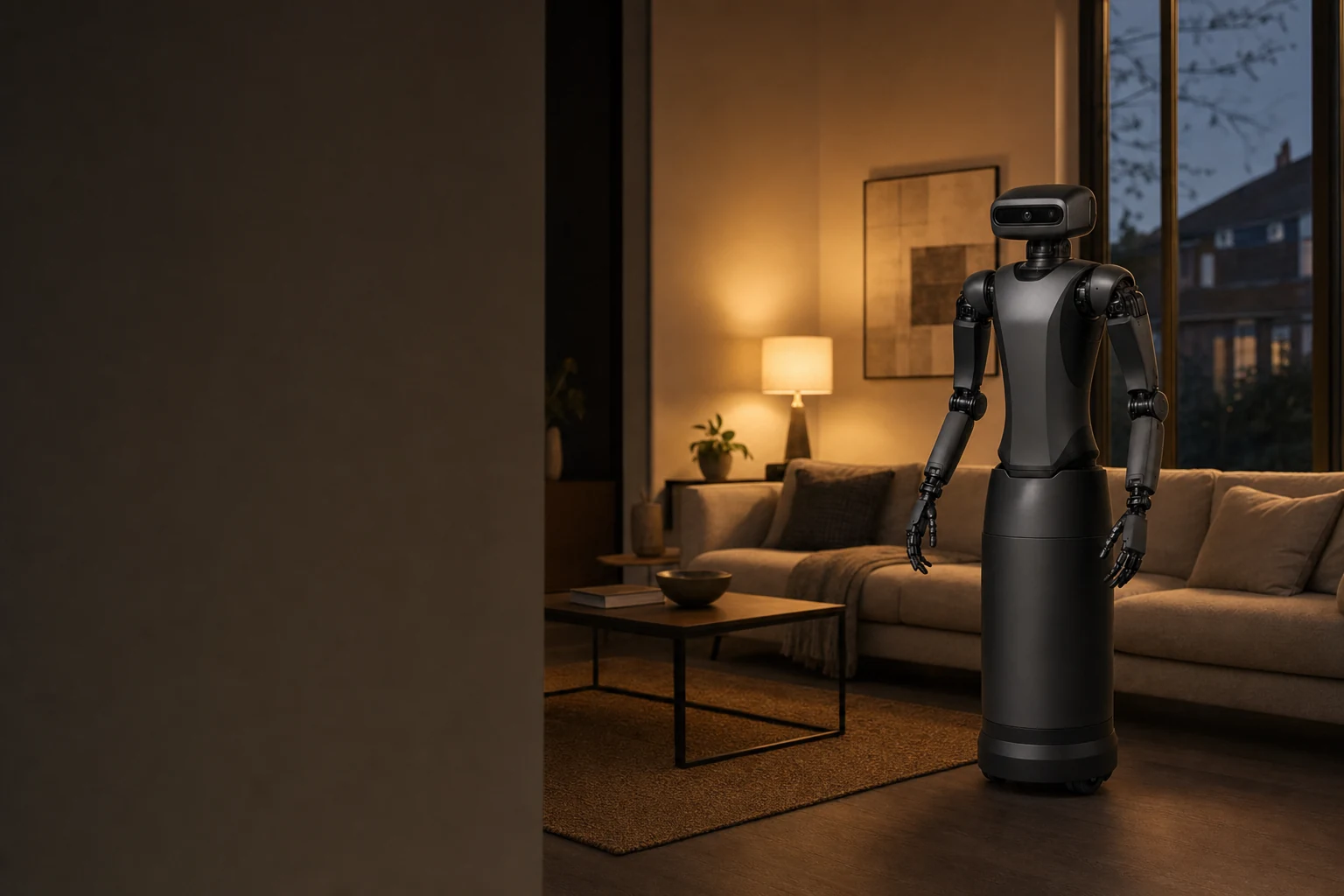
SwitchBot positioned the onero H1 as a domestic robot for the awkward jobs above floor level — although its public demonstrations remained far narrower than its promotional imagery.
There is a very particular sort of gadget story that makes all of us briefly imagine a better future. A robot that sorts washing? Lovely. A robot that folds it? Frankly, put my name down. SwitchBot's onero H1 landed squarely in that territory at CES 2026, arriving with arms, hands, cameras, an AI label and enough polished household imagery to make the utility room look like the set of a sci-fi advert.
The Robot Everyone's Talking About, But Nobody's Actually Bought
SwitchBot unveiled the onero H1 on 4 January 2026 as its first "universal humanoid household robot". That wording does a lot of work. H1 has a humanoid-style upper body, articulated arms and hands, plus a head-like sensor module. But it is not a walking android that strides through your kitchen carrying the laundry basket. It is a wheeled mobile manipulator: a robot designed to roll around on a base, then use human-shaped arms to interact with human-designed furniture and appliances.
That distinction matters more than it may first appear. Walking is an extraordinarily difficult robotics problem, especially around pets, rug edges, loose cables, thresholds and the sort of clutter most of us call "normal Tuesday". Wheels are much less glamorous, but they are a sensible shortcut. They should offer a more stable platform for manipulation on flat floors, without asking the robot to solve balance every time it moves an inch.
This is a first-look rumour round-up, not a review. The H1 had been demonstrated publicly, but it had not become a proven, broadly available household appliance. Its official US shop page displayed a price and still marked the robot Coming Soon.
That means the sensible way to read the H1 story is not "SwitchBot has solved domestic labour". It is "a major smart-home brand has shown a credible-looking mobile robot performing one real appliance task, and is attempting to turn that into a product". Those are not the same sentence. The difference is where the interesting stuff lives.
SwitchBot has an advantage over some robotics start-ups because it already understands connected homes. The company sells smart-home accessories, cleaning robots and automation gear, and it framed H1 as the part of the system that could deal with the physical chores other devices cannot reach. A robot vacuum can clean the floor. It cannot open the washing machine. That is H1's pitch in one neat, expensive nutshell.
The important reality check
H1's most convincing public moment was not laundry folding. It was loading a single garment into a washing machine. That may sound underwhelming against the marketing, but a robot successfully grasping fabric, navigating to an appliance, opening a door and placing the item inside is still a meaningful demonstration of physical robotics.
Meet the onero Family: H1 and Its Lesser-Known Sibling
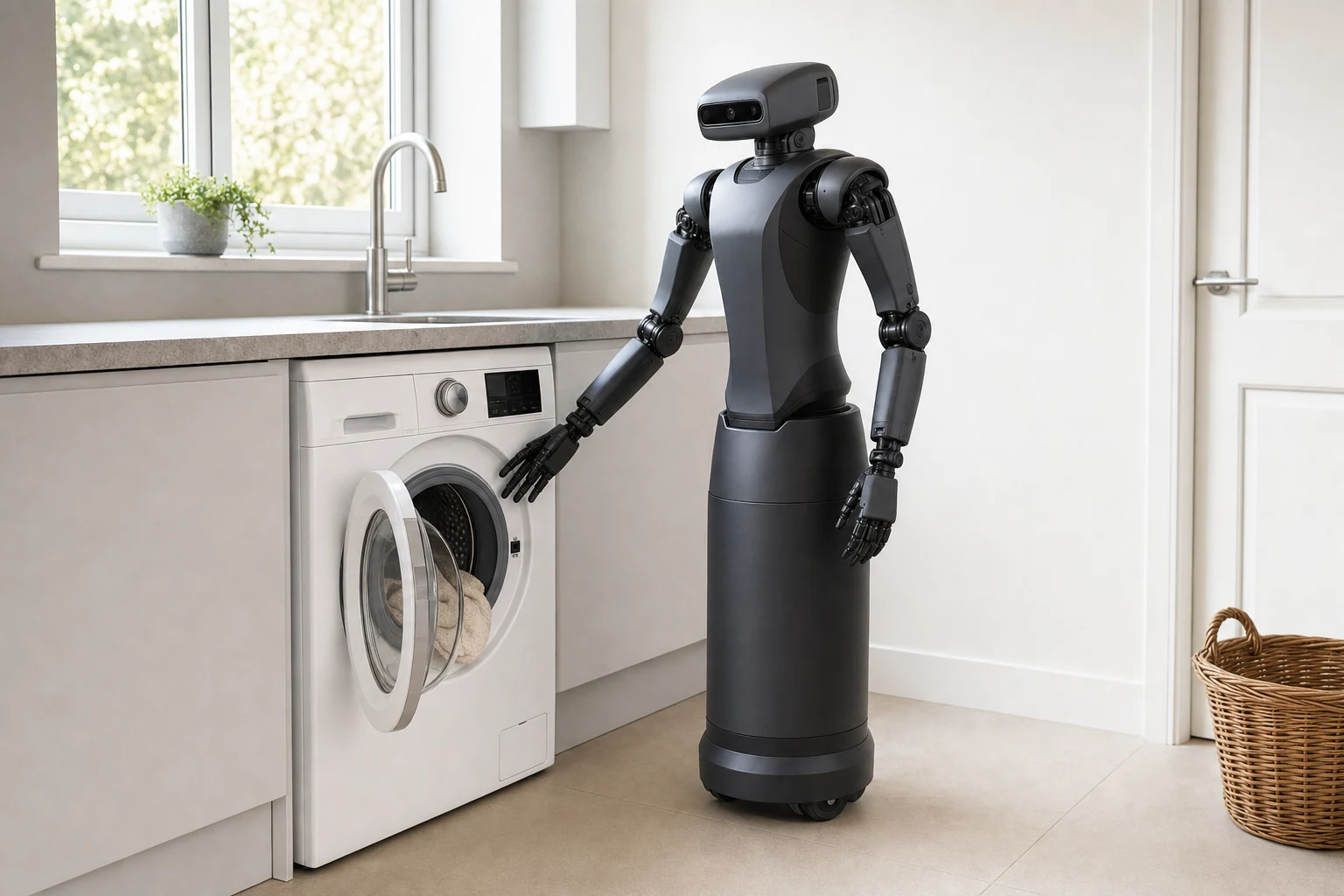
It is easy to get muddled by the onero branding, so let's separate the two products cleanly. The onero H1 is the headline act: a wheeled domestic robot intended to move around a home and manipulate everyday objects. The onero Robotic Arm A1 is a different proposition entirely. It is a standalone robotic arm aimed at embodied-AI experimentation, motion control and developer work.
The A1 was not a cheaper H1, an H1 accessory, or a second domestic robot model. It did not have a mobile base and it was not presented as a household helper that could toddle over to your dishwasher. Think of it as a platform for people who want to develop and test robotics applications, rather than a robot butler for people who have had enough of folding fitted sheets.
onero H1
A wheeled household robot with articulated arms and hands, intended for domestic manipulation tasks including appliance loading, object organisation and laundry handling.
onero Robotic Arm A1
A separate robotic arm product focused on embodied intelligence, physical arm control and development work rather than independent household mobility.
ROS2 Humble support
The A1 supported ROS2 Humble, giving robotics developers a familiar software framework for controlling and experimenting with the arm.
MoveIt2 integration
SwitchBot also listed MoveIt2 integration for the A1, alongside driver nodes for real-time topic publishing and arm-pose data.
Why bring up the A1 in an H1 article? Because it gives a little context to SwitchBot's strategy. The company was not only trying to sell a glossy domestic vision; it was also placing a product aimed at the people who build the software and control systems that could make robots more useful. That is a more grounded bit of the announcement than it sounds.
Do not treat H1 and A1 as trim levels. The H1 was built around moving through a home and doing physical chores. The A1 was a stationary robotic-arm platform with development-oriented software support.
For ordinary households, H1 is naturally the more intriguing machine. For robotics tinkerers, researchers and developers, the A1 may be the more immediately understandable product. One asks, "Can a robot eventually help in my kitchen?" The other asks, "Can I get an arm to follow a planned path reliably?" Both are valid questions. Only one helps with the duvet cover.
The onero range covered two very different ideas: H1 as a mobile home robot, and A1 as a separate arm for robotics development and embodied-AI work.
Inside the CES Booth: What SwitchBot Actually Demonstrated
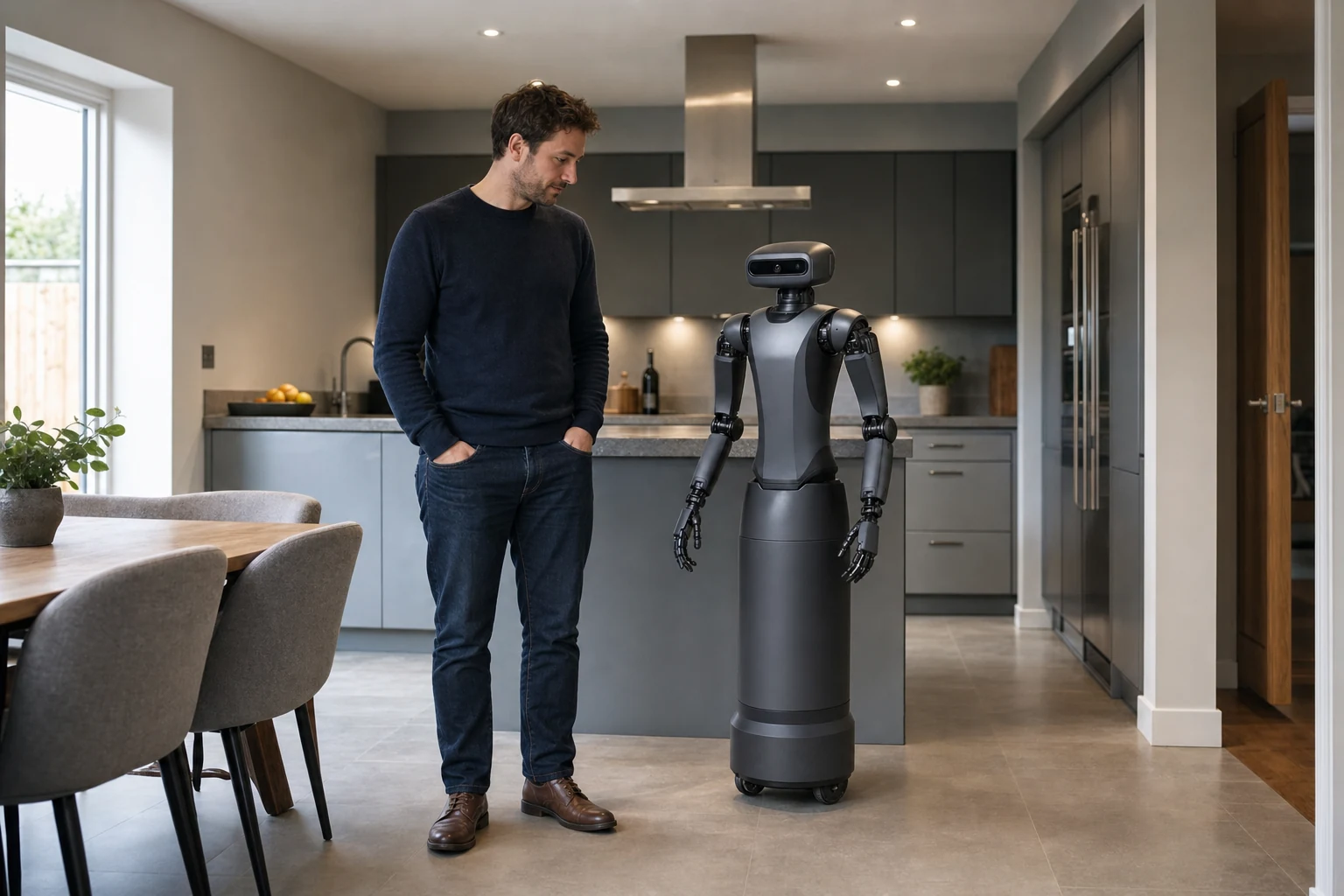
CES demonstrations are always worth watching with a little healthy scepticism. They can still be valuable — a physical demo is far more meaningful than an animation — but they are usually controlled environments with staff on hand, familiar objects, prepared spaces and a great deal of pressure for everything to go right. That is not a criticism. It is simply the nature of launch-event robotics.
Engadget saw the H1 pick up an individual garment, roll over to a washing machine, open its door, place the clothing inside and close the door. It was a full sequence rather than a single party trick, and that deserves credit. The robot had to identify a soft, awkward object, move it through space, approach an appliance and interact with a door. Fabric is annoying for robots precisely because it bends, bunches, catches and refuses to behave like a neat cardboard box.
There was, however, a number attached to that demonstration that should stay in your head: nearly two minutes for one garment. That is not a benchmark in the laboratory sense. It was one observed CES demonstration, not a controlled multi-run test. Still, it is the clearest public performance figure we have, and it says a lot about where domestic robotics sat in August 2026.
Slow is not automatically bad. A robot designed to operate while you work, sleep or get on with something else could be slower than a person and still be useful. The issue is the compounding effect. One item becomes ten. Ten garments become a mixed basket. A mixed basket becomes a tangle of sleeves, socks, towels and that one jumper you should probably have hand-washed. At nearly two minutes each, the robot was not yet showing the kind of pace that makes a full laundry load feel effortless.
TechRadar's observation is just as important as Engadget's successful run. It saw a sequence in which clothing was left hanging outside the machine. The H1 did not notice that the item obstructed the door, and it did not correct the problem. That may sound like a small mishap, but it gets to the central challenge of domestic robotics: error recovery.
It is one thing to carry out a prepared sequence when every object is where it should be. It is another thing entirely to recognise that something has gone wrong, work out why, decide what needs to happen next and perform a safe correction. Humans do this without thinking. A shirt catches in the door, you tuck it in. A robot needs to perceive the issue, interpret it and physically deal with it. That is the hard bit.
The demo that matters most
The failed washer-door attempt was not a reason to write H1 off. It was arguably the most useful thing shown. It revealed the gap between a narrow task sequence and reliable real-world autonomy — exactly the gap every domestic robot still had to cross.
So, credit where it is due: H1 had performed a real piece of manipulation in public. But the sensible conclusion was measured. It had shown that it could sometimes load an item into a washing machine under demonstration conditions. It had not shown that it could take a whole pile of laundry, handle interruptions and errors, start the correct cycle, unload it later and fold everything into neat stacks whilst you smugly watch Bake Off.
Promo Reel vs Show Floor: Sorting Claims From Evidence
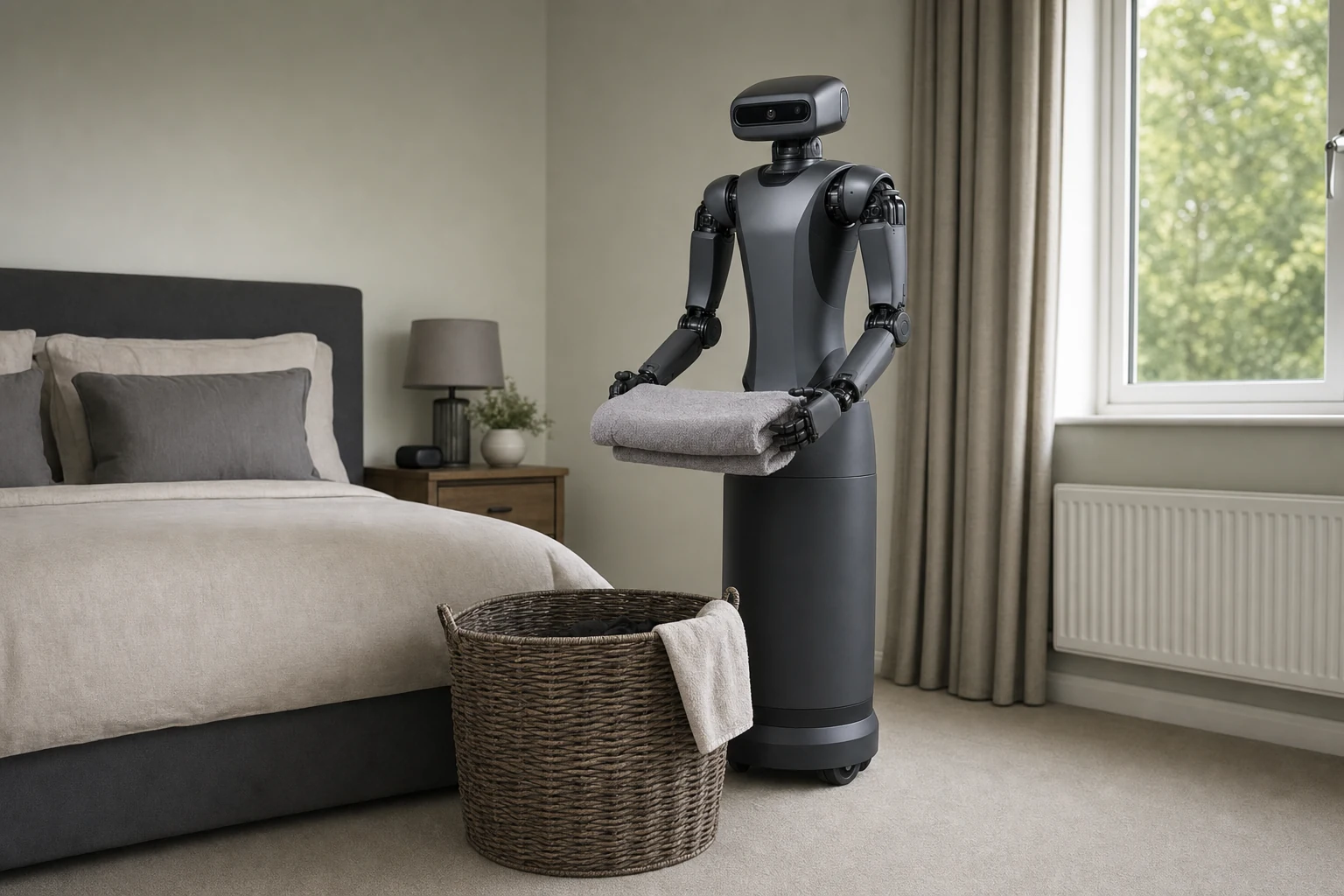
SwitchBot's promotional material gave H1 a very broad domestic job description. It showed or described folding laundry, washing dishes, loading appliances, cleaning windows, serving food and drinks, making coffee, organising household items and working alongside the wider SwitchBot ecosystem. It is an appealing list because it contains practically every job that makes a home feel like a never-ending to-do list.
But this is where we need to separate ambition from evidence. Marketing footage and company demonstrations can be useful indications of intended capability. They are not the same thing as independent proof that a product can repeat those jobs across ordinary homes, with unfamiliar objects, messy rooms and no quietly helpful engineer hovering just outside frame.
What H1 had shown publicly
- Picking up an individual garment from a sofa.
- Rolling across a flat CES demonstration space.
- Opening a washing machine door.
- Placing a garment into the machine during a successful run.
- Attempting to close the appliance door after loading.
What remained promotional
- Reliable laundry folding across different garments.
- Dishwashing and dishwasher loading as repeatable home tasks.
- Window cleaning, drink service and coffee preparation.
- Household organisation across cluttered real rooms.
- Consistently high-success autonomous operation.
The distinction may feel pedantic until you consider what each task involves. Folding a T-shirt is not merely "move cloth around". It requires detecting edges and sleeves, manipulating flexible material without losing the shape, making choices about orientation and repeating those choices across different sizes and fabrics. Towels are comparatively friendly. Socks are not. A hoodie with drawstrings is basically a small rebellion against mechanical order.
Dishwashing is equally complicated. Crockery can be slippery, reflective, wet, stacked in odd ways and breakable. A human knows that a mug is upside-down because it was just washed, and that a knife should not be grabbed carelessly. A robot needs perception, grasp planning, force control and a safety model that works when the kitchen is not arranged like a showroom.
SwitchBot used "high-success" language around household manipulation, but it had not published a quantified task-success rate. Without repeatable figures across many trials, there is no sensible way to turn that phrase into a consumer promise.
This is not a dig at SwitchBot specifically. Every company chasing domestic humanoids faced the same problem: the public wants a general-purpose helper, but general purpose is an enormous claim. A robot can be very impressive at a controlled task and still be nowhere near ready for an untidy semi-detached home with a narrow hall, a shedding dog and a washing basket that has achieved geological layers.
For now, I would file H1's folding, dishwashing and serving claims under "interesting targets", not "proven features". The washer-loading demonstration was the bit to watch because it was the bit outside observers actually saw. It was slow and imperfect. It was also real. That is a more useful starting point than a perfect-looking promotional montage.
The H1's strongest public evidence came from its washer-loading sequence; broader domestic chores such as folding and dishwashing remained company demonstrations or intended capabilities.
The Spec Sheet That Isn't: What We Know and What It Means
The H1 had a handful of genuinely interesting confirmed headline specifications. SwitchBot said it used a 22-degree-of-freedom platform, combining mobility, arms and hands with visual perception, depth awareness and tactile feedback. Its on-device AI system was called OmniSense VLA, short for vision-language-action: the broad idea being that the robot can use what it sees, understand a task instruction and then take a physical action.
That is the exciting bit. It is also the bit where jargon can run away with itself. A vision-language-action model does not automatically mean a robot understands your home in the robust, common-sense way a person does. It means SwitchBot was attempting to connect perception and instructions to physical control, which is absolutely where modern robotics needs to go. But it does not magically eliminate the hard realities of grasping a damp towel or navigating around a dropped school bag.
OneRobotics separately described the H1 platform as using a self-developed 7-DoF arm. That did not neatly explain how the company arrived at the published 22-DoF figure across the wider machine, and SwitchBot had not set out a detailed mechanical breakdown. It is best read as an interesting arm detail rather than an invitation to reverse-engineer the entire robot from a press release.
CES reporting also pointed to two end-effector configurations: a simpler claw or gripper, and a five-finger articulated hand. That is potentially significant. A gripper may be more robust and easier to control for basic object pickup. A five-finger hand can theoretically tackle more human-style interactions, but brings much more complexity. It was not clear whether both would be sold, whether they would be interchangeable, or which version was needed for which tasks.
Degrees of freedom are not a chores score
A 22-DoF headline tells you H1 had many independently controllable joints or movement axes. It does not tell you how quickly it works, how much it can safely carry, how long it runs, or whether it can recover when a sleeve snags in the washing machine door.
Android Authority reported Intel RealSense cameras on the H1, although SwitchBot's main product page did not spell out exact camera models or positions. That is plausible given RealSense's depth-sensing history, but it should be treated as reported hardware detail rather than a full official camera specification.
The broader takeaway is simple. H1 had enough confirmed technology to be worth taking seriously: articulated manipulation, multimodal sensing, wheels and on-device AI are all sensible ingredients. Yet it remained technically under-described in the areas that turn a clever demo into a household appliance. A good robot needs more than intelligent arms. It needs dependable operation day after day, safe behaviour around people and a practical answer to the question, "What happens when it gets stuck?"
onero Robotic Arm A1: The Quiet Developer Release Hiding in the Announcement
Whilst the H1 got the headlines, the onero Robotic Arm A1 was arguably the more straightforward product in SwitchBot's 2026 robotics push. It was marketed as an open-source robotic arm for embodied-intelligence work, and SwitchBot explicitly listed ROS2 Humble support, MoveIt2 integration and driver nodes capable of real-time topic publishing and arm-pose data.
That will mean much more to robotics developers than to most households, but it matters. ROS2 is a widely used robotics framework, and MoveIt2 is commonly used for motion planning. In plain English: the A1 was pitched as an arm that developers could control, integrate and use to test how software translates into physical movement.
ROS2 Humble
Confirmed compatibility gave developers a recognised route into building and controlling robotics projects around the A1.
MoveIt2 motion planning
MoveIt2 integration was listed for developers planning arm movement in physical or virtual environments.
Driver nodes
SwitchBot said the A1 provided driver nodes for real-time topic publishing and arm-pose data.
The official US page displayed the A1 at US$799 and marked it Coming Soon. That was a dramatically different scale from H1's US$9,999 listing, as it should be: this was a standalone arm rather than a self-moving household robot with perception, a mobile base and the ambition to tackle domestic chores.
The A1 was the better fit for robotics experimentation. The H1 was the product to watch if you were interested in domestic automation. They shared an onero badge, but they were solving very different problems.
There is something reassuringly honest about a developer arm sitting alongside a futuristic home robot. The A1 made fewer magical promises. It did not claim to fold your washing, serve your lunch or rescue your living room from itself. It was there to be programmed, moved and experimented with. In robotics, that sort of clear scope can be a virtue.
The onero Robotic Arm A1 was aimed at developers and embodied-AI experimentation, with ROS2 Humble and MoveIt2 support rather than household mobility.
The Price Question: US$9,999, "Less Than $10k", and No UK Number
SwitchBot's official US store displayed a US$9,999 price for the onero H1. The same page marked it unavailable and Coming Soon, so that figure should be read as a displayed list price rather than proof that buyers could place an order and expect a robot at their door.
That number broadly lined up with what a SwitchBot representative reportedly told Engadget at CES: that H1 would cost less than US$10,000 and was likely to arrive later in 2026, potentially closer to the end of the year. As of Tuesday 11 August 2026, however, there was still no confirmed delivery date on the official listing.
For UK readers, the important bit is even simpler: there was no confirmed UK price, no VAT-inclusive figure, no confirmed retail partner and no confirmed UK launch date. This was not yet a product you could sensibly plan a household budget around. There is no point pretending otherwise just because a dollar number looks tidy on a product page.
| Product | Displayed or reported US price | Public status | Primary role |
|---|---|---|---|
| SwitchBot onero H1 | US$9,999 displayed | Coming Soon / unavailable | Wheeled household robot |
| SwitchBot onero Robotic Arm A1 | US$799 displayed | Coming Soon / unavailable | Standalone development arm |
| 1X NEO | US$20,000 ownership or US$499/month subscription | US deliveries start in 2026 | Bipedal humanoid home robot |
| Weave Robotics Isaac 1 | US$7,999 pre-order price reported | First shipments planned for autumn 2026 | Wheeled home robot |
Price is not the same as value
US$9,999 would be a strikingly aggressive target for a mobile home robot with arms and hands. But for a machine with only limited public performance evidence, the more important question was not whether it sounded cheaper than rivals. It was whether it could reliably save enough time to justify being in your home at all.
It is tempting to compare H1 to premium appliances: a high-end washing machine, perhaps, or a household's entire smart-home budget for several years. But that does not quite capture it. H1 was closer to an early commercial robotics platform packaged for domestic use. It was not a mature appliance category with decades of known reliability, standardised servicing and clear expectations around performance.
For that reason, I would treat the displayed US price as an interesting signal rather than a recommendation trigger. It suggested SwitchBot wanted to push domestic manipulation below the eye-watering figures associated with some humanoid concepts. It did not tell us what a UK buyer would pay, what support would look like, or what the robot would actually manage in an average British home.
How the onero H1 Stacks Up Against Other Home Robot Attempts
H1 did not exist in a vacuum. CES 2026 was thick with home-robot ideas, and the wider robotics industry was busy trying to turn impressive demonstrations into actual commercial products. The most useful comparison is not "which one looks most like a person?" It is "what form factor did each company choose, what did it publicly specify, and how much evidence exists that it can help at home?"
1X's NEO was the more traditionally humanoid option. It used bipedal locomotion, stood 5ft 6in tall and had a much fuller public specification sheet: a 842Wh battery, four-hour runtime, 18lb arm payload, 55lb carry capacity, IP68-rated hands and an IP44-rated body. 1X also described app and VR remote control, plus scheduled "Expert Mode" remote supervision for complex work.
That last point is worth lingering on. Remote supervision is not a failure; it is an acknowledgement that robust autonomy is hard. But it does change what "robot helper" means. If a person sometimes needs to monitor or guide the robot remotely, you are not looking at a fully independent domestic worker. You are looking at a clever machine operating inside a support system.
Weave Robotics' Isaac 1 took a more H1-like wheeled approach. It was positioned as a home robot for folding laundry, tidying, bed-making and putting things away, with an eight-hour claimed runtime and approximately two-hour charge time. Its first shipments were planned for autumn 2026, with a reported US$7,999 pre-order price. Like H1, it aimed to sidestep the balance problem of bipedal walking.
| Feature | SwitchBot onero H1 | 1X NEO | Weave Robotics Isaac 1 |
|---|---|---|---|
| Form factor | Wheeled humanoid-style mobile manipulator | Bipedal humanoid home robot | Wheeled home robot with collapsible torso and arms |
| US price | US$9,999 displayed | US$20,000 ownership or US$499/month | US$7,999 pre-order price reported |
| Public task evidence | Washer loading demonstrated; nearly two minutes for one garment | Home and commercial positioning; remote support described for complex tasks | Laundry folding, tidying and bed-making positioned as intended chores |
| Mobility approach | Wheels prioritise stability on accessible floors | Legs aim for human-style movement through spaces | Wheels prioritise indoor mobility without bipedal balancing |
LG CLOiD belonged in the same broad conversation. LG presented it as a wheeled home robot able to retrieve food, operate appliances, initiate laundry cycles and fold or stack clothes in demonstration scenarios. It did not have a consumer price or confirmed retail release date. Figure AI's Figure 03 was another ambitious project, with soft materials, upgraded cameras, tactile fingertips and 2kW inductive charging, but it was not a normally purchasable consumer product either.
The point is not that one company had "won". Nobody had. The market was still full of prototypes, proposed products, controlled demos and partial disclosures. H1 stood out because SwitchBot's domestic focus was clear and its price ambition was lower than some high-profile humanoid projects. But it also had a much thinner published hardware story than 1X NEO, and its independently witnessed task evidence was still very narrow.
H1's wheeled base placed it alongside other practical mobile-manipulator concepts, while rivals such as 1X NEO pursued the much harder challenge of bipedal movement.
Reality Check: How Far Is a Robot Butler From Your Utility Room?
Here is the bit where the future gets less shiny, but more useful. If H1 took nearly two minutes to load one garment into a washing machine, a typical basket could take a long time. That alone might be acceptable if the robot could work safely and independently while you did something else. But the failed sequence witnessed by TechRadar makes that a very large "if".
A garment hanging out of the drum is a tiny domestic problem for a human. It is a serious test for a robot. The machine needs to recognise the obstruction, distinguish fabric from the machine door, work out how to grasp it, pull or tuck it correctly, then try the close action again without trapping material or damaging the appliance. That is not one problem. It is a chain of perception, planning and control problems.
Then there is the home itself. CES floors are flat, open and carefully arranged. British homes are not. They have thresholds, rugs, narrow spaces, door lips, clutter, soft furnishings, low tables, cables, unpredictable lighting and sometimes stairs. H1's wheeled base was likely the sensible choice for simple indoor movement, but it also meant the robot should be thought of as a single-level machine unless and until it demonstrated otherwise.
That does not make it useless. Plenty of homes have most key chores on one floor. A kitchen and utility room on the same level could be an ideal early environment. Flat floors, compatible appliance doors and carefully defined tasks are exactly where a mobile manipulator has the best chance of being useful. The trouble begins when marketing language starts implying that this neatly controlled environment equals a fully autonomous household helper.
Domestic robotics is mostly edge cases
The glamorous part is opening a washing machine. The difficult part is everything around it: the sock under the chair, the towel half inside the basket, the door not quite open enough, the rug curling at the corner and the child who has left a plastic dinosaur directly in the robot's path.
There were also practical questions around privacy. A robot that moves through the home, sees rooms and interacts with objects needs clear information about local processing, remote access, software updates and data handling. SwitchBot promoted on-device OmniSense VLA processing, which is encouraging in principle, but the wider privacy and security story mattered just as much as the AI headline. A robot in the lounge is a more intimate device than a smart speaker on a shelf.
So how far away was the robot butler? H1 suggested we were past the stage of pure concept art. A robot had physically performed a domestic appliance interaction. But we were not yet at the stage where you could hand over the laundry basket, go to bed and trust that everything would be washed, dried, folded and safely put away by breakfast. The first mile was visible. The last mile was still very, very long.
Weighing It Up: Promising Signs and Red Flags
There is a version of the H1 story that is easy to dismiss: flashy CES robot, big claims, no real product. That would be unfair. There is also a version that says SwitchBot has solved general-purpose domestic robotics. That would be much more unfair. The truth was in the middle, which is where most genuinely interesting technology lived.
Promising signs
- A real, independently witnessed manipulation task rather than a purely animated concept.
- Visual, depth and tactile sensing were a sensible combination for household interaction.
- On-device OmniSense VLA processing pointed towards a more capable perception-and-action system.
- Wheels were a pragmatic choice for stability and indoor efficiency.
- SwitchBot's existing smart-home ecosystem could provide useful future integration.
- The US$9,999 displayed price aimed below some premium humanoid proposals.
Serious caution points
- The successful public laundry sequence was slow: nearly two minutes for one item.
- A separate demonstration failed when clothing obstructed the washer door.
- Folding, dishwashing and service tasks had not been independently verified.
- No confirmed UK price, delivery date or retail availability existed.
- H1 remained commercially unavailable on SwitchBot's US store.
- Domestic robots still faced difficult reliability, safety and privacy questions.
The central positive is that SwitchBot did not merely show a face on a screen and call it AI. H1 had arms, hands, movement and a visibly physical job to do. It made contact with the messy real world. That is far more compelling than an assistant that can only speak about chores.
The central negative is that the real world immediately pushed back. The obstruction failure was exactly the kind of small, mundane complication that separates a demo from a dependable product. You do not need a robot to be perfect. You do need it to know when it has failed, avoid making a mess worse and either correct itself or ask for help.
My view is that H1 was worth watching because SwitchBot had chosen a sensible shape for the problem. Wheels below, human-compatible manipulation above. It may not look as dramatic as a bipedal android, but domestic usefulness is more interesting than a good catwalk walk. If it could reliably master a few tightly defined jobs, it might become useful before a true all-purpose humanoid does.
Who Each Home Robot Attempt Suits Best
This was not a normal buying guide because none of these machines had become a straightforward UK retail purchase. Still, it is helpful to map the ideas rather than simply throw every robot into one big "future tech" bucket. The best choice depended on what you thought the robot needed to do, how much autonomy you expected, and how much tolerance you had for early-stage technology.
Best fit for practical flat-floor chores: SwitchBot onero H1
H1 made the strongest case if you were interested in a wheeled robot using arms to interact with appliances. Its publicly witnessed washer-loading task was limited, but it was a meaningful physical demonstration.
Best fit for a fuller published hardware picture: 1X NEO
NEO had more published figures around battery capacity, runtime, payload and protection ratings, although its bipedal approach and remote-supervision model underlined how demanding true home autonomy remained.
Best fit for a wheeled rival concept: Weave Robotics Isaac 1
Isaac 1 also used wheels and claimed an eight-hour runtime with around two hours of charging, making it one of the more directly comparable household-robot ideas.
Best fit for developers: onero Robotic Arm A1
The A1's ROS2 Humble support, MoveIt2 integration and driver-node support made it the obvious onero product for people interested in building robotics systems rather than outsourcing the washing.
For most people, though, the best "pick" remained patience. That is not a cop-out; it is just the sensible answer when the product category is still proving itself. H1 was fascinating as a signpost, but no UK household should have felt they were missing out on a solved domestic essential.
The sensible early use case for wheeled domestic robots is likely to be a defined, accessible task on one floor — not a full home takeover from day one.
onero H1: Your Questions, Answered
For now, the onero H1 was better understood as an ambitious early household-robot project than a finished appliance ready to take over laundry day.
Our Take: A Genuinely Interesting Prototype, Not Yet a Product
Bottom line: watch this one, but keep both feet on the floor
The SwitchBot onero H1 was one of the more credible domestic-robot stories of 2026 because it had shown a real, independently witnessed task: handling a garment and loading it into a washing machine. That was not nothing. It was also slow, took nearly two minutes for one item, and a separate live run exposed weak error recovery when clothing obstructed the door. The polished claims around folding laundry, dishes, windows and serving remained much broader than the public evidence. With no confirmed UK price or launch date, H1 was a fascinating early-stage machine to track rather than a buying decision. SwitchBot's wheeled approach, multimodal sensing and on-device AI made sense. The robot butler, however, was still very much learning how to shut the washing machine door.