
Roborock Saros Rover First Look: The Robot Vacuum That Can Climb Stairs
A wheel-leg robot vacuum with a genuinely big promise: stop treating the staircase as the point where home automation gives up.
Roborock showed the Saros Rover concept at CES 2026, where its independently moving wheel-legs were the centrepiece rather than another incremental cleaning attachment.
Robot vacuums are brilliant right up until they meet a staircase. Then even the cleverest little floor-map becomes a very expensive way to clean one level of your house. Roborock's Saros Rover was built to tackle that awkward truth with wheel-legs that can climb, descend and reportedly clean stairs themselves. It is an exciting idea. It is also still a product in development, with no confirmed UK price, release date or availability.
What Is the Roborock Saros Rover? The Stair-Climbing Robot Vacuum Explained
Picture the familiar scene. Your robot vacuum has done a perfectly respectable circuit of the kitchen, hallway and lounge. It returns to its dock with the quiet self-satisfaction of a machine that believes it has completed its job. Meanwhile, the bedrooms upstairs remain untouched, the landing has collected a fortnight of fluff, and the stairs themselves are doing their best impression of a crumb museum.
That is the fundamental limitation Roborock targeted with the Saros Rover. Shown at CES 2026, it was presented as a robot vacuum using a hybrid wheel-leg architecture rather than the conventional fixed-wheel layout found on ordinary floor robots. Two wheel-legs can raise and lower independently, allowing the machine to keep its body comparatively level as it negotiates changes in height.
That sounds like a small mechanical detail. It is not. It is the difference between a robot that sees a stair edge as a cliff to avoid and one that can treat the same edge as a route to another floor. In theory, that takes the robot vacuum from being a single-storey appliance to something closer to a whole-home cleaning machine.
The important reality check: Roborock described the Saros Rover as a real product currently in development. It had no confirmed on-sale date, UK price or confirmed retail availability as of Sunday 2 August 2026. Treat every first-look impression accordingly.
There is another part of the pitch worth dwelling on. Roborock did not only show a robot getting from one floor to another. The company's claim was that the Rover could clean the individual steps while navigating them, including curved staircases, carpeted staircases and staircases with bullnose fronts. If that worked reliably outside a trade-show setting, it would be a much more meaningful leap than simply hauling a robot upstairs between runs.
For now, though, this is not a finished consumer product that you can judge by a long list of independent tests. It is a glimpse of where Roborock wanted the category to go next. And, frankly, it is one of the few robot-vacuum concepts in years that addresses a problem normal households actually have.
Why Stairs Have Always Been the Robot Vacuum's Achilles Heel
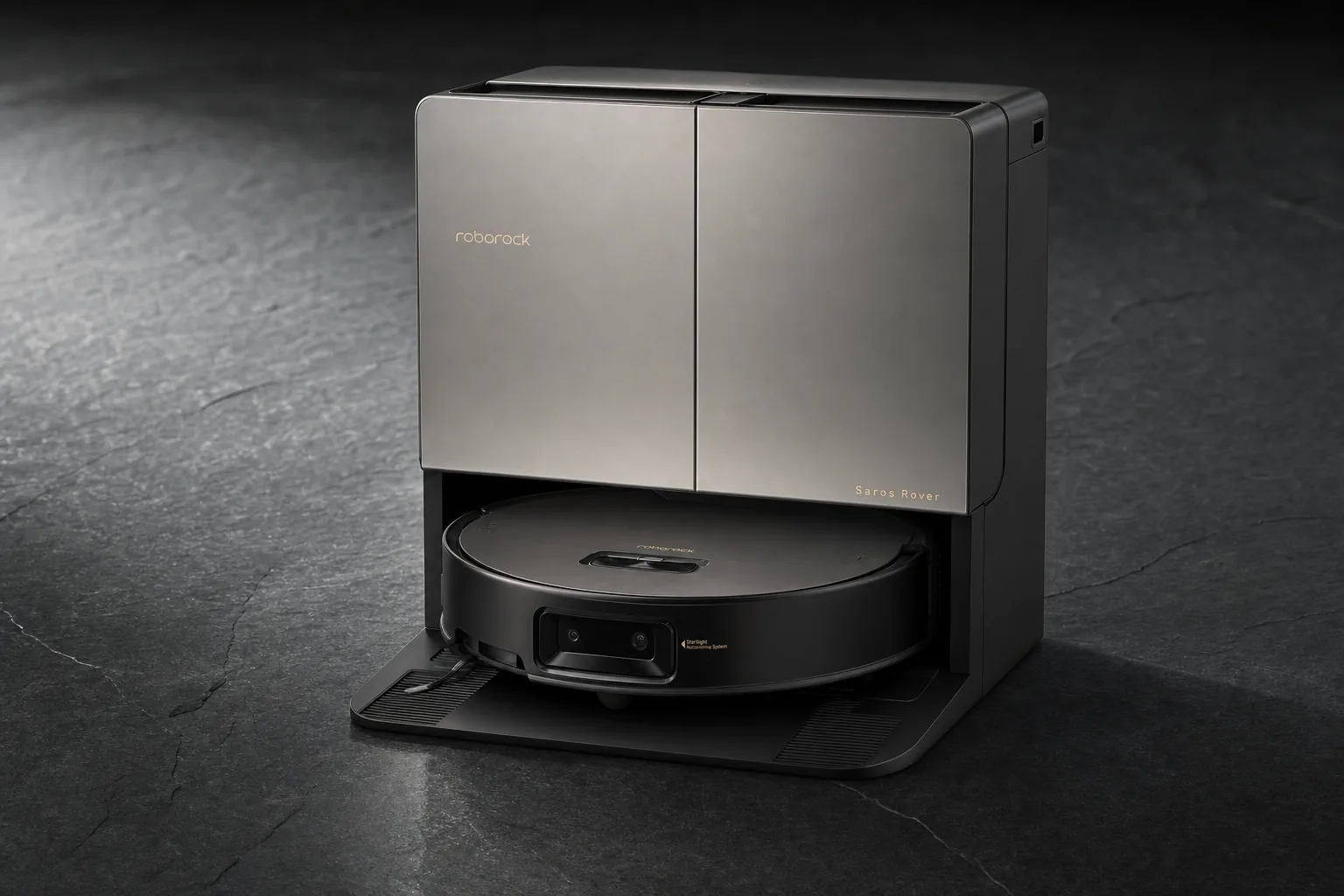
British homes and robot vacuums have always had a slightly awkward relationship. Many of us live in terraces, Victorian semis, compact townhouses or modern new-builds arranged over more than one floor. The layouts vary wildly; the central issue does not. A robot that cannot climb has only ever been able to clean one level at a time.
That has created a few unglamorous workarounds. Some owners physically carry the robot upstairs, start another job and carry it back down later. Some keep a second, often cheaper, robot on the upper floor. Others simply accept that the robot handles downstairs and they still do the stairs and bedrooms manually. None of those is quite the friction-free, automated future promised on the box.
Two robots can work, of course. But it means two sets of consumables, two charging docks, two maps, two dustbins and twice the chance of finding a stranded machine wedged beneath a chair. Carrying one robot around is cheaper, but it also means you are still part of the workflow. The moment a cleaning gadget needs collecting, lifting and redeploying, it has lost a fair slice of its magic.
The staircase has traditionally been an immovable boundary for robot vacuums; the Rover's proposition is to make it part of the cleaning route rather than a no-go zone.
Previous concepts in the wider category had already explored the problem by IFA 2025, but stair traversal and stair cleaning are not the same achievement. A machine that can get to the top is useful. A machine that can remove dust from each tread as it goes is potentially transformative. Roborock positioned the Saros Rover around that more ambitious second claim.
Why this matters more than another suction-number battle
Most modern robot vacuums already handle flat hard floors very well. The staircase is the stubborn domestic surface that has remained outside their reach. Solve it safely and consistently, and a single docked robot could plausibly cover a conventional multi-storey home without being carried from floor to floor.
There are obvious caveats. Staircases are not standardised objects. A narrow turning staircase in an older house, a deep-pile carpet runner, a loose cable on a tread, a child's toy halfway up the flight and a dark landing all present different challenges. That is exactly why I would not declare the problem solved because of a CES demonstration. But as a target? It is absolutely the right one.
There is also a safety dimension. Conventional robots have spent years becoming very good at recognising stairs as places they must not fall down. A stair-climbing machine has to make the opposite decision without losing that caution. It needs to know which vertical changes are intentional routes, where the edge is, where the next tread starts and when the surface is unsuitable. That is a much more difficult job than driving over a doorway threshold.
Confirmed Specs at a Glance: What Roborock Has Actually Told Us
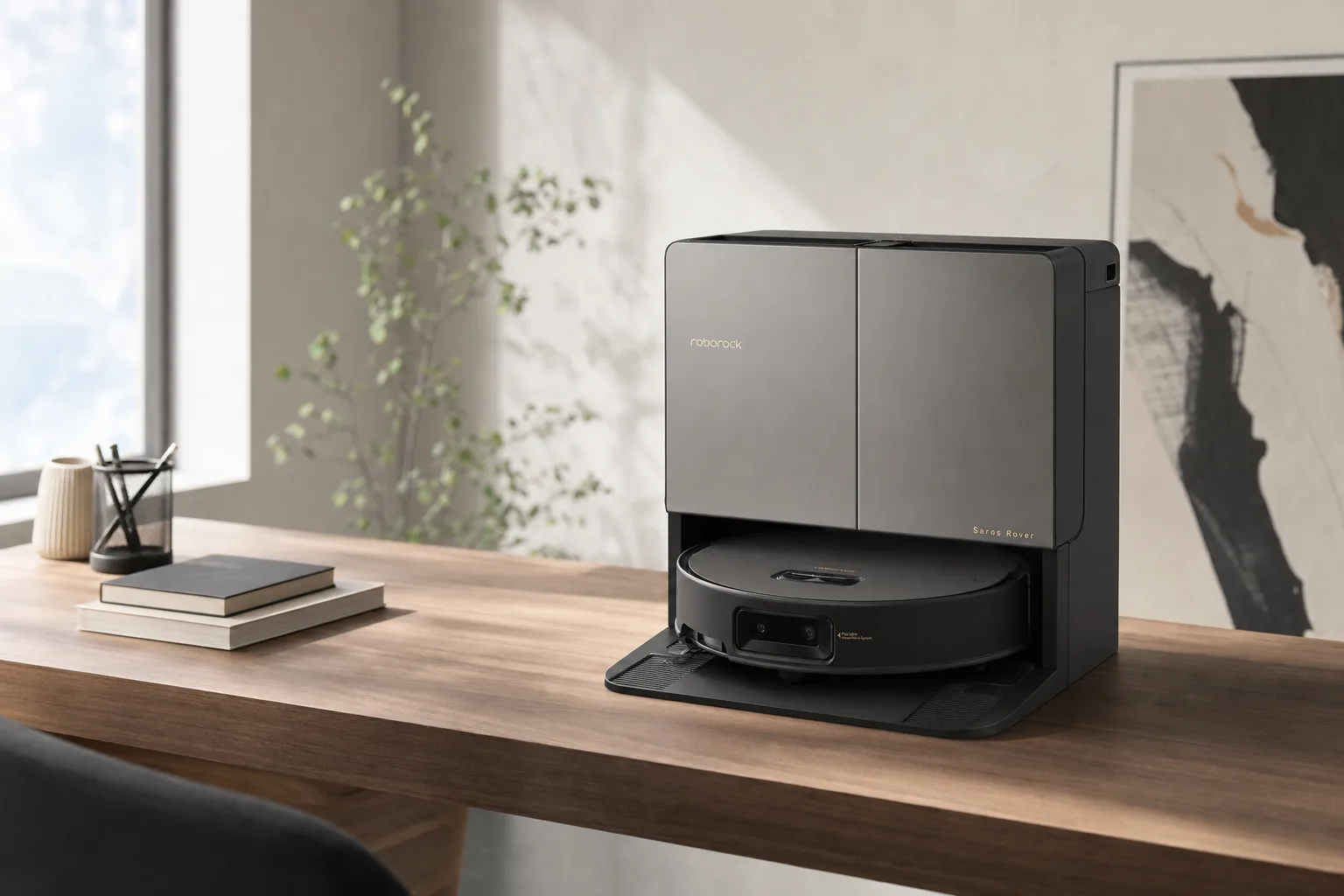
Before we get carried away with the wheel-legs, it is worth separating what Roborock had publicly demonstrated or described from the bits still being interpreted through early coverage. The confirmed headline is the locomotion system: two wheel-legs, independently articulated, intended to carry the robot up and down stairs while keeping its body level.
Several other elements fit the profile of a top-end Saros machine. StarSight 2.0 navigation with 3D spatial awareness was cited, along with AI obstacle avoidance for more than 200 object types. The Rover was also described with dual rotating mops spinning at 200 RPM, adaptive pressure and AI-driven StainTarget handling for wet and dry stains.
The 240-minute figure was the headline runtime claim, although some coverage referred to an 180–240 minute range. Roborock also said the top figure could cover roughly 2,500–3,000 square feet in one session, but real runtimes always depend heavily on cleaning mode, surfaces and how much climbing is involved.
On the brush side, the Rover was associated with Roborock's DuoDivide main brush and FlexiArm Arc side brush. Voice control through Alexa, Google and Siri was also listed, alongside Wi-Fi app control, scheduling and no-go zones. HEPA filtration and a self-emptying base station rounded out the announced support system.
The base was said to empty the robot after each session, with the larger station requiring attention every 30 to 60 days. That claim will be familiar to anyone who has used a self-emptying robot before: it is a convenience figure, not a guarantee. Homes with pets, long hair or a lot of carpet can fill things more quickly. Still, it is the right sort of dock for a robot intended to clean a lot more of the house.
The Wheel-Leg System: How It Actually Works — and What We Still Don't Know
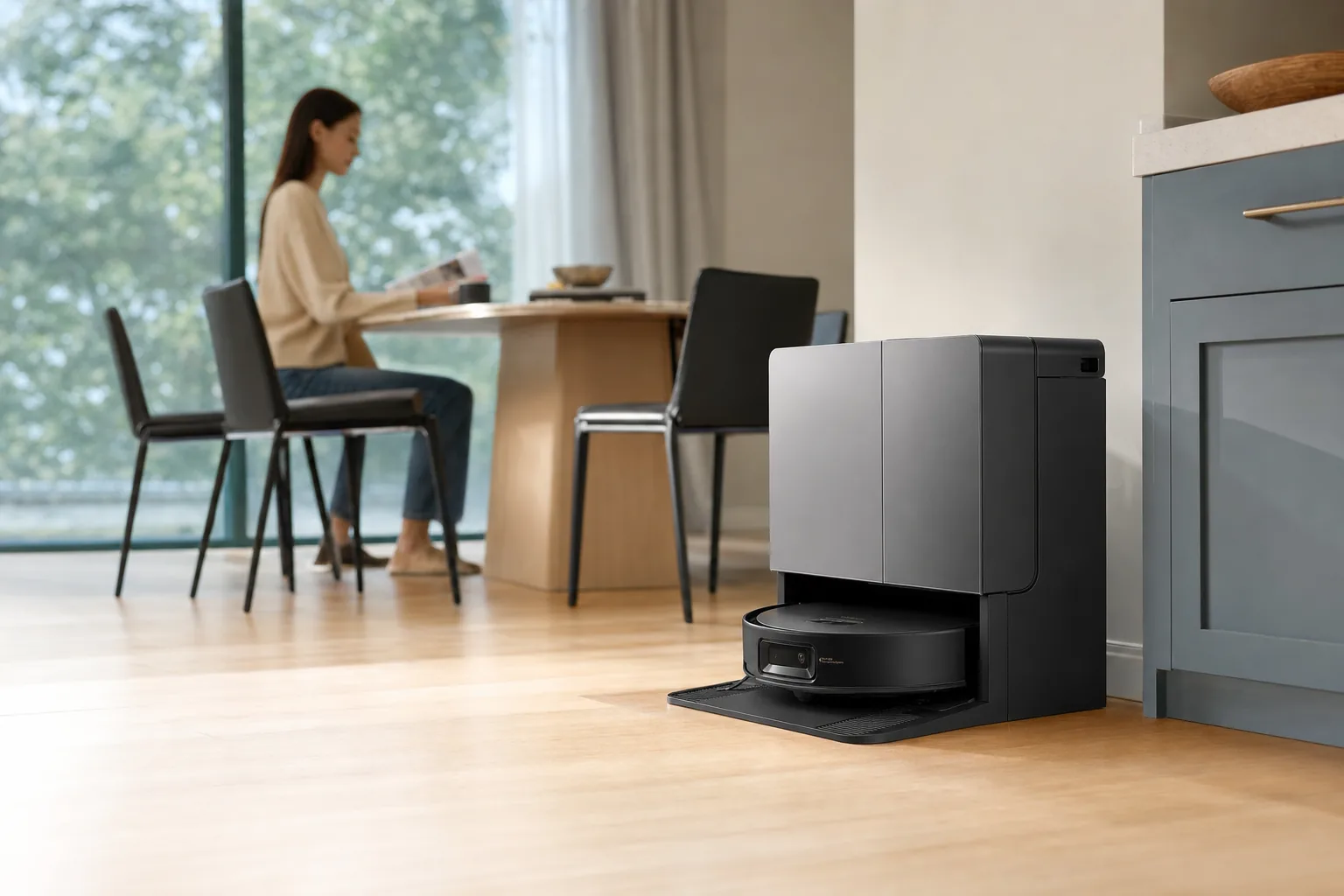
The Rover's defining trick was not a set of tracks, a ramp or some detachable stair-climbing accessory. It was a pair of wheel-legs that could move independently. In practical terms, that means one side can raise or lower while the other compensates, helping the robot preserve a more level main body as the terrain beneath it changes.
On a standard staircase, that matters because the machine is not crossing one smooth slope. It is repeatedly meeting a vertical riser and then settling onto a horizontal tread. A conventional circular robot vacuum cannot bridge that pattern: its wheels hit the riser and stop. The Rover's legs were intended to elevate and reposition the chassis through each change in level.
The key engineering idea is independent movement on each side, intended to stabilise the robot as it moves from tread to tread rather than simply bumping into a riser.
Independent body levelling
Each wheel-leg can raise and lower separately. Roborock's stated aim is to keep the main body level while it encounters uneven surfaces and stairs, which should matter for stability and cleaning contact.
Sudden stops, turns and directional changes
The Rover was described as able to stop and redirect quickly. That is not just show-floor theatre: a stair machine needs very precise movement where there is little room to correct a bad line.
Small jumps on descent
Roborock also described small jumping movements, particularly when descending steps. That makes sense mechanically, because the front edge has to deal with the sudden absence of floor beneath it.
More than one staircase style
CES 2026 demonstration coverage included curved stairs, carpeted stairs and stairs with bullnose fronts. Those are important examples because a perfectly straight, bare staircase would be a much easier test.
The 8.5cm multi-level threshold capability is another useful clue about the intended agility. It suggests the wheel-leg system was designed for more than the staircase alone: awkward doorway lips, raised room dividers and uneven changes between floor finishes are all things that can strand a normal robot. Again, though, a maximum obstacle figure tells us less about day-to-day reliability than it first appears. Shape, traction and approach angle matter.
What remained unclear was just as important. There was no published detail on stair speed, the maximum rise and run it could negotiate, how it handles narrow or open-sided stairs, or how it reacts to clutter on a tread. There was also no published charging-time figure. Those are not trivial omissions; they are the details that determine whether a clever demo becomes an appliance you can trust while you are out.
The real test is boring repetition
One clean ascent is impressive. Hundreds of safe, repeatable ascents across dusty carpet, uneven edges and daily household clutter are what would make the Saros Rover genuinely useful. This is why a development-stage product needs a little patience from all of us.
Cleaning Performance Claims: Suction, Mopping and the Spec Conflict We Can't Resolve
Here is where the early Saros Rover story gets a bit messy. Different reports cited materially different suction figures. Origin of Bots reported a 35,000Pa HyperForce suction motor. Household Robot reported 22,000Pa. Those are not rounding differences. They are competing claims, and neither should be treated as a settled official Rover specification until Roborock publishes definitive documentation.
This is worth being blunt about because suction figures are easy to repeat and even easier to misread. Pascal ratings are measured under specific conditions and are not a complete picture of real cleaning. Brush design, airflow, sealing, carpet contact, navigation passes and how the robot manages hair all affect the result. Still, 22,000Pa and 35,000Pa point to very different claims on paper.
For context only, the S8 MaxV Ultra was cited at 10,000Pa. Either of the two Rover figures would represent a substantial claimed uplift from that number. The Saros Z70, by contrast, is officially rated at 22,000Pa, so the 35,000Pa figure does not match Roborock’s published number for that model. That overlap could mean several things, but it does not prove that the Rover had the same final specification.
Speculation, clearly labelled
One possible explanation is that the discrepancy referred to different modes, such as a standard maximum setting versus a higher boost figure. Brands often structure robot-vacuum suction claims in tiers. That is only a hypothesis here, not a Roborock confirmation, and it should not be used to fill in the gap.
The mopping story was less muddled. The Rover was described with two rotating mop pads spinning at 200 RPM, adaptive pressure and AI-driven StainTarget cleaning for wet and dry stains. That combination suggests Roborock wanted the Rover to remain a proper vacuum-and-mop flagship rather than a quirky mobility experiment that sacrifices normal floor care.
The question is what happens when all of those jobs collide. Climbing stairs requires energy and mechanical control. Vacuuming carpet requires airflow. Mopping hard flooring needs water management and pressure. A product that can move brilliantly but has to compromise heavily on cleaning would miss the point. Conversely, a superb cleaner that spends too much battery getting upstairs would not fulfil the whole-home promise either.
The Rover's cleaning hardware was framed as flagship-grade, but the conflicting 22,000Pa and 35,000Pa reports mean its final suction claim should remain in the rumour column for now.
Navigation and Obstacle Avoidance: StarSight 2.0 in a Multi-Storey World
Stair climbing is not merely a question of having strong little legs. The Rover needs to understand the three-dimensional shape of its environment. That is why StarSight 2.0 and its stated 3D spatial awareness are arguably every bit as important as the physical mechanism.
A normal floor robot can largely work from a flat map: walls, rooms, furniture outlines, paths and boundaries. A stair robot has to recognise vertical geometry as usable structure. It must distinguish a staircase that it is meant to climb from a drop it must avoid, calculate where each tread begins and ends, and understand what its body can safely do next. That is a much richer map of a home.
Roborock said the system used AI algorithms and could identify more than 200 object types for obstacle avoidance. The exact sensor stack was not set out in the information available, so it would be wrong to assume a particular combination of cameras, laser or time-of-flight hardware. What we can say is that 3D awareness is a logical prerequisite for the Rover's broader ambition.
| Feature | Roborock Saros Rover | Roborock S8 MaxV Ultra | Roborock Saros Z70 |
|---|---|---|---|
| Claimed suction figure | 22,000Pa or 35,000Pa reported; unresolved | 10,000Pa | 22,000Pa (official) |
| Stair-climbing wheel-legs | Yes, shown at CES 2026 | Not stated | Not stated |
| Navigation claim | StarSight 2.0 with 3D spatial awareness | Not stated | Not stated |
That table deliberately leaves plenty of blank territory. It is better to be incomplete than invent a neat comparison from memory. The central point is simple: the Saros Rover was not trying to beat another flat-floor robot only on suction. It was trying to add a new category of movement to the normal high-end robot-vacuum toolkit.
There is a useful practical benefit to smarter spatial awareness beyond stairs, too. A machine moving over thresholds and changing levels must be extremely careful around pet bowls, footwear, cables and the sort of random household debris that appears the second you stop looking. The more confidence it has in what is in front of it, the less likely it is to turn a routine clean into an avoidable rescue mission.
Battery, Dock and the Self-Sufficient Home Robot Vision
Roborock's headline runtime claim for the Saros Rover was 240 minutes. Some reporting referred instead to a range of 180 to 240 minutes, so the sensible interpretation is that 240 minutes was an upper-end claim rather than a number every household should expect. There was no confirmed charge-time figure.
For a conventional three-bedroom semi, even the lower end of that range sounds generous for routine flat-floor cleaning. But the Rover's whole point is that it would not be operating like a normal robot. Stair climbing, descents, manoeuvres around turns and cleaning individual treads all introduce energy demands that a single-level robot never has to face. Until Roborock quantified those conditions, the multi-floor runtime was a question rather than a conclusion.
The dock was described as self-emptying, with hot-water maintenance. The dustbin was said to empty after cleaning sessions, and the base could reportedly need emptying only every 30 to 60 days. It is a promising foundation for autonomy: if the robot can move between floors but still needs frequent human intervention at the dock, the experience starts to unravel.
A self-emptying base and hot-water dock maintenance are intended to keep the Rover's whole-home ambitions from becoming a daily chore, although multi-floor battery behaviour remains unquantified.
There is a slightly funny logistical question here. The dock lives on one floor. If the Rover climbed to another level, cleaned it and ran low on charge, it would need to descend safely and find its way home. That is exactly the kind of unglamorous, repeatable behaviour I would want independently tested before making any grand claims about full autonomy.
Runtime is not the same thing as whole-home coverage
A 240-minute claim is encouraging, but it does not tell us how much of that time is spent cleaning, climbing, mapping or returning to base. Stair performance will be as much about energy management as mechanical daring.
Noise was another small area of disagreement in early reporting. One figure put operation at 68dB, while another cited 62dB on standard mode. Those could be mode-dependent readings, but that was not established. Either way, a robot climbing and cleaning stairs may be a more noticeable event than a robot quietly tracing the kitchen perimeter, particularly in a compact house.
Roborock Saros Rover: Best-Fit Buyers and Households to Watch
This is not a normal buying-guide situation. The Saros Rover was not a confirmed retail product, and it would be daft to tell anyone to plan a purchase around an unfinished machine. But the concept does have a very clear target household, and thinking through that target helps explain why Roborock chose stairs as its big next problem.
Best for multi-storey homes
Homes with several regularly used floors are the Rover's obvious use case. If stair climbing works reliably, one robot could replace the awkward upstairs/downstairs split.
Best for mixed staircases
Roborock demonstrated curved, carpeted and bullnose-front stairs. Owners of less straightforward staircases will want independent evidence that their own layout is supported.
Best for early-adopter patience
The right audience is someone interested in a major new capability, but happy to wait for final specifications, safety detail and real-world testing.
Best for flat-floor homes
Not necessarily the Rover. If your home has no stairs to conquer, the wheel-leg system may be solving a problem you simply do not have.
The Saros Rover makes most sense in the homes conventional robot vacuums serve least well: layouts where the stairs divide everyday cleaning into separate jobs.
There is a particularly strong argument for households that currently use two machines. If one robot could handle both floors, return to a single dock and clean stair treads on the way, it could reduce clutter as well as effort. That is the neatest version of the Rover pitch.
At the same time, a ground-floor flat or bungalow is the perfect reminder that more technology is not automatically better technology. Wheel-legs add mechanical complexity. If your entire home is level, a proven conventional robot might remain the more straightforward answer. New capability is only valuable when it meets a real need.
The Questions Roborock Still Needs to Answer
The Saros Rover earned attention because it tackled the category's most obvious unsolved limitation. It also earned scrutiny for exactly the same reason. Stair climbing is a high-stakes feature. A robot that misses a crumb under a sofa is mildly annoying; one that behaves unpredictably on a staircase is another matter entirely.
First, we need final performance information. The suction conflict needs resolving, and the 180–240 minute runtime range needs proper context. How long does the robot run when it is cleaning multiple floors? How much charge does an ascent consume? How does the answer change on carpeted stairs? These are basic ownership questions.
Second, we need clear boundaries. The CES demonstrations showed curved stairs, carpeted stairs and bullnose fronts, which is encouraging. Yet UK homes contain open risers, narrow turns, worn carpet edges, irregular step dimensions and stair gates. It matters whether the Rover can identify an unsuitable route and politely refuse it rather than attempting a manoeuvre it cannot complete safely.
Third, cleaning quality on the steps themselves needs proof. A robot travelling over a stair is not automatically cleaning the corners, the riser edge or the strip where carpet meets wall. The claim is exciting precisely because stairs are the place most robot vacuums cannot clean. It deserves a proper close-up test rather than a distant demo shot.
What looks genuinely promising
- A direct answer to the multi-storey limitation that has defined robot vacuums for years.
- Independently articulated wheel-legs designed to stabilise the body on changing levels.
- Demonstrated claims covering curved, carpeted and bullnose-front stairs.
- Flagship-style cleaning, navigation and dock features alongside the mobility system.
Why caution is still sensible
- The product remained in development with no confirmed release date, UK price or availability.
- Reported suction and noise figures conflicted between sources.
- No charge-time figure or quantified multi-floor battery result was available.
- Real homes will be far messier and more varied than a controlled demonstration route.
None of that is a criticism of ambition. Quite the opposite. I would much rather see a manufacturer attempt a difficult, useful problem than add another marginally different mop-pad flourish. The trick is keeping the excitement in proportion. The Saros Rover looked like one of the most consequential robot-vacuum ideas shown in 2026. It had not yet proved that it was one of the best robot vacuums to own.
Roborock Saros Rover FAQ
The Saros Rover is compelling because it imagines a robot vacuum that treats the entire house as its territory, but the final judgement depends on real-world reliability rather than the CES stage.
Verdict: A Properly Exciting Robot Vacuum Idea, Not Yet a Buying Decision
The bottom line
The Roborock Saros Rover was one of the most interesting cleaning concepts to emerge from CES 2026 because it addressed the one obstacle robot vacuums have never properly conquered: stairs. Its independently moving wheel-legs, claimed stair cleaning, 3D navigation and self-maintaining dock make a persuasive vision of one robot for a multi-storey home. But it remained in development, its final specifications included unresolved conflicts, and Roborock had not confirmed a UK price, release date or availability. Put it firmly on the watchlist, not the shopping list — for now.
Similar reads
- Cordless stick vacuums for UK homes: seven worth buying — the other half of this category, from GBP 178 to GBP 799