
Samsung Galaxy Z Fold8 vs Google Pixel 11 Pro Fold vs Apple iPhone Duo
Three book-style foldables, three very different compromises. We weigh up design, cameras, multitasking, software support and everyday practicality for UK buyers.
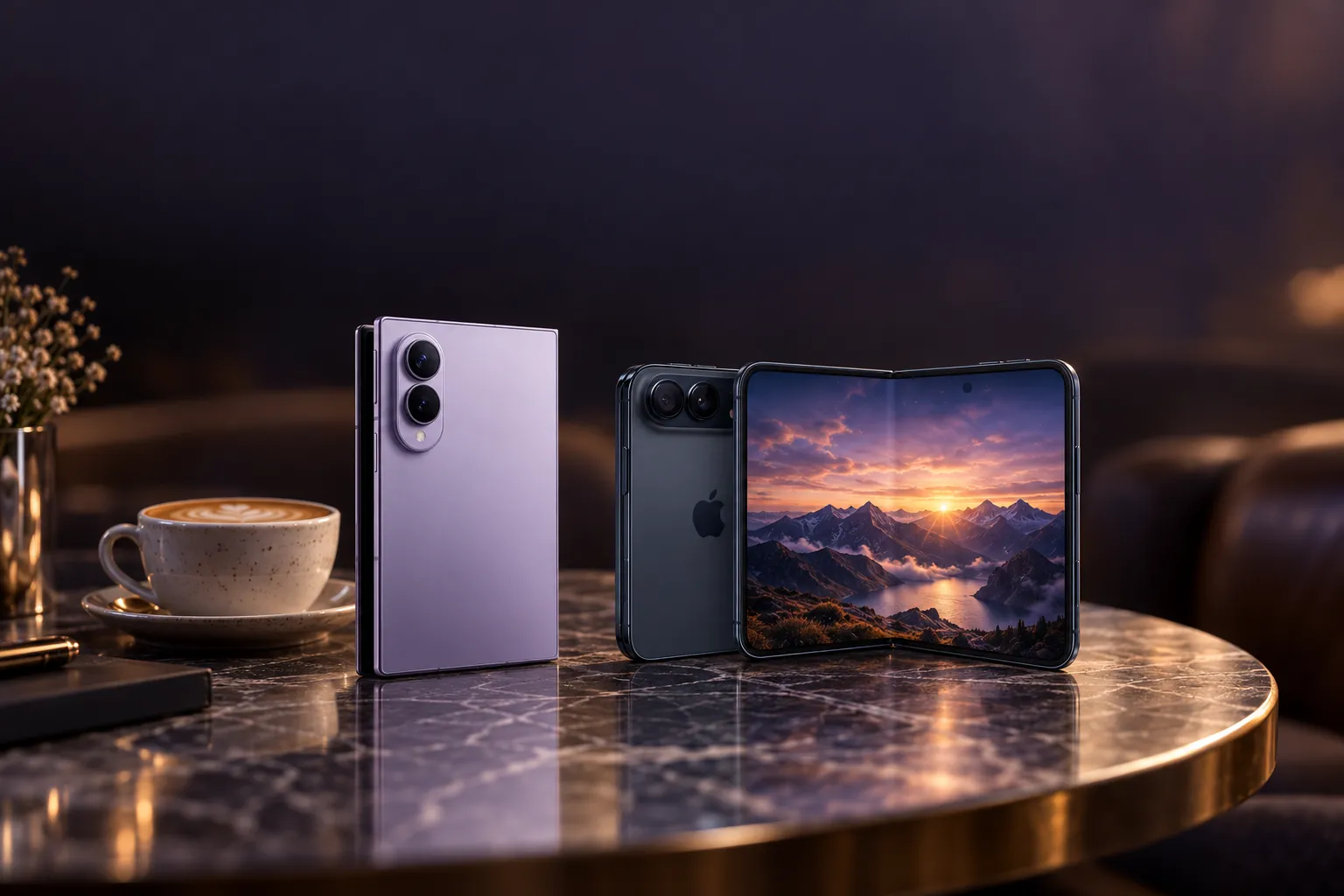


Only one here with a 5x telephoto, plus IP68, seven years of updates, 25W magnetic charging and an 8-inch screen.
Check price on Amazon
At 201g and 9.7mm folded it is the lightest and slimmest here, with a wide 4:3 screen for reading.
Check price on Amazon
Led Tom's Guide's battery test at 13h 20m, with IP68, titanium build and strong A20 Pro performance.
Check price on AmazonWe link to the exact model on Amazon UK. Prices change often, so check the live price before you buy. As an Amazon Associate we earn from qualifying purchases.
Picture the 7.42 into town: one hand on the rail, the other trying to read a contract, a recipe or the match report on a screen the size of a playing card. A book-style foldable promises to fix that by turning into a small tablet when you need one. With all three of these now in UK shops, roughly £2,000 rides on choosing the one whose compromises you can actually live with.
The short answer
Most Android buyers should start with the Google Pixel 11 Pro Fold. It is the only one of the three with a dedicated 5x telephoto camera, it carries IP68 protection and seven years of updates, and it has the biggest screens.
Choose the Samsung Galaxy Z Fold8 if carrying comfort comes first. At 201g and 9.7mm folded, it is the lightest and slimmest here, and its wide 4:3 inner screen suits reading and video.
Choose the Apple iPhone Duo if you live in Apple's world. It posted the longest battery result in Tom's Guide's shared test and led TechRadar's benchmarks, but it is the heaviest and priciest.
| At a glance | Samsung Galaxy Z Fold8 | Google Pixel 11 Pro Fold | Apple iPhone Duo |
|---|---|---|---|
| UK RRP (Amazon listing config) | £1,869 (512GB/12GB, Lavender) | £1,799 (256GB/16GB, Obsidian) | £1,999 (256GB, Night Sky) |
| UK release | 7 August 2026 | 20 August 2026 | 23 October 2026 |
| Inner screen | 7.6in, 120Hz | 8in, 120Hz | 7.6in, 120Hz ProMotion |
| Cover screen | 5.5in | 6.5in | 5.4in |
| Chip | Snapdragon 8 Elite Gen 5 for Galaxy | Google Tensor G6 | Apple A20 Pro |
| Rear cameras | 50MP wide + 50MP ultra-wide | 48MP wide + 10.5MP ultra-wide + 10.8MP 5x telephoto | 48MP main + 48MP ultra-wide |
| Weight | 201g | 239g | 254g |
| Folded thickness | 9.7mm | 10.1mm | 11.3mm |
| Water/dust rating | IP48 | IP68 | IP68 |
| Wireless charging | 20W | 25W Qi2.2 (Pixelsnap) | 25W MagSafe/Qi2 |
| Software | Android 17, One UI 9 | Android 17 | iOS 27 |
| Buy | Check price | Check price | Check price |
Three Very Different Ideas of What a Folding Phone Should Be
These phones are not three takes on the same template. Samsung, Google and Apple each reshaped the book-style foldable in a different direction this year, and the shape you prefer may matter more than any benchmark.
Samsung went wide. The Galaxy Z Fold8, which went on UK sale on 7 August 2026, swaps the tall, narrow cover screen of earlier Folds for a "passport" shape: roughly 10:16 closed and 4:3 open. Samsung calls it "content-native", and it now sits alongside a separate, larger Fold8 Ultra that takes over the productivity flagship role.
Google went big and bright. The Pixel 11 Pro Fold, released on 20 August 2026, is a conventional 6.5-inch phone when shut and an 8-inch near-square tablet when open. Its pitch is a very bright display, a proper zoom lens and Gemini-powered software.
Apple went its own way, as usual. The iPhone Duo arrived on 23 October 2026 as Apple's first foldable. It pairs a 5.4-inch outer screen with a 7.6-inch inner one, and both share a similar aspect ratio so apps move between them more naturally. It uses Touch ID in the side button rather than Face ID, and it takes eSIMs only, with no physical SIM tray.
Set your expectations now: there is no outright winner. Each phone leads in at least one area that matters, and each has a weakness the others avoid.
Open It Up: Display Size, Brightness and Crease Quality Compared
All three inner screens are adaptive-refresh OLEDs that run at up to 120Hz, so smoothness is a draw. The differences lie in shape, sharpness and how well each copes with sunlight.
| Display | Samsung Galaxy Z Fold8 | Google Pixel 11 Pro Fold | Apple iPhone Duo |
|---|---|---|---|
| Inner size and resolution | 7.6in, 1,848 × 2,448, 403ppi | 8in, 2,076 × 2,152, 372ppi | 7.6in, 2,670 × 1,878, 430ppi |
| Inner shape | About 4:3 | Near-square | Wide, matched to the outer screen |
| Cover screen | 5.5in, 428ppi | 6.5in, 399ppi | 5.4in, 460ppi |
| Refresh rate (both screens) | 1–120Hz | 1–120Hz | ProMotion up to 120Hz |
| Measured inner brightness | 1,419 nits max; 3,152 nits at 18% APL (Notebookcheck) | 2,982 nits peak (Tom's Guide) | 1,986 nits SDR; 2,558 nits HDR (Tom's Guide) |
The Pixel's 2,982-nit result made it the brightest foldable screen in Tom's Guide's testing, and that publication praised its outdoor visibility. Tom's Guide also measured it at a Delta-E of 0.26 to 0.31, which is very accurate colour. The same outlet measured the iPhone Duo at 1,986 nits in SDR and 2,558 nits in HDR, with a similarly tidy Delta-E of 0.27.
The Fold8's figures come from different labs, so treat them as context rather than a direct ranking. Notebookcheck recorded 1,419 nits maximum and over 3,000 nits on small bright areas. Expert Reviews found colour accuracy short of its ideal target. TechRadar found the Fold8 harder to read in direct sun than its spec sheet suggests.
Shape is the Fold8's real display argument. TechRadar found its 4:3 inner panel better suited to reading and widescreen video than a squarer layout. The Pixel's taller 6.5-inch cover screen is the most conventional phone-like experience closed. The Duo's 5.4-inch cover screen is the sharpest on paper at 460ppi, but Tom's Guide found its squat shape shows less of an inbox or webpage at once.
Mind the crease (and the flicker)
WIRED found the Pixel's crease more visible than on some rivals. Tom's Guide called the Fold8's crease less intrusive, and TechRadar said the Duo's nano-texture inner panel is unusually good at hiding the fold, although WIRED noted that the finish costs some movie contrast and off-axis viewing. If screen flicker gives you headaches, be cautious: Notebookcheck measured 240Hz PWM on the Fold8, and Android Central described the Pixel's PWM dimming as poor.
Pocket Test: Weight, Thickness and Everyday Carry
This is where the Fold8 pulls clearly ahead. At 201g (PhoneArena's scales read 200g), it weighs about the same as plenty of conventional flagships. PhoneArena scored its design 9/10 and found the short body easier to carry than several slab phones.
Thickness follows the same order. Folded, the Fold8 measures 9.7mm, the Pixel 10.1mm and the Duo 11.3mm. Unfolded, they are 4.5mm, 5.0mm and 5.2mm respectively. The 53g gap between the Samsung and the Apple is roughly the weight of a hen's egg. You won't notice it on the scales, but you will in a shirt pocket by mid-afternoon.
The heavier two are not clumsy, but reviewers did notice their weight. TechRadar wished the Duo were thinner and lighter, and WIRED singled out its 254g weight. WIRED also criticised the Pixel's weight and thickness against newer rivals, and Android Central found its flat sides made it awkward to prise open.
Footprint matters as much as weight. The Fold8 is 123.9mm tall folded and the Duo 117.8mm, both short and wide. The Pixel is a taller 155.2mm × 76mm when shut, closer to a normal phone. If you want something that feels like your current handset when closed, the Pixel is the familiar option.
Chips, Benchmarks and Whether It Actually Feels Fast
Each phone uses a different processor: Qualcomm's Snapdragon 8 Elite Gen 5 for Galaxy in the Fold8, Google's Tensor G6 in the Pixel and Apple's A20 Pro in the Duo. The A20 Pro is a six-core design (two performance and four efficiency cores) with a seven-core GPU featuring hardware ray tracing, plus a dual 16-core Neural Engine.
Benchmark comparisons need care, because labs used different versions of Geekbench. The cleanest Android comparison comes from Tom's Guide, which ran both the Fold8 and the Pixel through Geekbench 6.
Graphics tell a similar story. In 3DMark Wild Life Extreme Unlimited, TechRadar recorded 7,171 for the Duo and 3,110 for the Pixel. Its Fold8 stress-test run peaked at 5,087 and fell to 2,083. That drop matches Notebookcheck's finding of thermal throttling under sustained load. Tom's Guide measured 75.9% stability over 20 loops for the Duo and found it spread heat more evenly than the Fold8.
Does any of this matter day to day? Less than the bars suggest. TechRadar said the Pixel's deficit is hard to notice in ordinary use, and Tom's Guide described its everyday operation as smooth. For gaming, TechRadar ran Destiny Rising at 60fps on maximum settings and Asphalt Legends at 120fps on the Fold8 without difficulty. Tom's Guide had three apps running side by side on the Fold8 with no noticeable lag.
Memory is the Pixel's quiet advantage. Every Pixel 11 Pro Fold has 16GB of RAM, whereas the Fold8 has 12GB at 256GB and 512GB (16GB only on the 1TB model). Apple does not publish a RAM figure for the Duo.
Cameras: One Has a Zoom Lens, Two Don't
This is the clearest hardware split in the comparison. Only the Pixel has a dedicated telephoto camera. Both the Samsung and the Apple rely on cropping from high-resolution main sensors for their zoom.
| Cameras | Samsung Galaxy Z Fold8 | Google Pixel 11 Pro Fold | Apple iPhone Duo |
|---|---|---|---|
| Main | 50MP, f/1.8, OIS | 48MP wide | 48MP Fusion Main, f/1.6, sensor-shift OIS |
| Ultra-wide | 50MP, f/1.9, 120° | 10.5MP with autofocus and Macro Focus | 48MP Fusion Ultra Wide, f/2.2, 120° |
| Dedicated telephoto | No | Yes: 10.8MP, 5x optical, OIS | No |
| Zoom | 2x optical-quality; up to 10x digital | Optical-quality 2x, 5x and 10x; Super Zoom to 30x | 2x optical-quality; claimed 4x optical-quality range; up to 10x digital |
| Selfie cameras | 10MP cover + 10MP inner | 10MP dual-PD cover + inner | 12MP Center Stage outer + under-display inner |
Tom's Guide called the Pixel's 5x lens a major strength, noting its unusually long reach for a book-style foldable. WIRED rated its photos good against rival foldables, though it pointed out that the Fold lacks the more advanced camera hardware of the non-folding Pixel 11 Pro models.
The Fold8's twin 50MP sensors give it the highest resolution ultra-wide here, but TechRadar, Tom's Guide and Notebookcheck all criticised the missing telephoto. Tom's Guide called it a major compromise on a phone costing over £1,500.
The Duo makes the most of its two lenses with Smart Take, Duo Preview, Photographic Styles 3 and Smart Focus Tracking. Its video credentials are strong too: 4K Dolby Vision at up to 60fps, and up to 120fps on the main camera. Even so, PhoneArena found it weak for distant subjects, and Ars Technica called it a downgrade from a Pro iPhone.
Camera strengths
- Pixel: genuine 5x optical telephoto with OIS
- Fold8: 50MP ultra-wide, matching its main camera's resolution
- Duo: dual 48MP sensors and 4K Dolby Vision video up to 120fps on the main camera
- All three: selfie cameras on both screens, plus rear-camera selfies using the cover display
Camera weaknesses
- Fold8: no telephoto, which every major reviewer flagged
- Duo: no telephoto, so distant subjects suffer according to PhoneArena
- Pixel: 10.5MP ultra-wide, and hardware a step behind the Pixel 11 Pro, according to WIRED
Battery and Charging: Lab Numbers vs a Day in Your Pocket
On paper, the Android pair are twins: 4,800mAh typical for the Fold8 (4,660mAh rated) and 4,806mAh typical for the Pixel (4,658mAh minimum). Apple uses two batteries and does not publish their combined capacity. It claims up to 24 hours of typical use and up to 31 hours of video playback on the inner screen.
| Battery and charging | Samsung Galaxy Z Fold8 | Google Pixel 11 Pro Fold | Apple iPhone Duo |
|---|---|---|---|
| Capacity | 4,800mAh typical | 4,806mAh typical | Not published by Apple |
| Tom's Guide rundown | 12h 19m | 12h 31m | 13h 20m |
| TechRadar experience | One to 1.5 days mixed use | About 12h lab; 24h+ light use | 13h lab; about 14h varied use |
| Wired charging spec | 45W | 30W (50% in about 30 min) | 50% in about 20 min with a 60W-capable adapter |
| Wireless charging | 20W | 25W Qi2.2 | 25W MagSafe/Qi2 |
| Built-in magnets | No (case needed, per Tom's Guide) | Yes, Pixelsnap | Yes, MagSafe |
Tom's Guide's rundown puts the Duo first, but only by about an hour, with the Pixel and Fold8 just 12 minutes apart. In practice, all three last a working day. WIRED usually finished days on the Duo with around 40% left. WIRED also found the Pixel lasted a day, though heavy photography or gaming meant switching to Battery Saver before bedtime. PhoneArena logged just under six hours of screen-on time with the Fold8.
Charging reverses the order. The Fold8 refilled quickest in Tom's Guide's comparison, and TechRadar took it from empty to 43% in 15 minutes and to full in 1 hour 5 minutes. The Pixel's 30W wired charging trails both rivals, but its 25W magnetic wireless charging is a real convenience if you charge on a bedside puck.
Budget for a charger
None of the three comes with a power adapter. To hit Samsung's quoted 63% in about 30 minutes, you need its 45W adapter and a 3A cable. The Pixel needs a 30W USB-C PPS charger, and the Duo's headline wired figure needs a 60W-capable adapter. Samsung also publishes a minimum endurance of 1,200 charge cycles for the Fold8's battery.
Android's Two Flavours vs iOS: Software, AI and Update Promises
For many buyers, software settles the decision before hardware gets a look in. If your family group chat is on iMessage and your laptop is a MacBook, the Duo is probably your only realistic choice. If not, the two Android phones offer genuinely different personalities.
Samsung Galaxy Z Fold8: One UI 9 and Galaxy AI
Android 17 with Samsung's mature Multi-Window system, plus Galaxy AI features such as Now Nudge, Multi-Window automation and My FanCam subject tracking. Note that FanCam needs a Samsung account and won't work with every video. Samsung's UK page promises seven generations of OS upgrades and seven years of security updates. PhoneArena found some multitasking functions less flexible than on competing Android phones, and Notebookcheck confirms there is no S Pen support.
Google Pixel 11 Pro Fold: Gemini and clean Android
Seven years of Android OS, security and Pixel Drop updates. Tom's Guide liked Rambler in Gboard, Gemini task automation and floating app bubbles that work alongside split-screen. HiLight uses coloured LEDs around the camera visor to signal calls from chosen contacts while the phone is face down, though Android Central found HiLight less useful than advertised. Tom's Guide also reported occasional app refreshes and letterboxing when switching screens.
Apple iPhone Duo: iOS 27
Side-by-side apps, tabletop and tent positions, StandBy and layouts that adapt to the fold won praise from Tom's Guide. The Duo also supports Apple Pencil (USB-C), Apple Intelligence and DisplayPort output over USB-C. WIRED found multitasking somewhat rigid and many third-party apps initially showing black bars or a phone-sized window on the inner screen. Apple does not publish a fixed number of years of updates.
Samsung and Google both publish seven-year commitments. Apple supports iPhones for years but does not state a fixed figure for the Duo, so if a written guarantee matters to you, the Android pair are the safer bet.
Samsung Galaxy Z Fold8: The Case For and Against
The Fold8 is the foldable for people who want to forget they are carrying one. Reviewers loved the passport shape: TechRadar said it feels well-sized both open and closed, and Notebookcheck called it a refined, practical foldable rather than a technical novelty. It suits readers, video watchers and anyone already using Galaxy devices. The catch is the hardware you give up to keep it slim.

Reviewers liked
- 201g weight and 9.7mm folded depth
- 4:3 inner screen for reading and video
- Three apps at once without lag (Tom's Guide)
- Quickest charging of the three in Tom's Guide's comparison
Reviewers disliked
- No telephoto camera
- IP48 rather than IP68
- Weak speakers and thermal throttling (Notebookcheck)
- No built-in Qi2 magnets
Google Pixel 11 Pro Fold: The Case For and Against
The Pixel ticks the most practical boxes: IP68, a telephoto lens, magnetic charging, the biggest screens and 16GB of RAM. TechRadar called it a much lighter build than its predecessor, and Google says it is almost 10% lighter and about 1mm thinner than the Pixel 10 Pro Fold. It suits existing Pixel owners and anyone who photographs distant subjects. The catch is a processor that trails its rivals on paper.

Reviewers liked
- 2,982-nit inner screen (Tom's Guide)
- 5x optical telephoto
- IP68, which WIRED counted as a real advantage over Samsung
- 25W Pixelsnap magnetic charging
Reviewers disliked
- Tensor G6 benchmarks behind the Snapdragon rivals
- Slowest wired charging here: 56% in 30 minutes
- More visible crease (WIRED)
- Poor PWM dimming (Android Central)
Apple iPhone Duo: The Case For and Against
WIRED called Apple's first foldable astonishingly good, praising the hinge, the nano-texture finish and the reliable battery. Tom's Guide found its speakers surprisingly good and better placed than the Fold8's. It suits iPhone owners who have been waiting for Apple's take. The catch is weight, price and some early app rough edges.

Reviewers liked
- 13h 20m in Tom's Guide's rundown
- Strong A20 Pro benchmark results (TechRadar)
- Titanium frame, IP68 rated to 6 metres for 30 minutes
- Crease well hidden (TechRadar)
Reviewers disliked
- 254g and 11.3mm folded
- 256GB base storage felt small at this price (TechRadar)
- Squat outer screen, awkward left-side reach (Tom's Guide)
- No telephoto; patchy third-party app optimisation
Pound for Pound: Which Fold Justifies Its Price Tag
Here are the UK RRPs and launch prices. Retail prices, including Amazon's, move around and retailers often discount, so check the live price before you commit.
Fold8 256GB
12GB RAM
Fold8 512GB
12GB RAM · Amazon listing
Fold8 1TB
16GB RAM
Pixel 256GB
16GB RAM · Amazon listing
Pixel 512GB
Reported launch price
Pixel 1TB
Reported launch price
Duo 256GB
Amazon listing
Duo 512GB
Apple UK price
Duo 1TB
Apple UK price
Duo 2TB
Apple UK price
| RRP by storage | Samsung Galaxy Z Fold8 | Google Pixel 11 Pro Fold | Apple iPhone Duo |
|---|---|---|---|
| 256GB | £1,699 | £1,799 | £1,999 |
| 512GB | £1,869 | £1,919 | £2,199 |
| 1TB | £2,209 | £2,149 | £2,599 |
| 2TB | Not offered | Not offered | £3,199 |
Compare like for like. At 256GB, the Fold8 is the cheapest of the three, the Pixel costs £100 more and the Duo £300 more. Note that the Amazon listings here are not matched: the Fold8 listing is the 512GB model, while the Pixel and Duo listings are 256GB.
The Pixel makes the strongest value argument at any matched capacity. For £100 more than the 256GB Fold8, you get 16GB of RAM, a telephoto lens, IP68 and magnetic charging. The Duo's extra £300 or more buys titanium, iOS and the longest battery run here, but no extra camera hardware. TechRadar's view that 256GB feels tight on a £1,999 phone is worth heeding if you shoot a lot of 4K video.
The Fold8's Amazon listing mentions a three-year warranty. Samsung's three-year cover applies to its Enterprise Edition, and standard consumer terms may differ, so check exactly what the seller is offering before you buy.
Scorecard: How the Three Stack Up Category by Category
These are Gadget Scout's editorial scores, based on the published reviews and measurements covered above. On display, the Pixel's measured brightness leads, the Duo has the sharpest screens and the Fold8 has the more media-friendly shape. On performance, TechRadar's A20 Pro results lead, the Fold8 follows and the Pixel trails.
The tight spread is the point. Swap the weightings to suit your priorities and any one of these could come out on top.
Who Should Buy Which Fold
Buy the Google Pixel 11 Pro Fold if…
you want one foldable to do everything. You get a real 5x zoom, IP68, seven years of updates, 25W magnetic charging and the largest 8-inch canvas. Accept slower wired charging and lower benchmark scores, which reviewers say you rarely feel.
Buy the Samsung Galaxy Z Fold8 if…
you want the lightest and slimmest option at 201g and 9.7mm, love reading and video on a 4:3 screen, rely on Samsung's multitasking and can live without a zoom lens or full dust protection.
Buy the Apple iPhone Duo if…
you're committed to iOS and want titanium, IP68, strong performance and the longest Tom's Guide battery result (13h 20m). Be ready for 254g, Touch ID instead of Face ID, eSIM only and the highest prices here.
Our verdict
For most UK Android buyers, we recommend the Google Pixel 11 Pro Fold. It covers the brief's priorities (cameras, durability, software support and everyday practicality) with the fewest gaps, at a lower RRP than the Duo at every capacity.
The Samsung Galaxy Z Fold8 is the pick if portability decides it: no rival here comes close on weight. The Apple iPhone Duo is the one for iPhone loyalists, and it's a compelling first attempt, provided the weight and price don't put you off.
Foldable FAQs: What UK Buyers Keep Asking
Sources
- Samsung UK newsroom, Galaxy Z Fold8 specifications and pricing: news.samsung.com
- Samsung UK Fold8 specification page: samsung.com
- Google Pixel 11 Pro Fold specifications: store.google.com
- Apple iPhone Duo technical specifications: apple.com
- Galaxy Z Fold8 reviews: TechRadar, Tom's Guide, Notebookcheck, Expert Reviews, PhoneArena
- Pixel 11 Pro Fold reviews: Tom's Guide, TechRadar, WIRED, Android Central, Tech Advisor
- iPhone Duo reviews: TechRadar, Tom's Guide, WIRED, PhoneArena, Ars Technica
- Google Pixel 11 Pro FoldBest all-round AndroidView on Amazon
- Samsung Galaxy Z Fold8Best for portabilityView on Amazon
- Apple iPhone DuoBest for iPhone ownersView on Amazon
Sources and evidence (36)
- fi.ingrammicro.com (other)
- news.samsung.com (other)
- news.samsung.com (other)
- techradar.com (other)
- notebookcheck.net (other)
- tomsguide.com (other)
- phonearena.com (other)
- expertreviews.co.uk (other)
- samsung.com (other)
- news.samsung.com (other)
- support.google.com (other)
- blog.google (other)
- store.google.com (other)
- tomsguide.com (other)
- techradar.com (other)
- wired.com (other)
- androidcentral.com (other)
- store.google.com (other)
- techadvisor.com (other)
- apple.com (other)
- apple.com (other)
- apple.com (other)
- tomsguide.com (other)
- techradar.com (other)
- wired.com (other)
- phonearena.com (other)
- arstechnica.com (other)
- apple.com (other)
- notebookcheck.net (other)
- news.samsung.com (other)
- samsung.com (other)
- apple.com (other)
- apple.com (other)
- news.samsung.com (other)
- blog.google (other)
- en.wikipedia.org (other)