
JBL Xtreme 4 vs Bose SoundLink Max vs Sonos Move 2: which sounds right for you?
Three large portable speakers, three very different priorities: all-day outdoor stamina, richer Bluetooth listening, or a speaker that returns home to a smart multi-room system.
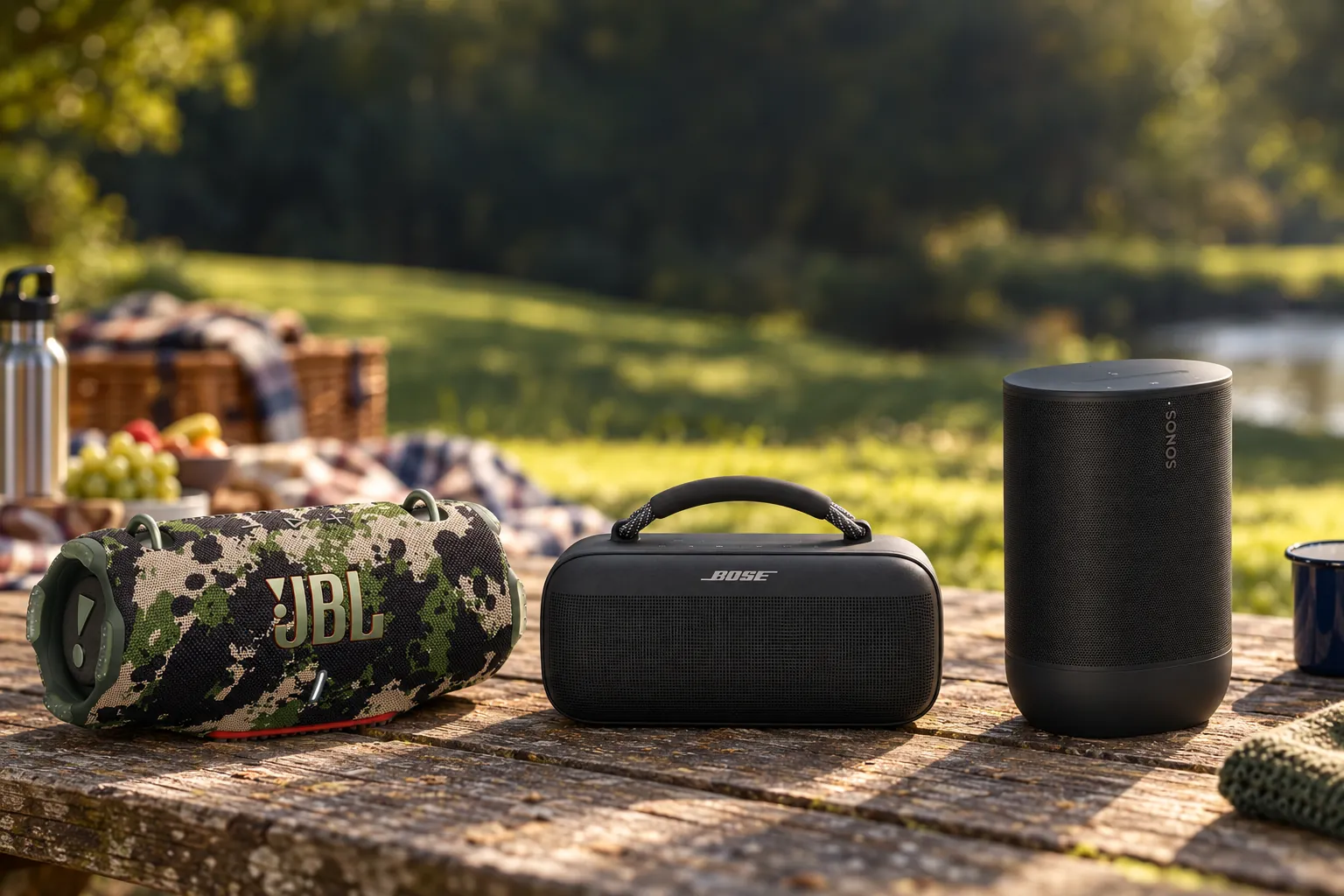


IP67 protection, a replaceable battery and about 27 hours reported by RTINGS suit long outdoor listening.
Check price on Amazon
Warm, punchy sound, AUX input and aptX Adaptive make it the flexible Bluetooth-focused choice.
Check price on Amazon
Wi-Fi 6, AirPlay 2, Trueplay and Sonos multi-room features suit an established Sonos household.
Check price on AmazonWe link to the exact model on Amazon UK. Prices change often, so check the live price before you buy. As an Amazon Associate we earn from qualifying purchases.
Picture the usual decision: music in the garden is getting lost beneath conversation, rain starts to threaten, and the speaker also needs enough charge left for tomorrow. JBL Xtreme 4 is a practical pick for long outdoor sessions and rougher use, with RTINGS reporting roughly 27 hours of battery life in its test, longer than the RTINGS figures reported for the other two speakers in this article. Bose SoundLink Max makes more sense for listeners who want an AUX input, a documented aptX Adaptive codec and a warm, forceful sound; RTINGS' own head-to-head comparison tool describes the SoundLink Max as more balanced-sounding than the JBL Xtreme 4. Sonos Move 2 can make sense in a Sonos household, where Wi-Fi, AirPlay 2, voice control and multi-room playback matter more than being the lightest thing to carry.
The Contenders: Three Very Different Routes to Big Sound
These speakers occupy the same broad premium portable category, but they are not interchangeable. JBL Xtreme 4 is a 2.1kg Bluetooth-first speaker built around IP67 protection, a shoulder strap, speaker linking and a replaceable battery. Bose SoundLink Max is similarly portable at about 2.13kg, with IP67 protection and a compact rope handle, but it adds a proper 3.5mm AUX input and aptX Adaptive support.
Sonos Move 2 has a different job. At 3kg, it is a substantial home speaker that can move onto a patio or into a garden. It has Wi-Fi 6, AirPlay 2, Alexa, Sonos Voice Control and automatic Trueplay tuning, plus an included charging base. Initial setup requires the Sonos app and Wi-Fi; JBL and Bose can be used as straightforward Bluetooth speakers without that onboarding step.
For a UK buyer, the most useful distinction is whether "portable" means a speaker that regularly leaves the house or one that simply changes rooms. JBL and Bose are close enough in weight to carry to a barbecue, campsite or holiday accommodation without much thought, while the Move 2 is better treated as a speaker with a home base. That also affects setup: JBL and Bose are immediate choices for guests who want to pair a phone, whereas Sonos rewards the extra initial setup only when its Wi-Fi, streaming and grouping features become part of everyday listening.
| Key specification | JBL Xtreme 4 | Bose SoundLink Max | Sonos Move 2 |
|---|---|---|---|
| UK launch RRP | £329.99 | £399 | £449 |
| Weight | 2.1kg | About 2.13kg | 3kg |
| Dimensions | 297 × 149 × 141mm (one source lists 297 × 141 × 149mm) | 264 × 120 × 104mm | 241 × 160 × 127mm |
| Water and dust rating | IP67 | IP67 | IP56 |
| Claimed playtime | Up to 24 hours | Up to 20 hours | Up to 24 hours |
| Bluetooth version | 5.3 | 5.4 | 5.3 |
| Replaceable battery | Yes | Not confirmed | Yes |
| Wi-Fi multi-room playback | No | No | Yes |
| Buy | Check price | Check price | Check price |
Launch RRP provides a stable price comparison rather than a temporary retailer promotion. Bose's current UK list price is £399.95, slightly above its £399 launch RRP; the price grid below uses this current £399.95 figure. The listed Amazon UK products were in stock on 23 October 2026.
JBL Xtreme 4: Rugged Build, Longest Tested Battery
JBL Xtreme 4 arrived in 2024 as the successor to the Xtreme 3. Its layout is designed for scale: two 70mm woofers, two 20mm tweeters and two passive radiators. JBL rates it at 100W RMS from mains power and 70W on battery, a difference worth remembering if the speaker will often run unplugged at party volume. RTINGS reported approximately 27 hours of battery life in its test, the longest of the three RTINGS figures cited in this article.
The physical design makes its intentions clear. There is IP67 dust and water protection, rubberised footing, physical controls, a detachable shoulder strap and a bottle opener built into the strap. It is the longest of the three but lighter than Sonos Move 2, and its horizontal shape is easy to wedge into the boot of a car or carry across a campsite.

Battery endurance is a strong selling point. JBL quoted up to 24 hours from its 68Wh battery, while RTINGS reported roughly 27 hours under its own procedure. TechRadar reported a 5% drop after two hours at 30% volume, a result that broadly supported the speaker's endurance claim. Playtime Boost can add up to six hours, but What Hi-Fi? found that it made the presentation noticeably leaner by reducing bass weight.
Why the replaceable battery matters
JBL sells the Battery 400 replacement pack separately. Fitting it requires a Torx-style screwdriver, but it gives the Xtreme 4 a credible route to a longer life once the original battery has aged. Sonos also sells a Move 2 replacement battery kit; Bose does not advertise a comparable user-replacement route.
Sound is lively, clean and more refined than the rugged styling suggests. What Hi-Fi? praised the controlled bass, crisp treble and improved clarity over the previous generation. TechRadar heard clear mids and sweet highs, but found the default JBL Signature tuning less satisfying for very deep bass; its reviewer recommended the five-band custom EQ in the JBL Portable app for a fuller low end.
The compromises are sensible rather than hidden. The Xtreme 4 has no 3.5mm input, USB-C does not carry audio, and SBC is the documented Bluetooth codec. SoundGuys also found the single-cabinet stereo spread narrow enough that panned elements could feel almost mono. It is a speaker for filling a space, not for sitting close to and analysing a wide left-right image.
In day-to-day use, that makes JBL the straightforward choice when the speaker will be placed near the middle of a garden, table or campsite rather than directly in front of one listener. Use the app before a trip to choose an EQ that suits your music, then rely on the physical controls when the phone is out of reach. The no-adapter version covered here still charges over USB-C with a compatible USB Power Delivery charger, so buyers should make sure they already have a suitable charger if they do not want to buy one separately.
Reasons to choose it
- RTINGS reported about 27 hours of playback in its test, longer than its results for the Bose and Sonos models here.
- IP67 protection suits poolside and wet-weather use.
- Battery replacement is officially supported.
- Auracast and stereo pairing help it scale for gatherings.
The catches
- Output drops when it runs on battery rather than mains power.
- There is no AUX socket or USB audio input.
- Playtime Boost trades bass for extra hours.
- Single-speaker stereo separation is limited.
Bose SoundLink Max: Balanced Sound Without the Smarts
Bose SoundLink Max launched in 2024 as a larger SoundLink portable. It is compact for its output class, measuring about 264 × 120 × 104mm, and its removable rope handle makes the 2.13kg body easier to move between rooms. The speaker uses one tweeter, two 2.5-inch midrange drivers and passive radiators, though Bose does not publish a wattage figure.
This is the Bluetooth-focused option with a broad set of wired and wireless source support: Bluetooth 5.4, SBC, AAC and aptX Adaptive, multipoint pairing for two source devices, USB-C phone charging and a 3.5mm AUX input. That socket has genuine practical value for a projector, laptop, games console monitor or older music player, and neither rival offers the same direct analogue connection without an adapter.

Its battery claim is up to 20 hours at moderate volume. Bose also states up to three hours at maximum volume, which gives a more realistic picture of the cost of sustained high output. RTINGS reported more than 15 hours of continuous battery life. TechGearLab reported 43 hours and seven minutes under its own conditions, an unusually high result that illustrates why battery figures from different publications should not be treated as a single common laboratory standard.
Sound profile in plain English
TechGearLab scored the SoundLink Max 8.4/10 for bass, 8.6/10 for midrange, 8.3/10 for treble and 8.0/10 for soundstage, with an overall score of 73/100. The result aligns with the wider review consensus: this is a weighty, energetic speaker that keeps vocals and instruments reasonably composed.
Reviewers did not describe it as neutral out of the box. What Hi-Fi? called the default balance very bass-heavy and suggested reducing the bass through the Bose app for a more measured presentation. TechRadar likewise praised its punch and control, whilst finding that the fine-detail retrieval did not match the scale and warmth of its broader sound. The adjustable bass, mid and treble EQ is useful rather than optional for listeners with particular tastes.
Its IP67 rating matches JBL's, so temporary immersion and dust are within its protection rating. That does not erase practical concerns: SoundGuys criticised the unprotected USB-C and AUX ports, and TechGearLab reported sand entering the grille during beach use. The rubberised finish can also collect dust. This is durable enough for travel and a garden party, but it benefits from a quick clean after a sandy day out.
The Bose is especially easy to recommend where a speaker has to cover both music and occasional non-Bluetooth jobs. Connect a projector or laptop by AUX, switch back to a phone without losing the convenience of multipoint, and use the handle for short moves around the house. It is less convincing for an all-day festival-style session because charging takes up to five hours with a 15W supply and charging a phone reduces playback time. Treat the power-bank function as an emergency convenience rather than a substitute for a separate battery pack.
Reasons to choose it
- Warm, powerful sound with useful app EQ.
- Built-in 3.5mm AUX input for wired sources.
- aptX Adaptive, AAC, multipoint and Bluetooth 5.4.
- IP67 protection and a practical removable handle.
The catches
- Five-hour full charge time with a 15W supply is slow.
- There is no Wi-Fi, AirPlay or voice control.
- Maximum-volume battery life is quoted at about three hours.
- Rear ports need care around sand and debris.
Sonos Move 2: The Smart Speaker That Travels
Sonos Move 2 is the second-generation Move and the outlier in this comparison. Its two angled tweeters, mid-woofer and three Class-D amplifiers aim to deliver a larger indoor sound than a typical Bluetooth cylinder, according to Sonos's specifications. More importantly, it is a networked Sonos speaker: it can join multi-room playback over Wi-Fi, receive AirPlay 2, respond to Alexa or Sonos Voice Control, and tune itself automatically with Trueplay.
Those features make sense when the Move 2 spends most of its time in a kitchen, office or living room, then moves to the patio for an evening. The included wireless charging base supports that pattern better than a loose USB-C cable. USB-C charging is also available on the go, and the port can charge another device or accept line-in audio through Sonos's separate Line-In Adapter.

It is also the heaviest model here at 3kg. The recessed rear grip is tidy, but TechRadar preferred a conventional handle for carrying. Its IP56 rating means resistance to dust and powerful water jets, not temporary immersion. For a boat deck, beside a swimming pool, or a beach where it could be dropped into water, JBL and Bose have a meaningful physical advantage.
Battery life is more complex than the up-to-24-hour headline suggests. TechRadar found a drain of around 4% per hour at about 25% volume over Wi-Fi using AirPlay 2, pointing to roughly 24 hours of active playback under that approach. It also saw about 20% drain over 24 hours when the speaker was left idle. RTINGS reported around 10 hours in its own procedure, making Move 2 the model whose results vary most sharply with volume, network activity and methodology.
Sonos Move 2 sounds detailed and controlled according to TechRadar, and What Hi-Fi? heard clearer vocals, improved bass control and better composure than the original Move. But the stereo promise should be kept in perspective. WIRED and DXOMARK both described limited stereo width from one enclosure, while DXOMARK found maximum loudness below expectations for this size and price.
Think of Move 2 as a docked room speaker first and an outdoor speaker second. It suits buyers who can play through Wi-Fi in the morning, join other Sonos rooms later, then lift it outside without needing to reconnect a phone. A buyer starting from scratch should also factor in the ecosystem: its most distinctive benefits are not heard from a single Bluetooth playlist. Conversely, someone who mainly wants a speaker for holidays or spontaneous trips will get more immediate value from the lighter JBL or Bose.
Reasons to choose it
- Wi-Fi 6, AirPlay 2 and Sonos multi-room playback.
- Alexa, Sonos Voice Control and automatic Trueplay.
- Charging base is included in the box.
- Official replacement battery kit is available.
The catches
- 3kg weight makes it less convenient for day trips.
- IP56 is not an immersion rating.
- Initial setup needs the Sonos app and Wi-Fi.
- Independent battery results vary markedly from the headline claim.
Sound Quality Head-to-Head: Bass, Detail and Loudness
Each model has enough output for a living room, garden table or modest gathering. JBL leans into physical scale and party energy; Bose pursues a warmer, more immediately substantial balance; Sonos puts refinement and room-aware home listening ahead of maximum outdoor aggression. Reviewers' views differ by publication and listening conditions, so the comparisons below are attributed to the specific reviewer who made each observation, and the loudness figures below are not a single calibrated ranking.
JBL's tuning is clear and controlled once the EQ is adjusted, with What Hi-Fi? praising its detail and crisp treble. Bose has the fuller default presentation, though some listeners will want to calm its upper bass. Sonos is convincing with vocals and indoor music, but DXOMARK noted darker treble, occasional midrange muddiness and less low-end punch in some conditions.
| Model | Reported loudness figure | Source and method |
|---|---|---|
| JBL Xtreme 4 | 104.9dB(C) peak | Alan Ross, rock track at 1 metre |
| Bose SoundLink Max | 98.2dB | TechGearLab, own test method |
| Sonos Move 2 | 89.1dBA | DXOMARK, correlated pink noise |
These figures are not a ranking. Each publication used a different microphone, weighting and test signal, so the numbers are not directly comparable to one another.
| Listening consideration | JBL Xtreme 4 | Bose SoundLink Max | Sonos Move 2 |
|---|---|---|---|
| Review characterisation | Clear, energetic and EQ-responsive | Warm, punchy and bass-forward | Detailed, controlled and room-aware |
| Single-unit imaging | SoundGuys found it close to mono | RTINGS found moderate directivity | DXOMARK found narrow width |
| Measured loudness evidence | 104.9dB(C) peak, Alan Ross | 98.2dB, TechGearLab | 89.1dBA pink noise, DXOMARK |
| EQ control | Five-band custom EQ | Bass, mid and treble adjustment | Bass, treble and loudness control |
Battery Life Reality Check: Claims and Independent Results
Published battery claims always need context. Volume, music with heavy bass, Bluetooth versus Wi-Fi, connection stability and charging a phone from the speaker all change the result. Bose explicitly bases its 20-hour rating on moderate listening conditions, while Sonos describes its 24-hour estimate as moderate-volume Wi-Fi playback.
RTINGS reported that JBL's 24-hour claim was exceeded by its own roughly 27-hour test figure. Bose's more-than-15-hour RTINGS result is below its 20-hour claim, while the much longer TechGearLab-reported result belongs to a different protocol. Sonos can reach its claimed figure under lighter use according to TechRadar's observations, but RTINGS' roughly 10-hour result means buyers planning off-grid weekends should not assume a guaranteed 24-hour outcome.
Charging arrangements matter in a UK household as well. JBL's linked Squad package is supplied without a PD adapter, so it charges over USB-C only if you already have a compatible USB Power Delivery charger. Bose's UK box includes a USB-C-to-USB-C cable, but whether a UK charging plug is also included is not confirmed. Sonos Move 2 is the simplest permanent-home option, since its charging base and 45W USB-PD adapter are included in the box. If the speaker will live in one place, that bundled base is a real convenience; if it will travel often, a compatible USB-C charger is the more flexible arrangement.
Buying implication: RTINGS reported roughly 27 hours of independent battery life for JBL, higher than its reported results for the other two speakers here, making it a strong option for camping, festivals and long garden days. Bose is likely to cover an evening and more at sensible volume, per RTINGS' 15-plus-hour result. Move 2 is more persuasive when it returns regularly to its charging base than when it must remain away from mains power for a whole weekend, given RTINGS' roughly 10-hour result.
Built to Survive: Waterproofing, Weight and Everyday Toughness
IP67 is a meaningful dividing line. JBL Xtreme 4 and Bose SoundLink Max are dust-tight and protected for temporary immersion. Neither is designed to float, but both are more forgiving beside a pool or during a sudden downpour. Sonos Move 2 resists dust and strong water jets under IP56, which is sufficient for rain and garden splashes but not for being submerged.
JBL is the lightest at 2.1kg and includes the most useful carry kit: its detachable shoulder strap leaves both hands free. Bose is virtually the same weight and its rope handle feels more natural for a short carry from kitchen to patio, though a longer Bose shoulder strap was sold separately. Sonos is nearly a kilogram heavier than either Bluetooth rival and is more likely to be carried around the home than packed for a long walk.
Smart Features and Connectivity: Where Sonos Differs
Sonos Move 2 is the only model here with a home network platform
Wi-Fi 6, AirPlay 2, Sonos multi-room grouping, Alexa, Sonos Voice Control and automatic Trueplay make it a different kind of product from the two Bluetooth-first speakers.
Bose SoundLink Max offers broad wired and wireless source support
AAC and aptX Adaptive support, multipoint Bluetooth and the integrated AUX socket suit a mixed collection of phones, laptops and wired devices.
JBL Xtreme 4 is built for speaker linking
Auracast can connect multiple compatible JBL speakers, while two Xtreme 4 units can form a stereo pair. The JBL Portable app also provides presets and a five-band EQ.
Both JBL and Bose support Bluetooth multipoint according to SoundGuys and Bose's product information, respectively. Sonos approaches the problem differently: it is designed around app-controlled network playback and grouping. That makes Move 2 more capable in a compatible home, but less immediate for someone who only wants to press Bluetooth and start a playlist.
Value and Running Costs: What Your Money Actually Buys
The launch price spread was £120 from JBL Xtreme 4 at £329.99 to Sonos Move 2 at £449, with Bose SoundLink Max at its £399 launch RRP (Bose's current UK list price is £399.95). That gap is not simply about louder sound. JBL directs its lower RRP towards endurance, durability and serviceability; Bose spends more on source connectivity and sound tuning; Sonos charges for an ecosystem of Wi-Fi and smart-home features.
JBL Xtreme 4
Longest independently reported battery figure, IP67 and an officially replaceable battery.
Bose SoundLink Max
AUX, aptX Adaptive, multipoint and a sound profile reviewers described as full and controlled.
Sonos Move 2
Wi-Fi 6, AirPlay 2, voice control, automatic Trueplay and an included charging base.
TechRadar considered JBL's full RRP difficult to justify against lower-priced party speakers, despite its strong feature set. TechRadar also questioned whether £399.95 is justified for a Bluetooth-only speaker with no Wi-Fi or smart features. With Sonos, the calculation is clearer: it makes financial sense only if its multi-room and smart-speaker functions will actually be used. Otherwise, its additional weight and lower protection rating give the Bluetooth models a more straightforward case.
Full Specification Face-Off
| Specification | JBL Xtreme 4 | Bose SoundLink Max | Sonos Move 2 |
|---|---|---|---|
| Driver arrangement | Two 70mm woofers, two 20mm tweeters, two passive radiators | One tweeter, two 2.5-inch midrange drivers, passive radiators | Two angled tweeters and one mid-woofer |
| Rated output | 100W mains; 70W battery | Not confirmed | Not confirmed (three Class-D amplifiers) |
| Claimed battery life | Up to 24 hours | Up to 20 hours | Up to 24 hours |
| Independent battery report | About 27 hours, RTINGS | More than 15 hours, RTINGS; 43h 7m, TechGearLab | About 10 hours, RTINGS |
| Charge time | About 3.5 hours | Up to 5 hours with 15W supply | About 3 hours on charging cradle, SoundGuys |
| Wired audio | No AUX input | 3.5mm AUX input | Line-in via separate Sonos adapter |
| Phone charging | USB-C power bank | USB-C phone charging | USB-C device charging |
| Smart functions (selected highlights — see full feature sections above for each model's complete capabilities) | Auracast, stereo pairing, multipoint and JBL Portable app | Bose app, SimpleSync and multipoint | Wi-Fi, AirPlay 2, Alexa, Sonos Voice Control, Trueplay and Sonos multi-room grouping |
Battery figures above came from different publications and methods. They indicate likely behaviour rather than directly comparable laboratory results.
Which One Should You Actually Buy?
Choose JBL Xtreme 4 for outdoor freedom
It suits camping, beach trips, barbecues and long weekends where IP67 protection, USB-C power output and the roughly 27-hour RTINGS result matter more than AUX or Wi-Fi. The replaceable battery is a strong long-term ownership advantage.
Choose Bose SoundLink Max for Bluetooth listening
It is the sensible fit for people who care about a rich, punchy presentation, want to adjust bass and treble, need a proper AUX socket, or use compatible phones that benefit from aptX Adaptive.
Choose Sonos Move 2 for a connected home
It earns its place beside existing Sonos products. Buy it for multi-room playback, AirPlay 2, voice control and a speaker that normally lives on its charging base, rather than for poolside durability.
The verdict
For buyers taking a large speaker outdoors, JBL Xtreme 4 combines the highest of the three RTINGS-reported battery figures cited here (approximately 27 hours, versus 15-plus hours for Bose and roughly 10 hours for Sonos), IP67 protection, carry-friendly design and a user-replaceable battery. Bose SoundLink Max suits buyers prioritising sound character, AUX and Bluetooth flexibility, and RTINGS' own comparison tool describes it as more balanced-sounding than the JBL. Sonos Move 2 makes its case through smart-home convenience, but asks buyers to accept more weight, IP56 rather than IP67 protection, and less predictable battery performance away from its dock.
Common Questions Before You Choose
Sources
- JBL UK: Xtreme 4 product information and specifications
- RTINGS: JBL Xtreme 4 review
- TechRadar: JBL Xtreme 4 review
- SoundGuys: JBL Xtreme 4 review
- Bose Support: SoundLink Max specifications
- RTINGS: Bose SoundLink Max review
- TechGearLab: Bose SoundLink Max review
- What Hi-Fi?: Bose SoundLink Max review
- Sonos UK: Move 2 product information and specifications
- RTINGS: Sonos Move 2 review
- DXOMARK: Sonos Move 2 speaker measurements
- TechRadar: Sonos Move 2 review
- JBL Xtreme 4Outdoor enduranceView on Amazon
- Bose SoundLink MaxBluetooth soundView on Amazon
- Sonos Move 2Smart home pickView on Amazon
Sources and evidence (44)
- rtings.com (other)
- techradar.com (other)
- whathifi.com (other)
- uk.jbl.com (other)
- uk.jbl.com (other)
- uk.jbl.com (other)
- soundguys.com (other)
- otza.com (other)
- uk.jbl.com (other)
- news.jbl.com (other)
- tomsguide.com (other)
- soundguys.com (other)
- assets.bose.com (other)
- support.bose.co.uk (other)
- bose.co.uk (other)
- techradar.com (other)
- rtings.com (other)
- techgearlab.com (other)
- whathifi.com (other)
- argos-support.co.uk (other)
- newsroom.sonos.com (other)
- assets.sonos.com (other)
- sonos.com (other)
- techradar.com (other)
- rtings.com (other)
- dxomark.com (other)
- whathifi.com (other)
- wired.com (other)
- rtings.com (other)
- sonos.com (other)
- bose.com (other)
- jbl.com (other)
- bose.com (other)
- bose.com (other)
- assets.bose.com (other)
- assets.sonos.com (other)
- soundguys.com (other)
- bose.com (other)
- uk.jbl.com (other)
- jbl.com (other)
- bose.co.uk (other)
- bose.com (other)
- news.jbl.com (other)
- investors.sonos.com (other)