
Galaxy S26 vs Galaxy S26 Ultra: Which Samsung Flagship Is Worth the Extra?
Samsung's compact flagship and no-compromise Ultra shared plenty of software, but the camera, battery, screen and S Pen differences were anything but cosmetic.
We link to the exact model on Amazon UK. Prices change often, so check the live price before you buy. As an Amazon Associate we earn from qualifying purchases.
The 2026 Galaxy range spans three distinctly sized phones: the pocket-friendly Galaxy S26, the larger Galaxy S26+ and the feature-heavy Galaxy S26 Ultra.
The Galaxy S26 and Galaxy S26 Ultra were not really trying to solve the same problem. The standard model was Samsung's answer for anyone who wanted flagship Android in a genuinely manageable 167g phone. The Ultra was the all-in version: bigger screen, bigger camera hardware, bigger battery, integrated S Pen and, inevitably, a bigger bill. The important question is not whether the Ultra was better. Of course it was. The question is whether you would actually use enough of its extras to justify paying £400/$400 more than the Galaxy S26.
Samsung announced the Galaxy S26 series on 25 February 2026, with general availability following on 11 March. By August, the range had settled into a familiar shape: the Galaxy S26 was the sensible compact pick, the Galaxy S26+ was the large-screen compromise, and the Galaxy S26 Ultra was the everything-phone for buyers who wanted the lot and did not mind carrying it.
Galaxy S26 vs Galaxy S26 Ultra: the short answer
If you want the quick version before we disappear into megapixels and charging wattage: buy the Galaxy S26 if you value a smaller phone, a lower price and Samsung's full Galaxy AI software experience. Buy the Galaxy S26 Ultra if photography, long zoom, handwriting, drawing, DeX work, the best battery life and the largest possible screen are central to how you use your phone.
Check today's price: Galaxy S26+ on Amazon UK
The Galaxy S26+ sat in the middle, and it was a perfectly capable handset. It added a 6.7-inch QHD+ screen, 4,900mAh battery and 45W charging, but retained the same rear cameras as the standard S26. That made it the difficult one to recommend at full price. It was only £180/$200 cheaper than the Ultra at launch, yet missed out on most of the Ultra's genuinely interesting hardware.
6.3in, 167g
6.7in QHD+
200MP main camera
Integrated S Pen
5,000mAh
60W wired
The sensible rule
The Ultra made most sense when you could name at least two reasons for wanting it: perhaps 5x zoom and S Pen, or better night photos and a 6.9-inch QHD+ display. If your answer was simply "because it is the best one", the Galaxy S26 was likely the happier, lighter and considerably cheaper everyday purchase.
Galaxy S26, S26+ and Galaxy S26 Ultra specifications
All three phones launched with Android 16 and One UI 8.5, Dynamic AMOLED 2X displays, adaptive 120Hz refresh rates, IP68 dust and water resistance, Galaxy AI, Now Brief, Now Nudge, Wireless PowerShare, 12GB of RAM and 256GB or 512GB storage options — with the Ultra additionally offering a 16GB RAM, 1TB configuration. There was no microSD expansion anywhere in the range. That shared foundation matters: spending less did not mean stepping down to a watered-down version of Samsung's core software experience.
| Specification | Galaxy S26 | Galaxy S26+ | Galaxy S26 Ultra |
|---|---|---|---|
| Display | 6.3in Dynamic AMOLED 2X, FHD+ 2340 × 1080 | 6.7in Dynamic AMOLED 2X, QHD+ | 6.9in Dynamic AMOLED 2X, QHD+ 3120 × 1440 |
| Refresh rate | Adaptive 120Hz | Adaptive 120Hz | Adaptive 1–120Hz |
| Processor in UK listings | Exynos 2600 | Exynos 2600 | Snapdragon 8 Elite Gen 5 for Galaxy |
| Rear cameras | 50MP wide, 12MP ultrawide, 10MP 3x telephoto | 50MP wide, 12MP ultrawide, 10MP 3x telephoto | 200MP wide, 50MP ultrawide, 10MP 3x, 50MP 5x telephoto |
| Maximum digital zoom | 30x | 30x | 100x |
| Battery | 4,300mAh | 4,900mAh | 5,000mAh |
| Wired charging | 25W | 45W | 60W |
| Wireless charging | 15W | 20W | 25W Qi2 |
| Weight | 167g | 190g | 214g |
| Special hardware | — | — | Integrated S Pen, Privacy Display, Samsung DeX |
| Buy | Check price | Check price | Check price |
The table tells the broad story rather neatly. The S26+ was chiefly a size, resolution and charging upgrade over the S26. The Ultra was a more complete hardware change: processor, screen, camera array, charging, storage ceiling, stylus and display privacy were all different. It was not merely an S26 with a bigger chassis and a more ambitious camera bump.
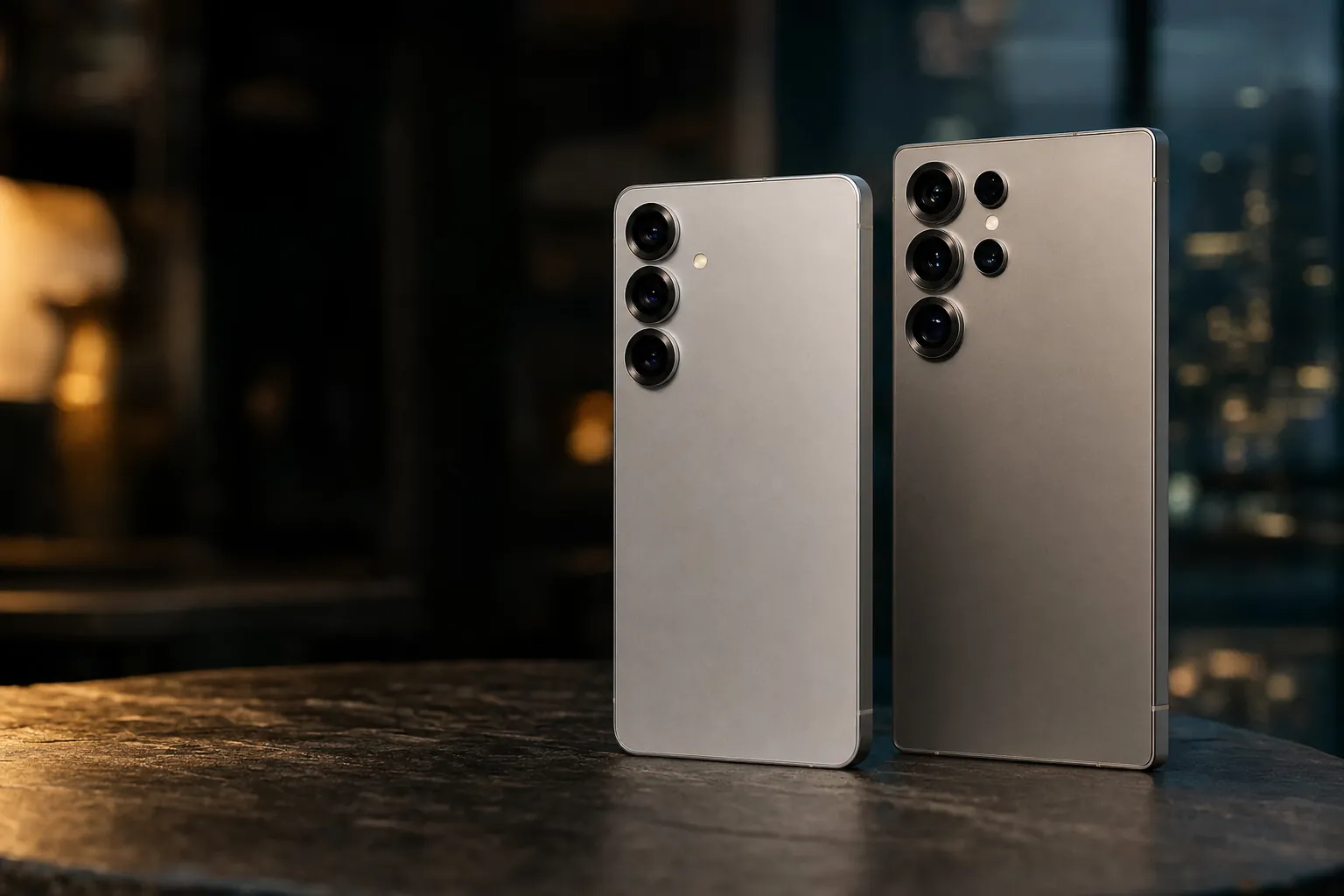
The Galaxy S26 was markedly easier to manage one-handed, whilst the Ultra traded portability for a larger canvas, extra cameras and an S Pen stored inside the phone.
Design, size and daily comfort
This was where the Galaxy S26 built its strongest case. At 149.6 × 71.7 × 7.2mm and 167g, it was the model you could use while standing on a train, reach across with your thumb, or slip into a trouser pocket without feeling as though you had packed a small paving slab. It still had a 6.3-inch display, so it was not tiny. It was simply sensible.
The Galaxy S26+ measured 158.4 × 75.8 × 7.3mm and weighed 190g. That is a fairly reasonable compromise if you wanted a larger display but did not fancy the Ultra's bulk. The Ultra was 163.6 × 78.1 × 7.9mm and 214g. It remained a large phone in every meaningful sense. Samsung made it thinner and lighter than the previous Ultra generation, but physics remains stubbornly unimpressed by marketing departments.
All three had IP68 protection, so an unexpected rain shower or a kitchen mishap was not a reason to panic. The S26+ also had Gorilla Glass Victus 2 confirmed front and back. The Ultra no longer used titanium, according to review coverage, but this was still a premium device designed around its considerable feature set rather than around disappearing into a pocket.
Galaxy S26 strengths
- At 167g, it was 47g lighter than the Ultra.
- The 6.3-inch body was much friendlier for one-handed use.
- It retained IP68 protection and flagship-grade connectivity including Wi-Fi 7.
- Its smaller physical footprint made it the more practical all-day carry.
Galaxy S26 Ultra trade-offs
- Its 214g weight was noticeable in a pocket and during long reading sessions.
- The 78.1mm width made one-handed typing more of a two-thumb affair.
- A case added still more bulk to an already substantial phone.
- The best hardware came with the least casual form factor.
Display: compact FHD+ versus expansive Ultra QHD+
Samsung's AMOLED screens remained excellent across the board. Every model offered adaptive 120Hz refresh rates, which kept scrolling, animations and compatible games feeling smooth. The S26 had a 6.3-inch FHD+ panel at 2340 × 1080. It was sharp enough for ordinary use, video, maps and social apps. You would not pick it up and think it looked cheap. That is not remotely the issue.
The S26+ and Ultra moved to QHD+, with the Ultra reaching 3120 × 1440 on its 6.9-inch panel. The difference was most meaningful if you regularly read small text, edit images, use split-screen apps, browse dense spreadsheets or simply prefer a big, pin-sharp display. For watching films, the bigger canvas was enjoyable. For writing a long email on the train, it was genuinely useful. For checking the weather, it was wildly unnecessary. Such is flagship life.
The Ultra's panel also supported an adaptive 1–120Hz range and introduced Samsung's built-in Privacy Display. This was an Ultra-exclusive hardware feature designed to reduce side-angle visibility. It was helpful when you were reading sensitive information on public transport or answering work messages in a café. The compromise was that it could also reduce off-angle visibility for you, which made it a situational tool rather than something to leave on permanently.
Galaxy S26: the display for people who prefer a phone to feel like a phone
The 6.3-inch FHD+ screen was still vivid, fluid and flagship-class. Its advantage was comfort, not specification-sheet supremacy.
Galaxy S26+: the overlooked QHD+ option
The 6.7-inch QHD+ screen offered more space than the standard S26 without the Ultra's 214g weight. It was the range's cleanest screen-size upgrade.
Galaxy S26 Ultra: the most capable display
The 6.9-inch QHD+ panel, 1–120Hz adaptive range and built-in Privacy Display made the Ultra the best option for work, media and privacy-conscious travel.
The Ultra's 6.9-inch QHD+ display delivered the biggest working area in the range, with its Privacy Display adding a practical advantage for commuting and public spaces.
Performance: Exynos Galaxy S26 versus Snapdragon Galaxy S26 Ultra
In UK comparison material, the Galaxy S26 and S26+ used Samsung's Exynos 2600, while the Ultra used Qualcomm's Snapdragon 8 Elite Gen 5 for Galaxy. Regional processor variation remained something worth checking before buying, but that was the split in Samsung's UK listings. In normal use, all three had more than enough power for messaging, multitasking, photography, navigation and the usual pile of browser tabs we all insist are important.
The Galaxy S26 recorded a Geekbench 6 single-core score of 3,616 and a multi-core score of 10,827 in TechRadar testing. It also managed 6,933 at its best in the 3DMark Wild Life Extreme Stress Test, dropping to 2,962 at its low point. Those are healthy figures, and the phone felt smooth in ordinary use. But it did become noticeably warm under sustained benchmark work, with a recorded temperature of approximately 45°C.
The Ultra was faster, though not by an absurd margin in short burst tests. Tom's Guide recorded a Geekbench 6 single-core result of 3,785, while broader TechRadar testing recorded 3,766 single-core and 11,537 multi-core in Geekbench 6.5. Its 3DMark Wild Life Extreme Unlimited score was 6,645, or 39.8fps. More importantly, the Snapdragon Ultra had the better headroom for demanding games, heavy camera processing and long DeX sessions. It too could get hot, especially around the upper rear during a 3DMark Solar Bay stress test.
Benchmarks are useful for showing performance headroom, not for deciding whether a phone feels quick in WhatsApp. Both phones were rapid in day-to-day use. The Ultra's advantage mattered most for sustained heavy workloads, large-screen multitasking and buyers who simply wanted Samsung's highest-performance configuration.
Camera comparison: where the Galaxy S26 Ultra earns its keep
Camera hardware was the clearest reason to move from the Galaxy S26 to the Galaxy S26 Ultra. The S26 and S26+ shared exactly the same practical setup: a 50MP f/1.8 main camera, 12MP f/2.2 ultrawide and 10MP f/2.4 3x telephoto. There was also a 12MP f/2.2 front camera. It was a perfectly good arrangement for everyday photos, pets, food, family snapshots and holiday scenery. Reviews found all three rear cameras capable in ordinary conditions.
The limitation appeared once you asked more of the zoom. The 3x telephoto was the sweet spot; TechRadar advised against leaning too heavily on it beyond that. The S26 and S26+ could reach 30x digital zoom, but that figure was a ceiling, not a promise of a frame-worthy photo at maximum magnification. As ever, the moon was not your friend here.
The Ultra went much further. Its 200MP f/1.4 main sensor had a brighter lens than the S26's f/1.8 main camera. It paired that with a 50MP f/1.9 ultrawide, the same 10MP f/2.4 3x telephoto and an additional 50MP f/2.9 5x telephoto. It offered 3x and 5x optical zoom, 2x and 10x optical-quality zoom, and up to 100x digital zoom. The Guardian found the four-camera setup more adaptable, with the faster lenses bringing useful improvements to low-light performance and depth of field.
| Camera hardware | Galaxy S26 | Galaxy S26+ | Galaxy S26 Ultra |
|---|---|---|---|
| Main camera | 50MP, f/1.8 | 50MP, f/1.8 | 200MP, f/1.4 |
| Ultrawide | 12MP, f/2.2 | 12MP, f/2.2 | 50MP, f/1.9 |
| Telephoto cameras | 10MP, f/2.4, 3x | 10MP, f/2.4, 3x | 10MP, f/2.4, 3x + 50MP, f/2.9, 5x |
| Optical zoom | 3x | 3x | 3x and 5x |
| Optical-quality zoom | 2x | 2x | 2x and 10x |
| Maximum digital zoom | 30x | 30x | 100x |
| Front camera | 12MP, f/2.2 | 12MP, f/2.2 | 12MP, f/2.2 |
The practical message is straightforward. For casual daylight shooting, the Galaxy S26 did not leave you stranded. Its main camera was capable, its 3x telephoto was useful, and its results broadly matched the S26+. But the Ultra was the phone to buy if you took photos deliberately rather than incidentally. Long-distance shots, travel photography, portraits with more natural compression, night scenes, cropping room and flexible video framing all favoured the Ultra.
The Galaxy S26 Ultra's four-camera system added a 50MP ultrawide and dedicated 5x telephoto, giving it far more room to frame distant subjects and night scenes.
S Pen and Privacy Display: the Ultra-only productivity extras
The integrated S Pen was the Ultra's least subtle differentiator. It lived inside the phone, so it was always there for quick notes, signing documents, marking up screenshots, sketching a rough plan or navigating precisely around a spreadsheet. Samsung included Air Command, Wacom technology, IP68 water resistance and 4,096 pressure levels. If that sounds like the sort of feature you would use twice in a fortnight, do not buy the Ultra just for it. You will have paid dearly for an excellent electronic toothpick.
For some people, though, the S Pen was transformative. Students who annotate lecture notes, people who regularly review PDFs, creatives who jot visual ideas, and professionals who find themselves approving documents from a phone all had a solid reason to choose the Ultra. Its larger screen made the pen more useful too. A stylus on a 6.3-inch phone is possible; a stylus on a 6.9-inch display is a workspace.
Samsung's Privacy Display was another Ultra-exclusive piece of hardware. It was aimed at anyone who had ever noticed the stranger next to them on the train apparently taking a keen interest in their bank balance. It did not replace basic privacy habits, and the reduced side-angle visibility could be a compromise in itself, but it was a meaningful differentiator for travellers and people handling work information in public.
*A practical buying assessment based on confirmed hardware differences, not a laboratory score.
Battery life and charging: the Ultra had the clear advantage
Battery capacity rose as the phones got bigger: 4,300mAh in the S26, 4,900mAh in the S26+ and 5,000mAh in the Ultra. Capacity alone never tells the whole story, but the measured results still pointed in one direction. The Galaxy S26 averaged 11 hours and 28 minutes in Tom's Guide's battery-drain test. That was enough for a normal workday, though weaker than some direct rivals. In a separate real-world report, it managed roughly 40 hours between charges with average use, including around five hours of active screen time across Wi-Fi and 5G.
The S26+ had no directly comparable standardised figure here, but reviews generally treated it as a full-day phone for moderate use, with heavy users potentially finding it less impressive than a 4,900mAh capacity might suggest. It was not a disaster. It just did not turn into an endurance monster because Samsung printed a larger number on the spec sheet.
The Ultra was much stronger. Tom's Guide recorded 16 hours and 10 minutes, while Gadgets 360 measured 15 hours and 44 minutes in PCMark. Those different tests should not be mashed together into a pretend average, but both made the same point: the Ultra had notably more stamina than the standard S26. It was the one to choose for long travel days, serious camera use and anyone who would rather not watch a battery percentage like it is the cricket score.
| Battery and charging | Galaxy S26 | Galaxy S26+ | Galaxy S26 Ultra |
|---|---|---|---|
| Typical battery capacity | 4,300mAh | 4,900mAh | 5,000mAh |
| Wired charging | Up to 25W | Up to 45W | Up to 60W |
| Wireless charging | Up to 15W | Up to 20W | Up to 25W |
| Measured battery result | 11hr 28min in Tom's Guide battery-drain testing | — | 16hr 10min in Tom's Guide; 15hr 44min in PCMark |
| Observed fast-charge result | — | — | About 80% in 30 minutes; full in about 45 minutes with a 60W-or-higher charger |
The S26's 25W wired charging was its most obvious 2026 compromise. It worked, but it was slow beside the rest of the range. The S26+ at 45W was meaningfully better. The Ultra's 60W charging was best, and it supported Qi2 25W wireless charging. It lacked built-in magnetic alignment, however, so a compatible case was needed for magnetic accessories. Also, as with plenty of flagships now, there was no charger in the box. Annoying? Yes. Surprising? Not even slightly.
Charging stepped up sharply through the range: 25W on the S26, 45W on the S26+ and 60W on the Ultra, which reached roughly 80% in 30 minutes in testing.
Galaxy S26 vs Galaxy S26 Ultra price and storage value
At UK launch pricing, the Galaxy S26 started at £879 for 256GB and £1,049 for 512GB. The Galaxy S26+ started at £1,099 for 256GB and £1,269 for 512GB. The Galaxy S26 Ultra began at £1,279 for 256GB, rising to £1,449 for 512GB and £1,699 for the 1TB model. In the US, the starting prices were $899.99 for the S26, $1,099.99 for the S26+ and $1,299.99 for the Ultra.
Galaxy S26
256GB UK launch price
$899.99 US starting price
Galaxy S26+
256GB UK launch price
$1,099.99 US starting price
Galaxy S26 Ultra
256GB UK launch price
$1,299.99 US starting price
Galaxy S26 Ultra 1TB
16GB RAM configuration
$1,799.99 US price
The £400/$400 difference between the S26 and Ultra was substantial, and it should be treated as such. The Ultra premium bought more than a screen-size increase: Snapdragon power in UK listings, a much more capable camera system, S Pen, Privacy Display, a 5,000mAh battery, 60W wired charging, 25W wireless charging, and the option of 16GB RAM with 1TB storage.
The awkward value story belonged to the S26+. It cost £220/$200 more than the S26, which was fair enough if you valued the bigger QHD+ display, 600mAh additional battery capacity and 45W charging. Yet the Ultra was only another £180/$200. For that gap, the Ultra added so much tangible hardware that the S26+ was really for the buyer who specifically wanted a large phone without committing to the Ultra's 214g weight.
Galaxy S26 and Galaxy S26 Ultra versus rival flagships
Samsung did not have the compact and premium Android market to itself. The iPhone 17 was a direct Galaxy S26 alternative, especially for buyers who wanted a mainstream-sized flagship and did not have a firm allegiance to Android. TechRadar put the iPhone 17 at $799, compared with $899 for the Galaxy S26, and considered it competitive on size, performance, battery life and camera quality.
At the other end, the iPhone 17 Pro Max started at $1,199 / £1,199, undercutting the Galaxy S26 Ultra's $1,299.99 / £1,279 start price. The iPhone remained a serious consideration for video, ecosystem integration and battery endurance: Tom's Guide recorded nearly 18 hours in its battery testing. The Samsung countered with an integrated S Pen, Privacy Display, DeX, more extensive AI tools and its unusually flexible zoom hardware.
| Confirmed comparison point | Galaxy S26 | Galaxy S26 Ultra | iPhone 17 | iPhone 17 Pro Max |
|---|---|---|---|---|
| US starting price | $899.99 | $1,299.99 | $799 | $1,199 |
| UK starting price | £879 | £1,279 | — | £1,199 |
| Geekbench single-core | 3,616 | 3,785 | — | 3,871 |
| Tom's Guide battery result | 11hr 28min | 16hr 10min | — | Nearly 18hr |
| Integrated stylus | — | S Pen | No | No |
The OnePlus 15 was another rival worth considering for people who prioritised endurance. It had a substantial real-world battery-life advantage according to Android Central, whilst Samsung's Ultra countered with a more versatile camera system, S Pen, Privacy Display, DeX and longer software support. There was no universal winner here. The best phone depended on whether your personal priority was battery, camera versatility, stylus productivity or ecosystem comfort.
The Galaxy S26 Ultra competed directly with phones such as the iPhone 17 Pro Max, but Samsung's combination of zoom hardware, DeX, S Pen and Privacy Display remained unusual.
Which Galaxy S26 model should you buy?
The best purchase was not automatically the most expensive one. A good comparison should save you from buying features you admire but never touch. Here is the practical breakdown.
Best for most buyers: Galaxy S26
See Galaxy S26 on Amazon UK
Check today's price & availability on Amazon UK
Choose the S26 if you want a compact 6.3-inch flagship, a lighter 167g body, strong everyday performance and the same Galaxy AI software as its pricier siblings. It was the value pick for people who did not need 5x zoom, a stylus or a giant screen.
Best for camera enthusiasts: Galaxy S26 Ultra

See Galaxy S26 Ultra on Amazon UK
Check today's price & availability on Amazon UK
The Ultra's 200MP main camera, 50MP ultrawide, dedicated 3x and 5x telephotos and 100x maximum digital zoom made it the clear choice for travel, wildlife, events, portraits and night shooting.
Best for work and notes: Galaxy S26 Ultra
The integrated S Pen, 6.9-inch QHD+ display, DeX support and Privacy Display made the Ultra the Samsung to buy if your phone regularly doubled as a work tool.
Best large-screen compromise: Galaxy S26+
Pick the S26+ if you want QHD+ at 6.7 inches, a 4,900mAh battery and 45W charging, but find the Ultra too expensive or too heavy. It was not the best-value model, but it served a specific buyer well.
My broad recommendation remained the Galaxy S26 for most people. It avoided the Ultra's hefty price and 214g weight without sacrificing Samsung's key software experience, modern connectivity, IP68 protection or high-refresh AMOLED display. The Ultra was the right splurge when its upgraded camera system or integrated S Pen would become part of your routine. Not "might be useful one day". Actually useful.
Before paying for the Ultra
Ask yourself three questions: do I often shoot beyond 3x zoom, will I use a stylus at least weekly, and do I actively want a 6.9-inch phone? Two or three yeses made the Ultra easy to defend. Zero or one pointed squarely at the Galaxy S26.
The best Galaxy S26 was not the same for every buyer: the S26 prioritised comfort and price, the S26+ favoured screen size, and the Ultra focused on capability.
Galaxy S26 vs Galaxy S26 Ultra FAQs and final verdict
Final verdict: buy the Galaxy S26 for value, buy the Galaxy S26 Ultra for intent
The Galaxy S26 was the better buy for most people. It delivered a compact 6.3-inch design, 120Hz AMOLED screen, capable triple-camera setup, modern connectivity and Samsung's full software experience for £400/$400 less than the Ultra. Its biggest compromises were 25W charging, merely adequate tested endurance and camera hardware that was good rather than ambitious.
The Galaxy S26 Ultra was worth the extra for camera enthusiasts, frequent travellers, stylus users, mobile workers and buyers who wanted Samsung's largest, sharpest and most versatile flagship. Its 200MP camera system, 5x telephoto, stronger battery results, 60W charging, Privacy Display and integrated S Pen were real upgrades, not decorative spec-sheet padding. The Galaxy S26+ remained the pick for anyone who wanted a large QHD+ screen without the Ultra's 214g heft, but it was the least compelling value proposition at full launch pricing.
- Galaxy S26+View on Amazon
- Galaxy S26View on Amazon
- Galaxy S26 UltraView on Amazon