
Best Wireless Earbuds for Running in 2026
Four genuinely different ways to soundtrack a run, from locked-in sport buds with ANC to open-ear designs that leave the world firmly switched on.
We link to the exact model on Amazon UK. Prices change often, so check the live price before you buy. As an Amazon Associate we earn from qualifying purchases.
Running earbuds are not one-size-fits-all: the right design depends as much on your route and fit preference as it does on sound quality.
The 2026 running-earbud shortlist: four ways to hear your route
Running headphones are one of those categories where buying the “best” pair can be a spectacularly expensive mistake. A brilliant sealed earbud may be exactly what you want for a treadmill session, then feel downright wrong beside a busy road. Equally, an open-ear pair can make a morning route feel much more relaxed, whilst leaving you wanting far more bass on the train home. So this is not a beauty contest. It is a practical shortlist for actual runners.
This UK-first guide was current on 17 August 2026, with US pricing included where it helps make sense of the market. I have deliberately chosen four products that represent four distinct approaches rather than filling the page with near-identical true-wireless buds. The Beats Powerbeats Pro 2 is the conventional sport-earbud answer: sealed in-ear sound, flexible hooks, ANC, Transparency mode and workout heart-rate monitoring. The Shokz OpenRun Pro 2 is the awareness-first answer, using a wraparound open-ear design that keeps your ear canals clear.
Then there is the soundcore Sport X20, which makes a very persuasive case that runners do not need to spend premium money to get adjustable hooks, ANC and serious ingress protection. Finally, Bose Ultra Open Earbuds takes the open-ear idea in a more fashion-forward direction, clipping around the ear rather than sitting in it or looping behind it. It is a very different thing from a regular earbud. That is the point.
The short version
Choose the Powerbeats Pro 2 if a secure sealed fit and smart training features matter most. Choose OpenRun Pro 2 if hearing traffic is non-negotiable. Choose Sport X20 if ruggedness and price matter. Choose Bose Ultra Open if you want premium open-ear comfort without a neckband.
Open-ear products should not be judged as failed versions of sealed earbuds. They intentionally trade isolation and deep bass for environmental awareness, a cooler feel and less ear-canal pressure. Different job, different answer.
How Gadget Scout ranks earbuds for real-world running
I rank running earbuds with a slightly different set of priorities from office earbuds or sofa-and-podcast earbuds. Fit and stability carry the most weight here: roughly 25%. If an earbud loosens halfway through a set of hill repeats, it does not matter how lovely its tuning graph looks. It has failed the important bit.
Awareness and control take around 20%. This is not an argument that every run must happen in total acoustic transparency; plenty of people run in parks, on tracks and indoors. But it is a reminder that your surroundings are part of the experience. A useful Transparency mode can work well on sealed buds, whilst Shokz and Bose designs leave the ear open continuously. Neither option magically makes someone safe, of course. You still need your eyes up, your volume sensible and your brain engaged. Irritatingly, there is no firmware update for that last one.
Fit and stability — 25%
Hooks, neckbands and cuff clips behave very differently when sweat, speed and head movement enter the chat.
Awareness and control — 20%
Can you hear what matters, change volume without fumbling and stay in control of the route around you?
Battery and charging — 15%
Single-charge stamina matters more than a giant case total when you are away for a long run or a race weekend.
Durability and weather — 15%
Sweat, rain and dust ratings are practical details, not glamorous ones. They are still worth caring about.
Sound and noise control — 15%
ANC and bass can transform indoor sessions, but they should not overrule fit or route awareness.
Price and useful extras — 10%
Heart-rate sensing, wireless charging, multipoint and app controls count when they solve a real annoyance.
Battery and charging, durability and weather resistance, sound and noise control, then price and useful extras complete the picture. This is why the four picks below do not all chase the same finish line. The Powerbeats Pro 2 wins because it is exceptionally complete for a runner who wants conventional earbuds. The OpenRun Pro 2 wins its category because keeping your ears open is a feature, not a compromise, for many road runners.
Secure retention matters more during fast intervals and long sweaty efforts than it does during a short desk-side listening session.
The secure all-rounder for serious training
1. Beats Powerbeats Pro 2 — Best for secure conventional running earbuds

See Beats Powerbeats Pro 2 on Amazon UK
Check today's price & availability on Amazon UK

The Beats Powerbeats Pro 2 is the best conventional running earbud in this guide because it does the difficult balancing act properly. It is a sealed true-wireless earbud with flexible over-ear hooks, so it remains rooted in place when the pace climbs. But unlike older hook-based sports buds, it does not ask you to give up useful modern extras: there is adaptive ANC, a proper Transparency mode, Qi wireless charging and integrated heart-rate monitoring for workouts.
That combination is unusually persuasive. Plenty of runners want isolation for the gym, indoor cycling, travel and noisy environments, then want ambient sound when their route moves outside. With the Powerbeats Pro 2, you are not buying one set of earbuds for one very narrow moment of the week. You are buying a sport-first pair that can still be your everyday pair. Apple users get the deepest integration through the H2 chip, Find My and Apple Spatial Audio, though the Beats Android app provides pairing, controls, battery status, locating support and heart-rate functions too.
The physical layout deserves more credit than it tends to get. Each bud weighs 8.7g, while the charging case is 69g, for a total carry weight of 77.7g. That is not featherweight in the way a tiny stem earbud is featherweight, but a runner is likely to notice security long before they notice a few grams. The hooks make the buds feel planted through hard efforts, and the sealed tips add passive isolation before ANC does any electronic work.
Sound is energetic rather than studiously neutral. RTINGS found very good audio-accuracy reproduction and excellent frequency-response consistency, with mildly elevated bass, slightly recessed mids and bright treble. In plain English: it has the sort of momentum that suits a workout playlist, though it is not the most strictly balanced sound at this price. That is not a scandal. It is Beats doing Beats.
Pros
- Exceptionally secure hook-based fit for running and high-impact training.
- ANC and Transparency mode make it more versatile than awareness-only sport headphones.
- Up to 10 hours per charge and up to 45 hours with the case.
- Only primary pick with integrated workout heart-rate monitoring.
- USB-C plus Qi-compatible wireless charging is properly convenient.
Cons
- IPX4 protection is modest beside the IP68-rated Sport X20.
- Hooks and larger housings will not suit every ear shape.
- Call quality is merely average in difficult environments.
- Automatic switching is strongest inside Apple’s ecosystem.
Who it clicks with
Buy these if you have repeatedly lost faith in ordinary true-wireless earbuds staying put. The Powerbeats Pro 2 is the pair for someone who runs, lifts, travels and wants one capable set of buds rather than a dedicated running-only accessory.
UK official price
Available in standard colours and Nike special editions.
US official price
Specifications are consistent across the listed editions.
The main caution is straightforward: IPX4 means sweat and water resistance, not carefree abuse. If you regularly run in filthy weather, throw kit into a muddy bag or simply want the highest stated protection here, soundcore has the stronger paper specification. Still, for the runner who wants a conventional sealed earbud that refuses to fly out mid-sprint, Beats is the strongest all-round answer.
The awareness-first choice for roads and shared paths
2. Shokz OpenRun Pro 2 — Best for awareness-first road running
See Shokz OpenRun Pro 2 on Amazon UK
Check today's price & availability on Amazon UK
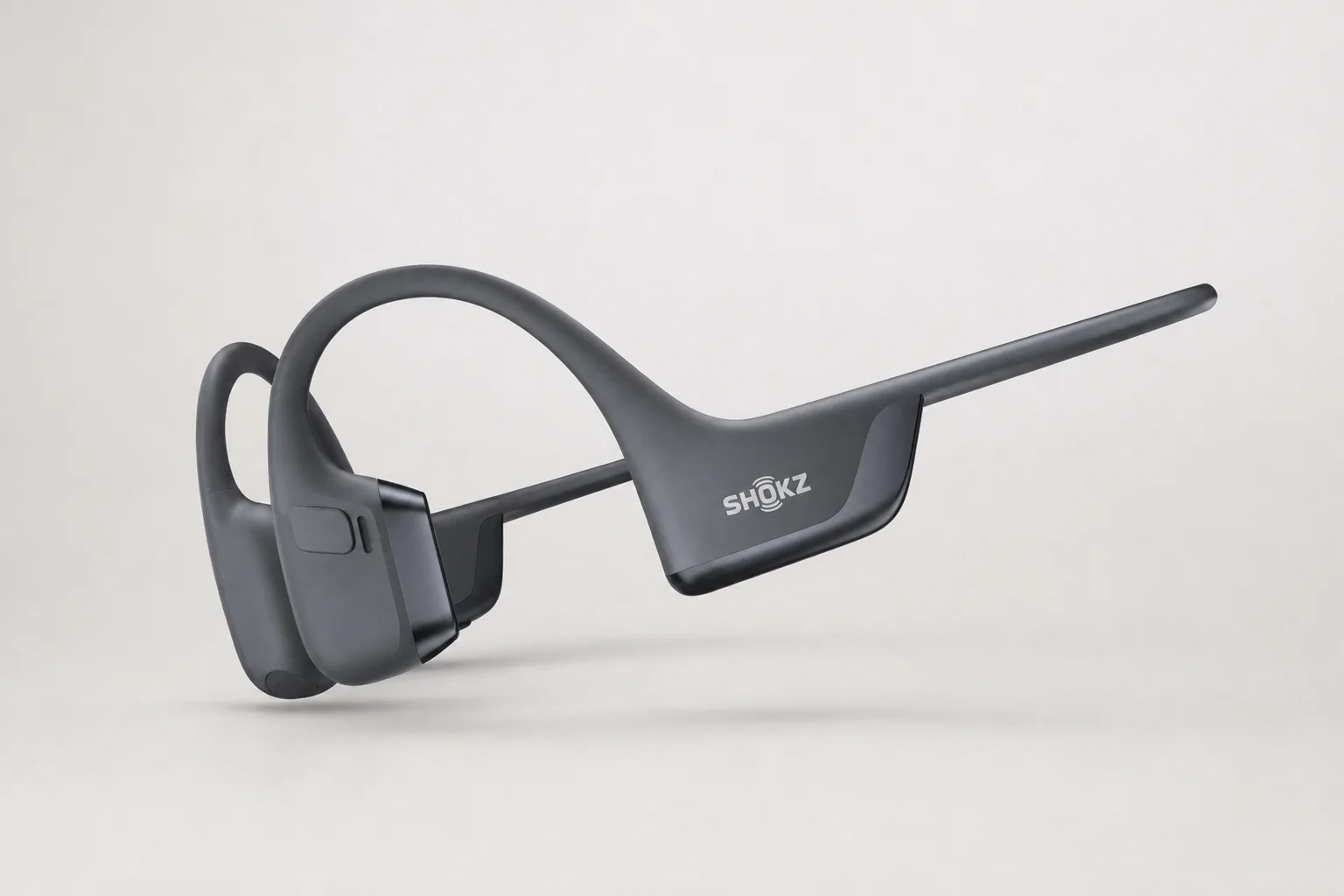
The Shokz OpenRun Pro 2 is the obvious recommendation for runners who genuinely want to hear their surroundings, not merely simulate that feeling with microphones. It uses an open-ear wraparound neckband, leaving the ear canal unblocked. Cars, cyclists, fellow runners, crossing beeps, a shouted warning from behind: all of that stays naturally audible because the ear is physically open.
This is a very different proposition from a sealed earbud running Transparency mode. Transparency can be excellent, and it gives you the option to switch back to isolation afterwards. But it is still an electronic mode. The OpenRun Pro 2 starts from awareness, which makes it especially sensible for road routes and shared paths where you do not want to spend every mile wondering whether an ambient setting is doing enough.
Shokz has improved the recipe with its DualPitch system. A bone-conduction driver handles mids and highs, while an 18 × 11mm air-conduction low-frequency driver supplies more body than older bone-conduction designs could manage. It does help. But let us not get carried away: this is not a cheat code that turns an open headset into a sealed in-ear monitor. It cannot match the bass weight, isolation or noisy-environment clarity of Powerbeats Pro 2 or Sport X20.
What it can do is feel remarkably uncomplicated on a run. The 30.3g band stays stable, the tactile controls are easier to find than a tiny touch panel when hands are sweaty, and up to 12 hours of battery is comfortably enough for long training days. The five-minute charge delivering up to 2.5 hours is the best emergency top-up claim in this four-product shortlist. That is the sort of number you appreciate at 6:55am when your watch says “run” and your headphones say “absolutely not”.
The OpenRun Pro 2’s wraparound structure keeps the ear canal clear, making it a natural fit for traffic-heavy roads and busy shared paths.
Pros
- Excellent route awareness without relying on an electronic ambient mode.
- Stable, lightweight 30.3g neckband design.
- Up to 12 hours of listening and very useful quick charging.
- USB-C charging, multipoint pairing and six app EQ modes.
- IP55 protection suits sweat and rainy runs.
Cons
- Sound quality and bass remain behind sealed in-ear earbuds.
- No ANC and no isolation for noisy gyms, trains or busy streets.
- Playback leaks audibly at moderate to high volume.
- The neckband can clash with high collars, some layers and lying-down exercises.
The honest trade-off
The OpenRun Pro 2 is not for the runner who wants to vanish into bass-heavy music. It is for the runner who wants music, podcasts and cues alongside the real world. That distinction is why it is so good at its job.
UK list price
Shokz also showed a temporary direct-sale price of £134.
US list price
Retail sale pricing has varied.
One important boundary: IP55 does not make this a swimming headset. Shokz specifically positions it for sweat and rain, not showering, seawater, saunas or submersion. Keep the categories separate and there is no disappointment. For road runners, that is a very easy compromise to make.
The tough, adjustable-hook bargain
3. soundcore Sport X20 — Best for value, durability and adjustable fit

See soundcore Sport X20 on Amazon UK
Check today's price & availability on Amazon UK
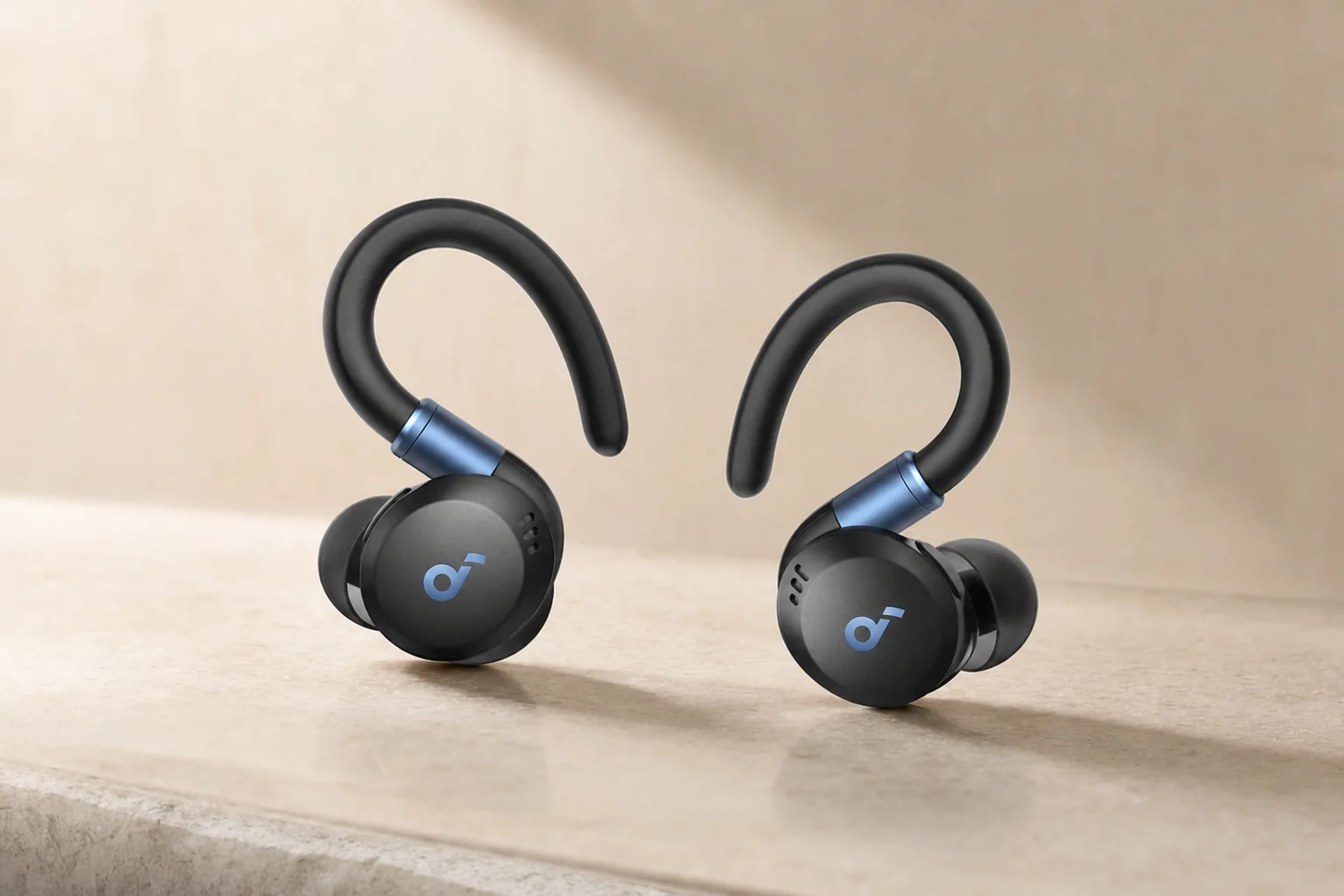
The soundcore Sport X20 is the value pick because it lands an awful lot of runner-relevant hardware for £89.99. It is a sealed true-wireless earbud with rotatable, adjustable hooks, ANC, Transparency mode, multipoint, app EQ and an IP68 rating with SweatGuard protection. That is a serious feature list at a price where many rivals are still making you choose between a secure fit and proper noise control.
The adjustable hook is the headline feature. It can extend by up to 4mm and rotate by up to 30 degrees, giving you room to tune the fit instead of accepting whatever angle the manufacturer picked. That matters because “secure” is a deeply personal word in earbuds. A fixed hook can be brilliant for one runner and press awkwardly behind another runner’s ear. Soundcore’s approach gives you more chance of finding a stable, comfortable position before you decide the product is not for you.
The X20 is not trying to be a delicate audiophile earbud. Its 11mm dynamic driver and BassUp processing aim for a powerful, bass-forward presentation. That can be brilliant for an energy-heavy running playlist and less ideal if you want the most neutral sound possible. The useful thing is that the Soundcore app gives you HearID personalisation and EQ controls, so there is more scope to tame or reshape the default character than there is with many cheap sport buds.
Battery claims are strong: up to 12 hours in normal mode, or up to 48 hours with the case. Switch on ANC or Transparency and the earbuds are rated for up to seven hours, with 28 hours including the case. Soundcore states that its headline normal-mode figure was measured at 50% volume with default settings. That is a refreshingly clear reminder that battery claims are scenario-specific, not divine prophecy carved into a charging case.
The Sport X20 has the strongest stated protection in this shortlist at IP68. That makes it particularly appealing for wet-weather runners and anyone whose kit endures sweat, dust and the general chaos of a gym bag. It still pays to dry the earbuds and case before charging.
Pros
- Excellent value against the feature set.
- Adjustable hooks make it easier to fine-tune fit and stability.
- IP68 and SweatGuard offer the strongest stated protection here.
- ANC, Transparency, multipoint and app EQ are all included.
- Very long claimed battery life, including 48 hours with the case.
Cons
- Bass-forward sound will not suit every listener out of the box.
- ANC is useful rather than class-leading.
- Sealed tips reduce natural awareness compared with open-ear options.
- A tight sealed fit may feel warmer over long summer runs.
Sport X20’s rotatable, extendable hooks are designed to let runners tune stability rather than relying on a one-angle-fits-all fit.
UK official price
Available in black, green and white.
US official price
A feature-rich sport option at the lower end of this shortlist.
If you are buying on a strict budget, the Sport X20 is the first product to investigate. It is not simply the cheap alternative; it has a meaningful advantage in water and dust protection over the Beats. The trade-off is refinement. Beats feels more polished as a complete everyday ecosystem product, while soundcore gives you an impressively tough sport tool for considerably less money.
Premium open-ear comfort without a neckband
4. Bose Ultra Open Earbuds — Best for premium open-ear comfort

See Bose Ultra Open Earbuds on Amazon UK
Check today's price & availability on Amazon UK
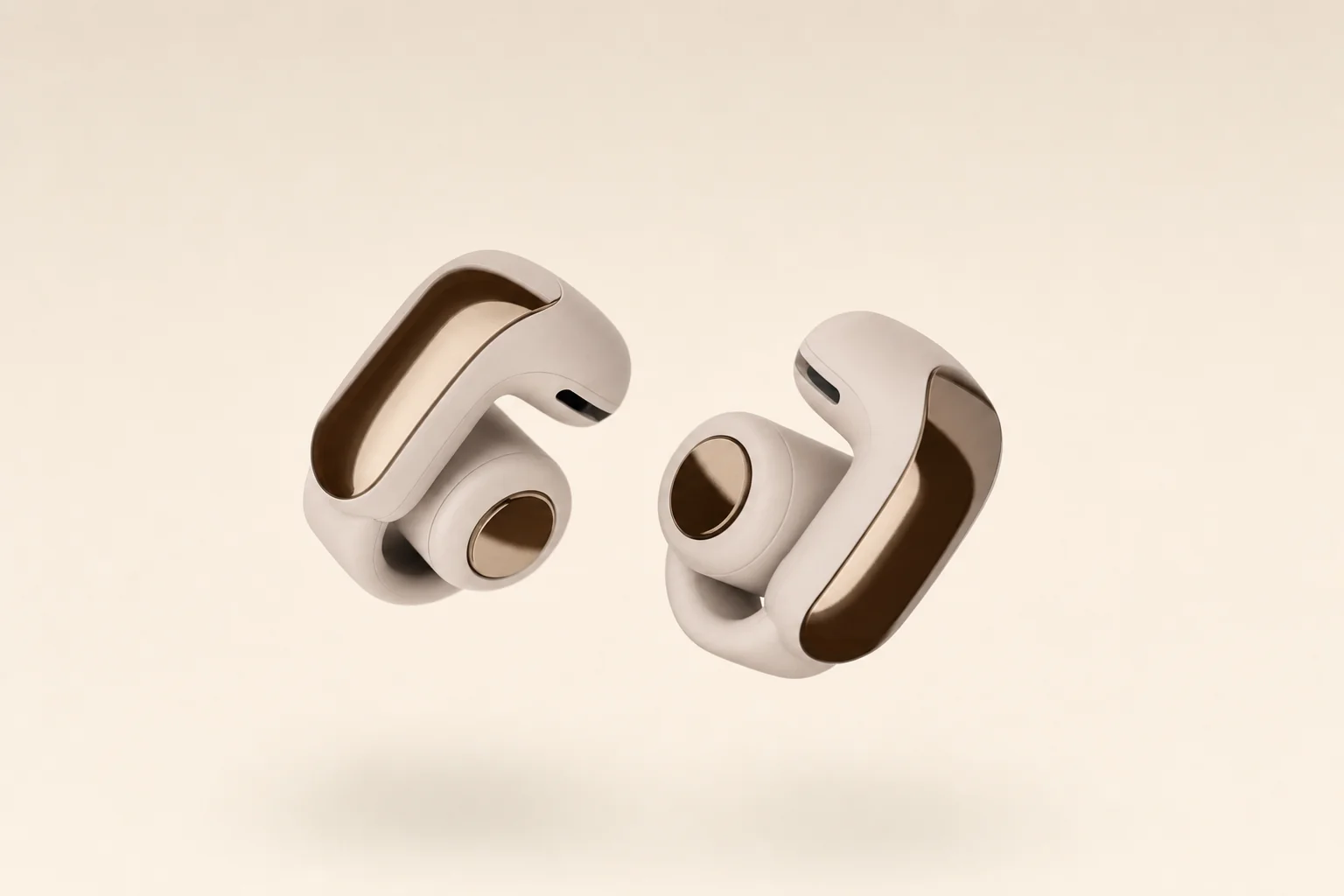
Bose Ultra Open Earbuds is the premium choice for runners who dislike ear-canal seals and do not fancy a wraparound neckband. Instead of sitting inside the ear, each earbud uses a cuff-like design: the speaker sits in front of the ear canal while the battery and control barrel rests behind the ear. It is unusual. It is also one of those designs that makes immediate sense once you have worn it.
The major advantage is comfort. The ear canal remains open, so there is no silicone tip creating pressure or gradually getting sweaty and slippery. That makes the Bose a compelling option for long easy runs, dog walks, commuting and anyone who simply cannot get along with conventional in-ear buds. The cuff design is also secure in a way that does not feel like a conventional sports hook.
There is no ANC because there is no ear-canal seal to work against. Bose has sensibly not pretended otherwise. The design preserves awareness by default, which is great for roads and shared paths, but it also means you will hear more traffic, wind and general life during playback. SoundGuys found poor wind-noise rejection in simulated outdoor testing, so this is not the pick for someone who spends every run in exposed, blustery conditions.
Sound performance is better understood as “impressive for an open-ear cuff” than “equal to a sealed earbud”. SoundGuys measured a major bass shortfall and upper-midrange emphasis against its preference target, with an overall MDAQS score of 2.3. There is no getting around the physical reality: leaving your ears open is lovely for awareness but bad news for deeply pressurised low-end rumble. Bose has done more with open-ear sound than basic designs manage, but it has not escaped physics. Nobody has. Physics remains annoyingly difficult to negotiate with.
Pros
- Distinctive cuff fit is comfortable and secure without sealing the ear.
- Excellent awareness for outdoor running and all-day use.
- SoundGuys measured 8 hours 53 minutes, beating Bose’s nominal claim.
- Bluetooth 5.3, aptX Adaptive, physical controls and multipoint support.
- A good option for runners who find neckbands or ear tips irritating.
Cons
- No ANC and very limited isolation by design.
- High list price for a product with open-ear acoustic compromises.
- Wind handling and outdoor microphone performance are weak.
- Standard charging case does not include wireless charging.
Bose’s best argument
If a neckband bothers you and silicone tips make your ears ache, this is the open-ear alternative that may finally make running audio feel effortless. Its value is comfort and awareness, not maximum thump or maximum silence.
UK list price
Bose also displayed a temporary direct price of £199.95.
Current US price
The original US MSRP was $299.
Bose Ultra Open Earbuds sit around the ear rather than sealing it, prioritising comfort and environmental awareness over isolation.
Four running earbuds side by side
Here is the practical view. Every model below is good at something specific, but none is universally better because the designs are solving different running problems. The key split is simple: Powerbeats Pro 2 and Sport X20 seal in the ear and offer electronic noise control; OpenRun Pro 2 and Bose Ultra Open keep the ear open continuously.
| Feature | Beats Powerbeats Pro 2 | Shokz OpenRun Pro 2 | soundcore Sport X20 | Bose Ultra Open Earbuds |
|---|---|---|---|---|
| Design | Sealed true wireless | Open-ear neckband | Sealed true wireless | Open-ear cuff |
| Fit mechanism | Flexible over-ear hooks | Wraparound band | Adjustable rotating hooks | Clip-style cuff |
| Awareness approach | Transparency mode | Always-open ears | Transparency mode | Always-open ears |
| ANC | Adaptive ANC | No | Adaptive/manual ANC | No |
| Battery per charge | Up to 10 hours | Up to 12 hours | Up to 12 hours | Up to 7.5 hours |
| Total battery | Up to 45 hours with case | Neckband design | Up to 48 hours with case | Charging case included |
| Quick charge | 5 mins for up to 1.5 hours | 5 mins for 2.5 hours | 5 mins for about 2 hours | 10 mins for up to 2 hours |
| Water resistance | IPX4 | IP55 | IP68 | IPX4 earbuds |
| Weight | 8.7g per earbud | 30.3g | — | About 6.4g per earbud |
| Standout feature | Workout heart-rate monitoring | Maximum awareness | Adjustable hooks and IP68 | Premium cuff comfort |
| UK price | £249.99 | £169 list | £89.99 | £299.95 list |
| US price | $249.99 | $179.95 list | $79.99 | $199 current |
| Buy | Check price | Check price | Check price | Check price |
There are useful cross-shop options too. Apple AirPods Pro 3 offered iPhone users ANC, Transparency, heart-rate sensing, IP57 protection and an eight-hour claimed ANC-on battery at £219, though TechRadar reported about 5.5 hours in practical use. Sony WF-1000XM6 was the better premium sealed alternative for sound, ANC and codec support, with LDAC, LC3, multipoint and IPX4 protection at £250. Neither is as purpose-built for high-impact running retention as the Beats.
For a true-wireless open-ear alternative, Shokz OpenFit 2 is also worth knowing about. It offered IP55 protection, Bluetooth 5.4, multipoint and up to 11 hours claimed per charge, although Which? measured approximately eight hours and one minute. It is the obvious rival if you want Shokz’s open-ear philosophy without the OpenRun Pro 2 neckband.
Choose by route, weather and the way you train
Start with where you actually run, not the sort of runner you hope to become after watching a motivational montage. Your weekly route tells you more than a product page will.
Traffic-heavy roads
Start with Shokz OpenRun Pro 2. Bose Ultra Open is the premium alternative if you prefer a cuff to a neckband. Both keep surrounding sound naturally audible.
Quiet parks and trails
Powerbeats Pro 2 or Sport X20 make more sense if you want fuller music, passive isolation and the option of ANC for travel afterwards.
Gym and mixed workouts
Powerbeats Pro 2 is the polished all-rounder; Sport X20 is the lower-cost, more rugged alternative with adjustable hooks.
Long-distance training
OpenRun Pro 2 and Sport X20 both advertise up to 12 hours per charge. The Shokz is especially appealing when ear-canal comfort matters over many miles.
Wet-weather running
Sport X20’s IP68 rating is the standout. OpenRun Pro 2 and OpenFit-style open designs are still suitable for sweat and rain within their ratings, but are not swimming products.
Mixed commuting
Powerbeats Pro 2 earns its keep here because it can move between ANC for transport and Transparency for the route on foot.
Stability versus comfort is not a straight line
Beats’ flexible over-ear hooks are the safest bet if you want a locked-in conventional bud. Soundcore’s adjustable hooks may be the better fit if fixed hooks have annoyed you before. Neither is automatically more comfortable; ears remain stubbornly individual.
For road running, open designs do not remove the need for sensible behaviour. Keep volume modest, stay alert at crossings and do not assume “awareness mode” means you can safely switch off the rest of your senses.
Your route should drive the decision: sealed earbuds suit isolation and gym sessions, while open designs make more sense where awareness matters.
What the headline specifications do not tell you
Battery figures are useful, but they are not all directly comparable. Manufacturers use different volume levels, playback settings and modes. ANC also changes the equation dramatically. Sport X20, for example, is rated for up to 12 hours in normal mode but up to seven hours with ANC or Transparency on. The OpenRun Pro 2 does not have a charging case at all because it is a neckband; its 12-hour number is simply the headset’s own battery.
Quick charging is more comparable, and all three leading sport options are reassuringly good. The chart below is not a performance score; it simply shows the maximum listening time each maker says you can recover from a five-minute charge. Bose uses a 10-minute figure, so it sits outside this like-for-like snapshot.
Independent testing is valuable precisely because it can puncture a neat marketing number. SoundGuys measured 8 hours 53 minutes from Bose Ultra Open Earbuds, better than Bose’s nominal 7.5-hour claim with Immersive Audio off. That is a solid result. On the other hand, TechRadar found approximately 5.5 hours from AirPods Pro 3 in use despite Apple’s eight-hour claim. Real usage varies. Loudness, connectivity, ANC, calls and even your route can all affect it.
There are also measurement limits worth respecting. SoundGuys had not completed a standardised battery test for Powerbeats Pro 2 when its accessible review was published, although it reported a day of heavy use. RTINGS could not apply its normal frequency-response test to OpenRun Pro 2 because bone conduction does not work with its usual test rig. That does not make the Shokz impossible to assess; it means an apples-to-apples graph would have pretended to be more definitive than it was.
Do not compare open-ear products directly with sealed earbuds on bass, leakage, loudness or isolation. Their purpose is different. For open-ear running gear, awareness, stable fit, real-world comfort and reliable battery life are the more useful benchmarks.
Who should buy which running earbuds?
If you have skimmed to the answer — no judgement, your run may be starting in ten minutes — these are the buying calls I would make. They are not a second ranking. They are a way to match the right compromise to the right runner.
The high-impact workout runner
Buy: Beats Powerbeats Pro 2. Best for runners who prioritise a locked-in conventional earbud fit, ANC, Transparency and integrated heart-rate monitoring.
The road-safety and awareness prioritiser
Buy: Shokz OpenRun Pro 2. Best for hearing traffic and surroundings through an open-ear 30.3g neckband with up to 12 hours of battery.
The value-focused runner
Buy: soundcore Sport X20. Best for someone who wants adjustable hooks, ANC, multipoint and IP68 protection without spending Beats or Bose money.
The comfort-first open-ear runner
Buy: Bose Ultra Open Earbuds. Best for runners who hate sealed tips and neckbands but still want secure, luxurious open-ear wear.
The best running earbud is the one whose compromises fit your routine: road awareness, locked-in stability, rugged value or all-day comfort.
Running-earbud questions, answered before checkout
A quick fit check before race day is worth doing: controls, hook position and awareness mode are all easier to learn before you are out on the route.
Bottom line
The Beats Powerbeats Pro 2 is the best all-round conventional running earbud in 2026: secure, feature-rich and flexible enough for training, commuting and everyday listening. The Shokz OpenRun Pro 2 is the pick I would start with for road awareness. soundcore Sport X20 is the smartest value buy and the toughest on paper. Bose Ultra Open Earbuds is the premium comfort choice for runners who want open ears without a neckband. Pick the design that best fits your route first. The rest becomes much easier from there.
- Bose Ultra Open EarbudsPremium open-ear comfort without a neckbandView on Amazon
- Beats Powerbeats Pro 2View on Amazon
 Shokz OpenRun Pro 2View on Amazon
- soundcore Sport X20View on Amazon