
Best VR headsets for PC, PS5 and standalone play: which one fits you?
Four routes into VR, from a cable-free living-room headset to OLED PS5 gaming and wireless PC streaming.
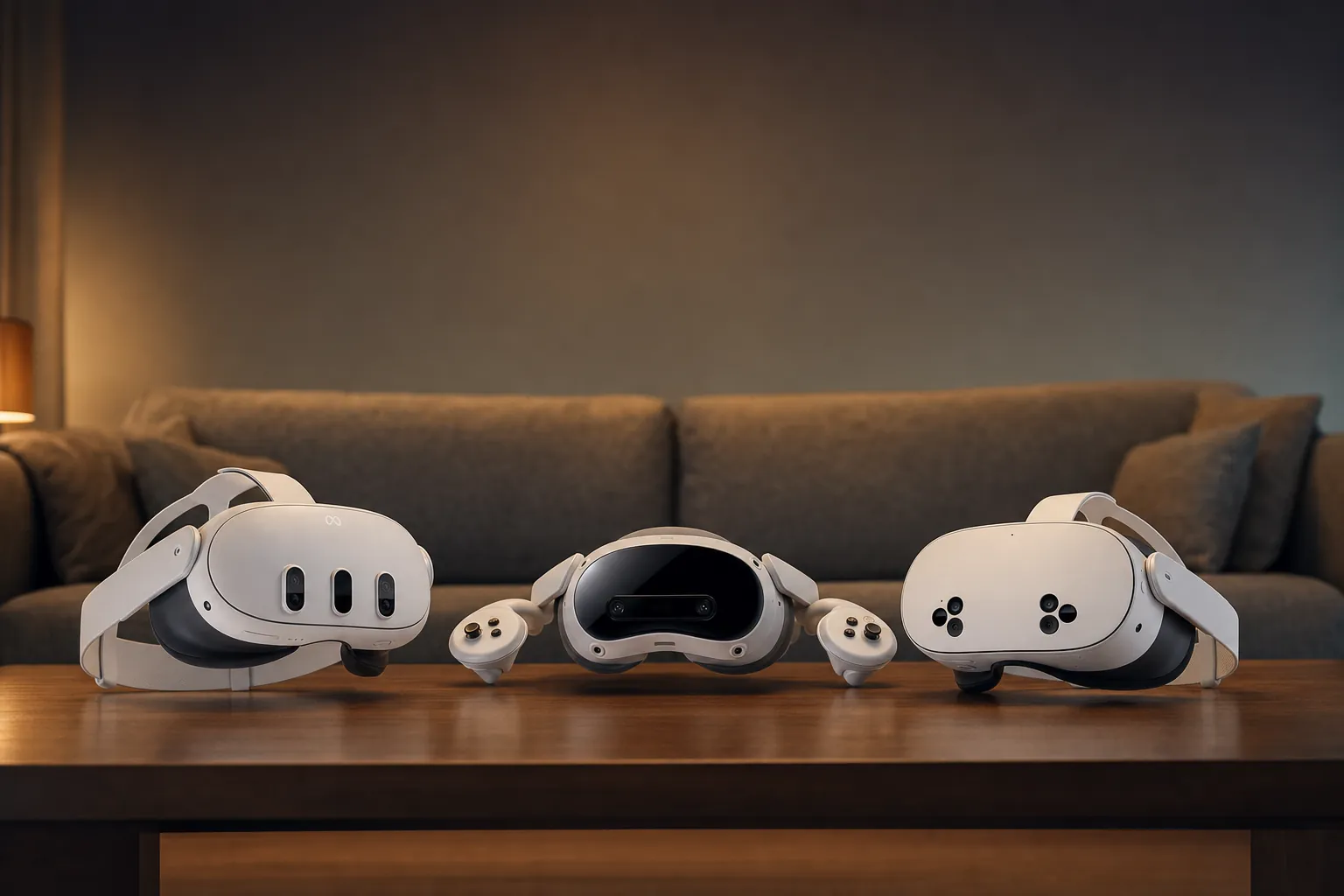


Pancake lenses, 512GB storage, depth-sensor mixed reality and PC VR make it the broadest standalone option.
Check price on Amazon
OLED HDR, eye tracking and Sense-controller haptics make it the focused choice for compatible PS5 VR games.
Check price on Amazon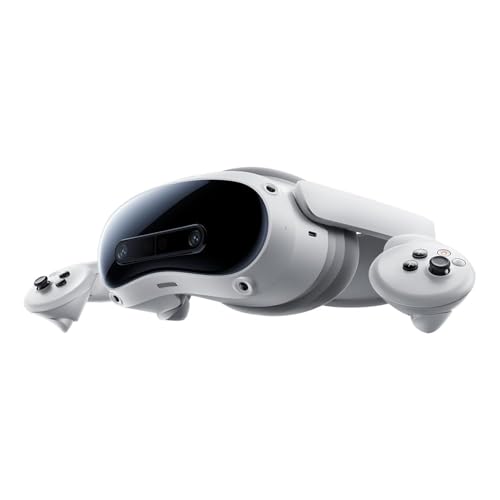
12GB RAM, Wi-Fi 7, motorised IPD and rear-balanced weight suit buyers prioritising wireless-PC features.
Check price on Amazon
It shares Quest 3’s processor and software library while accepting Fresnel optics, 128GB storage and shorter battery results.
Check price on AmazonWe link to the exact model on Amazon UK. Prices change often, so check the live price before you buy. As an Amazon Associate we earn from qualifying purchases.
You have cleared a patch of carpet, charged the controllers and are ready to step into a racing cockpit, a horror game or a virtual cinema. The costly mistake is buying a headset for the wrong ecosystem. A PlayStation VR2 makes little sense without a PS5; a standalone headset makes more sense if the living room is shared; and PC players need to decide how much they value wires, visual clarity and wireless freedom.
The short answer: Meta Quest 3 combines pancake lenses, standalone games, mixed reality and PC VR in one headset. Meta Quest 3S uses the same Quest processor and software library for a lower cost, with Fresnel optics instead. PlayStation VR2 requires a PS5 and offers OLED contrast and eye tracking. PICO 4 Ultra offers a rear-balanced standalone design, 12GB RAM and wireless-PC streaming outside Meta's ecosystem.
For UK shoppers, the purchase is also about what arrives in the box and what you already have at home. The linked Quest 3 is a refurbished 512GB UK Type-G model, so it is worth checking the stated refurbished condition, controller inclusion, battery condition, warranty and supplied power adapter before ordering. Quest 3S and PICO 4 Ultra are standalone purchases, although PICO does not confirm a mains charger in its standard box contents. PS VR2 includes its headset, Sense controllers, USB cable and wired earbuds, but a PS5 remains essential; PC use adds Sony's separate adapter, a DisplayPort 1.4 cable and compatible Bluetooth hardware.
How We Picked: Four Headsets Covering Four Buying Paths
This is not a single-winner list. These four Amazon UK listings were in stock on 27 September 2026 and represent four distinct buying paths: a premium Quest headset, a lower-cost Quest, PS5-tethered console VR and a standalone headset geared towards PC streaming and mixed reality.
Start with the hardware you already own. A PS5 owner who wants Gran Turismo 7 or Resident Evil Village should look at PlayStation VR2 first. A gaming-PC owner can use either Quest headset wirelessly through Meta Quest Link or Air Link, while PICO 4 Ultra supports PC streaming and AV1 decoding. If you have neither console nor a powerful PC, Quest 3, Quest 3S and PICO 4 Ultra can run their own apps without external hardware.
The next question is tolerance for cables. PlayStation VR2 uses one USB-C lead to the PS5: reviewers described this as simpler than first-generation PlayStation VR, but still a physical tether. Quest 3, Quest 3S and PICO 4 Ultra are cordless during standalone use, though none is intended for all-evening play away from power.
| Confirmed specification | Meta Quest 3 | Meta Quest 3S | PlayStation VR2 | PICO 4 Ultra |
|---|---|---|---|---|
| Use type | Standalone VR/MR; PC VR by USB-C or Air Link | Standalone VR/MR; PC VR by USB-C or Air Link | PS5 headset; PC use with Sony PC adapter | Standalone VR/MR; PC streaming |
| Resolution per eye | 2,064 × 2,208 LCD | 1,832 × 1,920 LCD | 2,000 × 2,040 OLED | 2,160 × 2,160 LCD |
| Lens type | Pancake | Fresnel | Fresnel | Pancake |
| Maximum refresh rate | 120Hz | 120Hz | 120Hz | 90Hz |
| IPD adjustment | Continuous, about 53–75mm | Three positions: about 58/63/68mm | Mechanical adjustment | Motorised, 58–72mm |
| Memory | 8GB | 8GB | Not applicable | 12GB |
| Storage in this listing | 512GB | 128GB | Not applicable | 256GB |
| Headset mass | About 515g | About 514g | About 560g excluding cable | About 580g |
| Buy | Check price | Check price | Check price | Check price |
Figures combine manufacturer specifications with the cited review measurements. Storage refers to the specific UK listings covered here.
Meta Quest 3: A Standalone Headset That Also Works for PC VR
The Meta Quest 3 covered here is the refurbished 512GB UK Type-G version, not the discontinued 128GB configuration. It is the broadest fit for someone who wants standalone games today, room-aware mixed reality tomorrow and the option to connect to a PC later. Its Snapdragon XR2 Gen 2 processor and 8GB RAM power the same current Quest software family as Quest 3S, but the viewing experience is materially different.
Quest 3 combines its 2,064 × 2,208-per-eye LCD panels with pancake lenses, approximately 25 pixels per degree and a 110° horizontal by 96° vertical field of view. Ars Technica praised the sharper lenses for reading virtual-monitor text; Meta and TechRadar noted that pancake optics give a clearer image across more of the lens than Fresnel designs, reducing the need to keep eyes in a narrow sweet spot.
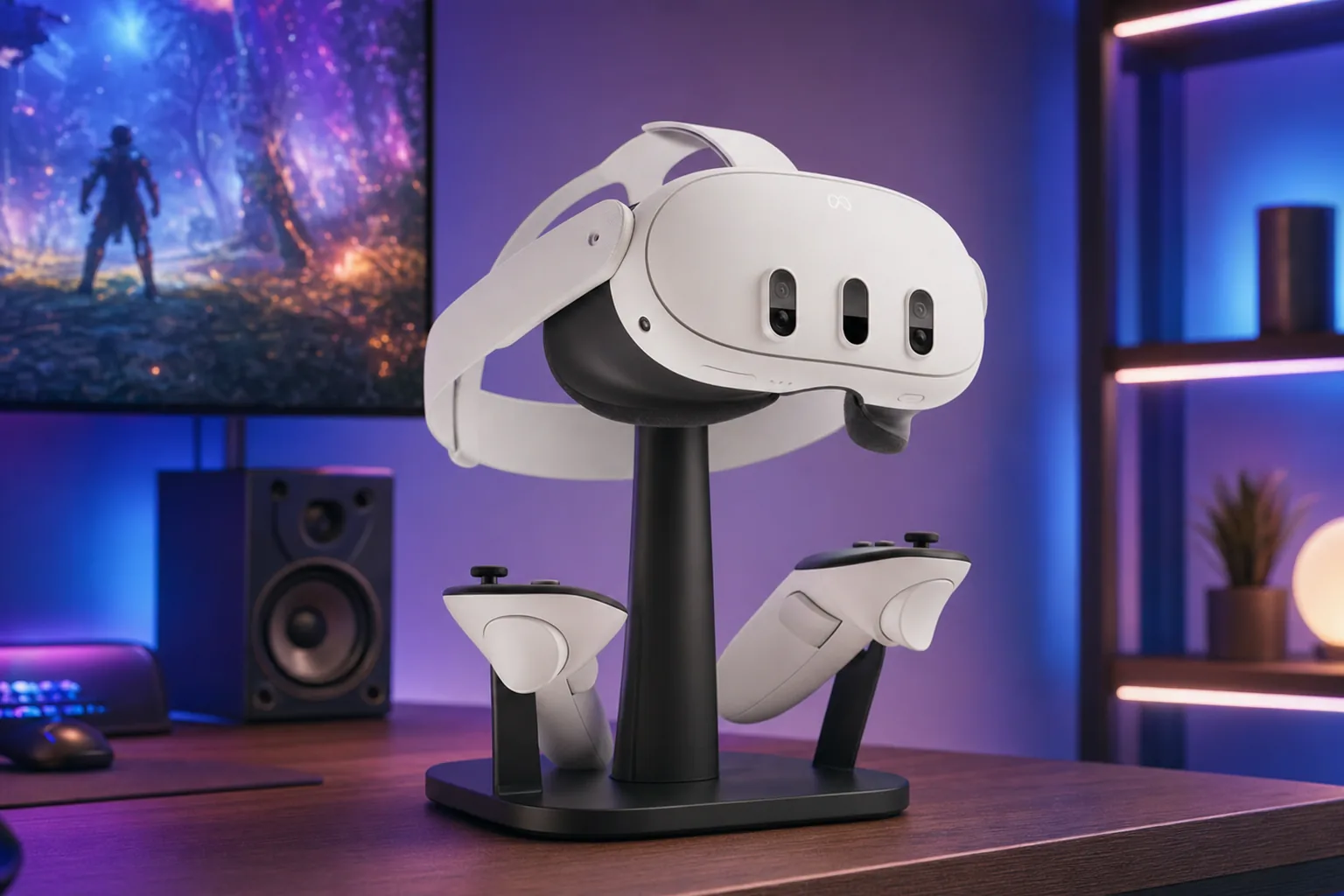
That matters in ordinary use. Menus, subtitles and distant objects are easier to resolve, while its physical IPD control serves more faces than the three fixed positions of Quest 3S. The headset supports 72Hz, 80Hz, 90Hz and 120Hz modes, plus integrated spatial speakers and a 3.5mm headphone socket for latency-free private audio.
Mixed reality is another reason to stretch to this model. Two 4MP RGB cameras work with a dedicated depth sensor, allowing the headset to understand walls, furniture and room geometry more naturally. Meta's developer specification describes Quest 3's GPU performance as approximately 2.5 times that of Quest 2, but here the relevant internal comparison is Quest 3S: both Quest models have the same processing platform, while Quest 3 supplies the clearer optics and depth hardware.
In day-to-day ownership, Quest 3 can switch roles: a buyer can use it as a self-contained headset for fitness or games, then connect it to a PC by USB-C or use Air Link when a larger PC VR library is the priority. The 512GB capacity reduces the pressure to remove installed standalone games, but it is not expandable. Tom's Hardware found the improved balance made the 515g headset feel less cumbersome than its weight suggests, yet it remains a face-worn device: Stuff reported facial and neck fatigue after around 45 minutes, so a better strap may be worth considering for longer sessions.
Why it suits many buyers
- Pancake lenses give a wider, clearer usable viewing area than Quest 3S.
- 512GB is useful for a substantial local game library.
- Continuous IPD adjustment is more accommodating than preset positions.
- Standalone apps, colour mixed reality and wired or wireless PC VR sit in one device.
The honest catches
- Ars Technica reported roughly two hours of battery life.
- The supplied fabric strap can become tiring; Stuff reported facial and neck fatigue after around 45 minutes.
- LCD black levels and roughly 100-nit measured peak brightness do not match OLED contrast.
- This particular Amazon listing is refurbished, so condition and included accessories deserve a final check.
Consider it if clarity changes how you will use VR
Quest 3 is a step up from Quest 3S for virtual screens, regular PC VR, fine text and people whose eye spacing does not align neatly with three preset IPD positions. Its advantage is optical comfort, not a separate tier of game performance.
Meta Quest 3S: A Lower-Cost Route Into the Same Quest Ecosystem
Meta Quest 3S is the lower-cost route into the current Quest ecosystem, and it does not sacrifice the processor that determines game compatibility. It has the same Snapdragon XR2 Gen 2 chip and 8GB RAM as Quest 3, so it can run the same current-generation Quest games and mixed-reality software. For a first headset, that matters more than a spec sheet which simply labels it "entry level".
The compromise is visible. Quest 3S uses 1,832 × 1,920-per-eye LCD panels, Fresnel lenses, around 20 pixels per degree and a 96° by 90° field of view. Its IPD adjustment is limited to approximately 58mm, 63mm or 68mm. PC Gamer and TechRadar both highlighted softer peripheral clarity compared with Quest 3, while Tom's Hardware noted the more noticeable screen-door effect.
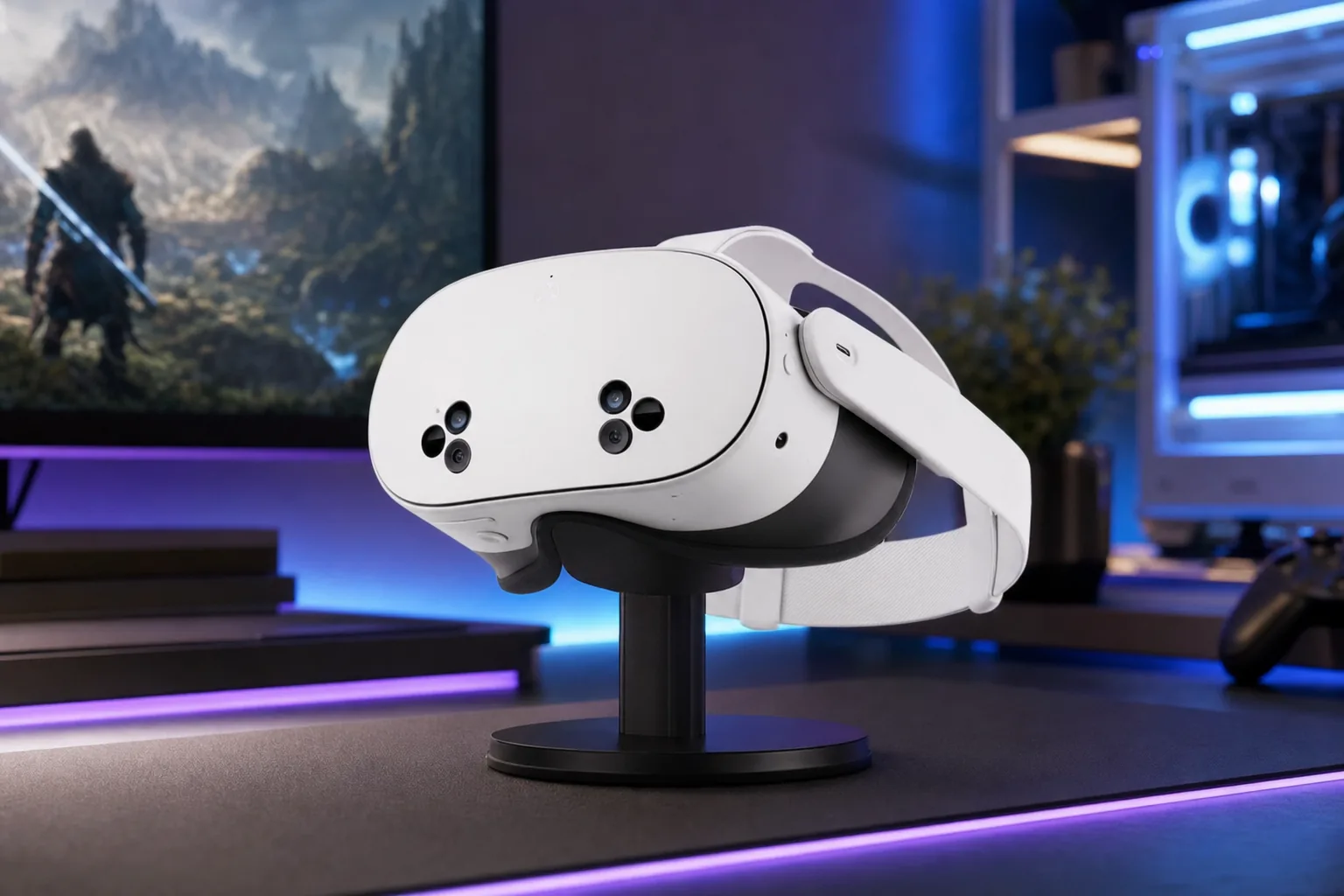
Passthrough remains full-colour and stereoscopic through dual 4MP cameras, and hand tracking, room-scale play and Touch Plus controllers are all present. Unlike Quest 3, though, it has no dedicated depth sensor. That makes it a capable mixed-reality headset for games and playful room overlays rather than the stronger option for buyers who expect precise room mapping or want virtual displays around their workspace.
Battery life is modest in real use. Trusted Reviews recorded around two hours five minutes over repeated mixed-use charges; Tech Advisor similarly recorded just over two hours, while WIRED saw around one hour 40 minutes in Horizon Worlds and Beat Saber. It is not dramatically behind Quest 3, but it is still a reason to treat a battery strap as a possible future purchase rather than an indulgence.
A good-fit Quest 3S buyer is not someone who expects it to look identical to Quest 3. It is someone who wants the same current Quest games, controllers and optional PC connection, then can accept being more deliberate about headset positioning. Its three IPD settings are worth considering before purchase: if none is comfortable, the lower initial outlay can become a false economy. Storage is the other practical trade-off. With no expansion, 128GB is best for a managed library rather than a keep-everything-installed approach.
Why it makes sense
- Same processor and RAM as Quest 3, so current game compatibility remains intact.
- Wireless standalone setup keeps family and casual sessions straightforward.
- Colour passthrough, hand tracking and PC VR flexibility remain part of the package.
- The 128GB version offers a more accessible entry tier than Quest 3.
What you give up
- Fresnel lenses are blurrier away from the centre than Quest 3's pancake optics.
- Three IPD positions are less forgiving for some faces.
- The 128GB capacity fills more quickly than Quest 3's 512GB; Tom's Hardware cited Batman: Arkham Shadow alone occupying about 19GB. A 3.5mm headphone socket is not confirmed in Meta's comparison specification for Quest 3S, so USB-C or Bluetooth audio are the likely routes to private listening.
PlayStation VR2: OLED Console VR for PS5 Owners
PlayStation VR2 has one decisive requirement: it needs a PS5. It is not a standalone headset, and original PlayStation VR games do not run in VR mode on it. That immediately narrows its audience, but it also lets Sony focus on a console-style experience with a single USB-C cable, dedicated VR games and features the standalone rivals do not share.
The display is the headline. PlayStation VR2 uses HDR OLED panels at 2,000 × 2,040 pixels per eye, with 90Hz and 120Hz operation and a roughly 110° field of view. UploadVR and TechRadar praised its genuinely dark blacks, saturated colour and HDR impact. None of the other models in this guide uses OLED panels, so night scenes and shadowy interiors are the clearest reason to favour Sony's approach.
It also pairs eye tracking with foveated rendering in compatible PS5 games. The console can concentrate rendering resources where you are looking, while the headset adds vibration and the Sense controllers supply haptic feedback, adaptive triggers and finger-touch detection. That layered feedback made an impression on AVForums, particularly alongside PS5 3D audio.
The headset is specified at about 560g excluding cable, yet UploadVR described it as balanced enough for long sessions. Its Fresnel lenses have the familiar compromise: UploadVR reported a limited sweet spot, some colour fringing and mura in darker scenes. TechRadar reported Sense controller life of around five to six hours, and separate charging remains part of the ownership routine.
Its setup suits a player who keeps a PS5 in one room and wants VR to feel like a console accessory rather than another computing platform to manage. Connect the single cable, fit the headset and use the included earbuds or the stereo headphone jack. The cable is still a movement constraint, particularly in standing games, but it also means the visor has no standalone battery countdown.
PlayStation VR2 can connect to a PC through Sony's separate PS VR2 PC adapter, a DisplayPort 1.4 cable and compatible Bluetooth hardware. HDR, eye tracking, headset feedback, adaptive triggers and advanced controller haptics are unavailable in PC use, so it makes most sense as a PS5 purchase first.
PICO 4 Ultra: 12GB RAM and Wi-Fi 7 for PC Streamers
PICO 4 Ultra is the alternative for buyers who want a standalone headset but do not want to join Meta's ecosystem. Its core platform is also Snapdragon XR2 Gen 2, but PICO pairs it with 12GB LPDDR5 RAM and 256GB UFS 3.1 storage. That is more memory than either Quest model, alongside Wi-Fi 7, Bluetooth 5.3 and PC streaming with AV1 decoding.
Its dual LCD panels offer 2,160 × 2,160 pixels per eye, 1,200 PPI and a 90Hz maximum refresh rate through pancake lenses. The 105° field of view is slightly tighter on paper than Quest 3's stated horizontal figure, but the motorised seamless 58–72mm IPD adjustment is unusually convenient. It lets the headset move the lenses into place rather than asking the wearer to choose from fixed steps.
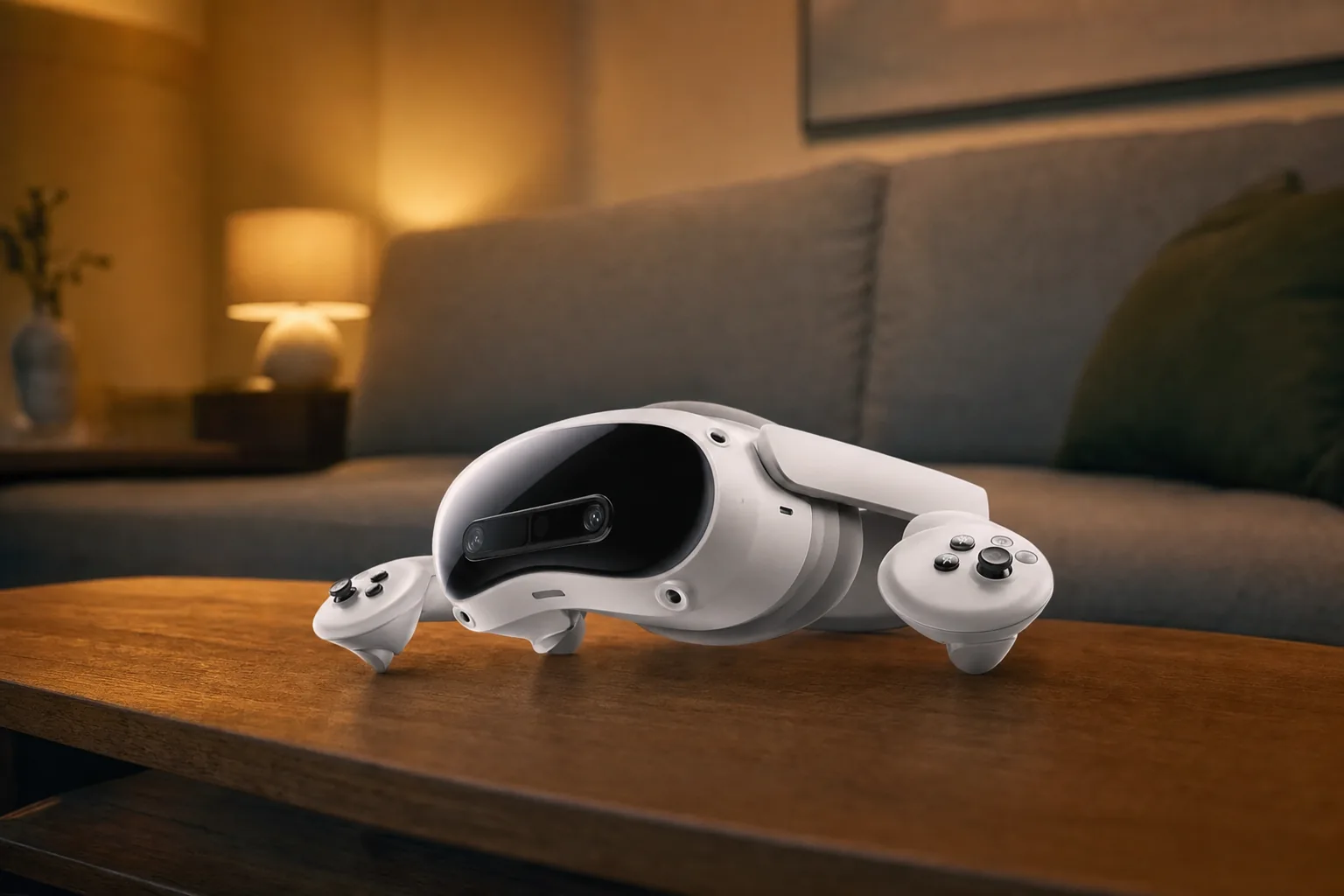
The design splits roughly 304g at the front and 276g at the rear, including the rear battery, for a total mass of about 580g. Stuff and GamesRadar+ both described the balance as effective despite that higher raw figure. The result is not a lightweight headset, but it may appeal to people who dislike all the mass sitting on their cheeks.
PICO has equipped it with two 32MP colour cameras and an iToF depth camera for mixed reality. UploadVR said the passthrough looked slightly sharper than Quest 3 in its demonstration, although reviewers differed over the wider productivity experience and window placement. Optional PICO Motion Trackers can add lower-body tracking without base stations, but they are not included with the standard headset.
This is therefore a compelling specialist choice rather than an automatic Quest replacement. Its hardware favours a buyer who values a rear-balanced fit, high-resolution pancake display and modern wireless connectivity for PC streaming. But PICO's software-library limitation matters every time you choose something to play. Reviewers noted missing high-profile titles including Beat Saber and Superhot at the time of review, so check that the games or apps you want are available before treating the stronger memory and Wi-Fi specification as decisive.
Why PC-focused buyers may prefer it
- 12GB RAM, Wi-Fi 7 and AV1-capable PC streaming make it well equipped for wireless PC use.
- Rear-battery distribution can feel more balanced than the total 580g figure suggests.
- High-resolution pancake-lens display and motorised IPD adjustment are appealing daily-use features.
- Optional Motion Trackers offer a route to lower-body tracking.
Why Meta remains easier for some
- Stuff reported a smaller software library and fewer major exclusive games than Meta's platform.
- GamesRadar+ criticised built-in speakers, haptics and dim-light controller tracking.
- The headset remains heavier than Quest 3 over very long sessions.
- Motion Trackers cost extra and are not part of the standard package.
Head-to-Head: Resolution, Weight, Battery and Price Side by Side
Price changes frequently, so it is more useful to think in tiers than quote a figure that may already have moved. Quest 3S is the lower-cost way into this group. Quest 3 adds premium optics and substantially more storage, while PICO 4 Ultra sits in the premium standalone tier with more memory and its balanced design. PlayStation VR2 is a separate calculation because a PS5 is a hard prerequisite.
Battery figures are not a direct race. Quest and PICO are self-contained devices that need a recharge once their internal batteries run down. PlayStation VR2 is powered by the PS5 cable, although its Sense controllers still need charging. Workload, brightness and mixed-reality use make a visible difference, so ranges are more useful than a single headline claim.
Think about the interruption you are prepared to live with. A Quest or PICO owner gets unrestricted standalone movement, but should expect to stop after roughly a couple of hours in demanding use or use a cable, power bank or battery strap for longer sessions. A PS VR2 owner avoids a headset recharge but has to route a lead safely between headset and PS5. Controller habits differ too: Quest and PICO controllers use replaceable AA batteries, whereas PS VR2's rechargeable Sense controllers need their own charging routine.
There are two particularly distinctive propositions. PlayStation VR2 alone combines OLED HDR and eye tracking in this group, which UploadVR and TechRadar praised for black levels and immersion in compatible PS5 games. PICO 4 Ultra alone combines 12GB RAM and motorised IPD adjustment, a pairing Stuff and GamesRadar+ noted as distinctive for fit and wireless-PC hardware.
Match Yourself to a Headset: Five Reader Profiles
The right choice can change even within the same household. A parent buying a headset to share may value the cordless setup and accessible Quest 3S route over maximum image quality. Someone who already spends evenings on PS5 games has a clearer reason to pay for PS VR2 than a newcomer starting without a console. Start with the games, room and devices you use most often; the specification then becomes easier to interpret.
Existing PS5 owner
Choose PlayStation VR2. OLED HDR, eye-tracked foveated rendering, headset feedback and Sense haptics are the persuasive reasons to accept the cable.
First-time VR buyer
Choose Meta Quest 3S. You get the same current Quest processor and library as Quest 3, accepting lower-resolution Fresnel optics and less storage.
Standalone plus PC flexibility
Choose Meta Quest 3. Its pancake lenses, continuous IPD adjustment, depth sensor and 512GB storage make it the more rounded long-term Quest choice.
Wireless PC streamer
Choose PICO 4 Ultra. Wi-Fi 7, 12GB RAM, AV1 decoding and a rear-balanced battery design make the hardware proposition compelling.
Buyer sensitive to fit
Choose Quest 3 or PICO 4 Ultra. Both offer continuous lens-spacing adjustment, while PICO automates the 58–72mm range.
Common Questions Before You Add One to Basket
No. PlayStation VR2 requires a PS5 for its PlayStation VR2 experience. It can also work with a compatible PC through Sony's separate PC adapter, but original PlayStation VR games are not compatible in VR mode and several PS5-specific features do not transfer to PC.
Yes. Both use Qualcomm's Snapdragon XR2 Gen 2 processor and 8GB RAM, so their current Quest game compatibility is shared. Quest 3's advantage is the higher-resolution display, pancake lenses, continuous IPD adjustment and dedicated depth sensor.
The standalone figures vary by task rather than producing a clear all-day winner. Cited use ranged from roughly one hour 40 minutes on Quest 3S in demanding use to up to four hours for PICO 4 Ultra video playback. PlayStation VR2 avoids a headset runtime limit by staying connected to the PS5.
It is if you intend to keep several large standalone games installed. The 128GB Quest 3S is workable for occasional use, while Quest 3's 512GB is more comfortable for a growing library without regular uninstalling.
Not for normal standalone or PS5 use: the listed headsets include the essentials needed to begin, subject to the refurbished Quest 3 listing's stated contents. Accessories become relevant for specific needs. Quest 3 users may prefer wired headphones because Bluetooth audio can add latency, while PS VR2 PC play requires Sony's separate adapter and the other specified PC hardware. A more supportive strap can also be a practical comfort upgrade for the Quest headsets after longer sessions.
The Bottom Line for Gadget Scout Readers
Buy around your ecosystem before comparing pixels. PlayStation VR2 is the focused choice for PS5 owners chasing OLED visuals and Sony's console-led VR features. Meta Quest 3S is the accessible route into modern standalone VR, provided its Fresnel lenses and 128GB storage fit your expectations.
Meta Quest 3 is the more complete Quest purchase for people who care about lens clarity, wider fit adjustment, mixed-reality room understanding and a large installed library. PICO 4 Ultra is the hardware-rich alternative for buyers attracted by its 12GB RAM, Wi-Fi 7, rear-balanced battery and motorised IPD.
Before purchase, verify current Amazon UK stock, the exact bundle contents and the listing condition. In particular, the Meta Quest 3 covered here is a refurbished 512GB Type-G unit, so its stated condition, included controllers, warranty and supplied power adapter should match what you expect.
Sources consulted
- Meta official Quest 3 and Quest 3S product, developer and comparison materials.
- PlayStation PS VR2 specifications, support documentation and PC adapter information.
- PICO 4 Ultra UK product information and specifications.
- Reviews and measurements from Ars Technica, AVForums, GamesRadar+, PC Gamer, Road to VR, Stuff, TechRadar, Tom's Guide, Tom's Hardware, Trusted Reviews, UploadVR and WIRED.
- Meta Quest 3All-round flexibilityView on Amazon
- PlayStation VR2For PS5 ownersView on Amazon
- PICO 4 UltraPC streaming hardwareView on Amazon
- Meta Quest 3SLower-cost entryView on Amazon
Sources and evidence (56)
- ypc.co.uk (other)
- techadvisor.com (other)
- about.fb.com (other)
- arstechnica.com (other)
- tomsguide.com (other)
- phonearena.com (other)
- stuff.tv (other)
- roadtovr.com (other)
- techradar.com (other)
- tomshardware.com (other)
- wired.com (other)
- techradar.com (other)
- about.fb.com (other)
- developers.meta.com (other)
- trustedreviews.com (other)
- techradar.com (other)
- tomshardware.com (other)
- pcgamer.com (other)
- wired.com (other)
- techadvisor.com (other)
- news.xbox.com (other)
- playstation.com (other)
- playstation.com (other)
- playstation.com (other)
- playstation.com (other)
- techgearlab.com (other)
- techradar.com (other)
- uploadvr.com (other)
- uploadvr.com (other)
- avforums.com (other)
- playstation.com (other)
- blog.playstation.com (other)
- arstechnica.com (other)
- ypc.co.uk (other)
- picoxr.com (other)
- picoxr.com (other)
- stuff.tv (other)
- gamesradar.com (other)
- uploadvr.com (other)
- techradar.com (other)
- picoxr.com (other)
- picoxr.com (other)
- stuff.tv (other)
- gamesradar.com (other)
- uploadvr.com (other)
- techradar.com (other)
- pcgamer.com (other)
- androidcentral.com (other)
- developers.meta.com (other)
- playstation.com (other)
- playstation.com (other)
- blog.playstation.com (other)
- store.steampowered.com (other)
- pcgamer.com (other)
- gamersnexus.net (other)
- developers.meta.com (other)