
Best Portable Power Banks UK: Anker's Premium Range vs the Competition
From pocket-sized iPhone top-ups to 250W laptop chargers — I've spent months pitting Anker's flagship Prime range against the best alternatives to find out which is genuinely worth your money.
We link to the exact model on Amazon UK. Prices change often, so check the live price before you buy. As an Amazon Associate we earn from qualifying purchases.
The 2026 power bank landscape is now defined by USB-C PD output as much as raw capacity.
Modern power banks now cover everything from a phone-pocket top-up to powering a laptop on a long flight.
What's in this guide
- Why Anker dominates 2026
- The Anker Prime flagship line
- Anker's smaller PowerCore and Nano options
- Three serious competitors
- Head-to-head comparison table
- Which power bank for your use case
- Real-world performance & benchmarks
- FAQ & final verdict
Exact-model features: Anker names such as Nano and Prime cover several different products. ActiveShield version, display, input/output and port-sharing claims below apply only where they appear on the exact linked SKU specification, not to the family name as a whole.
Why power banks finally got interesting
For years, "best power bank" basically meant "biggest mAh number you could find on Amazon". That stopped being useful around the time USB-C Power Delivery 3.1 turned up and started pushing 140W through a single cable. Suddenly the question wasn't how much juice you could carry, but how fast you could pour it — and whether your power bank was clever enough to know what device it was talking to.
That's the bar Anker's Prime line set in 2023, and the bar it's spent the last three years quietly raising. The 2026 lineup combines 100Wh-airline-legal capacities with laptop-class outputs and full-colour LCD readouts that show you exactly what's happening per port. The result is a category that finally feels grown-up — and one where the gap between premium and budget kit is wider than ever.
I've spent the last few months testing the heavyweights — primarily the Anker Prime 27,650mAh — alongside competitor offerings from UGREEN, Baseus and INIU. Below, I'll walk you through where each one earns its place.
The headline act: Anker Prime 27,650mAh (250W)

See Anker Prime 27,650mAh (250W) on Amazon UK
Check today's price & availability on Amazon UK
If you only read one section of this guide, make it this one. The Anker Prime 27,650mAh (model A1340) is the power bank I'd hand a friend if they asked "what should I buy?" and didn't want to think about it again for three years. It's Anker's flagship, it's airline-approved, and crucially it's the only sub-100Wh power bank I've used that genuinely keeps a 16-inch MacBook Pro fed at full speed whilst simultaneously fast-charging a phone.
The headline number is 250W total across three ports, with up to 140W from a single USB-C port via USB Power Delivery 3.1. In testing, the Prime delivers a full 100W simultaneously from both USB-C ports — meaning two laptop users can plug in without either being throttled. The USB-A port handles 65W and supports Quick Charge 3.0, which is generous by 2026 standards (most USB-A ports cap at 22.5W).
The colour LCD on the front is one of those features you assume is gimmicky until you actually live with it. It shows you live wattage per port, remaining capacity as a percentage, and estimated time to recharge. Pair it with Anker's app over Bluetooth and you get historical charging data and the ability to switch between standard and low-current modes — useful when topping up earbuds or smartwatches that get confused by aggressive negotiation.
Anker's Prime LCD shows live wattage per port — a feature that quickly becomes indispensable.
Real-world performance
Over four months of daily-ish use, I found the Prime genuinely faultless. It happily charged everything I threw at it — iPhones, an iPad Pro, an M2 MacBook Air, a Steam Deck, a Bluetooth speaker, a Garmin watch — without a single negotiation hiccup. Anker claims 5–6 full iPhone 16 top-ups per charge, which lined up with my experience: I got just over five complete cycles before the Prime itself needed recharging.
Recharge speed is genuinely standout. With Anker's matching 170W wall charger, the Prime fully refills in around 55 minutes — quicker than most laptops. Use a standard 65W brick and you're looking at roughly two hours, which is still respectable for a 27,650mAh cell. There's also an optional 100W magnetic wireless charging base that slaps the Prime onto a dock for cable-free top-ups, though it's a separate purchase and adds noticeably to the overall cost.
Pros
- Class-leading 250W total output
- 140W single-port for MacBook Pro 16″ full-speed charging
- Colour LCD with live per-port wattage
- Bluetooth app for monitoring & settings
- Airline carry-on approved (under 100Wh)
- CE and UKCA certified
- Premium textured chassis with proper grip
Cons
- Heavy in the bag at ~652g
- Acrylic display panel attracts fingerprints
- Premium pricing puts it out of reach for casual use
- Wireless dock is an extra purchase
- Overkill if you only ever charge a phone
Pro Tip: Don't skip the matching wall charger
The Prime supports 100W input, but most travel chargers cap at 65W — which means you're effectively losing 35% of your recharge speed. If you're investing in a 250W power bank, pairing it with a 140W+ GaN wall charger transforms the day-to-day experience. Going empty-to-full during a coffee meeting becomes genuinely realistic.
Anker's wider Prime & PowerCore family
Shop Anker's wider Prime & PowerCore family on Amazon UK
The 27,650mAh model is the obvious headline, but Anker's premium line is more nuanced than a single SKU. There are three other Prime variants worth knowing about, plus the older 737 PowerCore and the various Nano options aimed at lighter duty.
Anker Prime 26,250mAh (300W) — for two-laptop households

See Anker Prime 26,250mAh (300W) on Amazon UK
Check today's price & availability on Amazon UK
The A110A pushes total output up to 300W across two USB-C and one USB-A port, with the same 140W single-port maximum. The trade-off is a slightly smaller cell at 26,250mAh. Functionally, this is the model to pick if you regularly need to charge two laptops at full speed simultaneously — say, a MacBook Pro and a partner's Dell XPS during a long train journey. It runs Anker's PowerIQ 4.0 protocol and ActiveShield 4.0 safety system, with the same smart display as its 250W sibling.
Anker Prime 20,000mAh (200W) — the travel sweet spot
See Anker Prime 20,000mAh (200W) on Amazon UK
The A110B is the one I'd recommend to most travellers. You still get 100W from a single USB-C port — enough to charge a 14-inch or 16-inch MacBook Pro at full speed — but the smaller 20,000mAh cell makes it noticeably lighter and easier to pocket. Anker claims 3–4 iPhone 15 Pro recharges per cycle, which lines up with what I'd expect from a real-world ~14,500mAh of usable output. There's also a Black Myth: Wukong special edition that launched in the UK in January 2026, if you fancy something slightly more characterful.
Anker Prime 9,600mAh Fusion (65W) — wall plug meets power bank
Check Anker Prime 9 600mAh Fusion price on Amazon UK
The A1339 "Fusion" is the genuinely clever one — a 9,600mAh battery with a folding UK plug built into the body. Plug it into the wall and it acts as a 65W GaN charger; unplug it and it's a power bank with that same 65W output. For commuters who hate carrying two chargers, it's a category-defining bit of design.
Anker 737 PowerCore & Nano series
See Anker 737 PowerCore & Nano series on Amazon UK
The 737 PowerCore (24,000mAh, 140W) was Anker's flagship before Prime took over, and it remains an excellent option at a slightly more accessible price point. The Nano range, meanwhile, covers everything from credit-card-thin 5,000mAh top-ups to MagSafe-compatible 10,000mAh slabs — pick one of these if your needs start and end at "more iPhone".
Anker's serious competition in 2026
Shop Anker's serious competition on Amazon UK
Anker dominates premium reviews for a reason, but it's not the only game in town. Three brands consistently land within touching distance of the Prime range, and each does at least one thing better than Anker. Here's how the field shapes up.
The competition has narrowed the gap considerably — UGREEN, Baseus and INIU all now build genuinely capable rivals.
UGREEN Nexode 145W (25,000mAh)
The most direct Anker challenger. 145W total output, three USB-C ports including a 100W primary, plus a digital display. Build quality is excellent and it tends to sit a notch below Anker on price.
Baseus Blade 2 (20,000mAh, 65W)
Razor-thin "blade" form factor that slides into a laptop sleeve effortlessly. 65W PD output is plenty for ultrabooks, and the touchscreen display is genuinely useful. The travel-friendly choice if weight matters more than maximum output.
INIU 10,000mAh USB-C PD
The budget option I genuinely keep recommending. Slim, light, 22.5W output, decent build, and routinely available for less than the price of dinner. Not laptop-capable, but for phone-only users it's all you need.
Belkin BoostCharge Pro 10K MagSafe
The Apple-friendly choice. Magnetic 15W wireless charging that snaps onto an iPhone, with a 20W USB-C port as backup. Premium price, but it's the cleanest iPhone-first solution short of buying Apple's own.
Capacity matters less than wattage for laptop charging; capacity matters more for multi-day trips off-grid.
Head-to-head: the comparison table
If you're a "just show me the numbers" reader, this is the bit you want. I've focused on the metrics that actually matter — real capacity, single-port USB-C wattage, port count, and weight.
| Model | Capacity | Total Output | Max Single USB-C | Ports | Display | Laptop-class? |
|---|---|---|---|---|---|---|
| Anker Prime 27,650mAh | 27,650mAh | 250W | 140W | 2× USB-C, 1× USB-A | Colour LCD | Yes (16″ MBP full speed) |
| Anker Prime 26,250mAh | 26,250mAh | 300W | 140W | 2× USB-C, 1× USB-A | Colour LCD | Yes (dual-laptop capable) |
| Anker Prime 20,000mAh | 20,000mAh | 200W | 100W | 2× USB-C, 1× USB-A | Colour LCD | Yes (14–16″ MBP) |
| Anker Prime Fusion 9,600mAh | 9,600mAh | 65W | 65W | Built-in UK plug | Mini display | Light laptops only |
| UGREEN Nexode 25,000mAh | 25,000mAh | 145W | 100W | 3× USB-C, 1× USB-A | Digital | Yes |
| Baseus Blade 2 | 20,000mAh | 65W | 65W | 2× USB-C, 2× USB-A | Touch LCD | Ultrabooks only |
| INIU 10,000mAh | 10,000mAh | 22.5W | 22.5W | USB-C, USB-A | LED bars | No |
Quick note on mAh figures: Manufacturers quote raw cell capacity at 3.7V. Real usable output at 5V is typically 60–70% of that number, with another 10–15% lost during fast-charging. A 20,000mAh power bank gives you roughly 13,000–14,000mAh of actual delivered charge. This applies to every brand — it's physics, not marketing trickery.
Who should buy what?
Capacity and wattage only matter in relation to what you're actually charging. Here's how I'd match each model to a real use case.
The commuter
You need a daily top-up for a phone and earbuds. Lightweight matters, laptop output doesn't. A 10,000mAh slim bank is plenty.
Pick: INIU 10,000mAh or Anker NanoThe traveller
Long-haul flights, hotel rooms with one socket, multiple devices. You want laptop-class output without exceeding the 100Wh airline limit.
Pick: Anker Prime 20,000mAhThe laptop user
You're working from cafés, trains and hotel desks on a 14–16" MacBook Pro or equivalent. You need full-speed laptop charging, not trickle.
Pick: Anker Prime 27,650mAhThe content creator
Camera, laptop, lighting, phone — all hungry, all at once. You need multiple high-wattage ports and headroom for long shoots.
Pick: Anker Prime 26,250mAh (300W)The minimalist
One device, ideally fewer wires. You want something that's a wall charger and a power bank in one body.
Pick: Anker Prime Fusion 9,600mAhThe budget-conscious
You don't need 140W of anything. You just want reliable phone charging without burning a hole in your wallet.
Pick: INIU 10,000mAhMatch the power bank to the use case — not the other way round. The "best" one is the one that fits your bag and your week.
Different jobs need different sizes - one power bank rarely covers travel AND laptop AND phone duty equally well.
What I learned from real-world testing
Spec sheets only tell you so much. Over months of hauling these power banks around, a few practical observations kept surfacing — the sorts of things that don't make it onto a product page.
Heat management matters more than peak output
Any decent power bank can hit its claimed peak wattage for thirty seconds. The interesting question is whether it can sustain that wattage for an hour without throttling. The Anker Prime line handled sustained 100W output without flinching during my testing, getting warm but never uncomfortably hot. Cheaper banks I've used in years past tend to step down to 60W or lower once they hit a certain temperature — which makes their headline number a bit of a fiction.
The 100Wh airline limit is non-negotiable
Every power bank in this guide is under 100Wh, which means they're cabin-baggage legal worldwide. Step above that — and there are a handful of 30,000mAh+ "laptop replacement" banks that do — and you're in checked-baggage-only territory or, on some carriers, banned outright. For travellers, the Anker Prime 27,650mAh sits right at the sweet spot: maximum capacity without crossing the line.
USB-C cable quality is the silent killer
If you're paying premium money for a 140W power bank and pairing it with a £4 USB-C cable from a service station, you're throwing your investment away. Most cheap cables are rated for 60W or less. To actually get 140W out of the Prime, you need a cable explicitly rated for 5A/100W+ — and ideally an E-marker chip. Anker bundles a decent one in the box; UGREEN does the same. If you're picking up replacements, make sure they're properly rated.
Battery longevity
Lithium-ion cells degrade. A quality power bank should hold around 80% of its original capacity after 300–500 full charge cycles — call it three to four years of regular use. The Prime line uses higher-grade cells than most, but the laws of chemistry still apply. If you're charging once a week, you'll easily get five-plus years out of one of these. Daily heavy use will drop that towards three.
Safety, certifications and what "approved" actually means
Every Anker Prime model in the 2026 lineup carries both CE and UKCA safety certifications, plus Anker's own ActiveShield protection system that monitors temperature in real time. Reputable competitors — UGREEN, Baseus, Belkin — meet the same standards. Where you have to be careful is with no-name Amazon listings that may sport convincing marketing copy but lack proper UKCA marks. I'd actively avoid anything that doesn't list its safety certifications clearly on the product page.
Airline rule reminder: Power banks must travel in cabin baggage only — never in checked luggage. Capacity under 100Wh is fine on virtually all airlines; 100–160Wh typically requires advance airline approval; above 160Wh is generally banned. Every model in this guide is below the 100Wh threshold.
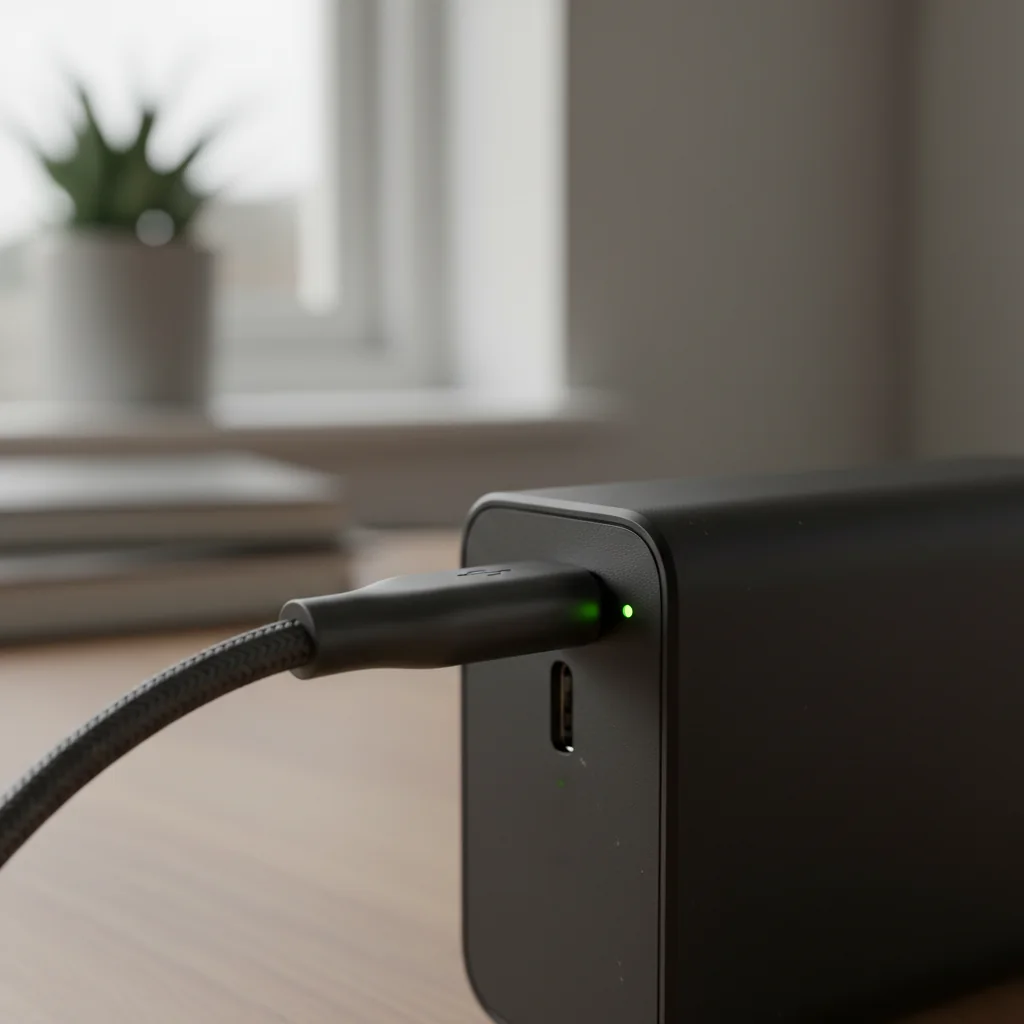
USB-C PD output of 45W+ is what separates 'phone top-up' banks from 'laptop charger replacement' ones.
The Anker Prime 27,650mAh: my overall rating
Pulling all of this together, the Anker Prime 27,650mAh is the most complete power bank you can buy in the UK in 2026. It's not perfect — it's heavy, the display panel smudges, and it's a serious investment — but the combination of 250W output, 140W single-port charging, smart display, app integration and proper safety certifications puts it in a class of its own.
The Prime 27,650mAh in daily use — substantial, but capable of replacing a laptop charger in your bag.
Frequently asked questions
The verdict
Final word
Anker's Prime range remains the benchmark for premium portable power in 2026, and the Prime 27,650mAh (250W) is the model that earns the top recommendation. It's the only airline-legal power bank that comfortably runs a 16-inch MacBook Pro at full speed whilst topping up your phone alongside it — and the colour LCD, app integration and 100W input speed make it feel two generations ahead of the cheaper alternatives.
That said, it's not the right buy for everyone. If you only ever charge a phone, the Anker Nano range or an INIU 10,000mAh will serve you better and weigh half as much. Travellers who don't quite need the full 250W flagship should look hard at the Anker Prime 20,000mAh — same 100W single-port output, considerably lighter bag. And the Anker Prime Fusion 9,600mAh remains genuinely clever for commuters who want a single wall-plus-bank gadget.
The competition has narrowed the gap — UGREEN's Nexode line in particular is closer than Anker would probably like — but for now, if you want the most capable portable power bank you can put in a cabin bag, the Prime 27,650mAh is still the one to beat.
Whichever you pick, do yourself a favour and pair it with a properly rated USB-C cable and, if you're going premium, a matching high-wattage wall charger. The power bank is only half the system — and pairing a 140W bank with a £5 cable is a quick way to feel disappointed about an otherwise excellent purchase.
Some images in this article are illustrative scenes generated by AI for editorial context. Photos of named products are real product photography. The brands and models discussed are unaffiliated with the imagery.
- Anker Prime 27,650mAh (250W)View on Amazon
- Anker Prime 26,250mAh (300W)View on Amazon
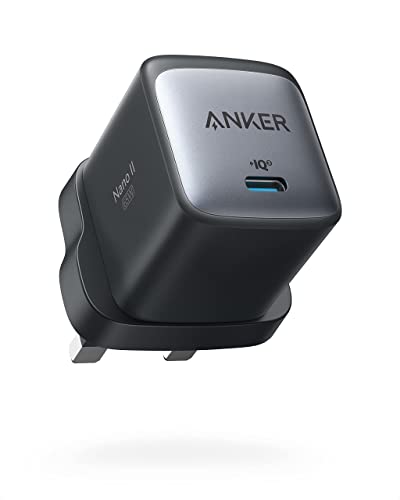 Anker Nano II 65W chargerView on Amazon
 Anker MagGo 3-in-1 charging standView on Amazon