
Aqara Smart Lock U400 Review: The Door That Knows You Are Coming
A genuinely clever UWB smart lock with a rather enormous catch for British homes: it needs the right door before it can do its magic.
We link to the exact model on Amazon UK. Prices change often, so check the live price before you buy. As an Amazon Associate we earn from qualifying purchases.
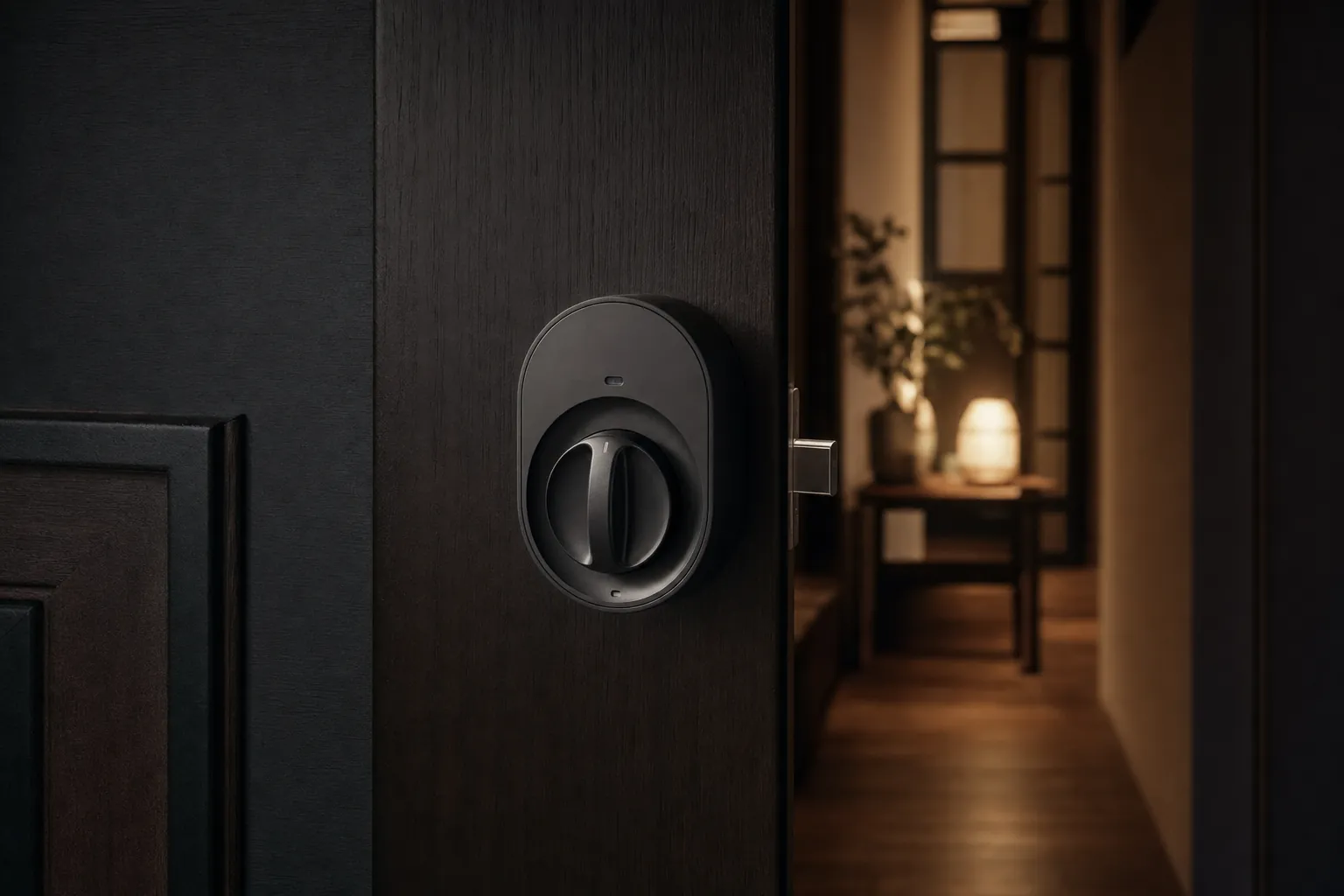
The Aqara Smart Lock U400 combines a keypad, fingerprint reader, physical cylinder and ultra-wideband approach unlocking in one substantial deadbolt replacement.
Smart locks are usually about replacing a key with something else: a phone, a PIN, a fingerprint, perhaps an NFC tag living permanently at the bottom of your bag. The Aqara Smart Lock U400 tried something more ambitious. With compatible Apple hardware, it could recognise that an authorised person was approaching and unlock the deadbolt before they had prodded a screen or touched a sensor. It was one of those ideas that sounded faintly silly until you pictured arriving home in proper British rain with two bags of shopping and absolutely no spare hands.
The Smart Lock That Wants to Meet You at the Door
The U400's headline trick was ultra-wideband, or UWB. This is not ordinary Bluetooth proximity where a device merely knows that your phone is vaguely somewhere nearby. Aqara used secure ranging to work out a much more precise relationship between you and the lock. In the right Apple household, that meant walking up to the door, waiting for the mechanism to wake, then using the handle. No app. No keypad. No fingerprint. Very neat indeed.
It was also a product that needed a giant asterisk after every exciting sentence. The U400 was a North American-style, single-cylinder deadbolt replacement. That means a conventional exterior key cylinder, a bolt in its own round bore, and a motorised thumb-turn assembly indoors. It was not a neat retrofit for the euro-profile cylinders, sashlocks, rim night latches and lift-to-lock multipoint mechanisms found on a great many British uPVC and composite doors.
That distinction was not a technical footnote. It was the whole review. Smart-home compatibility is easy to get seduced by; Matter badges, Thread logos and Apple Home Key icons all look lovely in a product listing. But none of them matters if your front door uses a mechanism the lock cannot replace. Before we get carried away with the door appearing to know your name, we need to talk about holes, bolts and very unglamorous measurements.
The short version

The U400 was impressive hardware for a compatible single-cylinder deadbolt door and an Apple household. For the typical UK uPVC or composite front door with a euro cylinder and multipoint lock, it was generally the wrong starting point rather than the wrong smart lock.
Aqara introduced the U400 at CES on 6 January 2026 for the US, Canada, Australia, New Zealand and Singapore. There was no official UK launch or UK retail price by 17 August 2026, so importing brought the usual questions around warranty, fitting work, tax and insurer approval.
Before You Buy: Measure Your Door, Not Your Expectations
There is a tendency in smart-home shopping to begin with an ecosystem question: "Will it work with Apple Home?" or "Can Alexa lock it at bedtime?" Those are fair questions, but with the U400 they came second. The first question was brutally simple: does your door have a compatible single-cylinder deadbolt?
The U400 replaced that type of deadbolt rather than sitting over the top of an existing lock. Outdoors, you got the keypad, fingerprint reader and key cylinder. Indoors, you got the larger motor housing and a physical thumb-turn. The deadbolt itself passed into a supplied strike plate on the frame. It was a proper lock replacement job, not the gentler "fit this over your existing thumb-turn" arrangement used by many European retrofit designs.
Those figures are where a tape measure earns its keep. A compatible door needed to be between 35 mm and 54 mm thick, with either a 60 mm or 70 mm backset. The latch bore was 25 mm, while the exterior bore was 54 mm; hollow doors could use a 38 mm bore. If your existing lock did not line up with that recipe, it was not a case of being "nearly compatible". It meant altering the door or choosing something designed for the hardware already installed.
Aqara specified use of its supplied strike plate too. That matters because even a beautifully intelligent lock has to move a metal bolt cleanly into a correctly aligned hole. If the door had dropped on its hinges, swelled in winter, or needed a shoulder against it to lock, the motor would have a harder job. You might still get the door to lock, but you would be asking the battery and mechanism to compensate for a carpentry problem. That is rarely a recipe for serenity.
The U400's published dimensions are for a North American deadbolt installation, so measure the door, bolt position and frame rather than assuming a smart-home badge means universal compatibility.
Measure before importing
Check door thickness, backset, bore diameters, clearance around the internal thumb-turn area and the position of the strike plate. If your existing door uses a handle-operated multipoint mechanism, stop there: the U400 was not designed to replace that system.
For UK readers, the practical split was fairly stark. A timber door already using a compatible deadbolt could be a candidate, subject to professional assessment. A standard euro-cylinder uPVC door, a composite door with lift-to-lock hardware, a traditional rim night latch, a mortice sashlock or a multipoint mechanism was a different world. You would be looking at substantial modification at best, and a poor security decision at worst.
Do not treat the U400 as a shortcut around a multipoint door lock. On many UK doors, lifting the handle engages several locking points before the cylinder is turned. A separate deadbolt does not reproduce that operation or the security design built around it.
A Chunky Deadbolt with a Surprisingly Modern Face
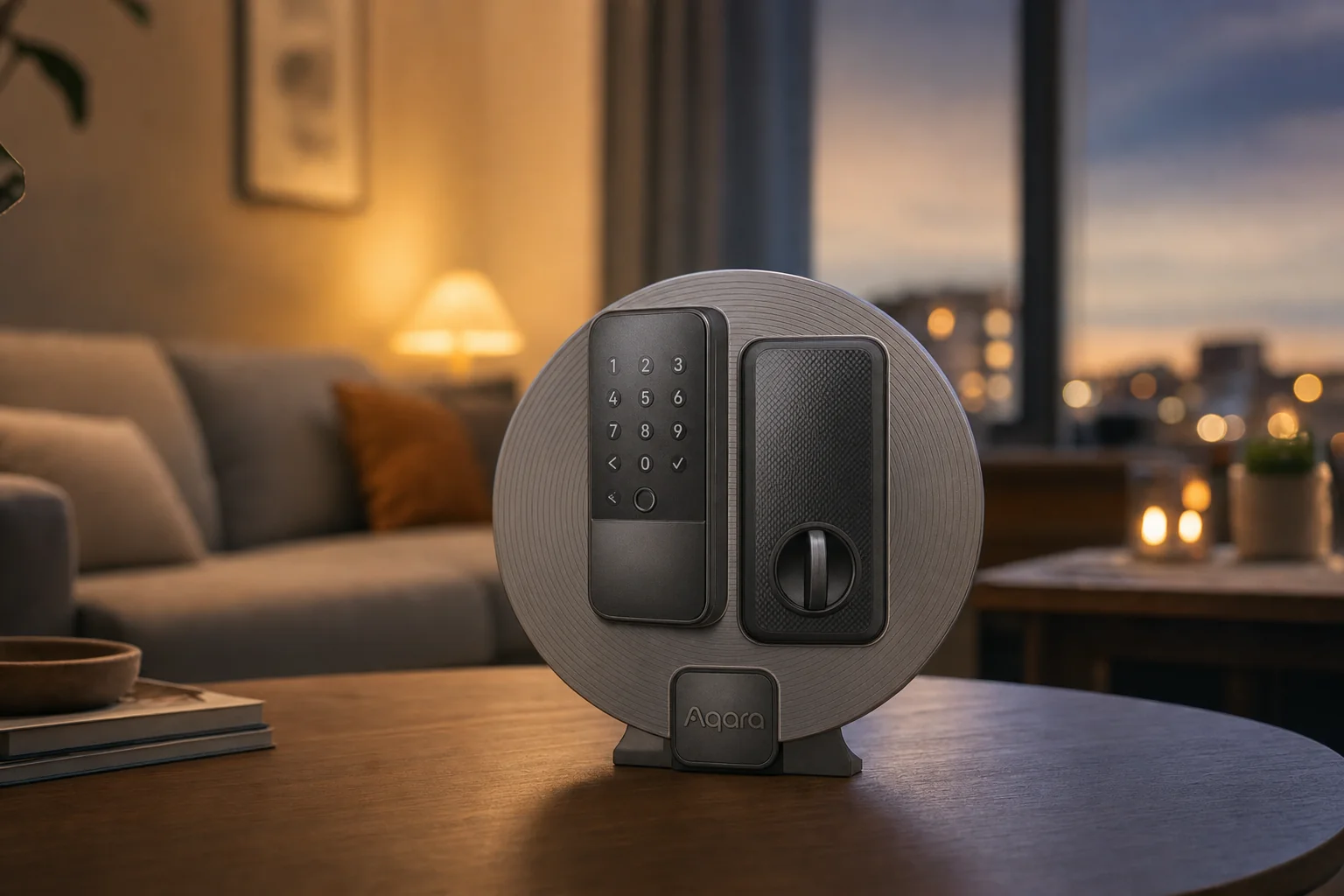
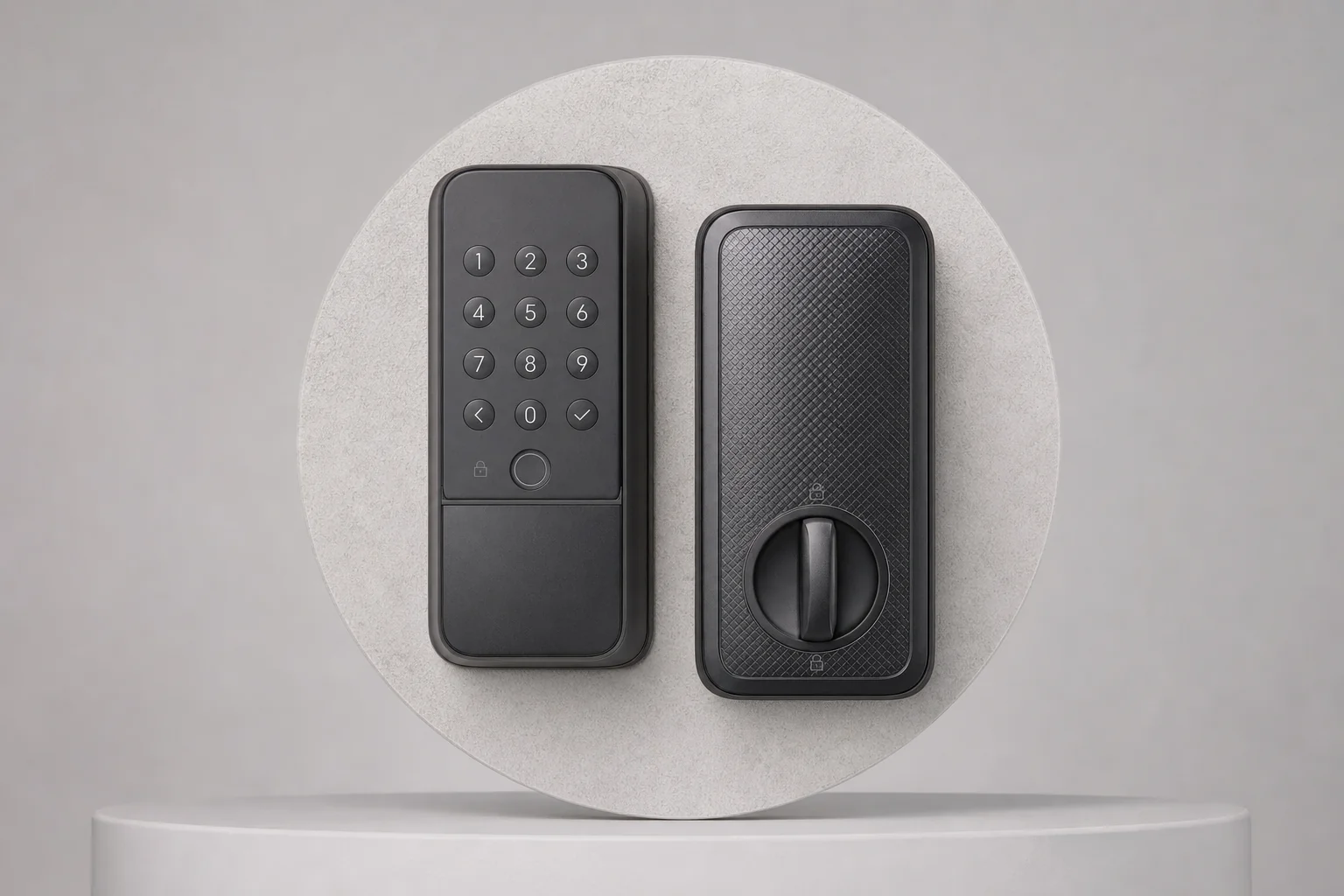
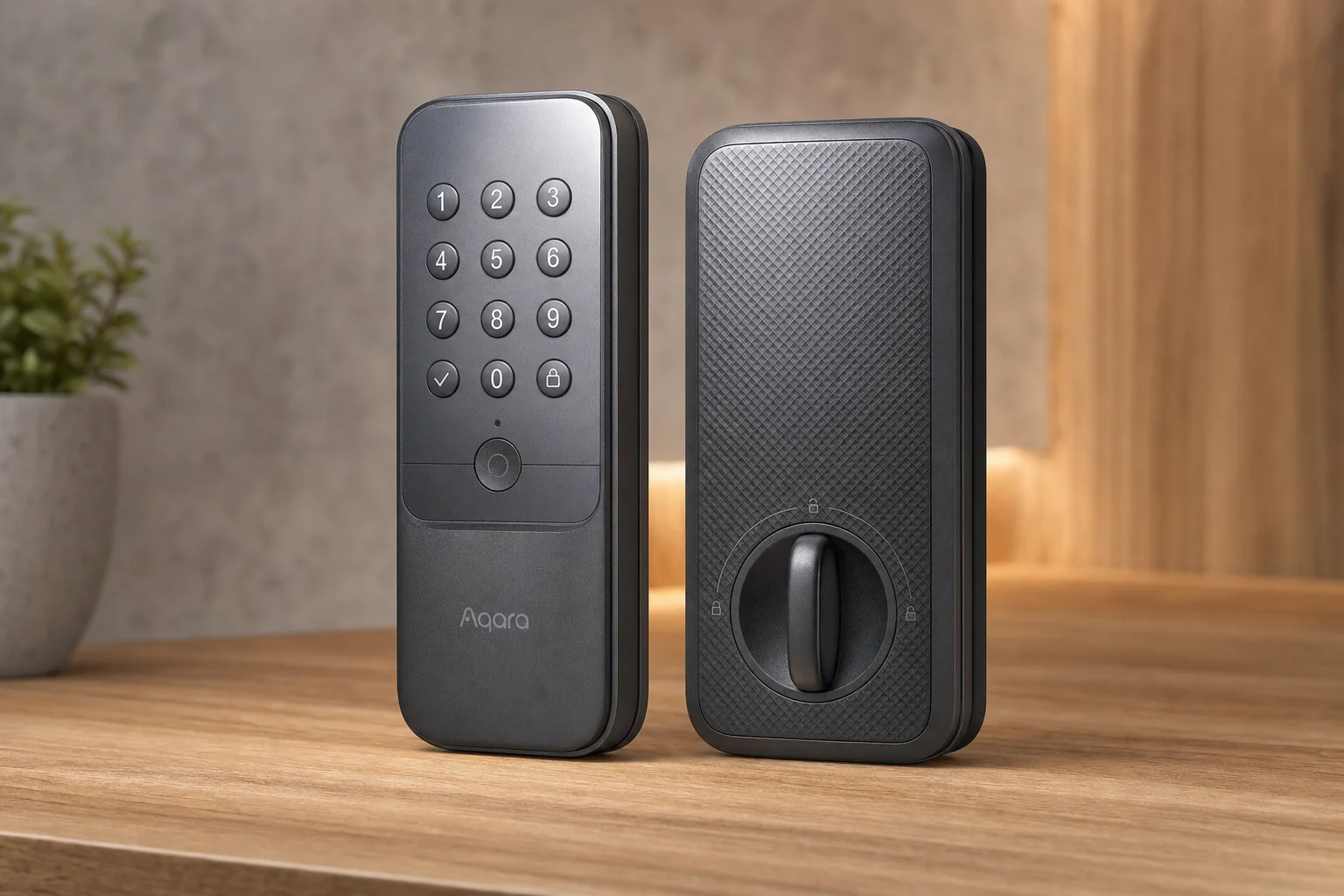
Assuming the door passes its physical audition, the U400 was a handsome bit of kit. "Handsome" is not always a word I reach for with smart locks; too many look like a cheap hotel safe attached to a front door. Aqara's approach was more restrained. The outside panel combined the keypad, fingerprint reader and keyway in a tidy vertical unit, whilst the inside housing looked purposefully mechanical rather than pretending it was a tiny speaker.
The outer panel measured 167 × 76 × 46.9 mm. The interior panel was 178 × 76 mm. That was not petite, and the lock's weight made the point even more clearly: approximately 967 g without its battery, or around 1,140 g with the battery installed. It felt like a proper deadbolt assembly because it was one. You were not strapping a motor to the back of a key; you were fitting an entire electronic locking system.
Fingerprint reader on the exterior panel
The fingerprint reader sat alongside keypad access and gave the U400 a fast, deliberate way in when hands-free UWB was not the right move.
A keypad that kept access flexible
Permanent, temporary, scheduled and offline codes made this more useful than a phone-only lock, particularly for family, guests and tradespeople.
Physical thumb-turn indoors
There was still a manual interior control. That is reassuring when the network is sulking, your phone battery has given up, or you simply want to leave the house without a small conference with the app.
A mechanical key remained
The U400 retained a physical-key backup and used a rekeyable cylinder. Smart access was additive here, not an instruction to throw every conventional contingency plan in the bin.
Aqara listed black and silver finishes for the standard lock. The Deluxe Kit also appeared in shadow black and satin nickel. That gives you enough choice to avoid a glaring mismatch with the door furniture, though it is worth remembering that the U400 was physically large enough to become a visible part of the façade. This was not one of those gadgets that disappears into the background. It was saying, politely but firmly, "yes, this door is smart now".
What the design got right
- A substantial lock body that looked and felt more serious than a bolt-on gadget.
- Fingerprint, keypad and physical key access all lived on the exterior side.
- A removable battery avoided permanently tethering the door to a cable.
- IP65 exterior protection was reassuring for a lock exposed to rain and dust.
What to watch
- Its size and deadbolt format made it a poor cosmetic or mechanical fit for many UK doors.
- The external panel needed enough clear, flat door area around the existing bore.
- There was no escaping the fact that this was a replacement installation, not a quick retrofit.
- The keypad could need more than one touch to wake before entering a code.
Setup Is a Matter of Door Geometry and Home-Ecosystem Patience
Mechanically, the basic installation sequence was clear enough. Remove the existing compatible deadbolt. Confirm the bore and backset. Fit Aqara's latch and strike plate. Mount the exterior assembly. Bring the interior section into place, connect the 10 cm cable, secure everything, insert the removable battery and calibrate the lock. In a door that was already drilled to the required standard, this was a conventional deadbolt replacement. In every other door, it could become a joinery project quite quickly.
Accurate alignment was more important here than it is with a lock that simply turns an existing cylinder from inside. The motor was responsible for driving the bolt, and motors do not have the instincts of a human wrist. A person can feel resistance and give the handle a tiny lift, push the door in a fraction, then turn the key. A smart lock expects the mechanism to be fundamentally sound. Give it a stiff bolt, a poorly aligned keep or a door that drags, and it may work harder, make more noise and use more battery than it ought to.
Bluetooth for initial local setup
Aqara Home setup began locally over Bluetooth, which was the sensible place to start before involving a wider home network.
Thread for the low-power smart-home layer
The U400 used Thread rather than relying on a built-in Wi-Fi radio. That was good for battery life and resilience, provided your home already had suitable Thread infrastructure.
Matter for platform choice
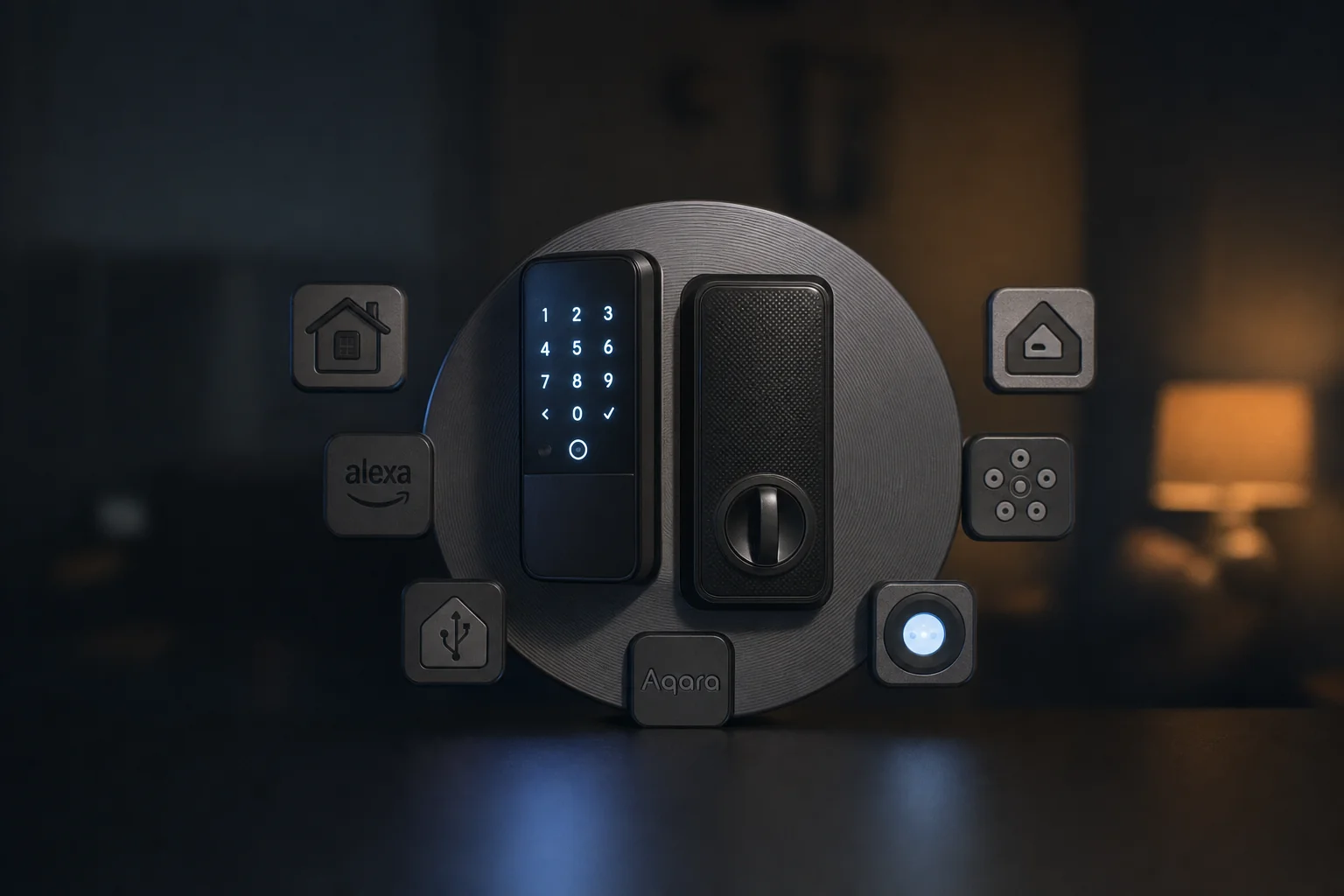
Matter over Thread opened the door to Apple Home, Google Home, Amazon Alexa, SmartThings and Home Assistant, with the appropriate controller or border router in place.
A hub for remote control
Remote access required a suitable Matter controller, Thread Border Router or Aqara hub. The lock itself was not specified as having built-in Wi-Fi.
Installation involves replacing a compatible deadbolt, fitting Aqara's supplied latch and strike plate, then connecting the exterior and interior assemblies with the included 10 cm cable.
That hierarchy is worth understanding. A locally paired smart lock could still perform local tasks even when the internet was not behaving itself. Fingerprint and UWB access were reported to work locally, rather than needing a cloud round trip to decide whether you were allowed into your own house. Remote app controls, notifications while away and wider automations were a different matter. They depended on the relevant hub, controller and network path being in good working order.
The slightly tedious part was not Aqara-specific; it was Matter and Thread in the real world. The standard was designed to make ecosystems simpler, and it often did, but the phrase "works with Matter" was not shorthand for "every clever feature works identically in every app". Apple Home was especially significant for UWB and Home Key. Google Home, Alexa, SmartThings and Home Assistant could participate through Matter, but the U400's headline hands-free arrival feature began life as an Apple-first proposition.
Do the boring network check first
Before fitting the lock, identify your Thread Border Router or Matter controller and confirm that it is working where the front door is. A smart lock can still be locally useful without remote control, but there is little point buying a connected deadbolt and discovering the connected part stops at the hallway.
Five Ways In, but Only One Feels Like the Future
The U400 did not leave you dependent on its cleverest feature. That was good design, because the best smart lock is one that still lets everyone in when one member of the household has forgotten their phone, another has wet hands, and somebody else refuses to install yet another app on principle. The U400 offered UWB approach unlocking, Apple Home Key, fingerprint, PIN codes, NFC, the Aqara app, voice controls and a physical key.
But UWB was the reason to care. With a compatible iPhone or Apple Watch, the U400 could detect an authorised person coming towards the door and unlock hands-free. In practical terms, the sensible rhythm was: approach from outside, pause for the lock to recognise you, operate the handle, and make sure the door had genuinely unlocked before pulling it open. That last bit sounds painfully obvious, but smart-home magic is at its best when it is quietly reliable rather than when it leaves you tugging a locked door whilst insisting to a neighbour that it normally works.
Consumer Reports found the hands-free arrival experience genuinely convenient, whilst Tom's Guide reported that it worked consistently almost every time. There were occasional reports of roughly an extra second of delay in some Apple Watch-only situations. That is not a catastrophe — we have all waited longer for an old-fashioned key to emerge from a pocket — but it explains why UWB should be treated as a helpful arrival ritual rather than instant telepathy.
Apple Home Key was the more deliberate alternative. Instead of waiting for approach detection, you tapped a compatible Apple device to unlock. It was less theatrical, but more predictable when you wanted to be absolutely intentional about entry. It was also a good middle ground for people who like Apple's wallet-style access model but feel slightly uneasy about the door unlocking as they wander into range.
The fingerprint reader was likely to be the everyday favourite after UWB. Aqara stated support for up to 50 fingerprints, with recognition in approximately 0.3 seconds and accuracy of up to 98.6%. Those were manufacturer claims rather than independently audited figures, but reviews found fingerprint access fast and dependable. It was the sensible answer for children, visitors with temporary access, or anyone who did not use compatible Apple hardware.
Fingerprint access is the U400's most practical fallback to UWB: Aqara rated the reader for up to 50 fingerprints, with claimed recognition in around 0.3 seconds.
Access strengths
- UWB removed the need to touch the lock when arriving with compatible Apple hardware.
- Apple Home Key gave a deliberate tap-to-unlock option.
- Fingerprint, PIN, NFC, app and physical key access covered almost every sensible fallback.
- Offline, temporary and scheduled codes were useful for managing access without lending out a key.
Access limitations
- UWB hands-free unlocking was tied to compatible Apple hardware at launch.
- Approach angle, narrow spaces and how quickly you arrive could affect the UWB experience.
- The keypad was not always as immediate as the fingerprint reader because it could need waking first.
- Android buyers could use other access methods, but should not buy it specifically for universal UWB support.
Security Is More Than a Green Tick in the App
Smart locks invite two very different security conversations. The first is digital: encryption, account permissions, local versus cloud operation, firmware and whether a wireless unlock signal can be replayed or relayed. The second is physical: what metal is actually in your door, whether it meets the standards your insurer expects, and whether the new arrangement is stronger or weaker than the lock it replaced. It is very easy to become fascinated by the first and forget the second. Burglars, famously, are not obliged to respect your Matter network.
The U400 held BHMA Grade 3 certification, a US residential-lock rating. Aqara also described secure Matter over Thread communications and said its UWB ranging used time-of-flight, angle-of-arrival and scrambled timestamp sequence techniques to help resist relay attacks. That was the right direction of travel. UWB was valuable precisely because it could judge distance more precisely than a basic "phone nearby" Bluetooth arrangement, making it harder for a signal to be artificially extended from elsewhere.
Still, BHMA Grade 3 was not the same as British Standard BS 3621. It was not confirmation of Sold Secure approval, and it was not evidence that any particular British insurer would accept the installation without question. This was especially important if you were replacing an existing BS 3621 deadlock, or changing the locking arrangement on a door with a multipoint system. The digital cleverness could be excellent and the insurance outcome still be awkward.
Ask your insurer before changing a front-door lock. The key question is not whether the U400 is "secure" in a general sense; it is whether the finished door configuration preserves the requirements of your specific policy.
There were reassuring physical contingencies. The U400 had a mechanical key override. The internal thumb-turn meant occupants could operate the lock from indoors without needing a phone, app or working network. The removable battery could be charged away from the door, and USB-C emergency power was available if the internal battery ran flat. Those are the things that stop a smart lock becoming a very expensive lesson in redundancy planning.
The security checklist I would use
Confirm insurance requirements; check whether existing British Standard hardware is being removed; test the internal thumb-turn; keep a physical key in a sensible place; understand emergency USB-C power; and test each household member's preferred unlock method before relying on the lock daily.
Reassuring security features
- BHMA Grade 3 certification for residential deadbolt use.
- UWB secure-ranging methods designed to help limit relay attacks.
- Matter over Thread gave the lock a modern, low-power connectivity foundation.
- Physical key, internal thumb-turn and emergency USB-C power covered several failure scenarios.
UK-specific concerns
- BHMA Grade 3 did not confirm BS 3621 or Sold Secure compliance.
- Changing a lock arrangement could affect insurance terms.
- A separate deadbolt could be a poor substitute for a multipoint locking system.
- Firmware, account security and access-code management still needed household discipline.
Six Months on Paper: What Charging Looks Like at Home
Aqara gave the U400 a removable rechargeable lithium-ion battery and quoted runtime of up to six months per charge. Apple's retailer listing put the figure at approximately seven months. I would use Aqara's six-month number as the sensible headline because it was the manufacturer's own claim, then treat Apple's longer figure as a retailer specification rather than an independent result. Either way, this was not a lock you wanted to think about every fortnight, which is the main point.
Battery life on a smart lock was always more complicated than the box suggested. Door alignment mattered. A motor fighting a sticky bolt would consume more power. Usage mattered too: a busy family door with frequent locking, unlocking and network activity would not behave like a lightly used side entrance. Cold weather, firmware behaviour and Thread-network conditions could all affect the result. Anecdotal owner reports suggested anything from roughly six to seven months was plausible, but that was not controlled testing and should be treated accordingly.
The day-to-day advantage of a removable battery was obvious: remove it, charge it indoors via USB-C, reinstall it. You did not have to leave a cable trailing from the front door, which would be a pretty bleak interpretation of "smart home". Aqara described charging as taking a few hours, while Apple listed six hours. The difference probably mattered less than building a habit: do not ignore the warning until the battery reaches the final few per cent, especially if the door is your only entrance.
The removable rechargeable battery is rated for up to six months by Aqara, with USB-C charging and emergency USB-C power available if the lock battery runs low.
The Deluxe Kit's extra rechargeable battery was more useful than its fancy name made it sound. A spare means you can swap batteries and charge the depleted one at leisure. That is the sort of small convenience that prevents a household from delaying a basic maintenance task for three weeks because everyone is busy and nobody can remember where the USB-C cable went.
Practical battery advice
Fit a properly aligned lock, charge the battery fully before installation, respond when the 20% warning appears, and keep a USB-C power bank somewhere accessible. If the U400 is your main entrance, a spare battery is the least glamorous accessory and possibly the most sensible one.
Does the Motor Feel Instant, or Merely Smart?
There was no reliable independent stopwatch benchmark for the total time from command to a fully retracted deadbolt, so it would be wrong to invent one. Aqara's most specific speed claim was the fingerprint reader's approximately 0.3-second recognition time, not a complete motor-cycle time. Those are not the same thing. A fingerprint can be recognised briskly, then the bolt still has to travel. Smart-lock marketing occasionally treats this distinction like a minor inconvenience. It is not.
The useful way to judge the U400 in a real home was to test each route in context. With fingerprint access, time from finger contact to a retracted deadbolt. With a PIN, time from the final digit to the bolt moving. With Apple Home Key, time from a deliberate tap to open readiness. With UWB, the longer and more human measurement: from arriving at the gate or threshold to being able to pull the door open naturally.
The latter was where the U400 earned its reputation. Reviews found hands-free UWB unlocking highly convenient and broadly consistent. It was particularly appealing with shopping, a pushchair, gloves, or rain. The caveat was that approach geometry could matter. Narrow hallways, steps, rapid approaches and standing near the door without intending to enter could make the experience less perfectly choreographed. That is not unusual for proximity technology; the real world stubbornly refuses to arrange itself like a product demo.
Approach with an iPhone in a pocket
This was the core test for UWB. The lock should recognise the authorised approach without needing the phone pulled out or the app opened.
Approach while carrying shopping
This is where hands-free entry stops being a party trick and becomes genuinely helpful. You still need to verify the deadbolt has retracted before pulling the door.
Two authorised people arriving together
A sensible household test: proximity rules should not create confusion just because more than one approved device has turned up at once.
Standing nearby without entering
Try lingering around the door, collecting post or saying goodbye. A proximity feature has to feel deliberate enough that it does not become unsettling.
The U400's 0.3-second fingerprint figure and up-to-98.6% accuracy were Aqara claims. They should be read as reader specifications, not as independently measured overall unlocking performance.
The Import Price Is Attractive; the UK Cost Is a Question Mark
The U400's US pricing was straightforward enough. The standard lock was listed at $269.99. A Kit with a hub appeared at approximately $289.99, while the Deluxe Kit was listed between $299.95 and $299.99. Aqara also offered a $529.99 two-pack, a $369.98 U400 plus G400 doorbell bundle, and a $393.99 U400 plus G410 doorbell hub bundle.
Those figures should not be casually converted into a pretend UK price. There was no official UK RRP, and an imported lock could bring VAT, shipping, import charges, warranty complications and installation costs. Most importantly, fitting cost was not an optional extra if your door required modification. A lock that looked attractively priced in dollars could become a very expensive experiment once the door, frame and insurer had entered the conversation.
U400 Standard
One rechargeable battery and two physical keys.
U400 Kit
Retailer package generally including an Aqara M100 hub.
U400 Deluxe Kit
Two rechargeable batteries with upgraded packaging or finish.
U400 Two-Pack
Two locks for multi-door installations.
The bundles changed accessories, not the heart of the lock. The core UWB, Matter-over-Thread connectivity, fingerprint reader, keypad and deadbolt hardware were the same. The Kit was mainly useful if you did not already have a suitable Aqara or Matter/Thread setup for remote control. The Deluxe Kit's second battery was arguably more compelling for a main entrance, because it made charging maintenance almost frictionless.
| At a glance | Aqara Smart Lock U400 | Yale Linus Smart Lock L2 | Nuki Smart Lock Pro, 5th Generation | SwitchBot Lock Pro |
|---|---|---|---|---|
| Listed price | $269.99 | From £220 | £229 | £139.99 |
| Installation type | Single-cylinder deadbolt replacement | Interior retrofit for compatible euro-profile friction cylinders | Interior retrofit lock | Interior retrofit lock robot |
| Battery approach | Removable rechargeable lithium-ion battery | Rechargeable lithium-ion battery | Built-in rechargeable lithium battery | Four AA batteries |
| Claimed battery life | Up to 6 months | Up to 6 months | Not listed in this comparison | 6–9 months |
| Primary connectivity | Bluetooth, Thread, Matter and UWB | Bluetooth and Wi-Fi | Wi-Fi, Bluetooth and Matter over Thread | Bluetooth; Matter through a compatible SwitchBot hub |
The comparison explains why the U400 was such an unusual proposition for Britain. Yale Linus L2, Nuki Smart Lock Pro and SwitchBot Lock Pro were all closer to the UK retrofit mindset: preserve the existing compatible cylinder, work from inside, and avoid drilling where possible. The U400 offered more dramatic arrival technology, but it started with a much narrower physical-door requirement.
The U400's core appeal is UWB arrival unlocking, but UK retrofit rivals such as Yale Linus L2, Nuki Smart Lock Pro and SwitchBot Lock Pro are often easier conversations for euro-cylinder doors.
Who Gets a Frictionless Front Door—and Who Should Walk Away?
The U400 was one of those products that could be brilliant for a small group of buyers and baffling for everyone else. That was not a criticism of the engineering. It was simply a reminder that doors are regional, mechanical things. A smart lock cannot wish away the fact that British homes use a broad mix of cylinders, multipoint systems, handles, sashlocks and night latches.
Best for compatible Apple homes: Aqara Smart Lock U400
See Aqara Smart Lock U400 on Amazon UK
Choose it if you already have a compatible single-cylinder deadbolt, supported Apple hardware and a real appetite for hands-free UWB arrival unlocking.
Best for euro-cylinder retrofit: Yale Linus Smart Lock L2

See Yale Linus Smart Lock L2 on Amazon UK
Check today's price & availability on Amazon UK
A more natural route for compatible UK euro-profile friction cylinders, retaining the familiar physical-key arrangement outside.
Best for fast Matter retrofit: Nuki Smart Lock Pro, 5th Generation
A strong fit for buyers wanting a no-drilling retrofit, Wi-Fi, Bluetooth and Matter over Thread with a rechargeable battery.
Best on a lower budget: SwitchBot Lock Pro

See SwitchBot Lock Pro on Amazon UK
Check today's price & availability on Amazon UK
Its £139.99 listed UK price makes it the accessible option, though Matter needs an additional compatible SwitchBot hub.
The ideal U400 owner was technically confident, comfortable checking specifications, and living with the right sort of door already fitted. They might have a timber front door with a suitable deadbolt, an Apple Home setup, a Thread Border Router, and a genuine desire to arrive home with their hands full and not play the traditional game of "which pocket did I put the key in?" For that person, the U400 could feel wonderfully futuristic without becoming impractical.
It was much less attractive for renters who could not modify a door, households relying on a multipoint lock, buyers who needed insurer-confirmed British Standard compliance, or anyone without compatible Apple hardware who specifically wanted the UWB feature. Yes, there were still plenty of ways to unlock without Apple gear. But if the reason you had paid for the U400 was the door knowing you were coming, losing that particular trick changed the value calculation rather sharply.
Buy the U400 if...
- You have verified a compatible single-cylinder deadbolt installation.
- You use compatible Apple hardware and want proper hands-free UWB unlocking.
- You value several fallback entry methods, including fingerprint and physical key.
- You already use Aqara, Thread or Matter and understand the controller requirements.
Skip the U400 if...
- Your door uses a euro cylinder, rim night latch, mortice lock or multipoint mechanism.
- You cannot drill or alter the door.
- Your insurance requirements depend on retaining a particular UK lock standard.
- You want UWB arrival unlocking but do not use compatible Apple hardware.
The Questions to Ask Before Letting It Guard Your Home
A smart lock should reduce tiny daily annoyances, not add a new collection of anxieties. These are the questions I would answer before fitting or importing an Aqara Smart Lock U400.
The U400 makes most sense where the door, physical security requirements, Apple hardware and Thread or Matter setup all line up before installation begins.
Verdict: Brilliant Arrival Magic, Narrow UK Audience
The Aqara Smart Lock U400 did something genuinely special. In the right home, it made arrival feel less like operating a lock and more like being recognised by your own front door. Walk up with compatible Apple hardware, wait a moment, use the handle and get on with your evening. That was not a revolutionary need, exactly, but it was the sort of small daily improvement that smart-home technology was supposed to deliver in the first place.
The problem was never the UWB trick. It was the door beneath it. The U400 was built around a US-style single-cylinder deadbolt and that made it a narrow fit for British homes. Most UK buyers did not need persuading that UWB was clever; they needed a smart lock that could work with a euro cylinder or a multipoint mechanism without compromising the door's security arrangement, insurance position or basic operation.
So this was not a blind-buy recommendation for a normal UK uPVC or composite front door. It was a conditional recommendation for an unusually well-matched household: compatible deadbolt, confirmed installation measurements, insurer approval, Apple hardware and a working Thread or Matter path for the connected features. Tick all of those boxes and the U400 was one of the most enjoyable smart locks around. Miss the first box and it was simply the wrong lock, however impressive the technology inside.
Gadget Scout's bottom line
The Aqara Smart Lock U400 was a brilliantly thought-out hands-free smart lock for compatible single-cylinder deadbolt doors, with excellent fallback access methods and genuinely useful Apple-focused UWB unlocking. Its overall score was held back not by lack of ambition, but by unconfirmed UK availability and a mechanical design that excluded many common British front doors. Measure first, check insurance second, then enjoy the magic.
- SwitchBot Lock ProView on Amazon