
Amazon Ember Artline vs Samsung The Frame: Which Art TV Looks Less Like a TV?
Amazon's new art TV takes aim at the category's original. One wins on wall-mounted theatre; the other is much kinder once the art bill arrives.
We link to the exact model on Amazon UK. Prices change often, so check the live price before you buy. As an Amazon Associate we earn from qualifying purchases.
Art TVs are a gloriously specific bit of consumer tech. You are still buying a television, with apps, HDMI ports and the occasional football match to show. But you are also buying permission to stop staring at a huge black rectangle when it is switched off. Amazon Ember Artline and Samsung The Frame both understand that brief. The question is whether either can genuinely pass for art once it is on your wall.
Amazon Ember Artline vs Samsung The Frame: can either TV truly vanish into the wall?

Amazon's Ember Artline arrived in the UK on 7 May 2026 in 55-inch and 65-inch sizes. It is a 4K QLED television with a matte anti-glare screen, an included interchangeable bezel, Fire TV built in and more than 2,000 artworks that do not need a subscription. At £949.99 for the 55-inch model and £1,199.99 for the 65-inch, it was a very deliberate shot across Samsung's bow.
Samsung The Frame, represented here by the 2025 QE55LS03F and QE65LS03F, had already spent years defining this niche. It also uses a matte QLED display and Art Mode, but it has a slimmer 24.9mm body, a dedicated slim wall-mount approach and a more mature presentation system. It also offers the better gaming specification by a country mile.
That leaves a slightly split decision. Samsung remains the television I would choose if the brief is simply, "make it look least like a television". Amazon is the more attractive proposition if you want regular art on the wall without signing up to another recurring service. Nobody needs a subscription for every wall in their house, thank you very much.
The short version

Samsung The Frame disappears more convincingly. Amazon Ember Artline includes more usable art from day one, includes a frame and supports a broader set of HDR formats. Your priority decides the winner.
The two art TVs, side by side: the numbers that shape the decision

Before we get into whether one feels more like a gallery piece and the other feels more like a clever television in fancy dress, the hard numbers are useful. Both ranges use 3,840 × 2,160 QLED panels with a matte surface. The big separation is physical depth, gaming capability, sound and what happens after you have chosen your first picture.
| Specification | Amazon Ember Artline 55 | Amazon Ember Artline 65 | Samsung The Frame QE55LS03F | Samsung The Frame QE65LS03F |
|---|---|---|---|---|
| Screen size | 55 inches | 65 inches | 55 inches | 65 inches |
| Resolution | 3,840 × 2,160 | 3,840 × 2,160 | 3,840 × 2,160 | 3,840 × 2,160 |
| Display | 4K QLED, matte | 4K QLED, matte | QLED, matte | QLED, matte |
| Refresh rate | 60Hz | 60Hz | 100Hz, up to 144Hz | 100Hz, up to 144Hz |
| Built-in audio | 20W, 2.0-channel | 24W, 2.0-channel | 40W, 2.0.2-channel | 40W, 2.0.2-channel |
| Chassis thickness | About 38mm without frame | About 38mm without frame | 24.9mm | 24.9mm |
| Art collection | 2,000+ included works | 2,000+ included works | 3,500+ Art Store works | 3,500+ Art Store works |
| Included frame | Yes | Yes | Optional bezels | Optional bezels |
| Operating system | Fire OS 8 / Fire TV | Fire OS 8 / Fire TV | Tizen | Tizen |
| Buy | Check price | Check price |
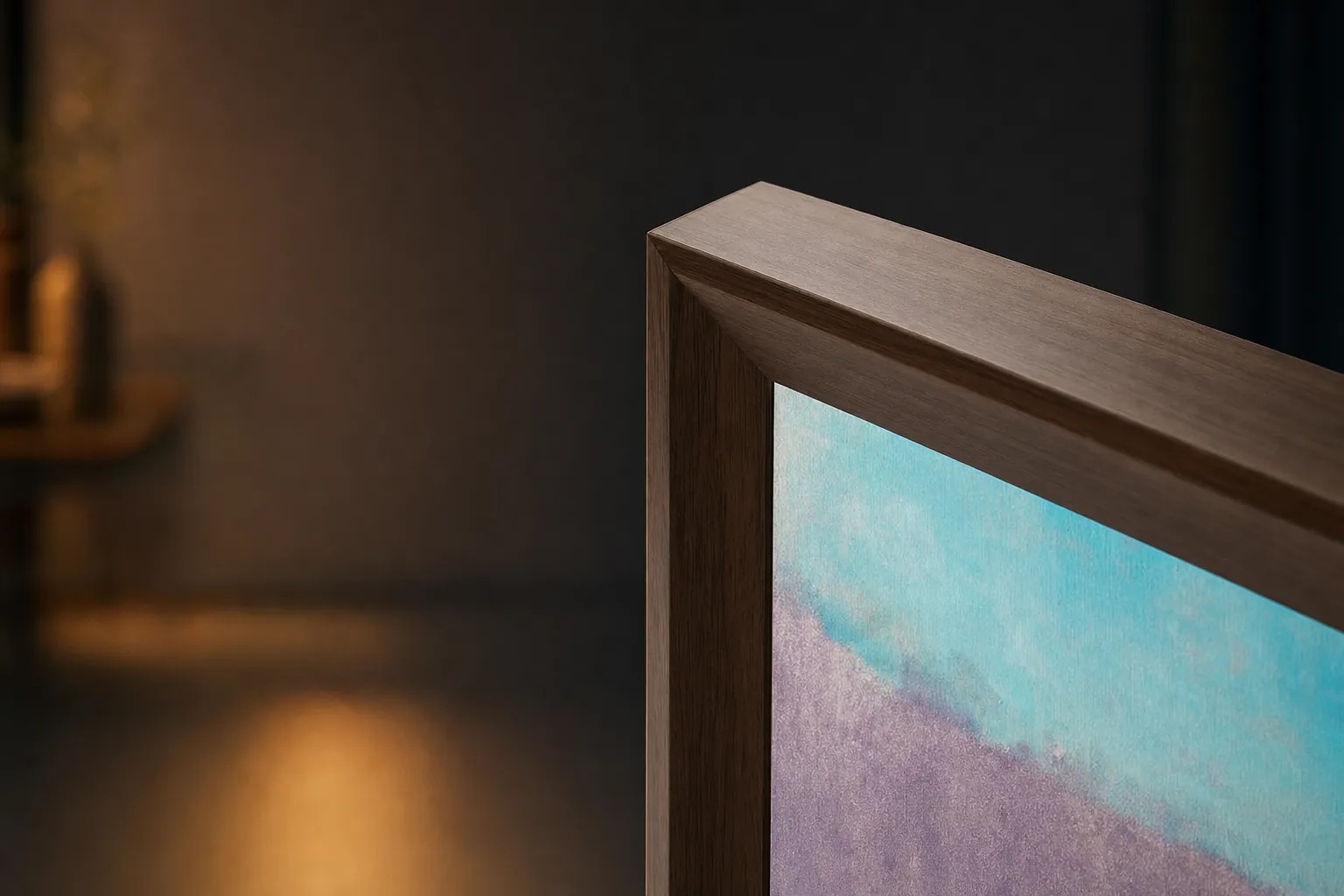
The crucial visual difference is not just the bezel: depth, wall gap and cable management determine whether an art TV reads as a picture or a screen.
Both models are mains-powered televisions. Their job is not to replace a reference OLED or a dedicated gaming display; it is to make a large screen easier to live with in a room where a permanent black panel would otherwise dominate.
Frame, flushness and fingerprints: which one looks like wall art?

Samsung wins this round, and it wins it for a very simple reason: geometry. The Frame's 24.9mm chassis is considerably slimmer than Artline's roughly 38mm body without its frame. Samsung's Slim Fit wall-mount system was designed to reduce the visual gap between television and wall, and that physical closeness matters more than a glossy marketing render ever suggests.
When you walk into a room, you notice shadows. A screen sitting proud of a wall throws one. A screen mounted close to it feels more intentional, particularly in a hallway, dining room or a living room where the TV shares space with actual paintings. Samsung's approach is better at getting that last bit right.
Amazon does plenty well. Ember Artline looks smart from the front, and its matte panel and included bezel give it an immediately more finished look than a conventional set. Amazon offers 10 frame colours across four wood tones and six metallic shades, with one selected bezel supplied in the box. That is a proper value point rather than an afterthought.
However, the cited installation gap of roughly 29mm is noticeable once you view it from the side. It is not ugly. It is just not the kind of "hang on, is that a TV?" illusion Samsung can pull off more reliably. There is also Artline's Omnisense sensor bar. It is useful, but it is a small technological tell in a product whose whole purpose is to disguise the technology.
Samsung's advantage is depth, not just decoration
The Frame's 24.9mm body and slim-fit mounting approach give it the cleaner profile. It looks especially convincing in rooms where people see the television from the side as often as from the sofa.
Amazon gives you more personality out of the box
One selected bezel is included with Artline, and the 10-colour selection gives you plenty of scope to suit a pale wall, dark joinery or a more traditional interior without immediately shopping for extras.
Front-on is kinder to both
From the main viewing position, either can look remarkably convincing with the right artwork. Side-on, the physical mounting solution becomes the deciding factor.
Amazon Ember Artline design wins
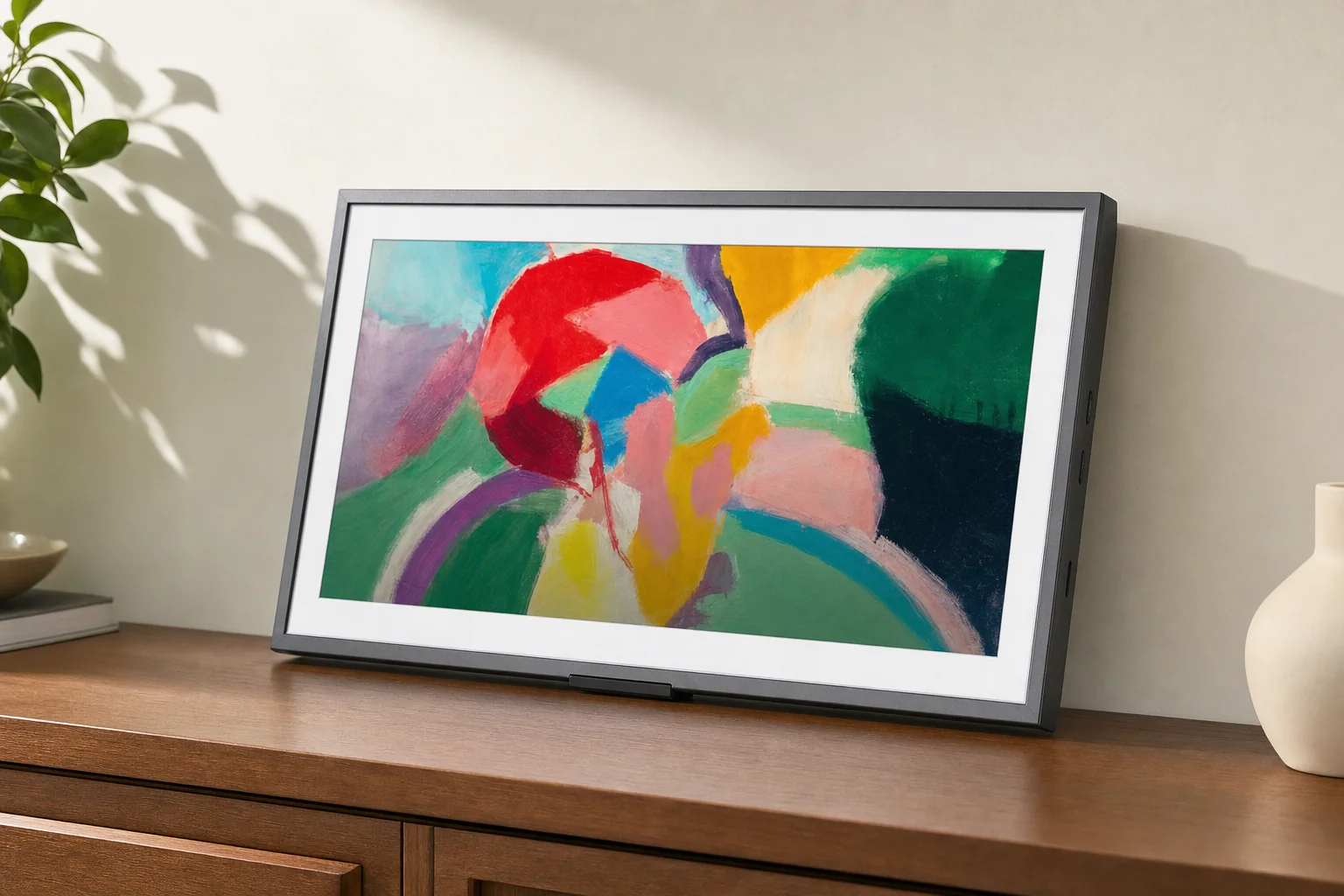
- Matte front and supplied bezel make it feel complete immediately.
- Ten advertised frame colours offer more choice without assuming you want one particular interior style.
- Art remains convincing from a normal straight-on viewing distance.
Amazon Ember Artline design compromises
- Its roughly 38mm body is chunkier than The Frame's 24.9mm chassis.
- A roughly 29mm wall gap was visible in one installation.
- The Omnisense bar can puncture the framed-art illusion.
Matte screens in the real world: less glare, but at what cost?
The matte display is the whole category's secret weapon. It tackles the two things that make a television look like a television when it is meant to be showing art: reflections and that deep, glassy black sheen. Put a lamp opposite a normal TV and you often get a near-perfect mirror. Put a large black slab next to a window and it becomes a slightly depressing weather station.
Both Artline and The Frame use matte finishes to diffuse those reflections. In a bright lounge, that is a genuine benefit. Artwork is easier to see, daytime television is less of a battle and you do not spend every Sunday repositioning a lamp by 10cm as if you are lighting a BBC drama.
Amazon's panel is capable enough in bright rooms, and its anti-glare treatment makes its art mode attractive at a glance. Samsung does the same broad job well. Neither product should be judged as though it were a glossy, high-end conventional TV, though, because the price of that reflection handling is reduced perceived contrast and slightly muted colour compared with a glossy or semi-gloss screen.
In controlled evening lighting, that trade-off is more obvious. A conventional glossy television can make blacks look deeper and colours more saturated. Both art TVs can look a little softer and flatter by comparison. Samsung's general picture presentation is the more refined of the two, but neither is a reference-picture purchase. If you are obsessive about dark-room film performance, there are better TVs. They just look like TVs when you turn them off.
| Real-world situation | Amazon Ember Artline | Samsung The Frame |
|---|---|---|
| Daylight and windows | Matte anti-glare finish helps artwork and TV content remain visible. | Matte display reduces reflections and supports the framed-art effect. |
| Lamp opposite the screen | Diffused reflections are less distracting than on a glossy television. | Diffused reflections are less distracting than on a glossy television. |
| Evening films | Matte coating can reduce perceived contrast and saturation. | Matte coating can reduce perceived contrast and saturation, though picture presentation is more refined. |
| Wide seating positions | Independent testing found poor side viewing angles. | Better suited to its gallery role, though the matte trade-off still applies. |
Matte finishes are at their best in rooms with windows and lamps opposite the screen, where a glossy television would otherwise become a mirror.
Choose the room before choosing the TV
For a bright, busy family room, the matte finish is a feature you will notice daily. For a dedicated dark cinema room, it is a compromise you will notice daily. Art TVs are happiest in the first sort of room.
Art mode versus art store: free pictures, subscriptions and everyday believability
This is where Amazon makes its strongest case. Ember Artline includes more than 2,000 works with no subscription. That includes classic art, contemporary pieces, photography, murals, mixed media and 60 commissioned motion-video works. It is a sizeable library, and more importantly, it is yours to use without mentally adding another small monthly line item to the household budget.
Samsung's Art Store is deeper, with more than 3,500 works. It is also the more developed art ecosystem, offering a very gallery-minded set of controls. You can use matting options, 16 palette colours and five layout styles to make a piece feel more like a framed print. The Frame also supports personal photo uploads through SmartThings, Google Photos or iCloud Photos.
The catch is that full Art Store access requires a subscription. Samsung does provide 30 complimentary streamed works each month, which is enough for occasional changes and a bit of variety. But it is not the same proposition as Amazon's included library if you want Art Mode to be a permanent part of how the screen lives in your room.
Amazon also has some clever extras. Match the Room uses a photo of your space to suggest artwork based on its colours, furnishings, décor and themes. It is not an excuse to hand over control of your taste to an algorithm, but it is a pleasant shortcut if you have ever found yourself scrolling through hundreds of paintings whilst trying to remember the name of your wall colour.
| Art-mode feature | Amazon Ember Artline | Samsung The Frame |
|---|---|---|
| Artwork library | More than 2,000 works included | More than 3,500 Art Store works |
| Subscription for full catalogue | No | Yes |
| Complimentary artwork access | Included collection available without subscription | 30 streamed works each month |
| Personal photos | Supported | Supported via SmartThings, Google Photos or iCloud Photos |
| Motion artwork | Motion, photography and video pieces included | Art Mode supported |
| Automatic sensing | Omnisense can respond to room presence | Motion and brightness sensors |
Amazon is easier to own long term
The included library changes the maths for anyone who expects to use art mode every day. You are not rationing the feature that made you buy the television.
Samsung remains the art specialist
The larger Art Store and stronger matting and layout controls offer the more considered gallery experience, assuming you are comfortable with the subscription model.
Films, sport and console play: the art disguise cannot hide the panel limits
Ember Artline runs Fire OS 8 with the familiar Fire TV interface. It has hands-free Alexa, Wi-Fi 6 and an Amlogic T963D4Z processor with a quad-core ARM Cortex-A55 CPU at 1.9GHz, a Mali-G57 MC1 GPU and 2.5GB of RAM. Those are useful platform details, but I would not pretend a spec sheet tells you everything about living with a smart TV. App launches, input switching and search all matter more than a chip name once you have owned the thing for six months.
Samsung uses Tizen and its art-focused interface. It also has a substantially stronger gaming feature set: 100Hz native refresh, support up to 144Hz, VRR, ALLM, FreeSync Premium, HGiG, Game Motion Plus and Gaming Hub. If a PlayStation 5, Xbox or gaming PC shares the television, this is not a close contest. The Frame is the far more capable choice.
Artline is limited to 60Hz. Independent testing found high input lag and problematic VRR behaviour, with VRR limited to one input. That makes it fine for occasional relaxed play, but not the television I would choose for anyone who cares about responsive multiplayer games, high-frame-rate console modes or PC gaming.
For film formats, Amazon has the better headline support. Artline supports HDR10, HDR10+ Adaptive, HLG and Dolby Vision on the 65-inch model. The Frame supports HDR10+ Adaptive and Gaming but does not list Dolby Vision. That is a meaningful Amazon win for viewers whose streaming services make regular use of Dolby Vision, although format support cannot erase the underlying limitations of an edge-lit panel without local dimming.
Samsung The Frame is the clear pick where art mode has to share a wall with serious console or PC gaming.
Samsung The Frame performance strengths
- Up to 144Hz support alongside VRR, ALLM and FreeSync Premium.
- More capable gaming-focused feature set for modern consoles and PCs.
- More refined all-round picture presentation.
Amazon Ember Artline performance limits
- 60Hz refresh rate caps high-frame-rate gaming.
- Independent testing found high input lag.
- No local dimming was reported, limiting contrast performance.
Sound, connections and the practical living-room setup
Sound is not the headline reason to buy either of these televisions, but Samsung has the more substantial built-in system. The Frame uses 40W 2.0.2-channel audio with Dolby Atmos support. Artline's 55-inch uses 10W + 10W 2.0-channel speakers, while the 65-inch uses 12W + 12W 2.0-channel speakers.
That does not mean Artline is unusable. Its speakers are perfectly reasonable for speech, casual streaming and a bedroom or smaller room. But they are rear-firing and were described as average in use. A soundbar is sensible in a larger living room, particularly if you want cinematic scale, convincing effects or any real bass. Televisions this thin are rarely hiding a concert hall inside them.
Amazon is well equipped for connections: three HDMI 2.0 ports, one HDMI 2.1 port with eARC, USB 3.0, RF input, optical digital output, headphone/audio output and a 3.5mm IR-blaster output. Samsung has four HDMI connections via its One Connect box, alongside two USB-A ports, USB-C, Ethernet and optical output. The One Connect setup is particularly useful for keeping the wall visually clean, although it does introduce a separate box to accommodate somewhere sensible.
Wall mounting is only half the installation. Plan the cables, power and audio route before drilling. A beautifully mounted art TV with a trailing cable is still a beautifully mounted television with a trailing cable.
The price of looking like art: upfront cost versus long-term ownership
Amazon's UK list pricing is wonderfully straightforward: £949.99 for Ember Artline 55-inch and £1,199.99 for Ember Artline 65-inch. The 55-inch has also been discounted as low as £719.99, but that was a promotional price rather than its regular list price.
For US context, Artline launched at $899.99 for 55 inches and $1,099.99 for 65 inches. Promotional pricing later reached $699.99 and $899.99 respectively. UK buyers should not convert those figures directly: tax, promotions and regional pricing have a habit of making that exercise less useful than it looks.
Samsung's 2025 55-inch Frame has appeared around £789 to £899, while the 65-inch has appeared around £879 to £899 through UK comparison listings and retailers. That can make Samsung look cheaper at a glance. But add an optional bezel if you want a specific frame style, then consider the Art Store subscription if you want full access to Samsung's artwork library, and the gap can look rather different over time.
Amazon Ember Artline 55
UK launch/list price. The selected bezel and 2,000+ included artworks are part of the package.
Amazon Ember Artline 65
UK launch/list price for the larger screen, with the same included-art approach.
Samsung The Frame 55
Current UK retailer and comparison-listing evidence varies with promotion and seller.
Samsung The Frame 65
Current UK comparison-listing range. Full Art Store access requires a subscription.
The cost comparison is not just the ticket price: included bezels and the ongoing artwork model matter if art mode will run every day.
The value question to ask yourself
If you only occasionally display art, Samsung's subscription model may be a minor issue. If your television will spend most of its life showing art, Amazon's included collection is a genuinely valuable part of the purchase rather than a bullet point.
What each reviewer's verdict would look like: strengths, compromises and unanswered questions
Amazon Ember Artline is a very credible first challenger. It has an appealing matte design, 2,000-plus included works, a supplied frame, Fire TV, Wi-Fi 6 and Dolby Vision support on the 65-inch. In a bright room, it can look attractive both as a TV and as art. It also avoids the awkward feeling that an expensive feature has been put behind a monthly paywall.
But there are clear compromises. It is a 60Hz TV with high input lag in independent testing, problematic VRR behaviour and no local dimming reported. Its wall installation is not as flush as Samsung's, and the sensor bar weakens the illusion. The 65-inch weighs 60.2lb, so do not mistake "included wall mount" for "one-person job" unless you have unusually generous upper-body strength and very forgiving walls.
Samsung The Frame remains stronger on the actual disappearing act. Its 24.9mm chassis, slim mounting approach, optional bezel ecosystem and art-focused controls all feel more polished. Add its up-to-144Hz gaming support, VRR, ALLM and FreeSync Premium, and it is simply the more rounded television.
Which art TV should you buy? Four real-world buyer profiles
There is no single correct purchase here because the two products solve slightly different problems. One is better at disappearing. The other is better at giving you the art-TV lifestyle without another bill attached to it. That distinction is more useful than pretending there is a universal winner.
Amazon Ember Artline 55-inch

See Amazon Ember Artline 55-inch on Amazon UK
Check today's price & availability on Amazon UK
Choose this if you want the lowest Artline entry point, a selected frame included and more than 2,000 artworks without a subscription. It is the most straightforward value pick for an art-first room.
Amazon Ember Artline 65-inch

See Amazon Ember Artline 65-inch on Amazon UK
Check today's price & availability on Amazon UK
Best for buyers who want a bigger display and Amazon's no-subscription art value, provided a 60Hz panel and the more visible wall gap are acceptable.
Samsung The Frame
See Samsung The Frame 55-inch LS03F at Samsung UK
Buy Samsung if your first question is which one most resembles a framed picture. Its thinner 24.9mm chassis and more convincing wall presentation make it the better disappearing act.
Samsung The Frame
The clear choice for gaming thanks to up-to-144Hz support, VRR, ALLM, FreeSync Premium and a substantially stronger all-round feature set.
The best choice depends on what you see most often: a framed artwork from across the room, or a TV doing proper TV jobs once everyone sits down.
Other art TVs UK buyers may realistically cross-shop
Amazon and Samsung are not alone anymore. TCL NXTVISION A300W is a serious alternative in the same 55-inch and 65-inch size class. It launched in the UK in September 2025 at roughly £949 for 55 inches and £1,199 for 65 inches. It brings a matte 4K QLED panel, 144Hz VRR, Dolby Vision, Dolby Vision IQ, HDR10+, Dolby Atmos, AMD FreeSync Premium, Google TV, a magnetic white frame and a slim wall mount.
Hisense Canvas S7S is another direct rival. The 55S7STUK is priced at £1,299 at Currys and the 65S7STUK at £1,599. It has a Hi-Matte anti-glare 4K QLED display, up-to-144Hz gaming support, four HDMI 2.1 connections, Dolby Vision, Dolby Vision IQ, HDR10+, an included magnetic frame and an UltraSlim wall mount. It is considerably more expensive, but its gaming and HDR feature list is far closer to what enthusiasts expect from a modern TV.
If money is less of a concern, Samsung's Frame Pro range adds Neo QLED technology, a wireless One Connect box and stronger brightness and contrast. The 65-inch Frame Pro was listed around £1,169 on promotion against a £1,399 regular price. It is the premium art-TV route, but its larger Art Store still uses the same subscription model.
| Art-TV alternative | 55-inch UK price | 65-inch UK price | Notable confirmed strengths |
|---|---|---|---|
| TCL NXTVISION A300W | About £949 | About £1,199 | 144Hz VRR, Dolby Vision IQ, FreeSync Premium, magnetic frame and slim wall mount |
| Hisense Canvas S7S | £1,299 | £1,599 | Up to 144Hz, four HDMI 2.1 ports, Dolby Vision and included magnetic frame |
Amazon Ember Artline vs Samsung The Frame FAQ
A successful art TV does not become invisible; it simply becomes something you are happier to look at for the many hours you are not watching it.
Final verdict: Samsung disappears better, Amazon costs less to live with
If you are asking the literal question in this comparison — which art TV looks least like a TV? — Samsung The Frame is still the answer. Its roughly 24.9mm body, more convincing flush-mount presentation, better gallery-oriented controls and lack of an obvious sensor bar give it the stronger illusion. It is the one to buy when visual integration with your room is the main event.
Amazon Ember Artline is the better value proposition for many UK buyers. At £949.99 for 55 inches and £1,199.99 for 65 inches, it includes a selected frame and more than 2,000 artworks without a subscription. That makes it easier to recommend to anyone who wants art mode permanently on, rather than occasionally dipping into it between TV sessions.
Amazon also wins on HDR-format breadth with Dolby Vision, HDR10, HDR10+ Adaptive and HLG support on the 65-inch model. But Samsung wins for gaming, built-in audio, physical neatness and the overall sense that it was designed from the wall backwards rather than from the television forwards.
Buy Amazon Ember Artline if you want included art, an included frame and better long-term ownership value. Buy Samsung The Frame if you want the most convincing framed-art illusion and a much better gaming TV. Neither completely vanishes. Samsung just gets closer, whilst Amazon makes the lifestyle easier to afford.
- Amazon Ember Artline 55-inchView on Amazon
- Amazon Ember Artline 65-inchView on Amazon