
Roborock Saros Z70 Review: Is the Robot Arm Brilliant or Just a Party Trick?
A 22,000Pa flagship robot vacuum with a five-axis arm sounds wonderfully bonkers. The cleaning fundamentals are excellent. The arm is clever, occasionally useful, and nowhere near as transformative as the marketing makes it sound.
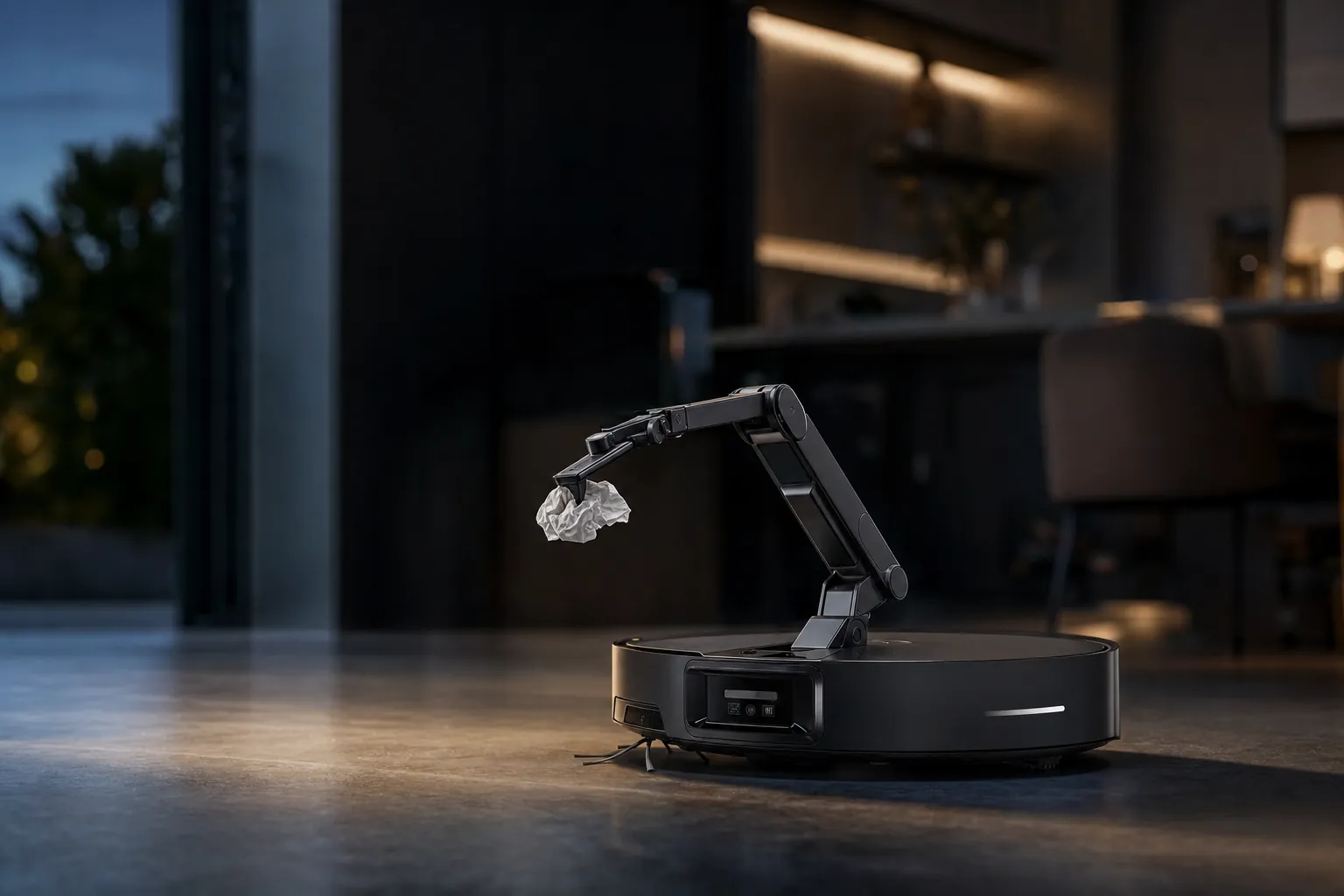
The Roborock Saros Z70 paired flagship vacuum-and-mop hardware with the retractable OmniGrip arm, a genuinely unusual addition to a domestic robot cleaner.
The Saros Z70 had one job before it was allowed to play robot butler: be a properly good robot vacuum. Thankfully, it passed that test. It vacuumed hard floors superbly, navigated with rare confidence, mopped with the sort of dock automation that makes daily cleaning genuinely hands-off, and fitted under furniture where many flagship robots simply could not go. Then there was the arm. It was impressive engineering, but it was not magic.
See roborock saros z70 robot arm on Amazon UK
Roborock Saros Z70: First Impressions & What Makes It Different
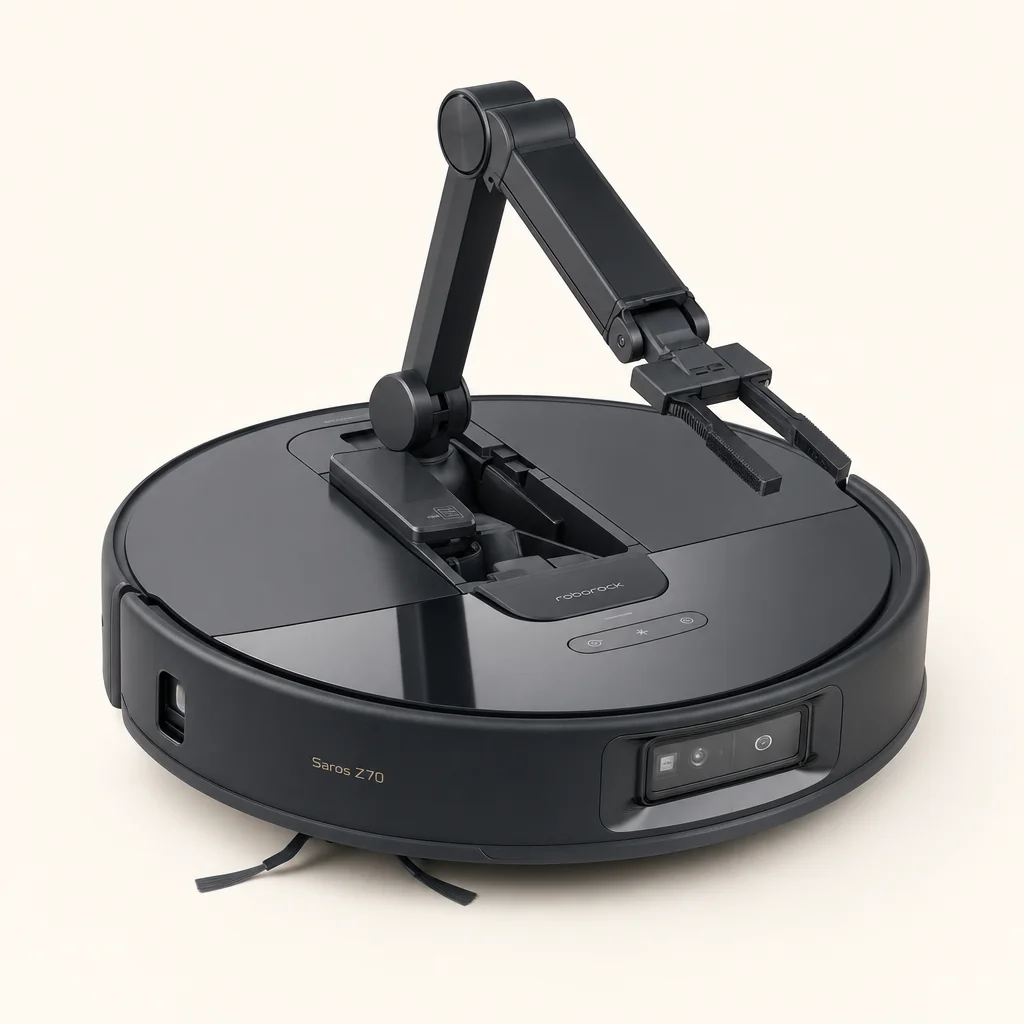
When Roborock announced the Saros Z70 at CES 2025, it was hard not to grin at the absurdity of it. Here was a robot vacuum with a fold-out, five-axis mechanical arm, a camera at the end and a soft gripper designed to clear little obstacles from its own path. Not a concept behind glass. A retail product that began shipping from Roborock's US store in May 2025.
That distinction matters. Plenty of robot-vacuum features look great in a launch video and then quietly disappear into the "perhaps next year" cupboard. The Z70 actually existed in people's homes, rolling about beneath sofas and attempting to pick up socks. It is an enormous engineering flex from Roborock's flagship Saros range.
Still, a robot vacuum with an arm is dangerously easy to judge backwards. You can spend all day watching it lift a tissue and miss whether it picked up the crumbs under the table. So here is the blunt version up front: the Saros Z70 was a premium robot vacuum first and a novelty object-moving machine second. Buy it because you want excellent vacuuming, strong obstacle avoidance, a slim body and a very capable self-maintaining dock. Treat the OmniGrip arm as a fascinating bonus, not the reason it earns a place in your home.
At its original US RRP of $2,599, it was very much a money-no-object machine. Roborock subsequently listed it at $1,999, and US sale pricing had reached $1,299.99 in February 2026. In the UK, pricing ranged from a £1,799 RRP to £1,499 directly from Roborock for Prime members. Those are wildly different propositions. At the high end, you were paying handsomely to be an early adopter. At the lower sale end, it became a much easier flagship recommendation.
The sensible way to view the arm
The OmniGrip arm did not turn the Z70 into a tidying robot. It could remove a few light, recognised objects from the cleaning route. That is useful. It is not the same thing as clearing a messy room, and pretending otherwise is how expensive disappointment begins.
In the Box & Build Quality: A Robot That Means Business
The Saros Z70 arrived as a complete cleaning system rather than a simple robot and charging puck. The package centred on the robot itself and the Multifunctional Dock 4.0, with its clean-water tank, dirty-water tank, detergent dispensing and mop-care hardware. The dock is the bit that makes this a daily appliance instead of a hobby: it auto-empties the robot, washes the mop pads in hot water, dries them with hot air and manages detergent dispensing.
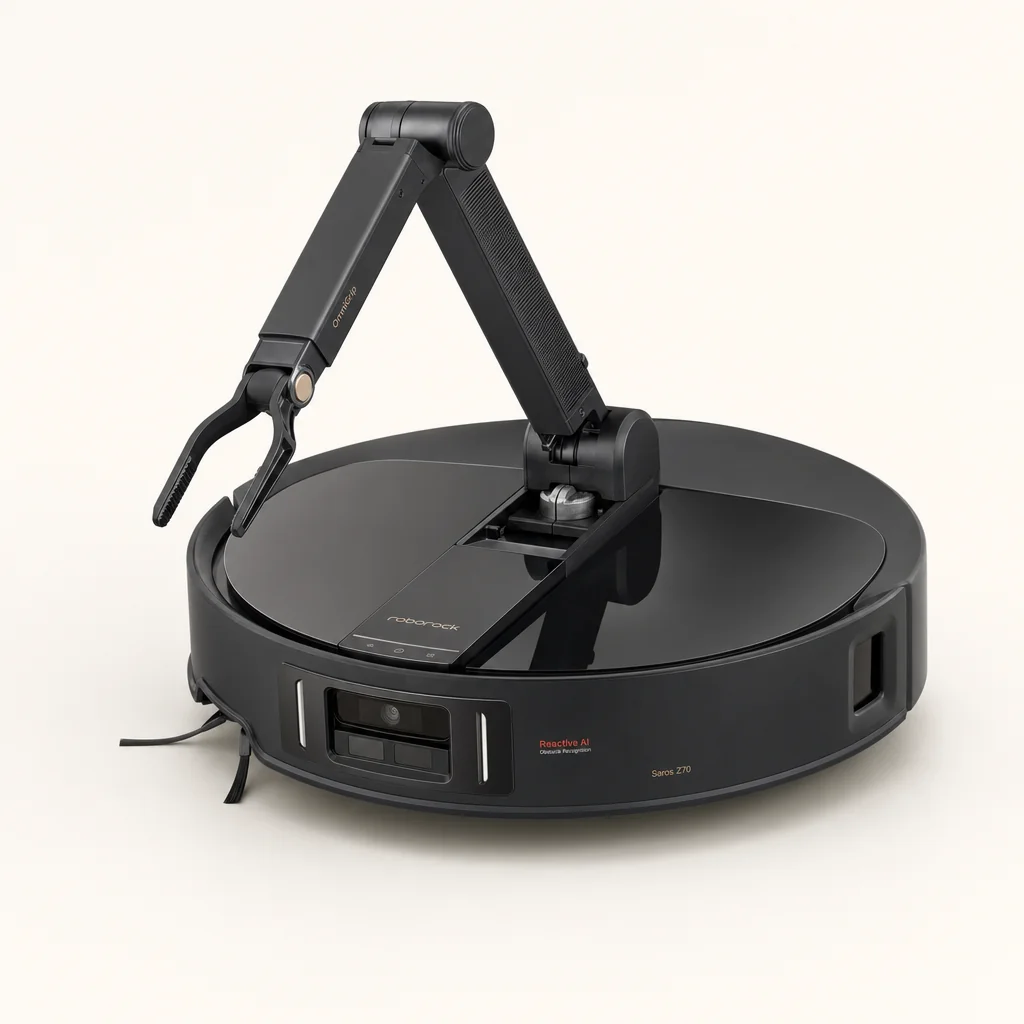
The robot weighed 9.9lb, which gave it a reassuringly substantial feel without becoming unwieldy when you needed to lift it. More importantly, it was just 79.8mm, or 3.14 inches, tall. That is properly slim for a flagship machine with advanced navigation hardware and a retractable arm tucked inside. In practical terms, low furniture stopped being a theoretical advantage and started becoming more floor actually cleaned.
Roborock lists the dock at roughly 15.0 by 18.7 by 19.21 inches. There is no graceful way to describe that as petite. It is substantial, closer to a small piece of furniture than a discreet charger, and it deserved a properly planned location. The upside was meaningful autonomy: 4L of clean water, 3L for dirty water, automatic emptying and automatic detergent dosing meant less fiddling between cleans.
The Z70 also used a dual all-rubber anti-tangle main brush with active cutting technology, an extendable side sweeper for corners and dual spinning mop pads. One mop extended sideways for edge cleaning. These are not experimental flourishes. They are the useful, mature bits of a premium robot vacuum, and arguably the more important story than the arm.
The dock supported a direct water-supply and drain connection, which was the closest route to genuinely low-maintenance ownership. Without it, the tanks still needed refilling and emptying; automation reduced chores, it did not repeal plumbing.
At 79.8mm tall, the Z70's low profile was one of its most practical advantages, helping it reach under furniture that defeats taller flagship robots.
The OmniGrip Arm: Brilliant Engineering, Honest Limitations
Let's get to the headline act. OmniGrip was a foldable five-axis arm that sat retracted within the Z70's body when it was not needed. When the robot identified a suitable object, the arm extended, used its camera and soft gripper, then attempted to lift the item away. You could also operate it remotely and use the arm camera for high- and low-view video. From a technical point of view, it was wonderfully overachieving for something whose day job was collecting cat hair.
But domestic clutter is messy, varied and annoying in exactly the way robots dislike. The arm had a maximum payload of 300g, which immediately narrowed the field. It was designed for light items: socks, tissues, fabric clumps, balls of paper, small towels, pet toys, baby toys and light slides. That is a credible list. A sock in a robot's path is a real problem; lifting it means the robot can continue rather than avoid a patch of floor forever.
Review testing, however, put autonomous arm success at roughly half the time. That is the number that matters. Half the time is not nothing, and it is impressive that this capability existed at all. Half the time is also nowhere near enough to change your habits around tidying. If you expect a Z70 to reliably patrol a child's bedroom, identify every stray item and restore order, you will be left staring at a rather expensive robot having a small existential crisis beside a slipper.
Most convincing: soft, light clutter
Socks, tissues, paper balls and small fabric clumps were the kinds of objects that suited the soft gripper and the 300g weight limit.
Slides rather than every shoe
The system recognised specific slide types, but autonomous recognition of slides showed low success rates. "Shoes" was too broad a promise for the real-world result.
Recognition was deliberately narrow
Its recognised-object list centred on slippers, socks and balls of paper. That was a sensible starting point, but it was not general-purpose object handling.
Manual control was the fun bit
Remote arm control and the arm camera gave owners more direct control when they wanted to attempt a pick-up themselves.
The biggest limitation was not strength but certainty. The robot needed to classify an item confidently before it could make a sensible autonomous decision. Roborock had said capability would expand through updates, but the Z70 as it stood was defined by what it could do then, not by a future shopping list. A product review should never award points for hypothetical socks lifted in hypothetical firmware.
There is also a simple behavioural point. The arm only helps once there is an object in its path that happens to be suitable for lifting. It does not eliminate the need to pick up cables, manage larger toys or put clutter away. Its best use was as an occasional rescue manoeuvre: a sock on the bedroom floor, a tissue near the sofa, a lightweight slide blocking a route. In those moments, it felt like the future. In the rest, it was a very clever mechanism sitting quietly inside a very good vacuum.
Party trick or practical feature?
Both. The arm was absolutely a party trick because watching it work remained delightful. It was also occasionally practical because a single lifted sock could save a whole room from being skipped. The mistake would be valuing "occasionally practical" as if it meant "reliably autonomous".
Vacuuming Performance: How Does 22,000Pa Stack Up?
On paper, 22,000Pa was powerful but no longer the biggest number in the premium category. The Dreame X60 Ultra was listed at 35,000Pa and the eufy OMNI S2 at 30,000Pa. If you enjoy a specification arms race, the Z70 lost that particular contest. Fortunately, suction figures are not a complete cleaning test, and the Saros Z70 did not behave like an underpowered machine.
On hard floors, it picked up virtually all debris in a single pass. Fine dust, cereal, pet hair and ordinary household crumbs were handled at a level comparable to market leaders. That is what matters in most kitchens, hallways and living rooms. Once a robot reaches this level, another giant number on the box does not necessarily make your floor visibly cleaner.
The all-rubber anti-tangle brush was particularly welcome in homes with long hair or pets. Rubber brushes are easier to live with than bristle-heavy designs when hair is involved, and active cutting technology was intended to reduce the tedious post-clean ritual of cutting hair away yourself. The side sweeper arm also extended to improve corner reach, one of those details that is much less glamorous than a robot arm but far more relevant on an average Tuesday.
Carpet was where the headline figure had more relevance. The Z70 performed well on low- and medium-pile carpet, extracting embedded pet hair and fine particles effectively. That should cover the sort of rugs and fitted carpet found in a great many homes. On very deep pile or shaggy rugs, higher-suction competitors had an edge in fine-particle extraction. There is no need to turn this into a disaster: the Z70 was still a strong carpet cleaner. But if your entire home is plush, dense carpet and vacuuming performance is the only priority, a 30,000Pa or 35,000Pa rival made a stronger technical case.
The key point is that Roborock had not sacrificed basic cleaning for the arm. That would have killed the product stone dead. Instead, the machine underneath the gimmick was among the better flagship cleaners of its period: methodical, powerful enough and unusually good at reaching tight spaces.
The retractable side sweeper and edge-reaching mop hardware tackled the less glamorous but more valuable jobs: corners, skirting edges and the everyday debris that builds up there.
Navigation & Obstacle Avoidance: The Feature You Will Notice Every Day
If the OmniGrip arm was the feature that got all the attention, StarSight System 2.0 was the feature that made the Z70 pleasant to own. Robot vacuums live or die by whether they navigate confidently. A machine that misses rooms, bumps furniture or eats a cable is not clever; it is just a chore with wheels.
The Z70's recorded obstacle-avoidance result of 99.8% was exceptional. For context, the eufy X10 Pro Omni achieved 94%, while the Dreame X60 Ultra avoided 22 of 24 test objects, or 91.7%. The Roborock handled cables, shoes, pet toys and similar hazards with near-perfect accuracy. That is a bigger deal than it sounds. It means fewer rescue missions, fewer aborted runs and less of that odd feeling that you have to clean for your cleaner.
VertiBeam technology added vertical structured light for edge detection, while the robot cleaned in efficient, methodical lines with minimal overlap. It mapped an 1,800-square-foot home in around 12 minutes, which was impressively brisk. The result was not merely a faster initial setup; it was a machine that understood where it was going and did not waste battery wandering about theatrically.
None of this removed the value of a tidy floor. Cables are still best lifted, loose objects still deserve a home and the arm could not be trusted to resolve every minor blockage. But the Z70 created a much lower-friction relationship with cleaning than older robots which treated every charger lead as a spicy noodle.
Multi-floor mapping was supported, alongside room-specific schedules, furniture labels and no-go zones. For a larger home, that flexibility was more useful than a single impressive cleaning run: it let the robot behave differently in different spaces without needing constant intervention.
Mopping System: Hot Water, Dual Pads, and Proper Daily Cleaning
The Saros Z70's mopping system was not an afterthought bolted onto a robot vacuum with a fancy arm. It used dual spinning pads at 200RPM, with 30 adjustable water-flow levels. One pad could extend laterally for better edge reach, a design that made far more sense than expecting a round robot to clean a square room perfectly.
The dock washed the pads with water at 80°C, or 176°F, then dried them with hot air. It also dispensed detergent automatically. These details are what separate a serious mopping robot from one that simply drags increasingly questionable pads around the kitchen. Hot-water washing and drying do not mean you never need to maintain the system, but they substantially improve the routine between your own deeper cleans.
Water control mattered too. With 30 levels available, the Z70 could be set up more conservatively for routine maintenance or with more water for areas that needed a more assertive pass. Combined with the spinning action, it had the hardware to do more than polish a clean floor. As ever, no robot mop completely replaced a manual scrub for dried-on stains or neglected grime. It did, however, reduce how often you reached that point.
Dual rotating pads at 200RPM
Spinning pads gave the Z70 an active cleaning action rather than a passive wipe.
Extendable edge pad
One mop shifted sideways to improve coverage alongside walls and at room edges.
80°C dock washing
The dock used genuinely hot water for pad washing before hot-air drying took over.
Automatic detergent dispensing
The dock dosed detergent automatically, reducing another repetitive bit of machine management.
The dock's hot-water mop washing, detergent dispensing and hot-air drying made the Z70's mopping setup feel built for regular use rather than occasional demonstrations.
Battery Life & Daily Use: Will It Actually Finish Your Home?
The 6,400mAh battery was rated for more than 180 minutes of runtime on standard mode, with Roborock positioning that for homes up to 2,500 square feet. In testing, the robot managed roughly 1.5 minutes per battery percentage point. That was slightly better than the industry average of around 1.3 minutes per percentage point, although it fell behind the Saros 10R's reported 1.7 minutes.
Real-world coverage could reach more than 3,200 square feet on a single charge cycle with adaptive power management. That figure needs the usual caveat: floor type, suction setting, carpet and mopping choices all influence runtime. But it was a reassuring sign for big homes. Most households should not worry about whether the Z70 could complete ordinary routine jobs; and if it did need more power, it returned to the dock, charged and resumed.
A full charge took around 150 minutes. The dock could intelligently adjust charging based on the remaining area, which was a sensible approach. There is little value in waiting for a full battery if the robot only needs enough power to finish the last bedroom and hallway.
Noise was also reasonable for such a powerful machine. Quiet mode was measured at 50dB, while standard operation was reported between 56dB and 68dB. That makes it suitable for daytime cleaning without feeling like a small aircraft has entered the kitchen. The auto-empty cycle, inevitably, was a different sort of event, but that brief burst bought you a much lower-touch ownership routine.
Daily use was where the Z70's flagship status made sense. The dock emptied dust, managed dirty water, washed and dried the pads and handled detergent. The robot navigated well, avoided hazards and covered a large area. The arm was the visual headline; the boring automation was what made it sustainable.
Roborock App, Smart Home & Setup Experience
Roborock's app was one of the more mature parts of the package. The initial map of an 1,800-square-foot home could be completed in around 12 minutes, and multi-floor mapping was supported for homes with more than one level. Once the map existed, you could create room-specific schedules, label furniture, set no-go zones and direct the robot to clean particular rooms.
SmartPlan 2.0 was the headline software feature. It analysed the floor plan and generated an optimised deep-clean schedule automatically. That sounds mildly vague on paper, but the broader aim was sensible: remove some of the faffing from robot ownership. Not everybody wants to become a part-time domestic logistics manager just to keep the kitchen floor presentable.
The app also offered advanced mopping strategies, Do-Not-Disturb mode and the ability to manage the arm's remote-control and pick-up functions. Matter 1.4 compatibility arrived via an over-the-air update, with Alexa and Google Home support alongside Apple Home integration through iOS 18.4. For a top-end appliance expected to sit in a smart home for years, that broader interoperability was welcome.
There is a small but important user-experience lesson here: the best robot vacuum app is one you stop opening. The Z70 got closer to that ideal than most because its mapping, obstacle avoidance and dock automation were all capable enough to run quietly in the background. The app remained useful for exceptions. It did not need to become a daily chore.
A useful ownership choice
The arm was not something you needed to build every clean around. The sensible approach was to leave the core cleaning automation doing its thing, then use OmniGrip as an occasional tool when a suitable lightweight object genuinely blocked the route.
Roborock Saros Z70 vs Dreame X60 Ultra vs eufy OMNI S2
The Z70 had a very particular competitive position. It was not the suction-specification champion, but it was the only machine in this comparison with a retractable five-axis mechanical arm. Whether that mattered depended entirely on how you value novelty and occasional object removal against raw headline performance.
| Feature | Roborock Saros Z70 | Dreame X60 Ultra | eufy OMNI S2 |
|---|---|---|---|
| Suction power | 22,000Pa | 35,000Pa | 30,000Pa |
| Object-lifting manipulator | Five-axis OmniGrip; up to 300g | No | No |
| Obstacle-avoidance result | 99.8% | 22 of 24 objects (91.7%) | — |
| Distinctive strength | Arm, slim body and automated dock | Highest listed suction | Higher listed suction |
The Dreame X60 Ultra's 35,000Pa figure made it the obvious choice for buyers focused on maximum suction on paper, particularly where dense carpet was the priority. The eufy OMNI S2's 30,000Pa figure also sat above the Roborock. Yet neither comparison should obscure what the Z70 did well: 22,000Pa was already enough for excellent real-world hard-floor cleaning, and its 99.8% obstacle-avoidance result was outstanding.
The more meaningful decision was not "which number is bigger?" It was "what sort of annoyance do I have?" If your annoyance is embedded carpet debris, higher suction deserved serious weight. If it is loose clutter, cables and pets' toys making robot runs unreliable, the Z70's navigation was the better story — with the arm as a sometimes-useful extra rather than the main cure.
The Saros Z70 was not the highest-suction robot on paper, but its navigation, slim build and complete dock system made it one of the more rounded flagship cleaning platforms.
Roborock Saros Z70 Price & Value in 2026
Value depended heavily on when and where you bought it. The original US RRP was $2,599, while Roborock later listed it at $1,999. In February 2026, Amazon sale pricing reached $1,299.99. UK pricing was similarly variable: £1,799 RRP, £1,699 through Amazon, and £1,499 directly from Roborock for Prime members.
At $2,599 or £1,799, the Saros Z70 was hard to recommend purely on rational cleaning value. It was an excellent vacuum-and-mop robot, but a large slice of the premium clearly paid for the arm's mechanical complexity and novelty. At around $1,299.99 or £1,499, the balance improved significantly. You were then getting flagship navigation, a slim design, powerful cleaning, advanced mopping and a highly automated dock at a price that still felt premium, but less absurdly experimental.
US original RRP
The full flagship launch proposition.
US sale price recorded
Amazon pricing in February 2026 made the Z70 much easier to justify.
UK direct price recorded
Roborock Prime-member pricing, below the £1,799 RRP.
The arm does not deliver enough consistent utility to pay a huge premium for it alone. That is the central value judgement. But if the price difference between the Z70 and a conventional flagship was modest, the arm became a harmlessly delightful extra attached to an already first-rate cleaner. If the difference was enormous, spend your money on the cleaning fundamentals instead.
Who Should Buy the Roborock Saros Z70?
The Z70 was not a universal recommendation. It was ambitious, expensive at full price and most rewarding for buyers who understood exactly where its cleverness stopped. Here is the short version.
Best for pet households with hard floors
Strong hard-floor pickup, effective pet-hair cleaning, anti-tangle brush design and excellent obstacle avoidance made this a very capable daily cleaner around pets.
Best for low furniture
The 79.8mm height gave it a genuine advantage beneath sofas, beds and cabinets where taller robots leave dust behind.
Best for early adopters
If you enjoy owning ambitious technology and accept that the arm succeeds only around half the time, the Z70 remained unlike anything else.
Pros
- Excellent hard-floor cleaning from 22,000Pa suction.
- Outstanding 99.8% obstacle-avoidance result.
- Very slim 79.8mm body reaches beneath low furniture.
- Strong dock automation with 80°C mop washing and hot-air drying.
- OmniGrip arm was genuinely capable with suitable light objects.
- Fast mapping, multi-floor support and useful smart-home integration.
Cons
- Arm success was only about half the time in real-world testing.
- Object recognition remained limited to a narrow set of clutter.
- 22,000Pa trailed the 30,000Pa and 35,000Pa rivals on paper.
- Deep-pile rugs favoured higher-suction competition.
- Large dock needed a carefully planned permanent home.
- Full launch pricing was difficult to defend for most households.
Gadget Scout Rating
The Saros Z70 was easier to score than it first appeared. As a robot vacuum and mop, it was excellent. As a robot that tidies your floor, it was an exciting but limited first attempt. The final score therefore rewards the bits you will use every day, whilst docking points for an arm that was cleverer than it was dependable.
The Z70 made the strongest case when judged as a complete automated floor-care system: it navigated confidently, cleaned thoroughly and required comparatively little intervention.
Roborock Saros Z70 FAQ
Final Verdict: Brilliant Robot Vacuum, Incomplete Robot Butler
The Roborock Saros Z70 was not a gimmick. The OmniGrip arm genuinely worked, and there was something deeply satisfying about seeing a robot lift a sock before getting on with the cleaning. But it was not dependable enough, broad enough or strong enough to justify buying the Z70 solely for that feature. Roughly half-time autonomous success is a promising first-generation result, not a domestic revolution.
Fortunately, the Z70 did not need the arm to carry the review. It was an outstanding robot vacuum and mop in its own right, with powerful real-world cleaning, exceptional obstacle avoidance, a genuinely useful low profile, impressive battery management and an excellent self-maintaining dock. If you found it at a sensible discount and wanted one of the most technically ambitious cleaning robots available, it was a terrific buy. If your priority was simply maximum carpet suction or best value, the arm was not enough reason to pay a huge premium.
Buy the Saros Z70 for its vacuuming, navigation and dock. Enjoy the robot arm when it works. Just do not expect it to tidy your house whilst you put the kettle on.