DJI Avata 360 vs Antigravity A1: Which 360 Drone Owns the Sky?
Two very different takes on the "shoot first, frame later" drone. One is a protected FPV bruiser with proper controller choice; the other is a featherweight, goggles-first flight experience with a clever regulatory advantage.
We link to the exact model on Amazon UK. Prices change often, so check the live price before you buy. As an Amazon Associate we earn from qualifying purchases.
360 drones are gloriously liberating. Instead of sweating over whether the camera is pointed at the right cyclist, tree line or suspiciously photogenic sheep, you record the entire world around the aircraft and choose the shot after landing. That is the promise. The catch, naturally, is that the two best-known ways of doing it are not remotely alike.
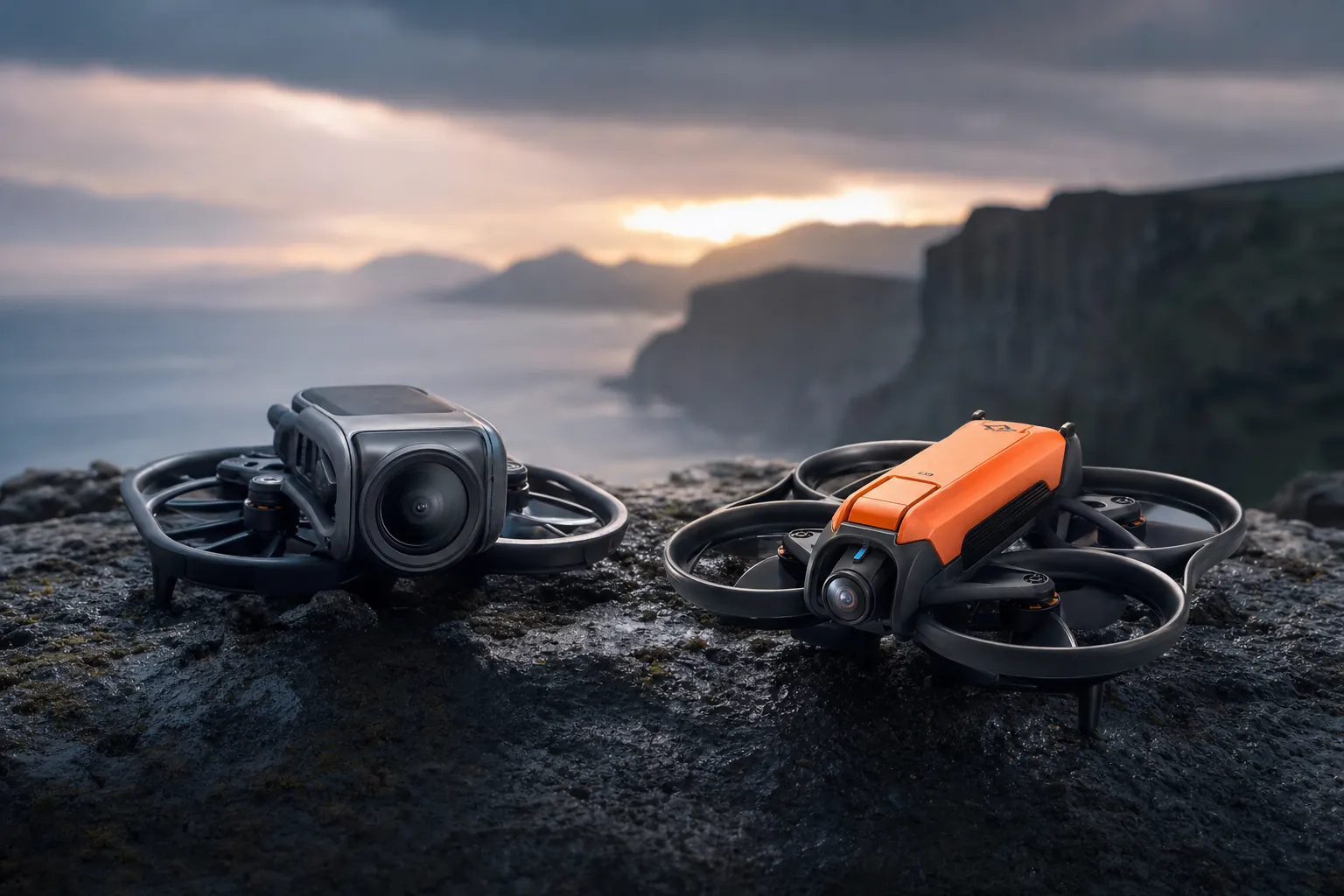
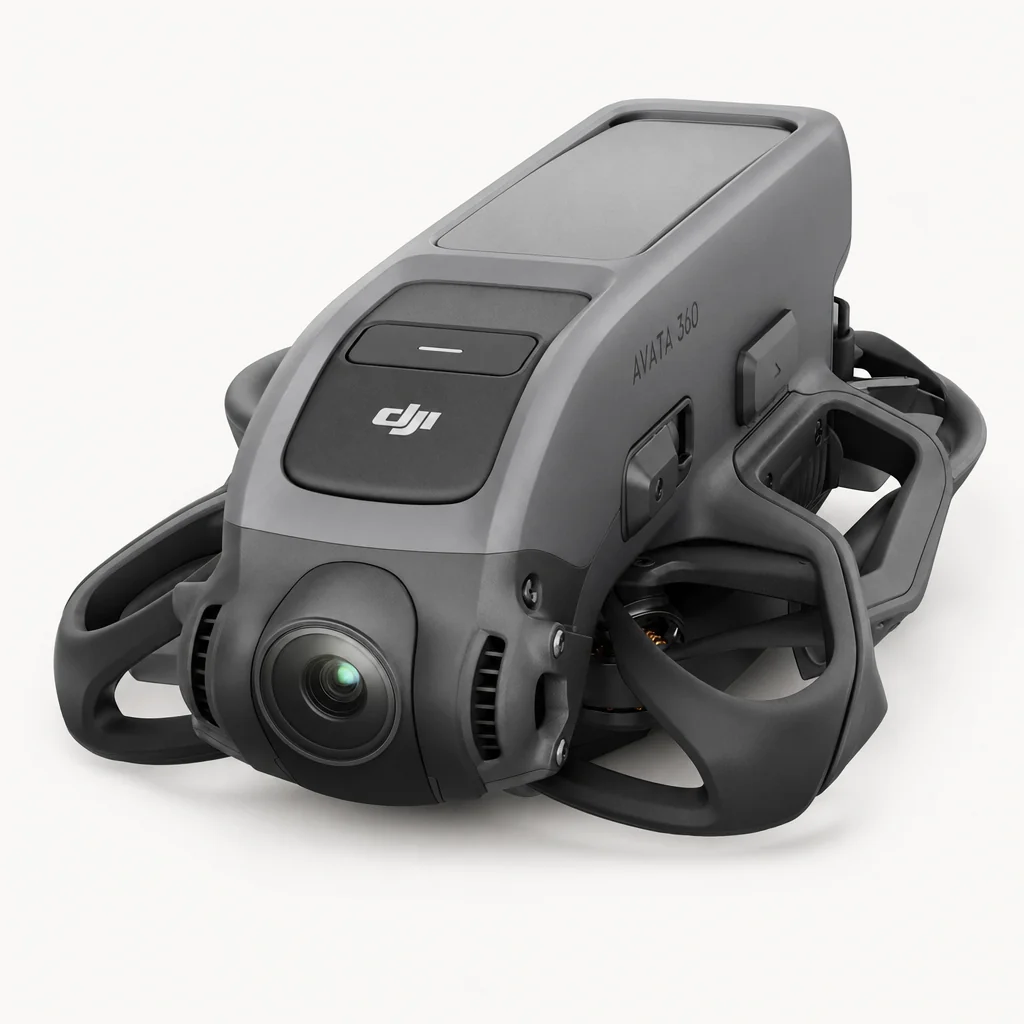
DJI's Avata 360 arrived in March 2026 as a 455g guarded cinewhoop that happens to capture a full 360-degree sphere. Antigravity's A1 had already been on sale since December 2025, and went almost completely the other way: a 249g foldable drone in standard-battery trim, designed around goggles, a hand-held Grip Motion Controller and the sensation of flying through your own footage.
Both let you reframe the shot later. Both record 8K 360 video. Both demand a little realism before you buy one. An 8K sphere is not the same thing as an immaculate native 8K flat video clip, and a pair of goggles does not make the UK's visual-line-of-sight rules vanish in a puff of marketing smoke. More on that shortly.
The short version: two routes to the same shot
If you simply want the answer before the detail: the DJI Avata 360 is the better buy for most creators. It costs much less to enter, records 8K at up to 60fps, has larger 1/1.1-inch sensors, offers D-Log M, protects its propellers, adds omnidirectional sensing and can be flown with a conventional screen controller. It is a considerably more flexible tool.
The Antigravity A1 is the more distinctive experience. With its standard battery it stays at 249g, its Vision Goggles and Grip Motion Controller are central rather than optional, and its High-Capacity Battery can deliver a genuinely useful 25–28 minutes of real-world flying. It is for the person who wants to feel as though they are in the air, rather than merely operating a camera platform from the ground.
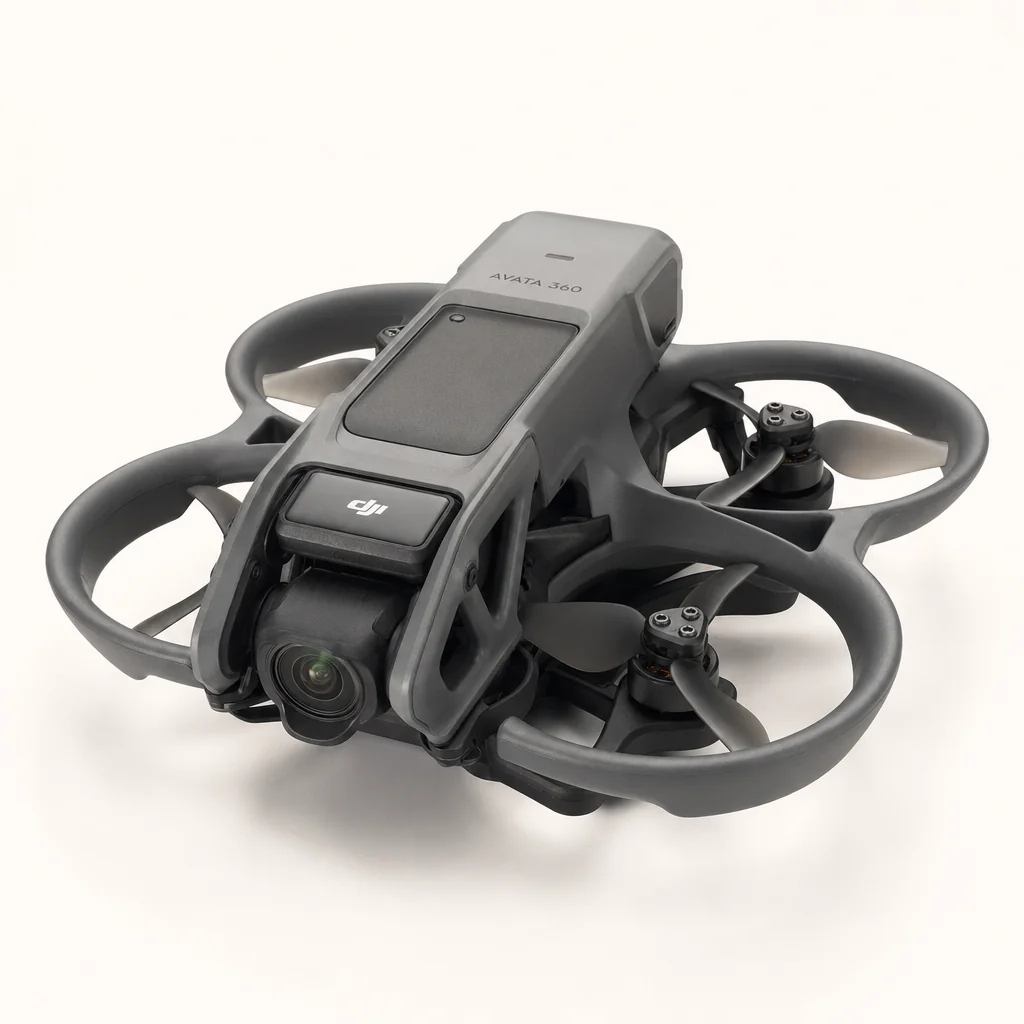
The real design split is obvious in the air: DJI's Avata 360 is a protected cinewhoop, whilst the Antigravity A1 is a light, foldable invisible-drone concept.
One important buying note: DJI and Antigravity each sell one aircraft, not a stack of different drone models. The various names are bundles, controller packages or battery configurations. That matters, because a cheaper DJI "Drone Only" package is not a ready-to-fly equivalent to an A1 bundle containing goggles and controller.
DJI Avata 360 vs Antigravity A1: the numbers that matter

Specs do not fly the drone for you, but they quickly explain why these two machines behave so differently. DJI has put sensor size, frame rate, protection and control flexibility ahead of weight. Antigravity has prioritised portability, headset immersion and a standard configuration that slips under the 250g line.
| Specification | DJI Avata 360 | Antigravity A1 |
|---|---|---|
| Take-off weight | Approx. 455g | 249g standard battery; 291g High-Capacity Battery |
| Camera sensor | Dual 1/1.1-inch CMOS | 1/1.28-inch dual-lens system |
| Maximum 360 video | 8K/60fps HDR | 8K/30fps |
| Higher-frame-rate option | 4K/120fps listed in review specifications | 4K/100fps |
| Maximum 360 stills | 120MP JPEG | 55MP |
| Conventional camera mode | Single-lens video up to 4K/60fps | 360 capture workflow |
| Rated flight time | 23 minutes | 24 minutes standard; 39 minutes High-Capacity |
| Maximum horizontal speed | 18m/s / 40.3mph Sport | 16m/s / 35.8mph Sport |
| Wind resistance | 10.7m/s, Level 5 | 10.7m/s, Level 5 |
| Obstacle protection | Omnidirectional sensing, LiDAR enhancement and integrated guards | Forward/downward vision and bottom infrared sensors; optional guards |
| Primary control options | Goggles, motion controller, FPV controller or RC 2 / RC-N2 / RC-N3 | Vision Goggles and Grip Motion Controller |
| Internal storage | Approx. 42GB usable | 20GB |
That table contains the central argument. The Avata 360 is better equipped for work. It has more camera headroom, a safer frame and more ways to control it. The A1 is lighter, simpler in concept and dramatically longer-lived with the larger battery, but that larger battery also takes it to 291g and changes its EU classification from C0 to C1. There is no free lunch in aviation. There is barely a free biscuit.
Camera quality and stitching: DJI Avata 360 takes the technical lead
Both drones use two opposing ultra-wide cameras to capture the full sphere. The appealing bit comes later: open the clip in DJI Studio or Antigravity Studio, find the moment you want, then create a conventional-looking shot by panning, tilting, zooming or tracking through the captured world. You can decide that the dramatic reveal should have been behind the drone after all. Very handy. Also mildly dangerous for anyone who already spends too long editing.
DJI has the more capable imaging platform. Its dual 1/1.1-inch sensors are larger than the A1's 1/1.28-inch sensor specification, its aperture is f/1.9 rather than f/2.2, and it records 8K 360 video at up to 60fps. That doubled frame-rate ceiling is not just a spec-sheet flourish. It gives you smoother movement, more scope for slowing footage and a more forgiving base for a fast FPV-style edit. D-Log M is another useful advantage if you colour grade rather than simply exporting a cheerful social clip and calling it a day.
The Avata 360 also makes 120MP 360 stills and has a separate single-lens mode up to 4K/60fps. The latter is a proper practical benefit: it can behave more like a normal FPV camera drone when you do not need the all-seeing sphere. The A1 is much more committed to the 360 idea. That focus is charming, but it also means less flexibility when a straightforward forward-facing shot would do nicely.
DJI Avata 360: better source material for a reframe
8K/60fps HDR, larger sensors, D-Log M and a 120MP still mode give DJI more room to work with before you crop a sphere into a flat clip.
Antigravity A1: the whole point is not aiming the camera
The A1 records the environment around it at 8K/30fps, leaving composition for the editing stage. Its 4K/100fps mode adds a slow-motion option.
Neither makes 360 compromises disappear
Once you dewarp and crop an 8K sphere into a 16:9 export, you are using only part of the source image. The finished clip can be 4K or lower after processing.
A reframed 360 clip lets you choose a forward view, orbit or reveal after landing, but the crop inevitably uses only part of the original 8K sphere.
DJI wins the daylight comparison, with reviewers finding its footage a little sharper and more colour-accurate than the A1's. Yet this is not a clean knockout, because 360 video has some unavoidable awkwardness. DJI footage can reveal stitching seams, edge softness and stabilisation artefacts. Low light is particularly demanding: electronic stabilisation and aggressive processing can introduce blur, whilst dewarping at the edge of the sphere is never especially flattering.
The A1 does a respectable job in daylight, and its 8K capture is more than enough to make the shooting concept enjoyable. In difficult light, though, the smaller sensor and lower frame-rate ceiling leave it behind. Neither should be bought as a replacement for a premium conventional gimbal drone if your priority is pin-sharp aerial photography, calm low-light footage or polished client work. They are creative cameras first. That distinction saves disappointment.
The 8K reality check
Think of 8K 360 as flexible source footage, not a promise that every reframed export will look like a native 8K camera shot. The closer you crop, the more you expose stitching, edge softness and the limits of the sensor. Use the freedom to find better angles, not to rescue footage from the other side of a county.
Flying experience: cage-and-goggles versus invisible drone
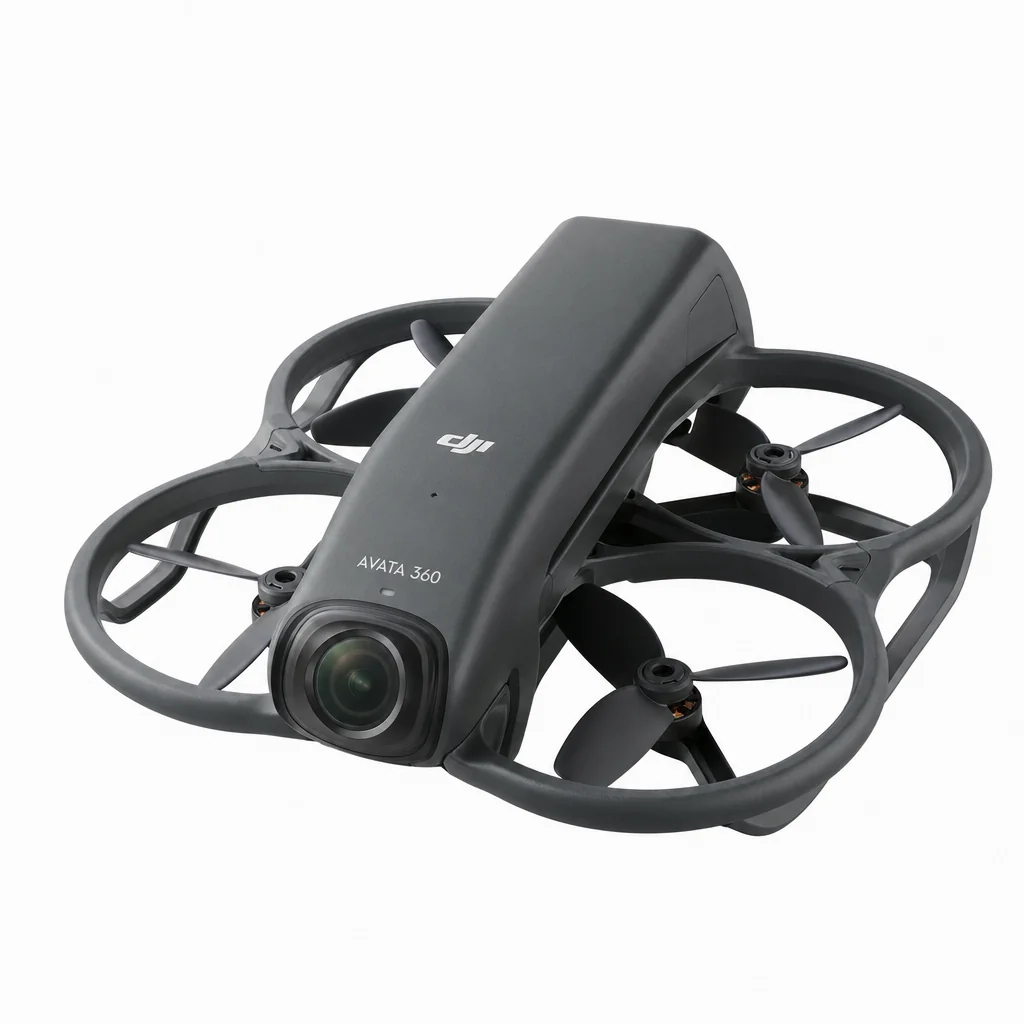
This is where the comparison gets fun. DJI's Avata 360 is a cinewhoop-style aircraft: compact, guarded and built to fly close to a subject or obstacle without making every small contact an expensive emotional event. Its integrated propeller guards and bumpers are not glamorous, but they are hugely useful. Flying through a gap, around a tree or close to a moving subject is much less nerve-racking when the props are not exposed like tiny spinning legal bills.
Its omnidirectional sensing with LiDAR enhancement is another substantial advantage. It does not make you invincible, and it certainly does not make it sensible to fly into branches for content, but it makes the Avata 360 more forgiving around obvious obstacles. The extra mass helps in wind too. At 455g, it is less likely than the A1 to be shoved about by every gust that rolls across a field.
The A1's experience is more unusual. The Vision Goggles and Grip Motion Controller are not accessories bolted onto a conventional-drone concept; they are the concept. You move your hand, look around the 360 view and fly as though the drone is a little extension of your own head. For the right person, it feels immediate and wonderfully absorbing. For someone who wants precise traditional sticks, a screen and a clean solo workflow, it can feel like being asked to play chess wearing boxing gloves.
Antigravity added a built-in flight simulator through a January 2026 update, which was a sensible move. A goggles-first setup has a learning curve, especially if you have only flown camera drones using a familiar screen controller. The A1 can be approachable, but it is not conventional. DJI, by contrast, lets you choose: Goggles 3 or Goggles N3 with RC Motion 3, an FPV Remote Controller 3, or a conventional RC 2, RC-N2 or RC-N3 controller.
DJI Avata 360 strengths
- Integrated guards make close, indoor and obstacle-adjacent flying less intimidating.
- Omnidirectional sensing and LiDAR enhancement create a stronger safety net.
- Screen-controller support works for pilots who do not want goggles every time.
- Single-lens 4K/60 mode broadens its job beyond pure 360 capture.
DJI Avata 360 drawbacks
- At 455g, it carries more registration and category baggage than a sub-250g drone.
- It is noticeably louder in testing than a conventional small camera drone.
- Goggles flight still needs an observer in the UK.
- Real-world endurance fell short of the headline figure.
Antigravity A1 strengths
- 249g standard configuration is compact and materially friendlier from a weight perspective.
- Its headset-first flying experience is genuinely distinctive.
- The High-Capacity Battery transforms endurance for longer outdoor sessions.
- It was described as relatively quiet at a distance.
Antigravity A1 drawbacks
- There is no conventional dual-stick or screen-controller alternative.
- Open propellers are less resilient than DJI's built-in guarded frame.
- It is more susceptible to wind despite the same Level 5 rating.
- Goggles-first flying still needs an observer in the UK.
Battery life, charging and the numbers you will actually feel
Drone manufacturers quote flight times under tidy test conditions. We live in Britain. The wind does not read product pages, and neither do your thumbs when you are having a lovely time in Sport mode.
DJI rates the Avata 360 for 23 minutes, but Engadget achieved about 18 minutes in real-world flying. Another hands-on report suggested 13–15 minutes depending on flying style, wind and reserve. That is not terrible for a guarded FPV-ish 360 drone, but it is not the sort of endurance that makes you stroll to a location with one battery and a carefree attitude.
The A1 standard battery is rated for 24 minutes. Real-world flight was around 15–17 minutes, with roughly 18 minutes measured while hovering. So far, fairly even. The big difference is the optional High-Capacity Battery: it is rated for 39 minutes and delivered roughly 25–28 minutes in real use, with around 30 minutes hovering. That is the A1's clearest functional victory, provided you accept the 291g take-off weight.
Charging is reasonably civilised on both. DJI quoted around 47 minutes for one battery through its hub and around 100 minutes for three from empty using a 100W adapter. Antigravity quoted about 45 minutes for the standard battery and 60 minutes for High-Capacity through its hub; its charging hub charges batteries sequentially. The DJI system therefore has the neater multi-battery turnaround when you are trying to reset between takes.
The A1's High-Capacity Battery is the endurance champion, but it changes the drone from 249g to 291g and with it the regulatory picture.
UK and US legal reality: goggles do not equal solo flight
This is the least glamorous part of the article. It is also the bit that stops you buying the wrong drone for your actual life.
In the UK, electronic viewing equipment including FPV goggles cannot substitute for direct unaided visual sight. If you fly FPV, you need an observer beside you who maintains direct visual contact with the aircraft and stays in direct communication with you. This applies to the DJI Avata 360 with Goggles 3 or Goggles N3, and it applies to the Antigravity A1 with its Vision Goggles. The A1's "invisible drone" approach is not a magic observer exemption. If only it were that easy.
This is why DJI's controller flexibility matters so much. With RC 2 or RC-N2/RC-N3, the Avata 360 can be operated through a conventional screen-based workflow, allowing the pilot to maintain visual contact with the drone subject to normal VLOS rules. The A1 is fundamentally goggles-first, with no equivalent conventional screen-controller option. If you usually fly alone in the UK, that is not a minor footnote; it may be the deciding factor.
UK registration is still relevant below 250g: a camera drone from 100g to 250g still requires a Flyer ID and Operator ID. The A1 standard battery is easier from a weight and C0-classification standpoint, but it is not a paperwork-free camera. The 455g Avata 360 is C1, while the A1 becomes C1 with its High-Capacity Battery.
In the US, the basic visual-observer logic is similar: recreational flyers must maintain visual line of sight or use a co-located visual observer, and FPV operation under Part 107 also requires an observer maintaining unaided sight. The A1's standard 249g setup sits below the FAA registration threshold for many recreational situations, while the 291g High-Capacity setup and 455g Avata 360 are above it. Registration is only one part of the picture, of course; TRUST, Remote ID where applicable, airspace authorisations and whether you are flying recreationally or commercially still matter.
Pricing and bundle value in the UK and US
DJI has an enormous price advantage, although it needs reading with a little bundle awareness. The cheapest Avata 360 package is an aircraft-only entry point, so it is not comparable with an A1 Standard Bundle containing the goggles and Grip Motion Controller. Even after accounting for that, though, DJI is the less costly system to enter.
DJI Avata 360
UK Drone Only. In the US, Drone Only was listed at $479.
DJI Avata 360 Motion Fly More Combo
Three batteries, charging hub, Goggles N3 and RC Motion 3. US price: $979.
Antigravity A1 Standard Bundle
US MSRP was $1,599, with retailer pricing observed as low as $1,279.
DJI's RC 2 package was £639 in the UK and $719 in the US. Its Fly More Combo with RC 2 was listed at £979 in the UK and $979 in the US. Antigravity's UK Explorer and Infinity Bundles were £1,399 and £1,499 respectively; Ultimate Bundle Lite and Ultimate Bundle were £1,595 and £1,679. In the US, Explorer was $1,899 MSRP and Infinity was $1,999 MSRP, though retailer deals were lower at the time of checking.
This is where the A1 needs a very specific buyer. At its price, it is not winning a conventional value contest against DJI's own camera-drone ecosystem. It earns its keep only if the unique goggles-and-360 experience is exactly what you want. If you are mostly chasing image quality, conventional controls or maximum versatility per pound, DJI makes the easier argument.
Competitors: where these two sit beside DJI's other drones
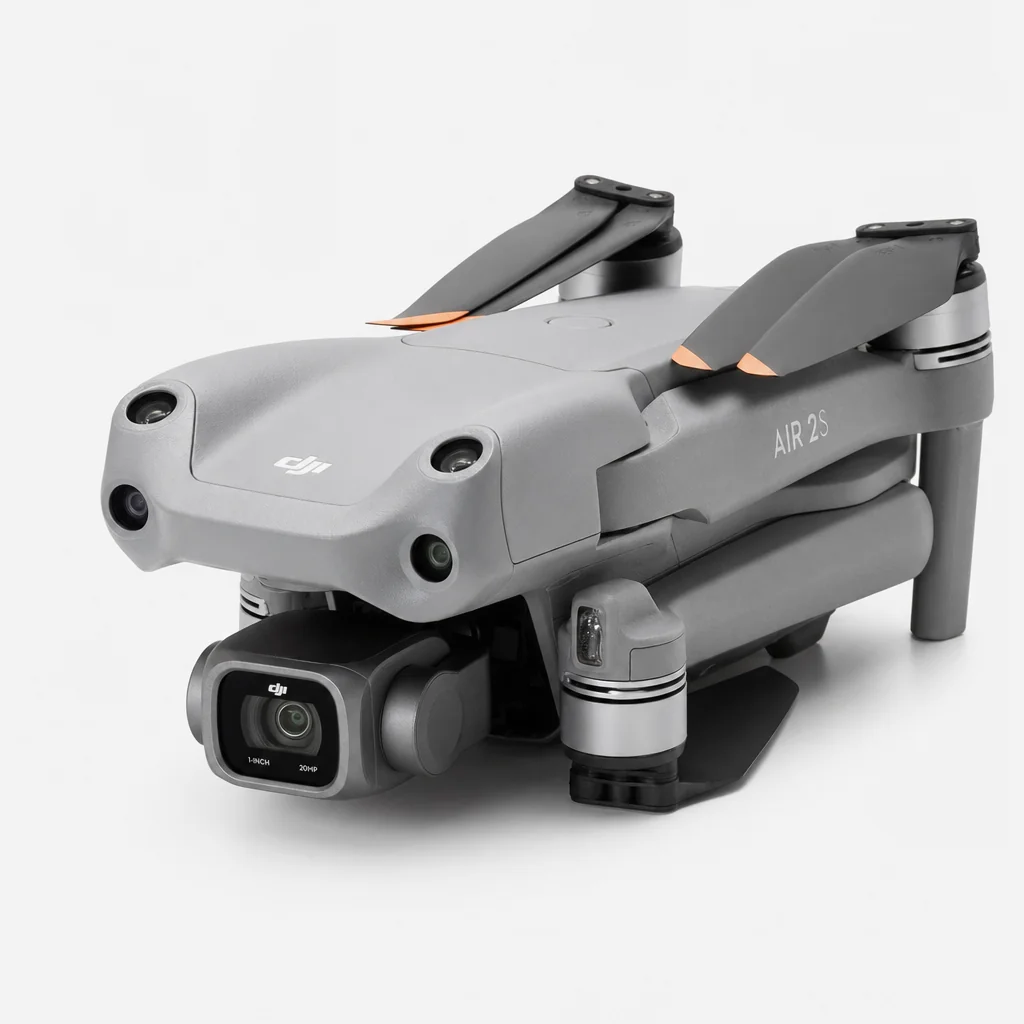
Neither 360 drone lives in isolation. The sensible alternative is often not the other 360 drone, but a conventional camera or FPV drone that better suits your actual shooting. The comparison below deliberately sticks to the figures that are known, because a table full of invented certainty is worse than no table at all.
| Feature | DJI Avata 360 | Antigravity A1 | DJI Avata 2 |
|---|---|---|---|
| Aircraft weight | Approx. 455g | 249g standard battery | Approx. 377g |
| Maximum video capture | 8K/60fps 360 | 8K/30fps 360 | 4K/60fps conventional video |
| Camera arrangement | Two 1/1.1-inch cameras | Dual-lens 360 system | Single 1/1.3-inch camera |
| Buy | Check price | Check price |
The Avata 360 occupies a middle ground: more creative latitude than a normal FPV drone, but less outright image purity than a conventional gimbal camera drone.
DJI Avata 2 is the straightforward alternative if 360 capture is not your priority. It is lighter at approximately 377g and uses a single 1/1.3-inch camera for conventional 4K/60 filming. You lose the ability to rescue a missed angle in post, but you also avoid some of the stitching and crop compromises inherent in 360 work.
A conventional DJI Mini-series camera drone remains the better direction for someone chasing polished aerial photography. The Mini 5 Pro was positioned as a conventional high-quality imaging option, and the Mini 4 Pro measured 67dB in Engadget testing compared with approximately 81dB for the Avata 360. Put bluntly: if you want quiet, crisp, composed footage rather than a camera that sees everywhere at once, buy the right tool and save yourself some late-night rationalising.
At the pricier end, WIRED compared the A1's value proposition with DJI Air 3S territory: a screen controller, two conventional cameras and mature normal-drone handling. That does not mean the Air 3S replaces an A1. It means the A1's case must be experiential. It is a drone you buy because no conventional platform quite makes you feel this way.
Which drone is best for you?
There is no universal winner here, which is rather the point. The best one depends less on whether you enjoy impressive-looking specifications and more on how, where and with whom you genuinely plan to fly.
DJI Avata 360
See DJI Avata 360 on Amazon UK
Check today's price & availability on Amazon UK
Choose DJI if you want better 360 image specifications, 8K/60fps, D-Log M, guarded props, sensing and the option to fly conventionally with RC 2 or RC-N2/RC-N3.
Antigravity A1 with Standard Flight Battery
The 249g configuration is the right A1 for pilots who value low weight, C0 classification and a goggles-first flying experience above conventional controls.
Antigravity A1 with High-Capacity Battery
Its 25–28 minutes of tested real-world flying is the endurance winner. Just remember that the aircraft rises to 291g and C1.
DJI Avata 360
Integrated propeller guards, bumpers, omnidirectional sensing and LiDAR enhancement make DJI the more forgiving option around obstacles and subjects.
DJI Avata 360 with RC 2

See DJI Avata 360 with RC 2 on Amazon UK
Check today's price & availability on Amazon UK
A screen controller is vastly more practical for a solo pilot maintaining visual line of sight. The A1's goggles-first design needs an observer for UK FPV flying.
Antigravity A1
If the destination is immersion rather than conventional drone utility, the Vision Goggles and Grip Motion Controller are the A1's entire reason for being.
The buying advice I would give a friend
First, decide whether you are buying a camera tool or a flying experience. The Avata 360 does both reasonably well, but it leans toward the tool. The A1 is more focused and leans heavily toward the experience. That is not criticism. Some products are better because they are opinionated. The A1 just needs your opinion to align with its own.
For a creator who shoots travel, action, cycling, cars, outdoor social clips or occasional paid work, I would choose the Avata 360. Its 8K/60 capture, larger sensors, D-Log M and single-lens mode make it more useful on a broader range of days. More importantly, its controller choice means you can fly it as an FPV machine when you have an observer and as a more traditional screen-controlled drone when you do not.
For a hobbyist who wants to wander out with a small drone, put on a headset and genuinely feel present in the flight, the A1 makes much more sense. In standard form it is only 249g, and its high-capacity option is superb for endurance. But I would not recommend it to a UK solo pilot who does not have someone available to act as observer. That would turn its headline feature into a logistical nuisance remarkably quickly.
Finally, do not buy either expecting a conventional gimbal drone with a clever extra camera. Reframing is marvellous for catching unpredictable action and experimenting with impossible-looking camera moves. It is less ideal for low-light perfection, aggressive crop-ins or footage where edge detail must withstand ruthless scrutiny. These are flying 360 cameras. Treat them as that, and both become far more satisfying.
For a solo UK pilot, DJI's RC 2 option can be more useful than another headline specification because it supports a conventional visual-line-of-sight workflow.
DJI Avata 360 vs Antigravity A1 FAQ
Both drones can create dramatic reframed aerial shots; DJI is the more versatile camera tool, while Antigravity is the more committed immersive-flight machine.
Final verdict: choose the flight style, not just the spec sheet
DJI Avata 360 is the best overall buy for most people. It is substantially cheaper to enter, shoots better-specified 360 footage at up to 8K/60fps, offers D-Log M and conventional 4K/60 single-lens video, and has the protective cage, sensing and controller flexibility that make it easier to recommend without a long list of caveats.
Antigravity A1 is the better specialist pick. Buy it with the standard battery if sub-250g weight, C0 classification and an immersive goggles-first experience are your priorities. Buy it with the High-Capacity Battery if you value the class-leading real-world endurance more than retaining that 249g status.
The key UK caveat applies equally: goggles require an observer. If you usually fly alone, DJI Avata 360 with RC 2 is the practical winner. If you have a flying partner, love the idea of steering with your hand and want a drone that feels more like a portal than a camera platform, the Antigravity A1 is the one with the bigger grin factor.
 DJI Avata 360View on Amazon
- DJI Avata 360 with RC 2View on Amazon