DJI Air 3S Review: Two Cameras, No Excuses - the Working Pilot's Drone
A 1-inch main camera, a real 70mm telephoto, LiDAR that sees in the dark and batteries that outlast your shot list. The Air 3S is the drone you buy when conditions stop being optional - our full UK review of DJI's mid-range workhorse.
 By Priya Sharma · Phones, Tablets & Cameras Editor · Updated July 01, 2026
1. What the Air 3S is: capability without the flagship tax
DJI's range has three personalities. The Minis are about freedom from rules; the Mavic is about ultimate image quality; and the Air line in the middle is about reliability of outcome - the drone that comes home with the shot regardless of wind, distance or fading light, without costing Mavic money.

The 3S spec headline: two real cameras - a 50MP 1-inch-sensor 24mm wide angle and a 48MP 1/1.3-inch 70mm telephoto - both shooting 4K up to 120fps with 10-bit colour and up to 14 stops of dynamic range. Plus forward-facing LiDAR for genuine low-light obstacle sensing, omnidirectional vision coverage, and a claimed 45 minutes aloft. From £859 in the UK with the RC-N3 controller.
Its buyers are recognisable: the property photographer who flies in whatever Tuesday offers; the holiday-let owner shooting their own marketing; the enthusiast whose local coastline eats Minis for breakfast; the videographer who needs B-roll delivered, not attempted. If the Mini 5 Pro is the travel camera, the Air 3S is the work van.
2. The 250g line: what 724 grams costs you in the UK
Honesty first: the Air 3S's biggest drawback isn't on the spec sheet, it's at the CAA. At 724g you leave the sub-250g comfort zone, and UK flying becomes more formal:
- Flyer ID required - a free online theory test (40 questions, multiple choice, open book; an evening's effort) on top of the operator ID registration.
- Distance rules with teeth: in the default Open category you keep 50m horizontally from uninvolved people and don't overfly them, and stay well clear of residential, commercial and recreational areas unless you hold an A2 Certificate of Competency (a paid course-plus-exam that restores much of that freedom).
- The practical translation: the Air 3S is a drone for landscapes, coastlines, open country, your own property and arranged shoots - not for casual flights over the village fete. If your flying life is parks and streets full of people, stay sub-250g; this is the wrong tool legally, not just socially.
Is the paperwork worth it?
For the right pilot, emphatically. The Flyer ID is one free evening; the A2 CofC (around £100-150 via online providers, valid five years) unlocks most of what the weight took away. In exchange you get wind authority, twin cameras and endurance no sub-250g drone can physically offer. The trade is real on both sides - which is exactly why this review and our Mini 5 Pro review exist as a pair.
3. Two cameras: the telephoto changes how you shoot
The main camera needs little argument: 1-inch, 50MP, f/1.8, the same sensor class that transformed the Mini 5 Pro, here paired with more stable footing. Daylight output is crisp and gradeable; dusk and blue hour are comfortably within range; 14 stops keeps British skies intact. It is, simply, a known-excellent camera.
The story is the 70mm telephoto, because 3x optical reach rewires your creative instincts in ways first-time owners never expect:
- Compression is the cinematic look. The 70mm stacks landscape layers - headland on headland, ridge behind ridge - into the dense, painterly frames that wide-angle drones physically cannot make. Half of 'expensive-looking' drone footage is just this lens.
- Distance becomes respect. Wildlife, livestock, people working a harbour: the telephoto shoots them naturally from distances that bother no one - a legal convenience at 250g+, and an ethical one at any weight.
- Subjects you can't approach become subjects. Boats under way, hilltop ruins beyond a boundary, the church spire across the valley: reach replaces permission you couldn't get.
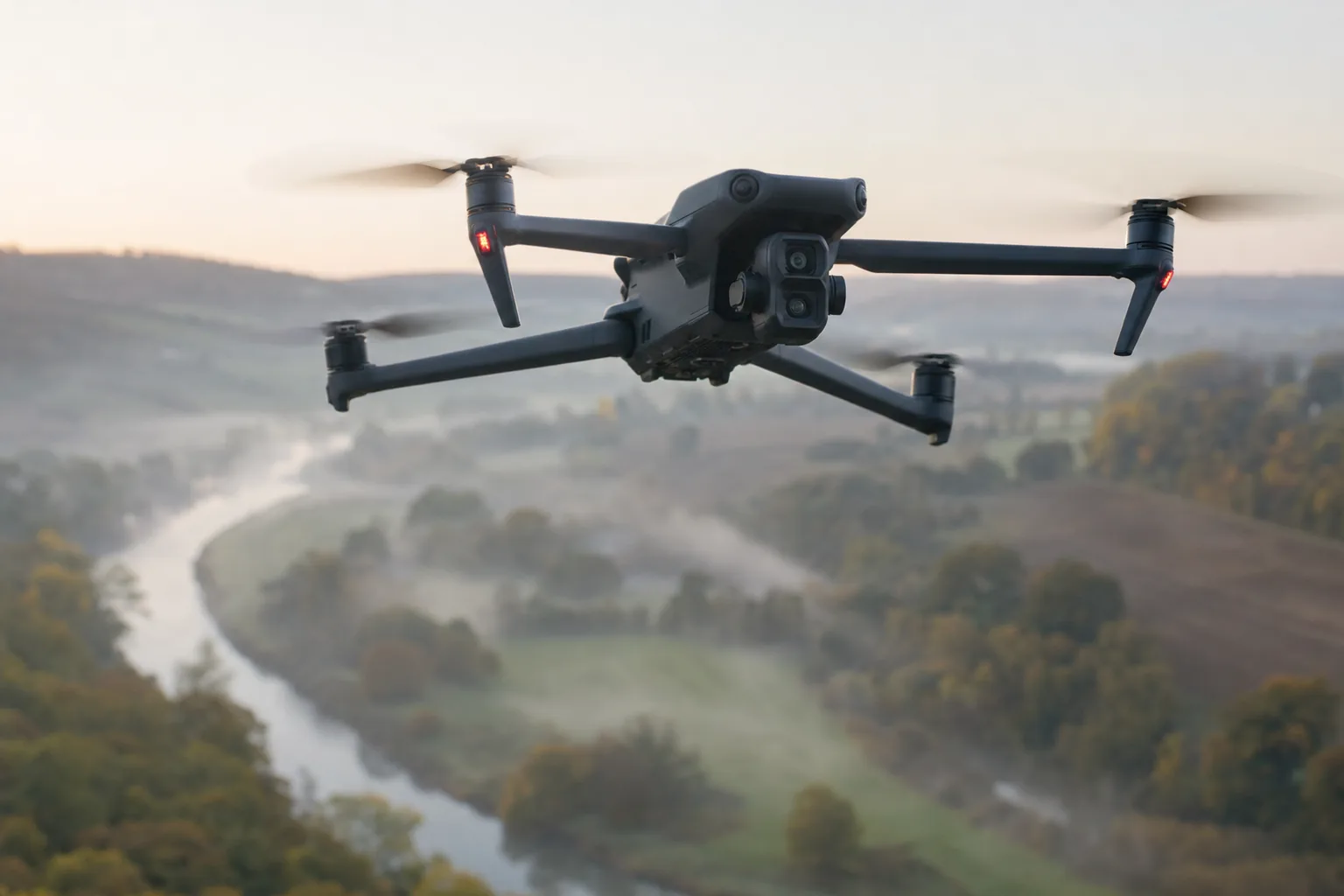
Both cameras record 4K/120 with 10-bit D-Log M, and they're colour-matched - cutting between wide and tele in an edit looks like a two-camera shoot, not two different drones. For paying work, that consistency is quietly the killer feature.
4. Flying it: where the extra 475 grams goes
Every gram the Air 3S carries over a Mini is spent on composure. In the gusts that send a Mini 5 Pro crabbing sideways and gulping battery, the 3S simply sits - hovering like it's bolted to the sky, holding a telephoto frame (where every wobble is magnified 3x) steadily enough to use. Coastal and upland pilots feel the difference in their shoulders: you stop flying the weather and go back to flying the shot.
The sensing suite matches the composure. Omnidirectional vision plus forward LiDAR gives the 3S genuine low-light awareness - dusk and dawn work, the hours where drone footage is best and crashes are easiest, becomes relaxed. Smart RTH plots an actual route home around obstacles rather than the old climb-and-pray, and ActiveTrack on a vehicle or boat at 70mm produces tracking shots that used to need a second operator.
Transmission is DJI's O4 system: across every legal UK distance it simply never enters your thoughts, including behind terrain and treelines that troubled earlier generations. The link is the most boring part of the drone, which is the highest compliment a link can earn.
5. Endurance: 45 claimed, and what that really means
DJI rates the Air 3S at 45 minutes (41 hovering). Our working figure across a British winter and spring: 33 to 38 real minutes with sensible reserves - which is not just a number, it's a different way of working. One battery now covers: the wide establishing set, the telephoto layer pass, the tracking shot, the vertical for socials, and the second attempt at the one you fluffed. Three batteries cover a working day.
UK buying picture: from £859 with the RC-N3; budget north of £1,100 for the Fly More Combo with the screen-equipped RC 2 - and as with every DJI, the Fly More's three batteries and hub are the correct answer for anyone flying more than monthly. The 3S also inherited 42GB of internal storage, the quiet hero feature for the day the microSD card stays in the laptop at home.
See the Air 3S Fly More Combo on Amazon UK
In stock and price-checked at the time of writing
6. Air 3S vs Mini 5 Pro vs Mavic 4 Pro: the middle child's case
| Mini 5 Pro | Air 3S | Mavic 4 Pro | |
|---|---|---|---|
| Cameras | 1" wide only | 1" wide + 70mm tele | 4/3 Hasselblad + 70mm + 168mm |
| Top video | 4K/120 | 4K/120 | 6K/60 HDR |
| Weight / UK class | 249.9g / friendly | 724g / Flyer ID + distances | ~1,063g / Flyer ID + distances |
| Real flight time | ~25-29 min | ~33-38 min | ~38-45 min |
| Wind authority | Fair | Strong | Strongest |
| UK price from | £689 | £859 | £1,879 |
- Stay with the Mini 5 Pro if portability and friendly rules shape your flying more than weather does - its camera concedes surprisingly little to the 3S's main sensor.
- Choose the Air 3S the day wind, telephoto reach or endurance has cost you a shot you cared about. It is the value sweet spot of DJI's serious tier - 80% of the Mavic's capability at 45% of its price.
- Pay for the Mavic 4 Pro (full review next in this series) only when clients, cinema-grade output or the 100MP Hasselblad look are the actual requirement.
7. Field diary: a winter and spring of actual work
The Air 3S logged more working hours with us than anything else in this series. Four entries carry the review's weight:
The holiday-let job that paid for the paperwork
A coastal cottage, owner wanting listing shots, forecast brisk. The sortie that justifies this drone's existence: wide establishing set from seaward (1-inch camera, HDR holding a pewter sky), then the 70mm pass - the cottage compressed against its headland, the path to the beach stacked into the frame, the shots that make scrolling thumbs stop. Twenty-nine minutes airborne, every listicle-ready angle captured, one battery, wind treated as weather rather than adversary. The fee covered the A2 CofC course with change. That's the Air 3S business case in one flight.
The dawn the LiDAR earned its line item
A river-mist sunrise brief - airborne in civil twilight, light levels that ground vision-only drones or turn their returns into prayer. The 3S mapped its surroundings like it was noon, threaded its RTH past a line of riverside alders we'd half-forgotten, and shot graded-ready 10-bit that needed almost nothing in post. Dawn and dusk hold the year's best light; this drone holds dawn and dusk.
The wildlife distance lesson
Deer in a valley bottom, us on the right-of-way above. The 70mm telephoto filmed browsing behaviour at a distance that left ears unflicked - footage ethically clean and legally untroubled. The same shot wide would have meant a approach no fieldcraft justifies. Reach is conscience, as much as composition.
The day it sat in the bag
And the honest entry: a village fete, families everywhere, a 'just get a quick aerial' request - declined. At 724g amid uninvolved crowds, the Open category says no, and no qualification shortcuts that particular no. The sub-250g Mini went up instead for thirty legal seconds of context shot. Owning the Air 3S well means knowing the flights it doesn't fly.
8. The working pilot's playbook: settings and sorties
The 3S as we actually configure it for repeatable, deliverable results:
- Both cameras to D-Log M, exposure locked per sequence. Matched grading across wide and tele is this drone's superpower; let auto-exposure wander between shots and you donate it back.
- The job rhythm: wide survey, then tele story. First battery-third on establishing geometry (orbits, push-ins, top-downs), second on the 70mm's compressed narratives, final third on the speculative shots and the redo. The 35-minute reality makes this a single-battery liturgy.
- 4K/60 as the workhorse, 120 for water and wheels. Property and landscape deliverables rarely want slow motion; surf, sport and vehicles always do. Knowing which job you're on is the setting.
- Waypoints for repeat clients. The 3S's automation flies the identical path season after season - the spring/summer/autumn triptych of the same property is a product clients understand instantly and pay for annually.
- ND filters live on the lens, not in the bag. At working shutter speeds in British light you'll want ND8-32 most daylight hours; the stacked-camera module swaps filters in seconds.
- Internal storage is the parachute, not the plan: 42GB catches the day the card stayed home, but offload discipline (card to SSD, every session, before the kettle) is what working means.
- Set RTH altitude per site, ritually. The drone that flies new locations weekly is the drone that one day meets a crane. Site survey, tallest-obstacle-plus-margin, then launch: the unglamorous habit that keeps invoices flowing.
9. The A2 CofC: your £130 route back to flexibility
Since the Air 3S all but assumes the qualification, here's the practical path UK buyers actually take:
- What it is: the A2 Certificate of Competency - an online theory course and remotely-invigilated exam from a CAA-recognised provider, typically £100-150 all-in, valid five years. No flight test, no logbook minimums for the certificate itself.
- What it unlocks at this weight class: operations in the A2 subcategory - flying down to 50m horizontally from uninvolved people reduced to 30m (5m in low-speed mode), and crucially a defensible footing for the residential, commercial and recreational environments where most paid briefs live.
- The honest effort estimate: a focused weekend. The syllabus (meteorology, airspace, risk assessment, the operational rules you half-know) is genuinely useful rather than ceremonial - most pilots report flying more confidently afterwards, which is the quiet point of it.
- When to do it: between ordering the drone and its arrival. The Flyer ID the same evening you unbox. Registration numbers on the airframe before the maiden flight. Then the paperwork chapter of ownership is simply over.
- Beyond it: genuinely commercial ambitions (close work in towns, congested-area operations) eventually point at an Operational Authorisation - a bigger conversation than this review, and one the A2 experience prepares you to have intelligently.
Framed correctly, the A2 isn't the Air 3S's tax - it's its tuition, and the receipt is every flight the sub-250g crowd watches from the ground.
10. Air 3S vs Air 3: should existing owners move?
The Air 3 (2023) remains everywhere - in bags, on the used market, in 'is it enough?' forum threads. The deltas that decide it:
- Main camera: the whole story. The 3S swapped the Air 3's 1/1.3-inch main sensor for the 1-inch unit - the same upgrade arc the Mini line just walked, with the same dividends: evening reach, highlight grace, crop courage. The 70mm telephoto carried over essentially unchanged (it was already right).
- LiDAR arrived: the 3S's forward LiDAR enables the nightscape sensing and smarter dusk RTH the Air 3 simply lacks. If golden-hour-and-after is your shooting life, this is the second purchase reason.
- Storage: 42GB internal vs 8GB - from 'emergency clip' to 'forgot the card, shot the job anyway'.
- What didn't move: endurance class (45 vs 46 claimed - identical in practice), airframe manners, O4 link, the controller ecosystem. An Air 3 still flies like a 3S; it just sees and resolves less.
Rulings: Air 3 owners shooting mostly daylight wide-and-tele: hold - your drone lost no capability the day the 3S launched. Owners bumping against dusk noise or sensing nerves: the 3S is precisely your missing piece, and Air 3 resale remains healthy enough to soften it. New buyers offered a clean used Air 3 at a deep discount: a rational budget route into the 250g+ class - just price in that the 3S's two additions are the two everyone covets.
11. Six money shots: exact recipes for the dual cameras
The shots clients and audiences reliably respond to, with the settings we actually use:
- The compression stack (the 3S signature): 70mm, subject 150-300m out, layers behind it - cottage/headland/sea, or ridge/ridge/sky. 4K/30, NDs to 1/60, slow lateral drift. This is the 'cinema' everyone means.
- The matched-pair reveal: same subject, wide establishing orbit then tele detail pass, cut together. Two cameras, one aircraft, looks like a crew.
- The dawn confidence shot: civil twilight, D-Log M, main camera wide at f/1.8's mercy, LiDAR babysitting the treeline. The frames nobody smaller dares collect.
- The respectful wildlife study: 70mm from 200m+, 4K/60 for the motion, drone high enough that ears never turn. Distance is the technique.
- The property doppelgänger: waypoint-saved orbit + elevations, reflown per season/milestone. Identical framing, time-series product, repeat invoice.
- The 120fps water study: weirs, bow-waves, surf - tele from across the water, 4K/120, shutter doubled. Slow water sells anywhere.
Common thread: five of six lean on the telephoto. New owners shoot the wide for a fortnight then discover, as everyone does, that the 70mm is where this drone keeps its money.
12. The conditions manual: flying the British year
The 3S earns its keep precisely when conditions degrade, so here's the seasonal operating wisdom owners accumulate:
- Wind doctrine: comfortable working ceiling well above any Mini's, but respect the gradient - what reads 15mph at the car park runs harder at 80m. The drone tells you before trouble: watch attitude in hover and battery burn rate; both speak before footage suffers. Telephoto work halves your acceptable wind, because magnification magnifies everything.
- Rain and the British drizzle question: not weather-sealed, officially - and unofficially, light passing drizzle has been survived by thousands of Airs. Our line: visible droplets on the lens = land now; anything heavier than mist = the day's a scout, not a shoot. Cold + moisture is the real enemy (sensor fog on descent through layers - let the aircraft acclimatise in its bag).
- Winter operations: batteries dislike the cold more than the airframe does - keep packs warm (inside pocket) until launch, expect 15-20% range tax below 5°C, and beware the deceptive stillness of freezing days that ices props at altitude in damp air.
- Summer's two traps: heat-soaked batteries straight off charge in a car boot (let them breathe), and the season's confidence itself - long evenings invite the battery's last 15% adventures that winter discipline would refuse.
- Coastal salt protocol: the 3S will become a coastal specialist in most UK hands - wipe-downs after salty sessions, hinge and gimbal inspection monthly, and never launch from sand without a mat (the intake's a hoover).
13. The 3S in specific hands: five owner profiles, field-tested
Capability is abstract; here's how five recognisable UK owner types actually deploy this aircraft, and the one habit each should adopt:
The smallholder and rural property owner
Fence lines walked in minutes from the kitchen step, gutters and ridge tiles inspected without a ladder's insurance excess, livestock counted from a respectful tele distance in weather that cancels walking. The habit: a saved waypoint circuit of the boundary, flown monthly - the property's health check as a four-minute ritual. (The 70mm checking a chimney from across the yard pays for the A2 course in one avoided scaffold quote.)
The sailing and waterside family
Club racing filmed from the seawall, the tele compressing the fleet against the headland; arrivals and departures documented without a chase boat. The habits: float-equipped courage is a myth - fly the margin like the water is lava, because it is; and the launch-from-deck dream needs a competent deckhand-spotter and a windless day, in that order.
The wedding videographer's second body
Not over the guests - never over the guests - but the venue establishing set, the couple's golden-hour walk at tele distance, the cars arriving. The habit: scout flight on the morning visit, shot list agreed with the lead shooter, eight airborne minutes total at the event itself. Aerial garnish, professionally rationed.
The walking-holiday documentarian
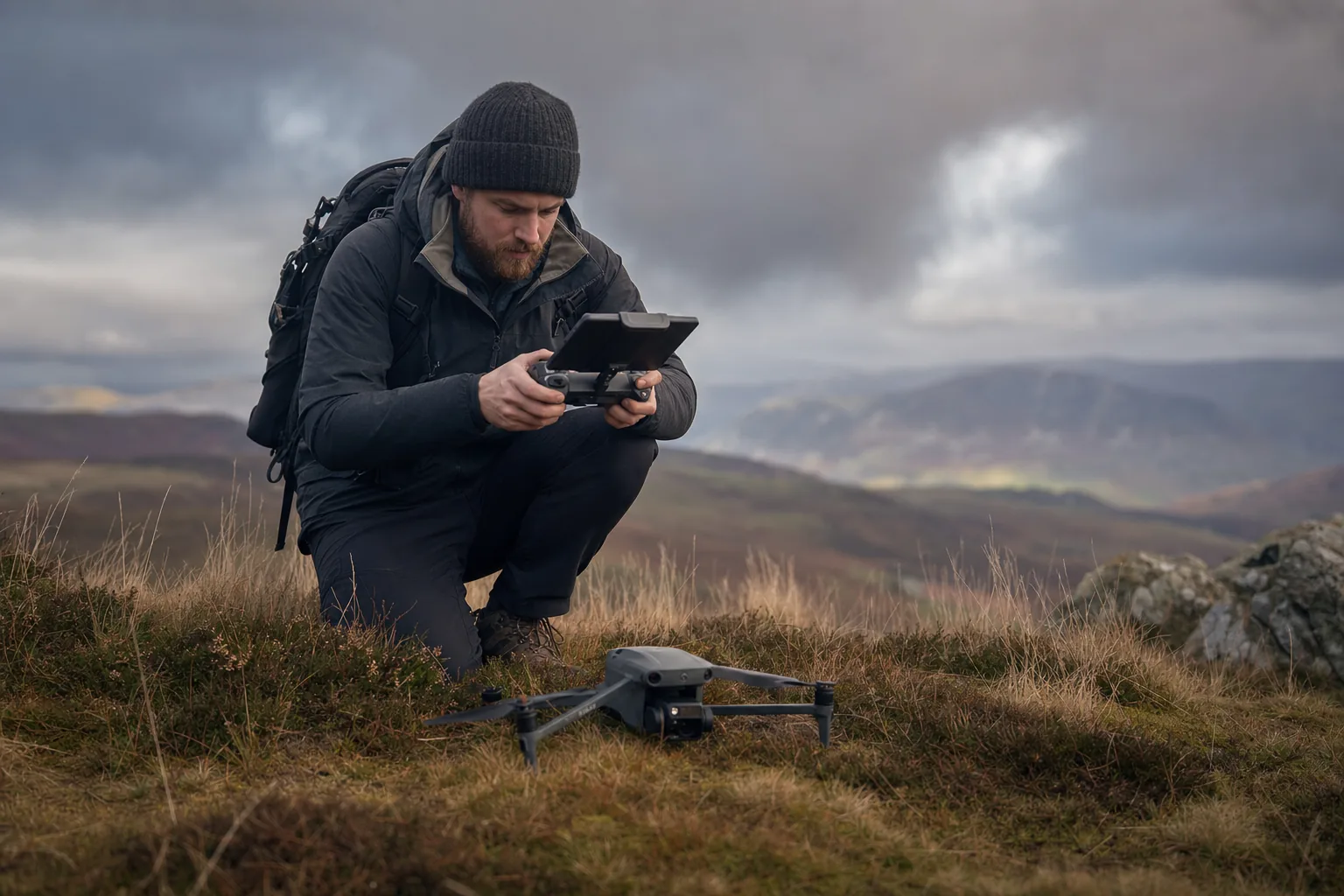
The 3S rides in bigger packs than the Mini crowd carries, and earns it on the days the forecast lies: ridge-line winds that ground the sub-250 class are this aircraft's ordinary office. The habit: battery discipline inverted - in remote country, the reserve isn't 20%, it's 'enough to return plus the climb out of the valley you descended into'.
The community organisation's reluctant pilot
Sports clubs, parish projects, heritage groups - someone's nephew suggests a drone, and the 3S is what serious-enough looks like. The habits: the organisation (not the nephew) holds the operator ID and the liability policy, flights happen at empty-ground hours, and the A2 CofC is the £130 that makes the committee's risk register smile. Charity-shop-window results, governance-meeting paperwork - the 3S suits both halves of that sentence.
Frequently asked questions
What do I legally need to fly the Air 3S in the UK?
Both CAA registrations: the operator ID (annual, displayed on the drone) and the free Flyer ID theory test. In the default Open category keep 50m from uninvolved people and away from built-up areas; the A2 CofC qualification (roughly £100-150) restores closer-in flying. Budget one evening for the test and you're airborne legally.
Air 3S or Mini 5 Pro - they're only £170 apart?
Choose by constraint, not price. If rules and portability matter most (travel, spontaneous flying, populated areas) the Mini 5 Pro wins on regulatory freedom alone. If conditions and reach matter most (coast, hills, property work, wildlife) the 3S's wind authority, telephoto and endurance are worth both the money and the paperwork.
Is the telephoto camera actually good, or a gimmick?
Genuinely good - 48MP on a 1/1.3-inch sensor with 10-bit video, colour-matched to the main camera. The compressed-perspective look it produces is half of what people mean by 'cinematic', and it quickly becomes most owners' favourite lens.
How long does the battery really last?
Expect 33-38 minutes per pack in real British conditions against the 45-minute claim - still enough to complete an entire location's shot list per battery. The Fly More Combo's three packs comfortably cover a full working day.
How loud is the Air 3S compared to the sub-250g drones?
Noticeably more present - a deeper, further-carrying tone than any Mini, which is partly why the 50m separation rules feel socially right as well as legally required. In open country it vanishes by 60-80m of distance; in a quiet village it's the audible argument for flying high, brief and elsewhere.
Can the Air 3S fly at night?
UK rules permit night flying in the Open category (with lighting requirements), and the 3S is unusually well equipped for it: forward LiDAR plus omnidirectional sensing keep obstacle awareness alive in light where vision-only drones go blind. Dusk and dawn - the beautiful, risky hours - are where it most outclasses cheaper drones.
Does the Air 3S have internal storage?
Yes - 42GB built in, enough for a full shoot at 4K when the microSD card inevitably stays in a laptop at home. Treat it as the parachute rather than the plan: offload discipline after every session remains the working habit, but this feature has saved more jobs than any other line on the spec sheet.
Can I fly the Air 3S over my own garden in a village?
In the default Open category, a 724g drone shouldn't be flown in residential areas - your garden included - without the A2 CofC, and even then with care about overflying neighbours and their uninvolved status. It's exactly the scenario where the A2 course pays for itself, or where a sub-250g drone earns its place as the second aircraft.
Should I wait for an Air 4?
DJI's release rhythm suggests the Air line updates roughly every two years, putting a successor plausibly within 2026 - but the 3S's spec remains current (LiDAR, 4K/120, O4) and prices have settled. Buy it when you have shots waiting; cameras depreciate slower than missed summers.
Verdict: the drone that delivers, full stop
The Air 3S has no party trick, no headline gimbal acrobatics, no weight-class miracle. What it has is the highest ratio of shots-delivered to conditions-encountered of anything near its price: two excellent matched cameras, sensing that works in the dark, and endurance that turns shoots from sorties into sessions.
And a closing word for the fence-sitters who reached this far: in two years of recommending drones to UK readers, no purchase has generated fewer regrets than this one - the buyers who needed it knew, and this review's job was confirming it.
Score: 9/10 - docked only for the regulatory load every 250g+ drone carries and a design that thrills nobody and fails nobody. For UK pilots whose conditions stopped being gentle, this is the buy. The question above it - whether the Mavic 4 Pro's Hasselblad justifies another thousand pounds - is exactly where this series goes next, before our full six-drone comparison brings the family together.
Sources & further reading: official DJI Air 3S specifications · Tom's Guide's Air 3S review · CAA drone registration · the CAA's drone rules hub.