DJI Neo 2 Review: The £209 Drone That Follows You Like a Film Crew
DJI's smallest brain yet now has eyes everywhere. The Neo 2 adds omnidirectional obstacle sensing, sharper tracking and 4K/100fps to the palm-launch formula - and it might be the most fun-per-pound gadget of 2026. Here's our full UK review.
 By Priya Sharma · Phones, Tablets & Cameras Editor · Updated July 01, 2026
1. What the Neo 2 actually is (and who it's for)
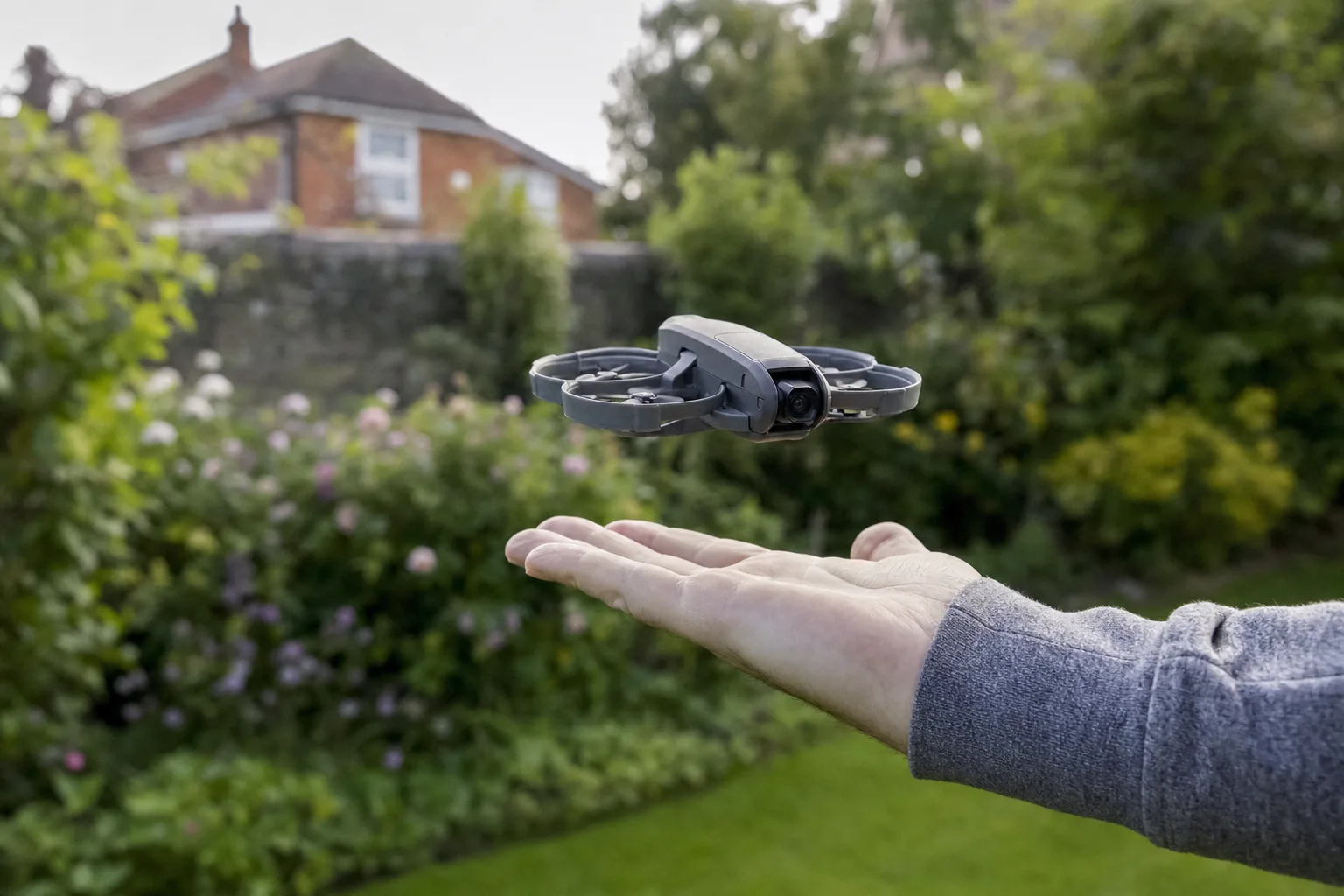
The Neo 2 is what DJI calls a "selfie drone", but that undersells it. Think of it instead as a self-flying action camera: a 151g machine with fully enclosed propellers that takes off from your open palm, locks onto you, and films you doing whatever you're doing - no controller, no licence test, no piloting skill required. Say "DJI, follow me" and it does. Hold out your hand and it lands on it like a tame kestrel.

That positioning matters because of what it replaces. The people buying the Neo 2 mostly weren't going to buy a "proper" drone at all - they're cyclists, runners, hikers, skaters and parents who want third-person footage of real life without learning sticks. DJI sold a mountain of original Neos to exactly this crowd, and the Neo 2 is a direct response to that drone's three loudest complaints: it was deaf to obstacles, jittery in wind, and its 1/2-inch camera was fixed to a single stabilisation axis. Two of those three are now properly fixed, and the third is half-fixed - more on that in the camera section.
Where does it sit in DJI's 2026 range? Below it there's nothing - this is the entry point. Above it, the DJI Flip (£369) adds a bigger sensor and triple the flight time for double the money, the Mini 4K covers the traditional cheap-camera-drone slot, and the Mini 5 Pro plays in a different league entirely. The Neo 2's job is to be the drone you actually take everywhere, and at this size and price it has no real competition - DJI's own April 2026 Lito drones come closest, and we'll cover those in our upcoming series comparison.
2. Design and build: 151g of consequence-free flying
The Neo 2 weighs 151g - about the same as a modern phone - or roughly 160g with the optional digital transceiver module clipped on. The whole airframe is wrapped in fixed propeller guards, so the worst-case outcome of most mistakes is a giggle and a re-launch rather than a repair bill. This is a drone you can hand-launch indoors, in a garden, around children and dogs, with a margin for error no unguarded drone can match.
Three design details stand out in daily use:
- Palm take-off and landing are genuinely reliable. Hold it flat on your hand, double-press the button, and it lifts off and hovers. At the end, hold out your hand and it settles back. After a week it feels as natural as putting on a watch.
- The guards are structural, not cosmetic. The Neo 2 shrugs off brushes with hedges, door frames and (in our case) a poorly-judged washing line. The props are recessed enough that grabbing the drone out of the air is officially supported.
- It's quieter than the original. New propellers and motors drop the pitch from "angry wasp" to "distant strimmer". You'll still hear it - every drone this size is audible - but it draws fewer stares.
The UK rules, in one paragraph
Because the Neo 2 weighs under 250g, it sits in the friendliest UK drone category: you can fly it in residential and recreational areas and over uninvolved people (never crowds), with no theory test required. You DO still need a CAA operator ID (a small annual registration at register-drones.caa.co.uk) because it has a camera, and the usual rules apply - 120m height limit, line of sight, nowhere near airports. That's it. This is as low-friction as UK drone ownership gets.
3. Camera: honest 4K that punches above £209
The Neo 2 shoots on a 12MP 1/2-inch sensor behind a fixed f/2.2 lens, recording 4K at up to 60fps, 4K/100fps slow motion, and 2.7K vertical video for the TikTok/Reels crowd - a genuinely useful addition, because this drone's footage is going to social media, not a colour grading suite.
The big upgrade over the original Neo is stabilisation: there's now a 2-axis mechanical gimbal (tilt and roll) with electronic stabilisation handling the rest. The result is footage that stays level and composed through turns and gusts that made the first Neo's horizon wobble. It's still not the glassy, three-axis float of a Mini or Flip - fast yaw moves show a hint of smear, and aggressive wind adds micro-jitter EIS can't fully hide - but for a drone you launch from your hand in ten seconds, it's remarkable.
In good light, results are crisp, colourful and immediately usable. The limits show in two places. First, dusk and overcast gloom: the small sensor needs light, and noise creeps in quickly once the sun drops. Second, dynamic range: bright skies over dark UK woodland will clip before a 1/1.3-inch sensor would. If those limits matter to you, that's precisely the gap the Flip and Mini 5 Pro exist to fill.
Photos are 12MP, fine for sharing and prints up to A4. There's no RAW - a deliberate line in the sand between this and DJI's photography drones. You're buying moving memories here, not gallery prints.
4. Tracking and obstacle sensing: the headline upgrade
Here's the sentence that justifies the whole upgrade: the Neo 2 is DJI's lightest drone ever with omnidirectional obstacle sensing. A forward monocular vision system, a compact LiDAR unit and downward infrared sensors give it awareness in every direction - something that, two years ago, you couldn't get below £700.
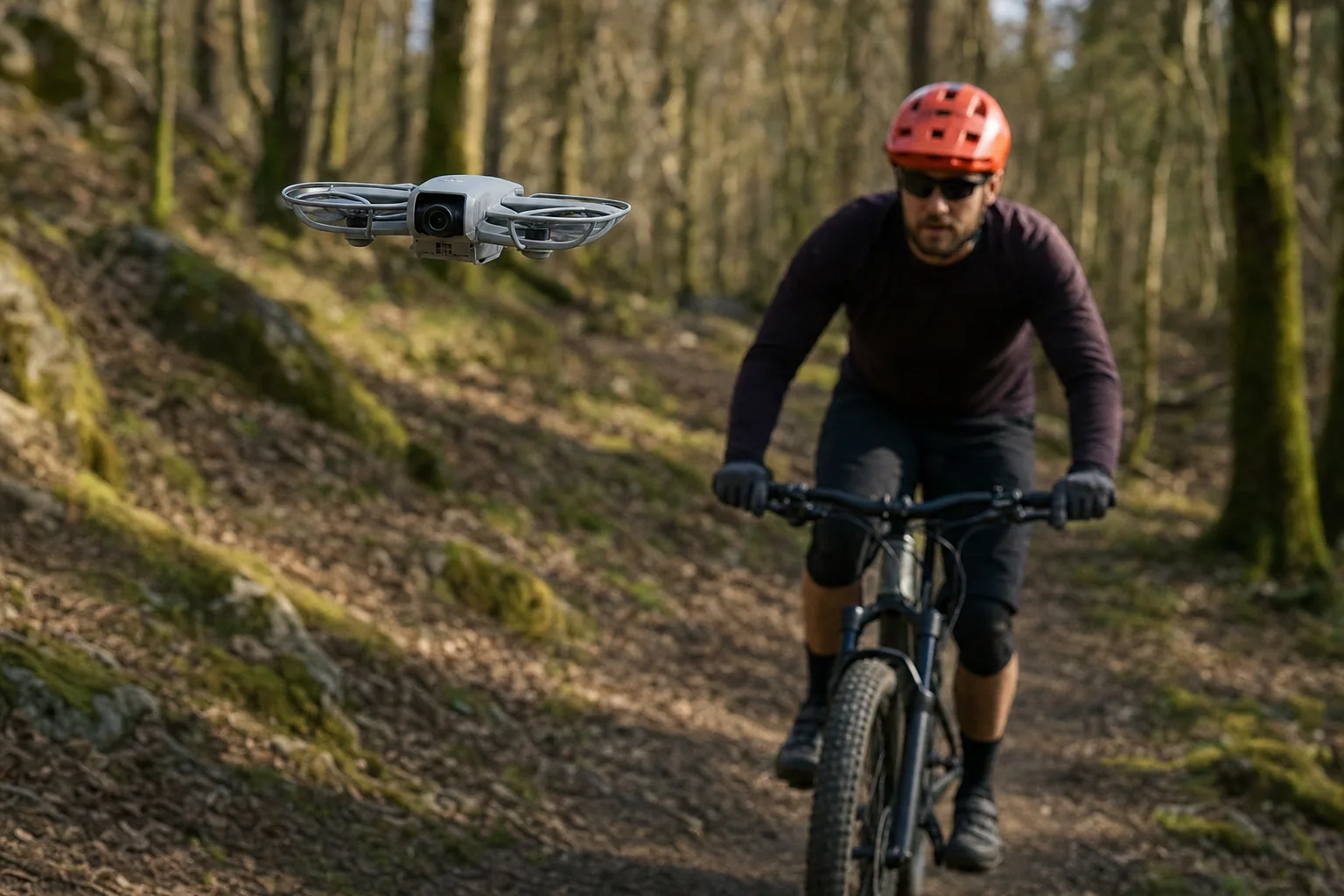
In practice this changes what the drone is. The original Neo would happily follow you into a tree; the Neo 2 flows around branches, gateposts and washing lines like water around a rock. Tracking a cyclist through gapped woodland - the classic torture test - it ducked, climbed and re-framed with only occasional hesitation, and when it did lose the subject it found them again within a second or two rather than drifting off to contemplate the sky.
The control story is equally clever, layered by how much involvement you want:
- No hardware at all: palm launch, then gesture and voice control ("DJI, follow me", "DJI, get closer"). Genuinely usable, slightly magic in public.
- Your phone: the Fly app unlocks framing, QuickShots (orbits, rockets, dronies) and manual nudging.
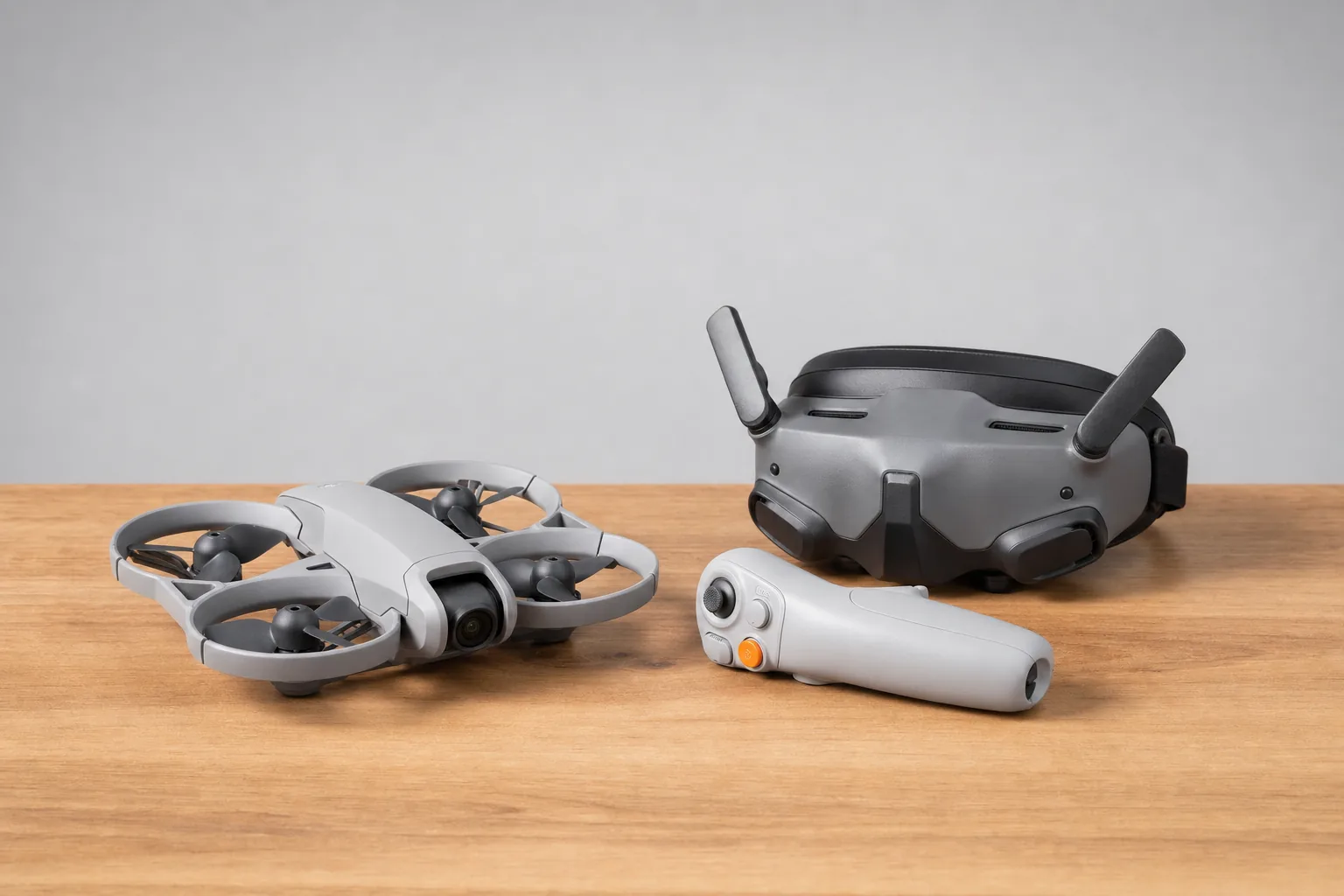
- Full FPV: with the transceiver module, the Neo 2 pairs with DJI's goggles and motion controller, turning it into the cheapest, safest entry into immersive flying DJI has ever offered. The guards mean your first FPV crashes are funny rather than expensive.
Wind handling deserves a mention: the Neo 2 copes with a stiff British breeze far better than its size suggests, holding position where the original got visibly shoved around. There's a limit - whitecaps-on-the-sea days are not Neo days - but it's no longer a still-air-only machine.
5. Battery life and the realities of range
DJI quotes up to 19 minutes per battery. Plan for 13-15 minutes of real flying - tracking modes, wind and the transceiver all take their cut. That's the Neo 2's most honest weakness, and it shapes how you use it: this is a drone for moments, not missions. Launch, grab the shot, land, pocket.
The travelling fix is the Fly More Combo (£349): three batteries and a charging hub for roughly 45 minutes of combined airtime, with the hub trickle-charging spares from a power bank between sessions. For most owners that combo is the right buy on day one - 13 minutes evaporates quickly the first time the tracking makes you grin.
Transmission range with the phone alone is short-leash (it's designed to stay near you); with the transceiver and goggles or controller it stretches to proper distances - though UK rules require visual line of sight regardless, and a 151g dot disappears from view fast. In honest use the Neo 2 lives within a couple of hundred metres, which is exactly where a follow-camera belongs.
6. Controllers, combos and what to actually buy
UK pricing breaks down into three sensible tiers:
- DJI Neo 2 (drone only) - £209. Palm launch, voice, gestures, phone app. The pure "self-flying action cam" experience, and how most people should start.
- Fly More Combo - £349. Adds two extra batteries, the charging hub and a controller. The sweet spot: triple the airtime is transformative.
- Motion Fly More Combo - £509. Adds the motion controller and FPV hardware for goggle flying. Brilliant fun, but only buy this tier if immersive flight is the point - at that money you're brushing against the Flip Fly More Combo, which is a better pure camera.
One buying note: the Neo 2 launched globally in November 2025 except the United States, so ignore any US review prices you see - UK stock is plentiful at the prices above, and that's reflected in strong UK availability and support.
See the DJI Neo 2 on Amazon UK
In stock and price-checked at the time of writing
7. Five ways owners actually use the Neo 2
Spec sheets undersell this drone, because its value lives in use cases. These are the five patterns we see again and again among real owners:
1. The training partner
Cyclists, runners and skaters use it as a coach's eye: launch, "DJI, follow me", do the lap, review the footage. Form analysis, line choice, or just proof of the gap you finally cleared. The omnidirectional sensing is what makes this viable on real trails rather than car parks.
2. The family memory machine
Beach days, park afternoons, camping trips. Because the props are caged and the launch is from a palm, it's the one drone nobody minds being airborne while kids run around - and the third-person footage of ordinary family chaos is the stuff people actually rewatch in ten years.
3. The travel B-roll tool
At 151g it costs you nothing in a rucksack, and thirty seconds of orbit shot over a harbour or hilltop transforms a holiday edit. Frequent travellers should note the sub-250g class also keeps paperwork minimal in most countries - though always check local rules abroad.
4. The FPV gateway drug
With the Motion Fly More Combo, this is the cheapest safe way to discover whether immersive flying is your thing - months of fun before deciding if a dedicated FPV machine like the Avata 2 (reviewed later in this series) is justified.
5. The content multiplier
Small creators use the Neo 2 as a second camera operator that works for free: vertical 2.7K for Shorts and Reels, orbits for intros, follow-shots for walking segments. One person becomes a crew.
8. Setup, the app, and living with it day to day
Out of the box to first flight is about fifteen minutes, most of which is account creation and a near-inevitable firmware update - DJI ships updates to this drone frequently, and they genuinely matter (tracking and sensing improvements have arrived steadily since launch). Do updates at home on Wi-Fi, never in the field with cold thumbs.
Day-to-day notes from extended use:
- The DJI Fly app is the brain. Mode selection, framing, firmware and footage transfer all live there. Transfer over the drone's own Wi-Fi link is quick enough that most owners never touch a card reader.
- Charge everything over USB-C. Drone and hub both take plain USB-C - the same charger as your phone and laptop. Pack one cable, fly all weekend (with the Fly More hub feeding batteries in rotation from a power bank).
- Pre-flight ritual worth keeping: guards clear of grass clippings, lens wiped, battery seated with a click. The Neo 2 tolerates carelessness better than any drone we've tested, but the lens-wipe habit pays for itself in every clip.
- Etiquette beats legality. You can legally fly near uninvolved people; whether you should is a different question. The Neo 2's quieter props help, but landing it when strangers look uncomfortable is the difference between drone owners being welcome and being a nuisance.
Three accessories that earn their place
The Fly More Combo (effectively mandatory - see the battery section). A 128GB microSD from a reputable brand - 4K/100 slow motion eats space at a startling rate. A soft pouch - the guards protect the props, but the lens and gimbal still appreciate not sharing a pocket with keys.
9. Neo 2 vs the alternatives: a 30-second decision
The honest decision tree, having flown them:
| DJI Neo 2 | DJI Flip | DJI Mini 4K | |
|---|---|---|---|
| Weight | 151g | <249g | <249g |
| Sensor | 1/2-inch, 12MP | 1/1.3-inch, 48MP | 1/1.3-inch, 48MP |
| Top video | 4K/60 (4K/100 slow-mo) | 4K/60 HDR, 10-bit | 4K/30 |
| Gimbal | 2-axis + EIS | 3-axis | 3-axis |
| Real flight time | ~13-15 min | ~22-25 min | ~25-28 min |
| Obstacle sensing | Omnidirectional (vision + LiDAR) | Forward 3D infrared | Downward only |
| Palm launch / guards | Yes / full | Yes / folding full | No / none |
| UK price from | £209 | £369 | ~£269 |
- Buy the Neo 2 if you want hands-free footage of yourself doing things - sport, family, travel - with zero learning curve, or the cheapest safe doorway into FPV.
- Buy the Flip instead if the footage itself is the product: bigger sensor, 3-axis gimbal, 10-bit colour and double the airtime for £160 more.
- Buy a Mini instead if you want a traditional fly-it-yourself camera drone for landscapes rather than a self-flying camera - see our Mini 4 Pro review and Mini 4K review.
10. A week in the field: three flights that define it
Spec tables tell you what a drone has. A week of ordinary British use tells you what it is. Three flights from our test period stand for the whole experience:
Flight one: the bridleway test
A gusty Tuesday evening, a wooded bridleway, a borrowed mountain bike and the exact scenario that humiliated the original Neo. Launch from the palm at the gate, "DJI, follow me", and off down the tunnel of hazel and hawthorn. The drone's path made the case for the LiDAR on its own: where the old Neo flew the straight line between it and you (through whatever foliage occupied that line), the Neo 2 visibly chose routes - swinging wide of an overhanging branch, dipping under a limb, pausing once where the canopy closed entirely, then catching up with an eagerness that reads on camera as enthusiasm. Two passes of the half-mile track, one momentary loss behind a holly bush, zero contact. The footage needed no explanation or apology when shared - which, for £209 and no pilot, is the entire revolution.
Flight two: the toddler's birthday
The use case nobody writes on spec sheets. A garden, fourteen adults, six children, cake. A naked-prop drone would have stayed in the car; the Neo 2 spent twenty minutes (two batteries) hovering at head height filming a three-year-old's chaos from angles no adult with a phone can reach, and at one point was carried indoors by a curious six-year-old, props still guarded, drama still zero. The resulting ninety-second edit - launch, orbit, cake, chase, palm landing - is the most rewatched video on a certain grandmother's phone. This is what 'fully enclosed props' actually purchases: admission to family life.
Flight three: the coastal humbling
Honesty requires the third flight. A headland car park, a stiff onshore blow, whitecaps visible - and the Neo 2, launched optimistically, spent its battery fighting to a draw. It held position, just; it tracked a walking subject, mostly; and its footage carried the micro-shudder of a 151g machine at the edge of its authority. It came home at 30% in eight minutes, and we filmed the cliffs with something heavier. Know this boundary and the Neo 2 never disappoints; ignore it and your first windy headland will teach it.
11. The settings cheat sheet: ten minutes that double the output
The Neo 2 works out of the box, but five minutes in the DJI Fly app separates default footage from footage that looks chosen:
- Video: 4K/60 as standard. Smooth motion that survives slow-down to half speed in edits. Drop to 4K/30 only when light fades and you want the longer effective shutter.
- 4K/100 is a tool, not a default. Slow motion flattens energy when overused; reserve it for the jump, the splash, the dog at full stretch - moments where time deserves stretching.
- Vertical 2.7K for anything destined for Shorts, Reels or TikTok. Shooting native vertical beats cropping horizontal footage every single time - the resolution lands where the platform looks.
- Set tracking distance before launch, not during. The follow modes offer near/far and height options: 'close and low' for running and cycling drama, 'higher and wider' for walks and family scenes. Changing mid-flight by voice works but interrupts the shot.
- Audio: yes, really. The Neo 2 can record audio via the app connection while filming - wind-affected but synced, and DJI's noise reduction makes voice notes and reactions usable. For pieces to camera it transforms the result; turn it on deliberately.
- Storage discipline: offload after every session. 4K/100 fills cards at a pace that turns 'I'll sort it Sunday' into a missed-shot Tuesday.
- Firmware on Wi-Fi nights: DJI ships meaningful tracking improvements to this drone regularly. The drone that lands in your hand in three months will genuinely fly better than the one in the box - but only if you let it update at home, not when four family members are waiting on a beach.
One omission to accept rather than fight: there's no RAW photo mode and no manual exposure beyond basics. The Neo 2 is opinionated by design; its opinions are usually right, and the moment you find them limiting is precisely the moment you've outgrown it - turn to the Flip or Mini 5 Pro with our blessing and your skills already formed.
12. Neo 2 vs the original Neo: every difference that matters
With original Neos now discounted everywhere, the upgrade question deserves its own ledger. The complete differences, ranked by how much they matter in use:
- Obstacle sensing: everything → from nothing. The original flew blind except downward; the Neo 2's omnidirectional vision-plus-LiDAR suite is the difference between a drone you supervise and one you trust. For the follow-me buyer this isn't an upgrade, it's the product working.
- Stabilisation: 2-axis gimbal vs single-axis. The original's horizon wobbled in any crosswind; the Neo 2's footage holds level and composed. Visible in every single clip.
- Camera: same 1/2-inch class, much more flexible. 4K/60 standard (vs 4K/30), 4K/100 slow motion (new), 2.7K true vertical (new). Stills remain 12MP-grade on both.
- Tracking intelligence: re-acquisition after losing you behind obstacles went from 'sometimes, eventually' to 'usually, promptly' - the firmware plus sensing dividend.
- Noise: meaningfully quieter props. The original announced itself; the Neo 2 hums.
- Weight and time aloft: 151g vs 135g; ~13-15 real minutes vs ~12-14. Effectively a wash - neither is the reason to choose either.
- What didn't change: the palm launch magic, the full prop guards, the social-first soul, and the FPV-expandability via goggles hardware.
The verdict by buyer: upgrading from a Neo you already love? Worth it only if trees, wind or vertical video are current frustrations. Choosing between the two fresh? The Neo 2's £40-80 premium over clearance originals buys the two features (sensing, gimbal) that define the experience - pay it. Gifting a first drone to someone careful with money? A clearance original Neo remains a delightful £150-class introduction whose limits teach exactly what the Neo 2 fixes.
Frequently asked questions
Do I need a licence to fly the DJI Neo 2 in the UK?
No test is required. Because it weighs under 250g you only need a CAA operator ID (a small annual registration, since it carries a camera) displayed on the drone. Standard rules still apply: keep it in sight, stay under 120m, avoid airports and never fly over crowds.
Can the Neo 2 really follow me through trees?
Mostly, yes - and this is the big upgrade. Omnidirectional sensing (vision plus LiDAR) lets it dodge branches and re-acquire you after brief occlusions. Dense woodland at speed will still defeat it occasionally; open trails, parks and streets are where it shines.
How long does the battery actually last?
DJI claims up to 19 minutes; expect 13-15 in real use with tracking active. The £349 Fly More Combo with three batteries (roughly 45 minutes combined) is the configuration most owners should buy.
Is the Neo 2 good for FPV flying with goggles?
It's the cheapest sensible entry point there is. With the transceiver, goggles and motion controller it delivers genuine immersive flight, and the full prop guards make beginner crashes survivable. Dedicated FPV pilots will outgrow it - that's what the Avata line is for.
Neo 2 or the original Neo - is the upgrade worth it?
Yes, decisively. Omnidirectional obstacle sensing, the 2-axis gimbal, 4K/100 slow motion, quieter props and better wind handling fix the original's three biggest complaints. If you see the original heavily discounted it remains fine for garden selfies, but the Neo 2 is the one to own.
Can it film in vertical format for TikTok and Reels?
Yes - 2.7K true vertical video, which is sharper than cropping a horizontal 4K frame and one of the most-used features for its social-first audience.
How loud is the Neo 2 - will it annoy people in a park?
It's the quietest drone in DJI's range - the redesigned props dropped the original's angry-wasp pitch to something closer to a distant strimmer. You'll still draw glances at close range; the difference is they're usually curious rather than irritated. Altitude and brevity remain the best etiquette tools.
Can the Neo 2 fly indoors safely?
Yes, more credibly than any other drone here: full prop guards, palm launch, omnidirectional sensing and low weight make living-room and hallway flights routine rather than reckless. Turn off any aggressive tracking modes indoors, mind ceiling fans and pets' nerves, and it's the one drone in this series that genuinely earns the phrase 'house-friendly'.
Verdict: the most fun per pound in tech right now
The Neo 2 isn't the best camera DJI makes, or the longest-flying, or the most capable. It's something rarer: the drone with the fewest reasons not to use it. It fits in a jacket pocket, launches from your hand in ten seconds, follows you with genuine intelligence, survives your mistakes, and costs £209.
Score: 9/10. Points off only for the 13-15 minute real-world battery and a camera that, while honest and likeable, runs out of talent at dusk. Buy the Fly More Combo, register your operator ID, and go film your life from the third person. It's the first drone we'd recommend to almost anyone - and the second one (for when the footage needs to get serious) is the DJI Flip, reviewed here.
Sources & further reading: official DJI Neo 2 specifications · heliguy's Neo 2 feature deep-dive · CAA drone registration · the CAA's drone rules hub.