
Anker Solix vs EcoFlow: Which Portable Power Station Should You Buy?
I've spent weeks living with these two heavyweight brands across camping trips, simulated blackouts and off-grid weekends. Here's the honest, no-nonsense verdict on capacity, recharge speed and value.
We link to the exact model on Amazon UK. Prices change often, so check the live price before you buy. As an Amazon Associate we earn from qualifying purchases.
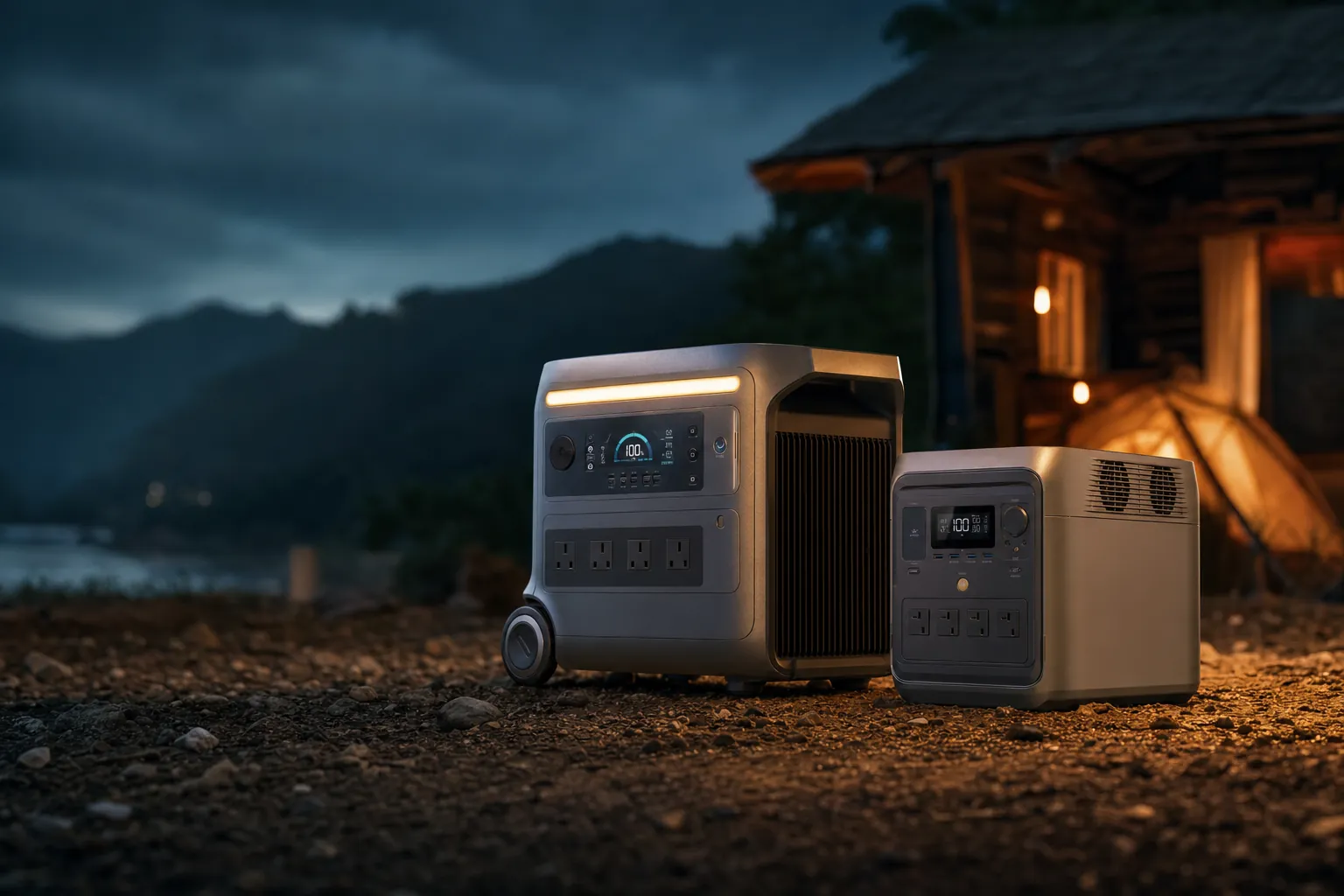
Anker Solix and EcoFlow now dominate the portable power station market — but they take very different approaches.
If you've been shopping for a portable power station in 2026, you've almost certainly bumped into the same two names again and again: Anker Solix and EcoFlow. They're the Coke and Pepsi of the battery world — both genuinely excellent, both with loyal followings, and both quietly brilliant at making you feel like you're missing out if you pick the other one. I've used both extensively, and the truth is that the "best" choice depends enormously on what you actually want the thing to do.
This guide is built around the three things that matter most when you're handing over a serious chunk of money: capacity (how much energy you can store), recharge speed (how quickly you can top it back up), and value (whether you're getting your money's worth for camping, blackouts or full off-grid living). I'll walk you through the key models in each range, throw in plenty of real specifications, and try to be honest about where each brand falls down — because no battery is perfect, no matter what the marketing says.
Whether you want a featherweight 256Wh unit to keep your phone and lights alive on a day trip, or a 180kWh whole-home monster that could run your house for a week, there's something here for you. Let's get into it.
The Two Brands at a Glance
Before we dive into individual models, it's worth understanding the philosophical difference between these two companies, because it shapes everything they make.
Anker comes at this from a charging-tech background. The brand built its name on chargers, cables and power banks, and that obsession with charging efficiency runs right through the Solix range. The headline example is the Solix C1000 Gen 2, which holds a Guinness World Record (certified 14 August 2025) as the fastest recharging portable power station in the 1kWh class — it goes from empty to 100% in just 49 minutes. That's not a marketing rounding-up; it's a verified record. Anker also leans heavily on idle efficiency, with several models drawing astonishingly little standby power.
EcoFlow, by contrast, has always been an energy company first. Its range scales dramatically, topping out with the DELTA Pro Ultra X, a whole-home backup system that pushes from 12kWh all the way to a frankly absurd 180kWh of expandable capacity. EcoFlow tends to win on raw scale, ecosystem breadth and slick app control, and it's been pushing hard on professional-grade home installation.
Both brands have now standardised on LiFePO4 (lithium iron phosphate) chemistry across their flagship lines. This is the safer, longer-lasting battery type, and it's the main reason cycle ratings have jumped to around 3,000 battery cycles — roughly a decade of regular use.
The Anker Solix Range Explained
Anker's Solix lineup has grown into a genuinely broad family, covering everything from pocket-money day-trip units to serious home backup. Here's how it breaks down.
Anker 521 — The Day-Trip Tiddler
At just 256Wh, the Anker 521 is the budget entry point. It's not going to run a fridge, but for a day out — keeping phones charged, running a small light, powering a portable speaker — it's a tidy, affordable option. Think of it as the "chuck it in the boot just in case" model rather than a serious backup device.
Anker Solix C1000 Gen 2 — The Camping Sweet Spot
See Anker Solix C1000 Gen 2 on Amazon UK
Check today's price & availability on Amazon UK
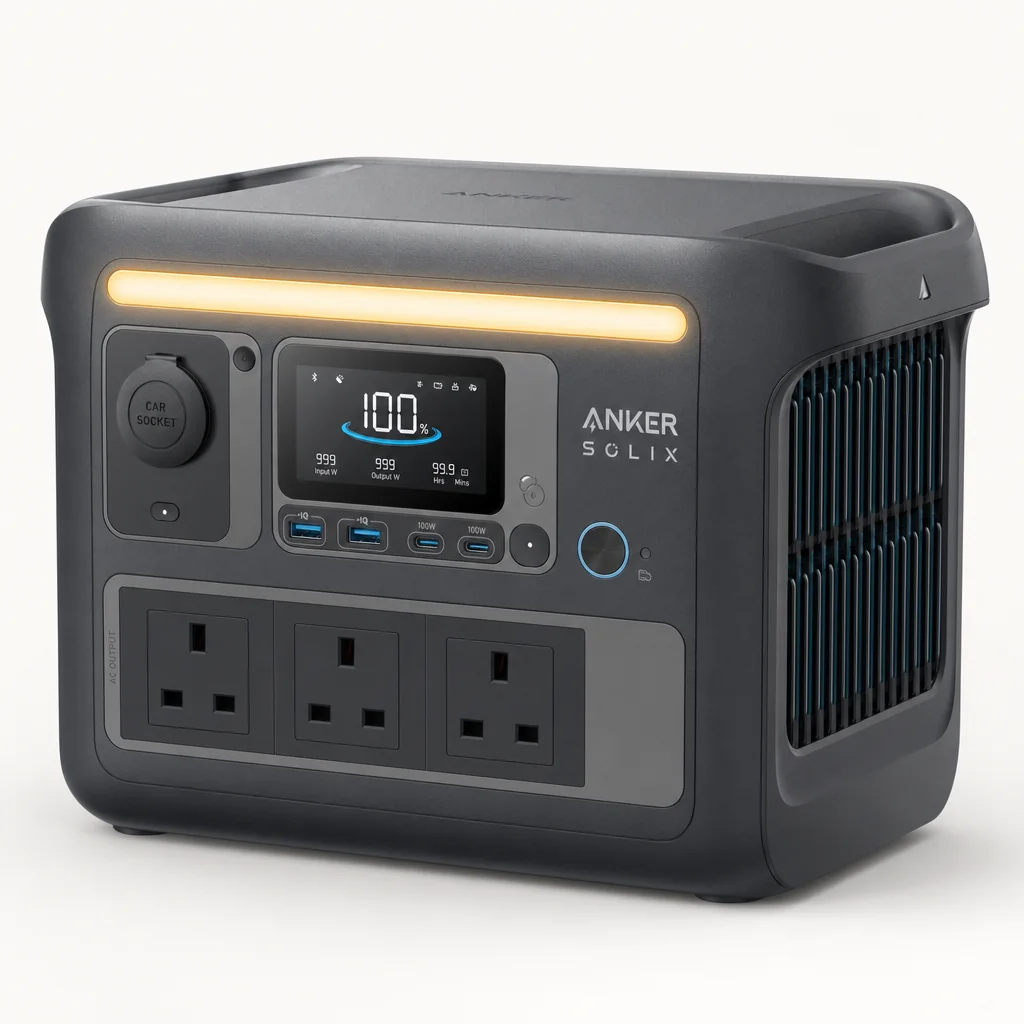
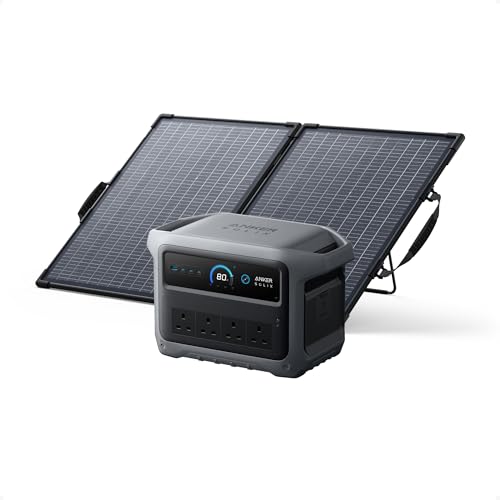
This is the model I'd point most casual buyers towards, and it's the record-breaker I mentioned earlier. It packs 1,024Wh of capacity with a 2,000W AC output, and it's built around third-generation LiFePO4 cells with Anker's InfiniPower technology, rated for up to 4,000 charge cycles. The headline trick is that 49-minute full recharge via AC, drawing up to 1,600W of input.
The Solix C1000 Gen 2 is compact, light and recharges faster than anything else in its class.
What makes the C1000 Gen 2 so likeable in person is its size-to-power ratio. It measures 384×208×244mm and weighs 11.3kg — Anker claims that's 14% smaller and 11% lighter than comparable 1,024Wh units, and lugging it across a campsite, I can believe it. It carries five AC output ports and three USB-C ports (two of them rated at a meaty 140W each), so it'll fast-charge a modern laptop without breaking a sweat.
It also doubles as an uninterruptible power supply. The C1000 Gen 2 has UL-1778 certified UPS functionality with a transition time of under 10 milliseconds, which means sensitive electronics — a desktop PC, a NAS, a router — won't even notice the mains has dropped out. Its SurgePad technology can briefly boost output to 3,000W for power-hungry tools and appliances.
Pro Tip
That 600W solar input recharging the C1000 Gen 2 in just 1.8 hours is genuinely transformative for off-grid use. Pair it with a folding solar panel and you can effectively keep a small campsite running indefinitely on a sunny day, topping the battery back up faster than you drain it.
Anker Solix S2000 — The Blackout Specialist
Shop Anker Solix S2000 on Amazon UK
Check today's price & availability on Amazon UK
Released in May 2026, the S2000 is clearly tuned for home backup rather than camping. It offers 2,010Wh of LiFePO4 capacity with 1,500W of continuous AC output. The clever bit is its idle efficiency: Anker's OptiSave technology cuts standby draw dramatically, to under 6W with the AC on and just 2W with all outlets disabled — a 40–70% reduction over older designs.
Why does that matter? Because for blackout protection, your power station might sit fully charged for weeks waiting for an outage. A unit that quietly bleeds energy whilst idling is far less useful than one that sips it. Anker backs this up with a TÜV SÜD A+ Runtime certification for up to 35 hours of refrigerator backup on a single charge, and it maintains over 90% efficiency under light loads.
Anker Solix C2000 Gen 2 — The Versatile Middleweight

See Anker Solix C2000 Gen 2 on Amazon UK
Check today's price & availability on Amazon UK
The C2000 Gen 2 sits between camping and home use. It delivers 2,400W of output and is expandable to 4kWh, making it a smart pick if you think your needs might grow. Like the S2000, it benefits from OptiSave, trimming idle consumption to just 9W — Anker says that's enough efficiency to keep a dual-door fridge running for 32 hours or more. Its LiFePO4 cells carry the same 4,000-cycle, roughly ten-year lifespan rating.
Anker Solix F3000, F3800 & F3800 Plus — The Home Backup Flagships
Shop Anker Solix F3000, F3800 on Amazon UK
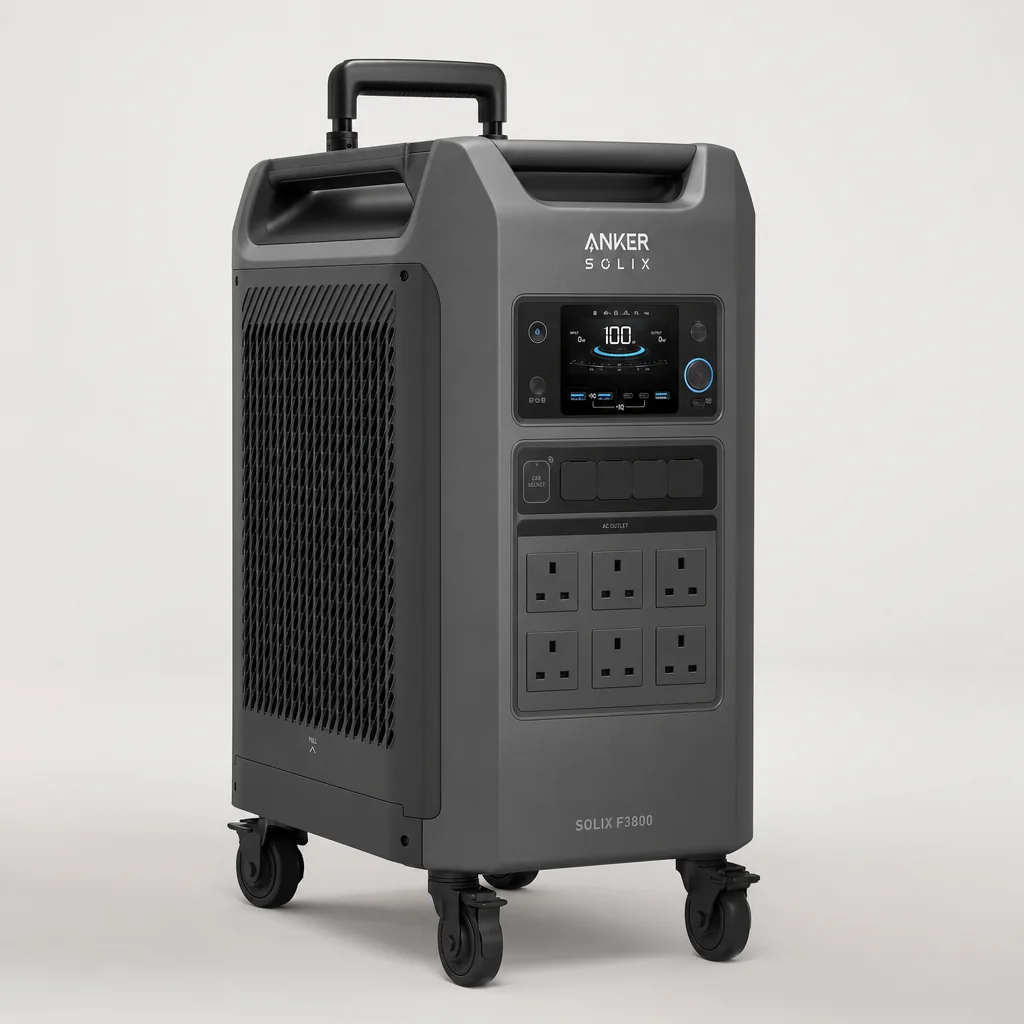
At the top of the range sit the F-series whole-home units. The F3000 offers 3,072Wh of LiFePO4 capacity, whilst the flagship F3800 steps up to 3,840Wh with a hefty 6,000W AC output and EV-class LFP batteries with a smart temperature management system.
Serious Expandability
The UK F3800 starts at 3.84kWh and expands to about 26.9kWh with six expansion batteries. The 26.88kWh figure quoted elsewhere requires two complete systems, so do not plan around it as a single unit.
Rapid Solar Charging
Up to 2,400W of dual 60V solar charging fully recharges the F3800 in under two hours in optimal sunlight.
Dual-Voltage Output
230V output handles high-voltage appliances as well as standard ones — important for running heavier kit.
EV & RV Ready
Those NEMA 14-50 and L14-30 outlets are on the North American model. The UK F3800 is a 230V unit and does not carry them, so treat US EV and RV hook-up claims as not applicable here.
Long Warranty
A 5-year warranty backs the F3800, with a 10-year lifespan thanks to InfiniPower technology.
The F3800 Plus is the expandable variant of the F3800 and sits as Anker's top-tier home backup proposition for those who want maximum headroom.
The EcoFlow Range Explained
EcoFlow's lineup is arguably even broader, and its naming convention — DELTA and RIVER, with a confetti of suffixes — takes a moment to get your head around. Let me untangle it.
EcoFlow's DELTA 3 family spans everything from light portable units to robust off-grid backup.
EcoFlow RIVER 3 — The Compact Companion

See EcoFlow RIVER 3 on Amazon UK
Check today's price & availability on Amazon UK
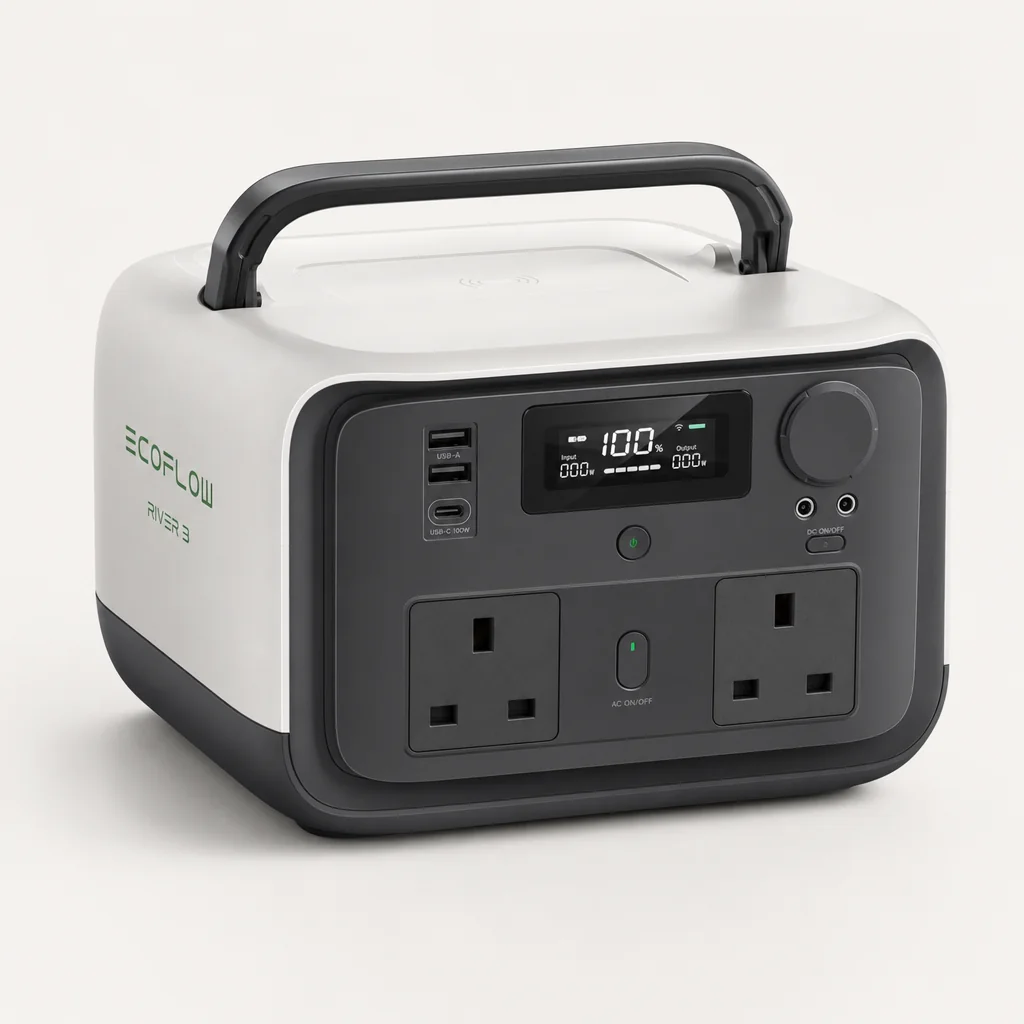
At the bottom of the range, the RIVER 3 starts at £179, making it EcoFlow's most affordable tier. It's the small, grab-and-go unit aimed at keeping essentials ticking over — the EcoFlow equivalent in spirit to Anker's little 521.
EcoFlow DELTA 3 Classic — The Entry Backup
See EcoFlow DELTA 3 Classic on Amazon UK
Check today's price & availability on Amazon UK
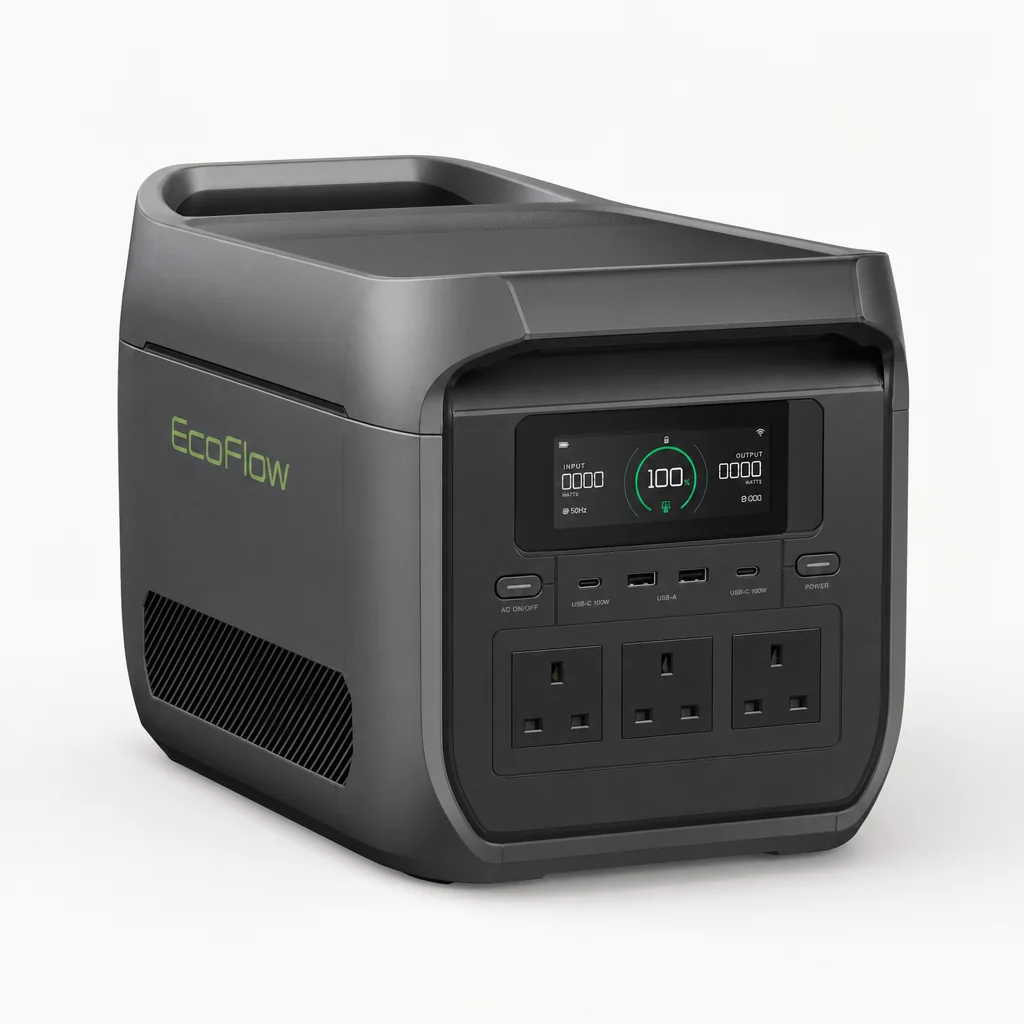
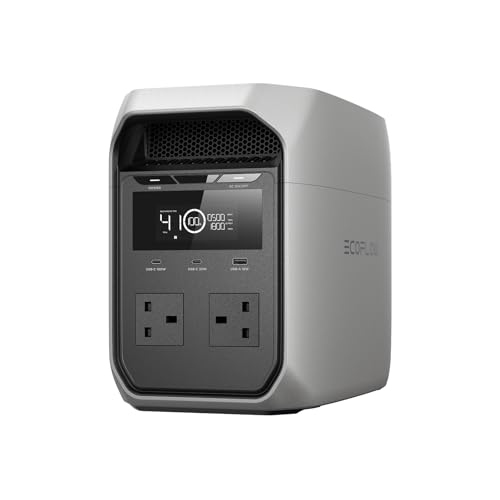
The DELTA 3 Classic is the entry point into EcoFlow's home backup and outdoor world. It's pitched at people who want essential blackout protection without spending big, and it's a sensible first step for anyone nervous about over-buying.
EcoFlow DELTA 3 2000 Air — The Lightweight 2kWh Unit
Shop EcoFlow DELTA 3 2000 Air on Amazon UK
Released in March 2026, the DELTA 3 2000 Air is one of EcoFlow's most interesting recent launches. It carries 1,920Wh of storage in a deliberately lightweight package, with 1,000W of rated output and a 1,500W surge capacity through dual AC outlets. It measures 220×223×426mm, which is impressively compact for the capacity.
EcoFlow positions the 2000 Air for household backup, vehicle use and outdoor applications — it's designed to support refrigerators, lighting, notebook PCs and communications equipment during a blackout. The "Air" in the name signals the focus on portability, and that lightweight design is its real selling point.
DELTA 3 Plus, Max Plus & Ultra Plus — The Mid Range

See DELTA 3 Plus, Max Plus on Amazon UK
Check today's price & availability on Amazon UK
This is where EcoFlow's range gets dense. The DELTA 3 Plus is widely regarded by reviewers as the best all-rounder, balancing capacity, output, expandability and versatility at its price point. Above it, the DELTA 3 Max Plus ramps up capacity and output for more demanding home and outdoor needs, whilst the DELTA 3 Ultra Plus targets robust home backup and proper off-grid living.
One genuinely useful upgrade across the DELTA 3 series is the UPS switchover, now improved to under 10ms (down from 30ms on the older DELTA generation). That brings it in line with Anker's C1000 Gen 2 and makes it safe for sensitive electronics.
EcoFlow DELTA Pro Ultra X — The Whole-Home Titan
Shop EcoFlow DELTA Pro Ultra X on Amazon UK
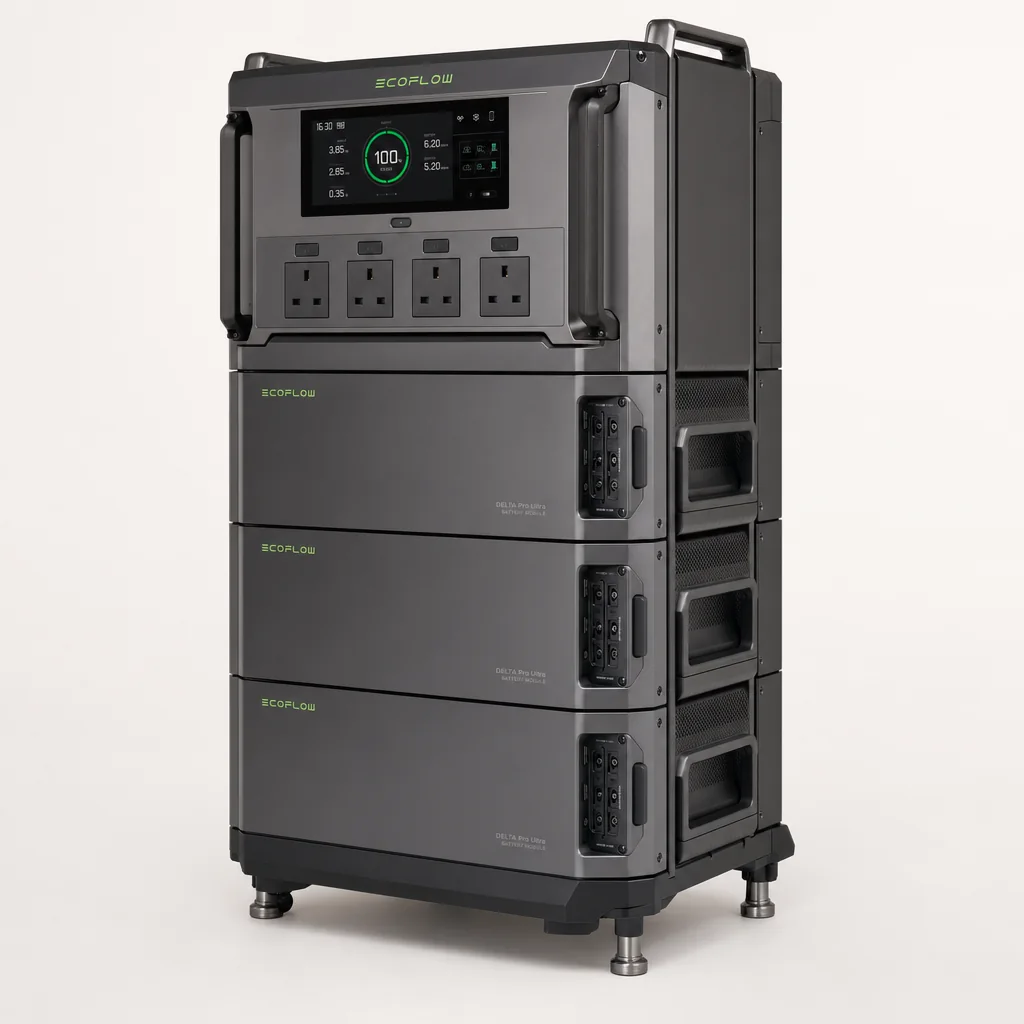
And then there's the big one. The DELTA Pro Ultra X is EcoFlow's flagship whole-home backup system, delivering 12–36kW of output and 12–180kWh of capacity. To put that in perspective, a single unit produces 12kW of output and 12kWh of base capacity — already enough to run most of a home — and it scales from there to genuinely off-grid-property levels.
The 2026 models carry a 4,000-cycle LFP rating to 80% capacity, and EcoFlow has clearly poured engineering into making installation painless — a "plug & play" setup in seven days, which is impressive for a system of this scale. It was also named a 2026 Honoree in Sustainability & Energy Transition for redefining whole-home backup, so it's not just big, it's well-regarded too.
Recharge Speed: Where Anker Pulls Ahead
If recharge speed is your priority — and for camping and off-grid use it genuinely should be — Anker has the upper hand. The Solix C1000 Gen 2's 49-minute full charge is the benchmark to beat, and that Guinness World Record isn't an accident; Anker has obsessed over this metric for years.
Here's a rough visual comparison of charging performance across the units I've discussed. Bear in mind these aren't apples-to-apples capacities, but they show how the brands prioritise speed differently.
The takeaway: at the portable end, Anker's charging speed is unmatched. The C1000 Gen 2 hitting 100% in under an hour is a game-changer when you're at a campsite with a brief window of mains power, or when bad weather has cut your solar window short and you need to top up from a generator quickly.
Why Recharge Speed Matters More Than You Think
People obsess over capacity, but in real off-grid life, recharge speed is often the bigger deal. A smaller battery that recharges in 49 minutes can effectively outperform a bigger one that takes hours, because you can cycle it more often. If you've got intermittent mains or solar access, fast charging turns a modest battery into a near-endless supply.
Capacity & Expandability: Where EcoFlow Wins Big
If recharge speed is Anker's trophy, raw capacity is EcoFlow's. Whilst Anker's F3800 expands to a very respectable 26.88kWh, EcoFlow's DELTA Pro Ultra X scales to a barely-believable 180kWh. That's a different category of ambition — we're talking about powering an entire off-grid property, not just keeping the fridge cold during a storm.
That said, expandability cuts both ways. For the vast majority of buyers — campers, weekenders, people who just want blackout insurance — neither brand's ceiling will ever be reached. The expandability arms race mostly matters if you're building a permanent off-grid setup or trying to run an entire house indefinitely.
| Spec | Anker Solix (flagship) | EcoFlow (flagship) |
|---|---|---|
| Top portable capacity | F3800: 3,840Wh | DELTA 3 2000 Air: 1,920Wh |
| Max expandable capacity | 26.88kWh (F3800) | 180kWh (DELTA Pro Ultra X) |
| Top output | 6,000W (F3800) | 12–36kW (DELTA Pro Ultra X) |
| Fastest 1kWh recharge | 49 min (C1000 Gen 2) | 27 minutes |
| UPS switchover | <10ms (C1000 Gen 2) | <10ms (DELTA 3 series) |
| Cell chemistry | LiFePO4 / InfiniPower | LiFePO4 |
| Cycle rating | Up to 3,000 battery cycles | 3,000 battery cycles (2026) |
Notice how neatly the two brands carve up the territory. Anker dominates the fast-recharge, mid-capacity portable space; EcoFlow runs away with the whole-home, mega-capacity space. In the overlapping middle ground — that 1.9–2kWh bracket where the DELTA 3 2000 Air, C2000 Gen 2 and S2000 all live — it genuinely comes down to your specific priorities.
Portability & Idle Efficiency
For camping, two things dominate the experience: how heavy the unit is to carry, and how little energy it wastes whilst sitting around.
On weight, Anker's C1000 Gen 2 is the star, at 11.3kg with that class-leading size-to-power ratio. EcoFlow's DELTA 3 2000 Air counters with a deliberately lightweight design and a compact 220×223×426mm footprint — clearly engineered to be lugged around. Both are far more manageable than the older, brick-like power stations of a few years ago.
On idle efficiency, Anker has made this a real selling point. The S2000's sub-6W idle draw (and just 2W with outlets off) and the C2000 Gen 2's 9W idle figure are genuinely impressive. If you're buying for blackout insurance — where the unit sits charged and waiting — that low standby draw means it holds its charge for far longer between top-ups.
Anker Solix Strengths
- Record-breaking 49-minute recharge on the C1000 Gen 2
- Excellent idle efficiency (down to 2–9W) for blackout standby
- Class-leading weight and size on portable models
- Strong USB-C output (140W ports) for laptops
- TÜV SÜD A+ runtime certification on the S2000
Anker Solix Limitations
- Top expandable capacity (26.88kWh) trails EcoFlow's ceiling
- Some newer models have limited real-world availability so far
- Range naming can be confusing across generations
EcoFlow Strengths
- Unmatched expandability up to 180kWh on the Pro Ultra X
- Huge 12–36kW output for whole-home backup
- Improved sub-10ms UPS across DELTA 3 series
- Lightweight, compact DELTA 3 2000 Air for portability
- Award-recognised whole-home system with quick installation
EcoFlow Limitations
- Portable models don't match Anker's recharge speed records
- Dense, suffix-heavy naming is genuinely confusing
- Flagship systems are overkill (and overpriced) for most buyers
Best Picks by Use Case
Rather than crown a single winner — which would be daft, given how differently these two carve up the market — let me give you my recommendation for each kind of buyer.
The right power station depends entirely on whether you're camping, prepping for blackouts, or going fully off-grid.
For Camping
The Anker Solix C1000 Gen 2 is my top pick. It's light at 11.3kg, recharges in 49 minutes, takes 600W of solar for a 1.8-hour solar top-up, and the 140W USB-C ports keep laptops and phones happy. Perfect for weekends off-grid.
For Blackouts
The Anker Solix S2000 shines here, with its TÜV-certified 35 hours of fridge backup and ultra-low idle draw. The EcoFlow DELTA 3 Plus is the best all-round alternative if you want EcoFlow's app ecosystem.
For Off-Grid Living
The EcoFlow DELTA Pro Ultra X is unrivalled, scaling to 180kWh and 36kW output. If you want fast solar recharging at a slightly smaller scale, Anker's F3800 (26.88kWh expandable, <2h solar recharge) is the strong alternative.
For Day Trips & Budgets
The EcoFlow RIVER 3 at £179 or the Anker 521 (256Wh) are the affordable grab-and-go choices — ideal for keeping phones, lights and small devices alive without spending big.
Checking Current Prices
Pricing on these units shifts constantly with seasonal bundles, solar-panel kits and flash sales, so it's always worth verifying before you buy.
Check the latest price and any current bundles on Amazon.
How They Rate Overall
Having weighed up capacity, recharge speed, portability, efficiency and overall value, here's how I'd score the two flagships for their respective sweet spots. These ratings reflect each brand at what it does best — Anker for fast, portable power, EcoFlow for large-scale backup.
The scores tell the story neatly: these are both superb products that excel at completely different things. The C1000 Gen 2 is the portable champion; the DELTA Pro Ultra X is the whole-home heavyweight. Choosing between them isn't about which is "better" — it's about which job you're hiring it for.
Frequently Asked Questions
Both ranges have matured into genuinely excellent products — the right choice is about matching the tool to the task.
The Verdict
After living with both brands, my honest conclusion is that there's no universal winner — and anyone who tells you otherwise is oversimplifying. Anker Solix is the brand to beat for portable power, fast recharging and idle efficiency. The Solix C1000 Gen 2's record-breaking 49-minute charge, 11.3kg weight and clever UPS make it my default recommendation for campers and anyone who values speed and convenience. The S2000, with its TÜV-certified 35 hours of fridge backup and sub-6W idle draw, is a superb dedicated blackout machine.
EcoFlow, meanwhile, owns the high end. If you're building an off-grid property or want a system that can run your entire home for days, the DELTA Pro Ultra X's 180kWh ceiling and 36kW output are in a league Anker simply doesn't reach. And the DELTA 3 2000 Air proves EcoFlow can still play the lightweight, portable game when it wants to.
So here's my simple rule of thumb: buy Anker if you prioritise recharge speed, portability and blackout efficiency; buy EcoFlow if you prioritise maximum capacity, raw output and serious off-grid scale. Both are genuinely excellent — and whichever you choose, you're getting a power station that would have seemed like science fiction just a few years ago.
Quick Summary
Best for camping: Anker Solix C1000 Gen 2 · Best for blackouts: Anker Solix S2000 · Best for off-grid: EcoFlow DELTA Pro Ultra X · Best budget grab-and-go: EcoFlow RIVER 3 or Anker 521 · Best all-rounder (EcoFlow): DELTA 3 Plus.
- Anker Solix C1000 Gen 2View on Amazon
- Anker Solix S2000View on Amazon
- Anker Solix C2000 Gen 2View on Amazon
- EcoFlow RIVER 3View on Amazon
- EcoFlow DELTA 3 ClassicView on Amazon
- DELTA 3 Plus, Max PlusView on Amazon