SK Hynix’s $26.5bn Nasdaq Debut Is the Biggest by a Foreign Firm
The South Korean memory-chip giant has raised $26.5 billion in a record US listing, but its shares quickly faced a sharp post-debut sell-off.
What you need to know
- SK Hynix raised $26.5 billion in its Nasdaq ADR offering, the largest US listing by a foreign company.
- The company’s ADRs trade under SKHY, offering UK investors with US market access a more direct route to the chipmaker.
- The listing bankrolls new chip production and packaging capacity as AI data centres continue to strain global memory supplies.
SK Hynix has raised $26.5 billion (£20.9 billion at an indicative $1.27 to £1 rate) through its Nasdaq American depositary receipt offering, making it the largest-ever US listing by a foreign company. The South Korean memory-chip maker began trading on Friday 10 July under the temporary ticker SKHYV, before switching to its permanent Nasdaq ticker, SKHY, on Monday 13 July.
The blockbuster raise overtakes Alibaba’s $25 billion US debut in 2014. SK Hynix sold 177.9 million ADRs at $149 each, with every ADR representing one-tenth of an ordinary share traded in Seoul. The structure gave US-based investors a way to buy into the company at roughly a tenth of the price of a full South Korean share.
Demand was formidable. Orders reportedly totalled around $171 billion, more than seven times the shares available. SK Hynix’s ADRs opened at $170 and ended their first Nasdaq session 13% higher at $168.01, after being priced at a 2.7% premium to the company’s three-day average share price in Seoul.
A record raise for the AI memory boom
SK Hynix sits in a particularly valuable position in the AI supply chain. It controls around 57% of the high-bandwidth memory market, the specialised memory used by AI servers, and counts Nvidia and Apple among its customers. The company has sold out its full 2026 memory supply, giving it unusual pricing power in a sector better known for dramatic booms and busts.
Chairman Chey Tae-won described the moment in an interview with CNBC on the debut day as “a kind of dream, and now it’s a dream come true.” Asked about demand for HBM, he said: “The demand is enormous, exponentially, so I don’t really see” signs that it is shrinking.
The company’s financial turnaround has been equally striking. SK Hynix nearly declared bankruptcy in 2001 and posted an annual operating loss of 7.73 trillion won in 2023. In 2025, however, it recorded revenue of 97.1 trillion won ($64.1 billion) and net income of 42.9 trillion won ($28.3 billion), a 44% net profit margin. It joined the trillion-dollar market-cap club in May, then briefly surpassed Samsung in June as South Korea’s most valuable company.
Where the money is going
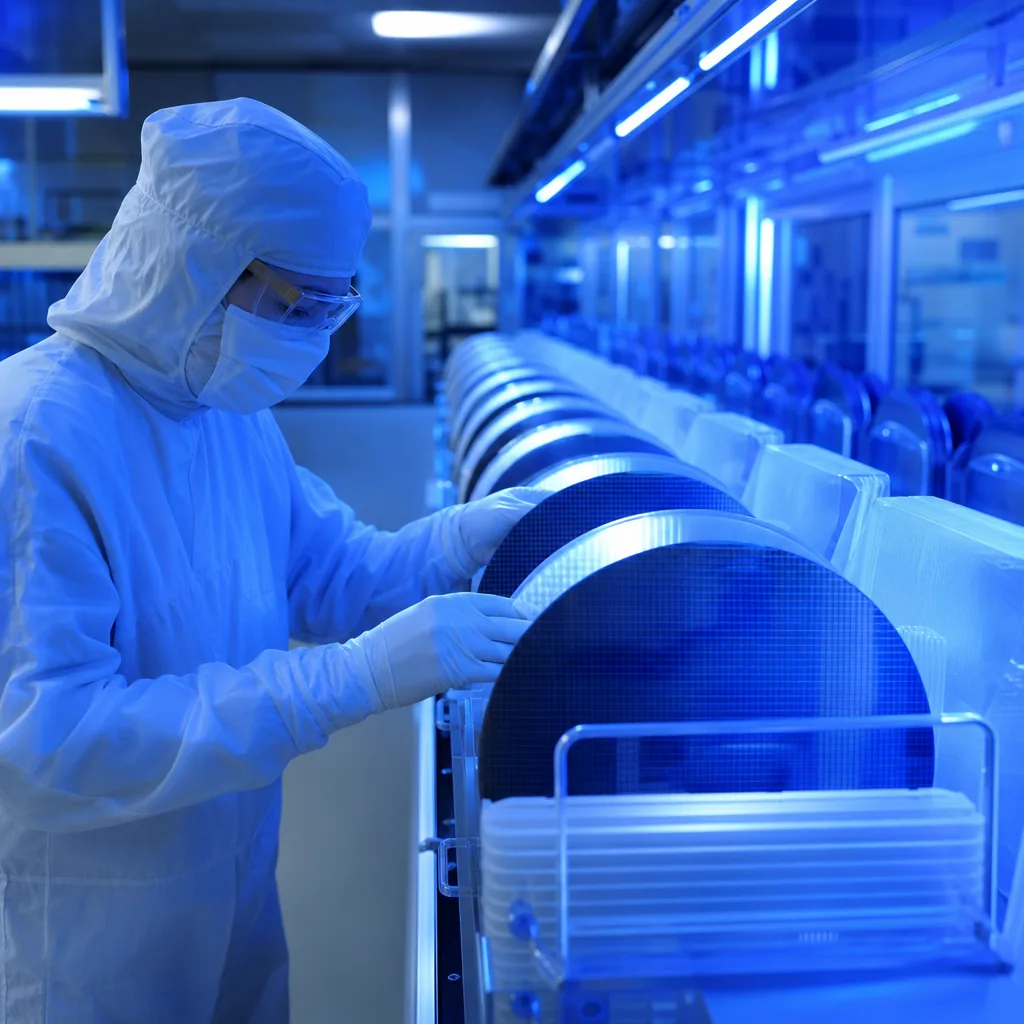
The proceeds are intended to fund an extensive manufacturing expansion, chiefly in South Korea. SK Hynix plans to build the first fabrication facility at its Yongin semiconductor cluster in Gyeonggi, expand its Cheongju P&T7 advanced-packaging plant and increase wider production capacity. It has set aside 11.9 trillion won ($7.9 billion) for extreme ultraviolet lithography equipment through the end of next year.
Yongin is central to the plan: the wider cluster of chip fabrication plants is expected to cost $390 billion. SK Hynix has also announced a $4 billion advanced-packaging plant in Indiana, where some HBM will be packaged. But the bulk of its planned expansion remains in South Korea.
That distinction matters amid US political pressure. Commerce Secretary Howard Lutnick has publicly urged both SK Hynix and Samsung Electronics to build memory-chip manufacturing facilities in the US. SK Hynix has not committed to a new American fab, however. Chief executive Kwak Noh-jung said a final location had not been selected from candidates including the US, Japan and Southeast Asia, with land, power, water and skilled workers all key factors.
“We forecast that next year will be the worst year in the industry’s history from the supply perspective,” Kwak told Reuters on 10 July. “Our customer demand continues to go up, while our capacity has limitations.”
A sudden comedown after the debut
The celebratory opening did not last. On Monday 13 July, SK Hynix shares in Seoul fell 15.4%, their biggest decline on record according to LSEG data. The fall followed an earnings note from Korea Investment & Securities, reports that full-scale HBM4 shipments had not ramped during the second quarter, and a wider market shock after US Central Command announced airstrikes against Iran and Iran’s Revolutionary Guard Corps threatened a Strait of Hormuz blockade. Oil prices rose sharply.
By the close of US trading that day, SKHY ADRs had dropped 9.32% to $152.35, only $3.35 above their $149 offering price. Analysts nevertheless said the pullback was likely to be temporary, arguing that AI-related demand still exceeds available supply and that shares could move “in the right direction” over the next six to 12 months despite near-term volatility.
Why UK buyers should care
This may sound like a distant stock-market story, but memory shortages are already affecting consumer technology. AI data centres are estimated to consume 70% of memory chips made worldwide, tightening supplies for the components used in laptops, smartphones and tablets. The shortage has helped push up device prices for products from companies including Microsoft and Apple.
New fabs and packaging plants can ease the squeeze, but they take years to build. Morningstar analyst Jing Jie Yu warned that new capacity takes “two to three years at the minimum” to arrive, while a later rush of supply can create oversupply if demand eases. For now, SK Hynix’s record Nasdaq listing gives the company a larger war chest to chase AI demand — and gives UK investors whose brokers offer US-market access a direct route to its shares for the first time.
Why it matters
SK Hynix is one of the companies at the centre of the AI memory shortage, and that pressure is already feeding through to laptops, tablets and smartphones. More manufacturing capacity should eventually help, but fabs take years to build and the company expects demand to exceed supply beyond 2030. For UK investors able to trade US shares, SKHY creates a direct way to invest in the dominant supplier of high-bandwidth memory.