
Etched Reaches $10.3bn Valuation With SK Hynix Backing
The San Jose AI chip startup has raised $300 million in a Sequoia-led Series C as it prepares to ship its first Sohu inference racks.
What you need to know
- Etched raised $300 million at a $10.3 billion valuation in a Sequoia-led Series C announced on 23 July.
- SK Hynix joined a16z, Jane Street and Diffusion in the round, which doubled Etched’s valuation in around seven months.
- Its Sohu chip is built for AI inference, but its headline speed and efficiency figures have not yet been independently verified.
AI chip startup Etched has raised $300 million at a $10.3 billion valuation, with memory maker SK Hynix among the backers of a new Sequoia-led Series C round announced on 23 July.
The San Jose company, which only emerged from stealth on 30 June, has now doubled its valuation in roughly seven months. Etched was valued at $5 billion when it raised $500 million in December 2025. Co-founder Rob Wachen confirmed the latest financing and valuation to TechCrunch.
The round also includes a16z, Jane Street and Diffusion. Etched says it is the highest valuation ever for a Sequoia-led Series C, a striking figure for a company that has only recently publicly disclosed its hardware. Across its seed, 2024, 2025 and latest rounds, Etched has raised approximately $925.4 million.
A specialist chip for serving AI models
Etched’s bet is that the next major AI infrastructure battle will be about inference: the repeated process of running a trained model to answer prompts, generate images, power software features or support autonomous agents. Training a frontier model is expensive, but it is a periodic cost. Serving that model at scale is the continuing bill.
Its Sohu chip is an application-specific integrated circuit, or ASIC, designed specifically for transformer inference rather than the broad range of tasks handled by a general-purpose GPU. The chip is fabricated on TSMC’s N4P, 4-nanometre process and includes 144GB of HBM3 memory per chip.
Etched says Sohu was designed around the two distinct stages of inference: prompt processing, also known as prefill, which is compute intensive; and decode, the stage that generates output tokens and places heavier demands on memory bandwidth. The company packages the chips into what it calls frontier inference clusters, combining hardware, custom racks and software.
The startup also promotes a “Low Voltage Inference” architecture. It says this targets less than half the voltage used by conventional AI chips, while sustaining more than 80% of peak floating-point operations on trillion-parameter sparse mixture-of-experts models. Lower voltage can mean less heat and smaller cooling and power requirements, two increasingly important considerations for data centre operators.
Big claims, but no independent benchmarks
Etched’s performance assertions are ambitious. The company claims that one server containing eight Sohu chips can deliver more than 500,000 tokens per second on Llama-3 70B and replace 160 Nvidia H100 GPUs. It also estimates that Sohu can run transformer inference around 20 times faster than an H100 while using significantly less energy.
Those are vendor claims, not independently verified results. There are no public third-party benchmarks for Sohu, the chip has not shipped in volume, and there is no self-serve service allowing developers to rent access to one today. Public pricing has not been disclosed either.
Etched says its systems can run models including DeepSeek and Qwen, which use mixture-of-experts designs, alongside Mamba, a non-transformer state-space model architecture. When it exited stealth in June, the company said it had achieved first-pass, or A0, silicon success and had rack-scale systems running DeepSeek, Qwen, Mamba and Llama.
“Now is the time to be aggressive. Our chips work, people want them, and it’s time to ship,” said Gavin Uberti, Etched’s co-founder and chief executive.
From stealth to production push
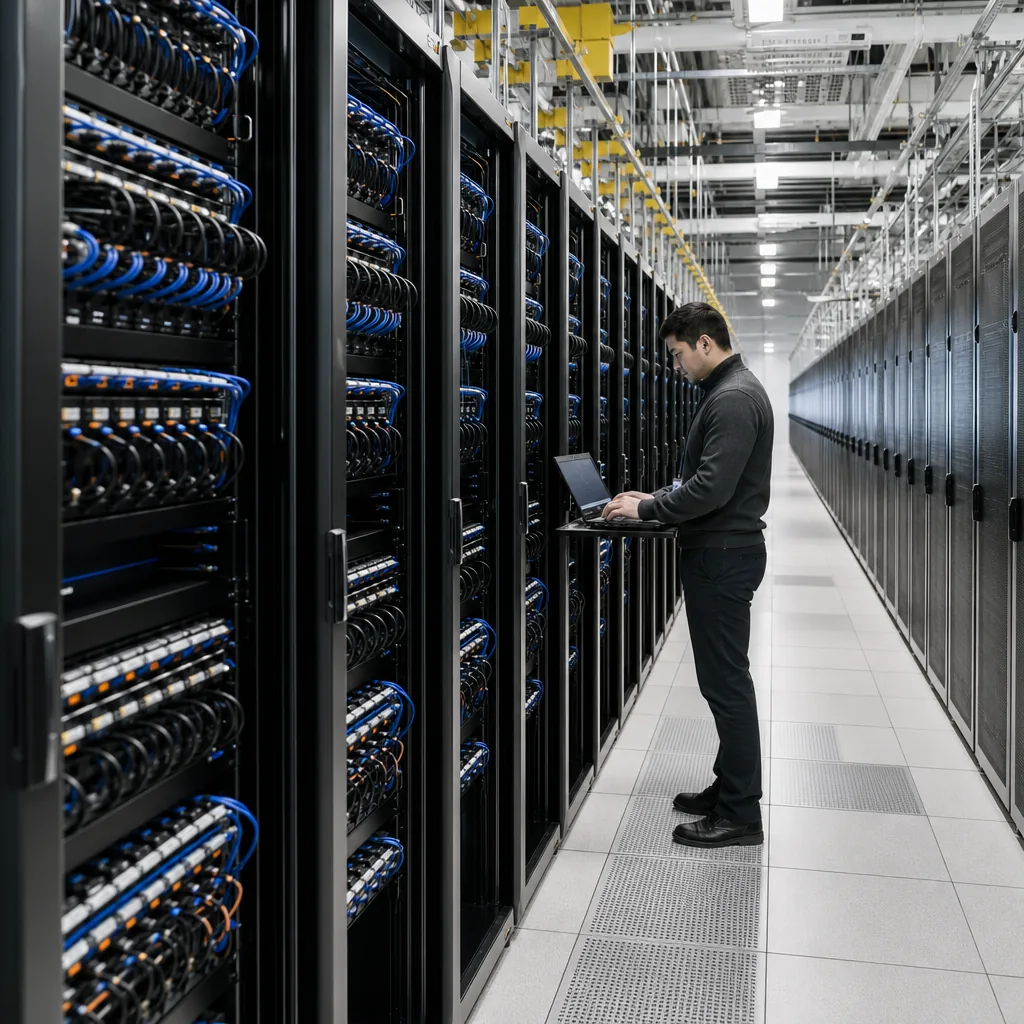
Etched employs around 400 people at its San Jose office, where it operates a 2MW data centre. It has also opened an 80,000-square-foot, 10MW facility in nearby Milpitas. That site will house a surface mount technology production line intended to speed up appliance assembly, as well as serving as a prototyping lab.
The company has a factory in Taiwan and says it has more than $1 billion in signed customer contracts, with first racks due to ship this summer. Its longer-term target is to scale production towards gigawatt capacity by 2027.
“We tend not to celebrate fundraises. We have a lot of work to do to get to Gigawatt scale,” said Wachen. “The team is working around the clock with our early customers to bring our first product to life.”
A crowded challenge to Nvidia
Etched is entering a fast-moving market for AI inference silicon. Cerebras went public in May 2026 at a valuation of nearly $56 billion, while Nvidia bought Groq for about $20 billion in December 2025. Microsoft-backed d-Matrix raised $275 million at a $2 billion valuation around the same time.
For ordinary UK buyers, Etched is not a product to put in a shopping basket. Its importance is indirect: if specialist chips genuinely make it cheaper and faster to serve leading AI models, the savings could reach the services used every day, from chatbots to workplace tools. But that remains conditional on Etched proving its claims outside its own testing, delivering systems at scale and expanding availability beyond its small group of early customers.
Why it matters
Etched does not sell chips or systems directly to UK consumers, but cheaper AI inference could eventually lower the cost of chatbots, productivity software and other AI services. More credible competition in specialist inference hardware could also challenge Nvidia’s pricing power and help ease infrastructure constraints. For now, though, Sohu’s performance claims remain unverified and its availability is limited to early customers.