
Samsung HW-QS90H Review: A Soundbar That Fires Sound Around the Room
Samsung's ambitious one-box Atmos soundbar delivered enormous width, serious built-in bass and unusually clear dialogue — but its overhead effects still depended on your ceiling doing its bit.
We link to the exact model on Amazon UK. Prices change often, so check the live price before you buy. As an Amazon Associate we earn from qualifying purchases.
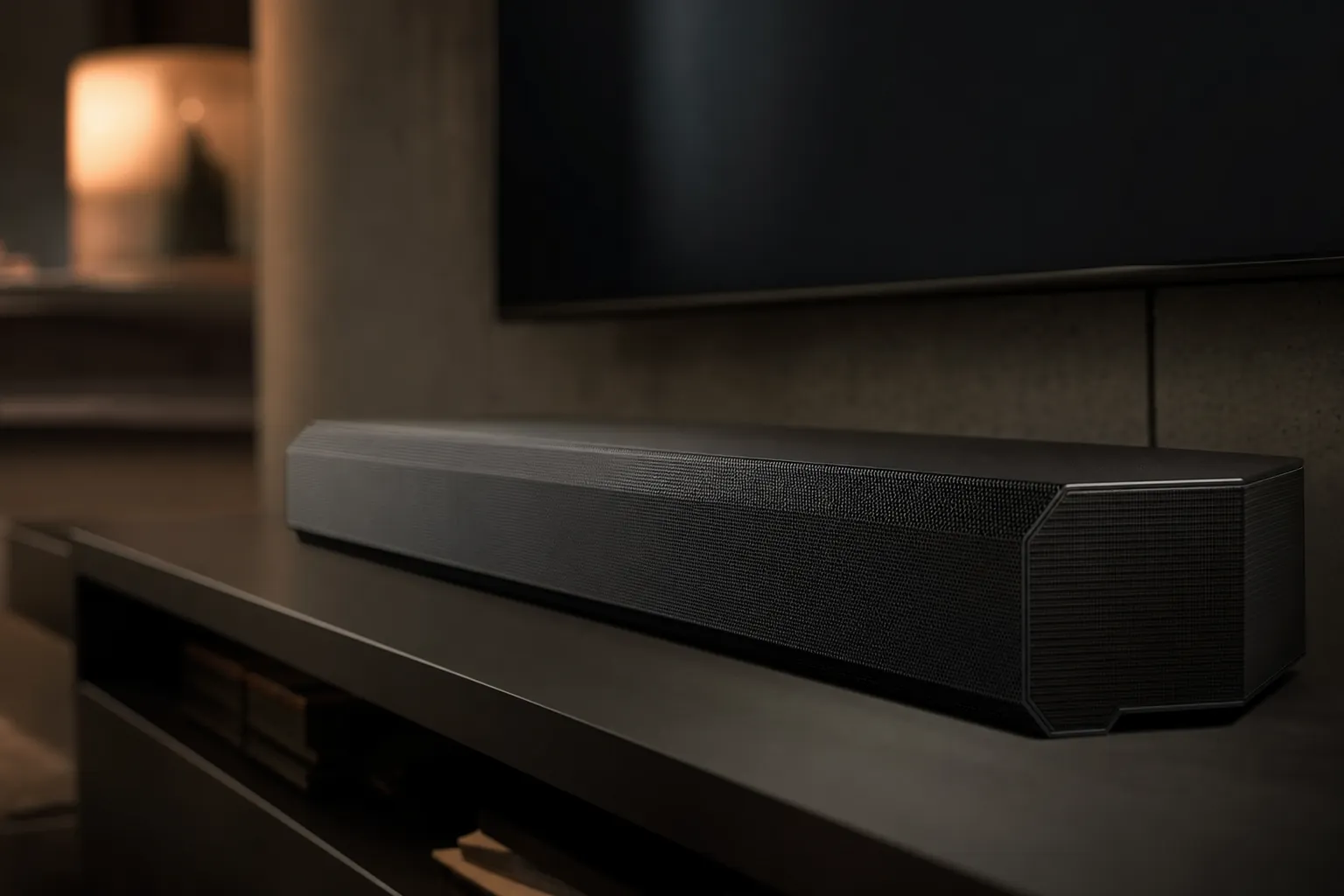
The Samsung HW-QS90H is a wide 1245mm all-in-one bar designed to replace a soundbar, wireless subwoofer and rear-speaker system with one enclosure.
A soundbar without a subwoofer usually asks you to accept a compromise. It will be neater, certainly. Your floor will remain free of a black bass cube, which is lovely. But explosions become polite, music loses its weight and the whole experience feels a little bit like watching an action film through a letterbox. Samsung's HW-QS90H tried to avoid that familiar trade-off with 13 speakers, four built-in woofers and drivers pointing forwards, sideways and upwards. It was a bold idea. Happily, it mostly worked.
The One-Bar Atmos Gamble: What Is the Samsung HW-QS90H?
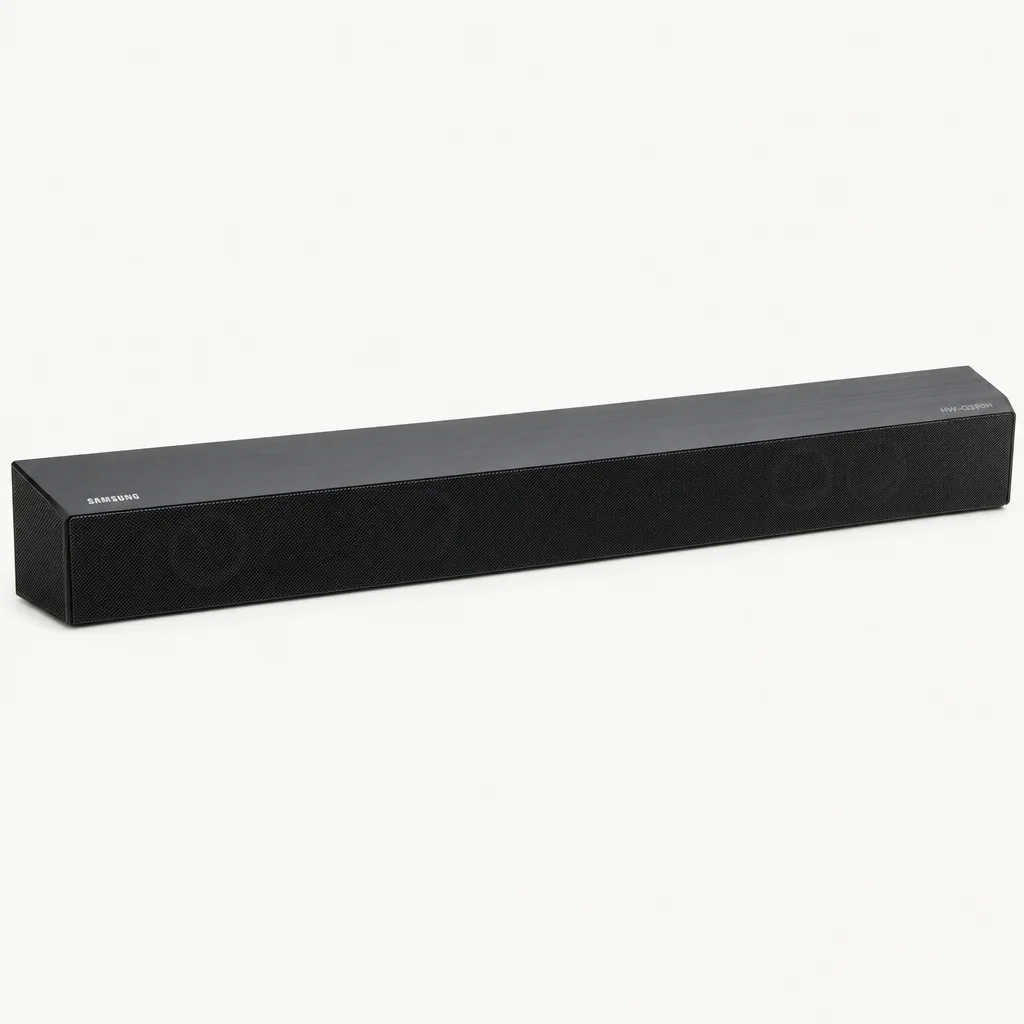
The Samsung HW-QS90H, also sold simply as the QS90H, was Samsung's distinctive all-in-one Q-Series soundbar for 2026. The UK version carried the HW-QS90H/XU model number, whilst the US model was HW-QS90H/ZA. It was not a family of different sizes or a slimmed-down derivative. This was one particular, rather large soundbar with a very clear mission: deliver a 7.1.2-channel Dolby Atmos presentation without filling the sitting room with separate boxes.
That placed it in an interesting part of Samsung's range. The HW-Q990H, HW-Q900H and HW-Q800H were the more conventional Q-Series alternatives, designed around a separate subwoofer and, depending on model, rear speakers. The QS90H went in the opposite direction. It put everything inside the bar: the front channels, centre speaker, front-wide drivers, side-firing drivers, up-firing height channels and four woofers.
There is a sensible audience for that approach. Not everyone wants a wireless subwoofer lurking by the sofa. Not everyone has spare sockets behind them for rear speakers. And plenty of UK living rooms are shared spaces rather than dedicated cinema rooms. The QS90H understood that. It was still a serious piece of home-cinema hardware, but it did not demand that your lounge become a minor branch of Richer Sounds.
The central idea
The QS90H was not trying to produce the most precise surround system Samsung made. It was trying to make a convincing, wide and bassy cinematic soundstage from one neatly contained piece of hardware. Judge it on that brief and it made far more sense.
UK launch/list price
Original UK list pricing
Typical observed UK price
Seen at John Lewis and specialist retailers
US list price
Samsung US list pricing
A 13-Speaker System Hiding in a 6.7kg Bar
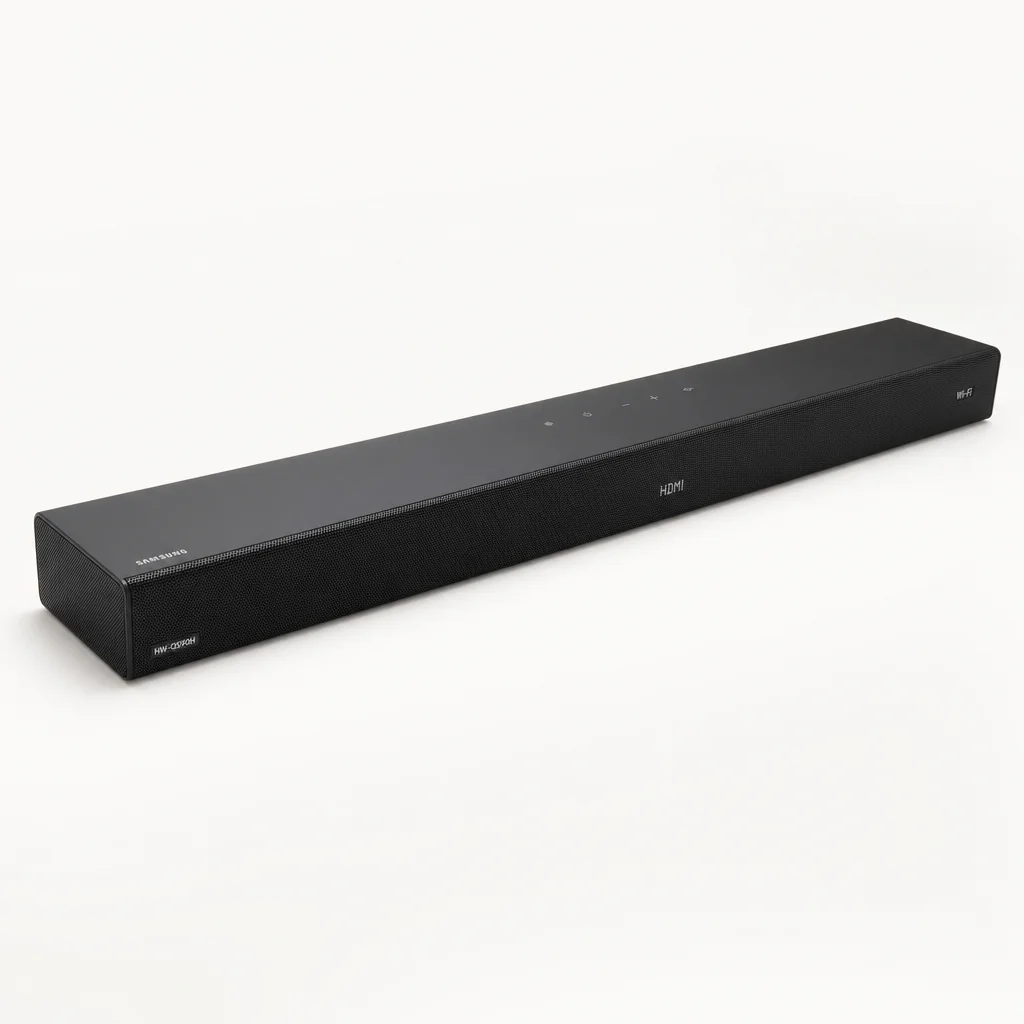
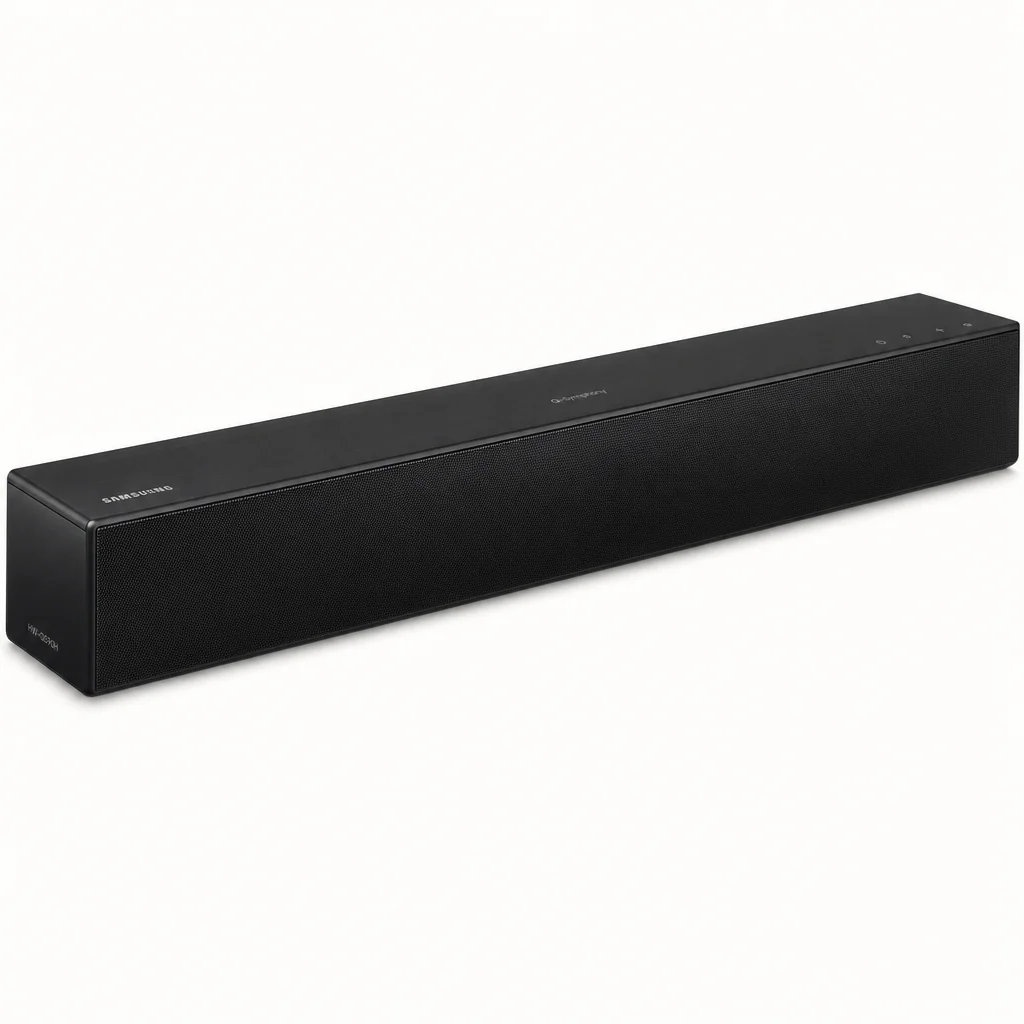
At 1245 × 68.8 × 125mm, the QS90H was not a discreet little television accessory. It was a substantial 6.7kg bar, finished in Graphite Black, and it looked most at home below a 65-inch television or larger. Under a smaller screen it could feel a bit like parking a Range Rover outside a terraced house. It would fit, technically. It just might not be the visual balance you were aiming for.
The enclosure was sensibly restrained rather than ostentatious. Samsung did not dress it up with theatrical lighting or glossy plastic that collected fingerprints by lunchtime. That was a good decision. A soundbar should disappear when the lights go down, and the QS90H mostly did. It had enough physical presence to feel premium, without demanding your admiration every time you entered the room.
The headline 7.1.2 figure was not just digital wizardry scribbled on a box. The QS90H had a dedicated centre channel, front-wide drivers, side-firing drivers and up-firing drivers, supported by those four internal woofers. The side-firing units were particularly important because they were responsible for the bar's signature trick: making the soundstage appear to stretch well beyond its physical edges.
One small but important clarification: Samsung did not publish a conventional total RMS or amplifier-wattage figure for this soundbar. The 65W number was operating power consumption, not an indication of acoustic output. Frankly, that is no bad thing. Soundbar wattage figures are often more marketing confetti than buying advice. What mattered here was whether the QS90H could sound substantial in a real room. On that front, it had a much stronger argument.
Front-wide and side-firing drivers
These supplied the QS90H's biggest spatial advantage: effects and music extended beyond the ends of the bar rather than clustering under the television.
Physical height channels
Up-firing drivers gave Dolby Atmos material a chance to reflect from the ceiling instead of relying entirely on virtual height processing.
One-box bass system
Four integrated woofers were tasked with producing low-end weight without a separate subwoofer taking up floor space.
Flexible orientation
A built-in gyroscope adjusted output when the bar was placed flat or wall-mounted on its edge. A wall bracket was included.
The QS90H's physical driver layout mattered more than a virtual-surround badge: front-wide, side-firing and up-firing channels all worked alongside the central dialogue speaker.
The all-in-one concept did not mean the QS90H was permanently closed to expansion. Samsung supported the optional SWA-9500S wireless rear speakers, although they were not supplied in the box.
Ports, Apps and the HDMI Catch
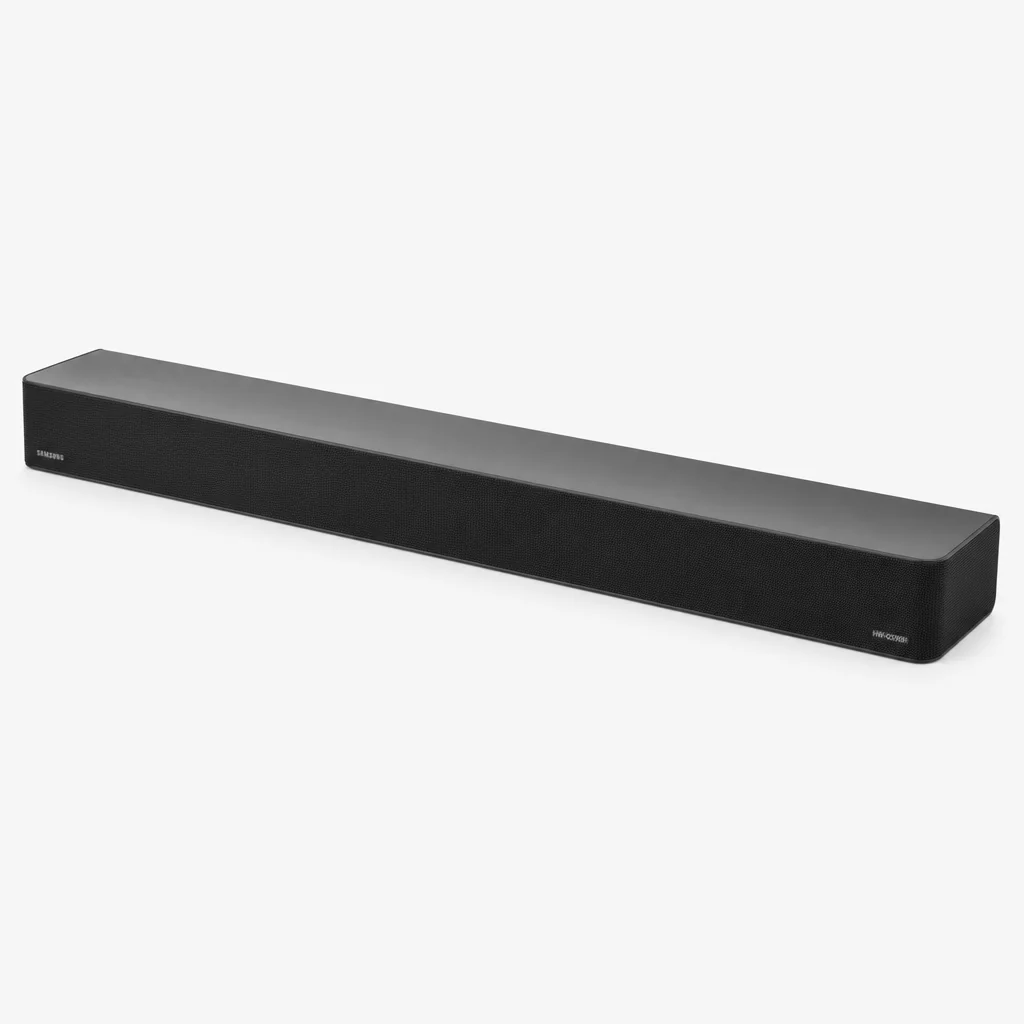
The QS90H's physical connections were straightforward: one HDMI input, one HDMI output with ARC and eARC, HDMI-CEC and one optical input. There was also Bluetooth 5.3 and Wi-Fi, so this was not a soundbar that forced you to choose between home cinema and streaming convenience.
In a simple setup, HDMI eARC was the sensible route. Connect the soundbar to the television's eARC port, plug your consoles and streaming devices into the television, and let the TV return sound to the QS90H. That preserved the clean, single-bar ethos and made the soundbar behave more like part of the television system than a separate AV hub.
The limitation was that solitary HDMI input. If you wanted the soundbar to become the switching centre for a games console, Blu-ray player and streaming box, it was not especially accommodating. More importantly, Samsung listed 4K passthrough at 60Hz. That was perfectly adequate for films, television and a lot of ordinary console use, but it was not the ideal route for a high-refresh-rate gaming setup.
For PlayStation 5, Xbox Series X or a gaming PC, the practical answer was to connect the console directly to a suitable television and return audio via eARC. The QS90H offered Game Pro sound processing, but it was not designed as a 4K/120Hz switching hub.
Samsung's wider ecosystem was excellent. The QS90H supported Chromecast, Spotify Connect, Tidal Connect, Apple AirPlay and Roon Ready, so there was no shortage of ways to get music into it. Alexa was built in, and SmartThings provided the deeper settings access. If you already owned a compatible Samsung television, Q-Symphony and Wireless Dolby Atmos were further reasons to keep the setup in-house. Wireless Dolby Atmos was a Samsung-TV-specific convenience rather than a universal HDMI replacement, but it could make an otherwise tidy system even tidier.
A useful Samsung-TV perk
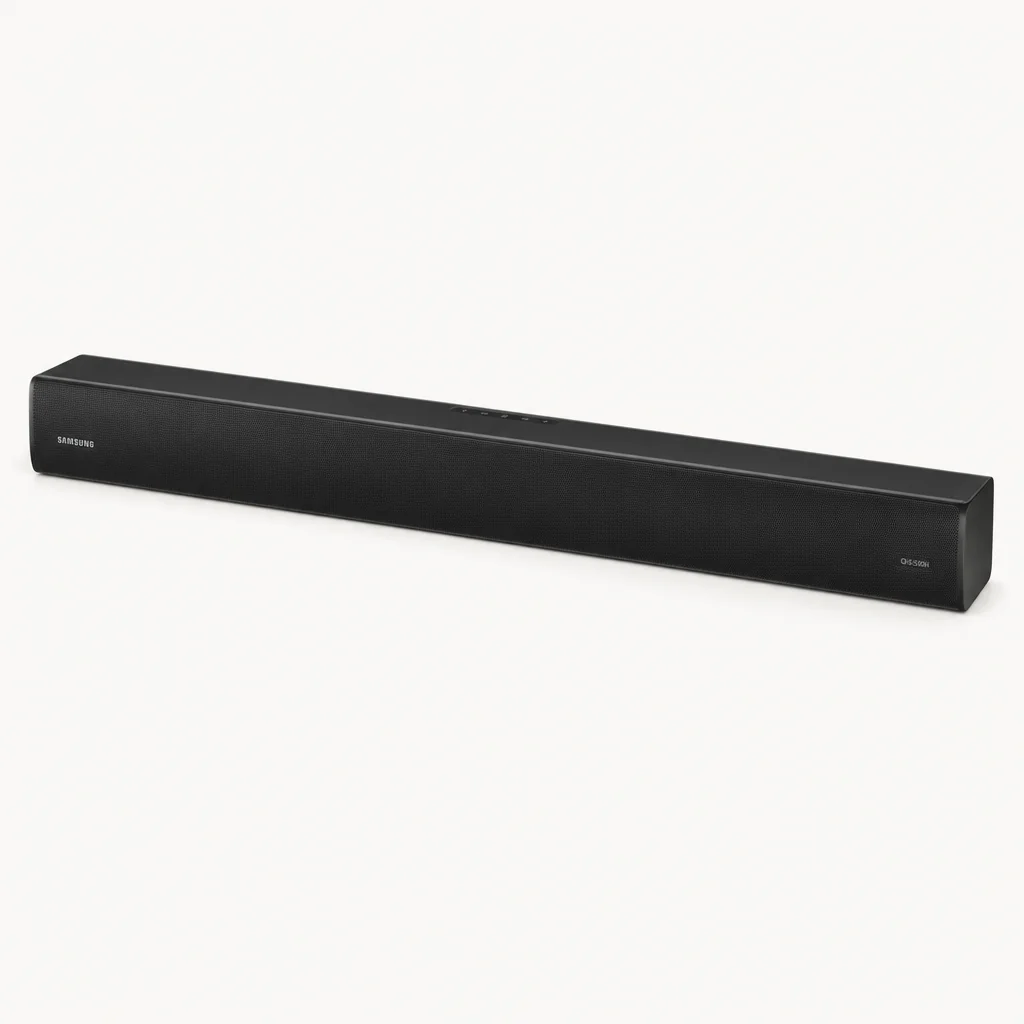
Q-Symphony let compatible Samsung TV speakers work with the soundbar rather than being automatically silenced. It was not essential to enjoying the QS90H, but for Samsung-TV owners it was a genuine ecosystem advantage that third-party bars could not replicate in quite the same way.
There was also broad format support, including Dolby Atmos, Dolby Atmos Music, Dolby Digital Plus, Dolby TrueHD, multichannel LPCM and Samsung's Eclipsa Audio format. Eclipsa Audio was initially more relevant to YouTube than mainstream film and television libraries, so it was best treated as a nice future-facing extra rather than the reason to buy the bar.
Can a Normal UK Ceiling Make Atmos Believable?
This was the section that mattered. Samsung could put "7.1.2" on the box all day long, but a soundbar had to earn that claim in the sort of room most people actually used: a rectangular UK living room, television against one wall, sofa opposite, perhaps a coffee table in between and at least one soft furnishing absorbing half the soundtrack. No acoustic panels. No perfectly positioned listening chair. Probably a cat asleep in the sweet spot.
The QS90H's side-firing presentation was the most convincing part of its immersive sound. It created a large, open front soundstage that reached beyond the physical bar with surprising confidence. In busy action sequences, sounds did not merely travel from left speaker to right speaker; they appeared to occupy a wider arc around the room. Aircraft, crowd ambience and musical layers were able to spread sideways in a way that made the television feel less like the fixed centre of every sound.
That mattered because width was immediately noticeable. Even if you had never owned an Atmos system, you could hear it. The QS90H made ordinary stereo material sound bigger, and it gave film mixes a sense of scale that conventional forward-firing bars often struggled to muster. It was not the same as genuine rear speakers placing a sound behind your shoulder, but it was far more effective than a vague "surround mode" that simply made everything louder and slightly echoey.
The side-firing drivers were the QS90H's strongest immersive feature, helping effects travel laterally beyond the soundbar's substantial physical width.
The height channels were more complicated. The up-firing drivers did produce an audible sense of vertical lift with Dolby Atmos content, particularly when a room had a reasonably low, flat ceiling and the seating position was centred. Rain could feel less glued to the television. Flyovers gained some extra scale. A helicopter or aircraft had more space to move through than on a typical 3.1-channel bar.
But the effect did not consistently become a sharply defined sound directly above your head. That was the distinction. The QS90H could make a soundtrack feel taller and airier; it did not always place individual overhead objects with the certainty of a system with dedicated rear height speakers, stronger room mapping or a very accommodating ceiling. During demanding action scenes, sounds that ought to have swept over the listener could remain more around the upper edges of the bar and room rather than genuinely overhead.
That was not a failure so much as physics being irritatingly stubborn. Up-firing Atmos depended on ceiling height, surface reflectivity, the distance from bar to sofa and the exact point where you sat. A low, flat painted ceiling was helpful. A high ceiling, vaulted ceiling, open-plan room or heavily absorbent surface was less helpful. If your room looked like a cosy Victorian lounge rather than an AV demo suite, the side effects were still likely to impress. The ceiling effects were the more variable element.
Width: very convincing
The lateral spread was the QS90H's most reliable spatial trick. It made films, sport and music feel much larger than the bar's single-box format suggested.
Height: room dependent
Atmos effects gained lift and spaciousness, but the result varied with the ceiling and did not always lock sounds directly above the listener.
Seating matters
Centred seating gave the up-firing and side-firing layout the best chance. Sitting far off-axis weakened the illusion, as it does with most soundbar-based surround systems.
Best room for the QS90H
Give this soundbar a conventional, enclosed living room with a reasonably low flat ceiling, a TV wall and a sofa opposite it. That is where its broad lateral stage and credible height lift made the strongest case. It was less at home in cavernous open-plan spaces.
Explosions, Whispered Lines and Four Woofers at Work
The four integrated woofers were not a minor feature. They were the reason the QS90H could credibly operate without a separate subwoofer. A lot of single-bar soundbars managed bass by making the upper bass louder, which gave voices and percussion a bit of bulk but did very little for the low-frequency drama that made a film soundtrack feel physical. Samsung's approach had more authority.
Action films benefited immediately. Explosions had weight, engine noise had body and large-scale scores had a foundation beneath the strings and brass. The bass was described consistently as deep, rich and controlled for a one-box soundbar, which was precisely the point. It did not make you forget what a genuinely large separate subwoofer could do, but it avoided the thinness that normally sent buyers shopping for an add-on sub a fortnight after purchasing a soundbar.
Better still, the bass was generally integrated with the rest of the presentation. It supported rather than bulldozed dialogue. That was important in a bar built for ordinary living rooms, where listening at cinema-reference volume would be an efficient way to meet your neighbours, but not necessarily make friends. The QS90H could sound energetic at sensible evening levels without turning every low-frequency effect into a rattle test for the sideboard.
Dialogue was another clear strength. The dedicated centre speaker helped voices remain intelligible in crowded scenes, including noisy flight and action sequences. Samsung also offered Active Voice Amplifier Pro and Voice Enhancement, which could push speech further forward when a mix was particularly dense. They were useful tools, especially for viewers who frequently reached for subtitles, but they were not always necessary. The base dialogue performance was strong enough that enhancement could be used sparingly rather than permanently.
Film and TV strengths
- Four built-in woofers brought unusually forceful low-end weight to a single-bar design.
- The dedicated centre channel kept dialogue clear when effects and music became busy.
- Side-firing drivers produced a notably broad, enveloping front stage.
- Atmos material sounded larger and taller than it did on conventional forward-facing bars.
Cinema compromises
- Height effects did not consistently create a precise overhead image.
- No rear speakers were included, so behind-you effects lacked the certainty of a full system.
- Some treble-heavy material could sound a touch bright or processed.
- The single HDMI input limited the QS90H as an AV switching hub.
Four internal woofers gave the QS90H action-film impact that most all-in-one bars struggled to deliver without a separate subwoofer.
Dialogue first, without flattening the film
The QS90H's best everyday quality was arguably not Atmos at all. It was the way spoken dialogue remained intelligible without stripping the soundtrack of its scale. That is the thing you notice on a Tuesday-night drama, not just during a Dolby demo clip.
From Bass-Led Playlists to Atmos Music
Music was not an afterthought here. The QS90H had enough streaming support to become the main music system in a living room, with Spotify Connect, Tidal Connect, AirPlay, Chromecast and Roon Ready all available. That meant it was easy to use without turning on the TV first — a small quality-of-life detail, but one that made a soundbar far more likely to earn its keep.
With bass-led music, the four woofers gave the QS90H a real advantage over thinner all-in-one rivals. Electronic tracks had satisfying weight, kick drums had physical presence and low synth notes arrived with more confidence than you would expect from an enclosure only 68.8mm high. Crucially, the bass did not feel detached from the rest of the mix. It came from the same broad soundstage rather than seeming like a separate appliance muttering from the corner.
Vocals were generally warm and textured, particularly at low and moderate listening levels where many soundbars started to sound a little flat. The centre image held together well, which made singer-led recordings engaging rather than merely loud. The expansion provided by the front-wide and side-firing drivers also gave live recordings and spacious pop mixes a welcome sense of breadth.
There were limits. Percussion and treble could occasionally sound slightly pinched or processed, depending on the track and which enhancement features were active. Voice-processing modes that helped television could make music feel less natural, so I would leave those switched off for albums and only bring them back when dialogue needed the extra lift. That was not a deal-breaker; it was simply sensible system management. The QS90H was capable enough to reward five minutes of setup rather than one-size-fits-all settings.
Streaming without TV faff
Spotify Connect, Tidal Connect, Chromecast, AirPlay and Roon Ready made the QS90H a flexible music speaker as well as a television upgrade.
Strong vocal focus
Vocals were generally warm, clear and centrally placed, particularly when dialogue-orientated enhancement modes were disabled for music.
Watch the processing
The most artificial edge arrived when voice and enhancement processing was pushed too hard. Use it for TV; ease it back for playlists.
Living With the QS90H: Setup, Control and the Missing Battery
This was a mains-powered soundbar, not a portable speaker pretending to be a home-cinema system. There was no battery to charge, no battery-life figure to fret about and no weatherproof rating to consider. That may sound obvious, but it matters because the real daily-use question was not "how long does it last?" but "how much household clutter does it remove?"
On that point, the QS90H was very persuasive. One mains cable for the bar was considerably easier to live with than a separate wireless subwoofer requiring its own socket, plus two rear speakers that needed either mains power or periodic charging. The 1245mm chassis still demanded a substantial TV stand, of course, and the angled HDMI and power connections could make cable routing a little awkward when the soundbar sat flat. But overall, the system was far simpler than a full surround package.
Setup was straightforward through HDMI eARC, optical or Bluetooth, although HDMI eARC was the route worth taking whenever the television supported it. SmartThings and the Samsung Sound app handled configuration, whilst SpaceFit Sound Pro could tailor playback to the room. That calibration did not transform the QS90H into a different speaker, but it was worth running before deciding what the Atmos effect could or could not do in your room.
Before judging the QS90H's height performance, run SpaceFit Sound Pro, make sure the soundbar is not hidden in a cabinet and sit in the main listening position. Those unglamorous basics made more difference than endlessly hopping between sound modes.
£849 Simplicity or £899 False Economy?
At its £899 UK launch price, and around £849 at John Lewis and specialist retailers, the QS90H was not cheap. But it was also not priced like a basic soundbar. Buyers were paying for 13 speakers, four internal woofers, Dolby Atmos support, side- and up-firing drivers, network streaming, room calibration and Samsung ecosystem features in one box.
The value calculation came down to what you were trying to avoid. If you wanted proper rear-channel precision and the physical slam of a dedicated subwoofer, spending more on a multi-box system remained the better route. If you wanted a clean lounge with fewer sockets, fewer stands and fewer arguments about where the subwoofer could live, the QS90H made a strong case. It delivered a surprisingly large share of the cinema experience without requiring the furniture rearrangement normally associated with it.
The most relevant rivals sat at very different points on that convenience-versus-scale spectrum. Sonos Arc Ultra was a premium one-box alternative with a mature multi-room platform. Sony's BRAVIA Theatre Bar 9 was another high-end single-bar option, with stronger HDMI 2.1 credentials for gamers. Bose Smart Ultra Soundbar offered a lower-cost all-in-one route at its observed promotional price. JBL Bar 1300MK2 was the other extreme: much more expensive and far more physically involved, but supplied with a subwoofer and detachable rear speakers.
The QS90H's clean single-bar installation was its main value proposition: fewer boxes than a full surround package, without surrendering bass altogether.
| Model | UK price | HDMI inputs | Key advantage |
|---|---|---|---|
| Samsung HW-QS90H | £849 observed | 1 | Wide soundstage and powerful integrated bass |
| Sonos Arc Ultra | £999 | None | Sonos multi-room ecosystem and Trueplay |
| Sony BRAVIA Theatre Bar 9 | £999 observed | 1 | HDMI 2.1 with 4K/120, VRR and 8K support |
| JBL Bar 1300MK2 | £1,299.99 | 3 | Real rear speakers and maximum cinema scale |
The value reality check
The QS90H was neither a bargain bar nor a false economy. It was a premium convenience product. Its value was strongest when you wanted a serious upgrade from TV speakers but had no appetite for a separate subwoofer, rear speakers and the accompanying cable-and-socket archaeology.
The Gadget Scout Scorecard
Scores need context with a product like this. The QS90H did not beat a true surround package for precise rear effects, and it was not the ideal gaming pass-through solution. But within its all-in-one mission, it was exceptionally capable. It made films sound huge, did an impressive job with bass and dialogue, and had enough streaming support to replace a standalone music speaker in many rooms.
The score reflected the QS90H's genuinely impressive sound quality against the realities of its format. It was better at width than height, better at cinematic scale than rear-channel pinpointing and better for a TV-led eARC setup than a complicated stack of HDMI sources. None of those caveats were hidden; they were simply the price of keeping everything in one enclosure.
Is This the Right Soundbar for Your Room and Routine?
The QS90H made most sense for buyers who wanted a soundbar that behaved like a proper home-cinema system without looking like one. It was a particularly natural fit for Samsung TV owners, renters and households where the prospect of adding a subwoofer and rear speakers caused more anxiety than excitement.
Best for Samsung TV owners
Q-Symphony, SmartThings integration and Wireless Dolby Atmos with compatible Samsung TVs gave the QS90H a stronger ecosystem case than most third-party alternatives.
Best for tidy living rooms
It delivered serious bass and an expansive front stage without a separate subwoofer, rear stands or a second round of cable management.
Best for dialogue-first viewers
The centre channel and voice tools made it a strong choice for television dramas, sport and films with busy, effects-heavy soundtracks.
Choose JBL Bar 1300MK2 for full surround
If actual rear effects and maximum cinema immersion mattered more than simplicity, JBL's supplied rear speakers and separate subwoofer were the more complete solution.
Choose Sony BRAVIA Theatre Bar 9 for gaming
Its HDMI 2.1 support, including 4K/120, VRR, ALLM and 8K HDR, made Sony the more suitable premium one-bar option for high-refresh-rate sources.
Choose Bose Smart Ultra for lower spend
At its observed £599.95 promotional price, Bose was the more affordable all-in-one Atmos route for buyers who prioritised dialogue processing and room correction.
For renters and minimalist households, the QS90H's appeal was simple: strong cinema sound without a subwoofer to hide or rear speakers to accommodate.
Buy the QS90H if…
- You want big, room-filling sound from a single enclosure.
- You value powerful bass but do not want a separate subwoofer.
- Clear speech matters as much as blockbuster effects.
- You have a suitable Samsung TV and want Q-Symphony or Wireless Dolby Atmos.
- Your room has a conventional flat ceiling and centred seating.
Consider something else if…
- You demand sharply placed rear effects behind the sofa.
- You need multiple HDMI inputs or 4K/120Hz passthrough.
- Your ceiling is very high, vaulted or acoustically awkward.
- You want the very deepest bass a dedicated subwoofer can supply.
- Your television is much smaller than 65 inches and visual balance matters.
Final Verdict: Wide, Weighty and More Room-Dependent Than It Looks
The Samsung HW-QS90H was one of the more convincing arguments for the premium all-in-one soundbar. Its achievement was not that it magically replaced a full surround system. It did not. Dedicated rear speakers still gave you more precise placement behind and beside the sofa, and a proper subwoofer still had the advantage when it came to the lowest, most physical bass.
Its real achievement was that it did not feel like a compromise in the usual single-bar ways. The four integrated woofers produced genuinely impressive weight. The centre channel kept dialogue clear. The side-firing drivers made the soundstage huge. And the up-firing channels added a useful sense of height when the room played along. That last qualification mattered, but it did not undo the wider success.
For a normal UK living room, the QS90H's lateral performance was more dependable than its overhead Atmos imaging. Effects spread beyond the bar with real confidence, whilst height effects ranged from pleasingly convincing to merely suggestive depending on ceiling geometry and seating. It was best viewed as a soundbar that made a room feel larger, rather than one that always put objects precisely above your head.
At around £849, it sat in a sensible place for people who wanted premium sound without the physical sprawl of a multi-box package. It had excellent wireless music options, useful Samsung-TV integration and enough bass authority to make the absence of a separate subwoofer feel like a choice rather than an omission. The HDMI limitation was the biggest practical annoyance, especially for keen gamers, but it was manageable in a TV-led eARC setup.
The final judgement: the Samsung HW-QS90H was at its best when asked to make a normal living room sound wider, weightier and clearer without filling it with extra speakers.
Samsung HW-QS90H verdict
Buy the QS90H if you want a clean, single-bar setup with unusually strong built-in bass, superb dialogue clarity and an expansive side-firing soundstage. Its Atmos height effect was credible rather than class-leading, and the 4K/60Hz HDMI limitation made it less appealing for serious gaming rigs. But for films, television and music in a normal UK living room, it was a remarkably complete one-box solution.
 Sony BRAVIA Theatre Bar 9View on Amazon
 Bose Smart UltraView on Amazon