
ROG Xbox Ally X20: ASUS Goes Full OLED for Its Wildest Handheld Yet
A translucent black-and-gold shell, the first OLED screen the Ally line has ever had, drift-proof sticks, and a pair of AR glasses thrown in the box. Here's everything ASUS confirmed at Computex 2026 about its 20th-anniversary showstopper.
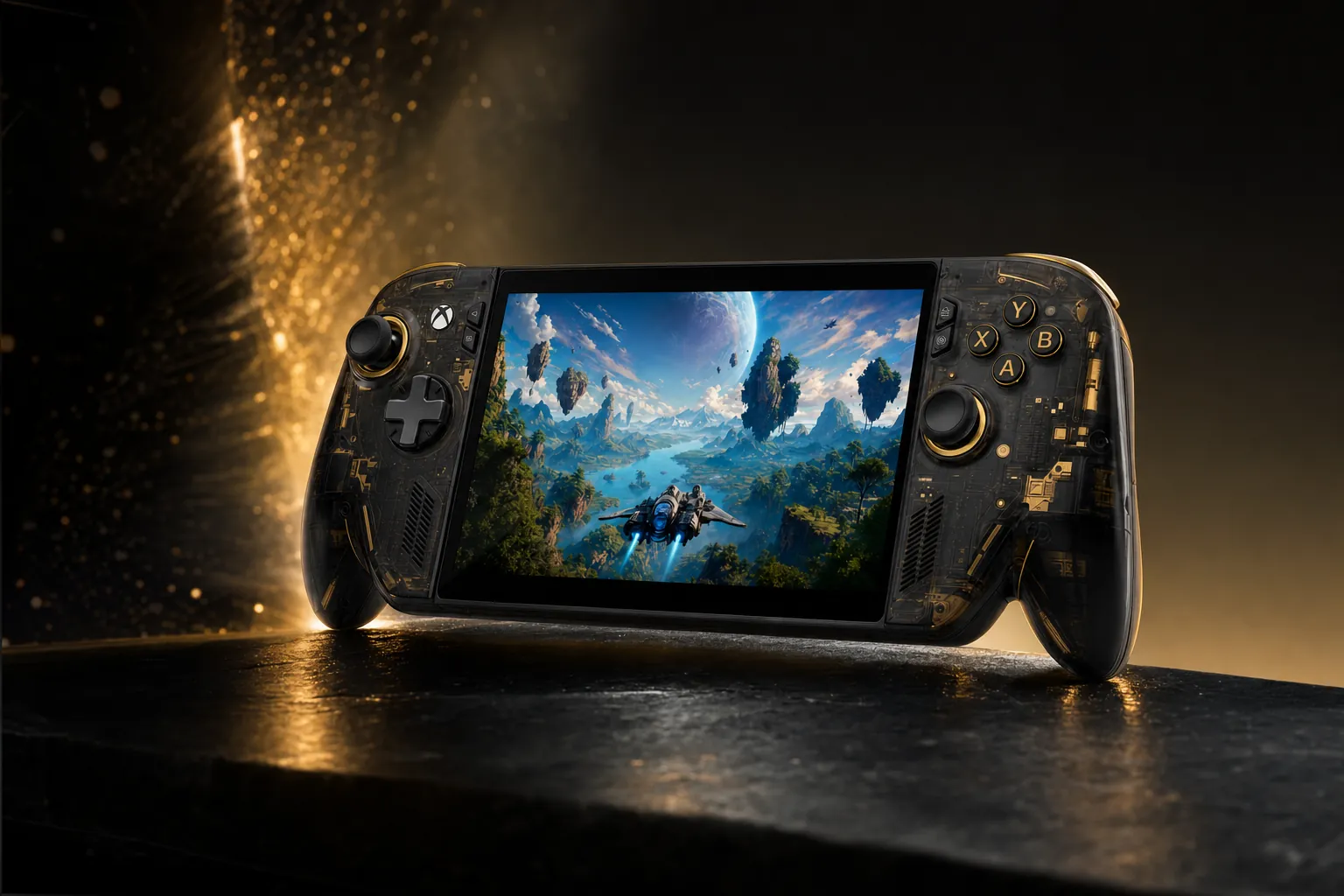

Every now and then a company builds a piece of kit purely to show off, and that's exactly what ASUS has done here. The ROG Xbox Ally X20 is a limited-edition handheld gaming PC built to mark 20 years of the Republic of Gamers brand — and rather than slap a gold sticker on last year's model and call it a day, ASUS has used the occasion to fix the one thing fans have been begging for since day one: a proper OLED screen.
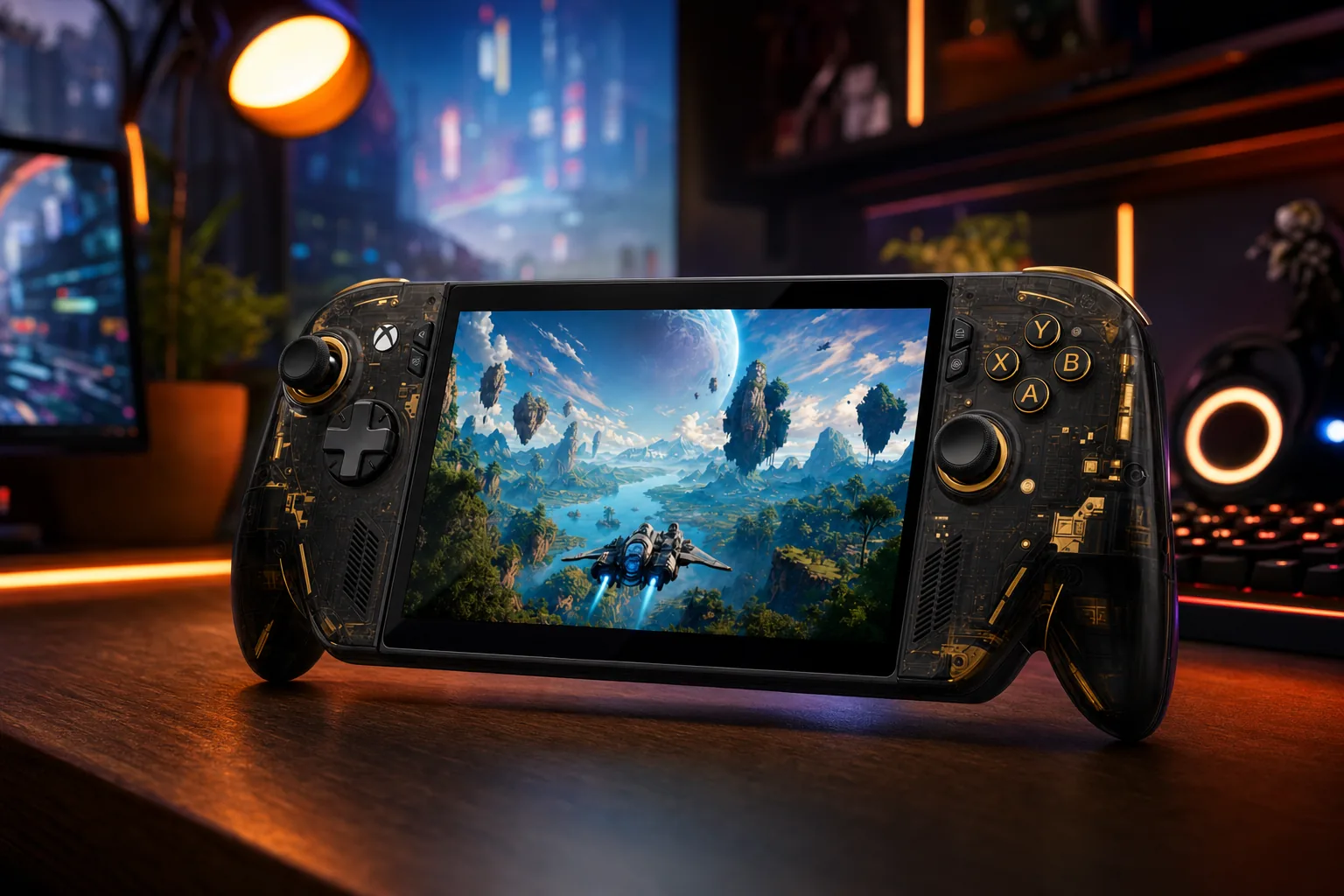
Revealed at Computex 2026 on 1 June, the X20 isn't a brand-new generation of handheld. Under the bonnet it's still the ROG Xbox Ally X you already know. But the changes ASUS has made are the ones that matter most for how a handheld actually feels to play — the display, the sticks, the buttons and the whole tactile experience — all wrapped in a see-through smoked-black body that shows off a gold-coloured skeleton underneath. Oh, and there's a set of AR glasses in the box that project a virtual 171-inch screen in front of your eyes. Because of course there is.
So is it a genuine upgrade worth queuing for, or a collector's trophy with a collector's price tag? Let's go through everything that's confirmed, everything that's still up in the air, and exactly how it stacks up against the standard Ally X.
The X20 at a glance
- 7.4-inch OLED, 1080p, 120Hz, 1,400 nits
- AMD Ryzen AI Z2 Extreme (same as Ally X)
- 24GB LPDDR5X RAM, 1TB PCIe 4.0 SSD
- TMR drift-proof sticks + transforming D-pad
- Translucent black shell, gold internals
- Bundled ROG Xreal R1 AR glasses
- 80Wh battery, ~756g
- Second half of 2026 (exact date TBC)
What exactly is the ROG Xbox Ally X20?
The name is a mouthful, so let's untangle it. "ROG" is ASUS's Republic of Gamers brand, which turns 20 in 2026. "Xbox Ally" is the line of Windows handhelds ASUS builds in partnership with Microsoft, complete with a dedicated Xbox button and a full-screen Xbox experience that boots you straight into your games instead of the Windows desktop. The "X" denotes the top-tier model (more RAM, bigger battery), and the "20" is the anniversary badge — not a generation number, not a performance multiplier, just "twenty years."
Even ASUS's biggest fans have raised an eyebrow at the naming, and honestly, fair enough. But look past the label and the X20 is easy to describe: it's the existing flagship Xbox Ally X, given the full anniversary treatment with the upgrades enthusiasts actually care about, sold as a one-off collector's bundle. ASUS is openly pitching it as "a true collector's item as well as a high-powered handheld," and the limited production run means it's the kind of thing that tends to sell out and resurface on auction sites at a markup.
One important update since launch: the X20 was originally revealed only as a bundle with the AR glasses, but ASUS has now confirmed it will also sell a standalone version of the new handheld without the glasses. In the company's words, it is "actively discussing the release schedule for a standalone version of the new Ally" and has asked buyers to "stay tuned for upcoming announcements." No separate date or price for that standalone model has been given yet, so if you fancy the OLED handheld but don't want to pay for the AR glasses, it looks like you'll eventually have the option.
The headline act: the Ally finally gets OLED
This is the upgrade everyone's been waiting for. Every Ally handheld until now — including the standard Xbox Ally X — has used an IPS LCD panel. Good, but not special. The X20 throws that out and fits a 7.4-inch OLED, and the jump in quality is the single biggest reason to care about this machine.
Numbers tell part of the story. The standard Ally X tops out at around 500 nits of brightness with no HDR to speak of. The X20's OLED hits 1,400 nits of peak HDR brightness — nearly three times as bright at its peak — and carries VESA DisplayHDR True Black 1000 certification plus full Dolby Vision support. That's the kind of HDR badge you normally see on premium TVs and high-end laptops, not pocket-sized handhelds.
But brightness is only half of it. Because OLED lights each pixel individually, blacks are genuinely black rather than the grey-ish glow you get from a backlit LCD. In a dark dungeon crawler or a moody space sim, the difference is night and day — literally. Explosions punch, neon signs in a cyberpunk city actually look like they're glowing, and contrast is effectively infinite. ASUS is using a panel it brands "ROG Nebula HDR," running at the same 1080p resolution and 120Hz refresh as before, with FreeSync Premium Pro to keep things tear-free and a blistering 0.2ms response time that all but eliminates motion blur in fast games.
ASUS even tackled the classic handheld problem of glare: the X20's screen uses Corning's DXC glass with an anti-reflective coating that the company says cuts reflections by 65%. Combined with that 1,400-nit ceiling, it should be far more usable in a bright room — or on a sunny train — than any Ally before it.

It's worth being clear-eyed about what hasn't changed: resolution is still Full HD, and bumping a small handheld screen to a sharper panel would only hammer the battery and the frame rate, so sticking at 1080p is the right call. The win here isn't more pixels — it's dramatically better ones.
A see-through shell with a gold skeleton
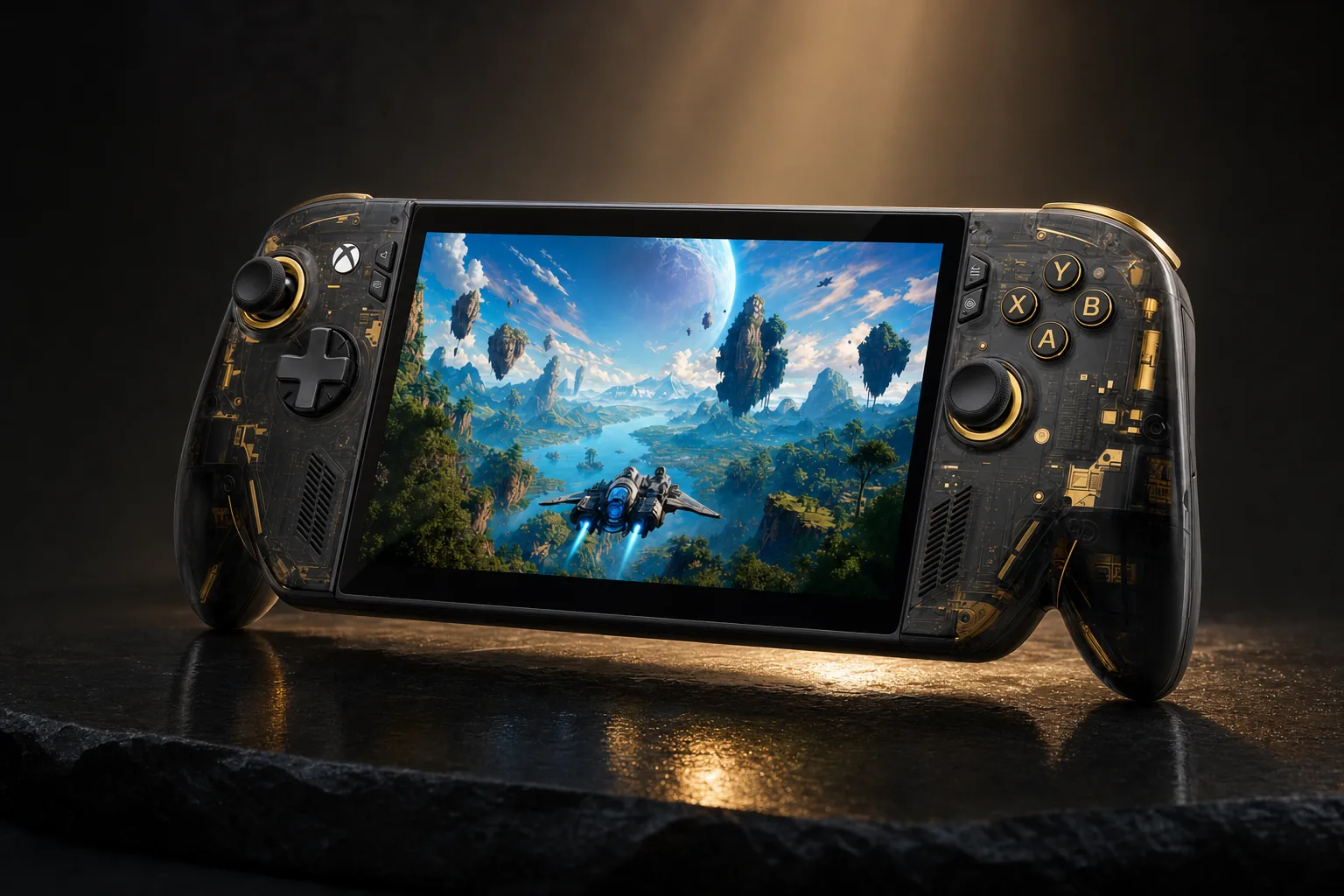
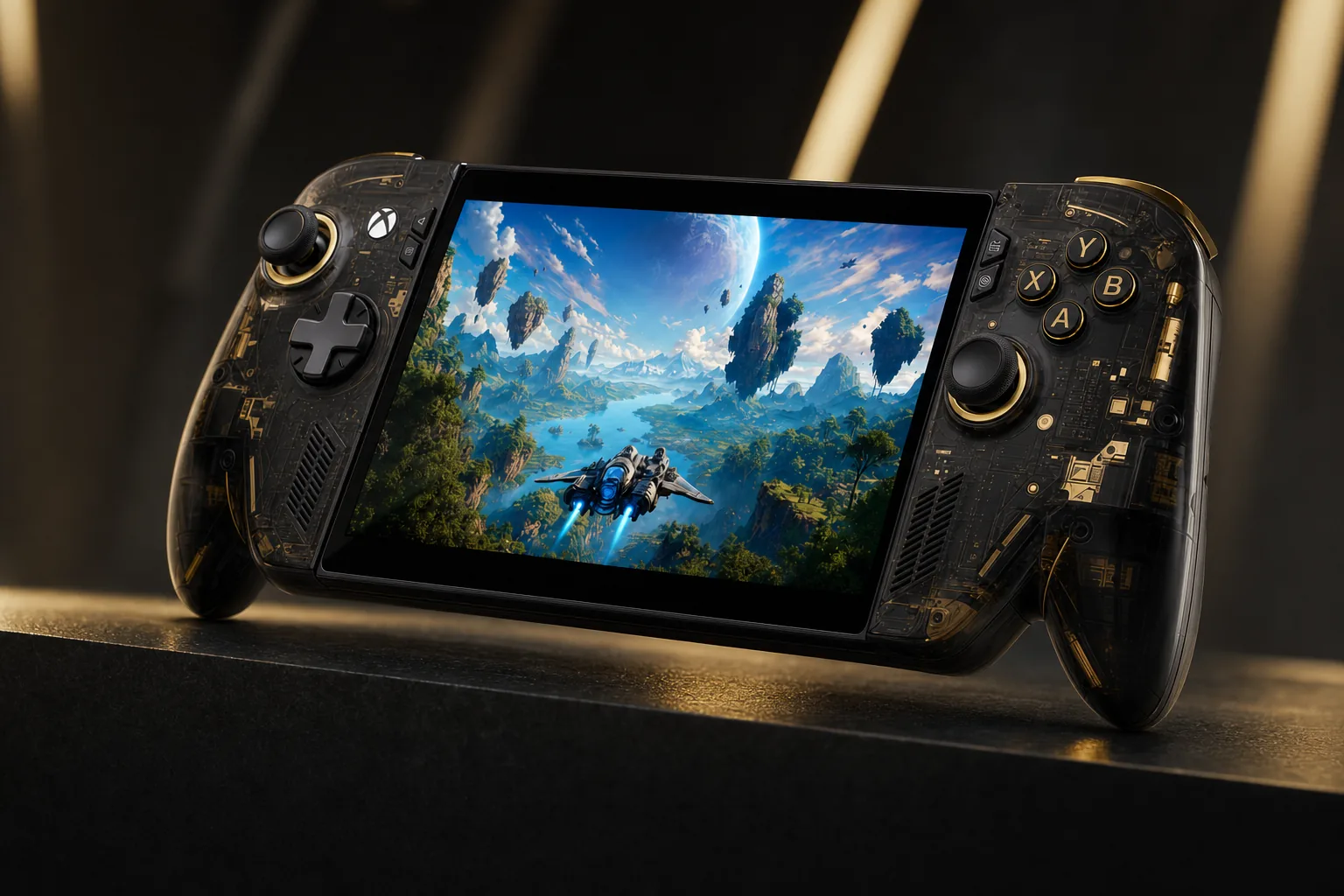
If the OLED is the substance, the design is the spectacle. The X20 ditches the standard model's plain matte plastic for a translucent smoked-black shell that lets you see right into the machine — and what you see has been deliberately dressed up. The internal structure is finished in gold, so the cooling hardware and framework glint through the tinted casing like the movement of an expensive watch. It's pure 20th-anniversary theatre, and it looks fantastic in person according to the hands-on crowd at Computex.
There's a redesigned cooling solution behind that translucent back too, re-routed to push more airflow directly over the AMD APU — partly to keep the new OLED happy, partly because nobody wants thermal throttling on a £1,500-plus toy. The Xbox button gets RGB illumination, the grips are wrapped in a grippier rubberised coating, and the whole thing carries matching black-and-gold styling right down to the bundled accessories.
All that reinforcement and flair adds a little heft. The X20 weighs in around 756g and is a touch thicker than the standard Ally X — roughly 40g heavier — because the see-through shell needs extra structure to stay rigid. In the hand that's a fair trade for the looks and the cooling, but it's worth knowing it's not the one to buy if shaving every last gram is your priority.
Controls that fix the Ally's oldest annoyances
ASUS used the anniversary edition to quietly overhaul the bits your thumbs actually touch — and this is where the X20 stops being "a prettier Ally X" and starts being a genuinely better one to play.
TMR sticks that shouldn't drift
The headline control change is the move to TMR (tunnelling magnetoresistance) joysticks. Stick drift — where a worn analogue stick registers movement you didn't make — is the bane of every controller and handheld ever made. The standard Ally X already used Hall-effect triggers — but conventional sticks, so this is a genuine control-system upgrade rather than a rename, but ASUS reckons TMR goes further: better precision, smoother tracking, and crucially lower power draw than Hall-effect designs while being just as resistant to drift over years of use. For a handheld where battery life is precious, sticks that are both more accurate and more efficient is a genuine double win.
A D-pad that transforms
The X20 also introduces a transforming D-pad that can switch between a standard four-way layout and an eight-way one. If you mostly play platformers and shooters, four-way crisp directions are ideal; if you're into fighting games where diagonals and quarter-circle motions matter, you flip it to eight-way. It's a clever bit of mechanical engineering aimed squarely at the kind of player who cares enough to buy a collector's handheld in the first place.
Buttons that get out of the way
Finally, the face buttons have been redesigned to sit almost flush against the chassis, so your thumb can slide between them smoothly instead of catching on raised edges — great for fast combos and frantic button-mashing. Hall-effect triggers round out the package. None of these are headline-grabbing on a spec sheet, but together they make the X20 feel meaningfully nicer to hold and play than the model it's based on.
Under the hood: power stays the same (and that's fine)
Here's the part to set expectations on: the X20 is not faster than the standard Xbox Ally X. It runs the very same AMD Ryzen AI Z2 Extreme processor (boosting up to 5.0GHz), the same 24GB of LPDDR5X memory, the same 1TB PCIe 4.0 NVMe SSD, and the same 80Wh battery. If you were hoping the anniversary model would also be a performance leap, it isn't — frame rates will land in the same ballpark as the current flagship.
And that's a perfectly reasonable decision. The Z2 Extreme is still one of the most capable handheld chips you can buy, comfortably handling modern games at 1080p with a bit of upscaling, and ASUS includes AMD's Auto SR AI upscaling plus the slick full-screen Xbox experience on Windows 11 to squeeze the most out of it. There's Dolby Atmos audio, a dual-speaker setup and AI noise-cancelling for chat, too. The X20's pitch was never "more frames" — it's "the best-feeling, best-looking way to play the frames you already get."
The wild card: a pair of AR glasses in the box
The single most surprising thing about the X20 isn't the handheld at all — it's what ASUS bundles with it. Every unit ships with the ROG Xreal R1 Edition 20 AR glasses, finished in the same black-and-gold anniversary livery, and they're a serious bit of kit in their own right.
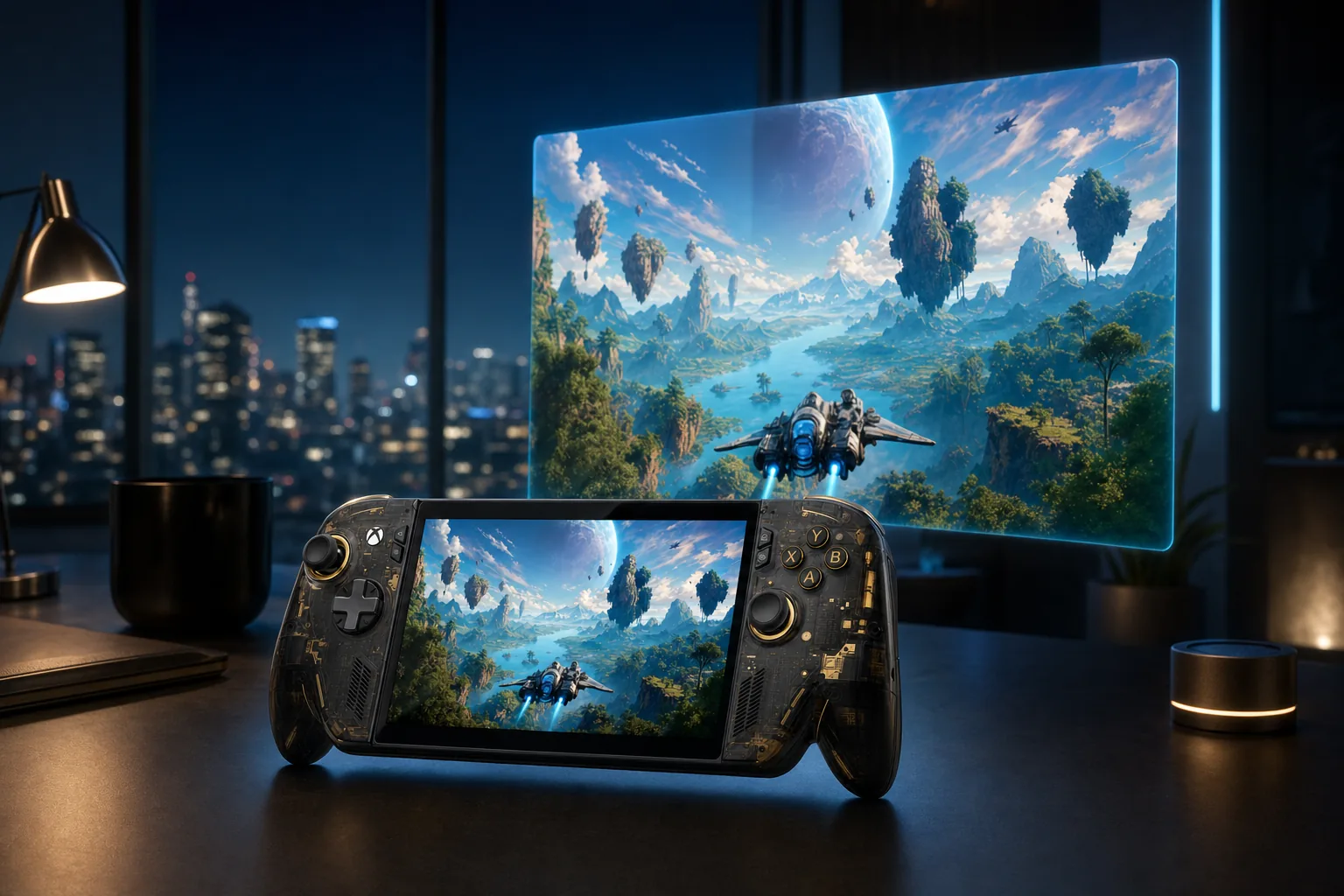
Plug them into the handheld with a single USB-C cable and the micro-OLED panels inside project what ASUS describes as a 171-inch virtual screen floating about four metres in front of you. Each eye gets a 1080p micro-OLED display running at up to 240Hz with a near-instant 0.01ms response time, covering 95% of your focused field of view, with 3DoF head tracking and audio tuned by Bose. At just 90g they're light enough to wear like sunglasses, and on their own these glasses retail for around £749.99 — so they're not a token freebie.
The idea is seductive: pop the glasses on during a flight or a late-night session and you get a giant private cinema-sized display without disturbing anyone, fed by a handheld that fits in a bag. Whether you'll actually use them every day or leave them in the box after the novelty fades is the real question — but as a centrepiece for an anniversary bundle, they're a brilliant bit of "wow."
ROG Xbox Ally X20 vs the standard Xbox Ally X
This is the comparison that matters, because the X20 is built directly on the standard Ally X. Here's what you gain — and what stays the same — by stepping up to the anniversary edition.
| Spec | ROG Xbox Ally X20 | Standard Xbox Ally X |
|---|---|---|
| Display | 7.4" OLED, 1,400 nits, HDR True Black 1000, Dolby Vision | 7" IPS LCD, ~500 nits, no HDR |
| Refresh / response | 120Hz, 0.2ms, FreeSync Premium Pro | 120Hz, FreeSync Premium |
| Processor | AMD Ryzen AI Z2 Extreme | AMD Ryzen AI Z2 Extreme |
| Memory / storage | 24GB LPDDR5X / 1TB PCIe 4.0 | 24GB LPDDR5X / 1TB PCIe 4.0 |
| Sticks | TMR (drift-proof, lower power) | Hall-effect |
| D-pad | Transforming (4-way & 8-way) | Standard 8-way |
| Design | Translucent black, gold internals, RGB Xbox button | Solid matte finish |
| Battery | 80Wh | 80Wh |
| Weight | ~756g (a touch heavier) | ~715g |
| In the box | + ROG Xreal R1 AR glasses | Handheld only |
| Availability | Limited anniversary run, H2 2026 | On sale now |
Read down that table and the pattern is obvious: the X20 wins on everything to do with the experience — how it looks, how the screen dazzles, how the controls feel — and ties on everything to do with raw performance. If you already own an Ally X and you're happy with your screen, there's no performance reason to upgrade. If you're buying your first high-end handheld and the budget stretches, the X20 is comfortably the nicer machine to live with.
Price and release date: what we know (and don't)
Here's where we have to be honest about the gaps. ASUS announced the X20 at Computex but stopped short of confirming the two things everyone wants most: the exact price and the exact release date.
On timing, ASUS has only committed to a launch in the second half of 2026, with most coverage expecting it later in the year in line with previous Ally launches. Given it's a limited anniversary run, expect stock to be tight and pre-orders to move quickly when they do open. As of now the ASUS UK product page is live but only offers a "Notify Me" button — there's no price, no on-sale date, and no UK retailer listings for pre-order yet.
On price, nothing is official — but we can do the maths. The standard Xbox Ally X sells for around £799–£899, and the bundled ROG Xreal R1 glasses cost about £749 on their own. Add the OLED upgrade, the anniversary design and the new controls on top, and most outlets expect the bundle to land at or above £1,799 — with a few more optimistic estimates floating the £1,499 mark. In UK terms that points to somewhere in the region of £1,500–£2,000+, though ASUS hasn't confirmed UK pricing or a UK on-sale date. Treat every number here as an educated estimate until ASUS says otherwise.
Is the ROG Xbox Ally X20 worth it? Who it's really for
Let's be real: at an expected £1,500–£2,000+, the X20 is not a sensible mainstream purchase, and ASUS knows it. This is a halo product — a way to celebrate 20 years of ROG and show off what the brand can do when it stops worrying about hitting a price point. The value question depends entirely on which camp you fall into.
You'll love it if you're a handheld enthusiast who's wanted an OLED Ally for years, you value how a device feels and looks as much as how it performs, and the AR glasses genuinely appeal to you. As a single bundle, getting a top-tier handheld, a stunning OLED, drift-proof sticks and £749 worth of AR glasses in one matching black-and-gold set is a real "treat yourself" moment — and as a limited collector's item, it should hold its value better than a standard model.
You should skip it if you already own a standard Ally X and you're chasing more performance (there isn't any), or if you just want the best frames-per-pound and don't care about OLED or AR. In that case the regular Xbox Ally X — or a cheaper handheld entirely — will get you the same gaming horsepower for a lot less money. It's also worth remembering ASUS has confirmed a standalone X20 is coming, so if you want the OLED handheld without paying for the glasses, that may be the smarter wait. The X20's magic is in the polish and the spectacle, not the benchmark numbers.
Frequently asked questions
When does the ROG Xbox Ally X20 come out?
ASUS announced it at Computex 2026 on 1 June and has committed to a launch in the second half of 2026, but hasn't confirmed an exact date. The ASUS UK page currently only offers a "Notify Me" option, so expect more details — and likely tight, limited stock — closer to release.
How much will it cost in the UK?
ASUS hasn't confirmed pricing. Based on the standard Ally X (~£799–£899) plus the bundled Xreal R1 glasses (~£749), most expect the bundle to exceed £1,799, which points to roughly £1,500–£2,000+ in the UK. That's an estimate, not an official figure.
Can I buy the X20 without the AR glasses?
Eventually, yes. The X20 was first revealed only as a bundle, but ASUS has since confirmed it will also release a standalone version of the handheld. The company says it is still "discussing the release schedule" for it, so there's no date or price for the glasses-free model just yet — but the option is coming.
Is the X20 more powerful than the standard Xbox Ally X?
No. It uses the same AMD Ryzen AI Z2 Extreme chip, 24GB of RAM and 1TB SSD, so frame rates are effectively identical. The upgrades are the OLED screen, the controls and the design — not raw performance.
What's the big deal about the OLED screen?
It's the first OLED in the Ally line. Compared with the standard model's ~500-nit LCD, the X20's 7.4-inch OLED hits 1,400 nits peak, with perfect blacks, HDR True Black 1000 and Dolby Vision. Games look dramatically more vivid, especially in dark scenes and HDR titles.
Should I worry about OLED burn-in?
For a gaming handheld used a few hours at a time with varied content, burn-in risk is very low over a normal ownership period — the same reason OLED is now standard on rival handhelds and phones. Static HUD elements left on screen for thousands of hours are the theoretical risk, but it's not something most players will ever encounter.
Can I buy the AR glasses separately instead?
The ROG Xreal R1 line is sold on its own (around £749 for the standard version). The special black-and-gold "Edition 20" finish, however, is part of the X20 bundle — that exact matching set is what makes it a collector's package.
How does it compare to the Steam Deck OLED?
The Steam Deck OLED is cheaper and runs SteamOS, but its custom AMD chip is less powerful and its OLED is lower-resolution and dimmer than the X20's 1,400-nit panel. The X20 is a Windows machine with far more horsepower and a brighter, sharper HDR screen — at a much higher price, especially with the AR glasses bundled in.
What does the "X20" name actually mean?
It marks the 20th anniversary of ASUS's Republic of Gamers brand. It's not a generation number or a performance rating — just a celebration badge, which is exactly why the naming has been so widely teased.
The verdict
The ROG Xbox Ally X20 is ASUS doing a victory lap — and doing it in style. It finally answers the one request handheld fans have made since the original Ally launched (give us OLED), throws in drift-proof TMR sticks and a clever transforming D-pad, wraps the lot in a gorgeous translucent black-and-gold body, and tops it off with a set of AR glasses that would cost the best part of a grand on their own.
What it doesn't do is run your games any faster than the standard Xbox Ally X — so this is a celebration of how good a handheld can feel and look, not a leap in how fast it goes. At an expected £1,500–£2,000+ it's firmly a treat for enthusiasts and collectors rather than a mainstream buy — though a confirmed standalone version should give glasses-free buyers a cheaper way in when it arrives. But as a 20th-birthday statement piece? It's hard not to be a little bit smitten. We'll update this page the moment ASUS confirms a UK price and release date — bookmark it and check back.