
DJI Mini 5 Pro Review: A 1-Inch Sensor in Your Coat Pocket Changes Everything
For years, 'serious sensor' and 'sub-250g' were opposite ends of the drone market. The Mini 5 Pro welds them together: a genuine 1-inch, 50MP camera, 4K/120 video and LiDAR-assisted night sensing in a drone that still ducks under the UK's friendliest rules. Here's our full review - including the weight asterisk nobody should ignore.
 By Priya Sharma · Phones, Tablets & Cameras Editor · Updated July 01, 2026
1. What the Mini 5 Pro is: the travel flagship
The Mini line has always been DJI's regulatory judo: maximum camera, minimum paperwork. The Mini 5 Pro is the most aggressive throw yet - a 50MP 1-inch sensor behind a fast f/1.8 lens, omnidirectional obstacle sensing with forward LiDAR, a 225° rotating gimbal and 4K/120fps video, in an airframe that folds to the size of a large orange and lifts off at 249.9g.
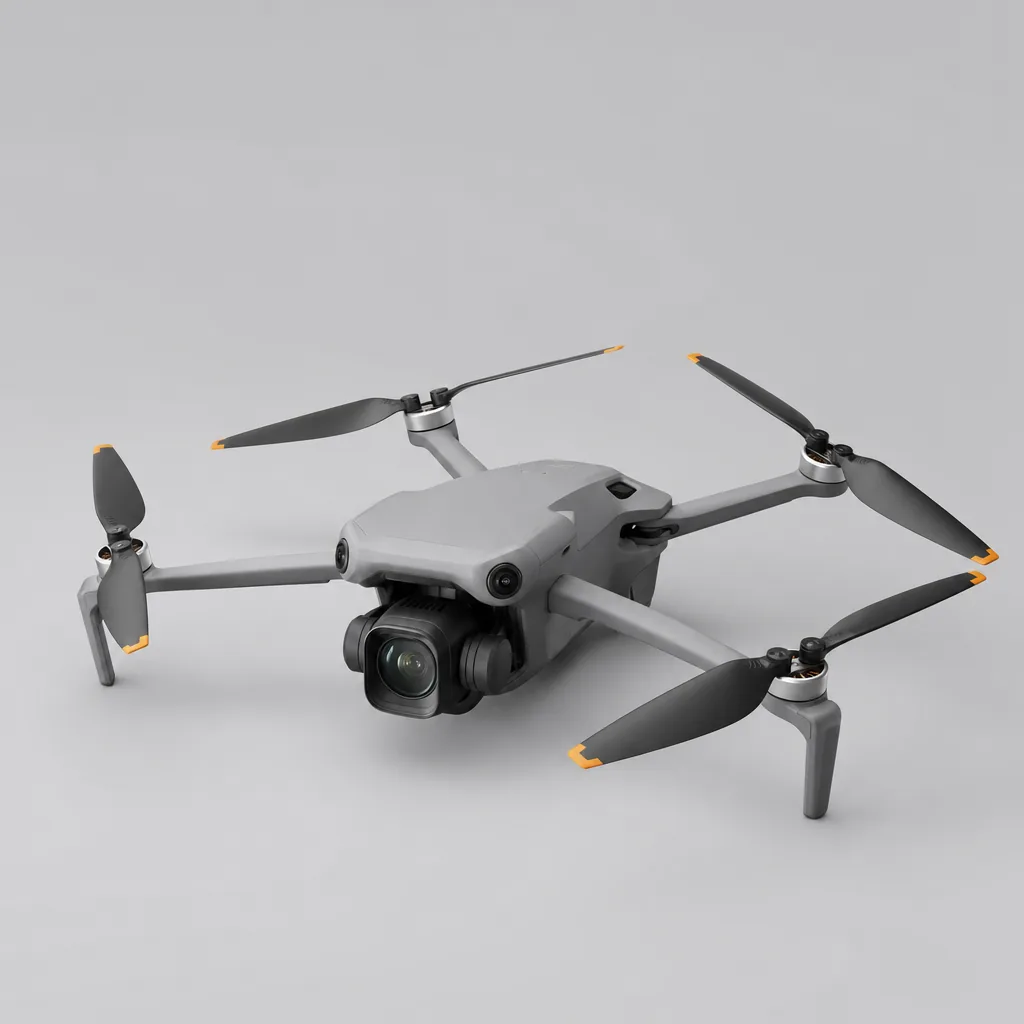
Who is it for? In one sentence: people whose subject is the world, not themselves. Landscape photographers, travellers, property and holiday-let owners, walkers who summit at golden hour. The Neo 2 films you; the Flip films people near you; the Mini 5 Pro photographs everything else, at a quality level that finally survives a big monitor and a picky client.
It replaced the much-loved Mini 4 Pro at the top of the line (that drone remains on sale, cheaper - our review here), and one regional quirk matters to UK buyers only as good news: DJI didn't launch the Mini 5 Pro in the United States, so UK stock, pricing and support are where this drone's story is actually being written.
2. The 249.9g question: read this before you rely on it
DJI quotes 249.9g with the standard battery - and honesty requires two asterisks that most coverage skips:
- Manufacturing variation is real. DJI itself notes roughly ±4g of unit-to-unit variation. Most units weigh in under 250g; a kitchen-scale check of your unit on arrival is five seconds well spent, because UK rules care about the actual take-off weight of the actual aircraft, stickers and skins included.
- The Intelligent Flight Battery Plus breaks the spell. The optional bigger battery stretches flight time to a frankly absurd 52 minutes - but pushes the drone over 250g, which in the UK moves it out of the friendliest category (and formally requires a Flyer ID and more restrictive distances). For most UK owners the standard battery isn't a compromise, it's the point of the product.
UK rules with the standard battery
Under 250g: fly in residential/recreational areas and over uninvolved people (never crowds), no theory test, just the CAA operator ID displayed on the airframe. Standard limits apply - line of sight, 120m, airport zones. With the Plus battery fitted you're flying a 250g+ aircraft and the stricter A3-style distances apply: know which drone you're holding before you launch.
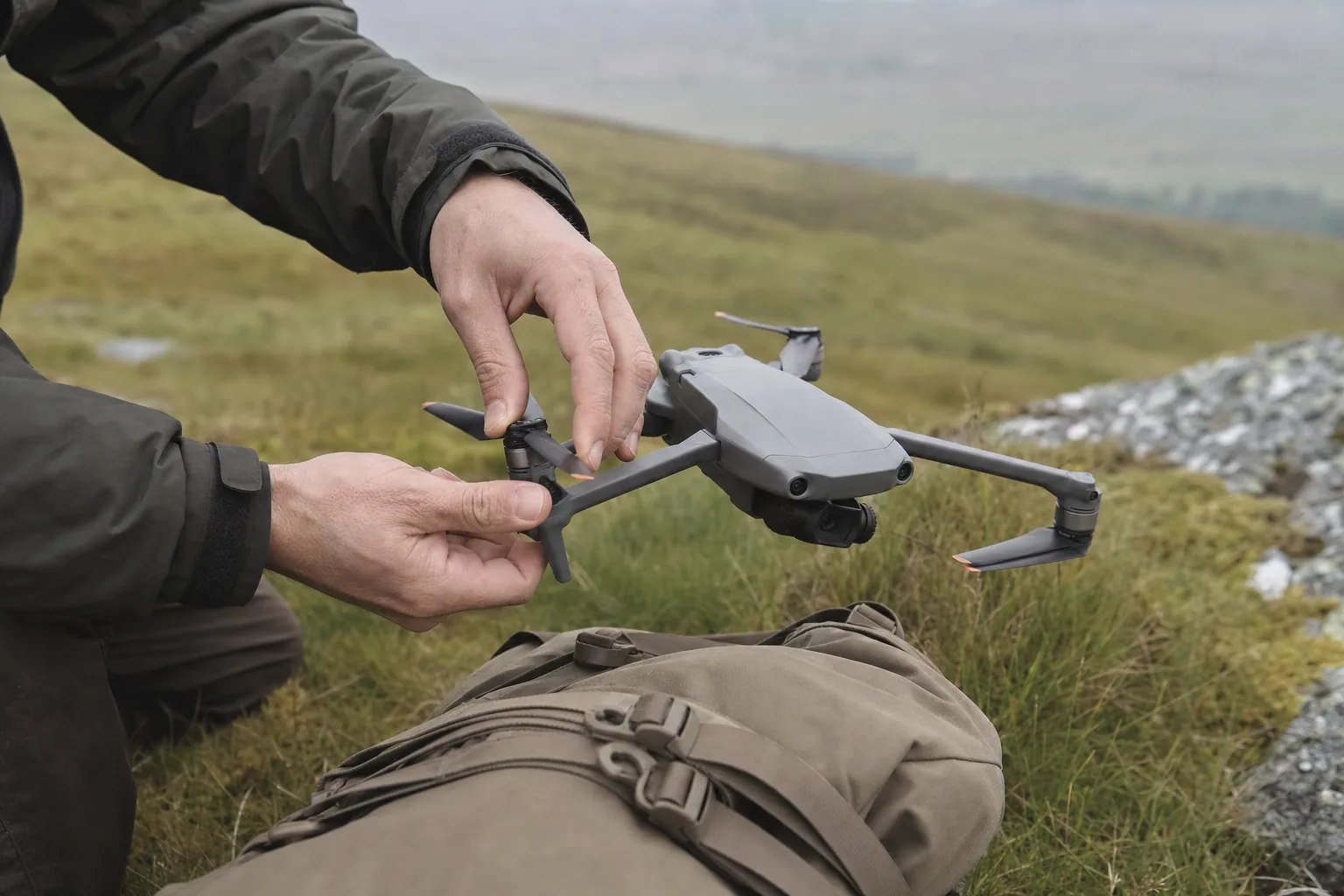
Beyond the scales, the airframe is classic Mini: fold-out arms, naked propellers (clip-on guards exist but cost weight), and build quality that has visibly matured - hinges are tighter and the gimbal cage more confidence-inspiring than any previous Mini we've handled.
3. The camera: what a 1-inch sensor actually buys you
Numbers first: 50MP Type 1 sensor, fixed f/1.8 aperture, 24mm equivalent view, 4K up to 120fps, 1080p to 240fps, 10-bit D-Log M and HLG, and up to 14 stops of dynamic range. On paper that embarrasses some drones at twice the price. In the field, the upgrade shows up in three specific places:
Low light stops being a countdown
Previous Minis gave you until about twenty minutes after sunset before noise ate the shadows. The 1-inch chip and f/1.8 glass move that boundary by what feels like an hour of usable light: blue-hour townscapes, dawn mist, interiors of light-filled barns for property work - all genuinely clean now. This single change is why upgraders pay.
Skies keep their drama
Fourteen stops of dynamic range means British weather - black cloud, silver sea, sun-struck headland, all in one frame - lands on the card the way your eye saw it, not as a choice between white sky and black land.
Crops survive
50MP stills mean a 24mm wide frame contains a dozen tighter compositions. No telephoto on this drone (that's the Air 3S's domain), but in practice you crop your way to one with resolution to spare.
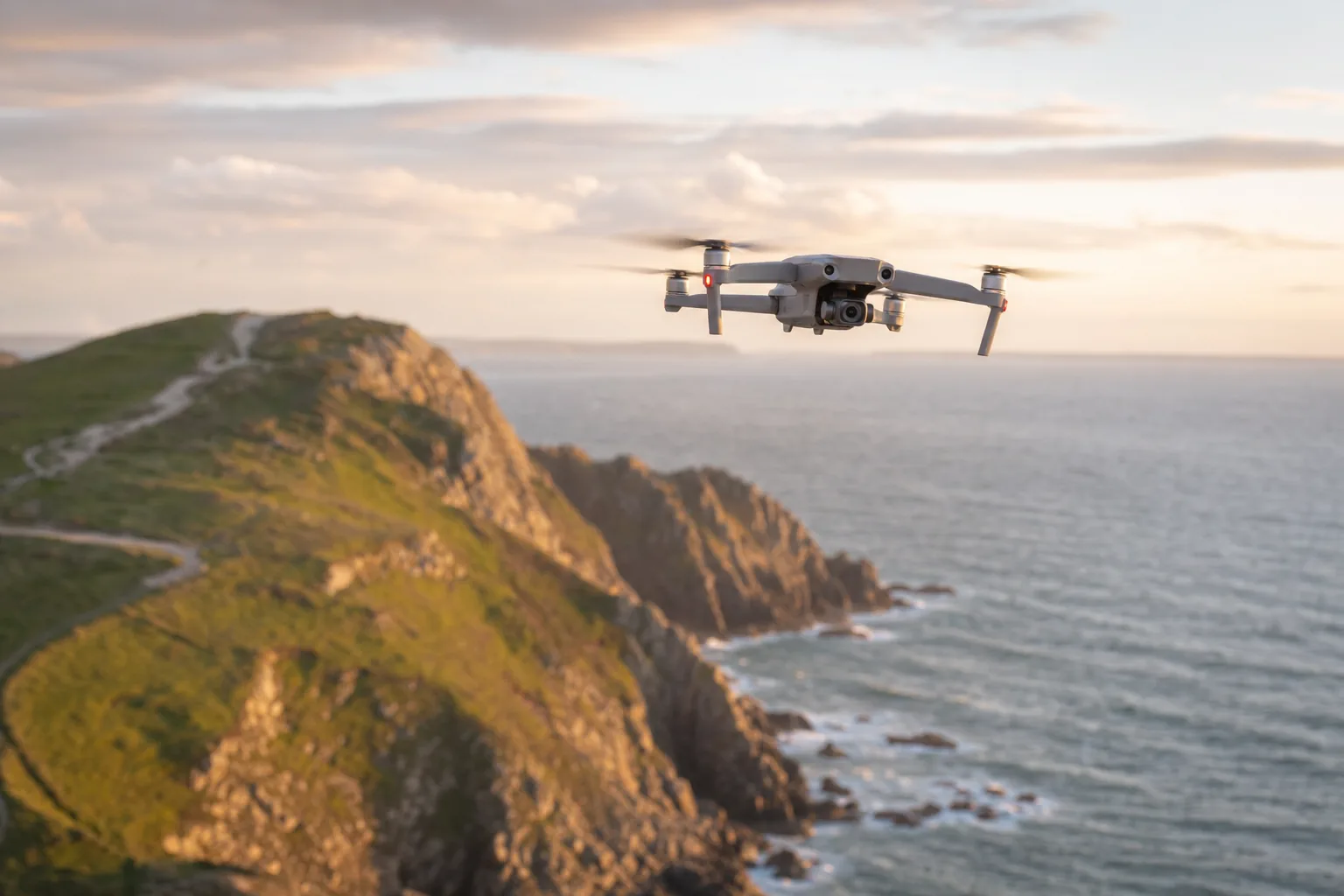
The party trick is the 225° rotating gimbal: true vertical shooting at full quality (not a crop) for social formats, plus tilted Dutch angles and smooth horizon-to-sky reveals that used to need post-production. Combined with 4K/120 slow motion, the creative envelope is genuinely the largest ever fitted under 250g.
Honest limits: the lens is fixed-aperture, so daylight cinematic shutter speeds need the ND filter set (included in Fly More combos); and while D-Log M grades beautifully, the 1-inch look still isn't the 4/3 Hasselblad look - the Mavic 4 Pro (reviewed later in this series) keeps its crown for paid cinema work.
4. In the air: sensing, tracking and the wind truth
The flight experience is defined by confidence. Omnidirectional vision sensing plus a forward LiDAR unit - sensitive down to 1 lux - means the Mini 5 Pro sees obstacles in conditions where previous Minis flew on faith. Dusk returns over treelined fields, the classic nervy moment, become routine: the drone maps what's ahead and Smart RTH threads its way home around it.
ActiveTrack 360° inherits the trajectory-drawing interface from the bigger drones: circle your subject on screen, sketch the path you want around them, and it executes - dodging as it goes. It's the best tracking ever fitted to a Mini, and for filming vehicles, boats or other people it's superb. (For tracking yourself through clutter, the Neo 2's fully enclosed props still make it the saner tool - know the difference.)
And the honest entry, confirmed by every long-term owner we've compared notes with: wind remains this drone's tax. There's no cheating physics at 249.9g. It resists gusts impressively for its mass and the gimbal hides most of the struggle, but on properly breezy British days you'll watch the battery drain at half-again the calm-day rate and feel the drone working. The Air 3S exists for people whose conditions, not skills, demand more.
5. Battery, range and charging realities
DJI claims 36 minutes on the standard battery. Real-world UK flying - some wind, some tracking, sensible reserves - delivers a dependable 25 to 29 minutes, which in practice means one battery covers a full location and three batteries cover a day out. The Fly More combos' three batteries plus charging hub remain the correct first purchase, as ever.
The Battery Plus option (52 minutes claimed) is real and remarkable - and, as covered above, takes you over 250g and out of the friendly UK category. It makes sense for specific missions in permitted contexts; it does not make sense as a default for UK hobbyists.
Transmission is DJI's current O4-generation link: flawless at every distance UK line-of-sight rules permit, with the practical benefit being penetration - the feed stays solid behind trees and dips in terrain where older Minis stuttered.
6. UK pricing and which bundle to buy
- Mini 5 Pro with RC-N3 - £689. Phone-as-screen controller. The right choice if you're testing the waters or upgrading from a Mini 2/3 with accessories to reuse.
- Fly More Combo (RC-N3) - £869. Three batteries, hub, bag, ND filters. The rational default: the extras cost £180 here and far more piecemeal.
- Fly More Combo (RC 2) - £979. Same kit with DJI's screen-built-in controller. The £110 step up is worth it for anyone flying weekly - bright-sun visibility and no phone faff compound over years of ownership.
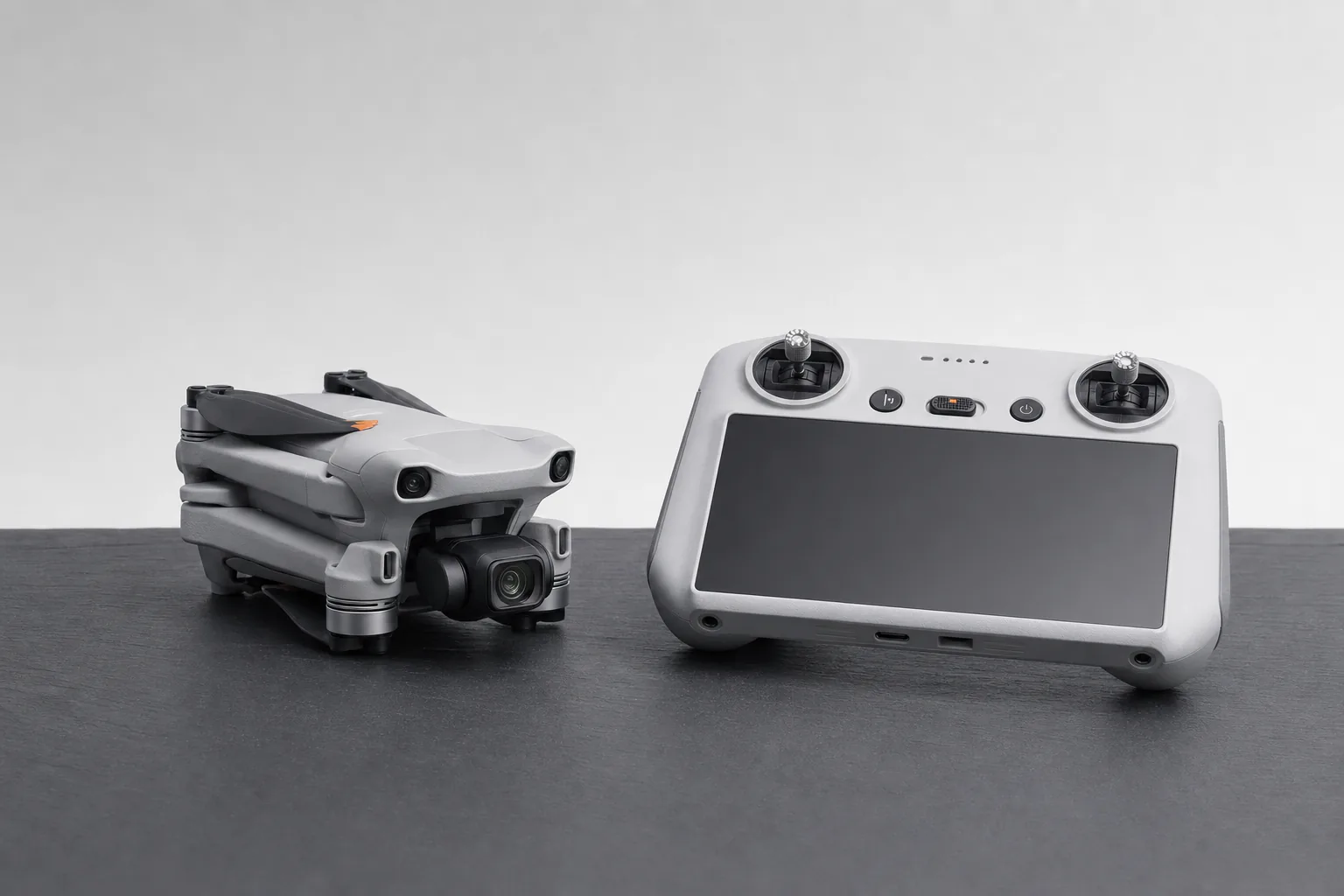
Value verdict: at £689 the Mini 5 Pro costs Mini 4 Pro launch money for an objectively superior camera, and undercuts the Air 3S by £170 while beating it on portability and paperwork. Unless you need the Air's telephoto or wind resistance, this is the imaging-per-pound king of DJI's whole range right now.
See the Mini 5 Pro Fly More Combo on Amazon UK
In stock and price-checked at the time of writing
7. Mini 5 Pro vs the family: the honest decision
| Mini 5 Pro | Mini 4 Pro | DJI Flip | Air 3S | |
|---|---|---|---|---|
| Sensor | 1-inch, 50MP | 1/1.3", 48MP | 1/1.3", 48MP | 1" + 1/1.3" tele |
| Top video | 4K/120, 10-bit | 4K/100, 10-bit | 4K/60 HDR, 10-bit | 4K/120, 10-bit |
| Weight | 249.9g | <249g | <249g | 724g |
| Real flight time | ~25-29 min | ~25-30 min | ~22-25 min | ~33-38 min |
| Sensing | Omni + LiDAR (1 lux) | Omnidirectional | Forward IR only | Omni + LiDAR |
| Telephoto | No (crop from 50MP) | No | No | 70mm 3x optical |
| UK price from | £689 | ~£689 launch, now less | £369 | £859 |
- Upgrade to the Mini 5 Pro from any older Mini if low light, big prints or graded video are in your life. From a Mini 4 Pro specifically, upgrade for the sensor and LiDAR night safety - otherwise your drone remains excellent.
- Save with the Flip if your footage stars people at close range and £320 matters - you trade sensor size and wind manners for cages and palm-launch ease.
- Spend up on the Air 3S (full review next in this series) if wind is your normal weather or the 70mm telephoto unlocks your shots - and the 250g paperwork doesn't put you off.
8. Field diary: three locations, three verdicts
Months of carrying the Mini 5 Pro reduced to the three outings that defined it:
The blue-hour town test
The flight that converts Mini 4 Pro owners. A market town twenty minutes after sunset - sky deep blue, streetlamps warming, the light photographers wait all day for and small drones traditionally waste. The 1-inch sensor at f/1.8 returned files that needed no apology: clean shadows under the eaves, lamp glow held without bloom, a high street readable to the last bunting flag. The same flight on a 1/1.3-inch drone produces a memory of the scene; this produced a print. And the LiDAR earned its keep on the way home, painting the church lime tree into the return path's awareness in light where vision sensing alone goes quiet.
The honeymoon-light coast
Golden hour on a western headland, gentle breeze, the conditions every drone loves - useful precisely because they isolate the camera from excuses. Verdict: 50MP stills cropped to 70mm-equivalent compositions out-resolved what our memory of the Air 3's actual 70mm delivered, the 225° gimbal shot a native-vertical waterfall of cliff that went straight to a story format, and 4K/120 turned wave impacts into silk. In friendly conditions this drone has no superior under £1,000 - including, for stills, the one above it in this series.
The Pennine reality check
And the day the asterisk cashed itself. A forecast '15mph, gusting 25' on an exposed edge - flyable on paper, work in practice. The Mini 5 Pro held its frames and brought every shot home, but the telemetry told the story: battery drained half-again as fast, position-hold visibly laboured between gusts, and the footage, though stabilised to smoothness, carried the slightly hunted framing of a camera concentrating. We got the shots. An Air 3S would have got them serenely. At 249.9 grams, physics always gets a vote - the Mini's genius is how rarely it uses it.
9. The photographer's settings playbook
The Mini 5 Pro rewards being treated like a camera. The setup that extracts its ceiling:
- Stills: 50MP + RAW, always. Storage is cheap; the day you want to crop to a composition you didn't see on the small screen, the pixels and latitude are either there or not. The 12.5MP binned mode is for sharing haste, not archives.
- Video: 4K/60 HDR for delivery, D-Log M for grading days. The 10-bit files withstand real correction - recover a sky, lift a woodland floor - in a way 8-bit drone footage never did.
- Fit the NDs like a habit. The Fly More combo's filter set isn't decoration: ND16-64 in daylight buys the 1/120 shutter that makes 60fps motion look filmic instead of camcorder-crisp.
- Master the 225° gimbal's three party pieces: true-vertical for social (full sensor, no crop), the slow roll for transitions (subtle beats showy), and the upward tilt - the angle that makes cliffs loom and bridges soar, unavailable on any previous Mini.
- Set the sensing to 'Bypass' once competent. 'Brake' is the right beginner default; Bypass lets the drone flow around obstacles during tracking and manual flight - the difference between footage that stutters and footage that breathes.
- Night flights: trust the LiDAR, verify the law. The 1-lux sensing makes dusk-into-dark technically comfortable; UK night flying is legal in the Open category with the drone's strobes doing their job. The limiting factor becomes your own line-of-sight on a small grey aircraft - fly closer patterns than daylight pride suggests.
- Hyperlapse and panorama live in the menus most owners never open. The stabilised hyperlapse over a harbour and the 50MP-tile panorama from a summit are this drone's two most shareable products per minute of effort invested. Find them before month two.
10. The travel kit, care and customs of ownership
This drone exists to travel; the ownership habits that keep it travelling:
- The whole kit fits a toiletry-bag footprint: drone, three batteries, hub, RC 2, filters, spare props and cards in the Fly More bag - under a kilogram of luggage delivering the imaging of a tripod-and-lens bag five times its weight. Cabin baggage always: lithium batteries belong with you, never in the hold (airline rule, not advice).
- Abroad, registration travels less well than the drone. The UK operator ID means nothing in the EU: most member states require a separate (usually free, online) registration, and sub-250g remains the friendly class almost everywhere. Twenty minutes of paperwork per country saves holiday arguments with officialdom.
- Battery longevity is a habit, not a feature: the packs self-discharge to storage levels if left, which is good - help them by not storing at 100%, not charging straight off a hot landing, and rotating all three evenly. Treated so, they outlive your interest in the airframe.
- Props are pence; carry them. The folding props tolerate years or fail on a Tuesday. Two spare sets weigh nothing, and the swap is a two-minute screwdriver job ideally rehearsed at home rather than discovered on a clifftop.
- The weigh-in ritual: kitchen scales, your actual unit, with card and any skin fitted - once, on arrival, for your own certainty about the 249.9g promise. Ours made weight; the habit costs nothing and the confidence is worth having when a curious official asks.
- Insurance posture: sub-250g keeps stakes low, but public liability cover (BMFA membership or specialist policy, modest annual cost) is the adult version of the hobby - especially for a drone this likely to fly near people and property abroad.
11. Mini 5 Pro vs Mini 4 Pro: the complete upgrade audit
The question filling our inbox, line by line:
- Sensor: 1-inch 50MP vs 1/1.3-inch 48MP - the headline, and it's real. Roughly double the light-gathering area translates to the extra usable evening hour, cleaner high-ISO, and visibly gentler highlight roll-off. Daylight side-by-sides? Closer than pride admits.
- Lens: f/1.8 vs f/1.7 - effectively identical glass speed; the sensor does the low-light winning, not the aperture.
- Video ceilings: 4K/120 vs 4K/100; both 10-bit D-Log M. Marginal on paper, though the 5 Pro's files carry more shadow truth into a grade.
- Gimbal: 225° rotation vs the 4 Pro's true-vertical. Both shoot native portrait; the 5 Pro adds the tilt-up angles and rolling moves - a creative gap that grows with your ambition.
- Sensing: omni + forward LiDAR (1 lux) vs omni vision. The dusk/dawn confidence gap is the second-biggest real difference after the sensor.
- Endurance: near-identical in practice (25-29 real minutes both, standard batteries) - ignore the brochure delta.
- Weight jeopardy: the 4 Pro sits more comfortably under the limit; the 5 Pro's 249.9±4g asks for the kitchen-scales ritual. A point, oddly, to the older drone.
Rulings: From a Mini 4 Pro - upgrade if twilight, print sizes or LiDAR safety name your current frustrations; otherwise spend the difference on batteries and trips. From a Mini 3/3 Pro or older - the jump is generational; go straight to the 5 Pro. Buying first drone at a discount - a clearance Mini 4 Pro Fly More under ~£600 remains 2026's stealth bargain, and everything it teaches transfers when you eventually want the inch.
12. 48 hours, one battery set: a travel shooting itinerary
To show what this drone is FOR, here's a real weekend template - coastal town, Fly More kit, three batteries a day, every shot legal under sub-250g rules:
Saturday
- 06:40, harbour, battery one: blue-hour town and harbour lights - the 1-inch sensor's showcase window. True-vertical waterfall shot of the main street for socials. Land at 25%.
- 11:00, headland walk, battery two: 50MP stills survey - the panorama tiles, the cliff-path leading lines, family on the trail (over them briefly, never the strangers' picnic). Hyperlapse of cloud shadows crossing the bay.
- 20:30, golden hour, battery three: the planned hero: tilt-up reveal from rockpools to sun-struck cliffs, 4K/60 HDR, NDs on. The shot you came for, shot twice.
Sunday
- 07:15, estuary mist, battery one (overnight hub refill): LiDAR-confident low light over the saltmarsh - D-Log M, grade-bait of the highest order.
- 13:00, the inland village, battery two: church, green, lanes - residential legality being the whole point. Ten minutes, high and brief and neighbourly.
- 16:00, the flexible third: the shot the weekend revealed - there's always one - or banked for the journey's golden-hour layby.
Sunday night's haul from a kit lighter than a paperback trilogy: ~200 keeper stills, 40 video clips, two platform-ready verticals and a hyperlapse. That inventory, against that luggage line, is the entire argument for this aircraft - and why it's the drone that actually leaves the house.
13. The lightning round: questions owners actually ask
The small answers that complete the picture, rapid-fire:
- Does it really fit a coat pocket? A proper jacket pocket, folded, yes - it's the RC 2 controller that demands the bag. The drone-plus-RC-N3-plus-phone loadout is the genuine minimalist kit.
- How close can it focus? From about half a metre - close enough for the take-off-from-the-picnic-table establishing shot and detail work no previous Mini's fixed-focus camera could attempt.
- Stickers, skins and the weight line: they count. A vinyl wrap can eat your 0.1g margin and then some - if you must personalise, weigh after, and keep decoration to the operator-ID label the law wants anyway.
- Clip-on prop guards? They exist, they work, and they push you over 250g while fitted - legally transforming the aircraft for that flight. Fit them for indoor practice if you like; remove them for the sub-250g privileges that justify the drone.
- How does it handle dogs/livestock attention? Quieter than its ancestors but still a drone: launch away from animals, gain height promptly, and treat livestock fields as no-fly courtesy zones - sheep worry is a real (and rural-reputation) issue no footage justifies.
- Phone compatibility for the RC-N3 route? Any recent iPhone/Android runs DJI Fly happily; the practical issues are sunlight legibility and the call that interrupts a flight - the two complaints that quietly sell RC 2 upgrades.
- Wi-Fi transfer or card reader? QuickTransfer is genuinely fast for clip-grabbing; serious shooting days still end with the card in a reader because 50MP RAW batches deserve a real pipe.
- The accessory actually worth adding beyond the combo: a £15 landing mat. Dust, damp grass and gravel are the gimbal's only natural predators, and British ground is usually at least one of the three.
Frequently asked questions
Is the DJI Mini 5 Pro really under 250g for UK rules?
With the standard battery DJI quotes 249.9g, with about ±4g unit variation - weigh your own unit, since UK rules judge actual take-off weight including stickers or skins. With the optional Battery Plus it exceeds 250g and loses the friendly-category privileges, so most UK owners should stay on standard batteries.
Mini 5 Pro or Mini 4 Pro - is the upgrade worth it?
For low-light shooters, yes without hesitation: the 1-inch sensor and f/1.8 lens are a generational jump, and LiDAR-assisted night sensing changes what's safe to attempt. If you fly mostly in good daylight, the Mini 4 Pro at today's discounted prices remains superb value.
Does the Mini 5 Pro shoot true vertical video?
Yes - the 225° rotating gimbal turns the whole camera for native portrait shooting at full quality, plus tilted creative angles. For social-first creators it's a headline feature, not a gimmick.
How does it cope with British wind?
Better than any sub-250g drone before it, but physics wins eventually: gusty days drain the battery noticeably faster and the drone visibly works. The footage usually survives thanks to the gimbal; your flight time doesn't. For routinely windy coastal or upland flying, the heavier Air 3S is the steadier instrument.
Which bundle should UK buyers get?
The Fly More Combo. Three batteries, the hub, the bag and the ND filters transform ownership for £180 over the bare drone. Choose the RC 2 version (£979) if you fly weekly; the RC-N3 version (£869) if you're occasional.
Is the Mini 5 Pro good for beginners, or too much drone?
It's a friendly first drone with an unusually long runway: beginner modes, omnidirectional sensing and LiDAR make early flights safe, while the camera ensures you never outgrow it. The honest counterargument is price - a £369 Flip teaches the same lessons with £320 less at stake, and its resale funds the Mini later. Confident buyers should start here; cautious ones should start there.
Why isn't the Mini 5 Pro sold in the US?
DJI skipped a US launch amid the ongoing regulatory standoff there. For UK buyers the practical effect is positive - stock and support here are unaffected - but ignore US-priced reviews and grey-import 'bargains' without UK warranty.
Verdict: the best travel camera DJI has ever made
The Mini 5 Pro ends the era of 'great for a Mini'. Its images need no asterisk, its night sensing removes the old anxiety, and its rotating gimbal hands creators tools no rival offers at any weight. The asterisks that remain are physics (wind) and paperwork (that Plus battery) - both manageable with knowledge this review has hopefully supplied.
Score: 9.5/10. The most complete sub-250g drone ever sold, and for landscape and travel shooters the smartest £689-£979 in the hobby. Pair it with our DJI Flip review and Neo 2 review to map the whole sub-250g landscape - or hold for the Air 3S review, next in this series, if your weather demands more drone.
Sources & further reading: official DJI Mini 5 Pro specifications · Amateur Photographer's long-term review · CAA drone registration · the CAA's drone rules hub.