DJI Air 4 Rumours: Specs, Leaks, Release Date & Price (2026)
A crashed prototype points to a Mavic-grade camera beast. A Chinese regulator's app says sub-250g featherweight. Both can't be true - so what is DJI actually building? Every Air 4 leak, weighed and made sense of, for UK buyers.
1. The state of play: what's actually confirmed (almost nothing)
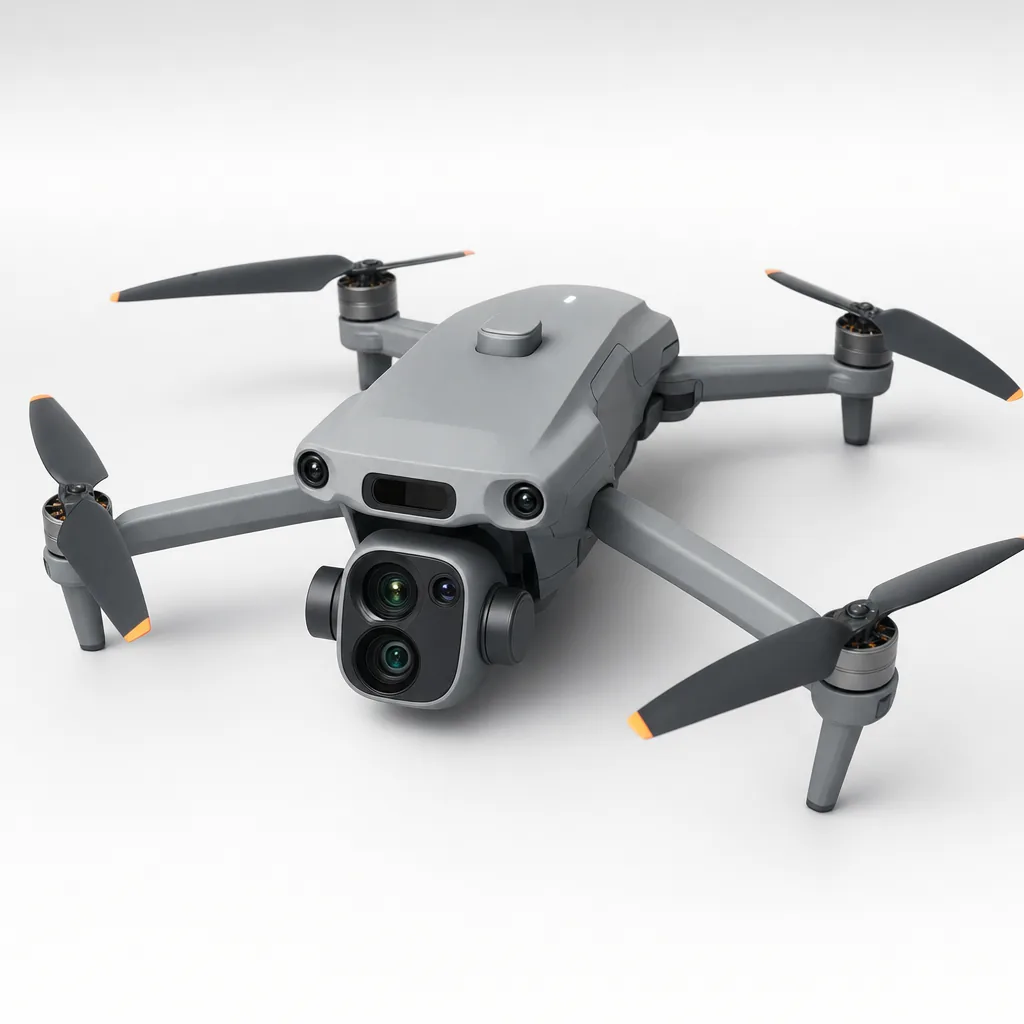
Concept visualisation for illustration only - based on the rumoured and leaked details described below, not a confirmed DJI design or an official image.
Let's anchor this in reality before we get to the fun part. As of late July 2026, DJI has announced nothing about an Air 4. There is no press release, no product page, and - the detail the drone community watches most closely - no FCC filing has surfaced. For DJI, an FCC (and equivalent regulator) filing almost always appears a few weeks to a couple of months before launch, so its absence is itself information: a summer-2026 release has now come and gone, and a slip into late 2026 or even early 2027 is firmly on the table.
What we do have is unusually rich for a pre-announcement drone: a physically crashed prototype that someone photographed and a respected leaker verified; a regulatory-app screenshot that places an "Air 4" in a specific weight class; a reported appearance in a Chinese certification database in mid-July 2026 (via TechAvid) - the drone's second registry signal after the May flight-app sighting, and a step that typically comes shortly before a launch; corroborating chatter from multiple drone outlets; and the most useful reference point of all - the drone it replaces, the DJI Air 3S, which we've reviewed in full. Everything that follows is triangulated from those, and where the leaks disagree, we say so rather than pretending there's a tidy answer.
One framing to carry through the whole article: DJI's Air line has always been the sensible middle - more camera and range than a Mini, far less bulk and cost than a Mavic. The Air 4's leaks suggest DJI is wrestling with which direction to push that middle. Up, toward the Mavic? Or sideways, into the rules-friendly featherweight territory that's been printing money for the Mini and Flip? That tension is the entire story.
2. The contradiction at the heart of it: two very different Air 4s
Here is the puzzle, stated plainly, because everything else hangs off it. Two credible leaks describe two incompatible drones:
- The "pro" Air 4 (early-2025 crashed prototype). Drone leaker Jasper Ellens shared images of a crashed unit believed to be the Air 4. It showed a Mavic-4-style top cover carrying extra sensors and an LED beacon for night flying, a redesigned front with an updated LiDAR array, noticeably more robust folding arms, and hints of a circular multi-lens camera module. This is an Air that grows up - heavier, tougher, more capable, closer to the Mavic.
- The featherweight Air 4 (May-2026 flight-app screenshot). Tech sleuth Igor Bogdanov posted a screenshot from an app tied to Chinese drone regulation that categorises an "Air 4" as a sub-250g aircraft. For context, the Air 3S weighs around 724g. Dropping below 250g would be a near-three-fold weight cut and a strategic earthquake - it would hand the Air line the Mini's biggest superpower: minimal paperwork and the freedom to fly near people.
These cannot both describe one drone. A 724g-class body stuffed with Mavic-grade sensors and a multi-lens gimbal is not going to weigh 249g. So one of a few things is true, and it's worth holding all of them loosely:
- DJI is making two Air 4 variants - perhaps an "Air 4" and an "Air 4 Pro", echoing how the Mini line splits into a base model and a Pro. The crashed prototype could be the Pro; the sub-250g listing a lighter standard model. This is the theory that reconciles everything, and it's the one we'd bet on.
- The flight-app categorisation is provisional or mislabelled - regulatory database entries are placeholders early on, and weight classes can be wrong or refer to a take-off-weight technicality rather than the real spec.
- The crashed prototype isn't the Air 4 at all - leakers are usually right, but "believed to be" is doing real work in that sentence, and prototypes get rebadged.
Our read: the two-model theory is the most likely, because it's the most DJI thing to do - it has steadily turned single products into families (Mini / Mini Pro, the Mavic's three combos, the Avata and Neo lines). But until an FCC filing or a clean leak settles it, anyone telling you the Air 4's weight as a fact is guessing.
3. The crashed-prototype leak, examined in detail
The single most substantial piece of Air 4 evidence is that crashed unit. Crashed-prototype photos are gold to the drone community precisely because they're unstaged - you're seeing real hardware, often with panels cracked open, rather than a render someone wants you to believe. Here's what it appeared to reveal, and what each detail would mean.
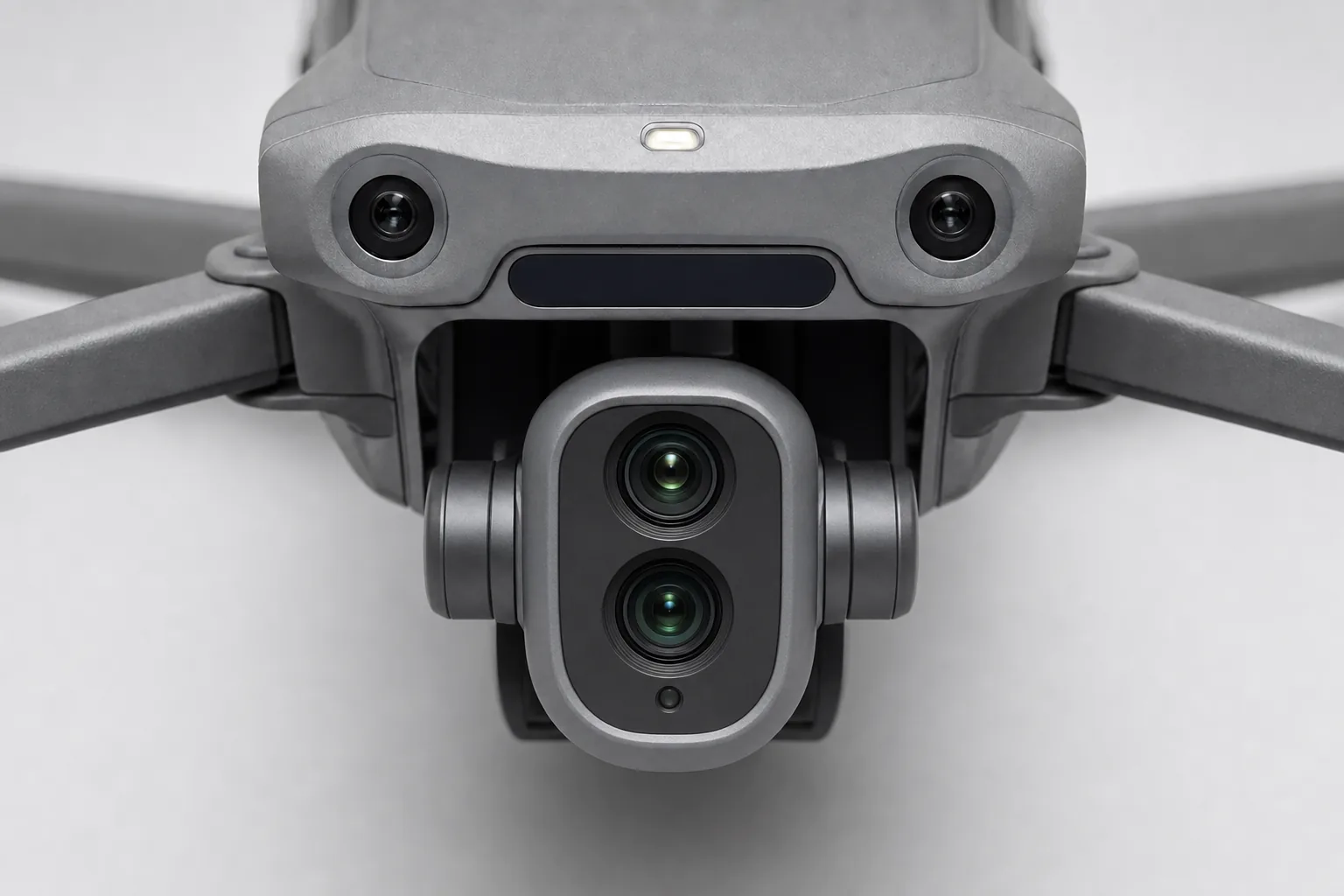
- A Mavic-4-style top cover. The prototype's top deck carried sensors and an LED beacon - a layout lifted straight from the Mavic 4 family. Top-facing sensors matter because upward obstacle detection has historically been a weak point for sub-flagship drones; bringing it down to the Air would be a genuine safety upgrade for flying under canopy or near structures.
- A redesigned front LiDAR array. The front section looked reworked with an updated LiDAR unit, possibly a wider field of view. The Air 3S already uses forward LiDAR for low-light obstacle sensing (one of its best features); an expanded array would push night and dusk flying further. Notably, the prototype appeared to drop the wide-angle sensors from its front corners - a possible shift in DJI's sensing approach.
- Hints of a multi-lens camera. Leaked references to 2.5x and 6x options suggest DJI may extend the Air's existing wide + telephoto pairing - possibly a sharper or longer tele, or a third focal length. The Air 3S's 70mm tele is already one of its most-loved features; more reach would be a headline.
- More robust arms. The folding arms looked sturdier than the Air 3S's. Mundane, but it points to better stability in wind and a more durable airframe - the unglamorous stuff that decides whether a drone survives years of real use.
If this prototype is the Air 4 (or the Air 4 Pro), the takeaway is a drone that narrows the gap to the Mavic 4 Pro considerably - inheriting its sensing philosophy and a more serious camera, at what would presumably remain a sub-Mavic price. That is a genuinely exciting prospect for enthusiasts who find the Mavic overkill but want more than a Mini.
4. The sub-250g leak, examined in detail
Now the leak that turns the above on its head. In May 2026, a screenshot from a Chinese drone-registration app surfaced showing an "Air 4" filed in the sub-250g category. If that's the real headline spec for a (or the) Air 4, it's arguably more significant than any camera upgrade, because weight is the single biggest factor in how freely you can fly a drone in the UK and most of the world.
Why it would matter so much, in concrete UK terms:
- No theory test required. Sub-250g camera drones need only a CAA operator ID (a small annual registration) - not the Flyer ID theory test that 250g-plus drones like the Air 3S require.
- Fly closer to people. Under 250g you may fly in residential and recreational areas and over uninvolved people (never crowds). The 724g Air 3S, by contrast, must keep 50m from uninvolved people and avoid built-up areas without an A2 Certificate of Competency.
- Travel-friendly. The sub-250g class enjoys the lightest registration burden in most countries, which is exactly why the Mini line dominates with travellers.
An Air with the Mini's regulatory freedom and the Air's camera ambitions would be a category-bending product. But hold the excitement against physics and history: cramming a 1-inch sensor, a real telephoto, omnidirectional sensing, LiDAR and a 38-40 minute battery into a sub-250g shell is extraordinarily hard - the Mini 5 Pro only just fits a single 1-inch camera under that line, and it has no telephoto. So if a sub-250g Air 4 is real, something has to give: most likely the telephoto, some sensing, or battery size. Which loops us right back to the two-model theory - a light "standard" Air 4 that trims features for the weight win, and a heavier "Pro" that keeps them. We'll know which when the filings appear.
5. Camera rumours: sensor, telephoto and what's realistic
The Air line's identity is its dual-camera system - a 1-inch-class main sensor plus a genuine telephoto - and the rumours suggest that stays central. Pulling the threads together:
- Main sensor. Expect a 1-inch (or at minimum a strong 1/1.3-inch) main camera. The Air 3S already shoots on a 50MP 1-inch sensor that punches well above its price; the Air 4's gains are more likely to come from processing - better low-light handling, cleaner high-ISO, improved dynamic range - than from a dramatically bigger chip, simply because there isn't much room to grow within the airframe. One less- corroborated source even speculates both cameras could use 1-inch sensors, though we'd treat that as low confidence.
- Telephoto. The leaked 2.5x and 6x references are the most intriguing camera detail. The Air 3S pairs its wide with a 70mm (3x) 48MP tele; a longer or sharper telephoto - or a step toward the Mavic 4 Pro's multi-focal approach - would meaningfully expand creative range. The telephoto is the Air's secret weapon (compression, reach, respectful distance from wildlife and people), so any upgrade here is a big deal.
- Video. The Air 3S already does 4K/120 and 10-bit D-Log M; the Air 4 will presumably match or extend that. A move to higher resolutions (5.1K/6K) - possibly with a built-in ND filter replacing clip-on filters, plus vertical shooting - isn't impossible if DJI wants to close the gap to the Mavic, but it's unconfirmed and low confidence.
The honest caveat: every specific camera number floating around is inference, not confirmation. What's well-supported is the shape of it - a refined 1-inch-class wide, a telephoto that's at least as good and possibly longer, and processing gains. Treat exact figures as placeholders until DJI or an FCC filing speaks. (Note the transmission leaks conflict too: most point to O4+, but a lower-confidence source floats O5 - neither is confirmed.)
6. Transmission, flight time and battery

Transmission: O4+ (or newer). It's close to certain the Air 4 adopts DJI's latest video link - O4+ or a successor - which in practice means rock-solid signal at any distance UK line-of-sight rules permit, better penetration behind terrain and trees, and the headroom DJI's pro tier enjoys. For reference, the Air 3S already uses O4 with a 20km range, while DJI developed O4+ for the Mavic 4 Pro with a 30km range. (One lower-confidence source even speculates O5, though that's not corroborated; some outlets reckon DJI may simply continue with O4 since no newer OcuSync has been announced.) For most pilots the link is already the most boring part of a modern DJI; the Air 4 will keep it that way.
Flight time: ~38-40 minutes (rumoured). Leaks point to a real-world-ish 38-40 minute figure. Interestingly, that's slightly below the Air 3S's 41-minute hover claim - which would make sense if the Air 4 is lighter (the sub-250g theory) and therefore carrying a smaller battery, trading a few minutes of endurance for a transformative weight class. If instead the Air 4 goes the heavier "pro" route, expect endurance to hold or improve. Either way, plan your buying around real figures, not the headline: across DJI's range, genuine flight time runs roughly 75-85% of the claim once you fly with sensible reserves.
Battery and charging. No firm leaks, but the pattern is predictable: an Intelligent Flight Battery, a Fly More Combo bundling three of them plus a charging hub, and USB-C charging throughout. As always, the combo will be the configuration most buyers should choose - spare batteries are the single accessory that changes drone ownership.
7. Obstacle sensing and the safety story
If one theme unites the credible leaks, it's sensing. The crashed prototype's extra top sensors, redesigned LiDAR array and Mavic-4-style layout all point the same way: DJI making the Air dramatically harder to crash, in more conditions, including the dark.
- Omnidirectional + LiDAR. The Air 3S already combines omnidirectional vision sensing with forward LiDAR for genuine low-light obstacle detection. The Air 4 looks set to refine this - the prototype's three top-mounted sensors (the same layout as the Mavic 4 Pro), a wider LiDAR field of view and possibly fuller top coverage would close the Air 3S's main remaining gap (upward awareness).
- Night operations. The leaked LED beacon and enhanced sensing suggest DJI is taking night and dusk flying seriously - exactly the hours when the light is best and the crash risk highest. This is where the Air 4 could most outclass cheaper drones.
- Smarter automation. Expect the latest ActiveTrack and Smart Return-to-Home generations, plotting routes around obstacles rather than the old climb-and-hope. DJI's tracking has become genuinely trustworthy; the Air 4 will inherit the best of it.
For working pilots and nervous hobbyists alike, the sensing upgrades may matter more day-to-day than any camera spec - a drone you trust is a drone you actually fly.
8. Design, build and the controllers

The folding-arm template that has defined the Air line will almost certainly carry over - it's the format that makes these drones pack down to a water-bottle footprint. The crashed prototype's sturdier arms hint at a more confidence-inspiring build, and the reworked top and front sections suggest the most visible redesign since the Air 3.
On controllers, expect continuity with DJI's current ecosystem: the phone-clamp RC-N3 as the value option and a screen-equipped RC 2-class controller as the premium pick (no phone needed, far better in bright sun). If you already own DJI controllers, that ecosystem continuity is a quiet saving - controllers and goggles routinely carry across generations even as batteries don't. The Fly More Combo will, as ever, be where the sensible money goes.
The big design unknown remains the weight, and it changes everything about how the drone feels and where you can fly it - which is why the sub-250g question isn't pedantry, it's the single most important spec on the page.
9. Release date: reading the tea leaves (and the FCC)
Here's where a little process knowledge beats wishful thinking. DJI launches follow a fairly reliable pipeline: prototype leaks, then regulatory filings (FCC in the US and equivalents elsewhere), then a brief pre-launch rumour crescendo, then the announcement. The filings are the reliable countdown - they typically appear a few weeks to a couple of months before a product goes on sale.
- The prototype leaked in early 2025 - which initially fuelled hopes of a late-2025 or early-2026 launch.
- The May-2026 flight-app sighting shows the Air 4 is moving through the regulatory pipeline in China.
- A reported Chinese certification-database listing in mid-July 2026 (via TechAvid) - the Air 4's second registry signal after the May flight-app sighting - suggests the drone has entered the final stages of development; products typically receive such certification shortly before launch, which is another sign the Air 4 could arrive in 2026, though the listing reveals no specifications.
- But no FCC filing had surfaced as of late July 2026 - and that's the key brake. For a summer 2026 launch, a filing would realistically need to have appeared around April-May; it never did, so a mid-2026 launch is now off the table. An FCC filing typically precedes a US launch by 6-10 weeks, so its continued absence pushes the likely window later: late 2026 / early 2027 is now the realistic read, and a US launch in particular remains in doubt.
The US wrinkle: the FCC Covered List and the Section 1260H label
There's a complication specific to American buyers that's worth understanding even from the UK, because it affects DJI's global launch calculus. On 23 December 2025 the FCC added all foreign-made drones to its Covered List, which blocks new equipment authorisations for as-yet unreleased foreign UAS - exactly the kind of filing an unannounced Air 4 would need. DJI has pushed back hard: it filed a petition for reconsideration on 21 January 2026 and, in parallel, a petition for review in the US Court of Appeals for the Ninth Circuit seeking to overturn the ruling. A filing from the US Department of Defense urges the FCC to reject DJI's petition, stating that certain foreign-made UAS present an "unacceptable risk" to national security. There is a second lock, too: the Pentagon's Section 1260H designation, which labels DJI a "Chinese military company". A federal court upheld that label in September 2025 (while rejecting the claim that the Communist Party owns or controls DJI); DJI appealed, the D.C. Circuit heard oral arguments on 6 February 2026, there is no ruling yet, and the Pentagon reaffirmed the listing on 8 June 2026. On top of that, since October 2024 US Customs and Border Protection has held DJI shipments under the Uyghur Forced Labor Prevention Act, which presumes goods tied to Xinjiang are made with forced labour. As of late July 2026, DJI and Autel remain on the Covered List with no exemption and no grace period, so new models cannot be imported into the US. The FCC did, however, open a conditional-approval path in March 2026 - the only visible door through which a new DJI model could, in theory, reach US shelves - though whether any consumer DJI drone ever walks through it is an open question, not a promise. Until the legal fights resolve, a new DJI drone may struggle to be marketed, sold or imported in the United States at all. In practical terms: even if the Air 4 launches globally, its US availability is genuinely uncertain and could face delays or restrictions - while UK and European buyers, who don't depend on FCC authorisation, are unlikely to be affected in the same way.
Our honest timing read: mid-2026 has now passed with no sign of a launch; late 2026 is the reasonable central estimate; early 2027 is a real possibility if DJI is still finalising which models it's launching. DJI also tends to stagger its big releases, and 2025-2026 has already been busy (Mavic 4 Pro, Mini 5 Pro, Neo 2, the Avata 360 and Pocket experiments), so the Air 4 may be waiting its turn. We'll update this page the moment a filing or official teaser appears - that's what a living rumour guide is for.
10. Price: what the Air 4 is likely to cost in the UK
No pricing has leaked, so we reason from precedent. The Air 3S launched at around $1,099 (about £859) in the US and roughly £859 in the UK for the base configuration. DJI typically holds or modestly raises prices generation-on-generation, with bigger jumps only when there's a substantial hardware leap.
- If the Air 4 is an iterative upgrade (better camera processing, O4+, refined sensing), expect UK pricing in the same ballpark as the Air 3S - roughly £850-£950 for the base, with Fly More combos £1,100-£1,300.
- If it brings a major leap (a genuinely upgraded telephoto, Mavic-grade sensing, new sensor), a modest premium over the Air 3S would be justified and likely.
- If there's a sub-250g model, it could sit a little lower or match the Mini 5 Pro-to-Air gap - DJI would price the regulatory freedom as a feature, and with dual sensors and extra sensing hardware to engineer into a lighter shell, the featherweight variant might even command a premium.
Two practical notes for UK buyers. First, DJI prices drift down a few months after launch and around Prime Day and Black Friday, so the launch price is rarely the price you must pay. Second, when the Air 4 lands, the Air 3S typically gets discounted - which, as we'll cover next, can make the outgoing model the smartest buy of all. (For reference, the Air 3S is currently around £801 in the UK and ~$1,259 on Amazon in the US.)
11. Should you wait for the Air 4 or buy now?
The eternal rumour-article question, answered honestly for three kinds of buyer.
Wait for the Air 4 if...
...you already own a capable drone and aren't in a hurry; you specifically want the rumoured upgrades (better telephoto, fuller sensing, or - if it's real - the sub-250g regulatory freedom); and you're comfortable that "later 2026 or early 2027" might mean a genuine wait with no guarantees. There's no downside to waiting if you're not currently missing shots.
Buy now if...
...you want to be flying this summer, you have trips or projects coming up, or you simply don't want to gamble on an unconfirmed timeline. Cameras and drones depreciate slower than missed summers, and the current Air is genuinely excellent.
The smart-money move
Watch the DJI Air 3S. It is, today, one of the best all-round camera drones you can buy - dual cameras, LiDAR night sensing, 30-plus real minutes of flight - and it already does almost everything the Air 4 is rumoured to do incrementally better. When the Air 4 launches, the Air 3S will be discounted further, making it the value sweet spot. For most people, a well-priced Air 3S is the rational choice whether or not you're tempted by the rumours.
12. The buy-now pick while you wait: DJI Air 3S
If reading all this has convinced you that you'd rather fly now than wait on an uncertain timeline, the answer is the drone the Air 4 is trying to beat. The Air 3S delivers the Air formula at its current peak: a 1-inch 50MP main camera, a 70mm telephoto, forward LiDAR for low-light obstacle sensing, O4 transmission and 30-plus real-world minutes per battery. We rate it a 9/10 and it's our pick for the working-pilot sweet spot - read the full Air 3S review for the detail.
See the DJI Air 3S Fly More Combo on Amazon UK
In stock and price-checked at the time of writing
Note: the Air 4 itself isn't on sale anywhere yet - anyone offering to sell you one today is selling something else. We'll add buying information here only when it's genuinely available and verified in stock. As an Amazon Associate we earn from qualifying purchases; it never changes what we recommend.
13. DJI Air 4 vs Air 3S: every rumoured change at a glance
To see what's genuinely at stake, here's the confirmed Air 3S against the best current read on the Air 4 rumours. Treat the right-hand column as informed speculation, not spec sheet - we've flagged confidence levels.
| DJI Air 3S (confirmed) | DJI Air 4 (rumoured) | |
|---|---|---|
| Weight | 724g | Contested - sub-250g leak vs heavier prototype (low confidence) |
| Main camera | 1-inch, 50MP | 1-inch-class, improved processing (medium) |
| Telephoto | 70mm (3x), 48MP | Upgraded/longer - 2.5x & 6x hinted (medium) |
| Transmission | O4 (20km) | O4+ likely, O5 rumoured but unconfirmed (medium) |
| Sensing | Omni + forward LiDAR | Omni + wider LiDAR + top sensors (medium-high) |
| Flight time (claim) | 41 min | ~38-40 min rumoured (low-medium) |
| UK price from | ~£859 | ~£850-£950 est. (speculative) |
| Status | On sale now | Unannounced; late 2026/early 2027 likely |
Read the table and one thing jumps out: on paper, the rumoured Air 4's gains over the Air 3S are mostly incremental (processing, O4+, sensing refinements) - except for the two wildcards that could make it a genuine generational leap: a meaningfully better telephoto, and that contested weight. If DJI lands a sub-250g Air with a real telephoto, the table above undersells a revolution. If it's a heavier, iterative refresh, the Air 3S already gives you ~90% of it today for a price that's only going to fall.
14. The 250g line: why the weight rumour decides everything
It's worth dwelling on why we keep returning to the weight, because for a UK flyer it's not a footnote - it's the spec that decides where you can legally point the thing. The Air line has always lived on the 'serious' side of the 250g line, and a jump to the friendly side would change the product's entire character.
What the Air 3S (724g) requires today: a CAA operator ID and the Flyer ID theory test; a 50m horizontal distance from uninvolved people; and no flying over residential, commercial or recreational areas in the default Open category without an A2 Certificate of Competency (an additional paid course and exam). In practice it's a drone for open country, coastlines, your own property and arranged shoots - not the village green on a Saturday.
What a sub-250g Air 4 would unlock: no theory test (just the operator ID, since it has a camera); the freedom to fly in residential and recreational areas and over uninvolved people (never crowds); and the lightest registration burden when travelling abroad. That's the difference between a drone you plan expeditions around and one you slip in a jacket pocket and fly on a whim near where people actually are.
This is exactly why the sub-250g leak, if real, would be a bigger deal than any camera upgrade for a huge slice of buyers - and why we're sceptical it can coexist with the heavyweight, Mavic-grade prototype in a single product. The honest position: if the weight matters to you (and for most casual and travelling flyers it should), do not assume the Air 4 will be sub-250g until DJI confirms it. If you need that freedom now, the Mini 5 Pro already delivers a 1-inch camera under 250g today - read our review for the full picture.
15. How reliable are these leaks? Our sourcing, graded
A rumour article is only as good as its sources, so here's how we weight the evidence behind everything above - and how you should too.
- Crashed-prototype photos (high reliability). Physical hardware, photographed in the wild and surfaced by an established leaker with a track record, is the gold standard of pre-launch evidence. It can still be an early prototype that changes before production, but it's real hardware, not a wish-list.
- Regulatory-database and flight-app sightings (medium-high). Filings and registration entries are official-process artefacts, so the product almost certainly exists - but early entries can carry placeholder or provisional details (the sub-250g categorisation could be exactly that). The May-2026 flight-app sighting was posted by Igor Bogdanov (@Quadro_News), who has accurately previewed the Air 3, Air 3S, Mini 4 Pro, Avata 360 and Osmo Pocket 4 ahead of their launches - a track record that raises, but doesn't guarantee, confidence. A separate report from TechAvid places the Air 4 in a Chinese certification database as of mid-July 2026 - a second registry signal that it's nearing the end of development.
- Reputable-outlet aggregation (medium). Established drone and camera publications corroborating each other raises confidence, but much of it traces back to the same handful of primary leaks, so agreement isn't independent confirmation.
- Spec numbers without a source (low). Specific figures - exact megapixels, precise flight minutes, prices - circulating without a traceable origin are the least reliable, which is why we've framed them as ranges and inferences rather than facts.
The single most reliable future signal to watch is an FCC (or equivalent) filing: when one appears, a launch is usually weeks away and many specs firm up overnight. We monitor for it, and we'll revise this page's confidence levels - and its facts - the moment harder evidence lands. That's the deal with a living rumour guide: it gets more accurate over time, and we'd rather tell you what we don't yet know than invent certainty.
Frequently asked questions
When will the DJI Air 4 be released?
DJI hasn't announced it, and as of late July 2026 no FCC filing had surfaced - the usual sign that a launch is weeks to a couple of months away. A mid-July 2026 Chinese certification-database listing (the second registry signal after the May flight-app sighting) suggests the drone is in the final stages of development, but the mid-2026 window has passed; late 2026 is now the reasonable estimate, with early 2027 possible if filings stay quiet - and a US launch in particular remains in doubt. We'll update this page the moment that changes.
Will the DJI Air 4 be under 250g?
Maybe - and it's the biggest open question. A May 2026 screenshot from a Chinese drone-registration app categorised an 'Air 4' as sub-250g, which would be a radical change from the 724g Air 3S. But a separately leaked prototype looked like a heavier, more Mavic-like drone. The likeliest explanation is two models (a light standard Air 4 and a heavier Pro), but nothing is confirmed.
What camera will the DJI Air 4 have?
Rumours point to a 1-inch-class main sensor with improved processing plus a telephoto - continuing the Air line's dual-camera identity - and leaked references to 2.5x and 6x options hint at a longer or upgraded tele. Exact specs are unconfirmed; the shape (strong wide + capable telephoto + processing gains) is well-supported.
How much will the DJI Air 4 cost in the UK?
No price has leaked. Based on the Air 3S's roughly £859 launch price, expect the Air 4 around £850-£950 for the base model and £1,100-£1,300 for a Fly More combo, with a modest premium possible if the hardware leap is large. DJI prices also drift down after launch and around sale events.
Will the DJI Air 4 be available in the US?
That's genuinely uncertain. The FCC added all foreign-made drones to its Covered List in December 2025, which blocks new equipment authorisations for unreleased foreign drones; DJI is challenging the ruling in the Ninth Circuit, and the US Department of Defense has urged the FCC to reject DJI's petition, citing an "unacceptable risk" to national security. Separately, a federal court upheld the Pentagon's Section 1260H "Chinese military company" label on DJI in September 2025, the D.C. Circuit heard DJI's appeal on 6 February 2026 with no ruling yet, and the Pentagon reaffirmed the listing on 8 June 2026. Customs has also held DJI shipments under the Uyghur Forced Labor Prevention Act since October 2024. As of late July 2026 DJI and Autel remain on the Covered List with no exemption or grace period, so new models can't be imported into the US - though the FCC opened a conditional-approval path in March 2026 that could, in theory, provide a route. UK and European buyers don't depend on FCC authorisation, so are unlikely to be affected the same way.
Should I buy the Air 3S now or wait for the Air 4?
If you want to fly this summer or have projects coming up, buy the Air 3S - it's excellent and the timeline for the Air 4 is uncertain. If you already have a capable drone and specifically want the rumoured upgrades, waiting costs nothing. The smart-money move is often a discounted Air 3S once the Air 4 finally launches.
Is the DJI Air 4 confirmed to exist?
Not officially by DJI. But the evidence - a crashed prototype verified by a respected leaker, a regulatory-app sighting, a reported certification-database listing, and consistent industry reporting - strongly suggests an Air 4 (or an Air 4 family) is in development. Treat every specific spec as a rumour until DJI or an FCC filing confirms it.
How will the Air 4 compare to the Mavic 4 Pro and Mini 5 Pro?
If the leaks hold, the Air 4 will again sit between them - more camera and sensing than the sub-250g Mini 5 Pro, but lighter and cheaper than the flagship Mavic 4 Pro. The intrigue is that a rumoured sub-250g Air 4 variant could blur the line with the Mini line, while a 'pro' Air 4 would edge toward Mavic territory. See our reviews of both for today's comparison points.
The bottom line on the Air 4 rumours
The DJI Air 4 is, right now, the most interesting drone you can't buy - not because of any single leaked spec, but because the leaks genuinely disagree about what it is. A Mavic-grade camera-and-sensing upgrade and a sub-250g featherweight are both on the table, and the most sensible reading is that DJI may be building both. Add near-certain O4+ transmission, refined LiDAR night sensing and the Air line's signature dual-camera versatility, and the Air 4 (or Air 4 family) is shaping up to be a genuine event - whenever it actually arrives, which now looks more like late 2026 or early 2027 than this summer. American buyers should note a further wrinkle: the FCC's December 2025 Covered List ruling, now being fought by DJI in the courts (with the US Department of Defense urging the FCC to reject DJI's petition), plus the Pentagon's Section 1260H "military company" label (upheld in court in September 2025 and reaffirmed on 8 June 2026), could delay or restrict any US release regardless of the global launch.
Our advice: don't put your flying on hold for a drone with no confirmed date. The DJI Air 3S already does almost everything the Air 4 promises, and it'll only get cheaper when the new model lands. Bookmark this page - we treat it as a living guide and will update it with every credible leak, filing and (eventually) the real thing. And when you're ready to compare the rest of the range, our best DJI drone guide and full DJI hub have you covered.
Sources & further reading: DroneXL (crashed prototype) · UAV Coach · Gizmochina (sub-250g leak) · Imaging Resource · Notebookcheck · CAA drone rules.